
Vacheron Constantin
Patrimony
81180/000R-9159
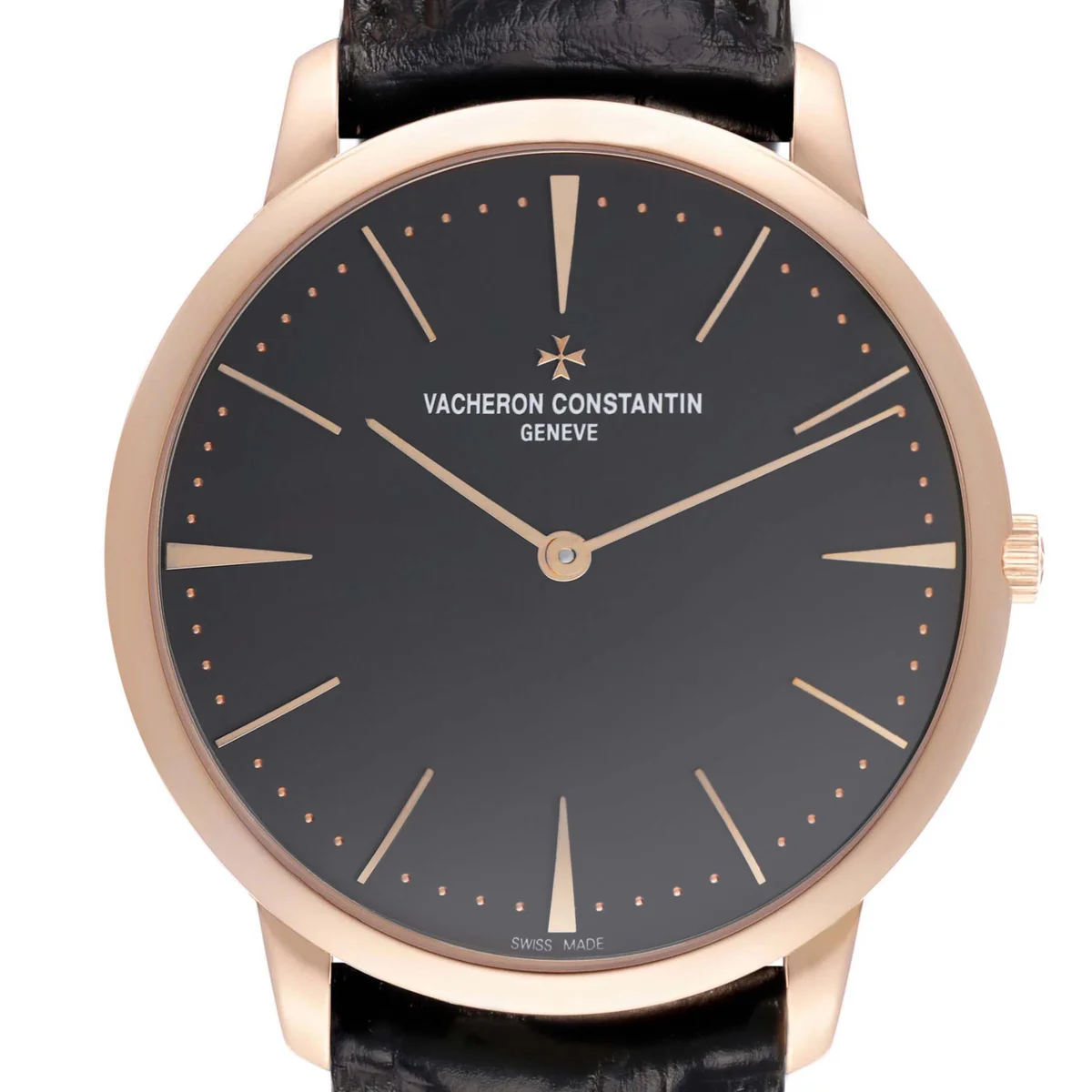
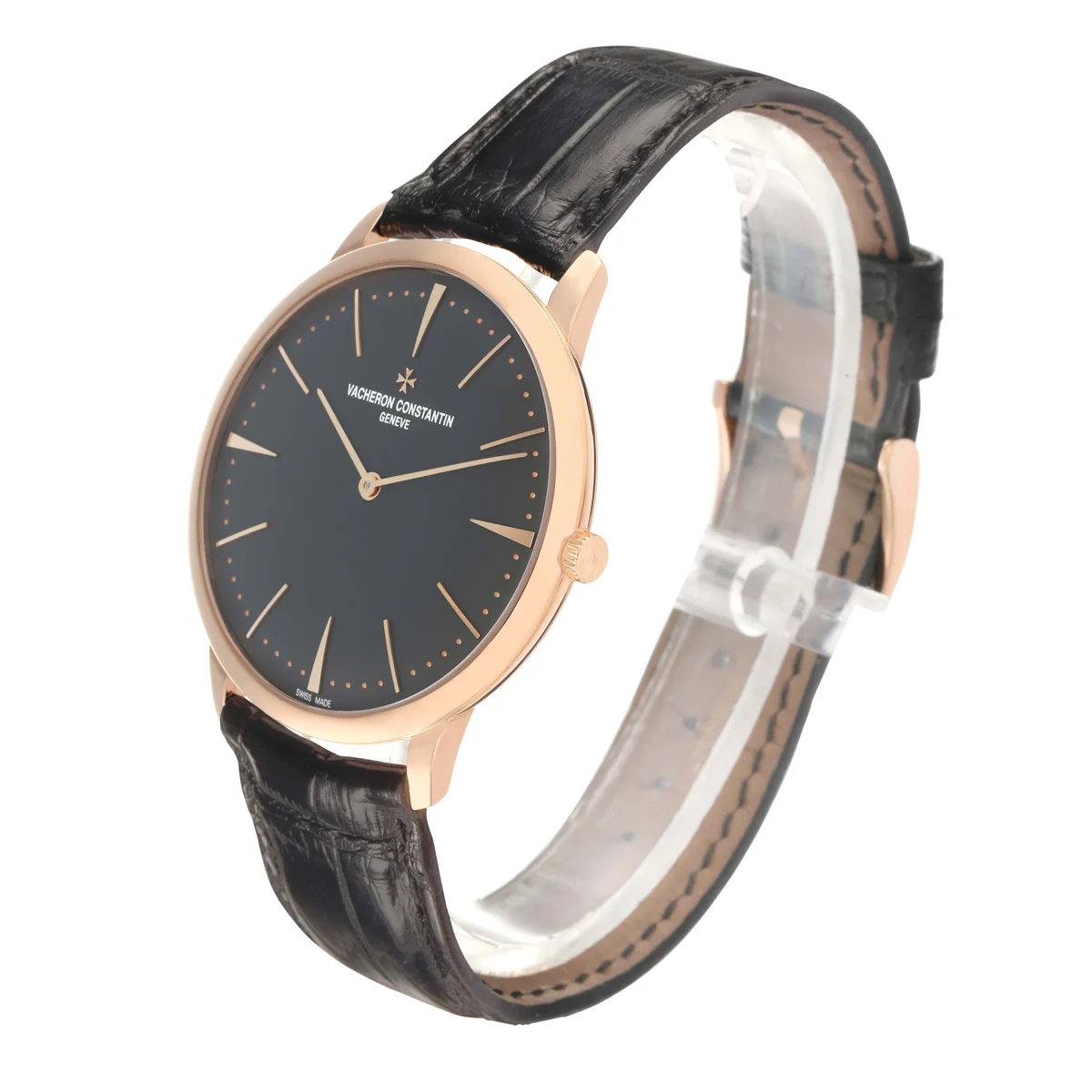
There are watches that impress you with what they do. Then there are watches that impress you with what they choose not to do. The Vacheron Constantin Patrimony is the second kind. No date. No seconds hand. No power reserve indicator. No chronograph. No complications of any kind. Just hours and minutes, displayed on a silver opaline dial inside a 40mm case of 18K rose gold that stands 6.79mm tall. That is thinner than most phones. Thinner than every Patek Calatrava. Thinner than every JLC Master Ultra Thin. Thinner than any Lange. The Patrimony does less than any of them and does it better. I find myself drawn to watches like this, the ones that communicate through what they leave out rather than what they pile on.
Vacheron Constantin was founded on September 17, 1755, when a 24-year-old master watchmaker named Jean-Marc Vacheron signed an apprenticeship contract with his first student in Geneva. That contract is the company's birth certificate. 271 years of continuous, uninterrupted production. No dormancy. No revival. No gap. Blancpain claims 1735 but stopped making watches during the Quartz Crisis and was revived by Jean-Claude Biver in 1983. Vacheron Constantin never stopped. Not during the Napoleonic Wars. Not during two World Wars. Not during the Quartz Crisis. When people call Vacheron the oldest watchmaker in the world, they mean the oldest one that never took a break. In 1819, Francois Constantin joined as a commercial partner, giving the company its full name. His motto, "Faire mieux si possible, ce qui est toujours possible" (do better if possible, and it is always possible), remains the company's guiding philosophy. In 1880, they registered the Maltese Cross as their trademark, inspired by the shape of the stopwork component inside their pocket watch movements that controls mainspring tension. That cross has been on every Vacheron since.
The Patrimony collection was officially introduced in 2004, but its DNA goes back to the 1950s. That decade produced some of the most refined round dress watches in Vacheron's history. Clean dials, slim profiles, trim lugs, quiet refinement. The Patrimony codified that aesthetic into a dedicated line. The name comes from the Latin patrimonium, an inheritance from one's father. Heritage. 271 years of inherited craft, distilled into the simplest possible expression of what a watch can be. If you visit Geneva and walk through the Musee de l'Horlogerie or look at the Vacheron archives, you can trace a direct line from those 1950s references to the watch on the table in front of you. The proportions evolved, the movement improved, but the idea never changed. What strikes me about the Patrimony lineup is the range. The collection spans from this manual-wind two-hander all the way up to the Patrimony Traditionnelle with perpetual calendar, retrograde date, and tourbillon. The fact that Vacheron chose to anchor the entire collection around this simple hours-and-minutes reference says something about where they think the soul of the line lives.
The Caliber 1400 inside the Patrimony is where the engineering lives. It stands 2.6mm tall. That is the thickness of two credit cards stacked together. 20.65mm in diameter, 20 jewels, 98 components, beating at 28,800 vibrations per hour with approximately 40 hours of power reserve. It is a genuine in-house Vacheron Constantin manufacture movement, developed and released in 2001. This matters because historically, Vacheron did use movements supplied by Jaeger-LeCoultre. The older Caliber 1003 was essentially a JLC ebauche. The 1400 is not. It is Vacheron's own, and it carries the Hallmark of Geneva. I think the 1400 is one of the most honest movements in haute horlogerie, a hand-wound caliber that does exactly one thing and does it at the highest possible level of finishing and certification.
The Hallmark of Geneva, the Poincon de Geneve, is the most stringent quality certification in Swiss watchmaking. Since 2012, it certifies the entire watch, not just the movement. Every decorative and functional component must be finished to the highest degree with no visible machining marks. Accuracy must be within one minute over a seven-day test period. Water resistance is tested. The complete watch must pass scrutiny by Timelab in Geneva. Only a handful of brands carry it: Vacheron Constantin, Chopard, Roger Dubuis, and select Cartier models. Patek Philippe withdrew from the Geneva Seal in 2009 and created their own Patek Philippe Seal, which they consider more stringent. But the Geneva Seal remains the gold standard for the rest of the industry. Every Patrimony that leaves Geneva has earned it.
The finishing of the Caliber 1400 is meticulous in a way that borders on philosophical. Cotes de Geneve on the bridges. Perlage on the base plates. Mirror-polished screw heads, each taking over an hour of hand polishing to achieve the required standard. Chamfered edges on every bridge and plate. And here is the part that gets me: Vacheron finishes surfaces that will never be seen by the owner. Parts hidden beneath bridges receive the same level of decoration as parts visible through the caseback on exhibition models. The finishing exists because it should, not because anyone will observe it. That is a commitment to craft that goes beyond marketing. It is a statement about what watchmaking means to the people who do it. In my experience, the brands that finish hidden surfaces are the ones that treat watchmaking as a discipline rather than a business. A. Lange and Sohne does this. F. P. Journe does this. Vacheron does this. It is a small club.
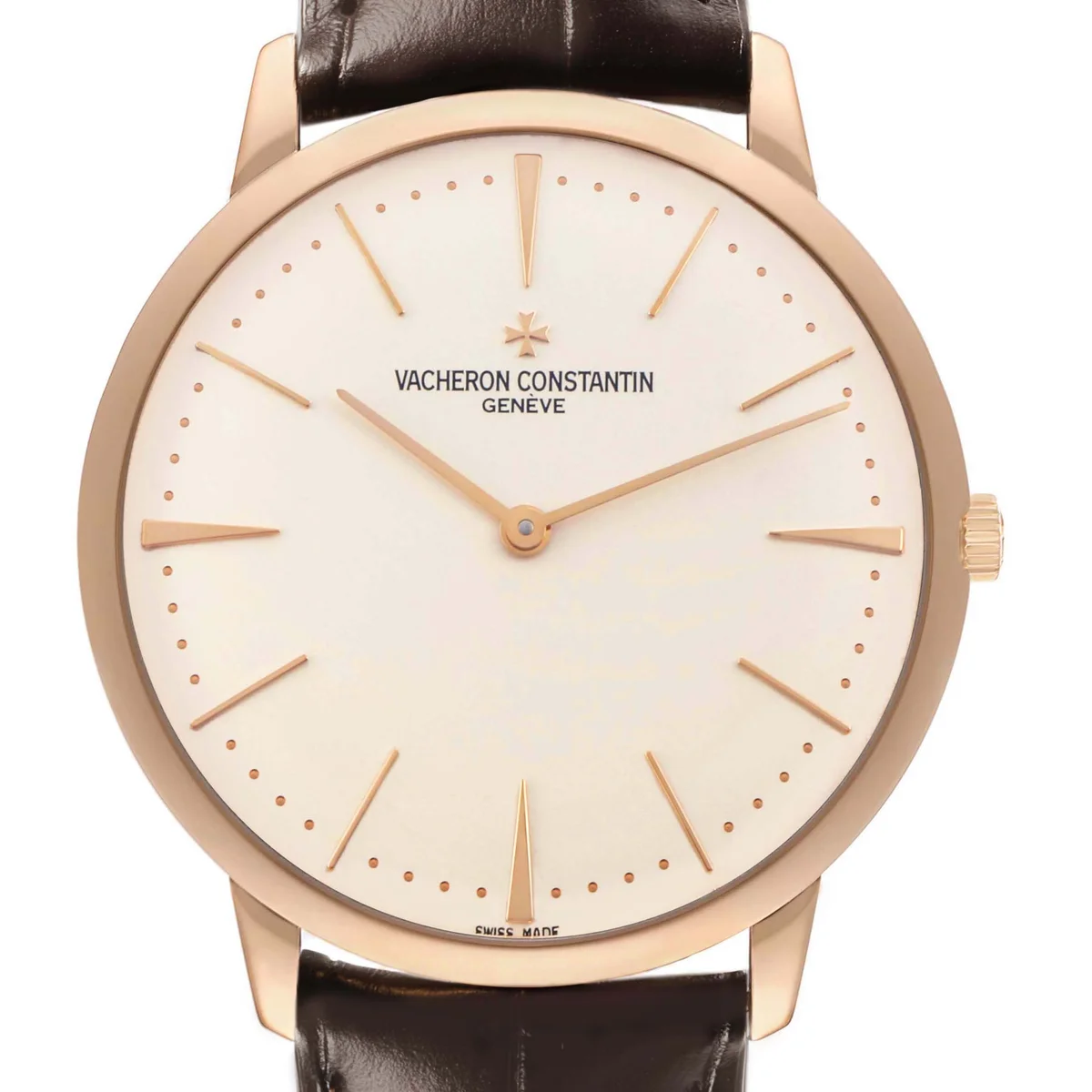
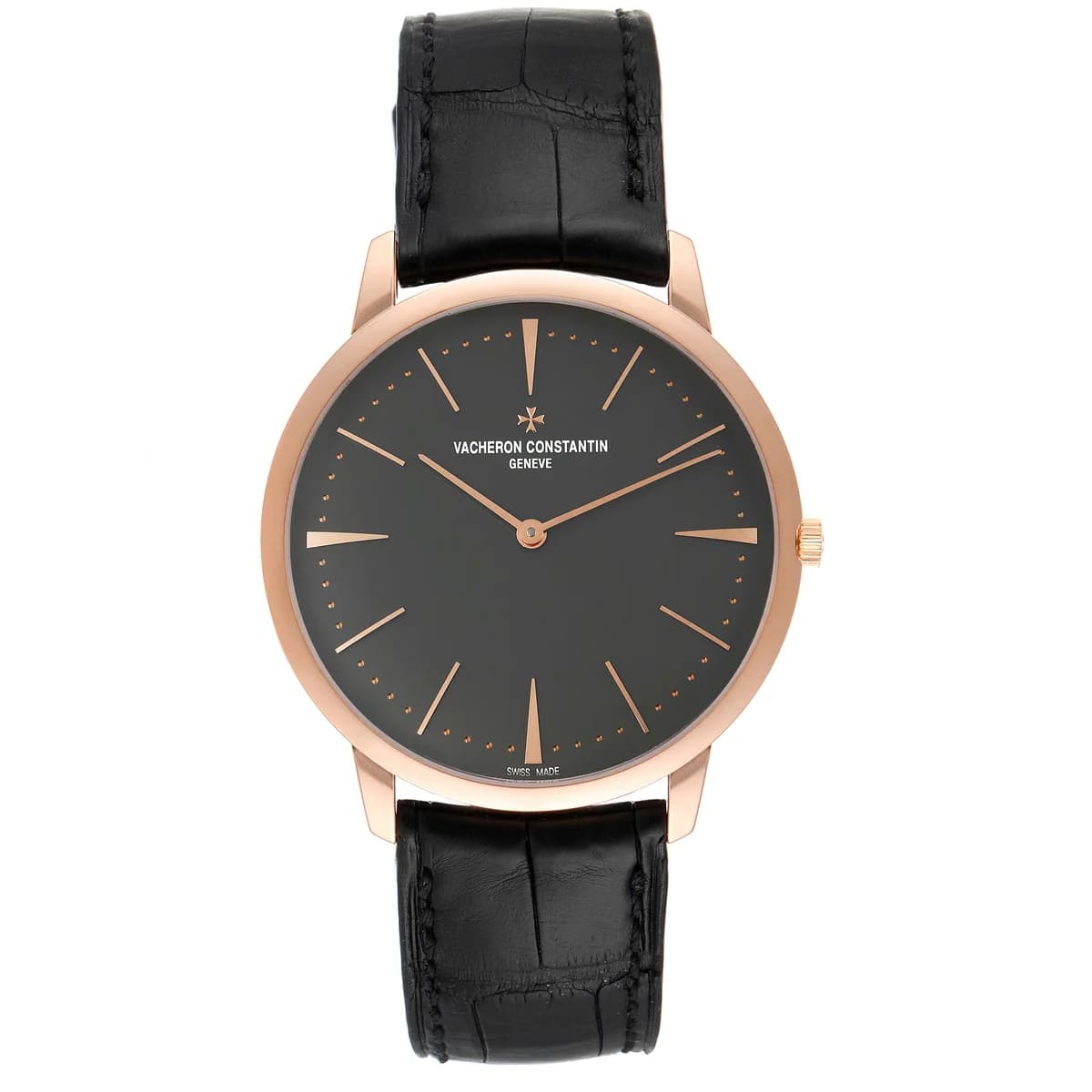
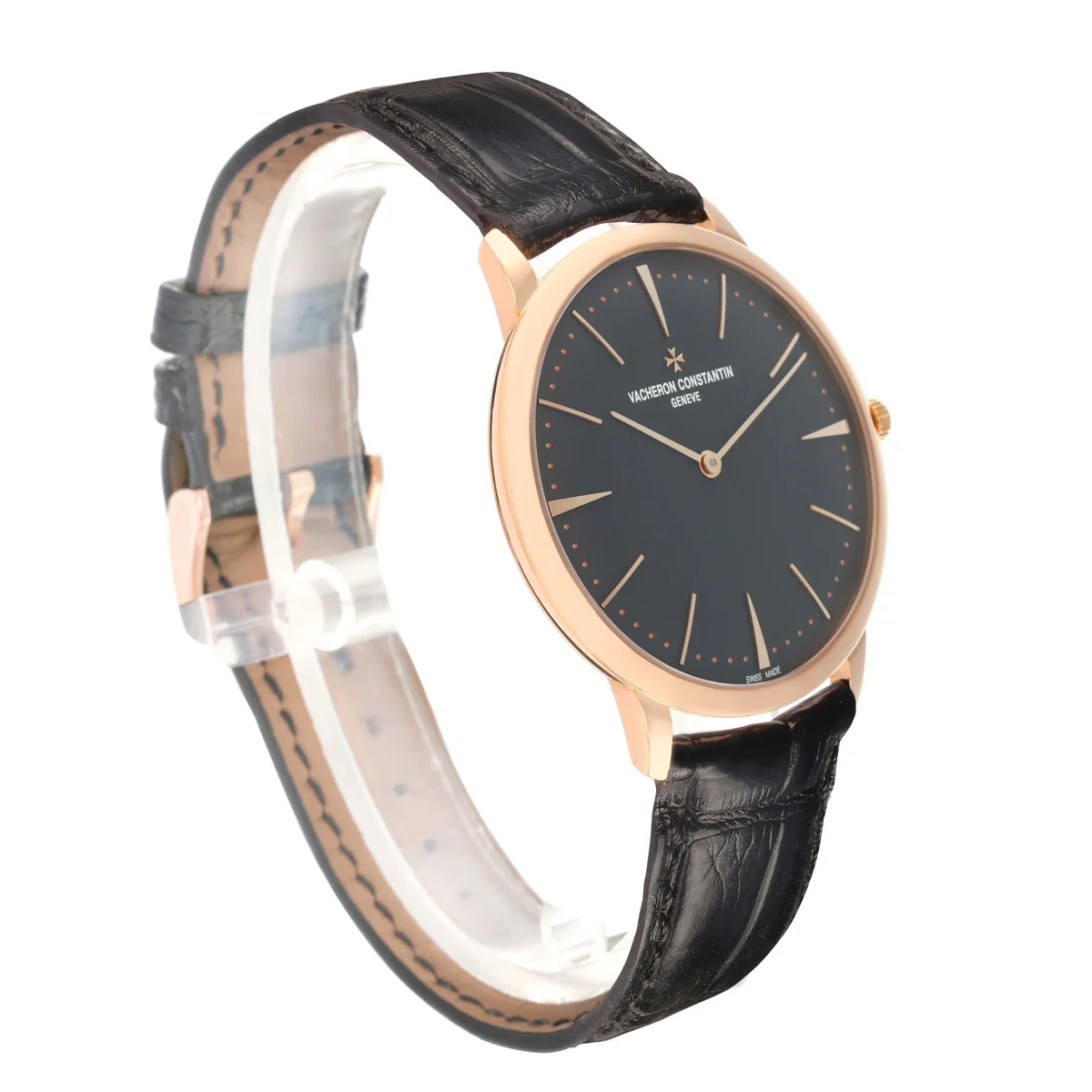
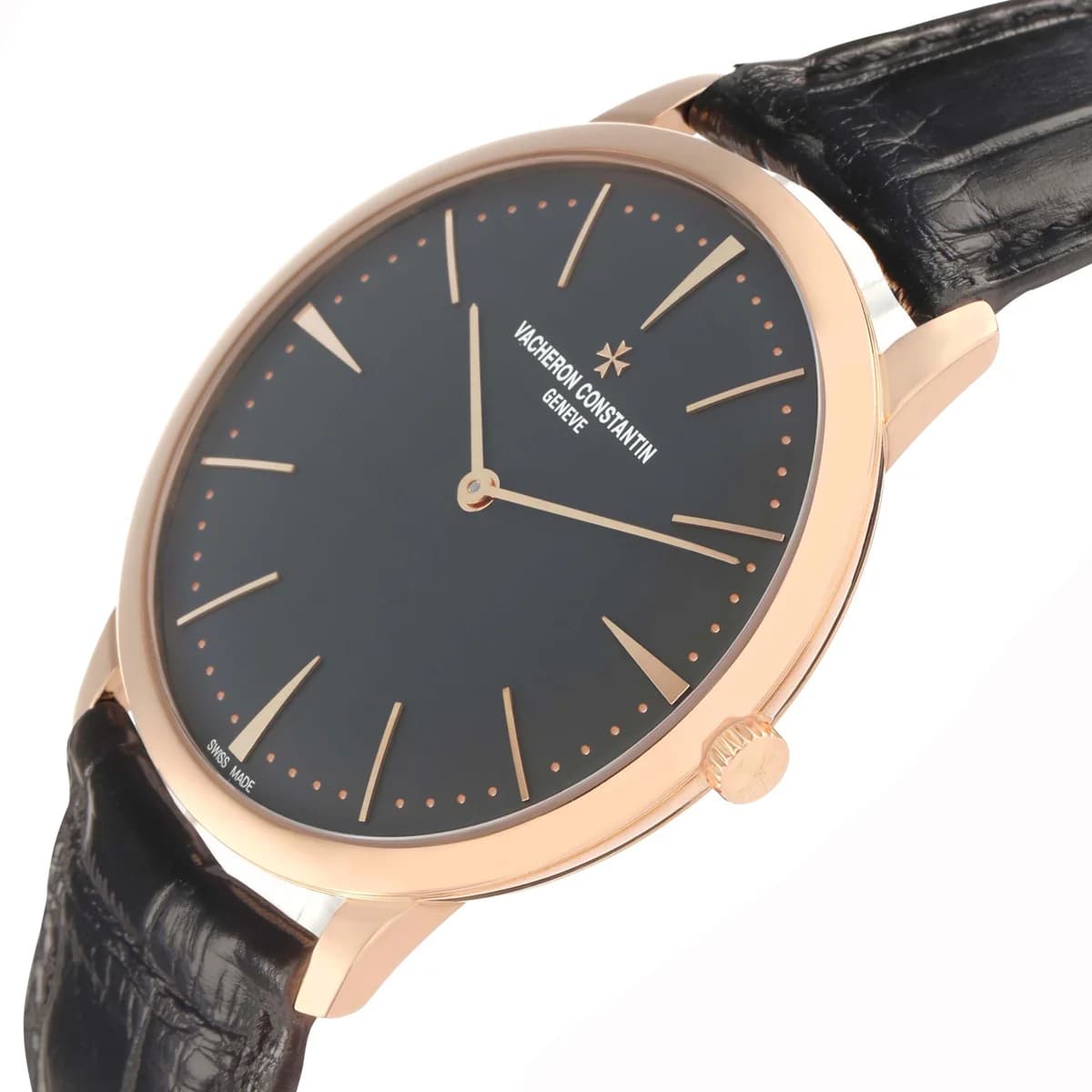
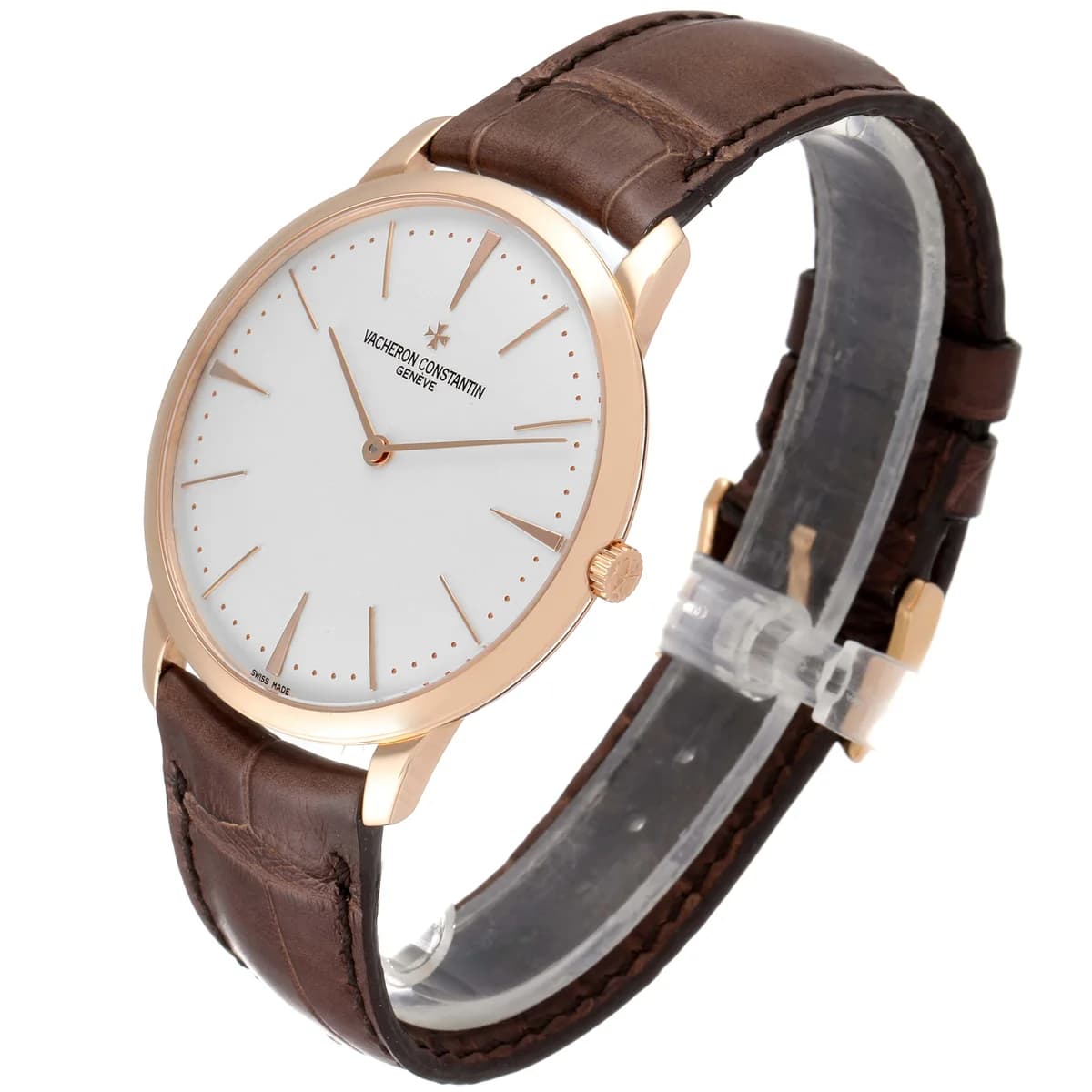
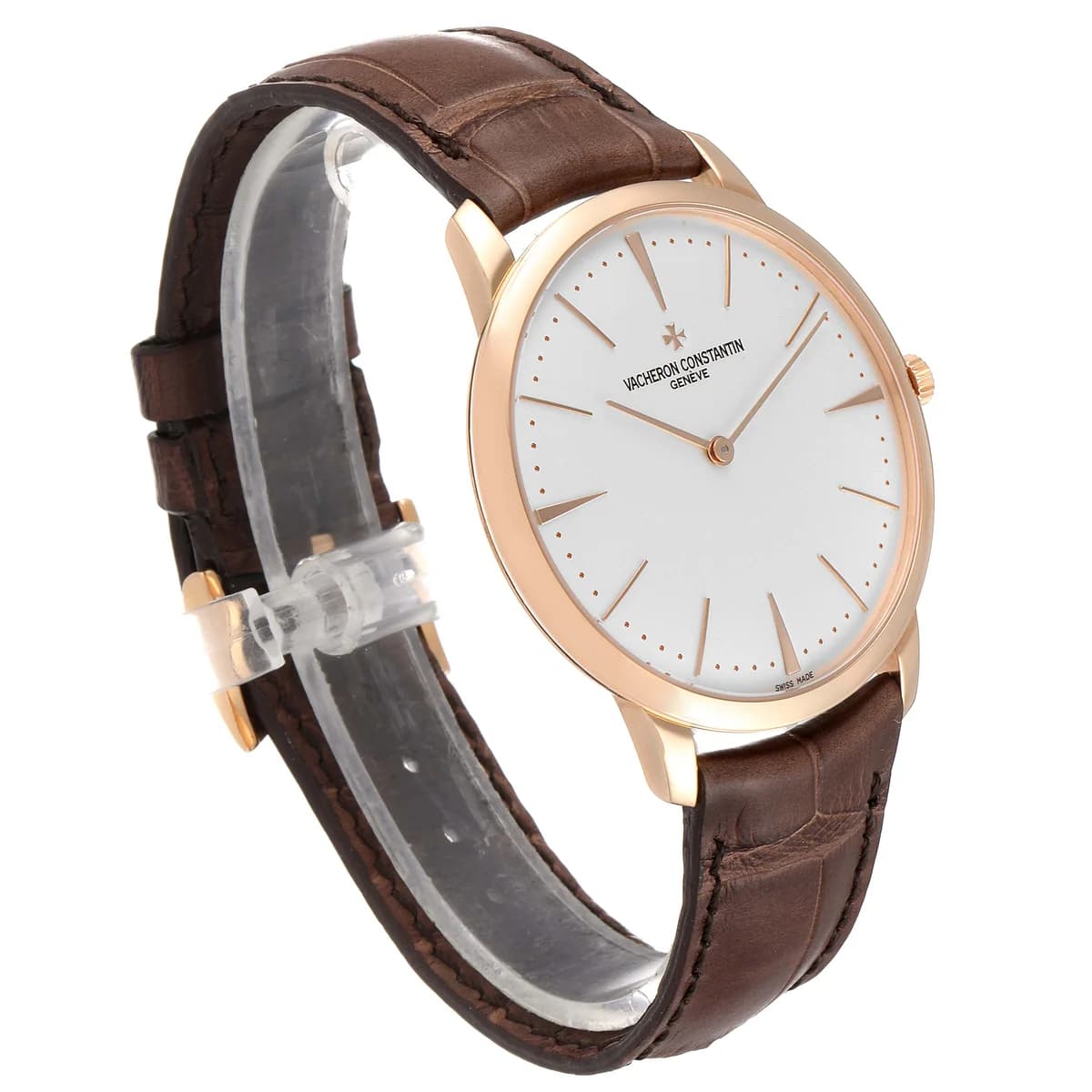
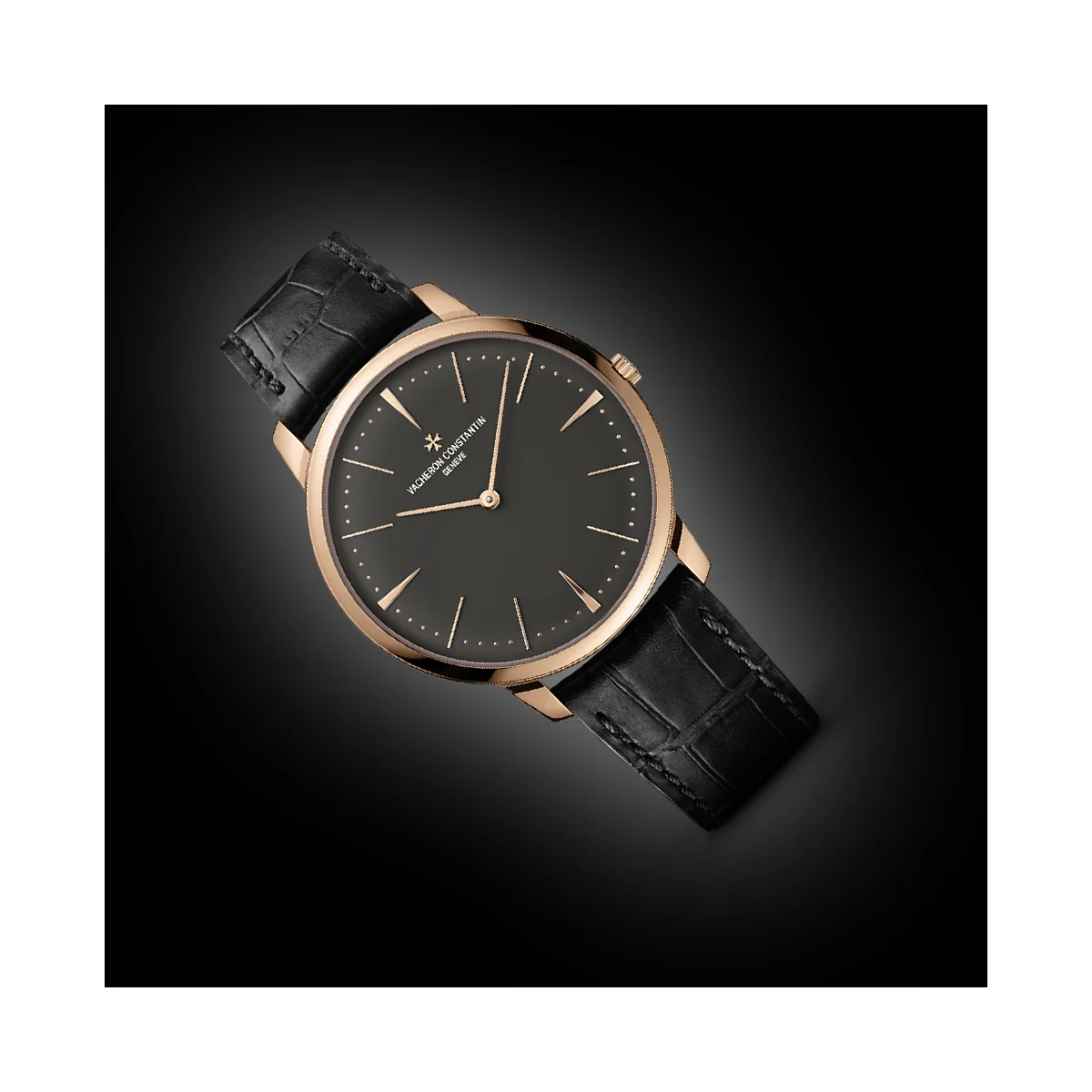
The dial of the 81180/000R-9159 is silver opaline, though the reference has also been produced with a dark grey dial that reads almost black in certain light. The opaline version has a warmth to it, catching light and shifting between cream and silver depending on the angle. The applied hour markers and dauphine hands are 18K rose gold, matching the case. There is no lume on any surface, which is the correct decision for a dress watch of this caliber. Lume would compromise the purity of the dial. The minute track is a ring of tiny dots, barely visible unless you are looking for them. At 12 o'clock, the Maltese Cross sits just below the crystal, small and precise. At 6 o'clock, "Swiss Made" in a typeface so small it practically vanishes. Every element on this dial serves a purpose. Nothing is decorative for its own sake. I spent a long time looking at the indices on this watch, and what I noticed is that the hour markers at 12, 3, 6, and 9 are slightly wider and more tapered than the rest. It is the kind of detail that takes deliberate effort to execute and even more effort to notice. The printing of "Vacheron Constantin Geneve" beneath the Maltese Cross is crisp and fine, the type of letterpress-quality text that only appears on dials finished to the Geneva Seal standard.
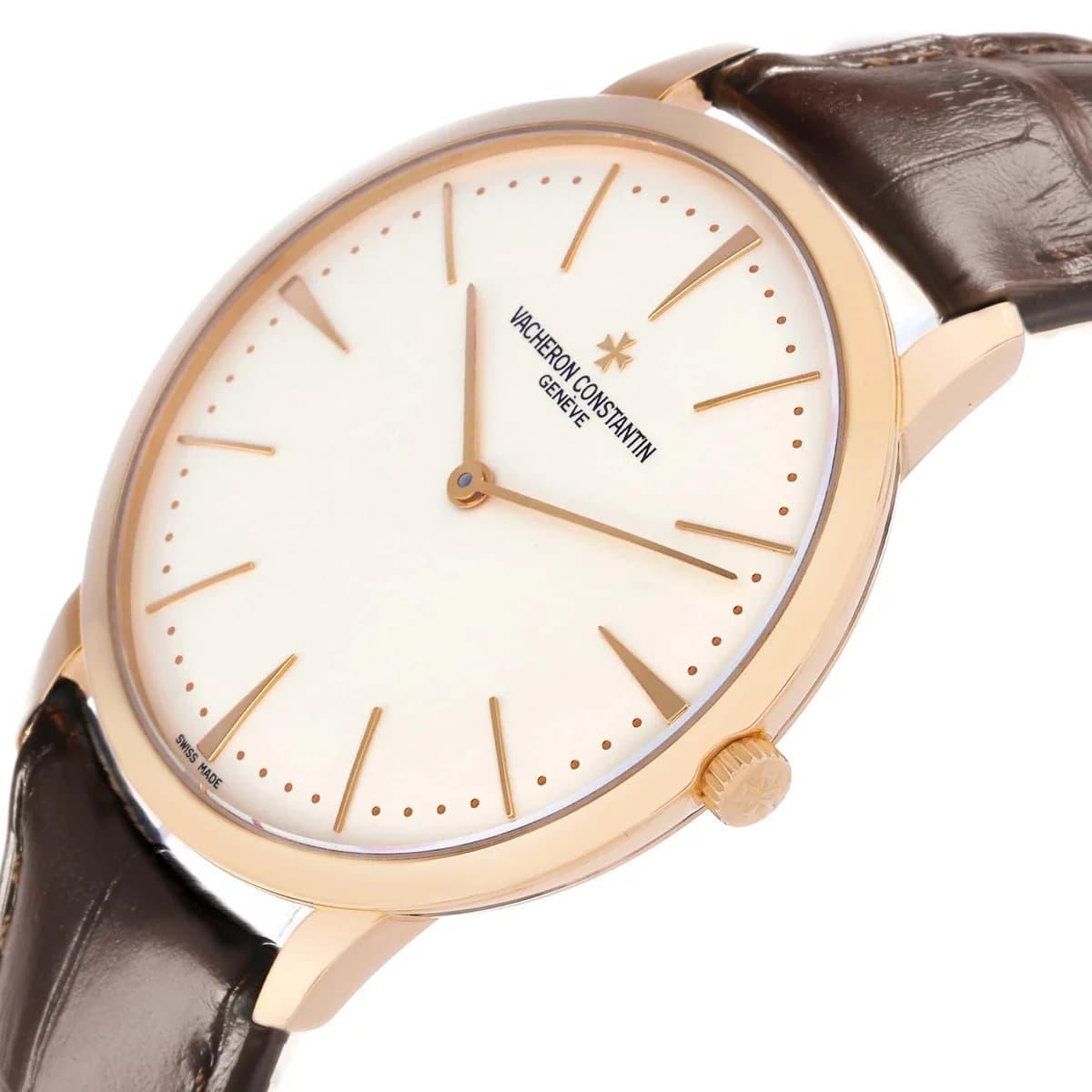
At 6.79mm on the wrist, the Patrimony essentially disappears. It does not sit on your wrist. It lies against it. Under a Canali cuff, it is invisible. With rolled sleeves, it has just enough presence to be noticed without drawing attention. The rose gold catches light along the fully polished case, and the warmth of 18K 5N pink gold on darker skin is exceptional. The copper content in the alloy produces a reddish warmth that harmonizes with melanin-rich complexions in a way that white gold and platinum do not. This is the same observation I made with the Grand Lange 1 and the Zeitwerk, and it holds true here. Rose gold on dark skin is not just flattering. It is beautiful in a way that photographs consistently fail to capture.

The Patrimony weighs roughly 67 grams on its strap. For a solid 18K gold watch, that is remarkably light. Owners consistently describe it as lighter than expected. The combination of the ultra-thin case and the small-diameter movement means there is simply less metal. On a 6.5-inch wrist, 40mm with a 45.5mm lug-to-lug sits perfectly. The gently curved lugs follow the wrist contour. There is no overhang. No awkward gap between case and skin. It is one of the most comfortable watches I have ever put on because there is almost nothing there to be uncomfortable. The sapphire crystal is slightly domed, sitting flush with the polished bezel. The crown is manually wound, as it should be on a watch this thin. Winding the 1400 is a smooth, refined experience with none of the grittiness that cheaper movements exhibit. About 40 turns from empty brings it to full wind, and the mainspring has a proper slip clutch to prevent overwinding. That daily winding ritual is part of the experience. It connects you to the movement in a way that an automatic never does. I genuinely prefer manual-wind movements on dress watches for this reason. An automatic rotor adds thickness, adds weight, and removes the tactile connection between your fingers and the mainspring. The Patrimony would not be the same watch with an automatic movement. Vacheron understood that, and I respect the decision to keep this reference as a pure manual-wind piece.
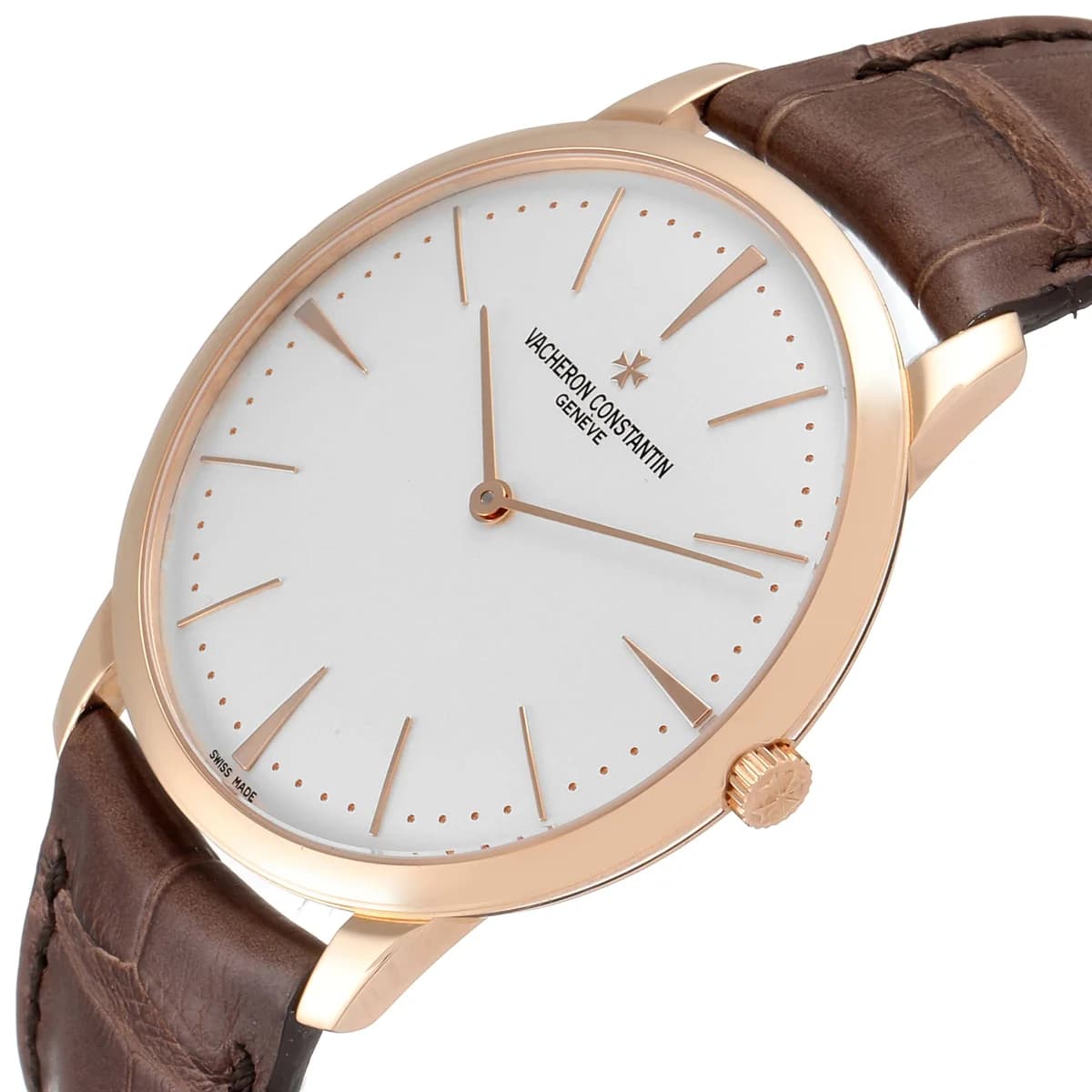
The strap is hand-stitched alligator leather on a rose gold pin buckle. The buckle carries the Maltese Cross, engraved cleanly into the metal. The strap is thinner than what most brands supply because it has to be. A thick strap on a 6.79mm case would look absurd, throwing off the entire proportion. Vacheron sized it correctly. I appreciate that attention to proportion because so many brands get this wrong. They build a thin case and then strap it to a 4mm-thick leather band that completely negates the slim profile. The Patrimony avoids that mistake.
The honest critique is the power reserve. At roughly 38 hours, you are looking at less than two days. Take it off Saturday morning and it might be dead Sunday afternoon. The Grand Lange 1 does 72 hours. The Zeitwerk does 72 hours. Even the Patek Calatrava 6119 manages 65 hours from a manual-wind movement. 38 hours is the tradeoff for the 2.6mm movement height. Less mainspring height means less stored energy. It is the same physics that limits the JLC Master Ultra Thin to 38 hours. If you want thin, you accept shorter power reserve. Water resistance is 30 meters, which is splash-proof at best. And servicing through Vacheron is not cheap. But these are the honest tradeoffs of a watch that weighs 67 grams and stands 6.79mm tall in solid rose gold. The 18K gold case is also softer than steel, sitting at roughly 2.75 on the Mohs scale versus 5.5 to 6.5 for stainless steel. The fully polished surfaces will pick up micro-scratches. This is not a flaw. It is the nature of solid gold. Over time, the patina tells the story of a watch that was actually worn. A polished rose gold case that has been on a wrist for five years develops a character that a new watch simply does not have. I find that appealing rather than concerning.
Vacheron Constantin belongs to the Richemont group, alongside Cartier, IWC, Jaeger-LeCoultre, A. Lange and Sohne, and Piaget. Within Richemont, Vacheron sits at the apex. The brand has access to shared research in materials science and escapement technology, but the Patrimony's Caliber 1400 remains distinctly Vacheron in its design philosophy. Where Lange uses German silver and untreated nickel silver plates, where Patek uses Gyromax balance wheels and Spiromax hairsprings, Vacheron pursues Geneva Seal certification on every piece. Each brand in the Holy Trinity has a different standard it holds itself to. Vacheron's is the Geneva Seal, and the Patrimony is its purest expression. There is also a practical consideration to Richemont ownership that rarely gets discussed: service infrastructure. Vacheron has boutiques and authorized service centers in major cities worldwide, which means the Patrimony can be serviced properly without sending it to Switzerland and waiting six months. For a watch that needs servicing every five to seven years, that accessibility matters. The movement is well documented, parts are available, and Vacheron's watchmakers are trained specifically on the Caliber 1400 and its variants.
The Patrimony 81180/000R-9159 in rose gold is a Geneva Seal certified, in-house manufacture, 18K rose gold dress watch from the oldest continuously operating watchmaker in the world. That sentence alone should tell you everything about where this watch sits. The finishing, the heritage, the movement quality, it is Holy Trinity watchmaking delivered with the kind of quiet confidence that does not need to announce itself. The Patrimony does not compete with Calatrava or Grand Lange 1 on brand recognition. It competes on craft. And the craft is extraordinary.

The Patrimony is not an entry-level watch. It sits firmly in the haute horlogerie tier, alongside the A. Lange and Sohne Saxonia Thin, the Breguet Classique 5157, and the Blancpain Villeret Ultraplate. These are all serious dress watches in precious metals from brands with centuries of history. What separates the Patrimony is 271 years of unbroken production and the Geneva Seal, a certification that governs not just the movement but the entire watch including the case and dial finishing. The Patrimony carries that seal because it earns it. Every surface, every angle, every component meets the standard. It is not the flashiest watch from the Holy Trinity. It is not trying to be. It is trying to be the purest, and it succeeds. If I could only show someone one watch to explain what haute horlogerie means without saying a word, the Patrimony would be on the short list.
Vacheron Constantin sits in the Holy Trinity alongside Patek Philippe and Audemars Piguet. Of the three, Vacheron is the oldest. Of the three, Vacheron is arguably the quietest. Patek has the Nautilus and the brand recognition that comes with it. AP has the Royal Oak and the cultural cachet of hip-hop and sports. Vacheron has the Overseas, which is excellent, but the brand's soul lives in pieces like the Patrimony. Restrained. Historically deep. Technically accomplished. And worn by people who do not need the watch to announce anything on their behalf. The Maltese Cross on the dial is a signal to the people who know, and invisible to everyone else. If you have ever walked through the streets of Geneva, past the Vacheron boutique on the Quai de l'Ile, you understand something about the brand that a website cannot convey. There is a quietness to how they present themselves that mirrors the watches they make.
I keep coming back to what the Patrimony chooses not to do. In a world where every watch brand is adding complications, increasing case sizes, chasing sport-luxury crossovers, and designing for Instagram visibility, Vacheron Constantin made a 40mm rose gold watch with nothing on the dial except hours and minutes, powered by a 98-component hand-wound movement that stands 2.6mm tall, certified by the most stringent quality standard in Swiss watchmaking, produced by a company that has been making watches without interruption since 1755. There is nothing to add. There is nothing to remove. It is complete. And that is the hardest thing in design to achieve.
Also in Haute Horlogerie