
Patek Philippe
Perpetual Calendar 5327R
5327R-001
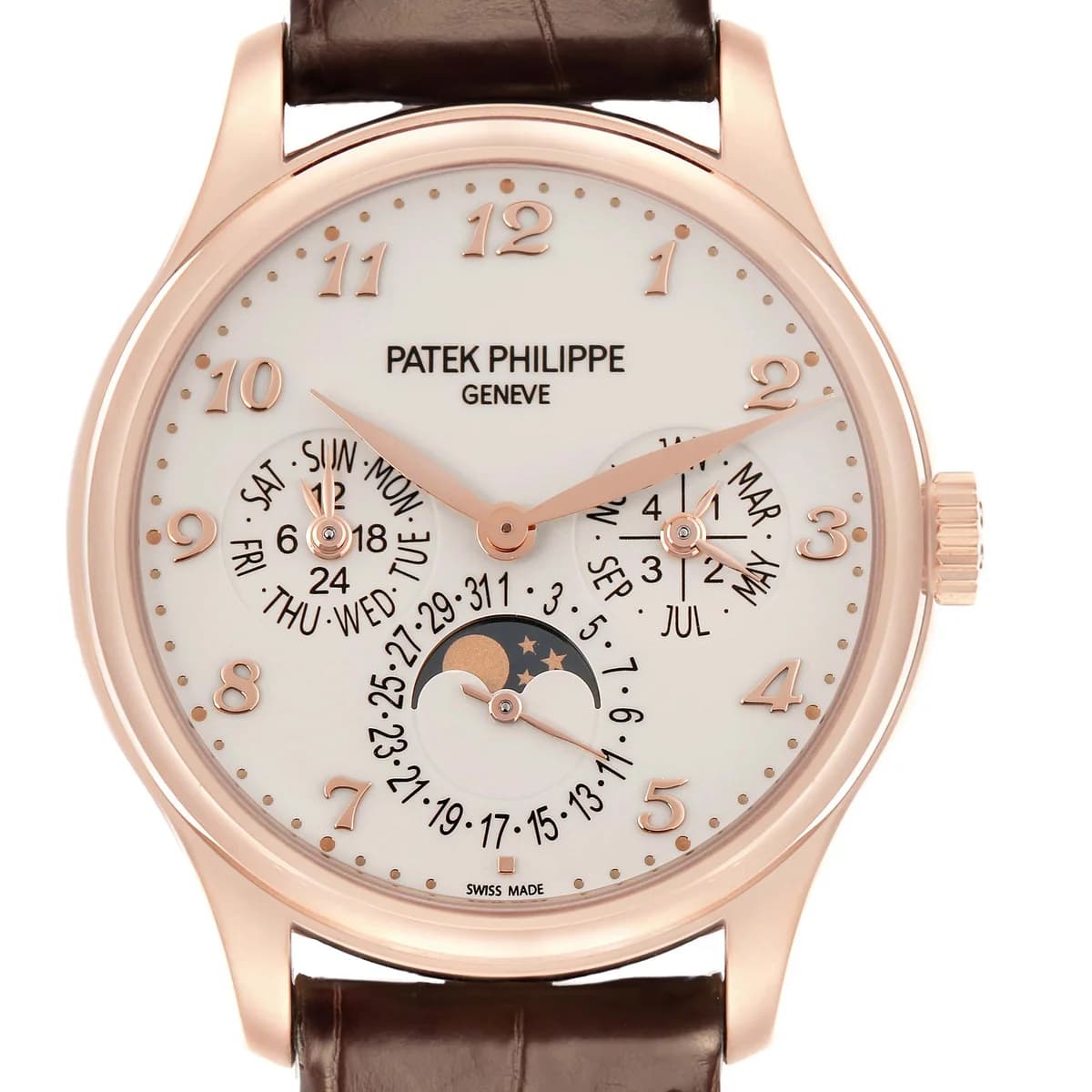
The Nautilus is the Patek Philippe that Instagram talks about. The Perpetual Calendar is the Patek Philippe that watchmakers talk about. There is a version of Patek Philippe that exists entirely inside the world of hype, waitlists, and grey market premiums, and then there is the version that exists inside the workshops on the Rue du Rhone in Geneva, where people spend their careers figuring out how to make a mechanical device track the irregularities of the Gregorian calendar without human intervention. The 5327R in rose gold is the current expression of that second version. It is a perpetual calendar, the complication that Patek Philippe has been refining longer than any other manufacturer, and it is a lineage that stretches back to 1925, when Patek produced the first wristwatch with a perpetual calendar ever made.
To understand why the perpetual calendar matters, it helps to understand the problem it solves. A simple date watch advances one number every 24 hours. It does not know that February has 28 days, or that April has 30 while May has 31. At the end of every short month, the owner has to manually advance the date. An annual calendar improves on this by knowing the lengths of the months, but it still needs a manual correction once a year, at the end of February. A perpetual calendar knows everything. It tracks the day of the week, the date, the month, the moon phase, and the leap year cycle. It automatically adjusts for months with 28, 29, 30, and 31 days. It knows that every fourth year, February gets an extra day. And it requires no manual correction until the year 2100, when the Gregorian calendar skips a leap year that the watch's mechanism expects. That is 75 years of self-correcting timekeeping from a purely mechanical system, no battery, no software, no GPS signal. Just gears, levers, and a program wheel that was set in motion the day the watch left the manufacture.
The story of Patek Philippe and the perpetual calendar begins with reference 97975. In 1898, Patek Philippe built an instantaneous perpetual calendar movement for a women's pendant watch. The pendant went unsold, and the movement sat for over two decades. Then in 1925, that same movement was re-cased into a 34.4mm yellow gold wristwatch with a hunter caseback and hand-engraved lugs. It was sold in 1927 to an American collector named Thomas Emery, and it became, by historical consensus, the first wristwatch with a perpetual calendar ever made. That watch now sits in the Patek Philippe Museum in Geneva. I have spent time in Geneva visiting the manufacture district, and the Museum is one of those places where the scale of what Patek has accomplished over two centuries becomes physically present in a way that no website or catalogue can communicate. Walking through the collection rooms, seeing the 97975 alongside pocket watches from the 1850s and minute repeaters from the early 1900s, you start to understand that Patek's relationship with the perpetual calendar is not a product line. It is an institutional obsession that has shaped everything about how they approach complications.
The modern lineage of Patek's thin, self-winding perpetual calendars begins with the reference 3940, introduced in 1985. The 3940 was powered by the Caliber 240 Q, which remains the engine of the 5327R over four decades later. At 36mm, the 3940 was elegant and restrained, and it stayed in production for 21 years. Approximately 7,000 examples were made before it was replaced in 2006 by the reference 5140, which refined the case to 37.2mm with a slightly different aesthetic but carried over the same Caliber 240 Q. Alongside these, the reference 5039, produced from approximately 1994 to 2007, offered the same movement in a case distinguished by a Clous de Paris hobnail bezel. Then in 2016, at Baselworld, Patek introduced the 5327. The case grew to 39mm, the dial layout shifted from applied baton markers to applied Breguet numerals, and the overall aesthetic moved toward a more classical Calatrava profile with scalloped lugs. The 5327 replaced the 5140 (though the 5140P in platinum remains in production) and represents the most current evolution of a perpetual calendar platform that Patek has been iterating on for over 40 years.
The Caliber 240 Q is the heart of the 5327R, and what I appreciate most about it is what it prioritizes. It is self-winding, 27.5mm in diameter, and 3.88mm thick. 275 parts. 27 jewels. 21,600 vibrations per hour, which is 3 Hz. The power reserve ranges from a minimum of 38 hours to a maximum of 48 hours depending on the state of the mainspring. What makes it thin is the micro-rotor winding system. Instead of a full-sized rotor that sits on top of the movement and adds height, the Caliber 240 uses a 22-karat gold off-center minirotor that is recessed into the movement itself. The rotor winds the mainspring without adding any vertical space to the movement architecture. This is why the entire watch, case included, stands just 9.71mm tall. A perpetual calendar under 10mm is a genuine achievement. The complication module adds layers of gears, levers, and program wheels to track the calendar, and keeping the total stack under 10mm requires engineering discipline that most manufactures cannot match. For context, the A. Lange and Sohne Langematik Perpetual, which uses a full-sized rotor, measures 10.2mm thick. That half millimeter matters on the wrist, particularly under a shirt cuff where every fraction of case height determines whether the watch catches on fabric or disappears.
The movement also carries Patek's modern material upgrades. The Gyromax balance wheel and the Spiromax balance spring, the latter made from Silinvar (a silicon-based material), were introduced to the Caliber 240 family starting in 2006. Silicon balance springs are antimagnetic and maintain their elasticity more consistently across temperature changes than traditional metallic hairsprings. These are not marketing features. They are measurable improvements to rate stability. The Patek Philippe Seal, which replaced the Geneva Seal in 2009, requires the finished watch to run within -3 to +2 seconds per day. That is a tighter standard than COSC certification, which allows -4 to +6 seconds. And the Patek Philippe Seal covers the entire watch, not just the movement. The case, dial, hands, crown, and strap all fall under its requirements. It is a holistic quality standard, and the 5327R meets it.
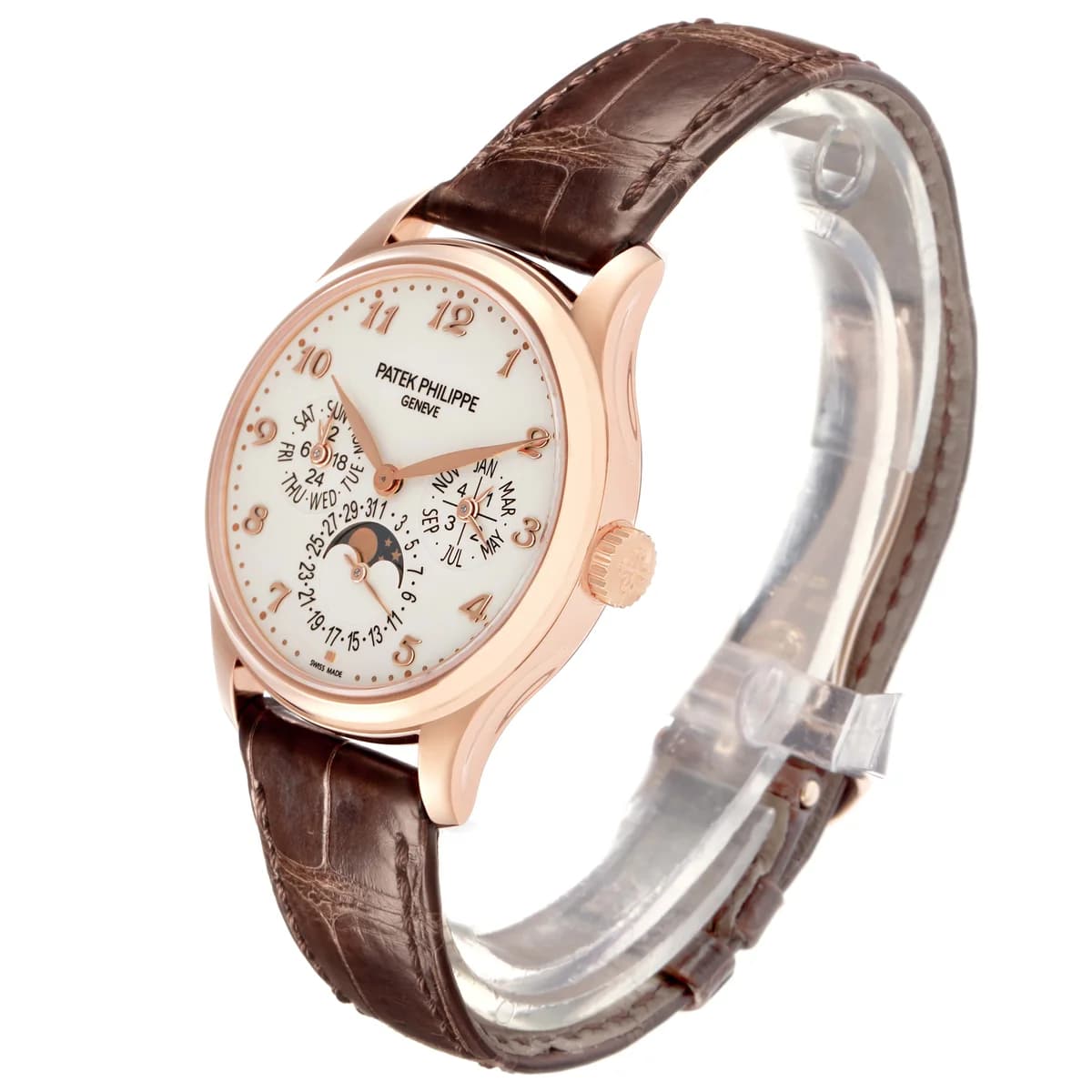
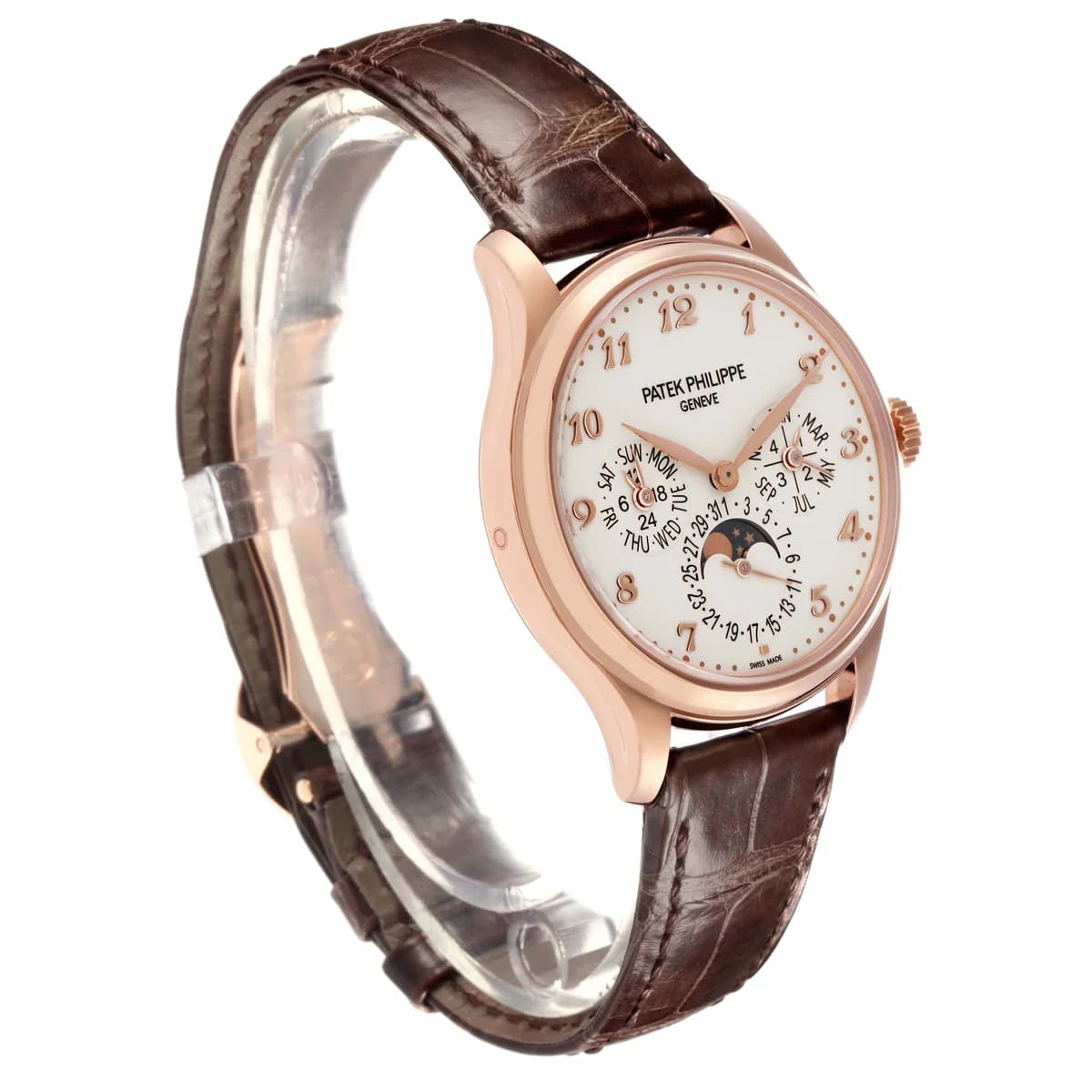
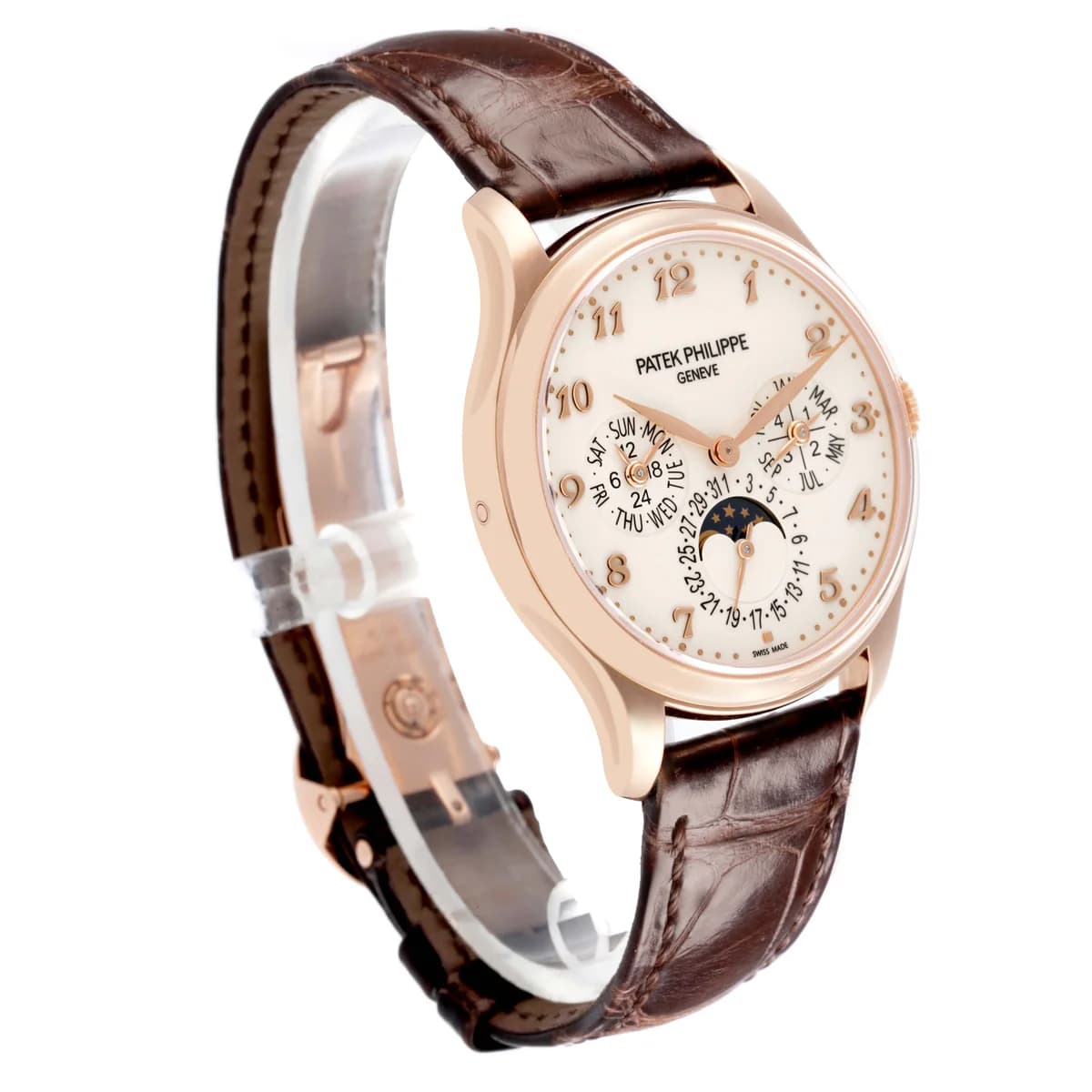
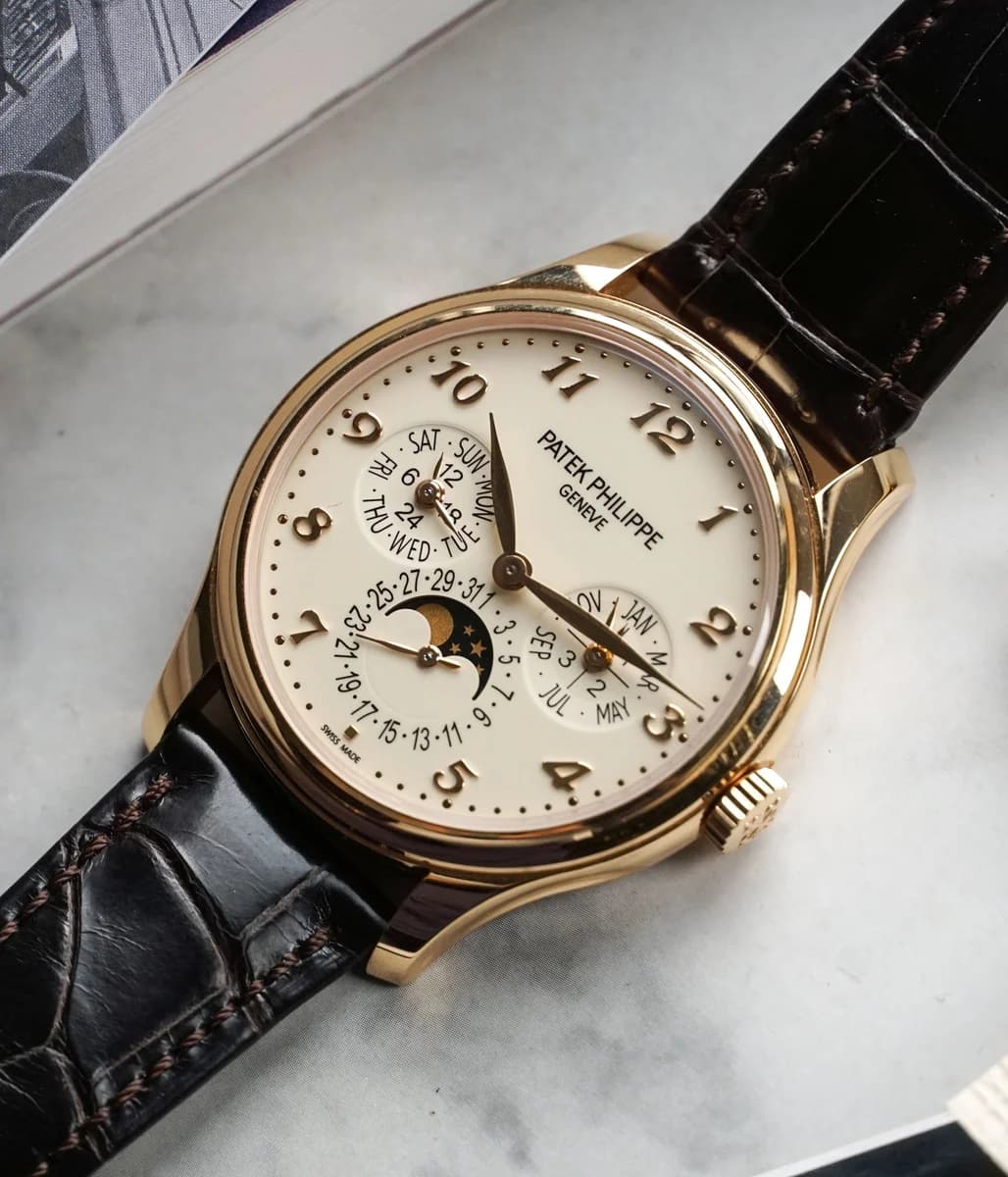
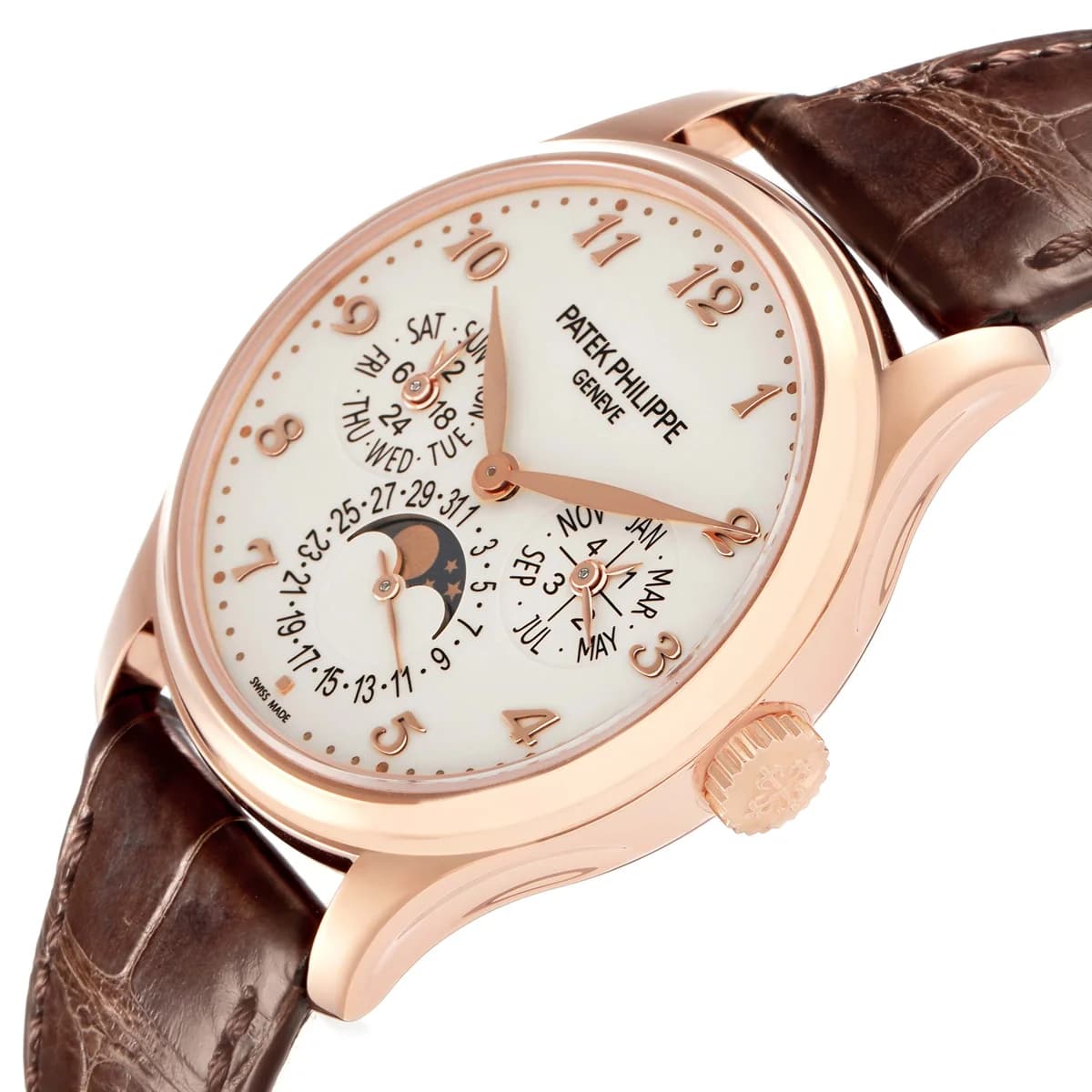
The dial of the 5327R is lacquered ivory, and it has a quality that photographs struggle to capture. The counters are hollowed, creating a multi-level surface where the day, date, month, and leap year displays sit in recessed apertures with genuine depth and shadow. At 9 o'clock, a subsidiary dial shows the day of the week and a 24-hour indicator. At 3 o'clock, another subsidiary shows the month with a leap year hand. The date is displayed around the perimeter of the dial using a central hand, with Arabic numerals for odd dates and small circles for even dates. And at 6 o'clock, the moon phase display uses a disc with 135 teeth that deviates from the actual lunar cycle by one day every 122 years and 45 days. A standard moon phase with a 59-tooth disc drifts by a full day every 2 years and 7 months. The 135-tooth system is more than 40 times more accurate. The golden moon and stars sit against a deep blue background, and the disc rotates so slowly that you never see it move. It just changes, like the moon itself. Rose gold applied Breguet numerals mark the hours. Rose gold feuille (leaf-shaped) hands sweep across the lacquered surface. The overall impression is quiet complexity. Despite having six different displays on the dial, nothing feels cluttered. Everything has space to breathe.
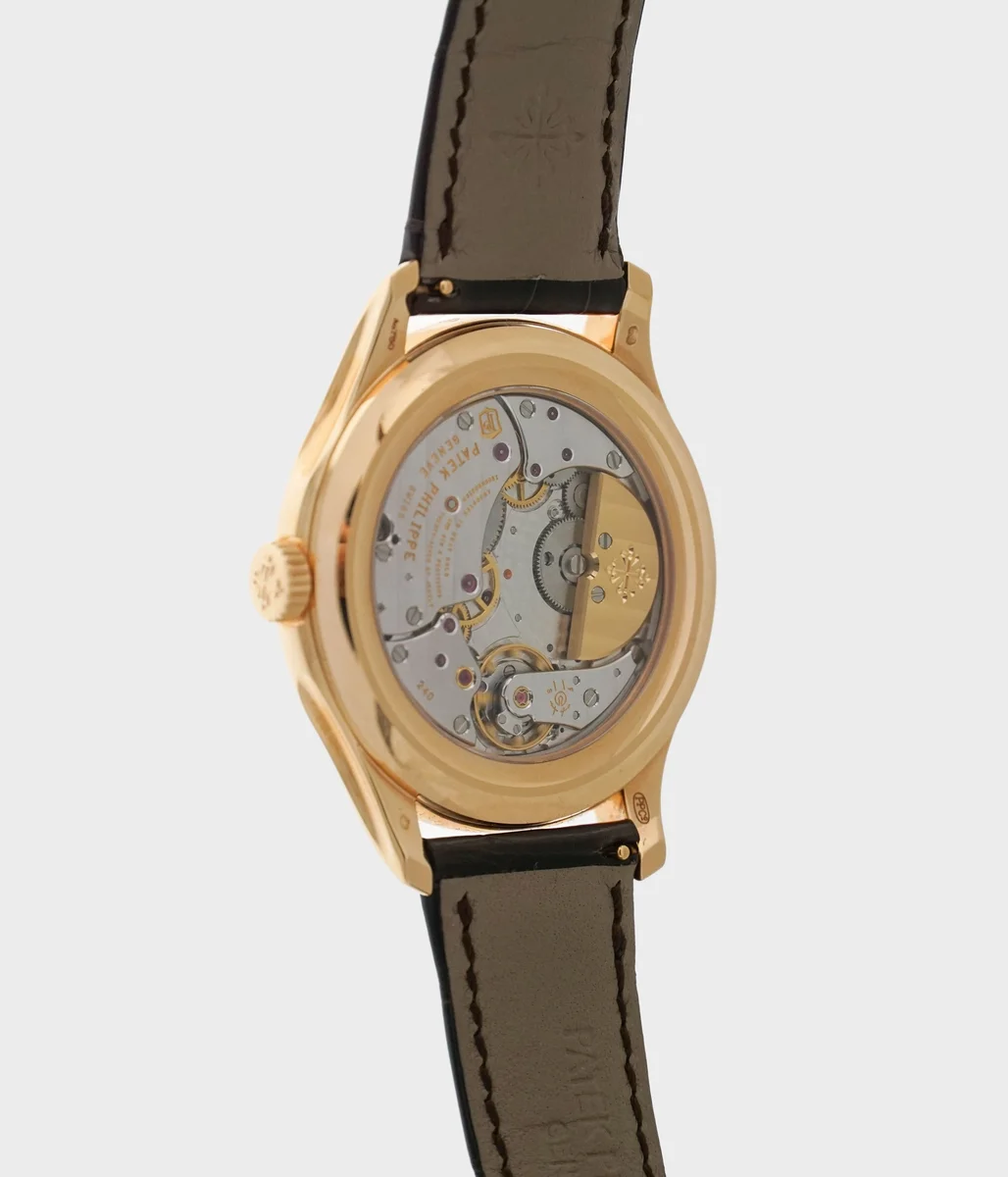
The case is 39mm in 18-karat rose gold with scalloped lugs that curve downward toward the wrist. The scalloping on the vertical flanks of the lugs is a design detail that separates the 5327 from its predecessors. It gives the case a visual lightness that the flat lugs of the 3940 and 5140 did not have. The crown is small and sits flush against the case band, which is the right approach for a dress complication. Sapphire crystal on the front, sapphire exhibition caseback on the rear, which reveals the Caliber 240 Q with its Geneva stripes on the bridges, perlage on the mainplate, polished bevels, and the 22K gold micro-rotor catching light as it winds. Water resistance is 30 meters, which is effectively splash-proof. The strap is hand-stitched dark chestnut alligator leather with square scales and a rose gold fold-over clasp.
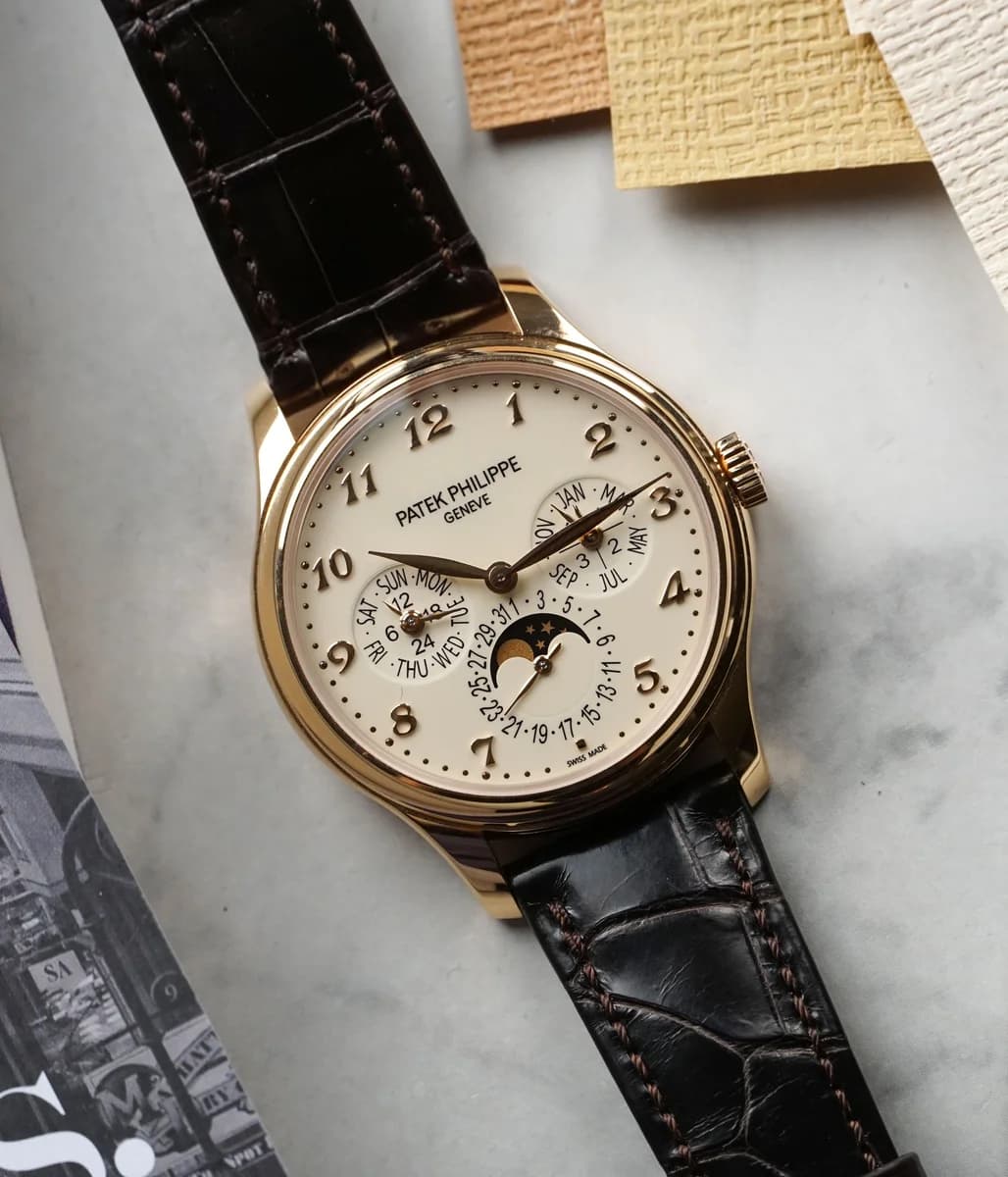
I notice that the 5327R wears smaller than its 39mm case diameter might suggest. The scalloped lugs pull the watch close to the wrist, and the 9.71mm case height means it sits flat under a shirt cuff. For a watch with this level of mechanical complexity, the ability to disappear under a cuff is the point. The perpetual calendar is not a complication that demands attention. It quietly does its work, tracking the calendar month after month, year after year, while looking like an elegant dress watch. On my wrist, the proportions feel balanced at 6.5 inches. Not oversized, not precious. Just right.
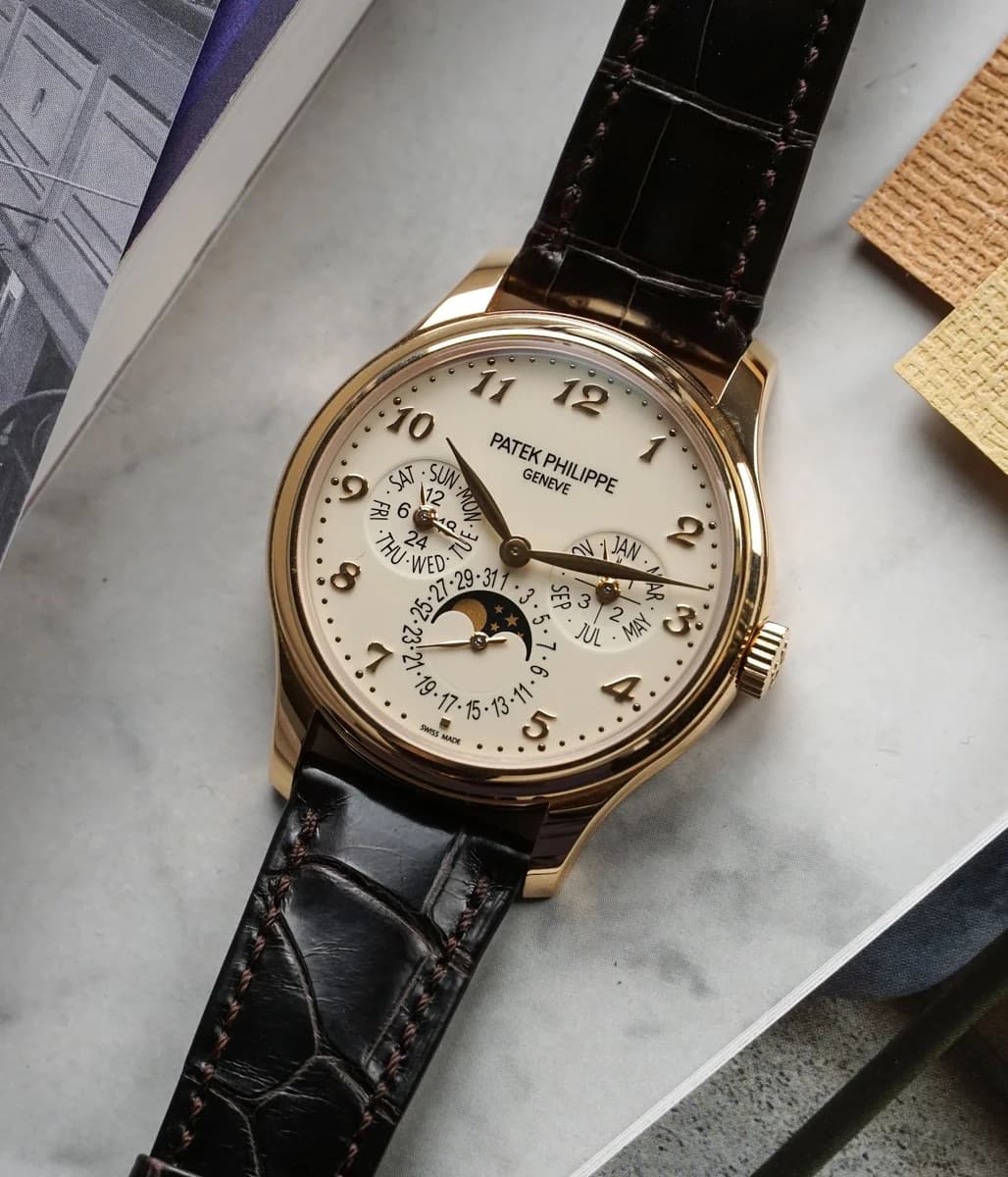
What I appreciate about the 5327R from a product design perspective is the restraint in how Patek has iterated on this platform. The Caliber 240 Q debuted in 1985. Forty-one years later, it is still the engine of their thinnest perpetual calendar. That could be read as stagnation, and some critics have made that argument, pointing out that brands like H. Moser have introduced instantaneous jumping calendar mechanisms and Ulysse Nardin offered crown-adjustable perpetual calendars back in 1996. I understand the critique. But I think it misses the point. The 240 Q has been refined continuously over four decades. The Spiromax silicon hairspring, the Gyromax balance, the Silinvar lever and escape wheel. These are not cosmetic changes. They represent genuine improvements to the movement's accuracy, durability, and antimagnetic resistance. Patek has not replaced the movement because the movement does not need to be replaced. It needs to be refined. And that is a different kind of engineering discipline, the discipline to not start over when iterating on something that already works.
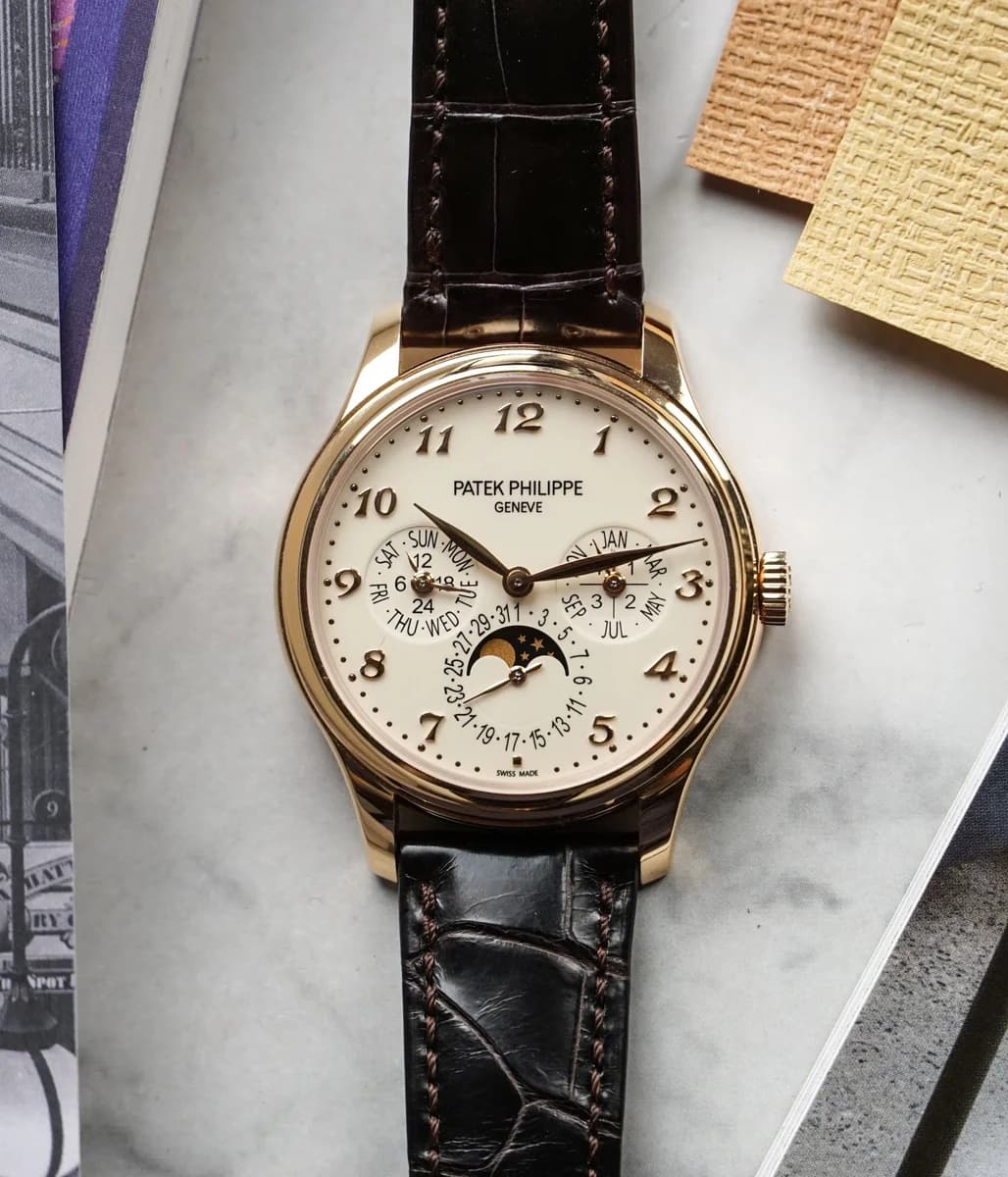
The 5327 comes in three metals. The 5327R in rose gold with the ivory lacquered dial. The 5327G in white gold with a royal blue sunburst dial that shifts from deep navy to bright cobalt as the light moves. And the 5327J in yellow gold with an ivory dial, which has been discontinued. All three use the same Caliber 240 Q, the same 39mm case, and the same scalloped lug design. The choice between them is entirely about aesthetic preference and how the metal interacts with the wearer's skin tone and wardrobe.
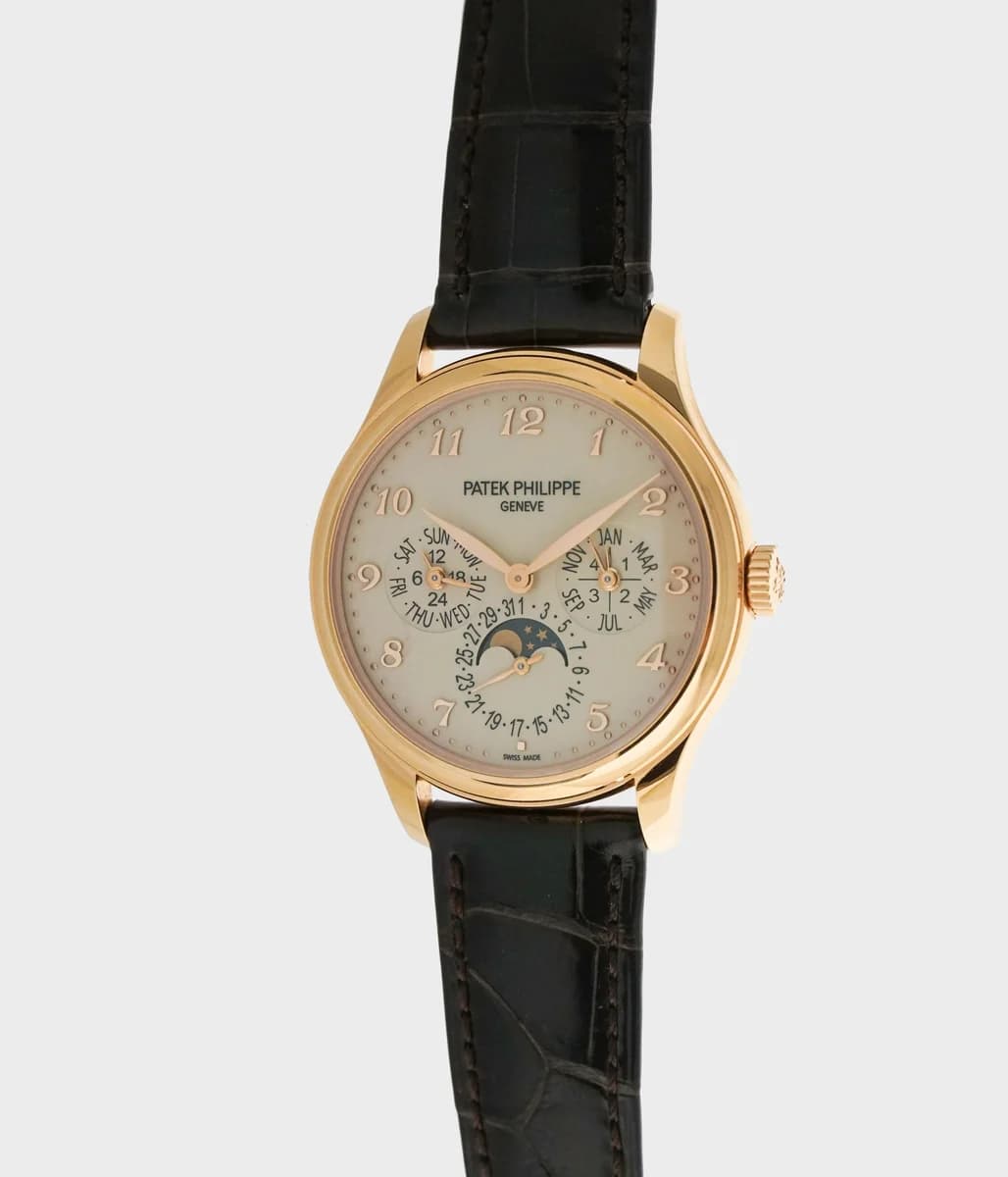
The honest critique of the 5327R starts with power reserve. At 38 to 48 hours, this is a watch that cannot survive a full weekend off the wrist without stopping. If the watch stops, the perpetual calendar needs to be corrected using tiny recessed corrector pushers in the case band, which require a stylus or the pointed tip of a tool to activate. Each function (day, date, month, moon phase) has its own corrector, and advancing through multiple months of calendar information is a slow, deliberate process. I wish the power reserve were closer to 60 or 70 hours. The thinness of the micro-rotor movement is the tradeoff. A larger mainspring barrel would add height, and the 3.88mm movement thickness is the architectural constraint. It is the honest cost of keeping a perpetual calendar under 10mm on the wrist. Water resistance at 30 meters is functionally splash-proof, and while I understand that the exhibition caseback and the thin case construction prioritize display over water sealing, it does mean taking this watch off before anything involving running water if caution is the priority. The movement, while continuously improved, is fundamentally a 1985 design, and some collectors feel that the bridge finishing on the 240 Q lacks the sharp inward and outward angles that the earlier 3940 exhibited. The rounded bridge corners are a deliberate Patek style choice, not a regression, but the observation is fair. And the lack of lume means this is entirely a daytime watch. In a dim restaurant, reading the date at 6 o'clock is not happening without reaching for a phone light. These are real tradeoffs, and they come with the territory of a watch that prioritizes thinness and classical elegance above all else.
The rose gold of the 5327R has a warmth that works beautifully on darker skin tones. The copper content in Patek's rose gold alloy gives it a depth that yellow gold and white gold do not achieve against melanin-rich complexions. The ivory dial, the rose gold case, the dark chestnut strap. There is a tonal harmony to the combination that feels intentional. This is a watch for Kiton cashmere, for dinner jackets, for mornings at the office where the only person who notices the watch is someone who already knows what a perpetual calendar is. The fold-over clasp keeps it secure without the stress that a tang buckle places on an alligator strap, and the 39mm case sits flat enough under a French cuff that the watch effectively vanishes. On warmer days with the sleeves rolled, the rose gold catches sunlight in a way that is warm without being loud.
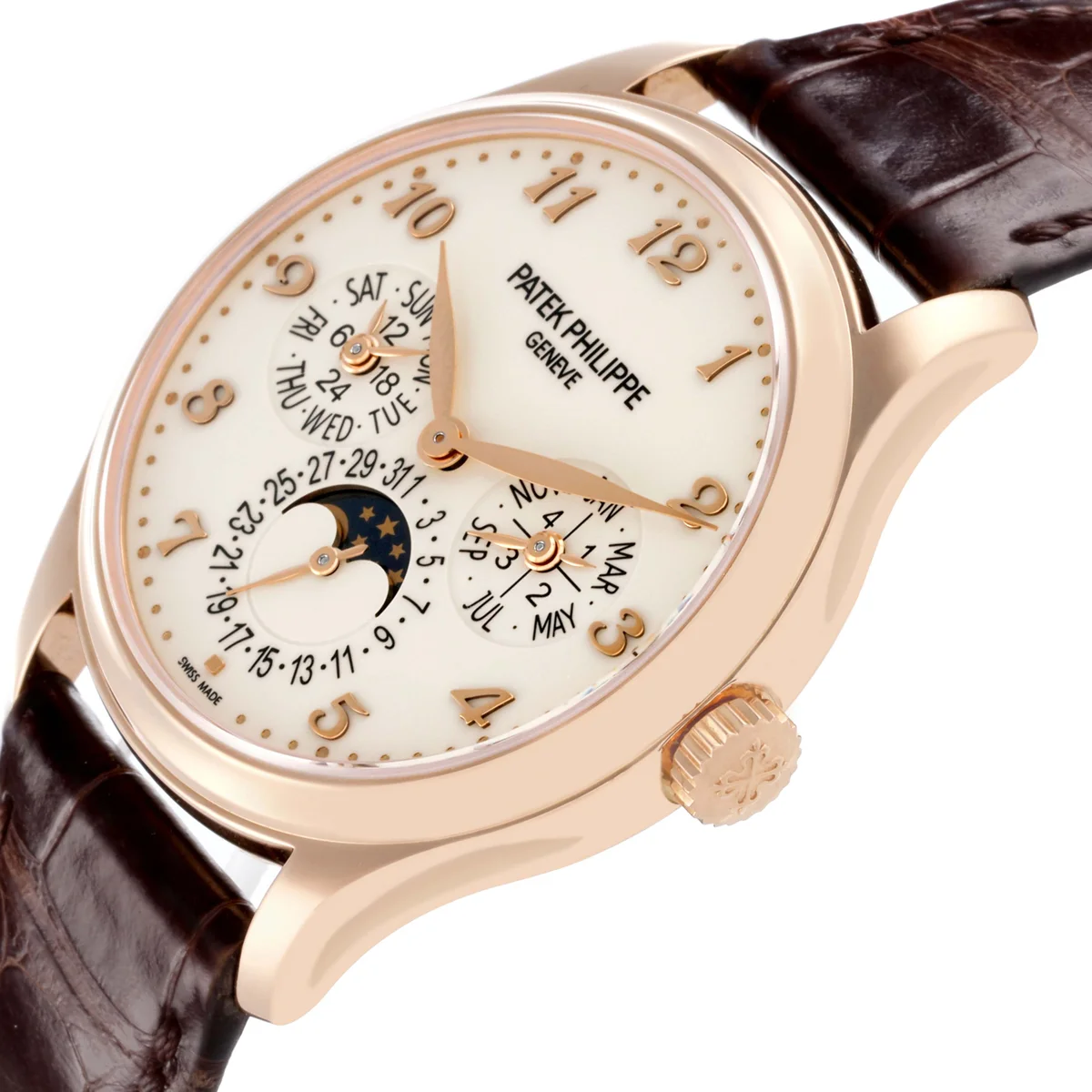
In the broader context of Patek Philippe's current perpetual calendar collection, the 5327R sits alongside some genuinely different approaches to the same complication. The 5320G uses an aperture-based display instead of hands, with day, date, and month shown in windows rather than on subdials. The 5270 adds a chronograph to the perpetual calendar, substantially increasing case height and mechanical complexity. The 5236P, introduced in 2021, uses an in-line perpetual calendar where the day, date, and month appear in a single horizontal window at 12 o'clock, driven by a completely new movement. The 5327R is the most classical of the group. It is the descendant of the 3940, the watch that defined what a thin, elegant, self-winding perpetual calendar looks like. The others have pushed the complication in new directions. The 5327R is the anchor. It is the one that says Patek can still do this the way they have always done it, just a little better each time.
I include this watch because a collection that claims to take watchmaking seriously needs a Patek complication, not a Patek status symbol. The Calatrava is in the collection for its restraint. The 5327R is here for its intelligence. A mechanical device on the wrist that knows February has 28 days, except when it has 29, and adjusts itself accordingly without a battery, without software, without any intervention until the year 2100. Patek Philippe built the first watch that could do this in 1925. They have spent the last century getting better at it. The 5327R is where that century of work stands right now, and I do not think there is a more elegant expression of this complication anywhere in production.
Also in Haute Horlogerie