
Vacheron Constantin
Overseas Brown Dial
4500V/110A-B146
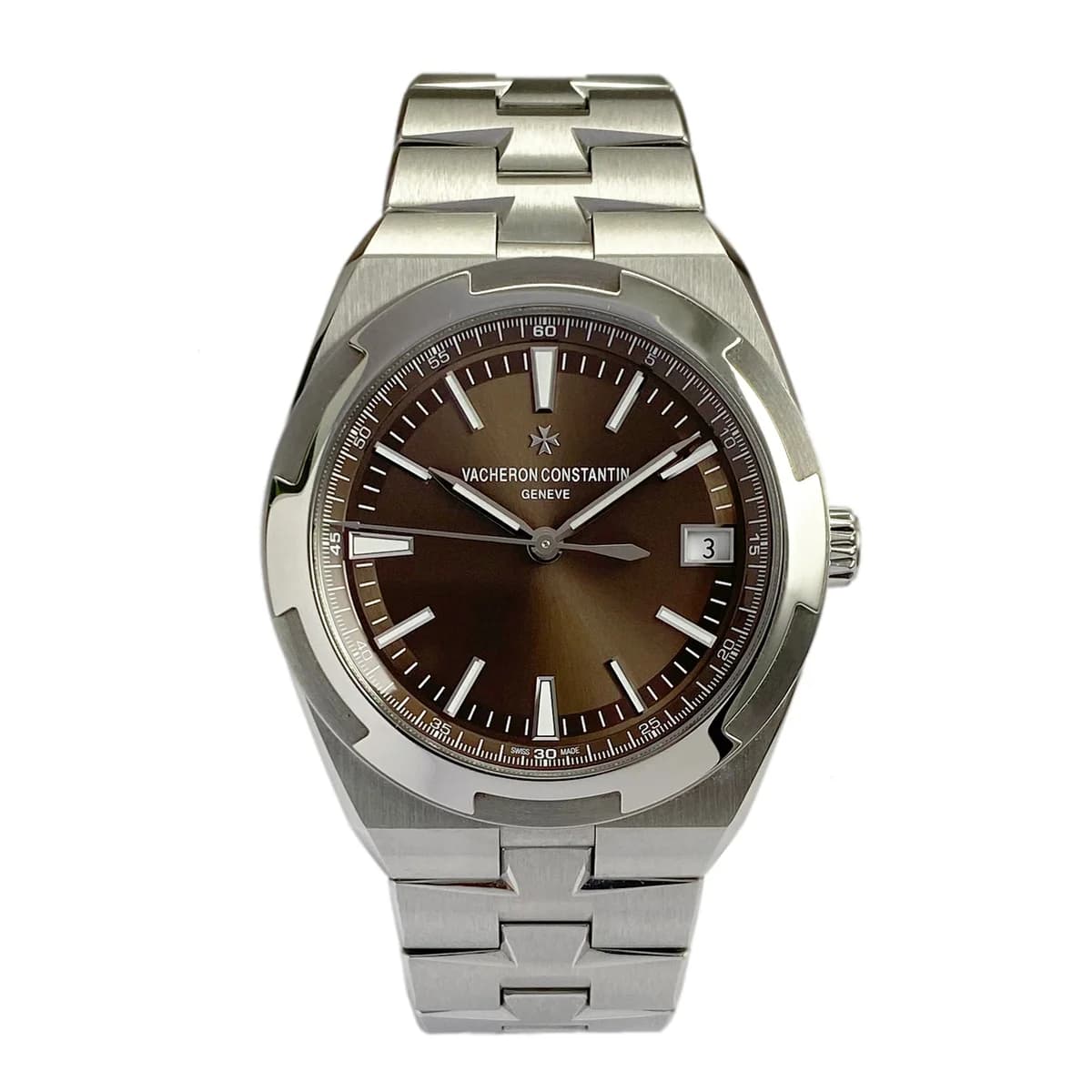
Vacheron Constantin was founded in 1755. That's not a typo. Jean-Marc Vacheron, a 24-year-old master watchmaker in Geneva, signed his first apprentice contract that year, and the company has been in continuous operation ever since. 270 years. No interruptions. No gaps. No "re-founded in" footnotes. When people talk about the Holy Trinity of watchmaking, they mean Patek Philippe, Audemars Piguet, and Vacheron Constantin, and Vacheron is the oldest of the three by a significant margin. 84 years older than Patek, 120 years older than AP. The Maltese cross logo that you see on every Vacheron isn't arbitrary either. It's the shape of a stopwork mechanism inside the movement's barrel, a small cross-shaped component that prevents the mainspring from being overwound. When they adopted it as a trademark in 1880, they chose a functional part of the watch. The brand identity is literally a mechanical component.
The Overseas is Vacheron's entry in the luxury steel sport watch category, and its story starts earlier than most people realize. In 1977, Vacheron released the 222 to mark their 222nd anniversary. It was designed by Jorg Hysek, and I want to be clear about that because there's a misconception that floats around the watch world that Gerald Genta designed it. He didn't. Genta designed the Audemars Piguet Royal Oak in 1972 and the Patek Philippe Nautilus in 1976. The Vacheron 222 was Hysek's work. He created a monobloc 37mm steel case with a scalloped bezel, an integrated bracelet, and the ultra-thin VC Caliber 1120 inside. Only 7.2mm thick. It was the third of the "big three" luxury sport watches from the 1970s, after the Royal Oak and the Nautilus, and it's the direct ancestor of the Overseas. The Overseas itself arrived in 1996, taking the 222's DNA and modernizing everything: bolder case, improved water resistance, and critically, the Maltese cross motif integrated into the bezel. Then in 2016, the current generation launched with the 4500V reference, a new in-house movement, and the interchangeable strap system that changed how the watch lives on your wrist.
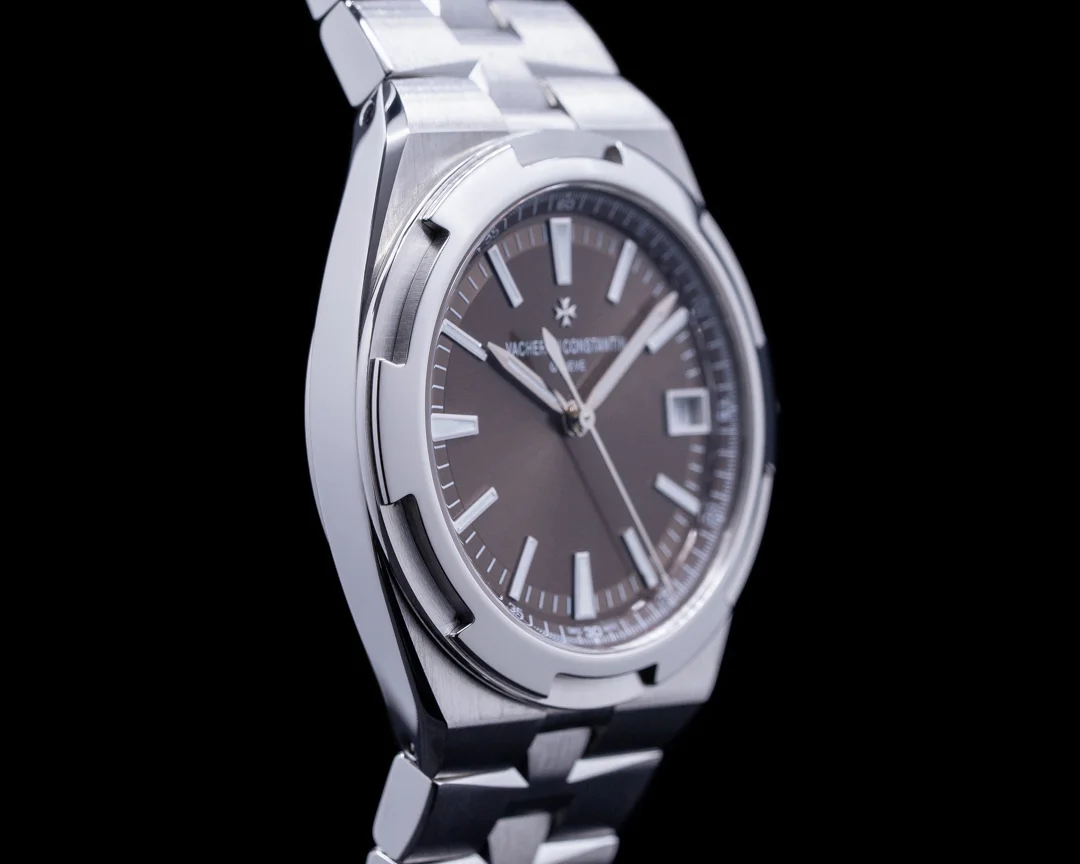
The brown dial is why I'm writing about this specific reference. Vacheron introduced the 4500V in early 2016 with blue and silver dials, then added the chestnut brown a few months later. And then roughly a year after that, they discontinued it. Replaced it with a black dial. That was it. Approximately one year of production for this dial color. It wasn't marketed as a limited edition. It was just a regular production color that Vacheron quietly stopped making. At the time, most buyers were gravitating toward the blue, which is a genuinely beautiful dial and remains the most popular Overseas by a wide margin. The brown didn't generate the same excitement. People passed on it.
That was a mistake. Fratello Watches published an article titled "Dear Vacheron Constantin, Bring Back The Overseas 4500V With The Stunning Brown Dial," and their team, who don't agree on everything when it comes to the Overseas, unanimously agreed on the brown. They called it "bold and different in a world where white, silver, black, and blue are the main dial colors." The rarest dial in the Overseas lineup turned out to be the one nobody wanted when it was available. That happens sometimes in this world.
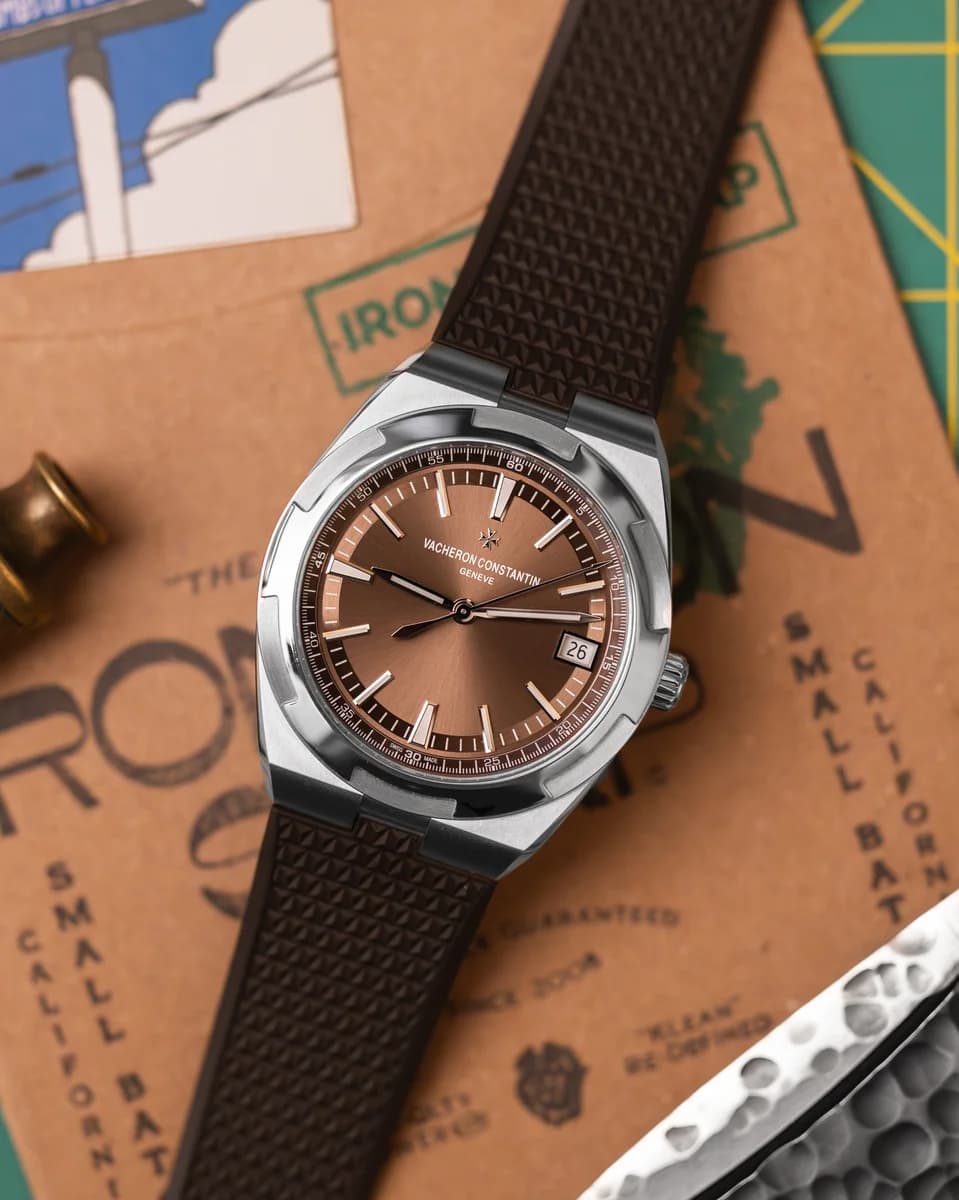
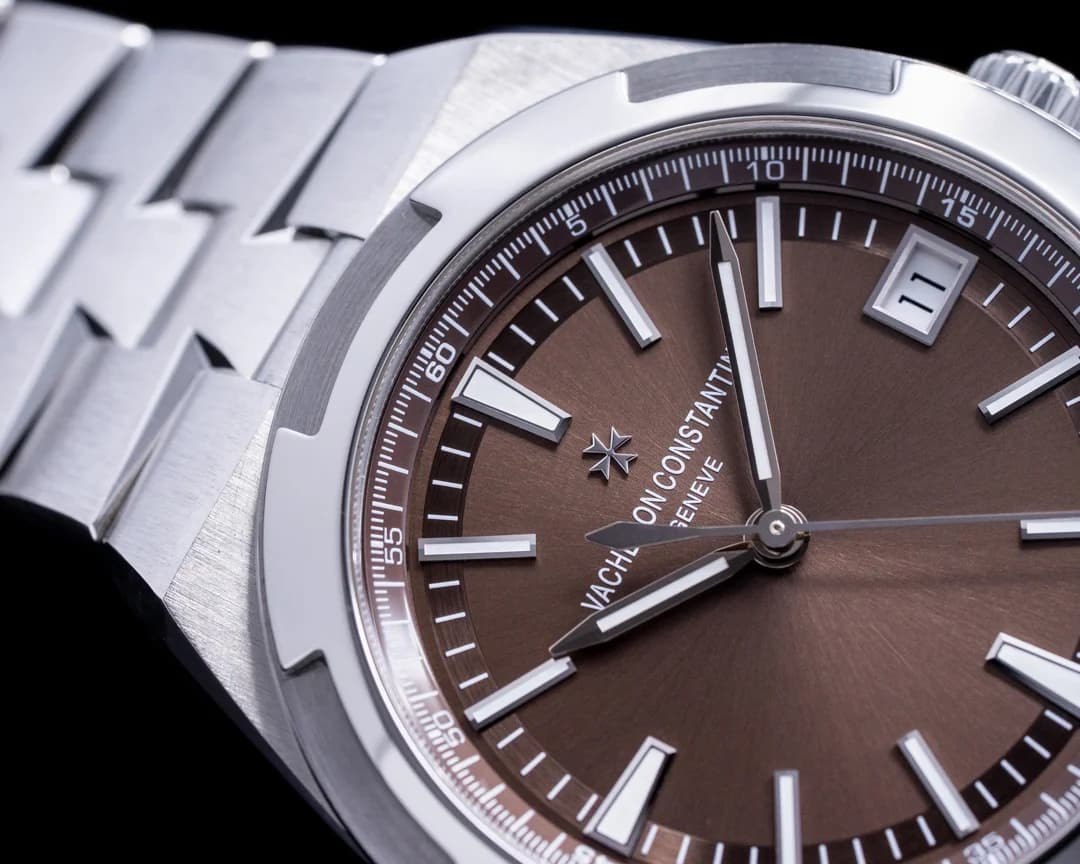
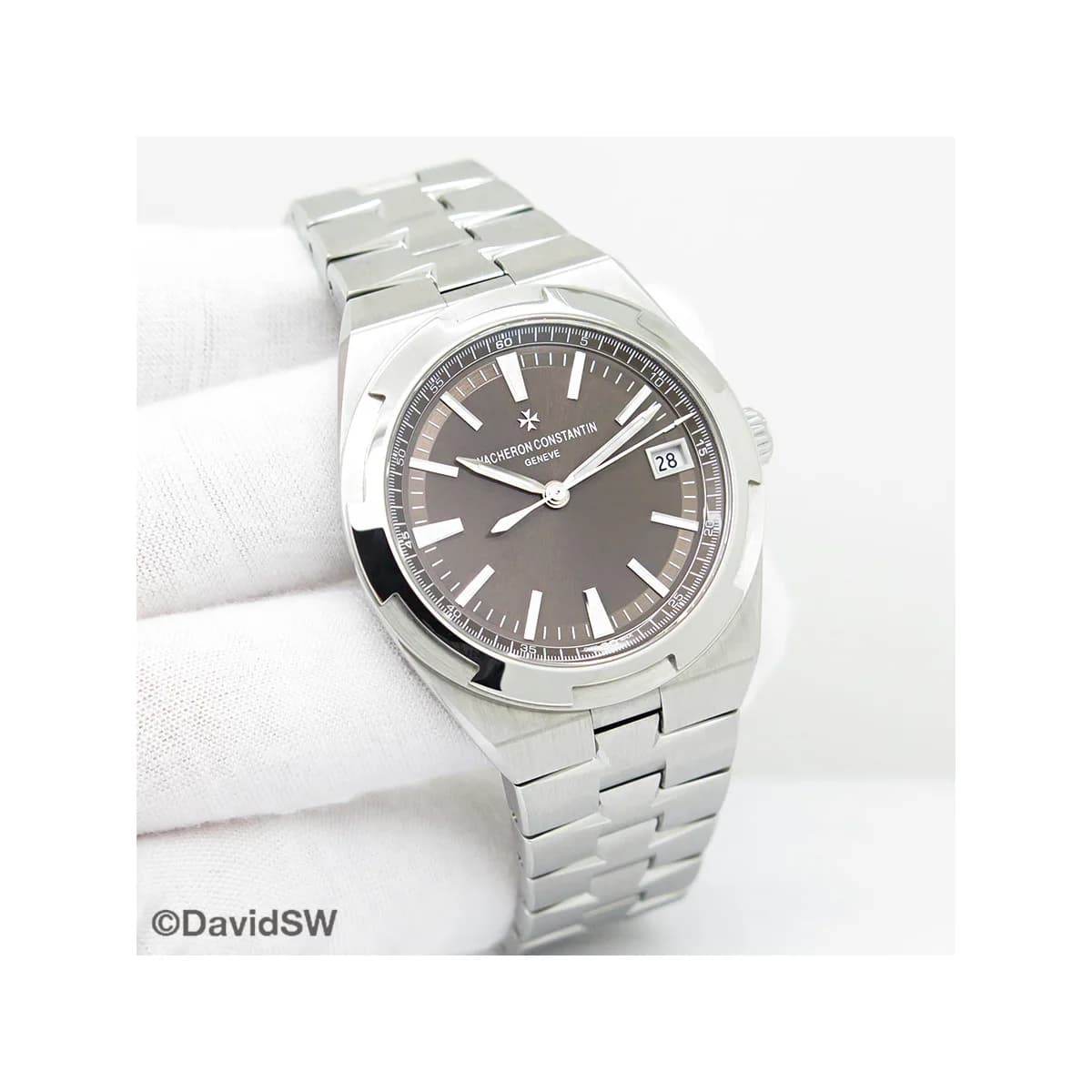
The dial itself is a lacquered sunburst in a shade Vacheron calls chestnut brown. In low light it reads as a deep, rich chocolate. As light hits the sunburst finish at different angles, it warms up into cognac and amber tones. It's not a flat color. It moves. And on stainless steel, it creates a pairing that you don't see very often. Most brown dials in the luxury space live on gold cases, the Rolex Day-Date or the Rootbeer, for example. Brown on steel is unusual, and I think that's part of what makes it work. The steel is cool, the brown is warm, and the tension between those two temperatures gives the watch a character that the blue and silver variants don't have. On darker skin tones, the warm brown against the cool steel creates a contrast that looks completely effortless. The blue is arguably better with a suit, but the brown is more understated, more personal. It doesn't announce itself the way the blue does. And for me, that's the appeal.
Turn the watch over and this is where the Overseas really starts to separate itself. The sapphire caseback gives you a full view of the Caliber 5100, and what you're looking at is genuinely beautiful. Prior to 2016, Vacheron relied on movements from Jaeger-LeCoultre, Frederic Piguet, and other suppliers for many of their automatic calibers. The 5100 changed that. It was entirely designed, developed, and manufactured by Vacheron Constantin. 172 components, 37 jewels, twin barrels delivering approximately 60 hours of power reserve, running at 28,800 vibrations per hour. And the entire movement stands just 4.7mm tall. That's remarkably thin for an automatic with twin barrels and this level of finishing.
The finishing is where you really need to take your time. Through the caseback you can see the bridges with their polished beveled edges transitioning to sandblasted surfaces, the polished screw heads, and the contrasting textures that create depth across the entire movement. Every edge, even on the smallest components, is finished to the standard required by the Hallmark of Geneva. This isn't just decorative. The Hallmark of Geneva is one of the strictest certifications in watchmaking. It doesn't just cover movement finishing. It certifies accuracy, water resistance, power reserve, and functional testing of the complete watch. For context, the Patek Nautilus carries the Patek Philippe Seal (their own internal standard), and the Royal Oak carries no external certification at all. The Overseas is the only member of the Holy Trinity's sport watch trio that carries an independent, third-party quality certification at this level.
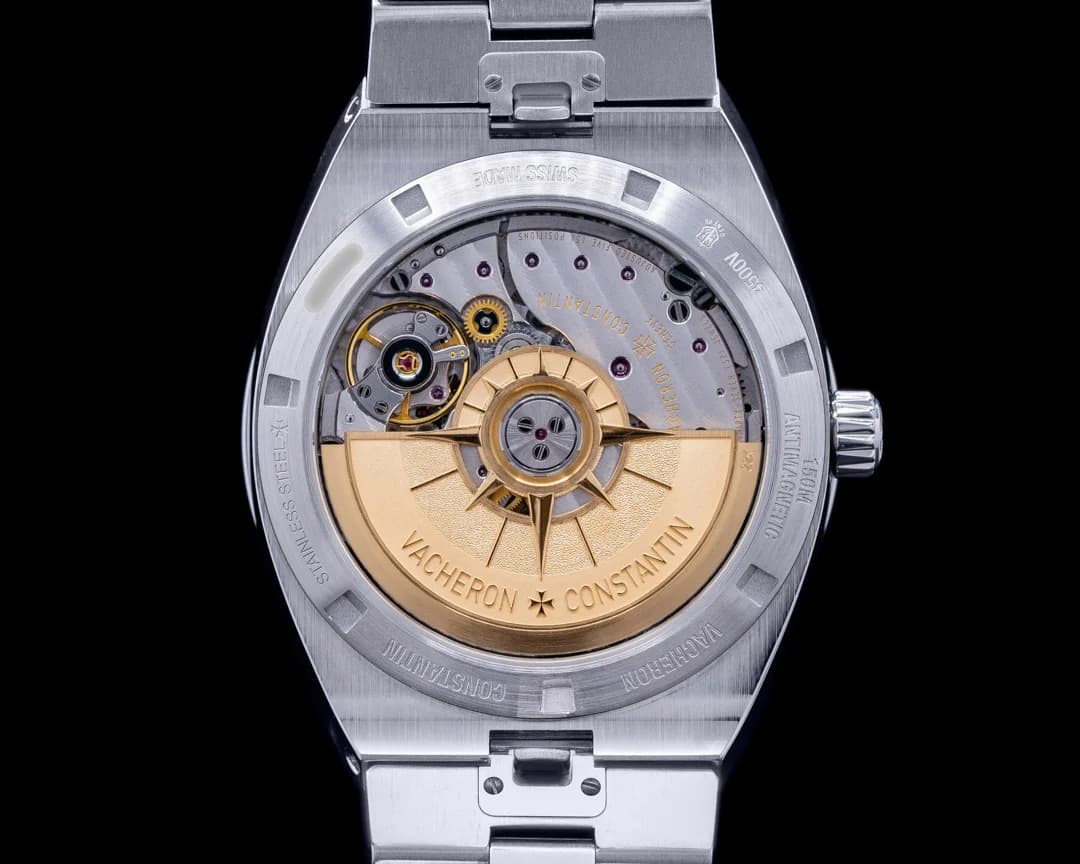
But the star of the caseback view is the rotor. It's 22-karat gold, which is heavier than 18K, and that weight is deliberate. A heavier rotor winds more efficiently because it responds to smaller wrist movements. The surface is engraved with a wind rose compass motif, a nautical reference that ties back to the Overseas name and its travel-inspired identity. The compass points radiate outward from the center in a pattern that catches light differently depending on how the rotor swings. You can see the contrast between the polished engraved lines and the matte gold surface, and when the rotor moves, the light plays across the compass pattern in a way that's almost hypnotic to watch. This is not a generic flat rotor with a brand name stamped on it. This is a piece of decorative art that also happens to be a functional winding mechanism. I have seen a lot of exhibition casebacks, and the Caliber 5100's rotor is one of the most visually striking ones at this level. The fact that you get this level of movement finishing and rotor decoration in a stainless steel sport watch is part of what makes the Overseas such a compelling alternative to its Holy Trinity siblings.
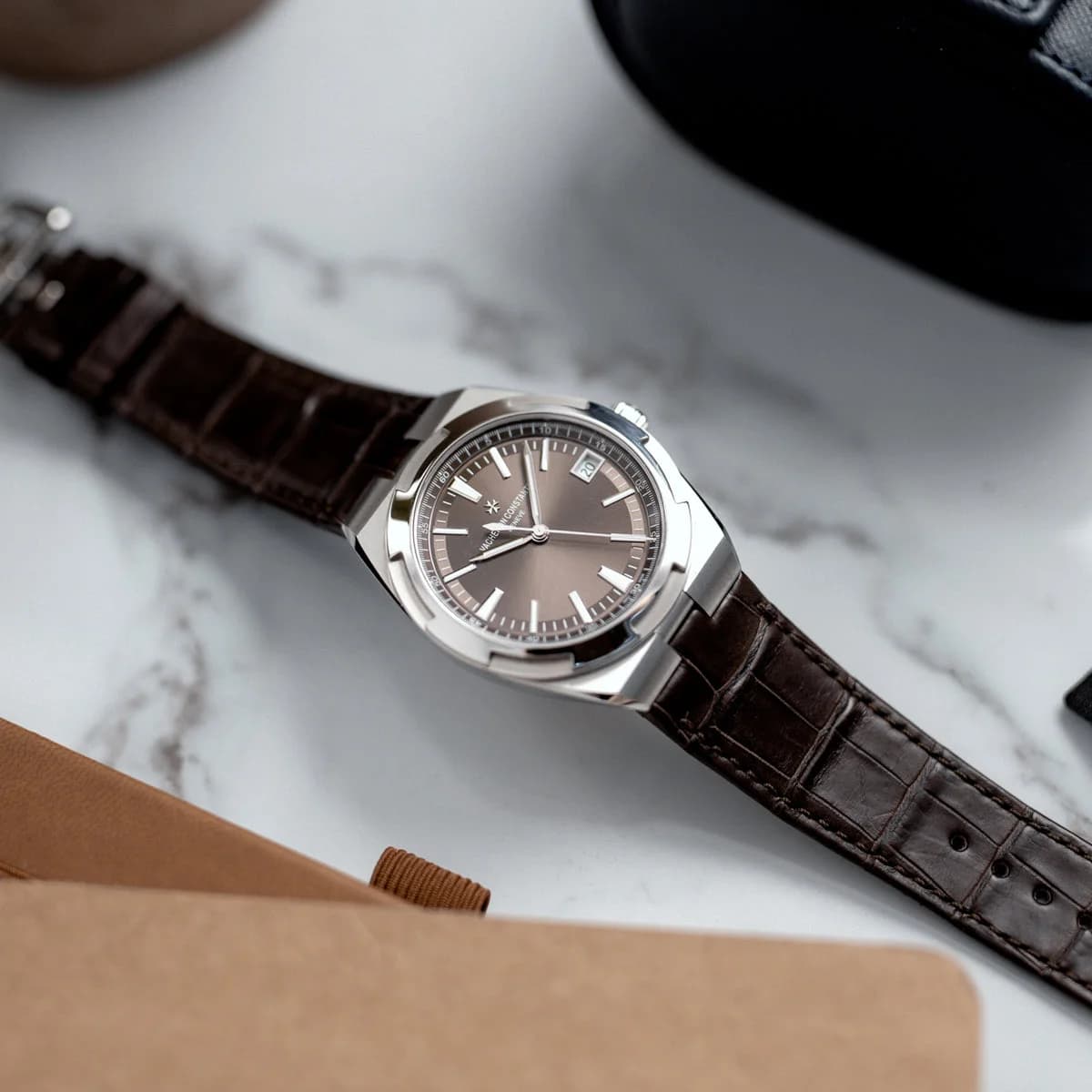
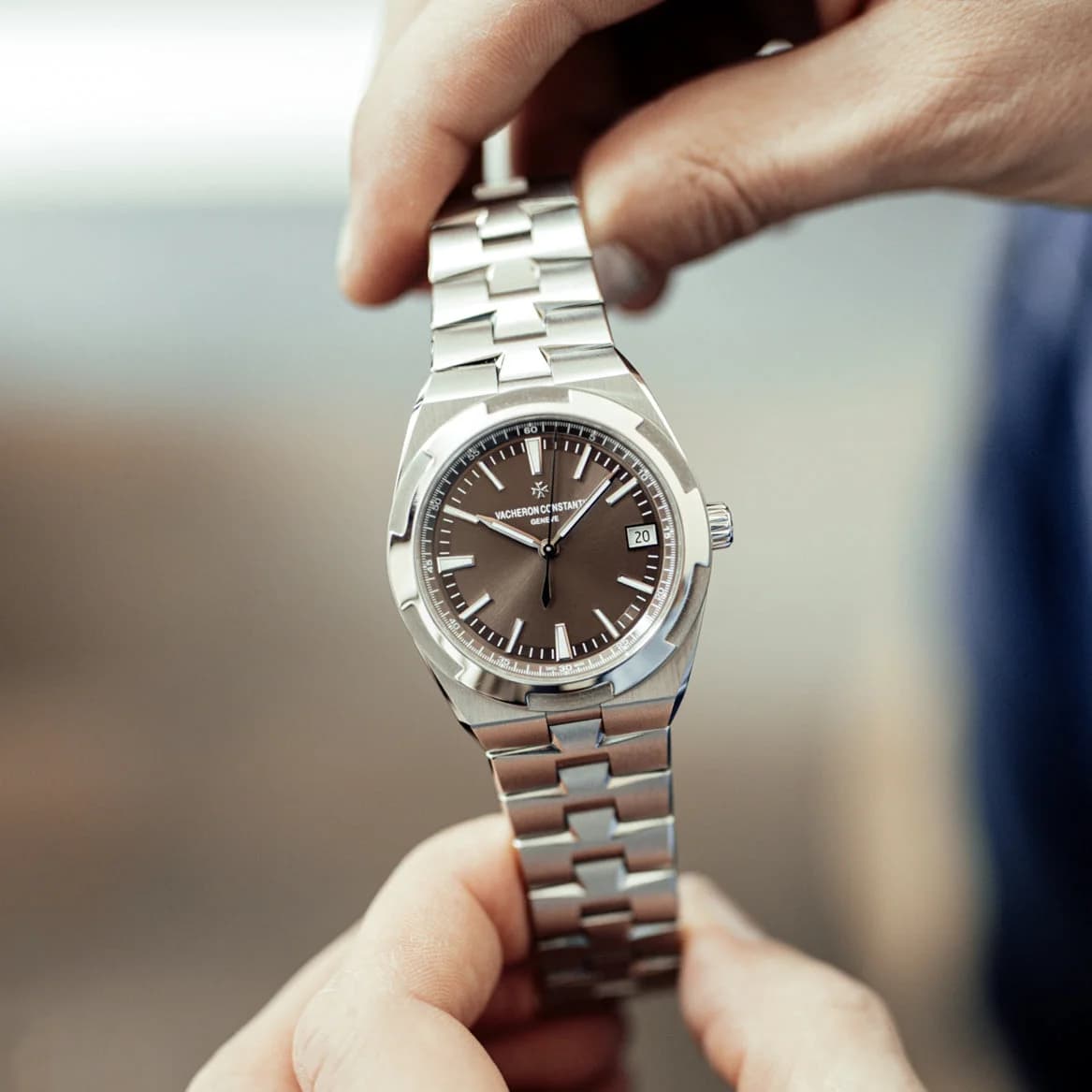
The interchangeable strap system is worth spending a minute on because Vacheron was ahead of the curve here. When the 4500V launched in 2016, tool-free strap changes were not the industry standard they are today. Cartier's QuickSwitch came in 2018. Patek's Nautilus didn't get an easy-change system until later generations. Vacheron had it first, at least among the Holy Trinity, and the implementation is clean. Small release buttons sit between the lugs at 4 and 8 o'clock. Press, slide, click. Every 4500V ships with three wearing configurations: the stainless steel bracelet with half-Maltese-cross links, an alligator leather strap on a deployant clasp, and a rubber strap on a deployant. For the brown dial specifically, the leather and rubber straps come in matching dark brown. Three completely different looks from one watch. Bracelet for daily wear, leather for a dinner, brown rubber for the weekend. And the brown rubber matching the brown dial is not something you see from other brands. It's a thoughtful detail.
At 41mm wide and 11mm thick, the Overseas wears smaller than you'd expect. The integrated bracelet design and the roughly 49mm lug-to-lug measurement keep it contained on the wrist. Owners with 6.5 to 6.75 inch wrists consistently report a comfortable fit with no overhang. It actually wears smaller than a 41mm Royal Oak, which tends to wear large because of the bezel shape. At 11mm thick, it slides under a shirt cuff without catching. The water resistance is 150 meters, which is more than the Nautilus (120m in earlier references) and substantially more than the Royal Oak (50m). Practical enough for swimming, which is what you want from a sport watch.
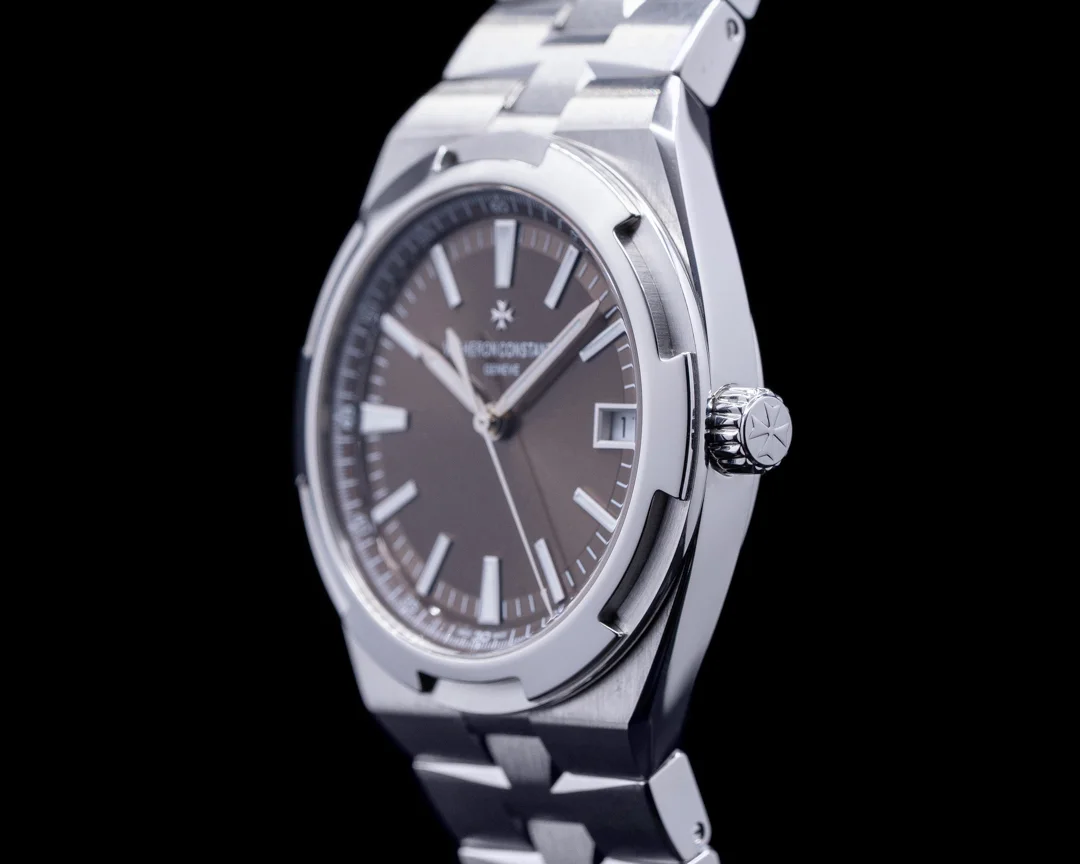
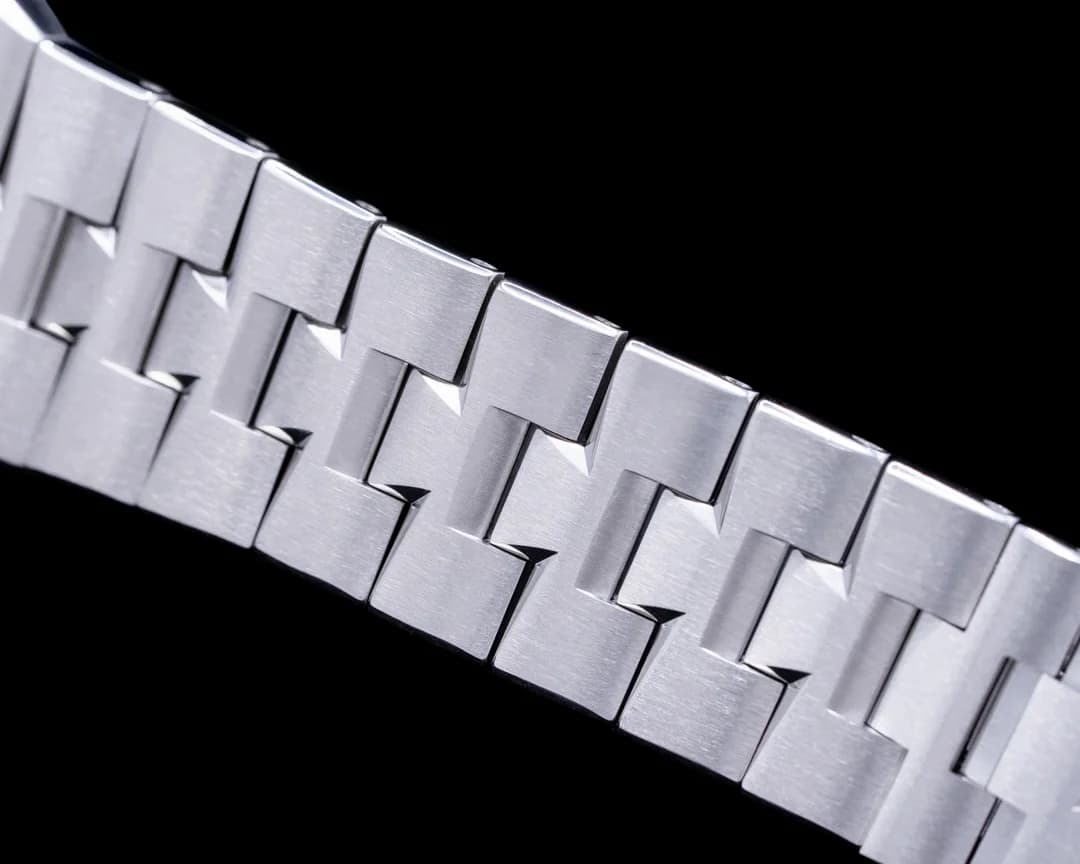
The Maltese cross bezel is the kind of design detail that separates Vacheron from the other two. The Royal Oak has the octagonal bezel with exposed screws. You see it from across the room. It's iconic and deliberate and loud. The Nautilus has the porthole-inspired case with the hinged bezel and the "ears" on the sides. Also immediately recognizable. The Overseas has six small notches cut into the outer rim of the bezel that echo the shape of the Maltese cross logo. You have to know what you're looking at to see it. A passing glance won't catch it. That's by design. Vacheron has always been the quietest of the three, and the Overseas reflects that. The bracelet carries the same motif in its link pattern, creating a visual continuity from bezel to wrist that's subtle but intentional. This is a watch that communicates through details rather than statements, and I think that's what draws me to it.
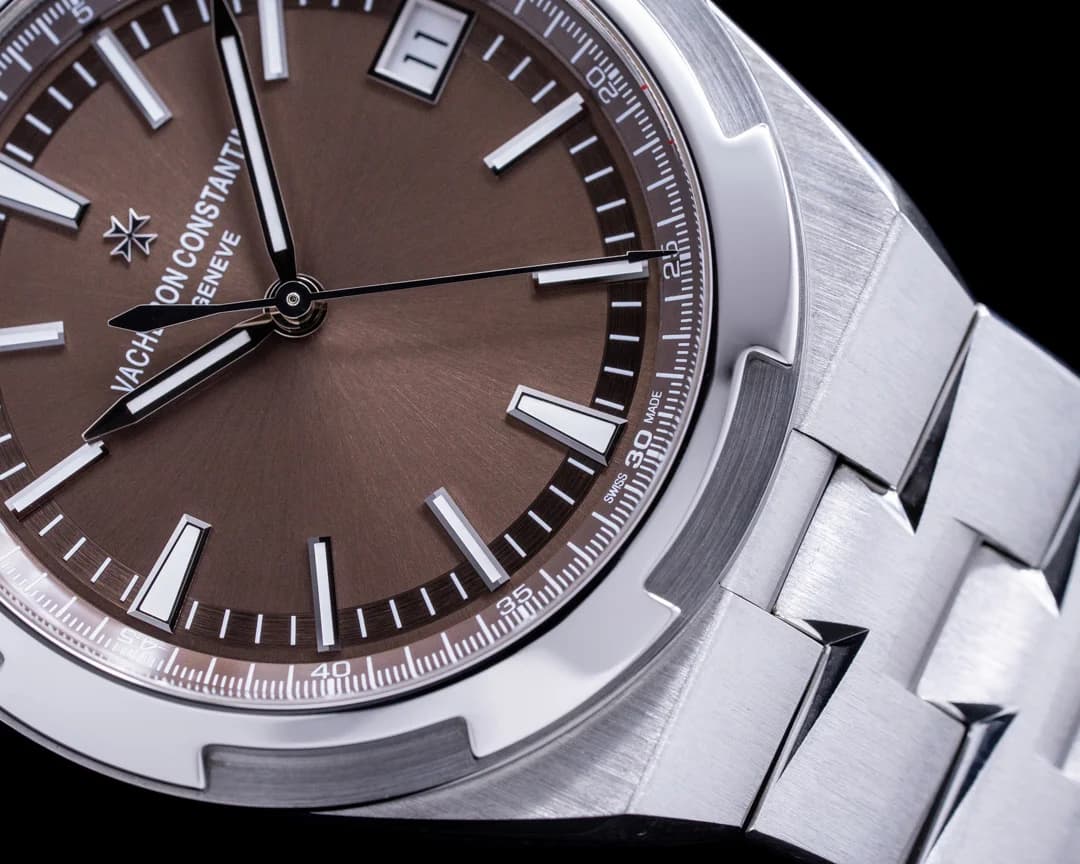
The symmetry of the dial is something else I appreciate. The applied white gold hour markers, the balanced layout, the date window at 3 that doesn't disrupt the visual flow. There's a harmony to the proportions that I find genuinely calming to look at. It doesn't try to be busy. It doesn't try to impress you with complications. It's a time-and-date watch from the oldest continuously operating watch manufacturer in the world, finished to one of the strictest standards in the industry, in a dial color that existed for roughly one year. Sometimes less really is more.
The Overseas is the most underrated member of the Holy Trinity sport watch trio, and I don't think that's even controversial at this point. It trades at the lowest It has the least brand recognition among the general public. It doesn't generate the waitlist frenzy of a Nautilus or the Instagram posts of a Royal Oak. But the finishing is at least equal, the movement is fully in-house with the strictest external certification, the strap system was first in its class, and the water resistance is the highest of the three. Serious collectors who already own a Royal Oak and a Nautilus often choose the Overseas as their third piece and end up wearing it the most. It's called the connoisseur's choice for a reason.
The Hallmark of Geneva certification is worth slowing down on because it is not well understood outside collector circles, and it is directly relevant to how the Overseas 4500V sits relative to its Holy Trinity competition. The Hallmark, formally called the Poincon de Geneve, is administered by the independent Bureau de Controle du Poincon de Geneve. It dates to 1886. To carry it, a watch must be assembled in the canton of Geneva, and the entire movement must meet strict standards covering finishing, materials, and construction. The certification also covers functional performance: accuracy testing, water resistance verification, and power reserve confirmation. An independent inspector seals the watch after verification. Vacheron has held the Hallmark since 1901, which is 125 years of continuous certification. The Patek Philippe Seal and the Rolex Superlative Chronometer are excellent internal standards. The Poincon de Geneve is an external standard, administered by a body that has no commercial relationship with the brand. Those are meaningfully different things, and the Overseas is the only Holy Trinity sport watch that carries it.
The 222 deserves a moment here because the Overseas doesn't exist without it, and most people who wear the 4500V have never seen one in person. Jorg Hysek's 1977 design for the 222nd anniversary of Vacheron is a genuinely beautiful object: 37mm, ultra-thin at 7.2mm, with the Caliber 1120 inside, which at 2.45mm is one of the thinnest automatic movements ever produced. It was made in relatively small numbers and has become increasingly sought after by collectors who understand its place in the lineage. The 222 sits at the origin of Vacheron's sport watch thinking, and the 4500V is the evolution of that thinking forty-seven years later. Vacheron chose to credit that heritage by carrying the Maltese cross motif forward rather than starting from scratch with a new identity. The cross in the bezel and the bracelet links is a quiet acknowledgment that this watch knows where it comes from.
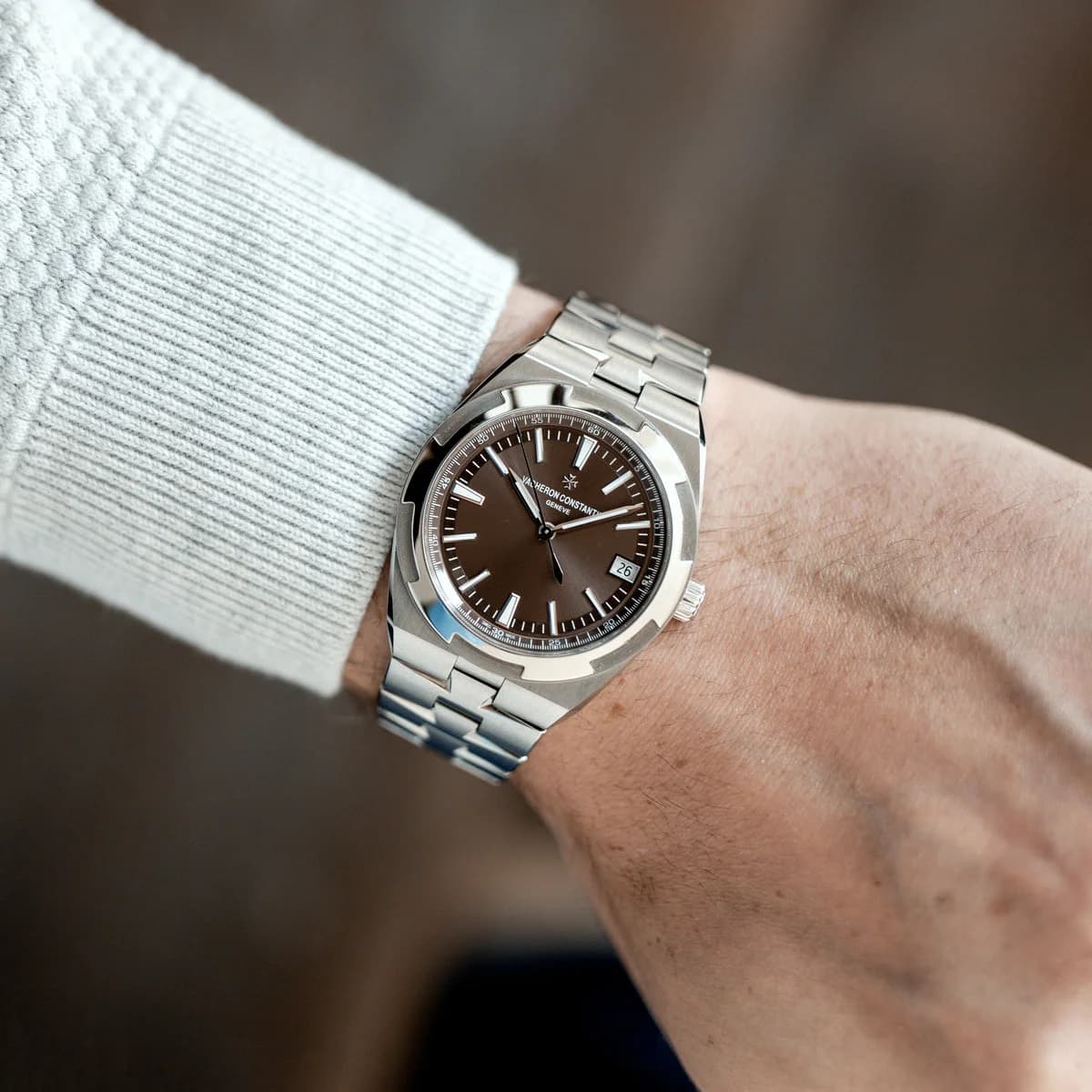
One practical note on the interchangeable strap system. The 4500V's three strap configurations span a wider range of contexts than the equivalent system on most competitors. The steel bracelet is the daily default: urban, precise, clean. The alligator on a deployant clasp is the dinner option, and the deployant matters here because a pin-and-buckle on a 41mm steel sport watch looks incongruous at a good table. The brown rubber on a deployant is where the Overseas does something I haven't seen done as well elsewhere. Brown rubber is unusual. Most rubber straps are black. Vacheron matched the strap color to the dial color in the brown-dial configuration, and the effect on the wrist is a color continuity from dial to strap that ties the whole look together. Flannel or tropical-weight gabardine with a brown dial Overseas on brown rubber is a combination that wears effortlessly. The fact that the entire swap takes ten seconds without tools means you actually do it, rather than thinking about it and leaving the bracelet on all week. That's the difference between a strap system that exists and one that gets used.
If there's a critique, it's the size for smaller wrists. At 41mm, some people with wrists under 6.5 inches might find it just a touch large in photos, though in person the integrated bracelet and short lug-to-lug tend to compensate. Vacheron has addressed this with smaller Overseas references, including the 37mm Ultra-Thin, but the 4500V remains the core of the collection and 41mm is where it lives. It's not a dealbreaker. It's just something to be aware of if you're considering it.
What stays with me about this watch is that it is a moment in time that most people missed. A Holy Trinity brand produced a brown sunburst dial for one year, nobody paid attention, and now everyone wants it back. That's watchmaking. The best pieces are often the ones that don't conform to what the market thinks it wants. Blue is safe. Black is expected. Brown is a statement of confidence, and it takes a certain eye to appreciate it. I think that's exactly the kind of person Vacheron Constantin has always made watches for.
Also in Haute Horlogerie