
Universal Geneve
Compax "Nina Rindt"
885103/02
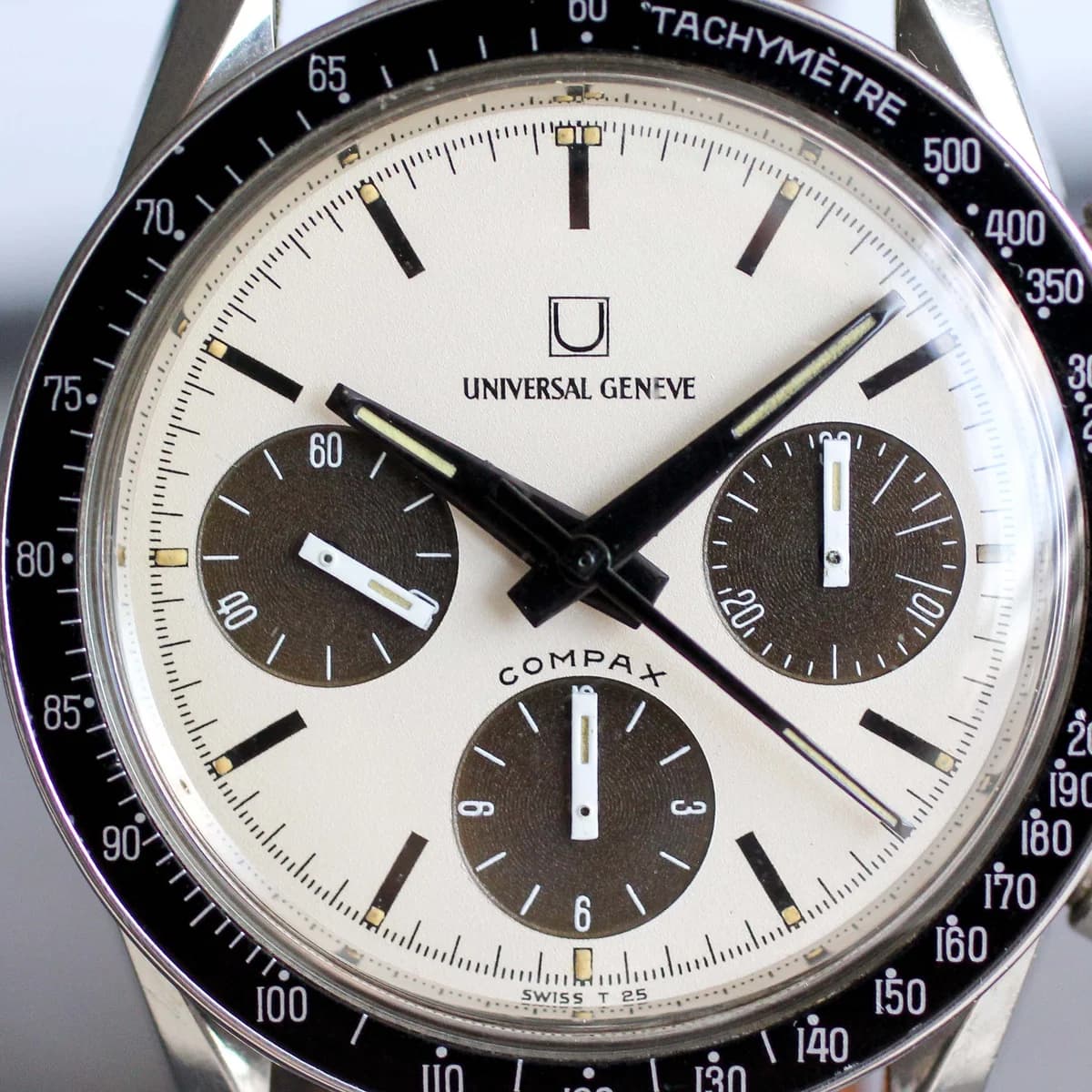
Every chronograph with three subdials follows a template that was invented in 1935 by a brand most people under 40 have never heard of. Look at a Rolex Daytona. Look at an Omega Speedmaster. Look at a Patek Philippe 5170. Three registers, twelve o'clock to six o'clock to nine o'clock, running seconds and chronograph minutes and elapsed hours. That layout, the one that defines what a modern chronograph looks like, started at Universal Geneve with a watch called the Compax. Before the Compax, chronograph wristwatches maxed out at 30 minutes of elapsed time. If whatever you were timing took longer than half an hour, you were out of luck. Universal Geneve added the 12-hour totalizer, the third register, and created the triple-register chronograph that every Swiss brand has been copying for ninety years. I love that this story starts not at Rolex, not at Omega, not at any of the brands that fill Instagram feeds today, but at a small factory in Geneva that most of the watch world has quietly forgotten.
Universal Geneve was founded on January 18, 1894 as Universal Watch in Le Locle, the same town where Zenith and Tissot built their reputations. The founders were two horology students named Ulysse Georges Perret and Numa-Emile Descombes. Descombes died just three years later at 34, but Perret kept going, eventually partnering with Louis Edouard Berthoud and moving the company to Geneva in 1919. The name officially changed to Universal Geneve in 1937. By then the brand was already deep into chronograph development. In 1934 they had introduced the Compur, a two-pusher chronograph that was the first movement ever fitted with two column wheels (Swiss patent no. 83340). The Compax followed in 1935, adding the 12-hour counter that changed everything. By 1944, they had the Tri-Compax with a triple-date calendar and moonphase. By 1945, the Dato-Compax and the Medico-Compax with a pulsometric scale for physicians. Universal Geneve was not just making chronographs. They were systematically building the entire vocabulary of what a chronograph wristwatch could do.
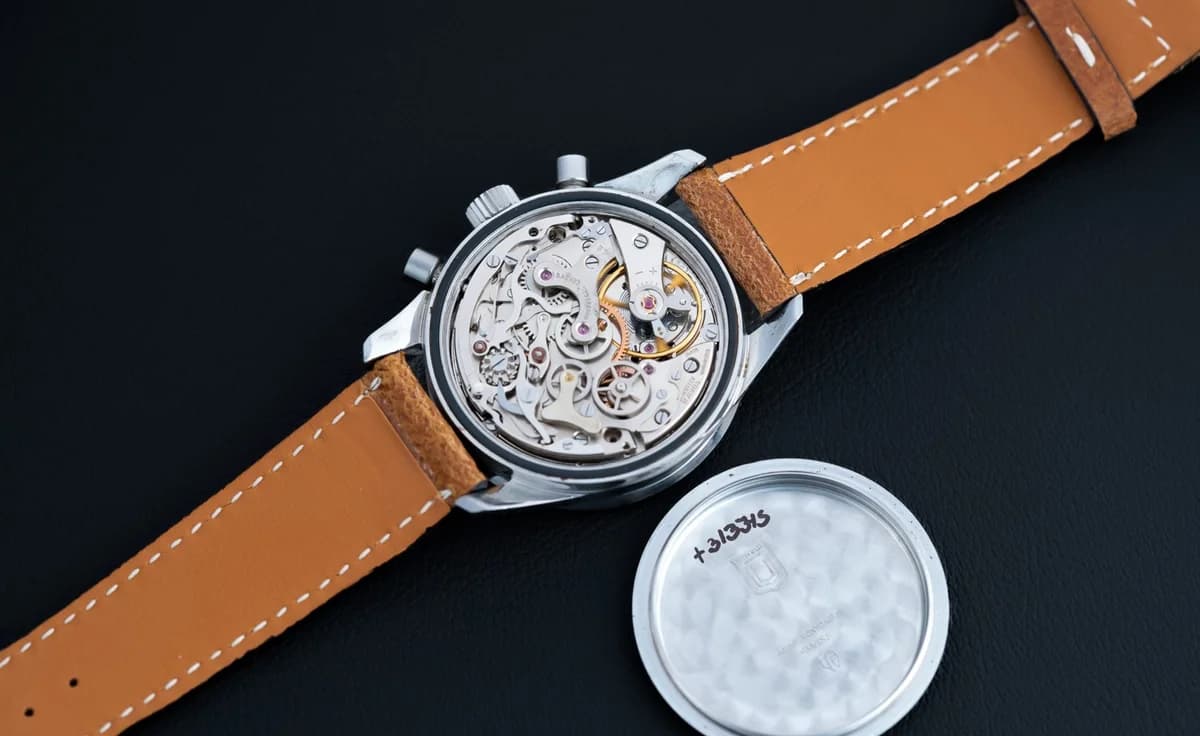
The Compax line used two different movement families over its lifetime. The earlier models ran the in-house Universal Geneve Caliber R72, based on the Valjoux 72, a column-wheel chronograph that the company manufactured with assistance from Martel Watch Co. It beat at 18,000 vibrations per hour, had 17 jewels, and came in variants for the Uni-Compax, Compax, and Tri-Compax. By the time the 885103 series arrived in the mid-1960s, Universal Geneve had switched to the Valjoux 72, one of the most celebrated chronograph movements in watchmaking history. The Valjoux 72 was a hand-winding, column-wheel chronograph with 17 jewels, beating at 18,000 vph with approximately 42 hours of power reserve. The movement measures 29.5mm in diameter and stands 6.95mm tall. Column wheel, not cam. That distinction matters. A column wheel uses a small rotating pillar to engage and disengage the chronograph mechanism, and the result is a smoother start-stop-reset action compared to the cam-operated alternative. The same Valjoux 72 powered the early Rolex Daytona (references 6239 through 6263), the Heuer Autavia, the Heuer Carrera, and the Breitling Navitimer. These are some of the most collectible chronographs ever made, and they all ran on the same movement that ticked inside the Nina Rindt.
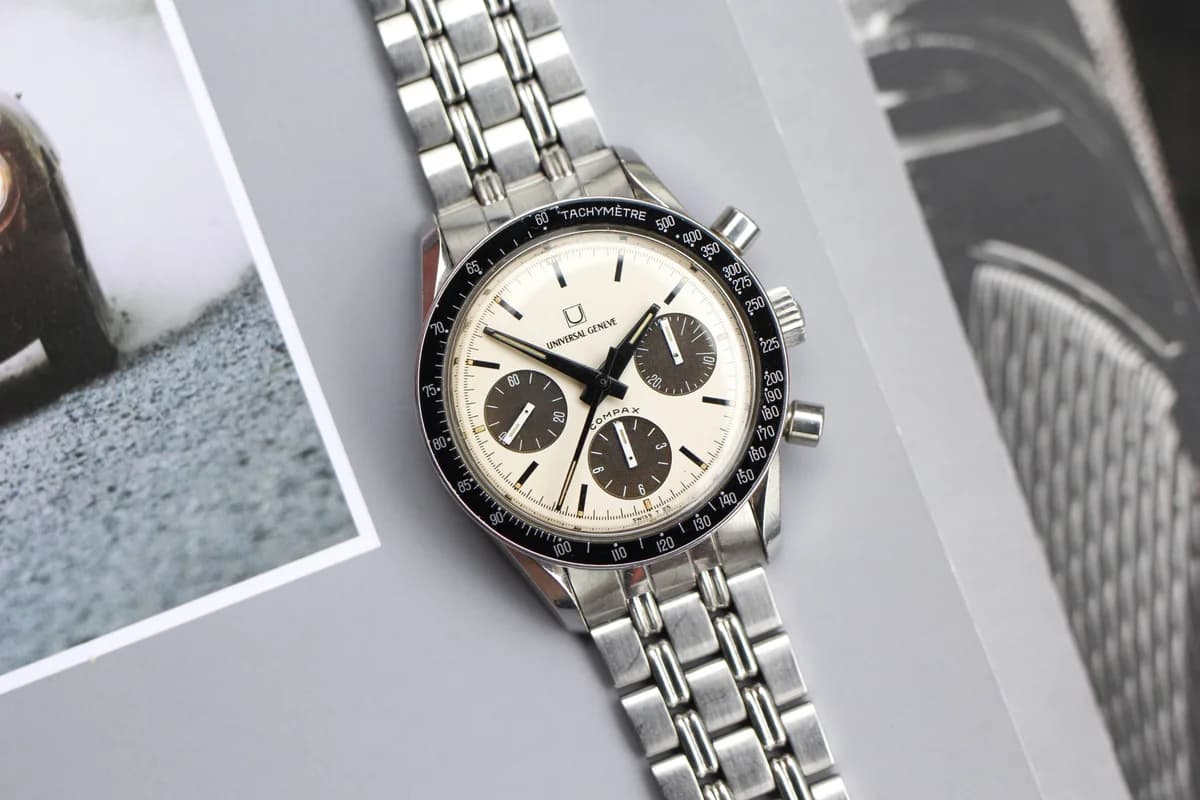
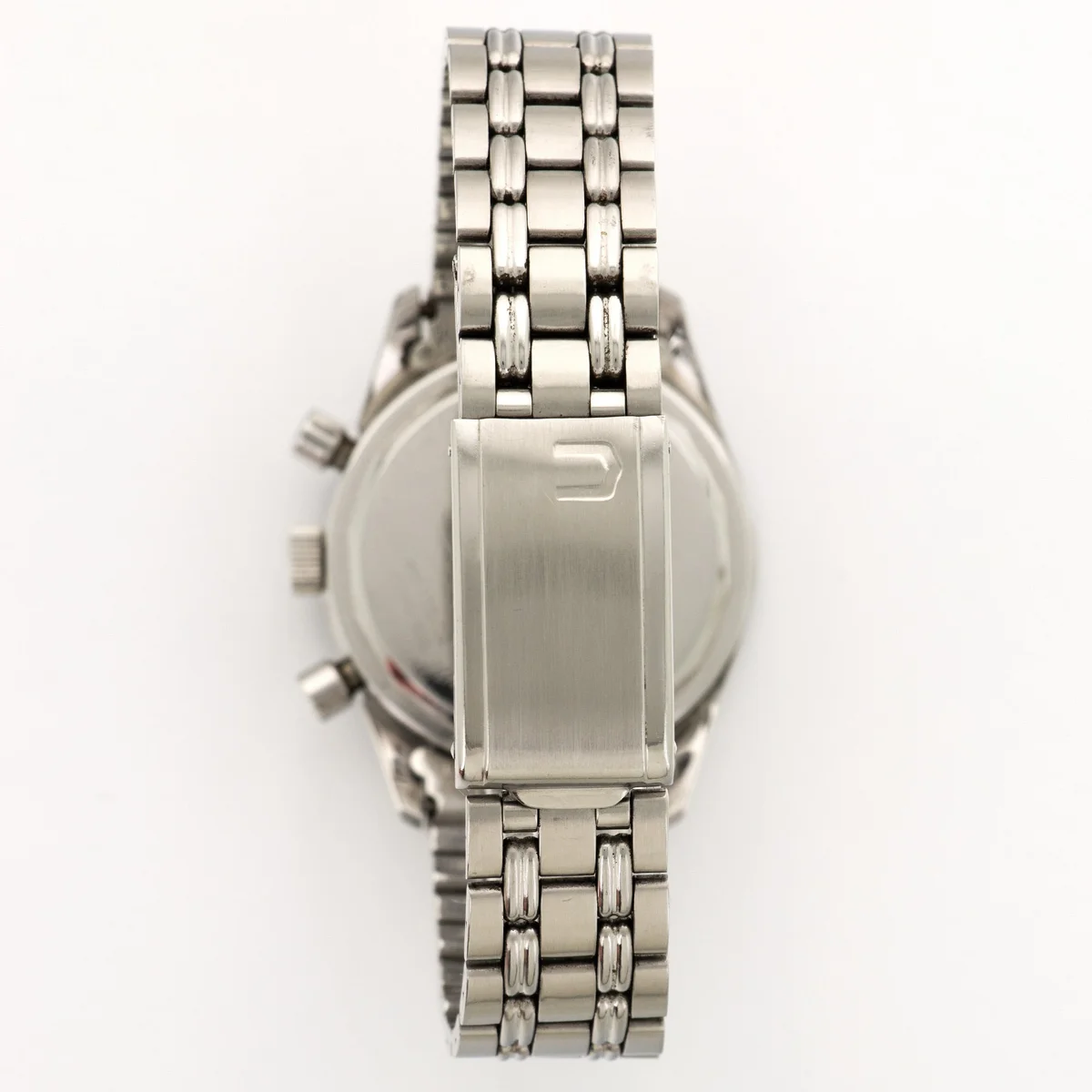
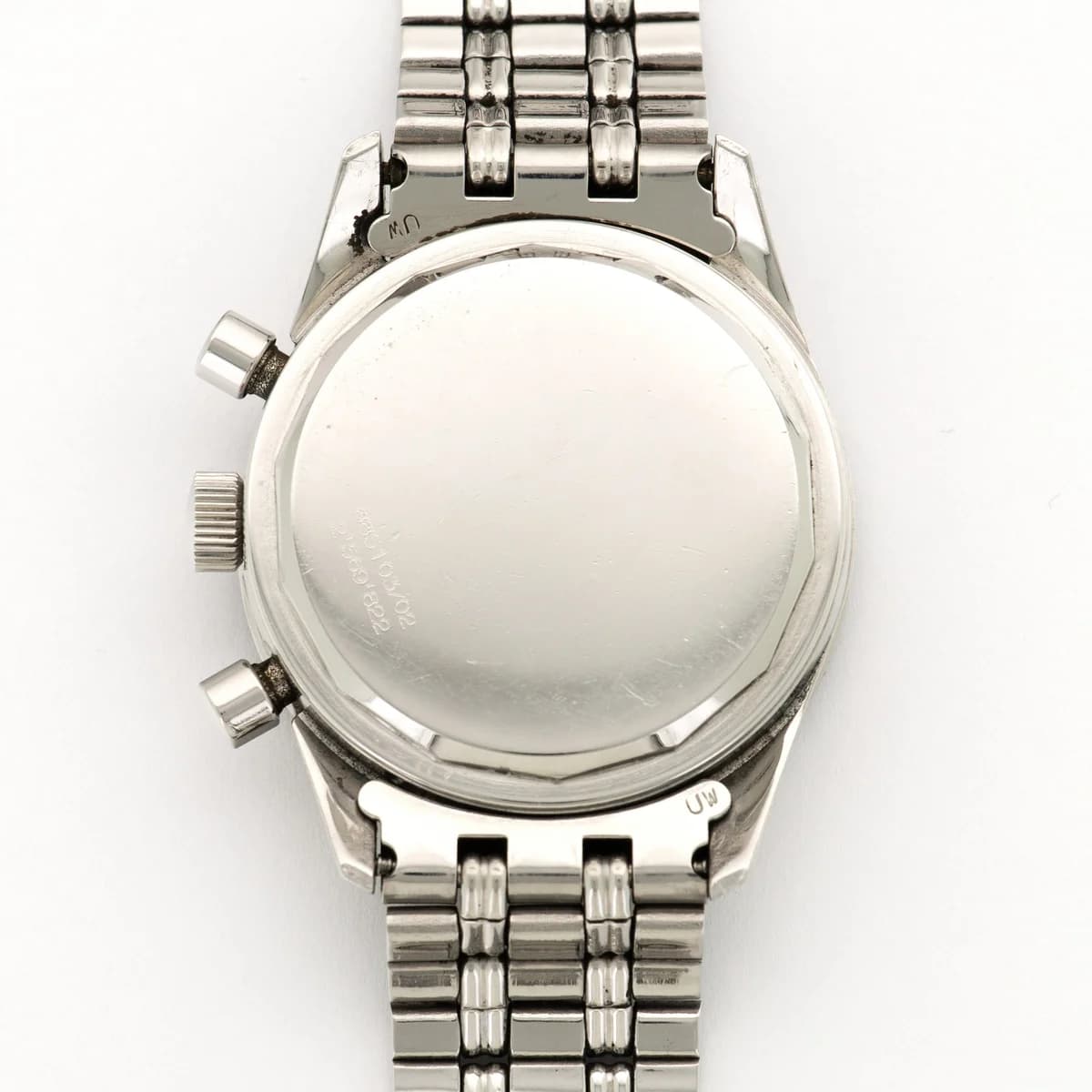
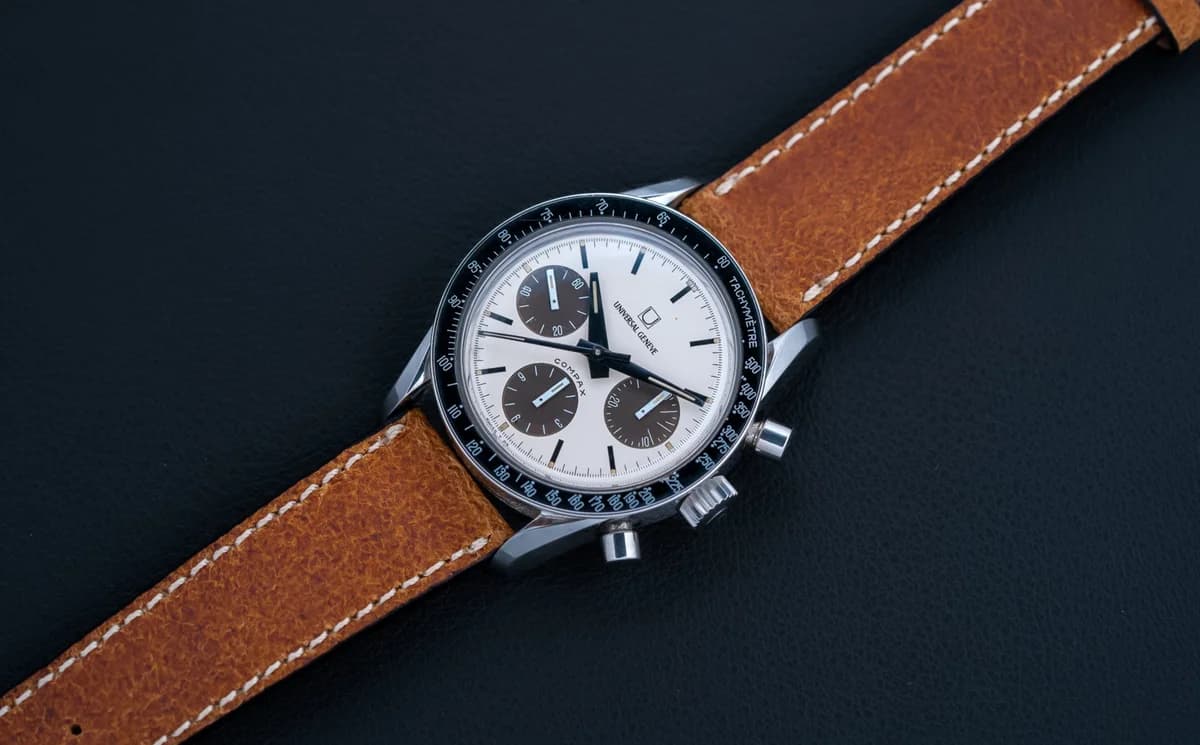
The reference 885103/02 was produced during a short window from 1964 to 1967. The case is stainless steel, 36mm in diameter with a thickness of approximately 12mm (including the plexiglass crystal), a lug-to-lug measurement of around 44mm, and a lug width of 19mm. By modern standards, 36mm is compact. But on the wrist, the lyre-shaped lugs and the tachymetric bezel give it a visual presence that belies the case diameter. The printed tachymeter scale on the bezel was not just decorative, it was functional for the racing drivers and enthusiasts who were the original audience for this watch. The plexiglass crystal is period-correct and part of the charm, though it scratches easily and needs occasional polishing with Polywatch or a similar acrylic polish. That is just the reality of vintage chronographs from this era. Hesalite on the Speedmaster, plexiglass on the Compax, acrylic on the Daytona. Nobody was using sapphire in the 1960s.
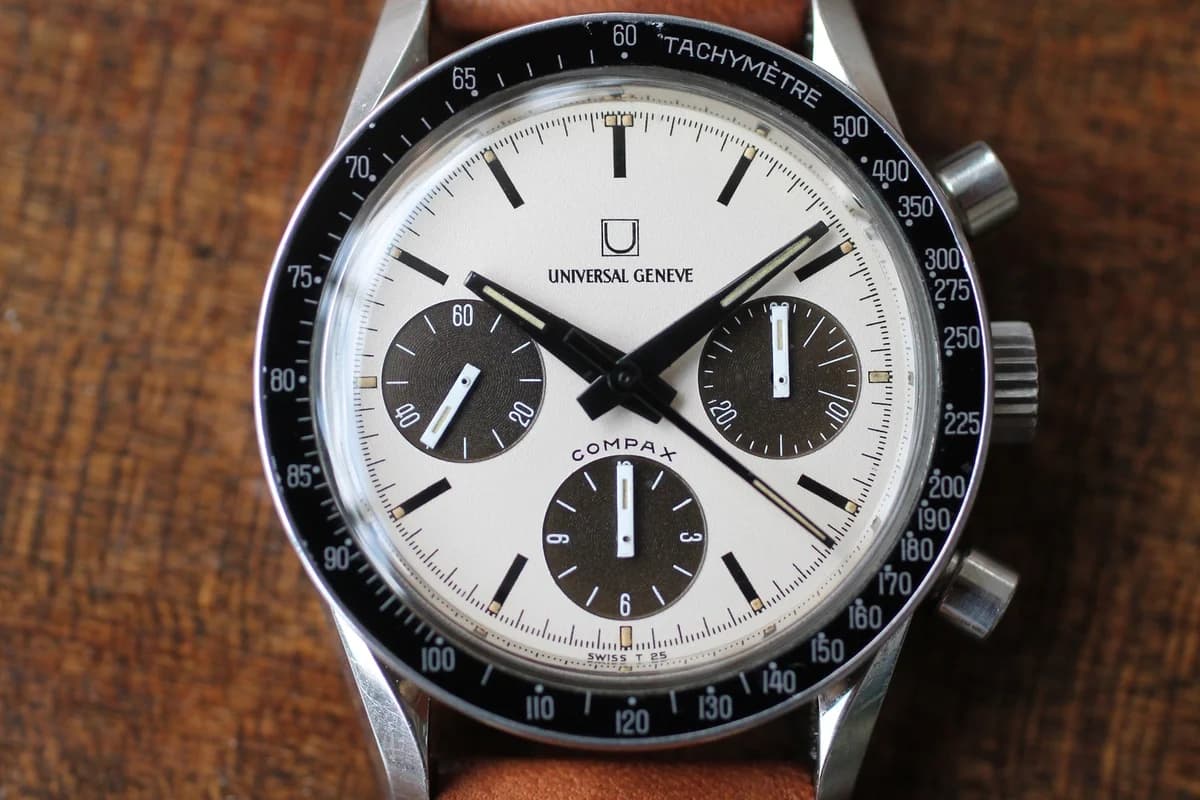
The dial on the 885103/02 is what collectors call a panda. White main dial, black subdials. Running seconds at nine, 30-minute counter at three, 12-hour counter at six. The contrast is striking and it makes the subdials legible at a glance, which is the entire point of a chronograph. There are two distinct production runs that collectors differentiate. The first execution has applied UG logos, glossy subdials, metallic hour and minute hands, and a blued steel chronograph hand. The second execution has printed logos, matte subdials that sometimes develop a beautiful tropical brown patina over the decades, and luminous-filled subdial hands. Transitional examples mixing characteristics from both executions show up in the market occasionally, adding another layer of complexity for collectors to obsess over. I appreciate that about vintage watches. Every dial tells a slightly different story about when exactly it left the factory and what happened to it in the sixty years since.
The watch gets its name from Nina Rindt, born Nina Lincoln in 1943 in Finland. Her father, Curt Lincoln, was a Finnish racing driver and tennis player who had represented Finland in the Davis Cup. Nina grew up around motorsport and competitive driving. She attended boarding school in Montreux, Switzerland, then started a course in haute couture in Brussels before abandoning it when her relationship with a young Austrian racing driver became serious. That driver was Jochen Rindt. They married in March 1967. Nina had been working as a fashion model in the 1960s, taking assignments in London, Paris, and New York. She became friends with Twiggy. She was beautiful, composed, and she understood the world of motor racing because she had literally grown up in it through her father.
Jochen Rindt was one of the most naturally talented drivers in Formula One history, and his story is inseparable from the watch. Born on April 18, 1942 in Mainz, Germany, orphaned as a baby when his parents were killed in a bombing raid during the war, and raised by his grandparents in Graz, Austria. He raced in Formula One from 1964 to 1970, driving for Cooper and then Lotus. He won five of the first nine races in the 1970 season, building what should have been an unassailable championship lead. Then on September 5, 1970, during practice for the Italian Grand Prix at Monza, the right front brake shaft on his Lotus 72 failed as he was braking for the Parabolica curve. The car had been running without rear wings that weekend to reduce drag on the high-speed Monza circuit. The Lotus veered left and struck a poorly installed guardrail. Jochen Rindt was 28 years old. He was pronounced dead on the way to the hospital. No other driver caught his points total for the remainder of the season, so Jochen Rindt became the only posthumous World Drivers' Champion in Formula One history. It is the saddest record in the sport.
Nina was at Monza that day. The photographs of her at various Grand Prix events, wearing a panda-dial Compax on a wide brown bund strap, became iconic images in both motorsport and watch collecting. Jochen had given her the watch. The bund strap was practical (it kept the steel caseback from getting sweaty on the skin in the heat of a Mediterranean racetrack), but the visual effect was something else entirely. A fashion model wearing a tool chronograph at a Formula One circuit, casual and confident, timing laps for her husband. It was the intersection of motorsport glamour and genuine function, and it happened years before the collector market had any concept of what these watches would come to represent. The nickname came later, but the image that created it is unforgettable.
The 885103 family has several dial variants beyond the panda. The 885103/01 is called the Evil Nina, a reverse panda with a matte black dial, white subdials, and a bright red center chronograph hand. The color scheme is darker, more dramatic, and the red hand gives it a personality that the panda does not have. There are also the Exotic Nina and Blue Exotic Nina variants with silver and blue dial configurations. And then there are the tropical dials, where the original black finish has deteriorated over the decades into a rich chocolate brown. Fewer than ten tropical Evil Nina examples are known to exist. For me, the original panda on the 885103/02 is the one. That white dial with the three black registers is the clearest, most legible chronograph layout I have seen on any vintage watch. The contrast works at arm's length. The proportions are balanced. There is a reason every chronograph maker since 1935 has been trying to get this right, and I think Universal Geneve nailed it on the first attempt.
What happened to Universal Geneve as a company is one of the great tragedies in Swiss watchmaking. In the late 1960s and early 1970s, the brand was acquired by Bulova. Then the quartz crisis hit. Then in 1989, the Hong Kong-based Stelux Holdings International bought the brand and effectively left it dormant. For decades, Universal Geneve existed only as a trademark owned by a holding company in Asia while the watchmaking world moved on. The Polerouter, the Compax, the Tri-Compax, all of these landmark watches gathered dust in vintage shops and auction catalogs while the brand that created them sat idle. I find it genuinely painful. A company that invented the triple-register chronograph layout, that built the first wristwatch chronograph as far back as 1917, that counted Harry Truman and Eric Clapton among its wearers, reduced to a dormant name in a holding company's portfolio. That is what happens when a watch brand loses control of its own destiny.
In 2023, Partners Group and CVC Capital Partners (the same firms that own Breitling) acquired Universal Geneve with the explicit intention of relaunching the brand. Georges Kern, the CEO of Breitling, has been leading the revival. In late 2025, Universal Geneve released the Tribute to Compax, a collection directly inspired by the Nina Rindt, offered as ultra-exclusive sets in 18K white gold and 18K red gold at 36mm. These tribute pieces use restored original Caliber 281 movements from the Compax era, which is a remarkable detail. They won the Revolution Award for Best Revival Watch in 2025. The full relaunch includes the Polerouter, the Cabriolet, and a new collection called the Disco Mini. Whether this revival will succeed in a crowded luxury market remains to be seen, but the pedigree is undeniable. The story is there. The designs are there. The question is whether a new generation of collectors will care about the brand the way the vintage community always has.
On February 7, 2014, Hodinkee published a profile of the Nina Rindt Compax that changed the market overnight. Before that article, good examples traded in the low four figures. Within months, the watch featured in the article itself sold for multiples of its previous value through Analog Shift. By December 2015, a Nina Rindt hammered at Christie's for a sum that would have been unthinkable two years earlier. The Hodinkee effect is real, and the Nina Rindt is one of the most dramatic examples of it. A single well-researched article with beautiful photography took a watch that was known mainly to a small community of Universal Geneve enthusiasts and turned it into one of the most coveted vintage chronographs in the market. I think about that when I see people dismiss watch journalism as irrelevant. One article. One day in February 2014. And the entire market moved.
Here is my honest critique. The Valjoux 72 is a wonderful movement, a genuine column-wheel chronograph that powers some of the greatest watches ever made. But it is a purchased caliber, not an in-house one. Universal Geneve's own Caliber 281 family was the heart of the earlier Compax models, and I wish the 885103 had kept it. When the same movement sits inside a Rolex Daytona, a Heuer Carrera, and a Universal Geneve Compax, the movement itself is not what differentiates them. The case design, the dial, the brand story, those are what make the Nina Rindt special. Not the engine. I also wish the production run had been longer than three years. The short 1964 to 1967 window means original examples are genuinely scarce, and scarcity in vintage watches cuts both ways. It makes them collectible, but it also means many people who want one will never find a good example at any reasonable level. The 36mm case size will also feel small to collectors who are accustomed to modern 40 to 42mm chronographs, though I personally think 36mm is where vintage chronographs look their best. It is confident without being loud.
At 36mm, the Nina Rindt is a watch that disappears under a cuff in the best possible way. It sits flat on the wrist, the lyre lugs follow the wrist curve naturally, and the whole package weighs next to nothing compared to a modern steel chronograph. On my 6.5-inch wrist, 36mm vintage chronographs wear perfectly. They look proportional, they sit comfortably, and they pair with everything from an Isaia suit jacket to a rolled linen shirt without looking either overdressed or underdressed. The warm cream tones that develop on the white dial over decades play beautifully against darker skin tones, and the steel case is neutral enough to work with any metal in your wardrobe. I appreciate a watch that does not demand attention but rewards it when someone looks closely.
The plexiglass crystal is another practical consideration. It scratches easily. It develops a cloudy haze over time. Unlike sapphire, which resists everything short of a diamond, plexiglass picks up marks from brushing against a shirt cuff. The upside is that it is cheap and easy to replace, and there is something about the way plexiglass sits slightly domed over the dial, catching light in a warmer way than the flat precision of sapphire. Speedmaster purists debate hesalite versus sapphire endlessly, and the same conversation applies here. The original material is part of the character. Replacing it with sapphire would be technically superior and aesthetically wrong.
The Nina Rindt sits differently from most watches I think about. It is not about specifications or engineering superlatives. It is about a moment in time. A Finnish model at a racetrack in the late 1960s. A watch that her husband gave her. A husband who became the only posthumous world champion in the history of his sport. The intersection of motorsport, fashion, love, and loss, all sitting on a 36mm steel case with a panda dial and a column-wheel chronograph beating at 18,000 vibrations per hour inside. Universal Geneve created the template that the entire chronograph industry followed, and this particular reference, the one Nina wore, is the version that transcended the category. It stopped being just a watch. Somewhere between a pit lane at Monza and a Hodinkee article in February 2014, it became one of the most important chronographs ever made. And the brand that made it is finally, after decades in the dark, getting a second chance to tell its own story.
Also in Sport Chronographs & GMT