
Omega
Speedmaster Moonwatch Professional
310.30.42.50.01.001
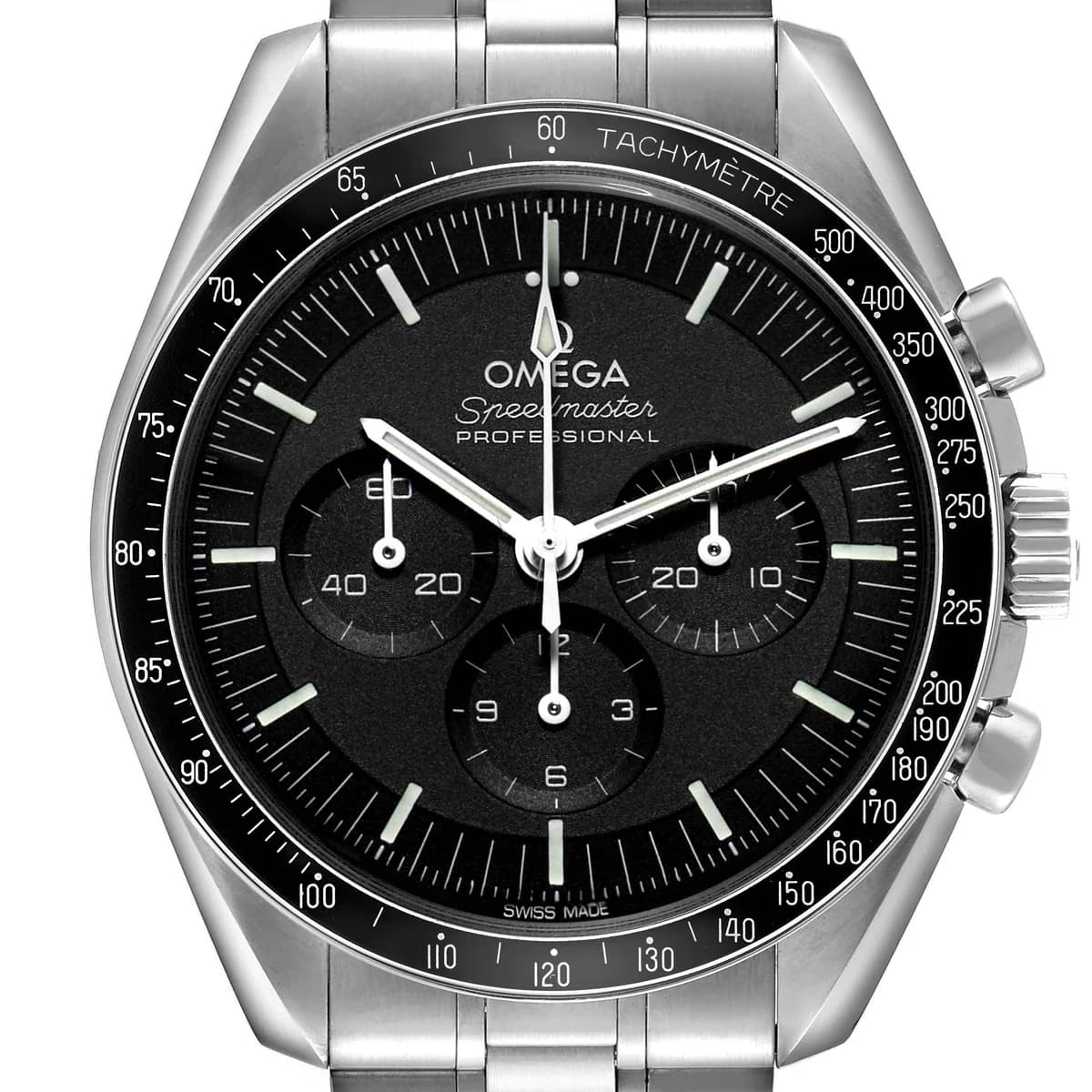
On July 20, 1969, Buzz Aldrin stepped onto the surface of the moon wearing an Omega Speedmaster Professional on his wrist. Neil Armstrong had left his inside the Lunar Module as a backup to the onboard electronic timer. That single event made the Speedmaster the most famous watch in history. Not the most expensive. Not the most complicated. The most famous. No other watch has a story that compares. The Submariner has Bond. The Speedmaster has the moon.
But the Speedmaster did not start as a space watch. It started as a racing chronograph. In 1957, Omega introduced the first Speedmaster as reference CK2915, powered by the Caliber 321 and fitted with a tachymeter bezel for calculating speed over a measured distance. The 321 was not even an Omega-designed movement. It was based on the Lemania 2310, developed in the 1940s by a watchmaker named Albert Piguet at Lemania, which was part of the same corporate family as Omega under SSIH (Societe Suisse pour l'Industrie Horlogere). The movement was a column-wheel chronograph beating at 18,000 vibrations per hour, and it turned out to be one of the most reliable chronograph calibers ever produced. Nobody at Omega in 1957 was thinking about space. They were thinking about the racetrack and the timing needs of motorsport. The original CK2915 had broad arrow hands and a tachymeter scale on the bezel, both designed for professional use. The fact that the same movement would later survive NASA's most punishing tests is the kind of engineering serendipity that you cannot plan for. I appreciate that about the Speedmaster's origin story. It was not designed for glory. It was designed for a job, and the engineering happened to be good enough for a much bigger one.
The Speedmaster's relationship with space began almost by accident. On October 3, 1962, astronaut Wally Schirra orbited the Earth six times aboard Mercury-Atlas 8 wearing his personal Speedmaster, a reference CK2998 that he had purchased himself. It was not issued by NASA. It was not part of any official flight equipment protocol. Schirra just liked the watch. That nine-hour flight made the Speedmaster the first Omega in space, three years before NASA would formally qualify any wristwatch for spaceflight. Then in June 1965, Ed White performed the first American extravehicular activity during the Gemini 4 mission with a Speedmaster reference 105.003 strapped to the outside of his spacesuit on a long nylon strap secured with Velcro. The watch could not fit under the suit, so it went over it, fully exposed to the vacuum and thermal extremes of low Earth orbit. It survived. The photograph of White floating in space with the Speedmaster visible on his wrist became one of the defining images of the early space program.
NASA did not choose the Speedmaster because Omega had the best marketing department. They chose it because it survived. In March 1965, NASA's Manned Spacecraft Center in Houston conducted eleven qualification tests on chronographs from multiple manufacturers. The testing was designed to simulate conditions far beyond what any watch would actually face in space, building in margins of safety that bordered on sadistic. Temperature cycling from minus 18 degrees Celsius to 93 degrees Celsius. Sustained exposure at 93 degrees for 30 minutes. Humidity at 95 percent and 38 degrees Celsius for 240 hours straight. Shock at 40G with an 11 millisecond duration in six different orientations. Vibration. Vacuum at near-zero pressure. High-pressure pure oxygen environments. Decompression. The Speedmaster was the only watch that passed every single test without failure. The others stopped, fogged, or lost timekeeping accuracy. The Speedmaster just kept running. James Ragan, the NASA engineer who oversaw the testing program, would later become one of the most important advocates for mechanical wristwatches in the space program, ensuring that astronauts always had an analog backup independent of the spacecraft's electrical systems.
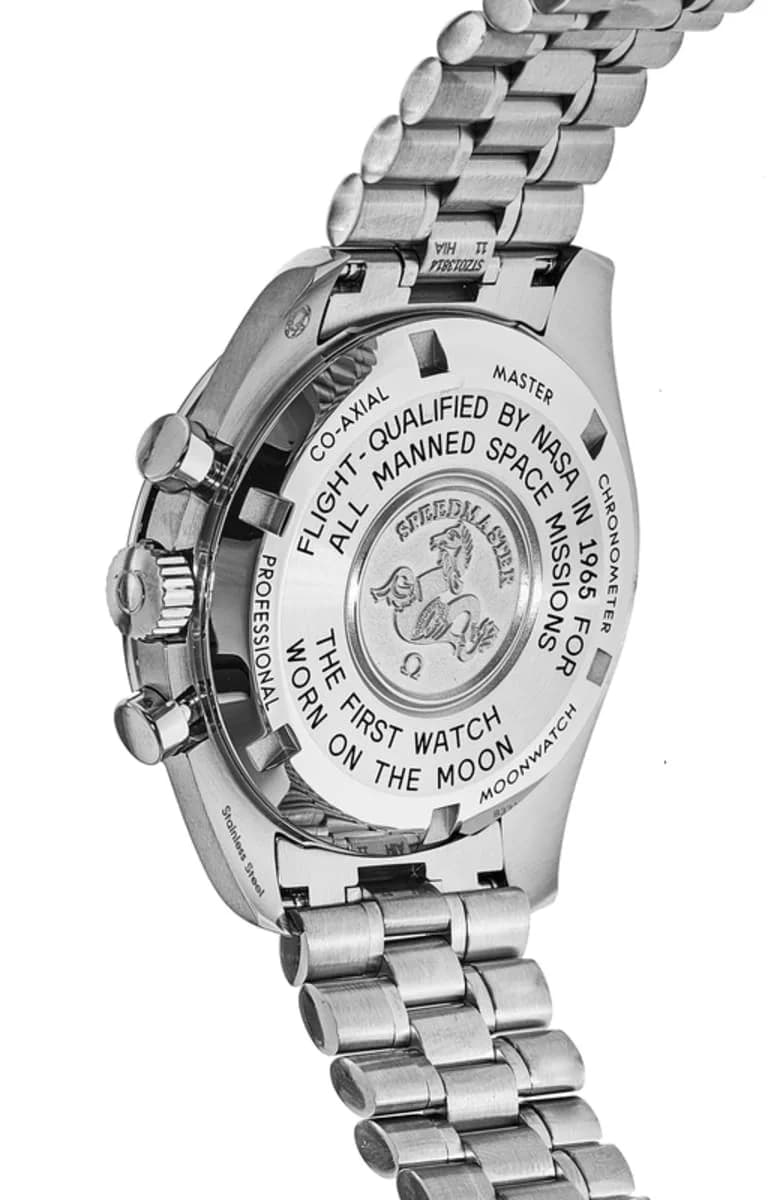
The Apollo 13 mission in April 1970 proved Ragan right. After an oxygen tank explosion crippled the spacecraft, the crew had to shut down the onboard guidance computer to conserve battery power for reentry. They needed to perform a critical 14-second engine burn using the Lunar Module's descent propulsion system to correct their trajectory, and they needed to time it manually. Jack Swigert used Jim Lovell's Speedmaster to time that burn. They chose Lovell's watch because it was the most recently serviced chronograph among the three crew watches, and they trusted its accuracy the most. Fourteen seconds. Timed on a wristwatch. In a freezing, dark spacecraft hurtling around the far side of the moon. The burn worked. The crew came home. NASA later presented Omega with the Silver Snoopy Award, the agency's highest honor for contributions to mission safety.
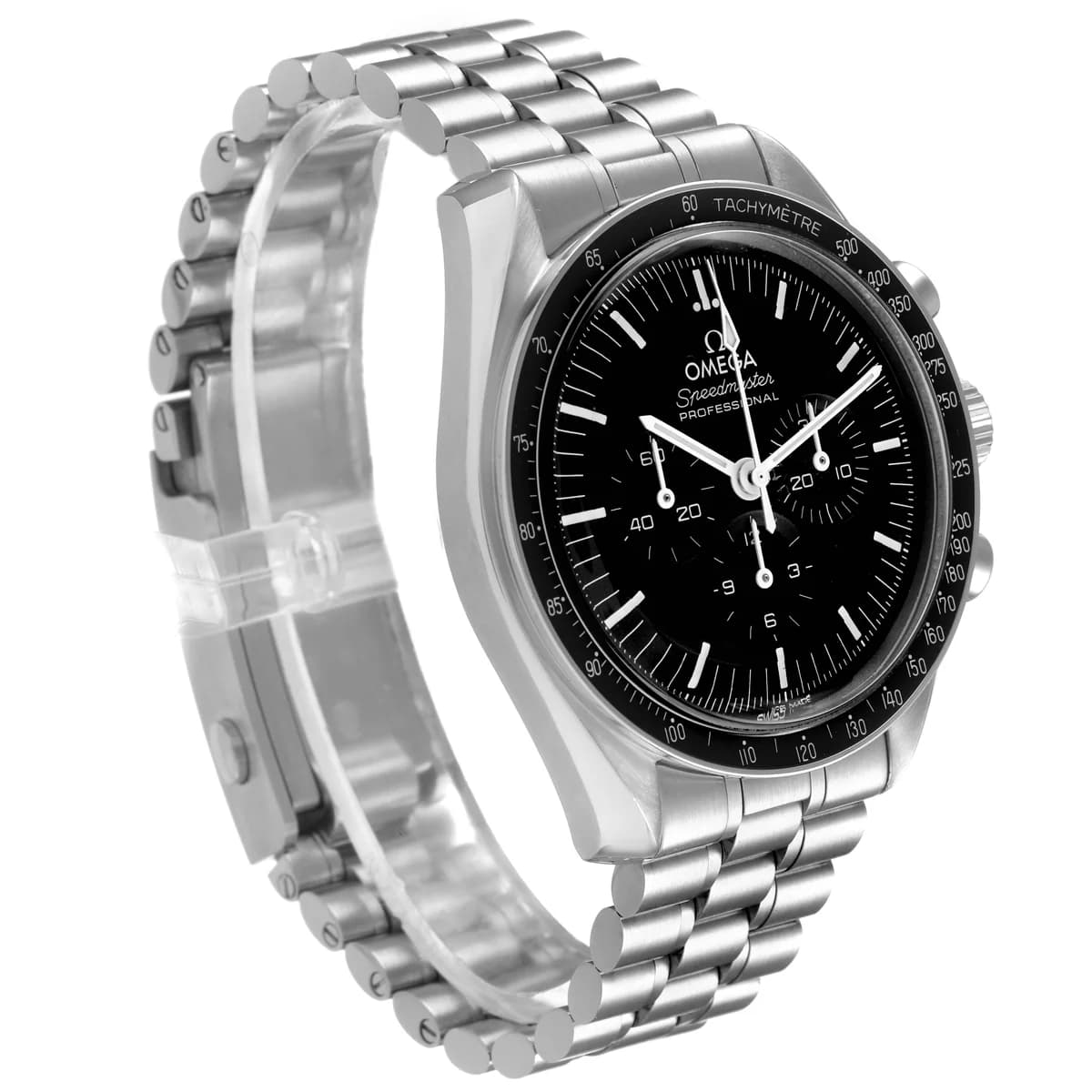
The movement inside the Speedmaster has evolved four times across nearly seven decades, and tracking that lineage is one of the things I find genuinely fascinating about this watch. The original Caliber 321 ran from the CK2915 in 1957 through the references that went to the moon. It was a column-wheel chronograph, the type of switching mechanism considered the gold standard for smooth pusher feel and precise engagement. In 1968, Omega replaced the 321 with the Caliber 861 in the new reference 145.022. The 861 swapped the column wheel for a less expensive cam-lever switching mechanism, which was simpler to manufacture and service. It also increased the beat rate from 18,000 to 21,600 vibrations per hour, improving the chronograph's timing resolution from one-fifth of a second to one-sixth. The 861 is the movement that flew on more space missions than any other. In 1996, Omega updated the 861 to the Caliber 1861, with the primary change being rhodium-plated bridges and parts instead of the copper-plated finish of the 861. The architecture remained largely the same.
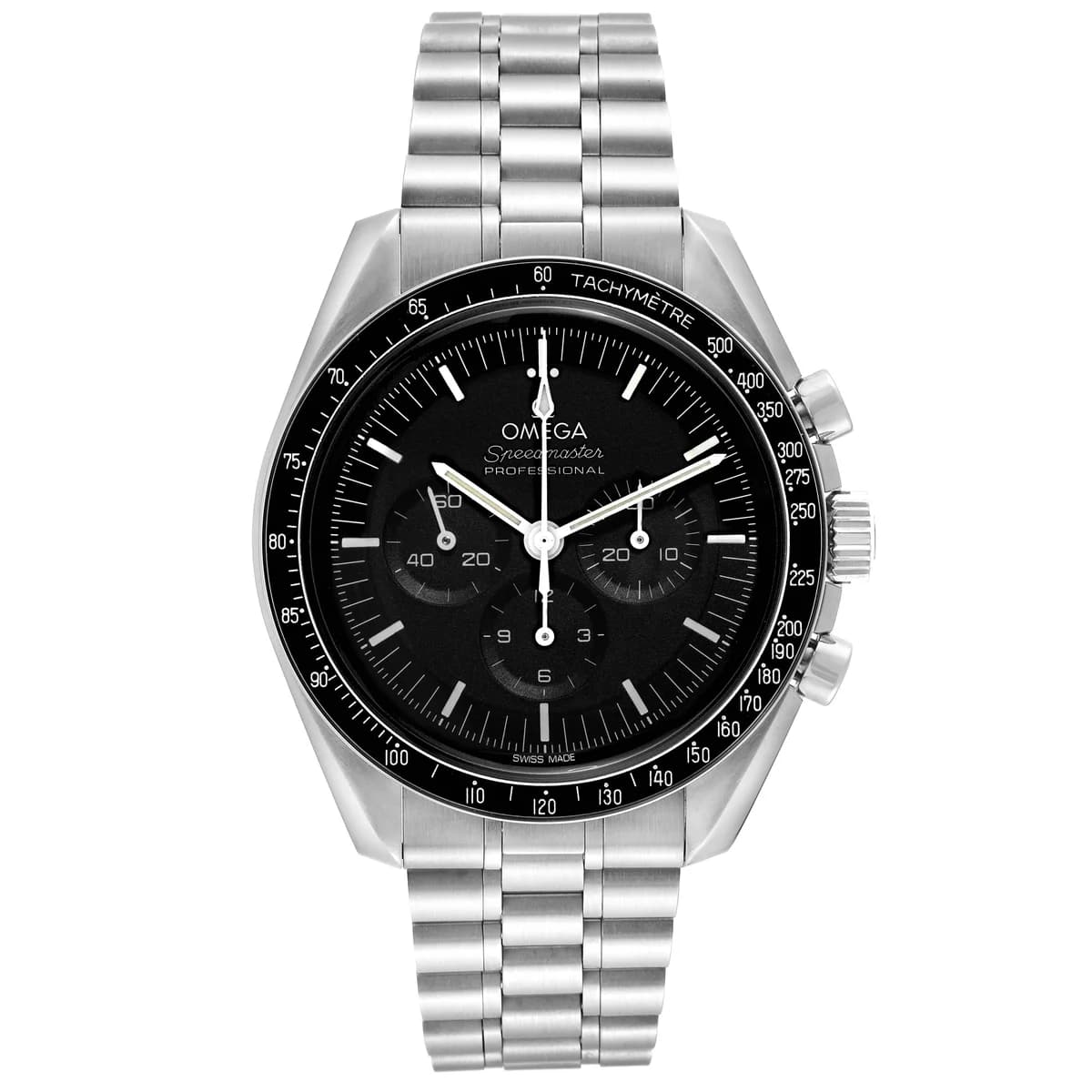
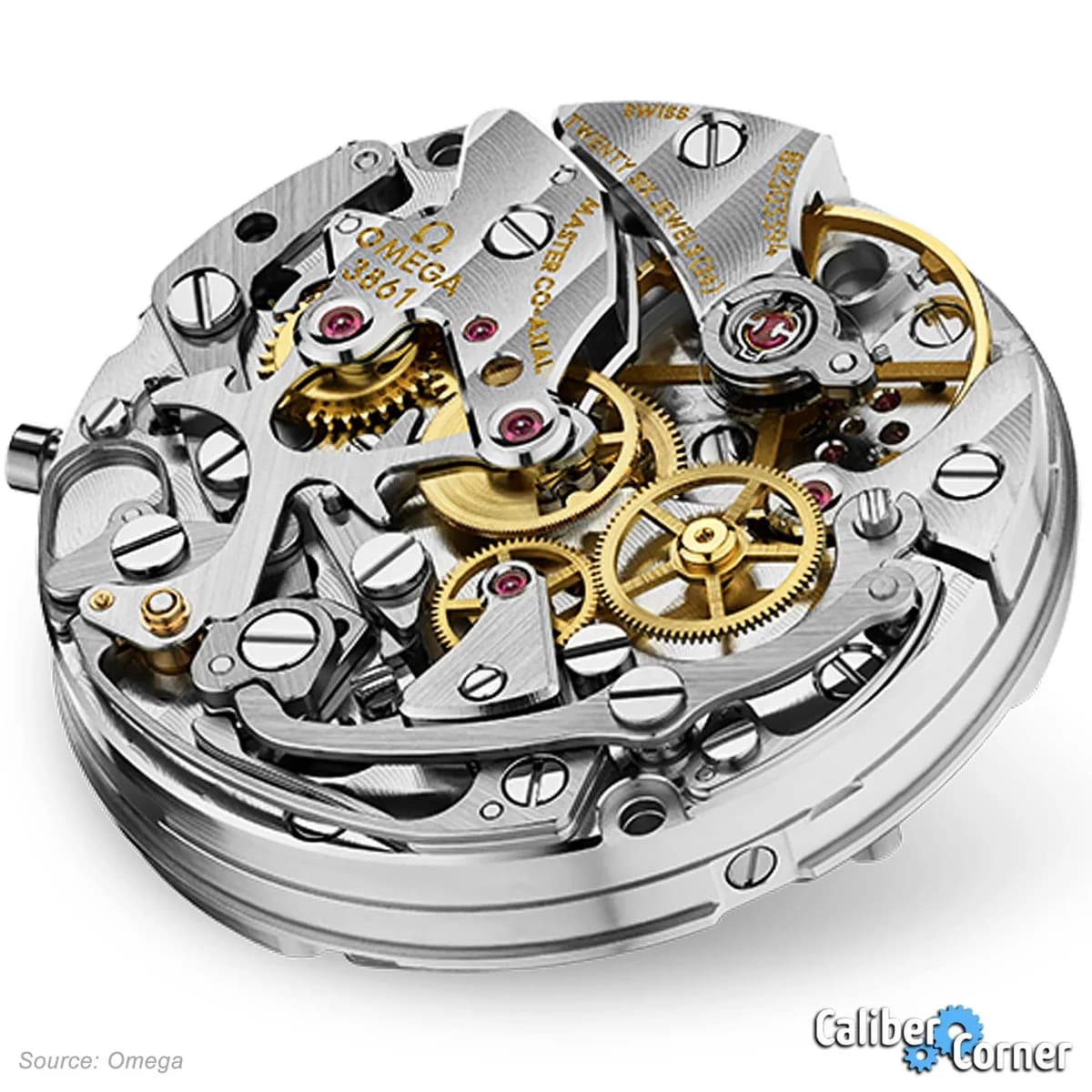
The current Moonwatch Professional runs the Caliber 3861, introduced in January 2021. This is where Omega made the most meaningful technical leap in the Speedmaster's history. The 3861 adds Omega's co-axial escapement, developed by the legendary George Daniels and adopted by Omega in the late 1990s. The co-axial escapement reduces friction at the contact surfaces between the escapement wheel and pallet fork, which means less lubricant degradation over time and longer service intervals. The 3861 also uses a Si14 silicon balance spring, which is antimagnetic, impervious to temperature variations, and immune to the effects of shock on the hairspring's geometry. That silicon balance spring is what earns the 15,000 gauss magnetic resistance rating. For perspective, the old 1861 had no particular magnetic resistance. Set it next to a laptop speaker or a magnetic phone mount and it could be affected. The 3861 is essentially unbothered by any magnetic field you would encounter in daily life. Master Chronometer certification from METAS means the watch is tested on the wrist, after casing, to a standard of 0 to plus 5 seconds per day. That is tighter than COSC, which tests the bare movement. 26 jewels. 21,600 vibrations per hour, same as the 861 and 1861. 50 hours of power reserve. Hand-wound, not automatic. That is a deliberate choice. The original was hand-wound and the Moonwatch stays hand-wound.
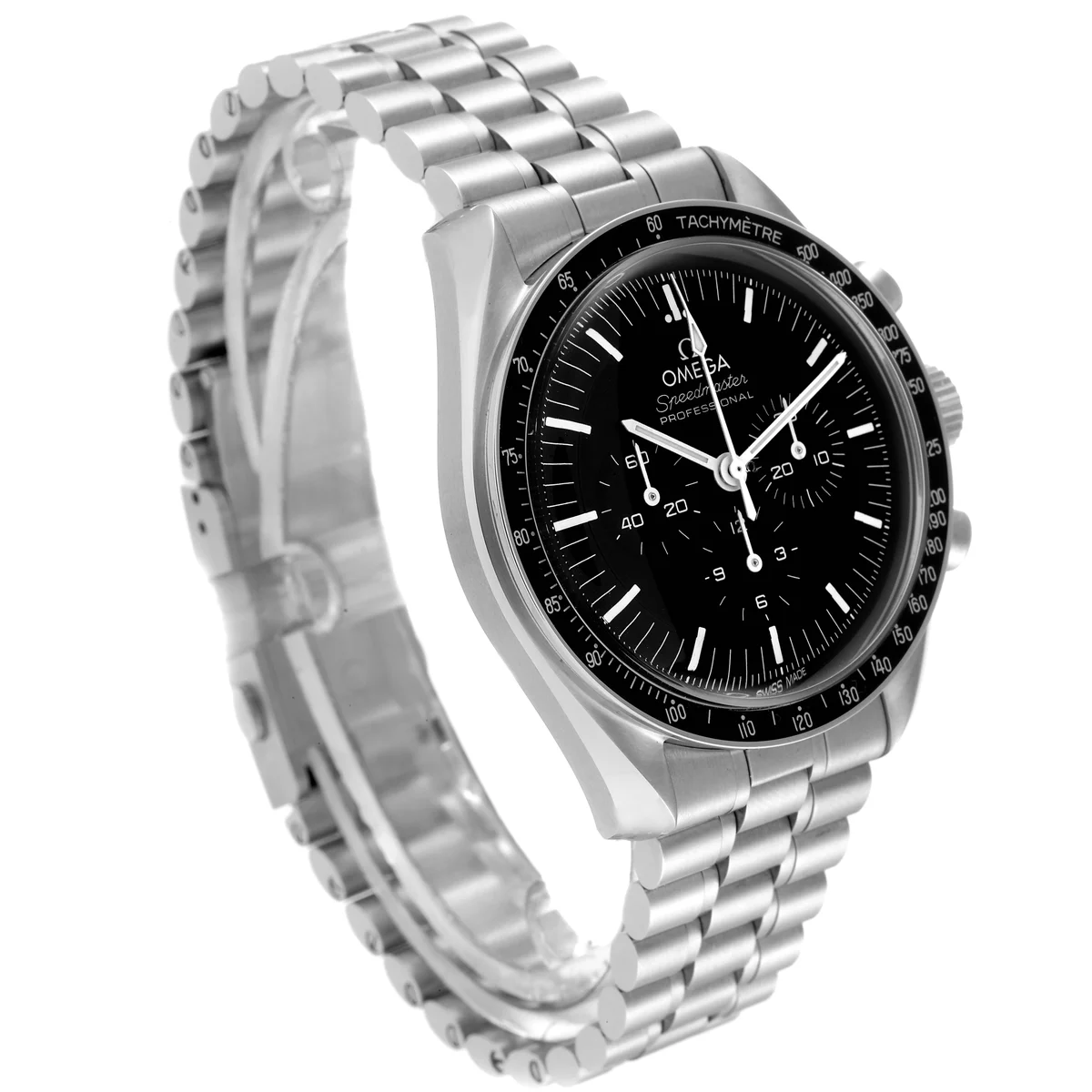
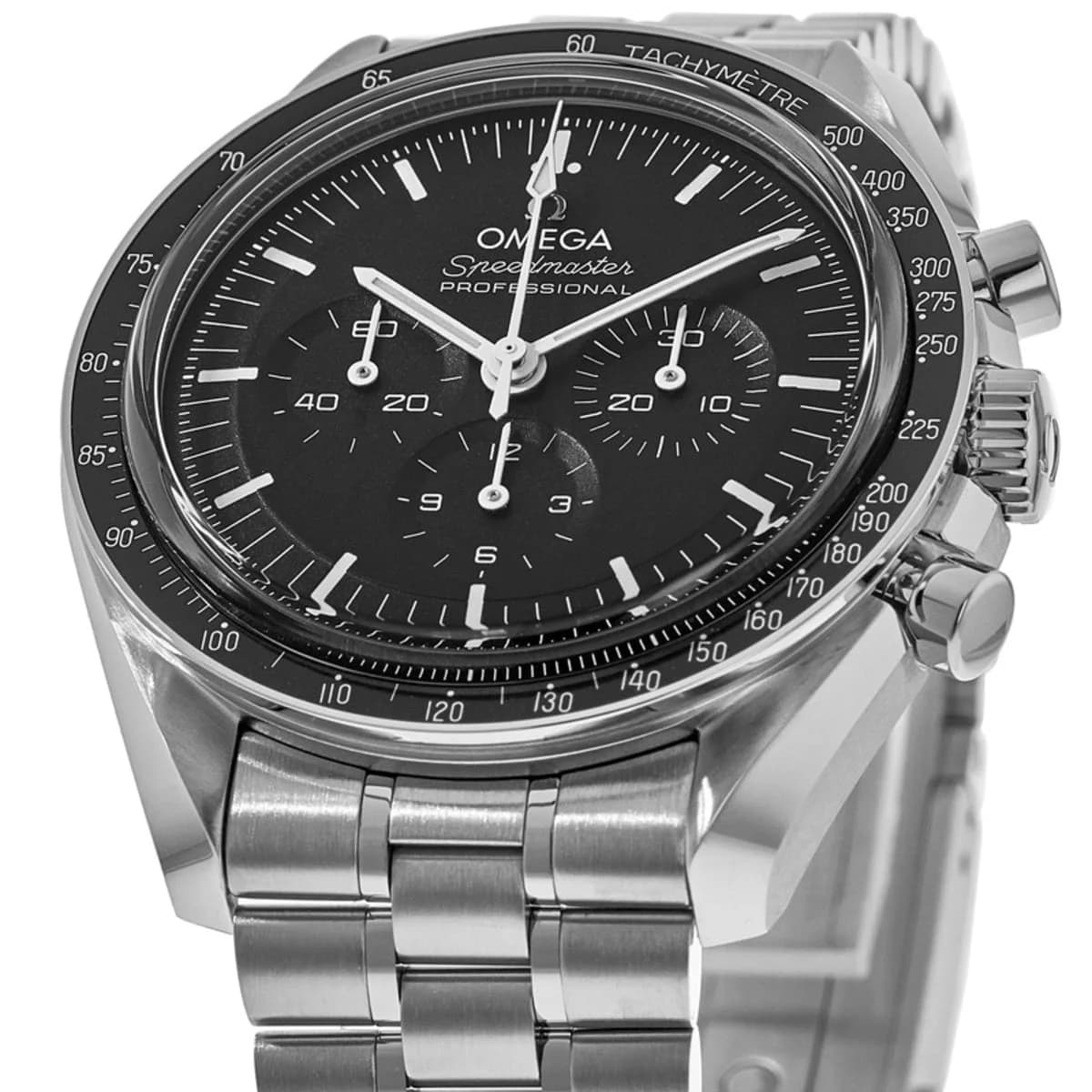
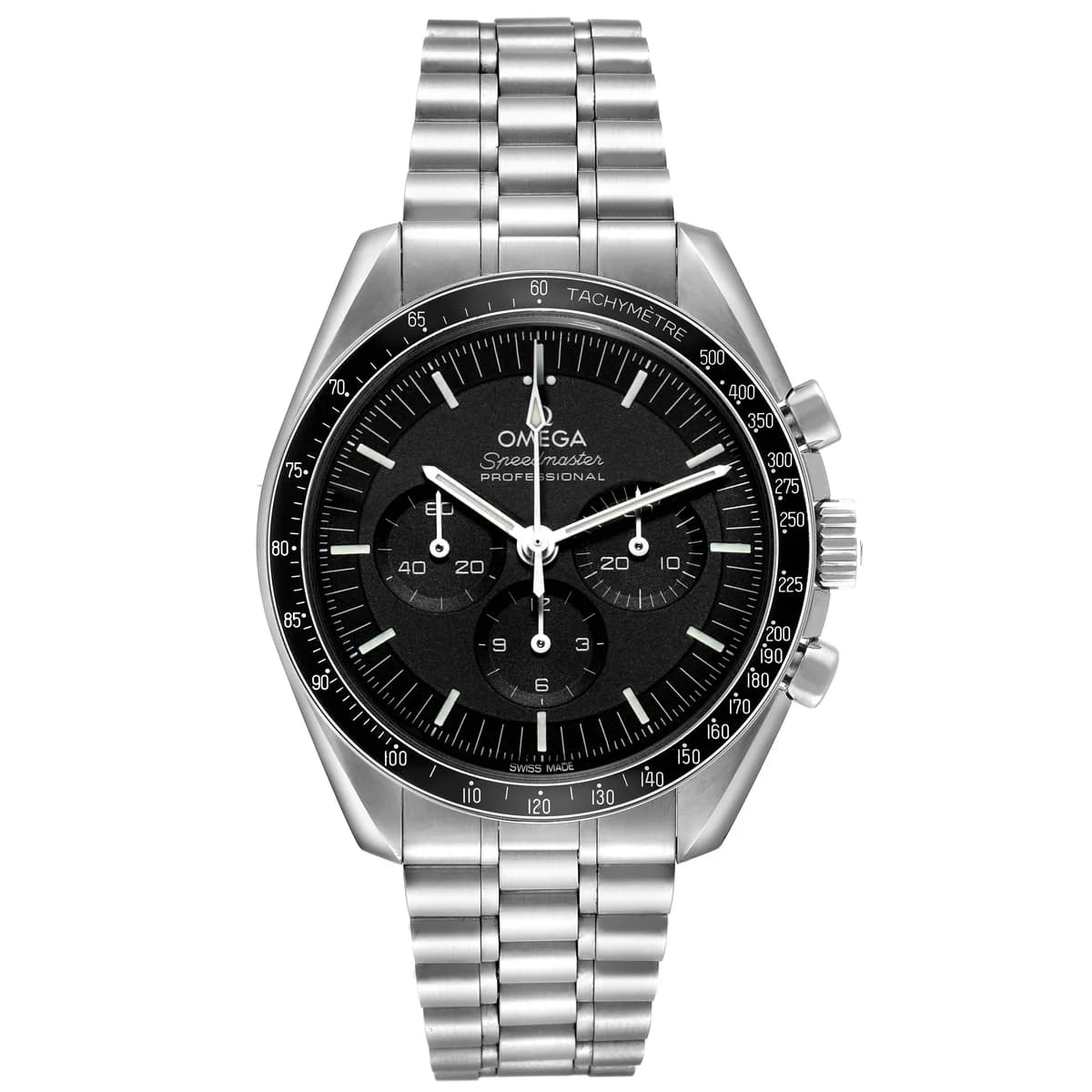
The case is 42mm in stainless steel with an asymmetric profile, the crown guards sitting on the right side only. The thickness is 13.54mm and the lug-to-lug measurement is 47.50mm, which means it wears like a proper tool watch on the wrist. This is not a dress watch. It has presence. The black step dial is a design detail from the early Speedmaster references that Omega revived for the 2021 update, where the dial surface sits slightly recessed relative to the subdial rings. The bezel is anodized aluminum (not ceramic) with the tachymeter scale and the famous dot over 90, another detail from the early references that collectors call the DON (Dot Over Ninety). On the original Cal 321 era Speedmasters, the tachymeter dot sat directly above the 90 marking. When Omega transitioned to the Cal 861 around 1969, the dot moved next to the 90. The 2021 Moonwatch brought the DON back. Three subdials: small seconds at 9, 30-minute recorder at 3, 12-hour recorder at 6. Water resistance is 50 meters, which is adequate for incidental exposure but this is not a watch for swimming. The hesalite crystal on the front carries a small Omega logo that is invisible until you catch it at the right angle. NASA specified hesalite because sapphire, while harder, can shatter into sharp fragments in a vacuum. Hesalite dents instead of shattering. In a spacesuit, that distinction could save your life. Omega also makes a sapphire sandwich version of the Moonwatch with sapphire crystals on both front and back, but the hesalite is the one that connects directly to the flight heritage.
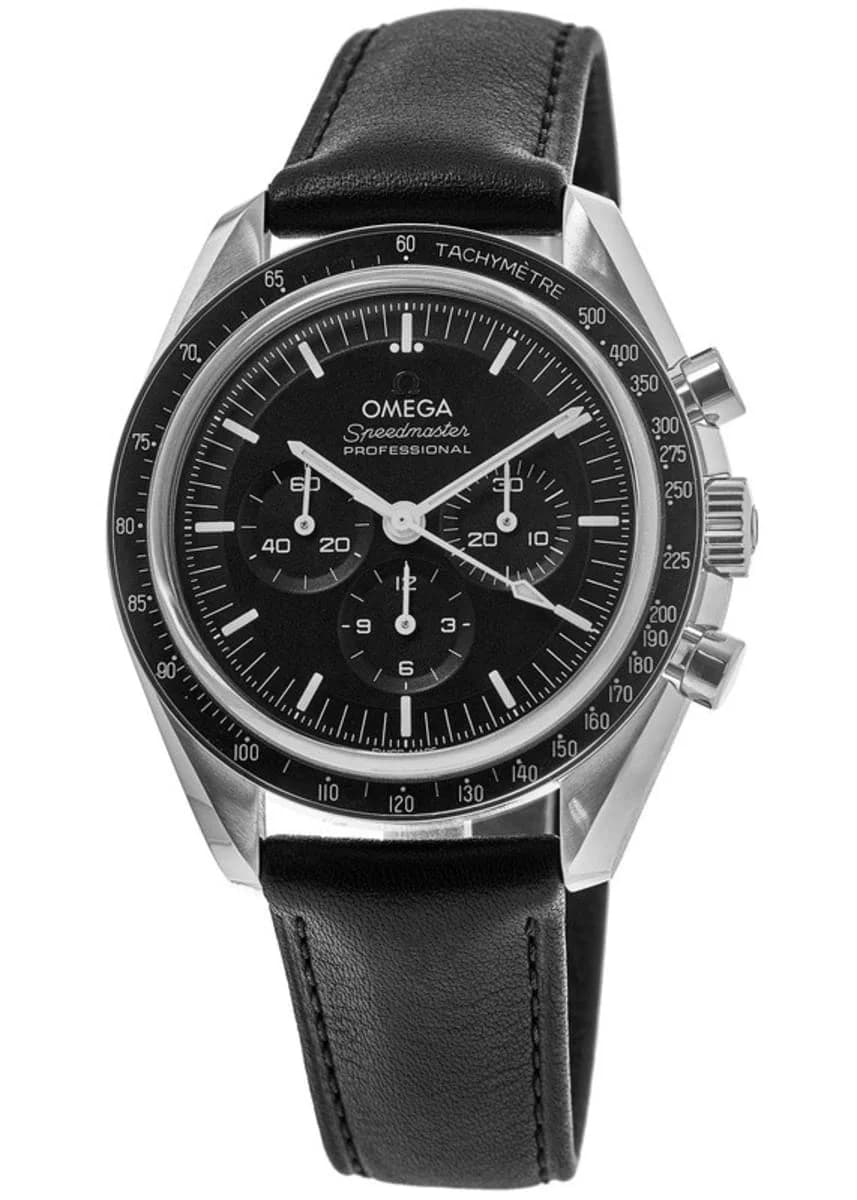
I love the daily ritual of winding the Speedmaster. It sounds like a minor thing, but there is something grounding about picking up the watch each morning and giving the crown 30 to 40 turns to wind the mainspring. You feel the resistance build as the spring tightens. You feel the crown stop when it is fully wound. The watch cannot overwind because the mainspring has a slipping bridle that prevents damage. For someone who wears automatic watches most of the time, the manual winding is a deliberate moment of engagement with the mechanics. It is the difference between a car that starts with a button and one that starts with a key and a turn. Both get you where you are going. One of them asks you to participate.
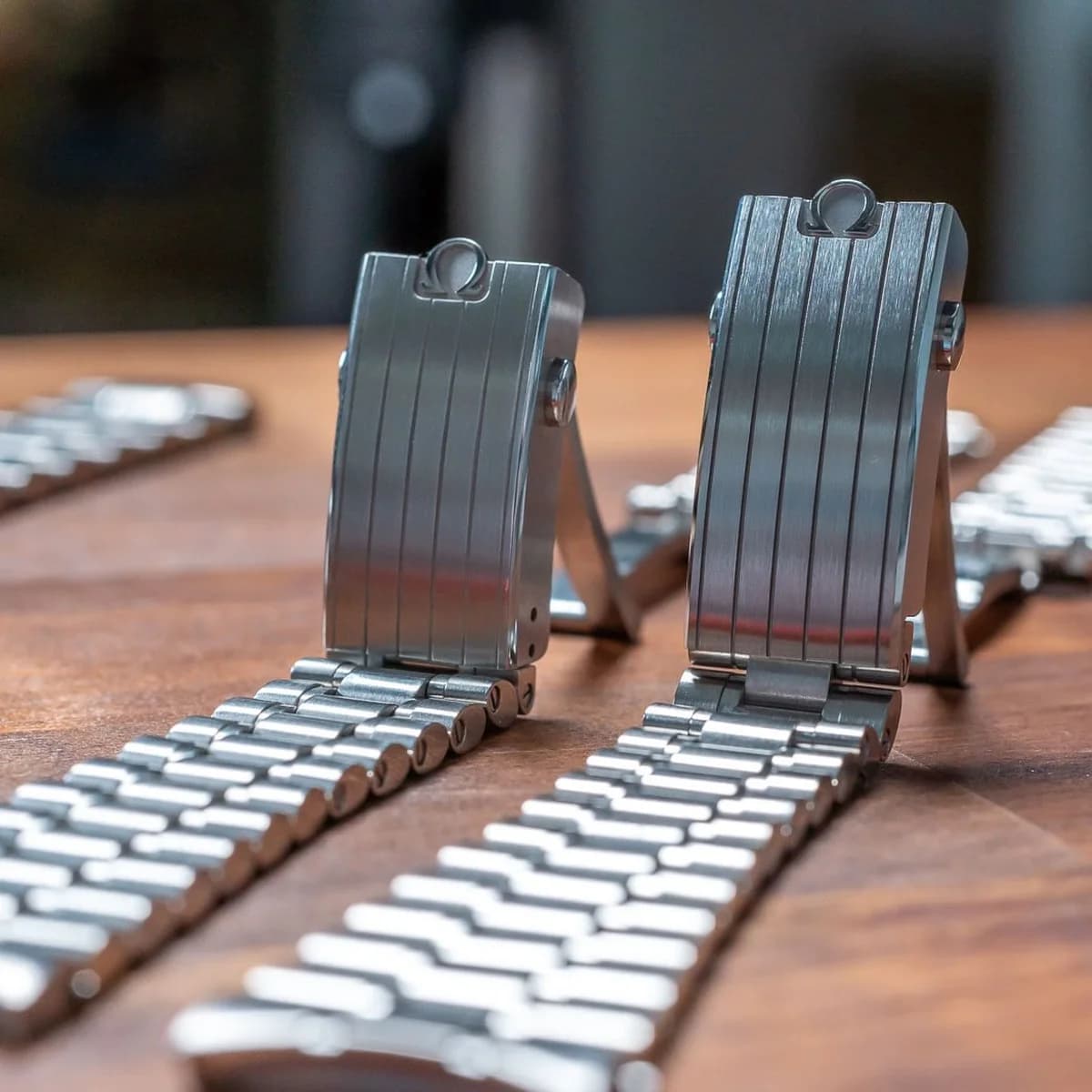
The honest critique of the Speedmaster is its thickness and its bracelet. At 13.54mm, this watch does not slide easily under a shirt cuff. It catches. If I am wearing a Canali wool suit with proper French cuffs, the Speedmaster pokes out rather than sitting flush. A Cartier Santos at 9.38mm or a Rolex Datejust at 11.8mm would disappear under that same cuff. The Speedmaster does not. It is a watch that looks better with rolled sleeves or a casual jacket. The bracelet has improved noticeably with the 2021 update, but I wish it had a micro-adjust mechanism on the clasp for on-the-fly sizing. Omega has a push-pin micro-adjust on the Seamaster line, and I would love to see it on the Moonwatch. On a warm day when your wrist swells slightly, the difference between a perfect fit and a slightly tight fit is noticeable, and removing a half-link with a pin and spring bar tool is not something anyone wants to do at their desk. The hesalite crystal is the other tradeoff. It will scratch. That is not a defect. It is acrylic. Within a few weeks of daily wear, the crystal will have fine marks visible at certain angles. Polywatch, a mild abrasive paste, removes them in about 60 seconds of gentle buffing. Some owners keep a tube in their desk drawer. The scratching is a feature of the material choice, not a flaw, but it is a maintenance reality that sapphire-crystal owners never deal with.
Omega sits within the Swatch Group's prestige and luxury tier, alongside Breguet, Blancpain, Harry Winston, Glashutte Original, and Jaquet Droz. They are the largest revenue generator in the group by a wide margin. This position gives Omega access to movement technology from across the Swatch Group's manufacturing ecosystem, including ETA and Nivarox for components, while maintaining their own in-house development for the co-axial escapement and silicon hairspring technology. The Speedmaster's competition in the chronograph space includes the Rolex Daytona, the TAG Heuer Carrera, and the Breitling Navitimer. Each has its own heritage and strengths. The Daytona has the racing connection and the Rolex cachet. The Carrera has motorsport DNA from Jack Heuer's partnership with Jo Siffert. The Navitimer has the slide rule bezel and aviation heritage. None of them went to the moon. That is not a knock on any of those watches. It is simply the reality that the Speedmaster owns a piece of human history that no other chronograph can claim.
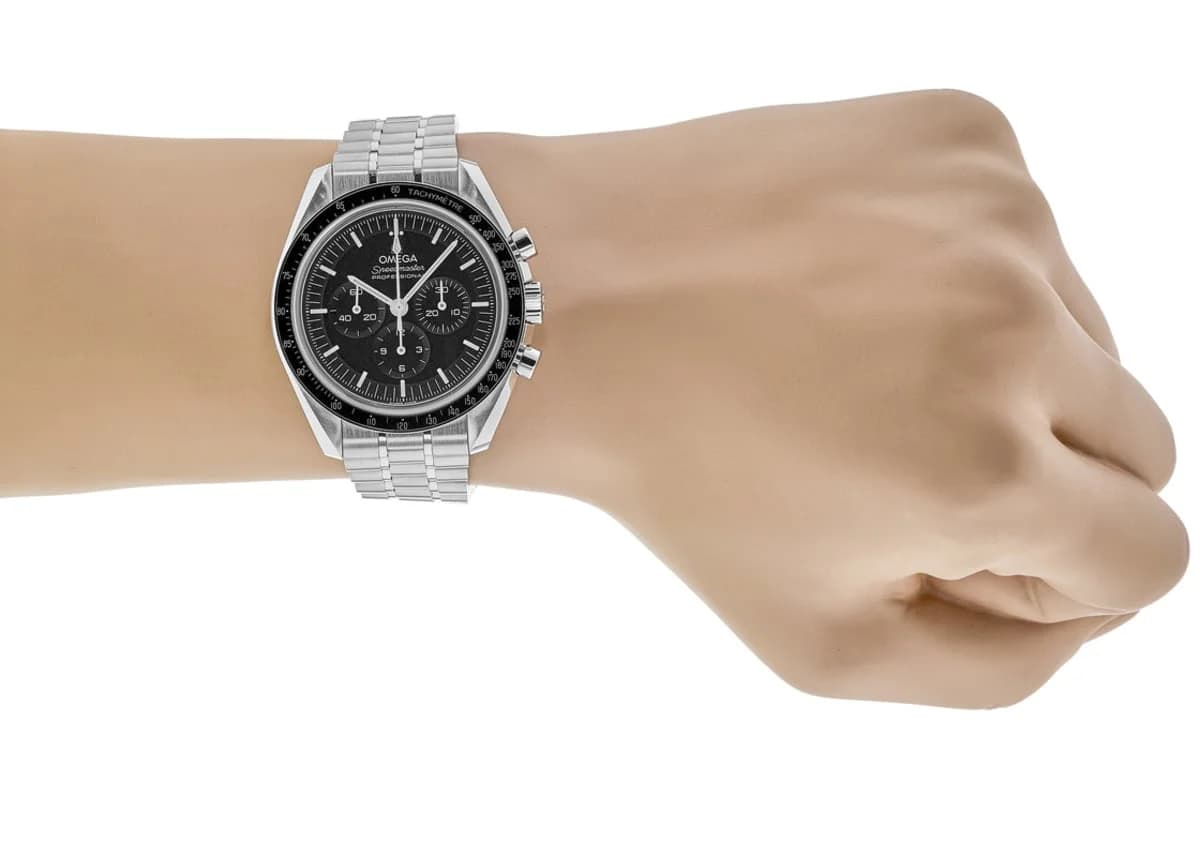
On the wrist, the 42mm case with its 47.50mm lug-to-lug sits well on a 6.5-inch wrist, though it wears at the larger end of comfortable. The watch has real visual weight at around 134 grams on the bracelet. The contrast between the black dial and the brushed steel case creates a tool-watch aesthetic that pairs naturally with casual and smart-casual outfits. On darker skin, the black and steel contrast looks particularly clean, and the warm lume on the hands and indices adds a subtle cream accent that works across skin tones. The brushed finishing on the bracelet catches light in a way that reads as utilitarian rather than dressy. A black leather strap changes the personality entirely, softening the Speedmaster for situations where the steel bracelet feels too heavy or too casual for a Holland and Sherry flannel suit. The watch works surprisingly well under a sport coat with rolled-up sleeves, which is honestly where I think the Speedmaster looks its best. It does not pretend to be a dress watch. It is a tool watch with enough class to move between contexts, and that authenticity is part of what makes it work.
The lume on the Speedmaster deserves a mention because it is one of the details that separates a serious tool watch from a fashion chronograph. The hour indices and hands are filled with Super-LumiNova that glows a strong green in darkness. It is not the brightest or longest-lasting lume in the watch world (a Seiko diver would win that contest), but it is functional and consistent. The three subdial hands also have luminous tips, which means you can read the running seconds and the chronograph registers in low light. For a watch that was designed to be legible inside a spacecraft with the cabin lights off, that attention to lume continuity across all the hands makes sense.
The Speedmaster exists at an intersection that no other watch occupies. It is historically important in a way that cannot be manufactured or purchased. Rolex can sponsor every yacht race on Earth and it will not change the fact that the Speedmaster went to the moon. But strip away the history for a moment and look at the 310.30.42.50.01.001 as a watch. A hand-wound chronograph with a co-axial escapement, silicon balance spring, Master Chronometer certification, and 50 hours of power reserve in a 42mm steel case with hesalite crystal. It is a genuinely well-engineered chronograph by any standard. The 3861 is the best movement the Moonwatch has ever had, by a comfortable margin. The fact that it also carries 65 years of unbroken space heritage from the CK2915 to the International Space Station is the part that transcends specifications. In my experience, a collection without the Moonwatch has a hole in it. The Speedmaster is not the most technically advanced chronograph. It is not the thinnest. It is not the most beautifully finished. It is the one that went to the moon, and the one that timed 14 seconds to bring three astronauts home. Those are not marketing stories. Those are facts.
Also in Sport Chronographs & GMT