
Simon Brette
Chronometre Artisans Rose Gold
Chronometre Artisans Rose Gold
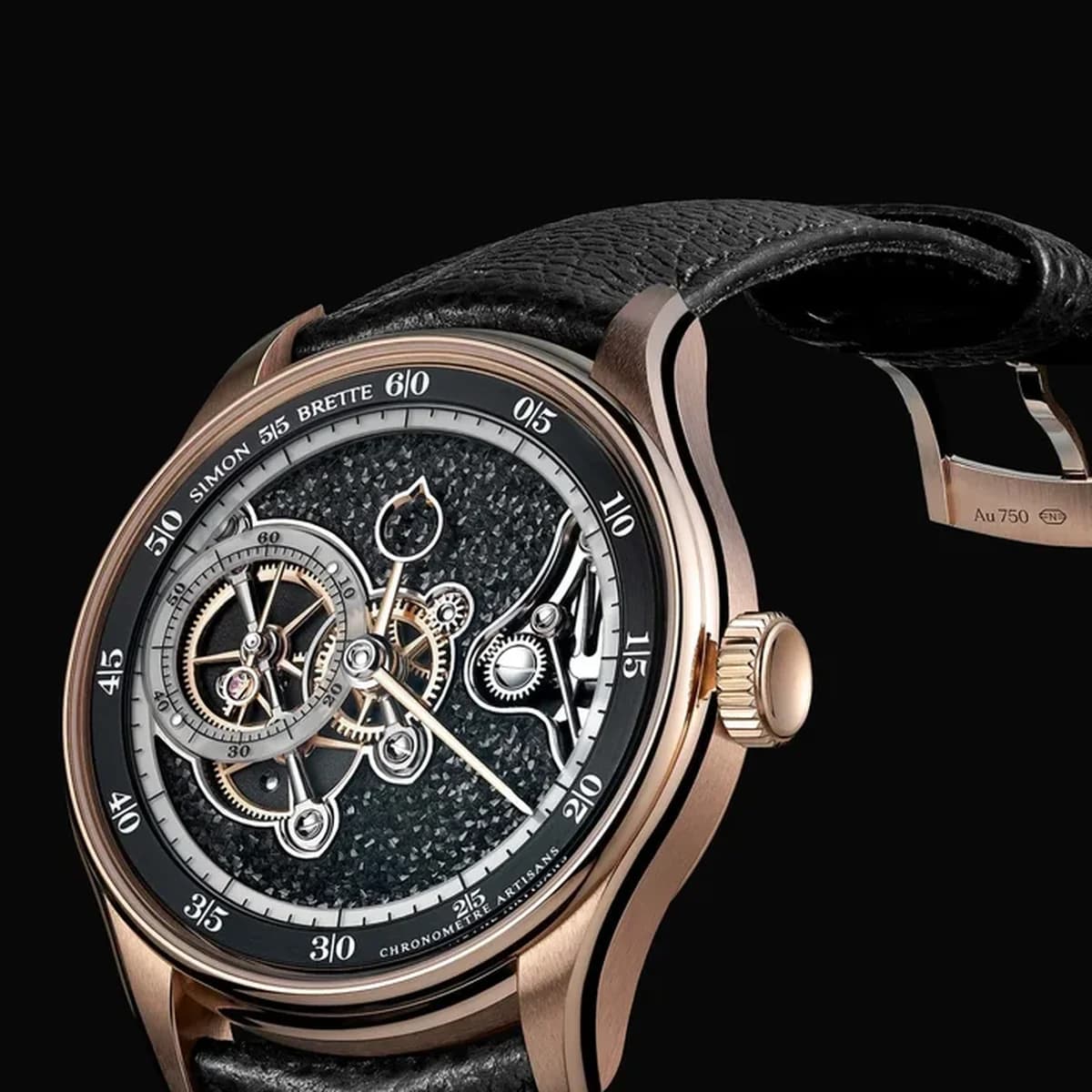
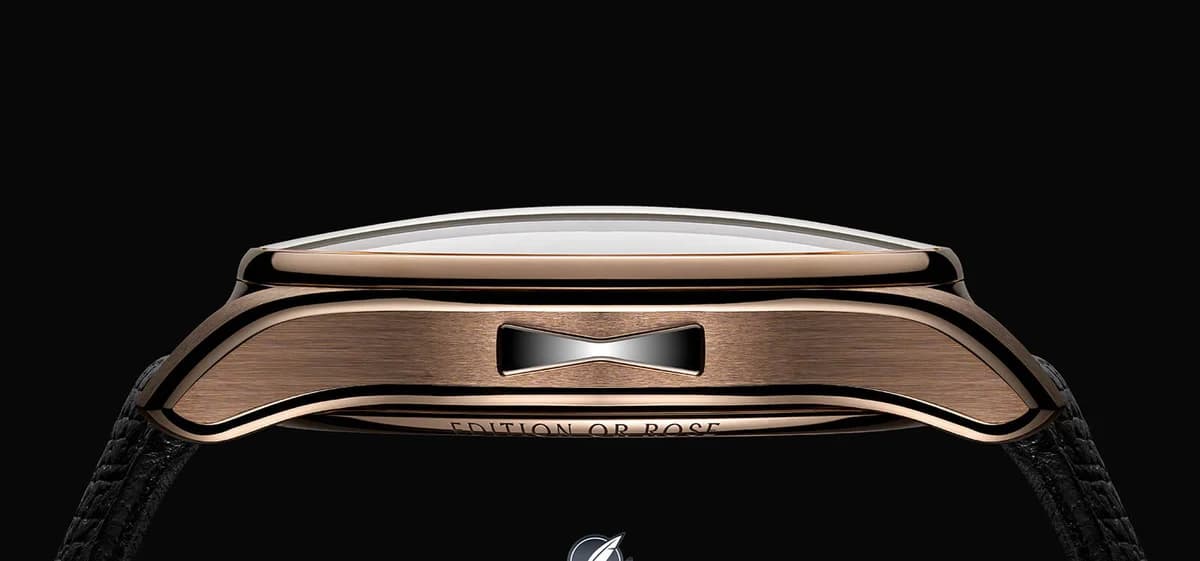
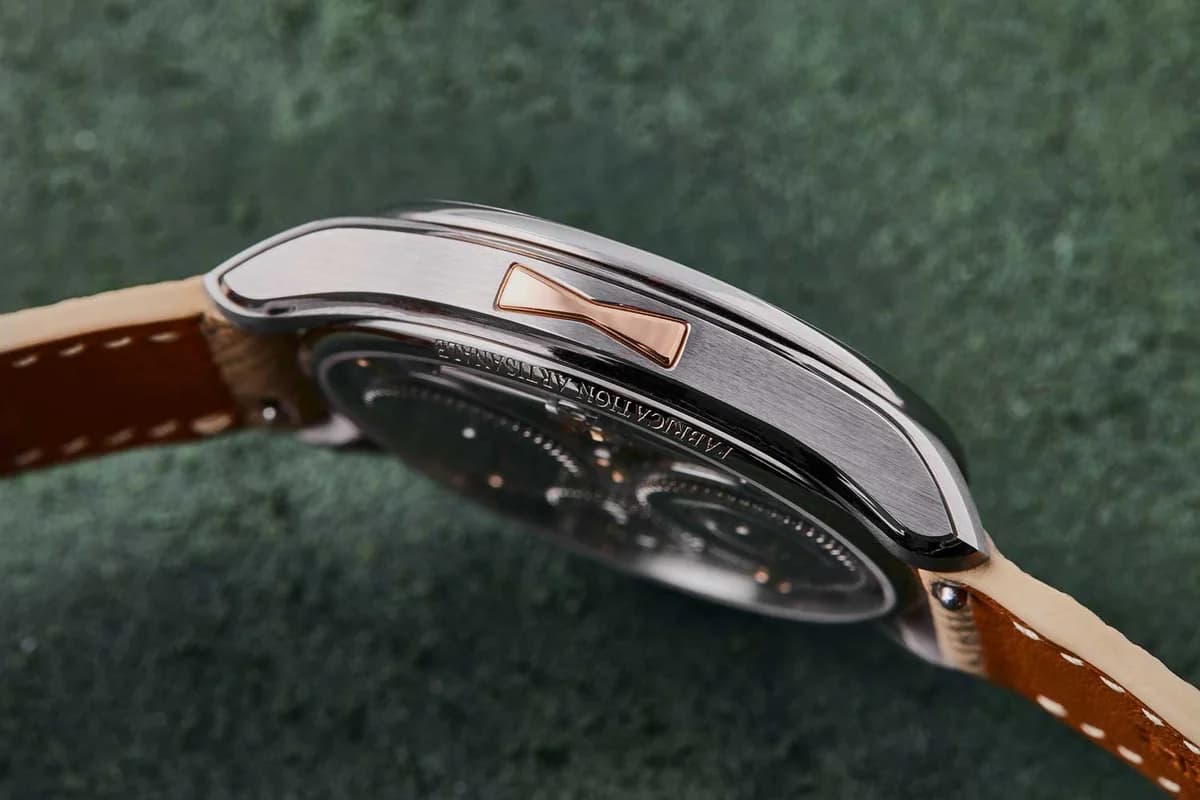
Simon Brette is the son of a carpenter from the Auvergne region of France. That detail matters more than anything else you will read about this watch because the defining design element of the Chronometre Artisans, a polished gold dovetail joint on the side of the case, is a direct tribute to his father's craft. A dovetail is the strongest joint in woodworking. It is the joint a carpenter uses when something needs to last generations. Brette put one on his watch case in white gold against rose gold, and every time you look at the side of this watch, you are looking at a man honoring his father. For me, that is the kind of detail that separates independent watchmaking from everything else. I love that it is the first thing you notice when you pick the watch up and turn it in your hand. Not the dial, not the crown, not the finishing. The dovetail. The carpenter's son put his father's signature on the case before anything else.
Brette studied engineering at the Haute Ecole Arc Ingenierie in Le Locle, graduating in 2011. Le Locle sits in the Jura mountains alongside Zenith and Tissot, one of those Swiss towns where watchmaking is not an industry but a culture. After graduating, Brette joined Chronode, Jean-Francois Mojon's movement development firm that builds calibers for some of the most respected independents in the world. He spent nearly five years there as a technical constructor, working on caliber development for clients that included MB&F, where he helped develop the original Legacy Machine 1 and Legacy Machine 2 in the early 2010s. From Chronode he moved to MCT, the avant-garde brand that builds watches with revolving prism displays, serving as a project manager for roughly two years. Then he joined MB&F directly, Max Busser's creative lab, where he managed movement concepts from initial research through to production. His work at MB&F was not abstract. He designed the case and developed the movement for the Horological Machine 10 Bulldog. He engineered the entirely sapphire crystal case for the Horological Machine 9. He designed and developed the LMX, which went on to win the Horological Revelation award at the 2023 GPHG. When you look at the Chronometre Artisans, you are looking at a movement constructor who learned from the best independent minds in the industry before building his own.
Brette left MB&F in April 2021. He spent 18 months freelancing, observing the industry from the outside, and growing increasingly concerned about verticalization. The large groups were bringing more and more operations in-house, and the independent artisans who had spent decades mastering specific disciplines, the dial engravers, the anglage specialists, the hairspring regulators, were losing visibility and commercial leverage. Brette decided to build a watch that would do two things: demonstrate his own vision for what a chronometer could be, and give those independent artisans a platform. He launched the Chronometre Artisans Subscription Edition in April 2023, limited to 12 pieces in zirconium, and every piece was allocated before the watch was publicly announced. That same year, the GPHG awarded it the Horological Revelation prize. That is the award the jury gives to a new watchmaker whose debut work announces a serious talent. They were right.
The Rose Gold edition is the one I want to talk about. Fifty pieces, sold out before production began. The case is 39mm in 18-karat rose gold, 10.5mm thick, 45mm lug to lug, with a 20mm lug width. Those dimensions put it squarely in dress watch territory but it does not feel like a dress watch. The case is built from five distinct parts. The bezel and caseback are both screwed down, providing 30 meters of water resistance. The lugs attach via internal screws rather than being machined from the same block as the case middle, which is a construction detail that allows Brette to control the finishing on each surface independently. The result is an alternation between brushed and polished surfaces that gives the rose gold more visual weight than most gold dress watches manage. The crown is oversized with a concave polished surface that catches light in a way that draws attention without being ornamental. The dovetail is white gold set into the rose gold case band. It is the first thing your eye finds when you turn the watch on its side. The lugs have dual drilled holes that accommodate both curved and straight spring bars, which means Brette designed the case to accept different strap configurations without compromise. That is a product design decision, not a watchmaking decision, and it tells you something about where Brette's mind goes.
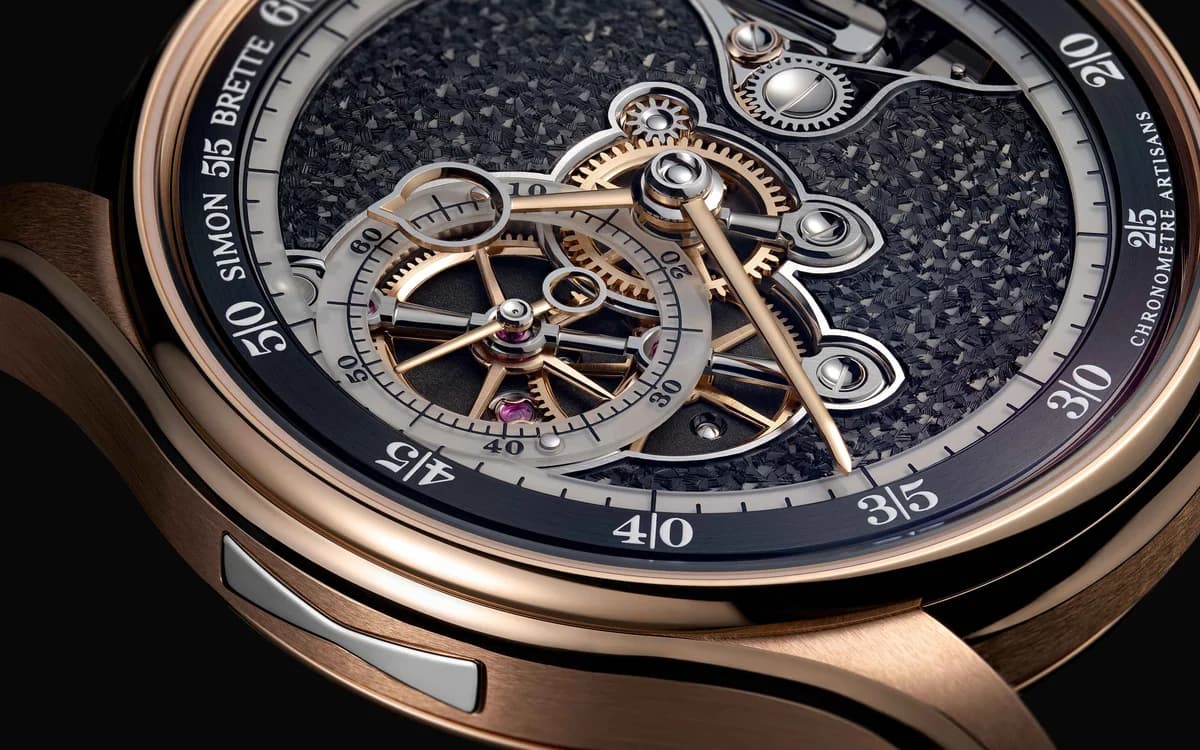
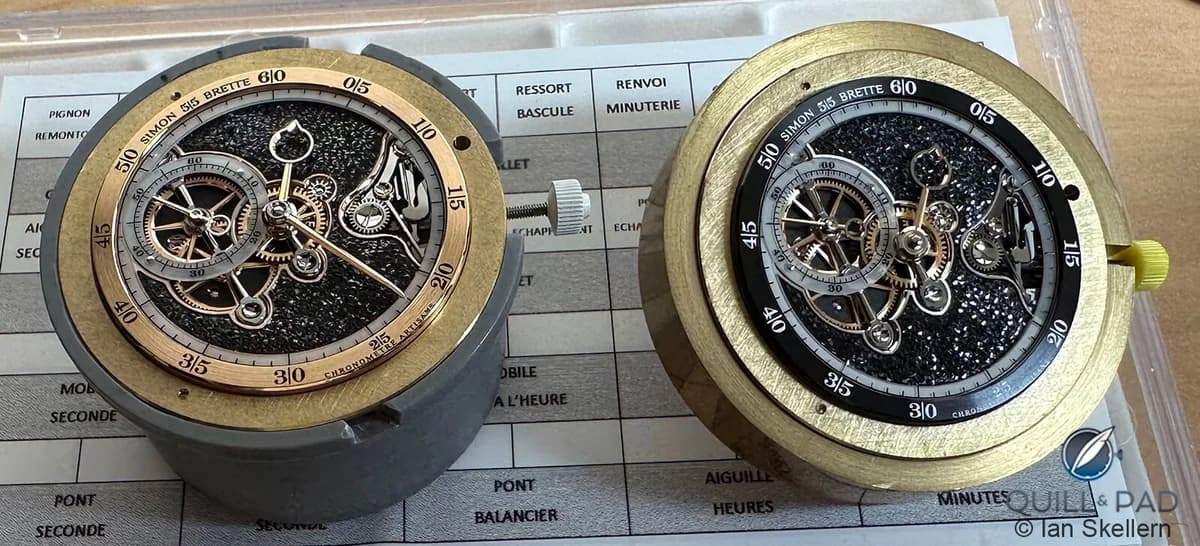
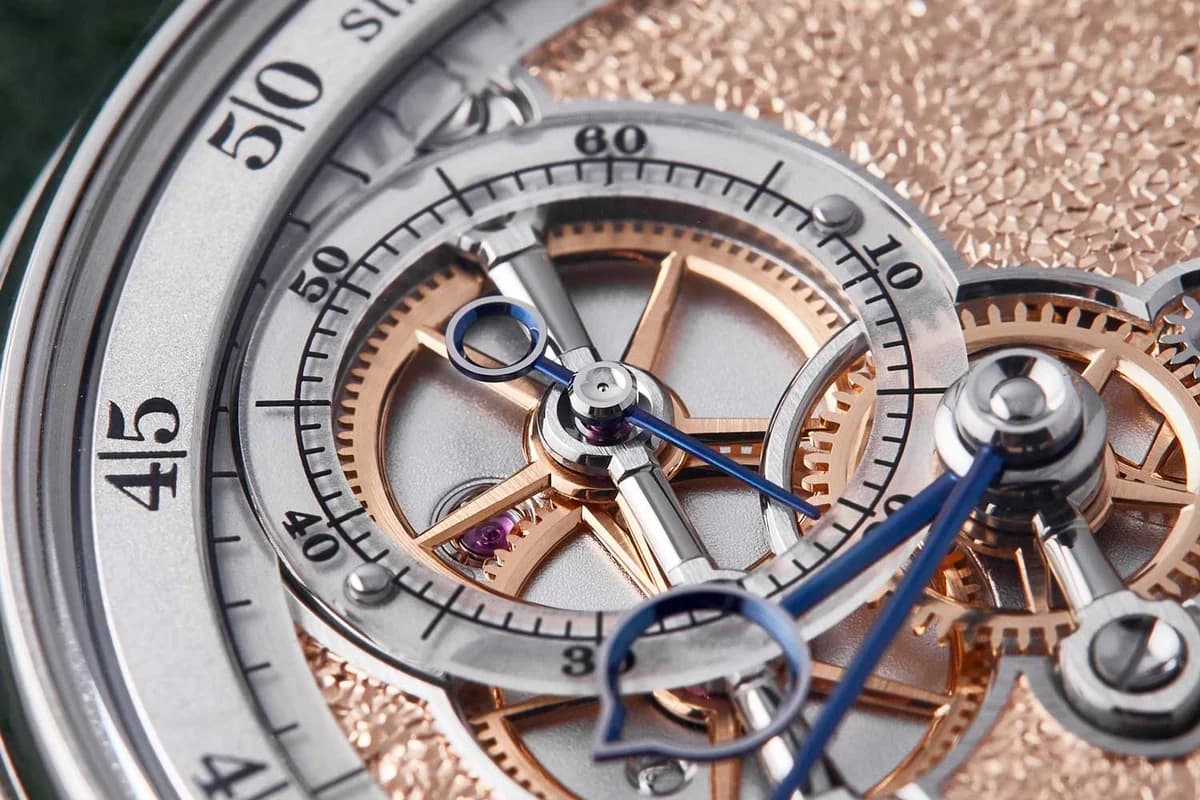
The dial is where this watch becomes something else entirely. The artist Yasmina Anti has spent more than 25 years in the metiers d'art, working from her atelier in the Vallee de Joux. For the Subscription Edition in zirconium, she created a pattern called Dragon Scales. For the Titanium edition, she developed Tiger Claws. For the Rose Gold, she fused both techniques into a new pattern she calls Battle, a three-dimensional mosaic across the entire surface of a solid 5N rose gold dial. After the engraving is complete, the dial receives a black DLC coating, Diamond-Like Carbon, which fills the recesses of the pattern and creates a depth that makes the surface look alive. The contrast between the warm rose gold peaks and the black DLC valleys gives the dial a texture that shifts constantly as light moves across it. The small seconds sits at 09:15, offset from center, on a frosted sapphire subdial with minute markers. The minute disc around the perimeter carries white lacquer pad-printed numerals. The hands are two-tone, grey steel with a rose gold PVD coating, and Brette achieves the contrast by applying the PVD layer and then removing it from the top surface through block polishing. The result is a hand with rose gold flanks and a polished steel spine. I have seen hand-engraved dials from Kari Voutilainen, from Philippe Dufour, from the Geneva ateliers that supply the top maisons. This is in that conversation. The fact that it comes from a collaboration between a French movement constructor and an engraver working in techniques that have no precedent in traditional Swiss dial-making is what makes it genuinely original.
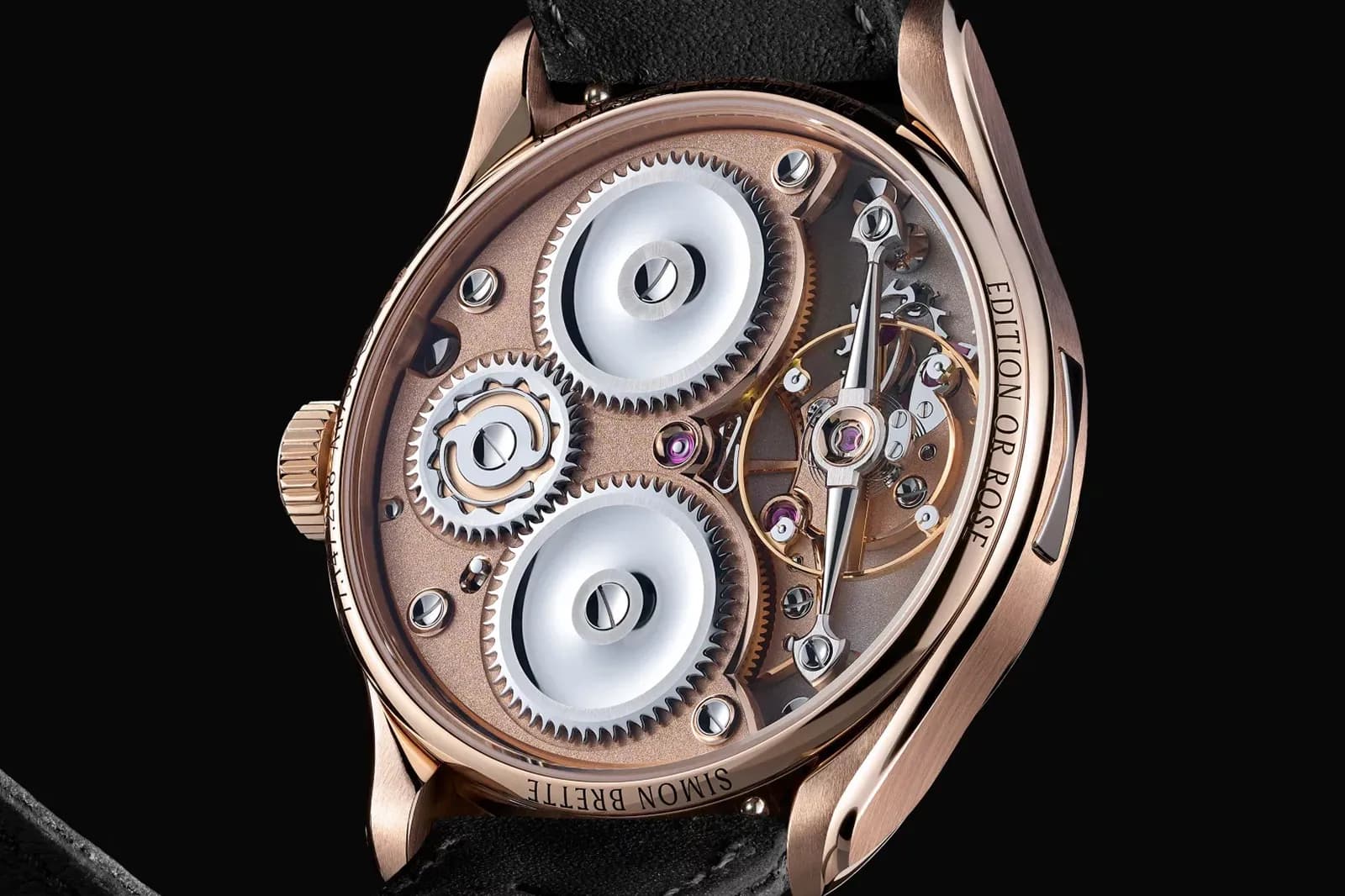
The Caliber sbca is hand-wound, 33.3mm in diameter, 7.8mm thick, with 226 components in the assembled watch and 24 jewels. It beats at 18,000 vibrations per hour, 2.5 Hz. That frequency is deliberate and it is the most important technical decision in the entire watch. It matches the specification of a marine chronometer, the precision instruments that navigators used to determine longitude at sea. Marine chronometers beat at 2.5 Hz because the slower oscillation is more stable and more efficient than the 4 Hz frequency used in most modern sport watches. A slower beat means fewer impulses per hour, which means less energy consumed per oscillation, which means longer power reserve from the same mainspring. It also means each individual oscillation is more controlled, more deliberate. Brette chose it because the entire watch is built around accuracy and efficiency, not speed. Two parallel barrels provide 72 hours of power reserve, plus or minus 5 hours depending on mainspring state. A full wind takes 45 turns of the crown. The balance wheel is large, free-sprung with four turnable inertia weights and a Breguet overcoil terminal curve hairspring. The official specs list a 52-degree lift angle, 40 mg per square centimeter of inertia, and an amplitude of 310 degrees when fully wound declining to 280 degrees at the 24-hour mark. The escapement uses an angled anchor with a 15-tooth escape wheel. The stop-seconds mechanism uses a flexible S-shaped arm rather than a conventional lever, which is a detail that only someone who has studied movement architecture at the depth Brette has would think to implement. The S-shape provides a softer contact with the balance wheel, reducing the risk of damage during repeated hacking.

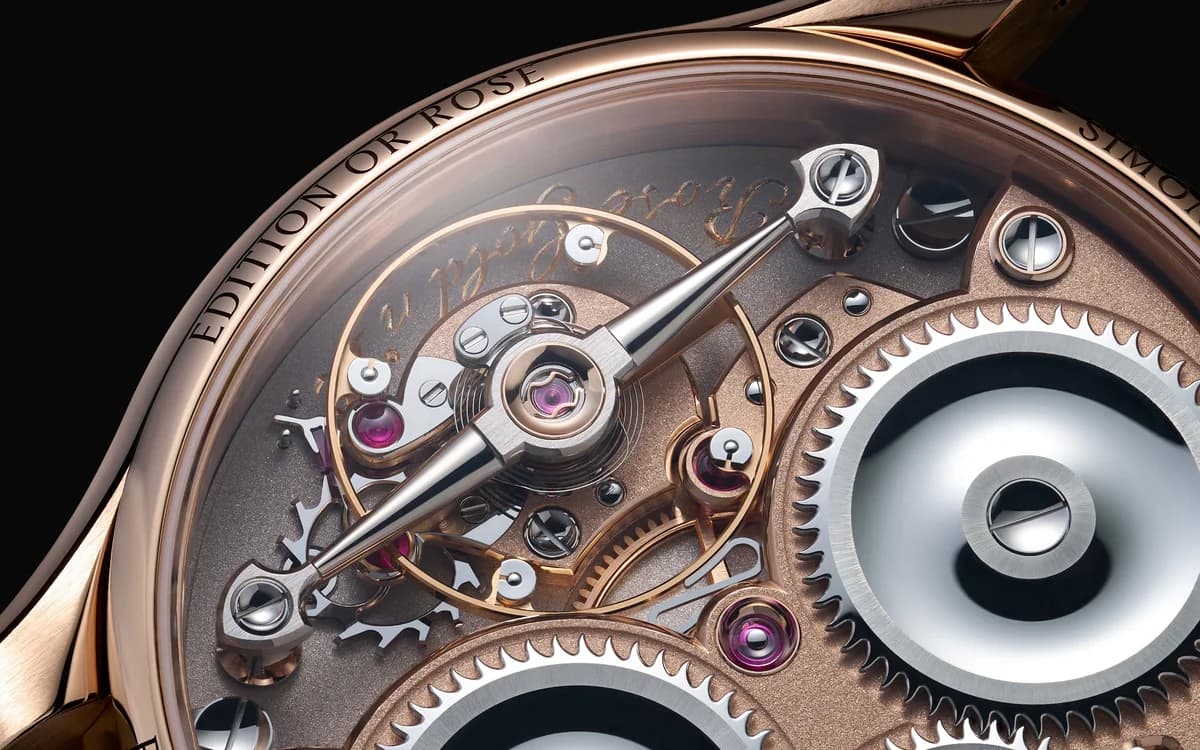
I appreciate how the movement architecture reveals Brette's obsession with marine chronometer principles beyond just the frequency. The dual parallel barrels deliver more consistent torque to the gear train than a single barrel, which means the amplitude drop over the power reserve is gradual rather than cliff-like. That 310-to-280-degree decline over 24 hours is remarkably flat. Most hand-wound watches with single barrels lose 50 or more degrees of amplitude over the same period. The 3/4 plate design gives the movement a visual architecture that recalls German watchmaking, though Brette is unmistakably French in his approach. Through the sapphire caseback, the gear train is partially visible, and the escape wheel appears almost disconnected from the rest of the train, sitting in its own visual space. That separation is not accidental. It draws the eye to the part of the movement that matters most.
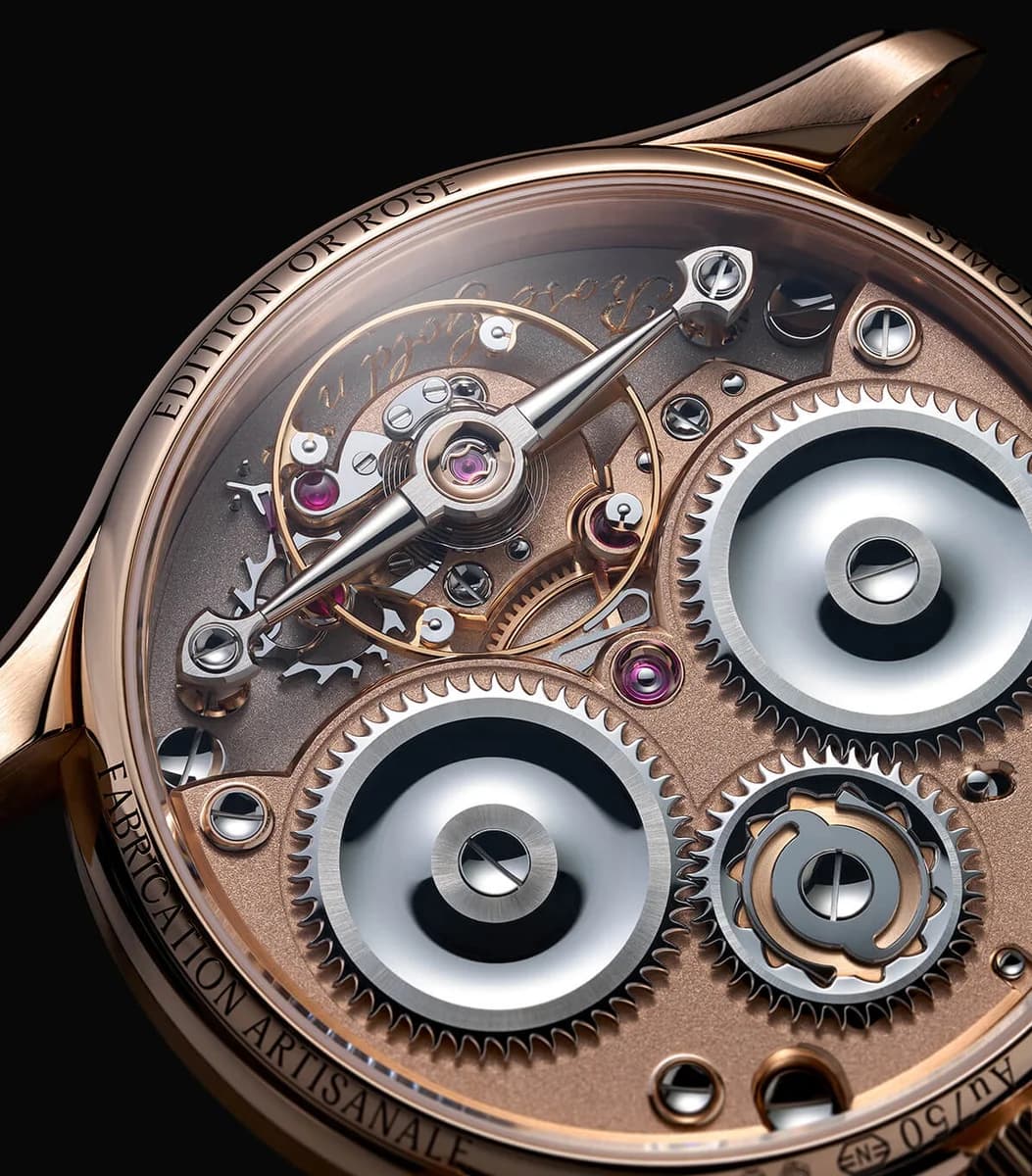
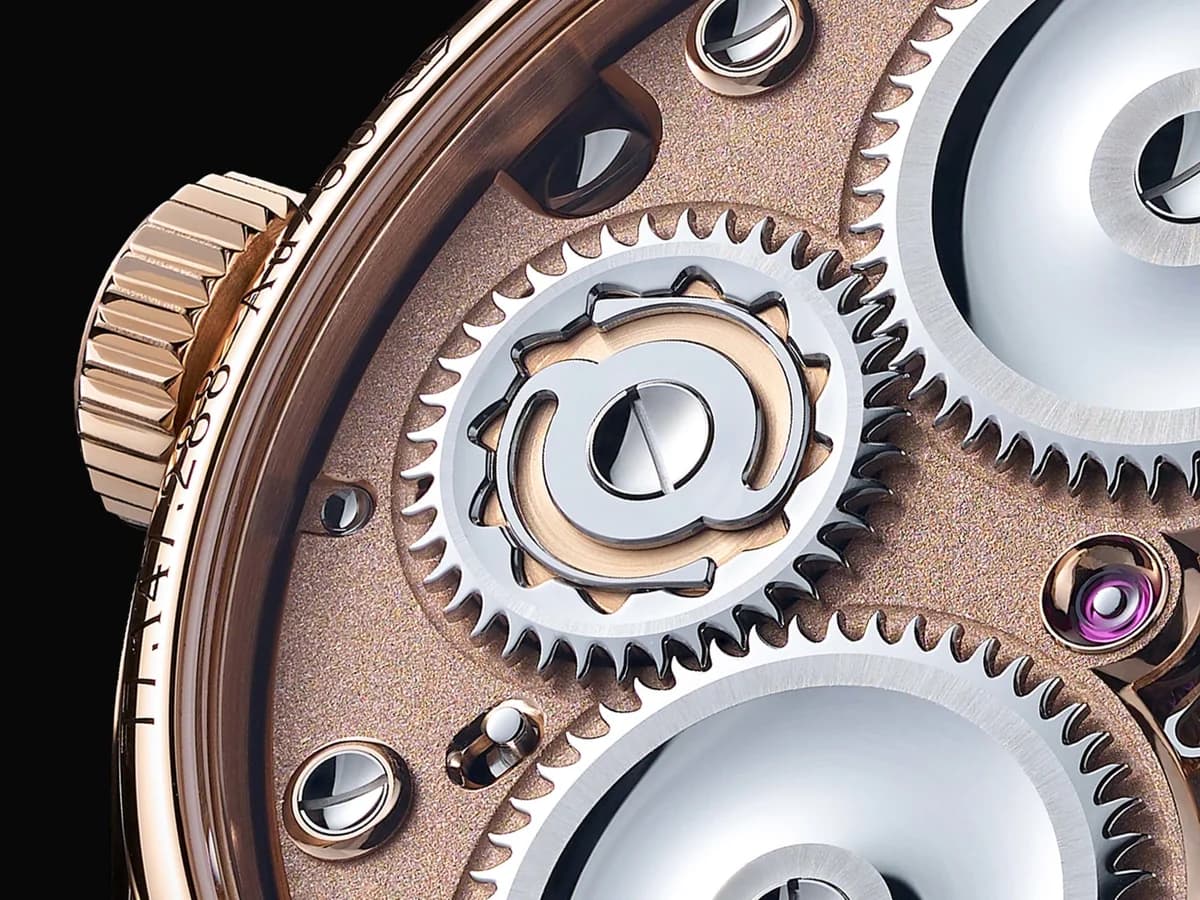
The movement finishing on the Rose Gold edition uses three bridges in 5N gold, which is extraordinary. Gold is soft. Finishing gold to haute horlogerie standards requires a different touch than finishing steel or German silver. The screw heads throughout the movement are concave and mirror-polished, set in solid gold chatons for both the center wheel and the balance staff. The crown wheel uses wolf-tooth gearing, an older technique where the gear teeth are shaped asymmetrically to reduce backlash during winding. Wolf-tooth gearing was standard in marine chronometers of the 18th and 19th centuries but it largely disappeared from modern watchmaking because it requires more precision to execute than conventional gearing. Brette brought it back because it fits the chronometer philosophy. The winding click springs are integrated into the crown wheel assembly in a style reminiscent of grande sonnerie construction. The chamfering is done entirely by hand. Every edge is beveled and polished under magnification. The hand-setting mechanism uses black-polished levers with beveled edges and screws in gold chatons, a level of finishing on functional components that most brands reserve for decorative ones. Through the sapphire caseback, the Caliber sbca looks like movement work from a maison with two centuries of heritage. It comes from a man who started his brand four years ago.
One of the things I respect most about Brette is his transparency. He publicly credits every contributor to the watch on his website, by name, with their role and their expertise. The dial engraver Yasmina Anti. The prototypist Luc Monnet, who was crowned Meilleur Ouvrier de France in 2015 and previously worked at Greubel Forsey. The watchmaker Anton Pettersson, who manufactured thirty different components by hand and had previously worked on the Greubel Forsey Hand Made 1. The hairspring regulator Nadine Gorgl, who assembled the complete balance wheel and produced the Breguet terminal curve. The decoration specialists Barbara Coyon and Nathalie Jean-Louis, the latter with more than 20 years as a hand beveller. The surface finisher Damien Genillard, who has been finishing surfaces for two decades. The designer Matthieu Allegre. The case makers Pierre-Alain Dornier and Julien Ducommun. In an industry where many brands obscure their supply chains and present the finished product as if one genius made the whole thing alone, Brette names everyone. He calls the watch the Chronometre Artisans, plural, because it is the product of multiple artisans working together. The name is the philosophy.
The honest critique is availability, and it goes deeper than just scarcity. Fifty pieces of the Rose Gold, sold out before production. The 12-piece Subscription Edition in zirconium sold out before it was announced. The Titanium edition of 99 pieces sold out. The Steel edition of 60 pieces, announced with a new Aurora Waves dial by Yasmina Anti using Atomic Layer Deposition for a color-shifting green-to-purple effect, sold out. Every single watch Simon Brette has ever made is gone before it is built. The subscription model means the Chronometre Artisans exists primarily as an idea for most collectors. You can admire it. You can study it. You cannot own it unless you were in the room when the allocation happened. That exclusivity is genuine, not manufactured. Brette does not have a factory. He coordinates a network of independent artisans, each working in their own ateliers. The limitation is real. But it does mean that for most of the watch world, the Chronometre Artisans is a reference point rather than a purchase. Water resistance at 30 meters is functionally splash-proof, which is fine for a gold dress watch but worth knowing. And there is the long-term servicing question that comes with every independent at this scale. A network of specialists is flexible and produces extraordinary work, but it depends on every member of that network continuing to practice their craft. Twenty years from now, will the same artisans be available to service and restore these watches? Brette has thought about this, and the fact that he names and documents every contributor is part of the answer. But the question is honest.
I imagine on the wrist with a Brioni tropical-weight wool in navy, the Rose Gold would sit flat and comfortable. At 39mm and 10.5mm thick, it should disappear under a shirt cuff entirely. On my wrist, the proportions would likely feel natural. The rose gold against darker skin has a warmth that white gold and steel cannot match. The black DLC dial creates contrast, and the Battle pattern catches light in a way that should give the watch a presence that belies its modest dimensions. I suspect the two-tone hands are more legible than they appear in photographs. The grey steel spine against the rose gold PVD flanks creates enough contrast to read the time easily against the textured dial. The 20mm lug width and 45mm lug-to-lug distance mean the watch would sit proportionally on a 6.5-inch wrist without any overhang. This is a watch that would work with a charcoal suit as naturally as it works with rolled sleeves on a Saturday afternoon.
The broader context of what Brette is building matters. The Chronometre Artisans is not one watch in multiple metals. Each edition has its own identity. The Subscription Edition in zirconium with Dragon Scales. The Titanium edition with Tiger Claws. The Rose Gold with Battle. The Steel edition with Aurora Waves, an entirely new technique using Atomic Layer Deposition rather than traditional engraving, creating a dial that shifts from deep green to translucent purple depending on the viewing angle. The Steel edition also introduces a stainless steel bracelet that took two and a half years to develop, with 446 individual parts including 146 concave screws, a double-blade clasp, and a quick-release system. Brette is not repeating himself. Every edition pushes the artisans into new territory. That progression, from zirconium to titanium to rose gold to steel, from Dragon Scales to Tiger Claws to Battle to Aurora Waves, tells you that the Chronometre Artisans is a platform for artistic exploration, not a single product being churned through different case materials.
The rose gold remains the definitive version. The warmth of the gold case against the black DLC dial, the white gold dovetail, the 5N gold movement bridges visible through the caseback, the two-tone hands. It is a complete vision executed with a coherence that most brands never achieve. Simon Brette learned from Mojon at Chronode, from the revolving prisms at MCT, from Max Busser's creative chaos at MB&F. He built the Bulldog, engineered the sapphire HM9 case, designed the LMX that won a GPHG before he ever put his own name on a dial. Then he built something that is entirely his own and won the GPHG again. The jury saw it immediately. The collectors saw it immediately. Every watch he has made has sold out before it was built. That does not happen by accident. That happens when the work is undeniable.
Also in Independent Masters