
Roger Smith
Series 2
Series 2
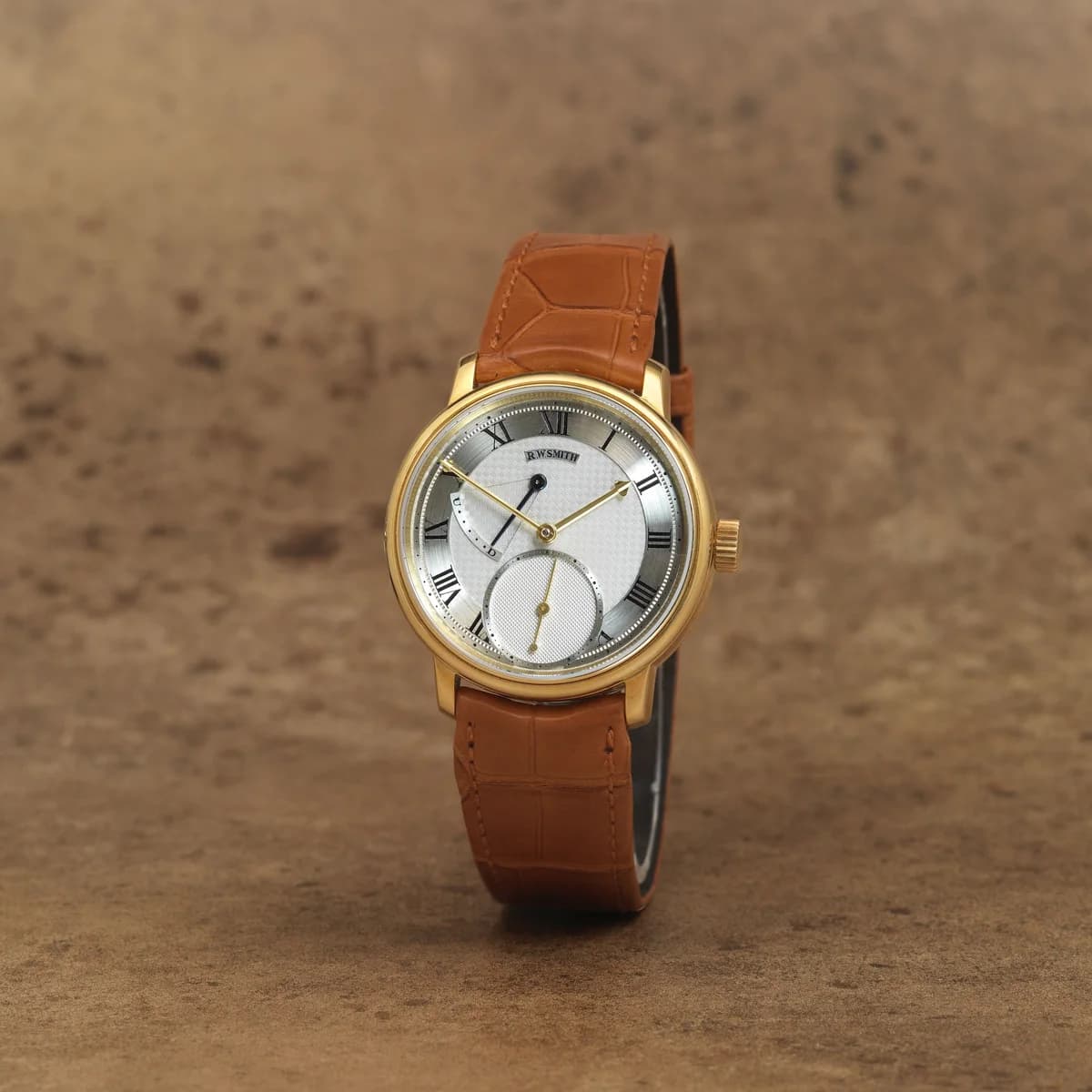
To understand why the Roger Smith Series 2 matters, I think it helps to understand what almost did not happen. In 1986, a sixteen-year-old kid from Bolton, near Manchester, enrolled at the Manchester School of Horology. He was not academically inclined by his own admission, but he was good with his hands. His father suggested the course. That kid was Roger Smith, and during his time at the school, George Daniels came to give a visiting lecture. That moment changed the trajectory of English watchmaking. Smith decided right then that he wanted to make watches by hand, in the tradition Daniels had revived from Abraham-Louis Breguet. He graduated in 1989, winning the British Horological Institute's Bronze Medal as the top student in his class. Then he went to work servicing watches at Mappin and Webb, did a brief stint at Tag Heuer, and spent his evenings teaching himself to build a pocket watch from scratch using Daniels' book Watchmaking as his guide. That first pocket watch, completed in 1990 when Smith was twenty-two, featured a one-minute tourbillon and detent escapement. He brought it to Daniels. Daniels' verdict was blunt: too handmade. It took Smith another seven years of rebuilding and refining before Daniels looked at his second pocket watch, a tourbillon with a four-year perpetual calendar, and said four words: you are now a watchmaker.
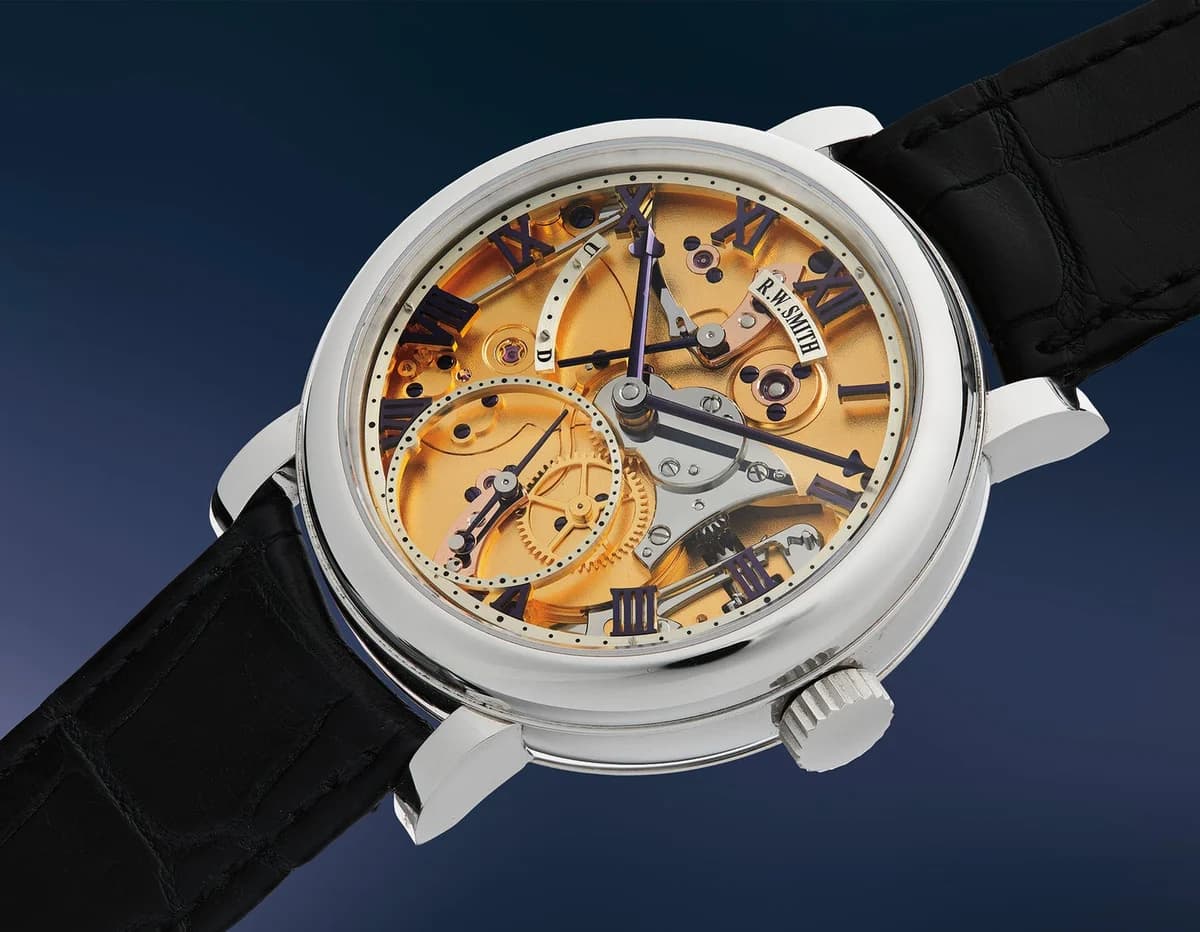
That approval opened the door. In 1998, Daniels invited Smith to the Isle of Man to collaborate on the Millennium wristwatch project, a commission of 48 yellow gold and 8 white gold watches that would become Daniels' final series production. Smith spent three and a half years working directly under Daniels, learning what he calls the Daniels Method. It is not a single technique. It is mastery of thirty-two distinct skills required to design and manufacture a complete watch from raw materials to finished movement. Case fabrication, wheel cutting, gear train calculation, dial making, hand finishing, escapement construction, all of it. The method requires that one person can do everything, and that every surface of every component passes through that person's hands. When the Millennium project was delivered in 2001, Smith founded Roger W. Smith Ltd in a converted bedroom in his cottage in Ballaugh, a small village on the Isle of Man. That cottage would serve as his workshop for seventeen years.
The Series 2 was introduced in 2006, with the first pieces delivered in late 2007. It was Smith's first wristwatch designed and built entirely in-house using the Daniels Method, and it was the first production movement ever specifically designed around the Daniels co-axial escapement. I want to pause on that because it is easy to gloss over. The co-axial escapement that Daniels invented is arguably the most important innovation in mechanical watchmaking since Breguet's own work in the late eighteenth century. The standard Swiss lever escapement, which every conventional mechanical watch uses, works through sliding friction. The pallet stones slide against the escape wheel teeth to transmit impulse to the balance wheel. That sliding friction requires lubrication, and lubrication degrades over time, which is why mechanical watches need periodic servicing. Daniels' co-axial eliminates most of that sliding friction by separating the locking function from the impulse function onto different planes. The impulse is delivered tangentially, with minimal sliding contact. The practical result is a watch that maintains its accuracy over much longer intervals between services because the escapement surfaces barely wear.
I appreciate the way Smith explains the co-axial to people who are not watchmakers. The conventional escapement is like a door that slams open and bounces back. The co-axial is like a door that swings open smoothly. Both let you through, but one wears out the hinges faster. That is a simplification, but the core idea is right. The co-axial delivers energy to the balance wheel with less destructive contact, and less destruction means longer service intervals and more consistent timekeeping over time.
Omega licensed the co-axial from Daniels in the late 1990s and has since produced millions of co-axial movements. But the Omega implementation is a different animal from what Smith builds. Omega industrialized the concept and adapted it to mass production. Smith builds each co-axial escapement entirely by hand, one at a time, following the original Daniels geometry. The Series 2 initially used Daniels' two-wheel design, where the co-axial escape wheel consisted of two separate gears joined together on a single arbor. In 2010, Smith made a critical improvement. He combined those two wheels into a single piece, guaranteeing concentricity and angular orientation between the teeth and the arbor in a way that two joined wheels physically could not. The result is an escapement that actually performs better than Daniels' original design, built by the one person Daniels authorized to modify it. Smith did not stop there. In 2012, he reduced the escape wheel weight by 23 percent, and in 2014 he reduced the diameter from 6mm to 4.5mm. Each reduction allowed a corresponding decrease in mainspring strength, which reduced force through the entire gear train, improved efficiency, and extended service intervals even further. The co-axial in a current Series 2 is three generations more refined than what Smith started with in 2005.
The movement itself is beautiful in a way that is distinctly English rather than Swiss. The 28-jewel hand-wound caliber beats at 18,000 vibrations per hour (2.5 Hz) and delivers a 36-hour power reserve. The frequency is deliberately low. A slower beat rate means less energy consumed per oscillation, which contributes to the longevity of the escapement surfaces. It also gives the seconds hand a different visual character, a visible sweep rather than the quicker tick of a 4 Hz movement. The movement contains 225 parts, every one finished by hand. The plates are frosted gilt, a traditional English finishing technique where the surface is given a granular texture and then gold-plated. The jewels sit in gold chatons, small gold settings pressed into the plate, which is a technique that precedes modern press-fit jeweling and requires considerably more labor. The cocks and bridges are raised at different levels, giving the movement a three-dimensional depth when viewed through the sapphire exhibition caseback. A large three-quarter plate provides structural rigidity for the gear train.
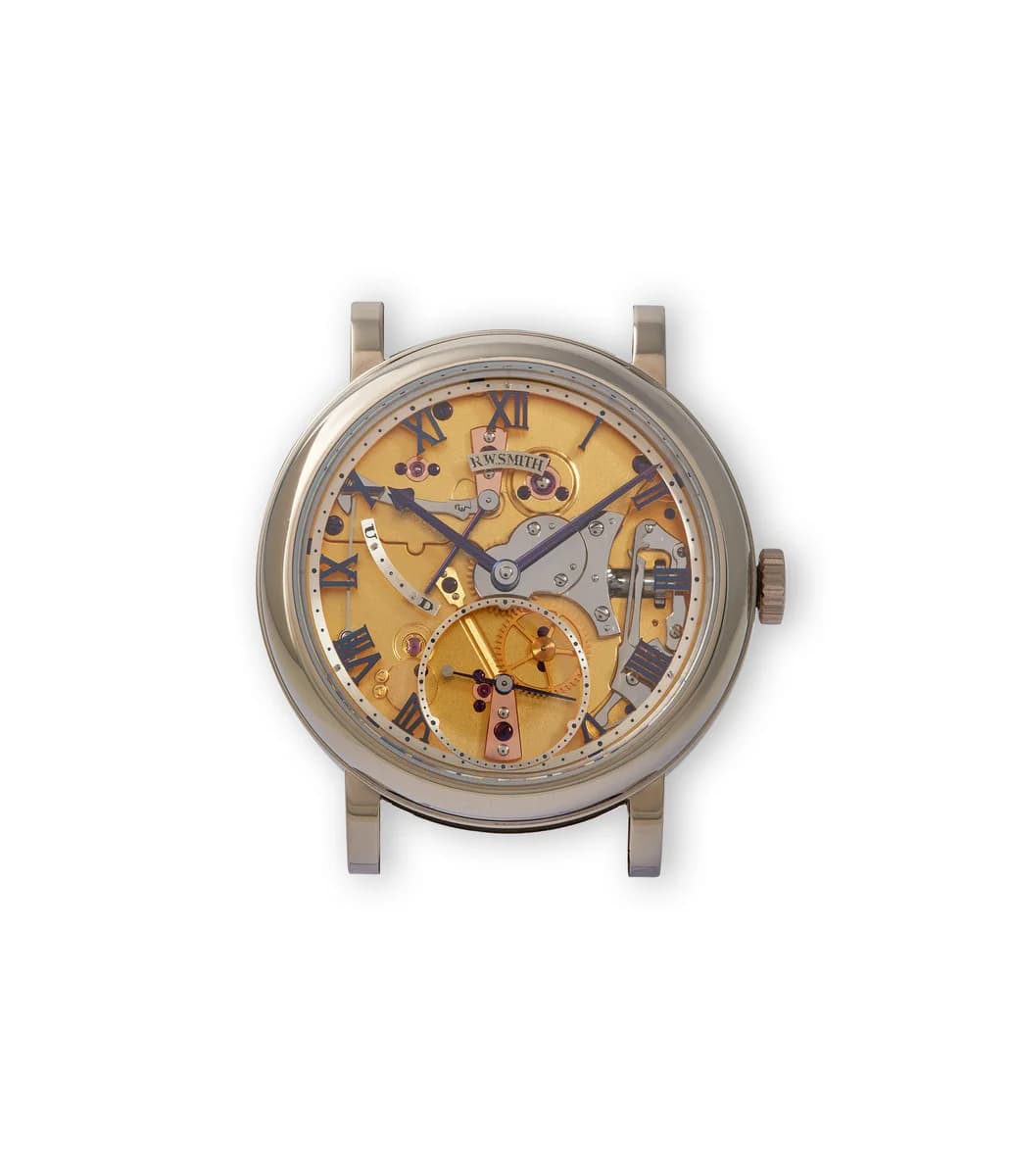
I love the screws. Every steel screw in a Roger Smith movement is hand-flamed blued, individually, over an alcohol lamp. The blue-purple color comes from controlled oxidation at a specific temperature. The window between the correct deep blue and a ruined brown is measured in seconds. It is a technique that takes years of practice to perform consistently, and Smith does it screw by screw across 225 components. There is no chemical bluing here, no batch process. Each screw is held over the flame and judged by eye. The specular polishing on the steel components, the black polish that creates a mirror-like surface, is another finishing technique that separates English from Swiss tradition. Swiss watches typically use Cotes de Geneve or perlage. English watches pursue this deep, reflective black polish that is extraordinarily difficult to achieve without leaving any visible scratches under magnification.
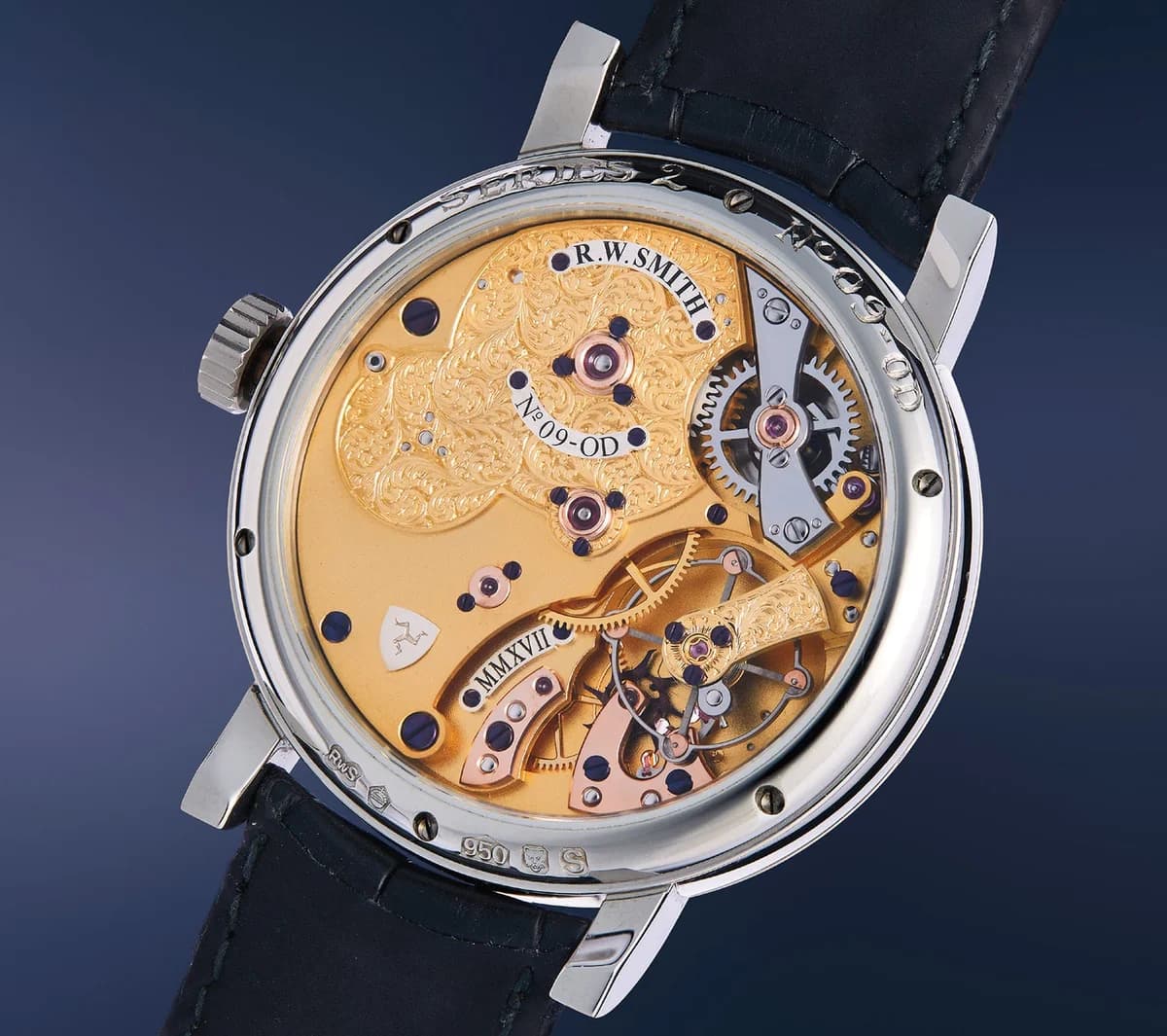
The balance wheel is a freesprung Quadrajust design, regulated using four D-shaped inertia weights on the rim. A freesprung balance has no regulator index, which means the rate is adjusted by moving the four weights rather than shifting a regulator arm along the hairspring. This is theoretically superior because it avoids the minor positional errors that a regulator can introduce. The hairspring itself is the one component Smith does not make in-house. It is purchased. Everything else in the watch, from the case to the dial to the hands to every wheel and pinion in the movement, comes from raw materials entering one end of Smith's workshop and a finished watch exiting the other. That level of vertical integration in a single-person workshop is something only a handful of watchmakers in history have achieved.
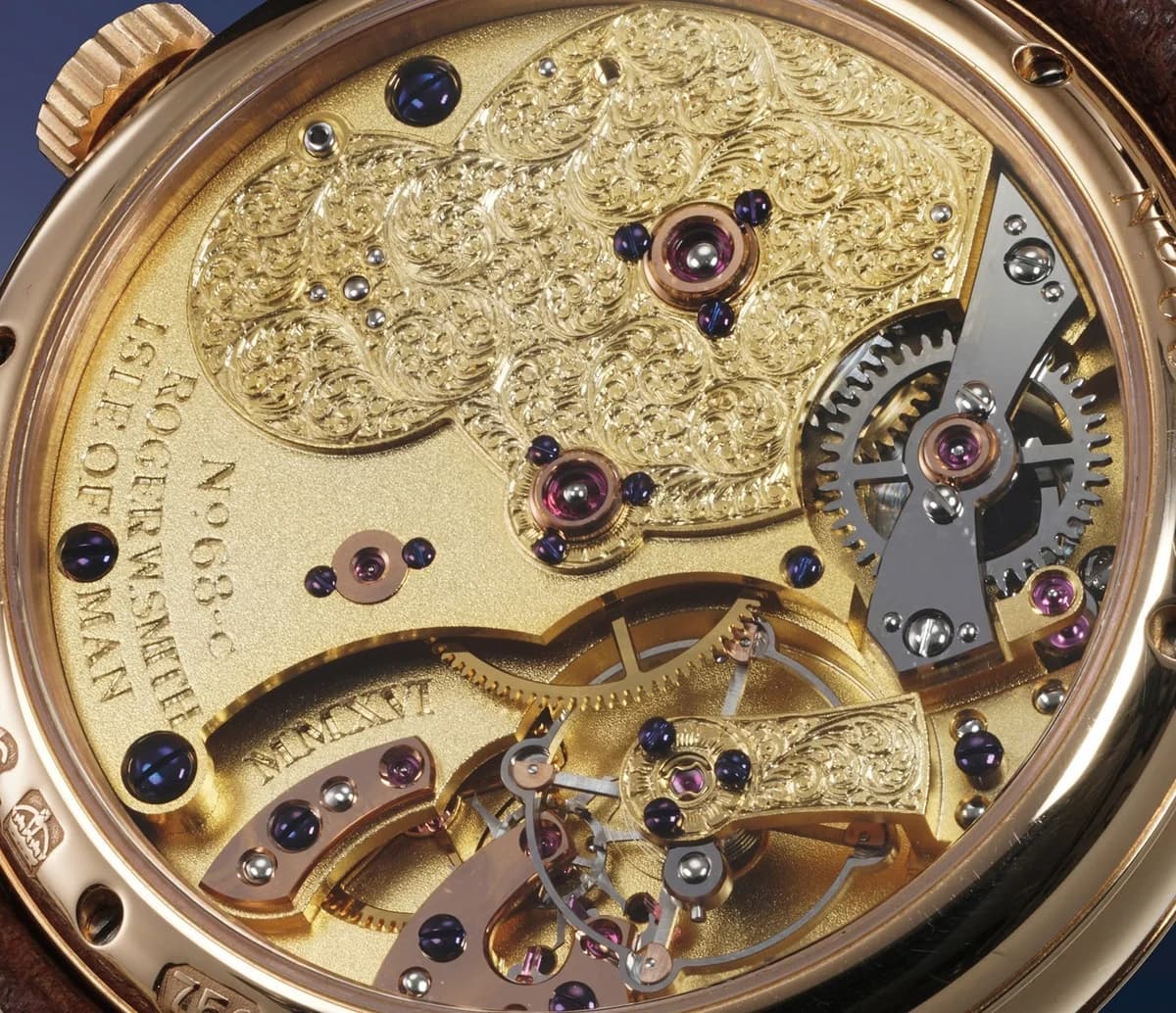
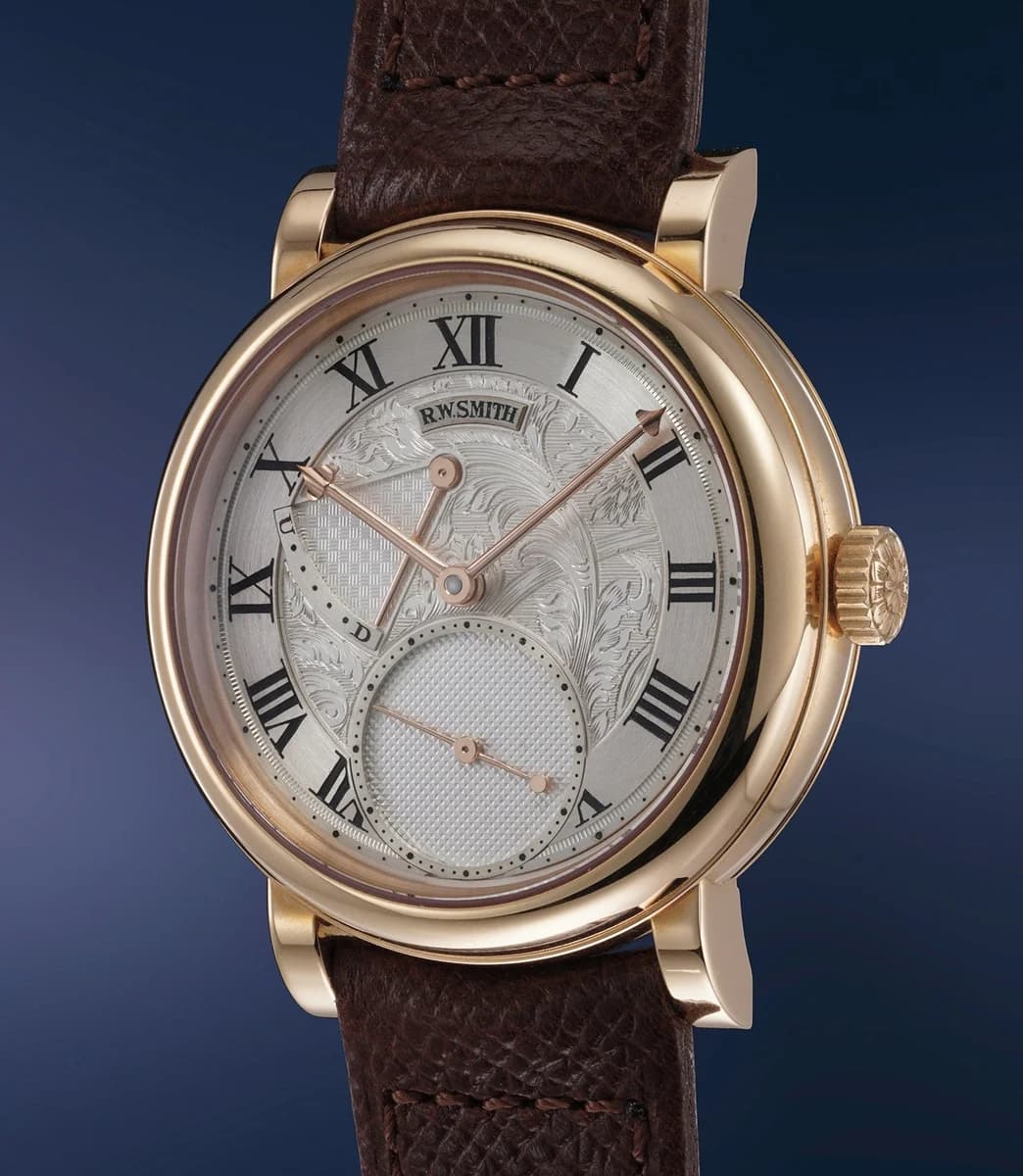
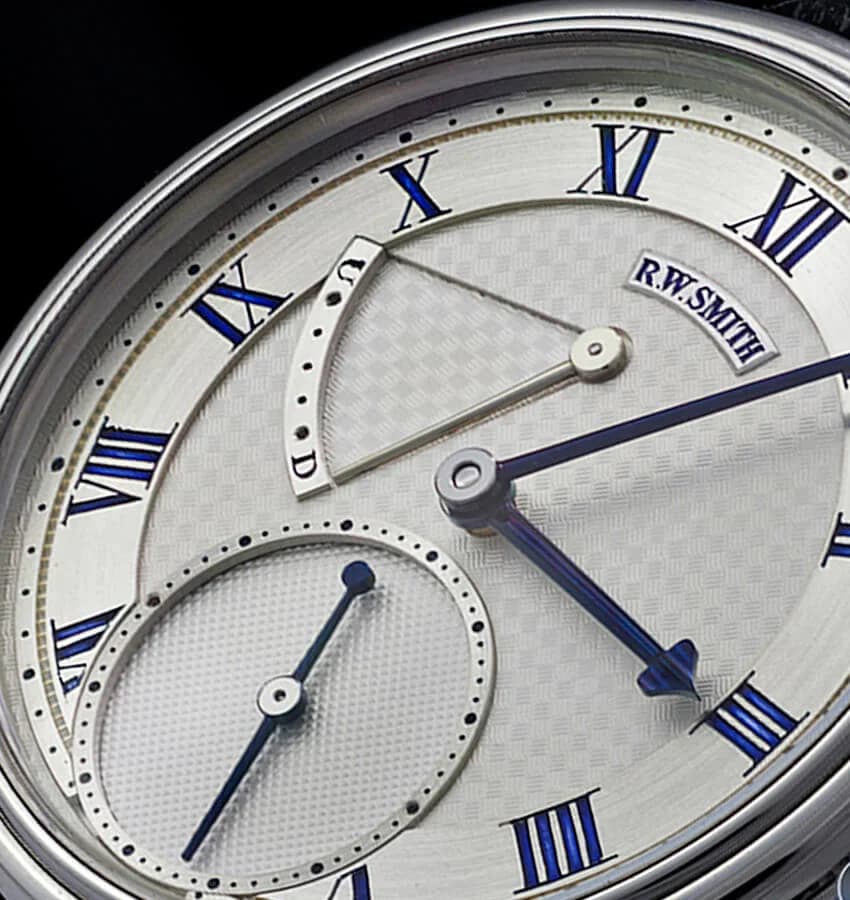
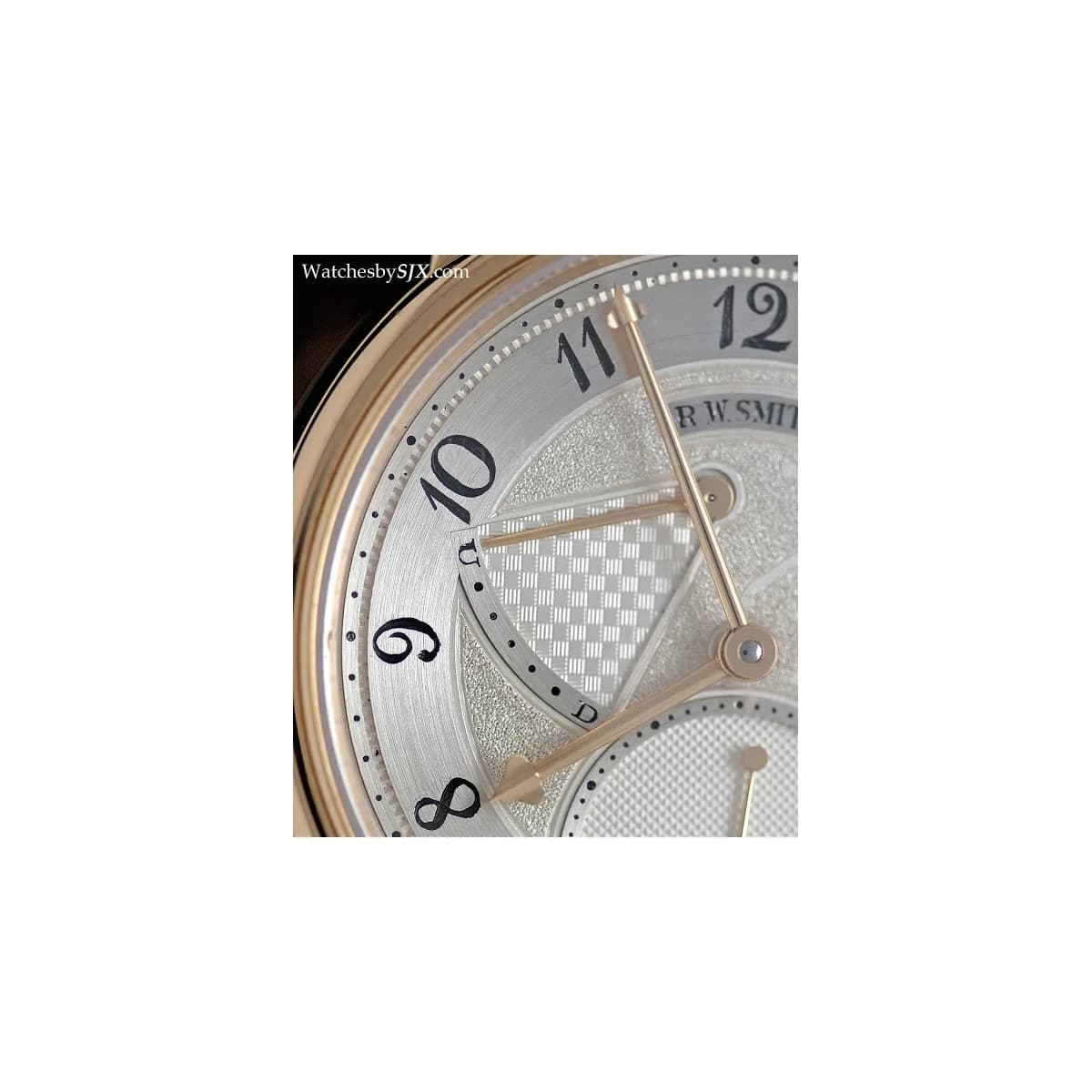
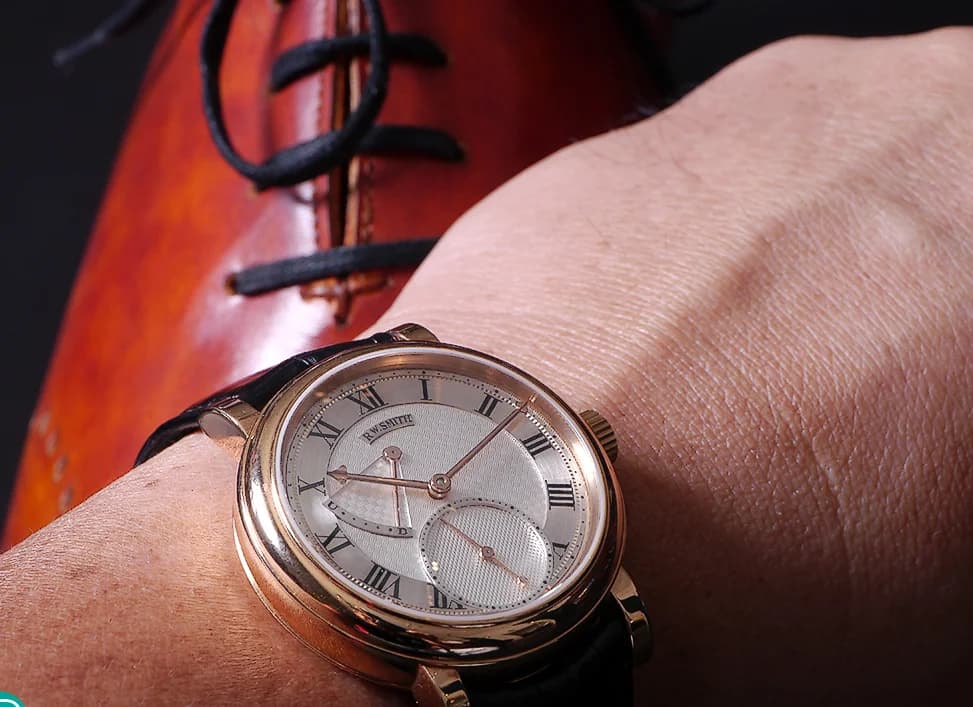
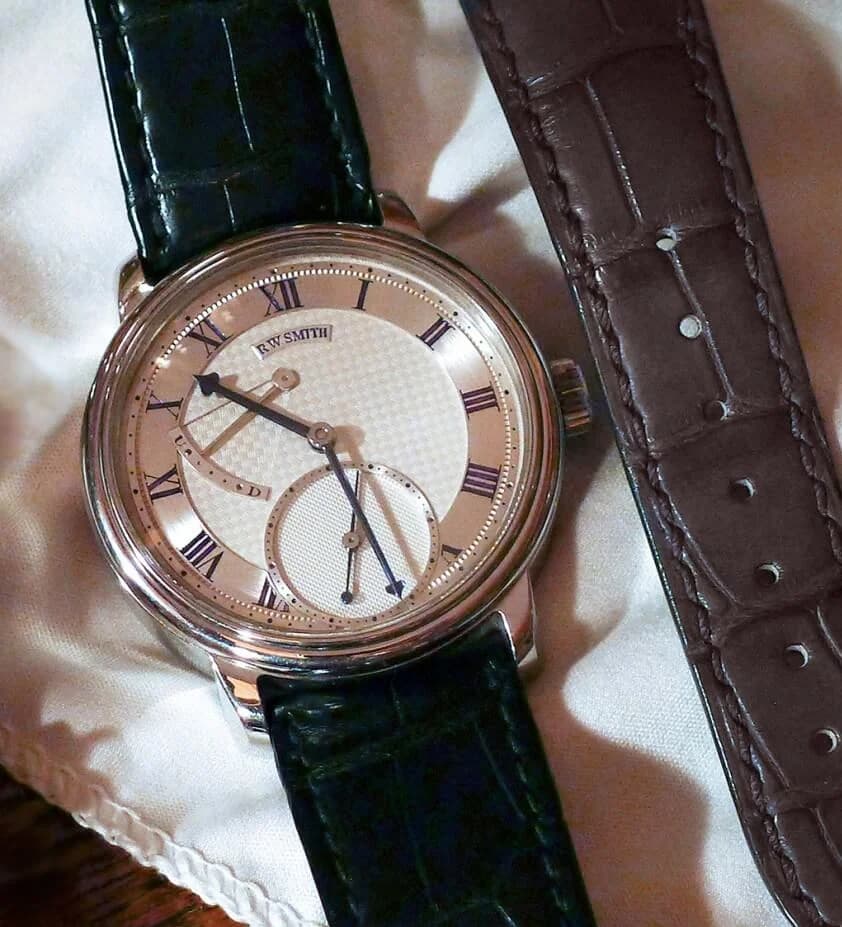
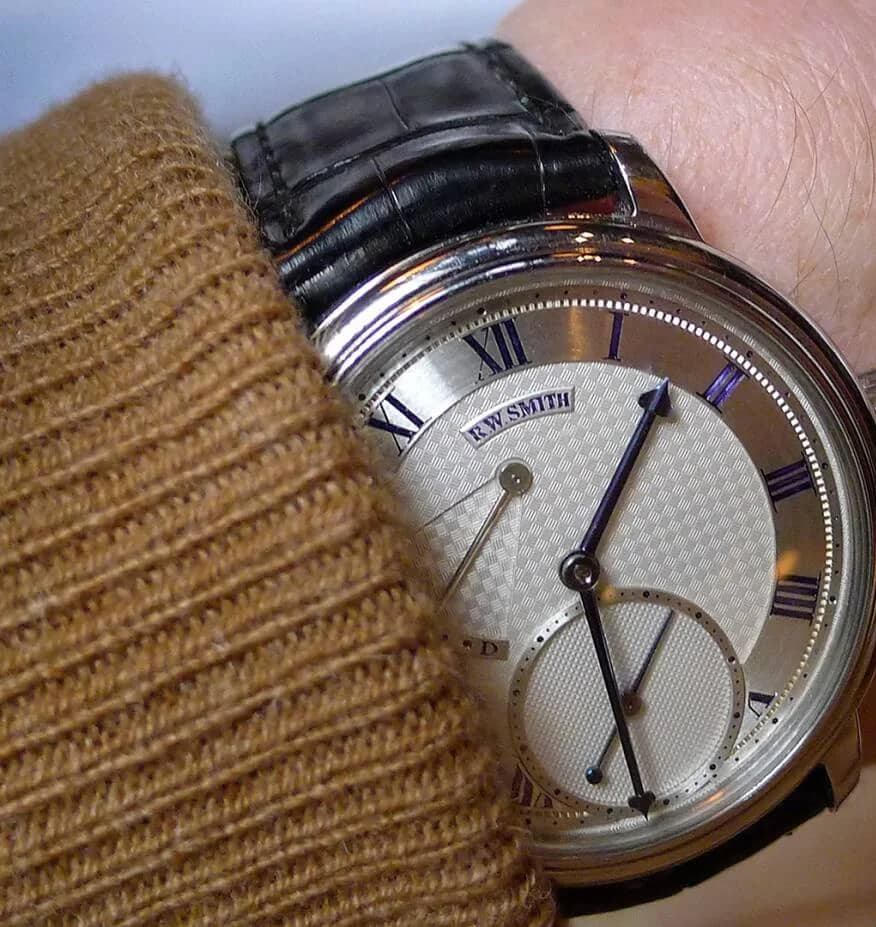
The case is offered in 38mm or 40mm, with the 40mm version measuring 40 by 13mm. Both sizes are available in 18K gold (yellow, rose, or white) and stainless steel. The case is hand-fabricated using the Daniels Method, a three-part construction of middle, back, and bezel. The exhibition caseback is secured by six screws and fitted with a sapphire crystal, as is the front. The dial is engine-turned silver with black Roman numerals, a subsidiary seconds display at six o'clock, and a power reserve indicator at ten o'clock. The power reserve display is straightforward, like a fuel gauge, showing how much energy remains in the mainspring. With only 36 hours of reserve, that gauge becomes a practical feature rather than a decorative one. The hands are 18K gold pointed batons with a blued steel power reserve hand. The overall aesthetic is classical, quiet, and profoundly English. There is nothing here trying to be modern or sporty. It is a watch that knows exactly what it is.
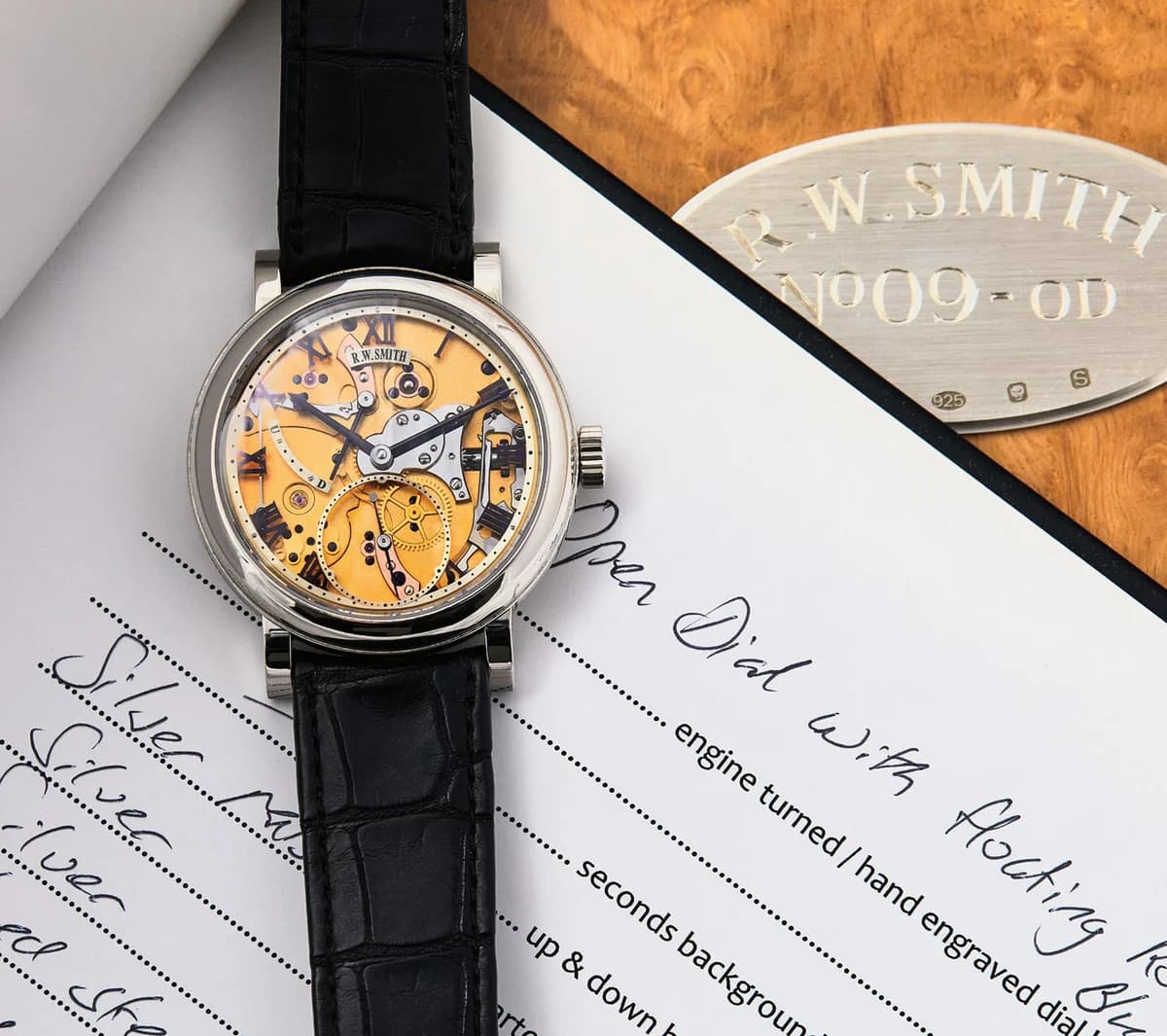
Smith originally planned an Edition concept for the Series 2, with 90 total pieces: 30 in each color of gold. The reality of his clientele changed that plan quickly. Most collectors who approached Smith wanted something bespoke, a custom dial treatment or a specific engraving or a particular combination of finishes. The Edition concept was abandoned after only five examples of each variant were produced, making those early Edition pieces some of the rarest modern watches in existence. Today, every Series 2 is essentially a commission piece. Each one is unique in the details even if the fundamental architecture remains the same.
The Isle of Man itself is part of the story. It is a small Crown dependency in the Irish Sea, population of about 85,000, known more for motorcycle racing and offshore finance than for horology. But it was home to Daniels for decades, and it became home to Smith when he went to work on the Millennium project. The isolation is deliberate. There are no watchmaking neighbors to borrow from, no suppliers down the road, no shared infrastructure. Everything ships in as raw material and ships out as a finished watch. That isolation forces a level of self-sufficiency that a Geneva-based watchmaker simply does not face. In my experience, the best work in any craft comes from people who have deliberately chosen constraints that most would consider impractical.
Smith started in that converted bedroom in Ballaugh and stayed there for seventeen years. In 2018, the same year he received the Order of the British Empire for outstanding services to watchmaking, he relocated to a purpose-built workshop elsewhere in the Manx countryside. He now has a small team, but Smith's hands still touch every critical surface. The annual production remains approximately ten watches per year across all series. His total output since founding the company in 2001 is measured in the low hundreds. Compare that to Dufour's approximately 230 watches over his entire career, or Daniels' output of perhaps 50 complete watches. These are the numbers that define independent watchmaking at its most pure. The British Horological Institute awarded Smith the Silver Medal in 2011, the same year Daniels passed. In 2025, he received the Gaia Prize in the Craftsmanship-Creation category, joining a list of recipients that includes Daniels himself.
I think the honest critique of the Series 2 centers on two practical realities. The first is the 36-hour power reserve. For a hand-wound watch with no automatic winding, 36 hours is tight. It means the watch needs to be wound every day without exception. Miss a morning and the watch will have stopped by evening. Philippe Dufour's Simplicity manages 52 hours from a manually wound movement. A Lange and Sohne's Lange 1, also hand-wound, delivers 72 hours. I understand the tradeoff. Smith's mainspring is deliberately light to reduce force through the gear train and protect the co-axial escapement surfaces. A stronger spring for longer power reserve would increase the forces on an escapement designed specifically to minimize them. The engineering logic is sound, and Smith has prioritized escapement longevity over winding convenience. But it is a tradeoff worth knowing before committing. The second reality is thickness. At 13mm in the 40mm case, this is not a slim dress watch. The three-quarter plate, the raised bridges, the gold chatons all contribute to vertical height. It will sit proud on a 6.5-inch wrist rather than disappearing under a cuff. Some of that height is inseparable from the finishing that makes the movement worth looking at through the caseback. You cannot have a three-dimensional movement architecture and a thin case. Pick one.
On the wrist, the Series 2 in yellow gold has a warmth that I notice particularly against darker skin. The combination of the gilt movement visible through the back, the gold case, and the silver dial creates a watch that reads as unmistakably traditional English. It pairs naturally with warm fabrics, a Ermenegildo Zegna Super 150 in charcoal or a mid-weight flannel in navy. The watch does not call attention to itself the way a complicated dial or a large case might. Its presence is quiet. Someone who knows watches will recognize what it is. Everyone else will see a refined gold watch with a clean dial. That distinction, between the small community that understands what they are looking at and the wider world that does not, is entirely the point.
I put Dufour, Daniels, and Smith together in this collection because they represent a lineage. Daniels revived the methods of Breguet. He taught Smith. Dufour worked independently in the Vallee de Joux but pursued the same ideal of total handcraft. Together, they represent the argument that the highest form of watchmaking is not industrial production, no matter how refined, but the work of a single pair of hands applied to every surface of a mechanical object. That argument is getting harder to sustain as the last generation of craftsmen capable of this work ages. Smith, born in 1970, is the youngest of the three and he is the future of this tradition. He is also the only one still actively producing watches. Daniels is gone. Dufour has essentially retired. Smith is the last one at the bench, on a small island in the Irish Sea, building ten watches a year with an escapement that nobody else in the world makes by hand.
What I find most compelling about the Series 2 is what it represents philosophically. There is a version of watchmaking where progress means higher frequency, more complications, thinner cases, longer power reserves, more automated manufacturing. Smith's version of progress is different. He took an escapement design that his teacher invented and made it better. He took a method of handcraft that dates back to Breguet and proved it could still produce watches that perform as well as anything coming out of a Swiss manufacture. The Series 2 does not compete on specifications. It competes on integrity. Every surface, every angle, every screw in this watch was shaped by the same person who designed the escapement and calculated the gear train. That is not just rare in modern watchmaking. It is nearly extinct. When Smith stops, and I hope that day is far away, this tradition may stop with him. The Series 2 is not just a watch. It is evidence that one person can still do everything.
Also in Independent Masters