
Philippe Dufour
Simplicity
Simplicity 37mm
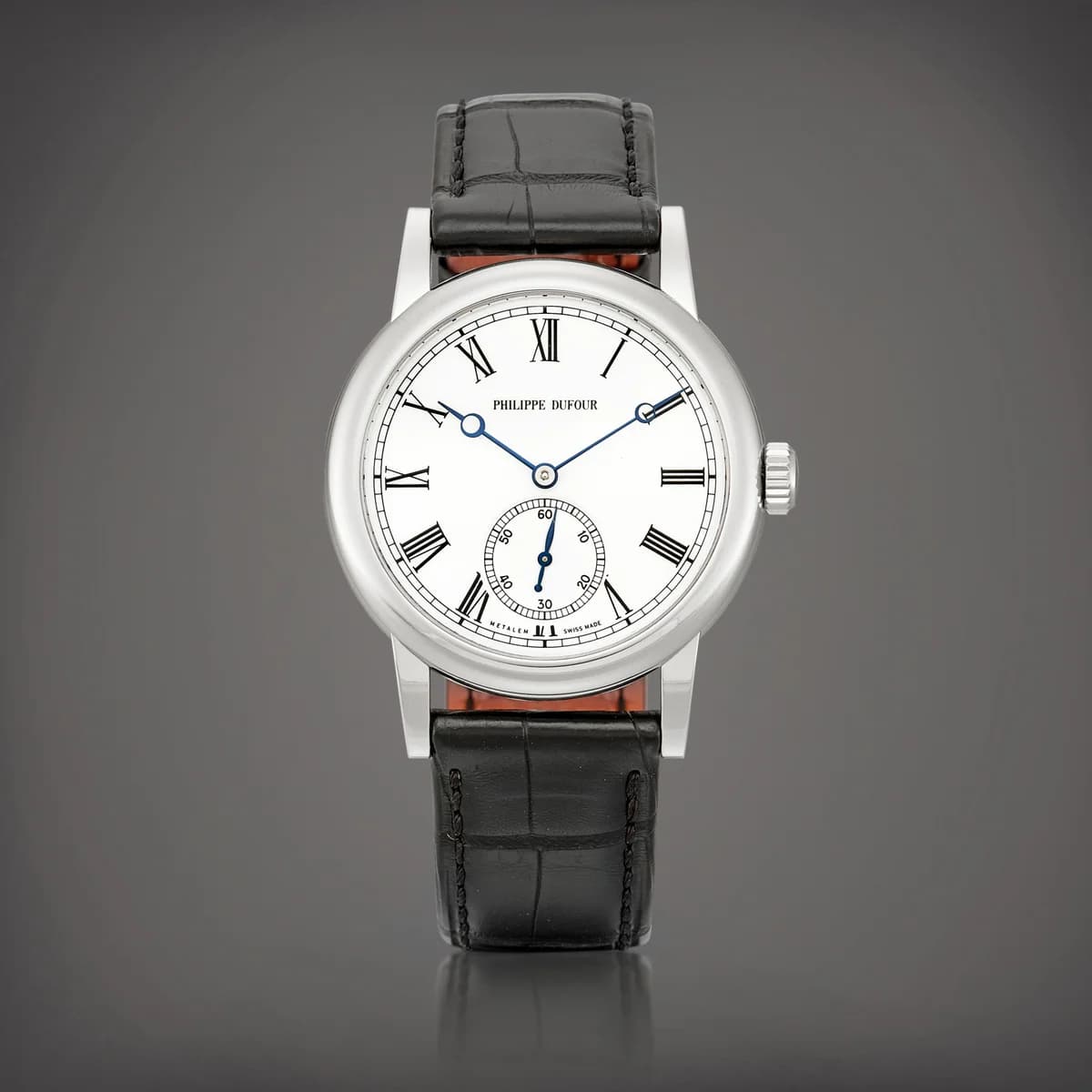
You have to understand what independent watchmaking actually means to appreciate why the Simplicity matters. In the Swiss industry, even the most prestigious brands operate as organizations. Patek Philippe has over 2,000 employees. Audemars Piguet has more than 2,300. Rolex, somewhere north of 14,000. These are factories, refined and meticulous ones, but factories nonetheless. Components are machined by CNC, finished by specialists in one department, assembled by other specialists in another, and quality-controlled by yet another team. Philippe Dufour works alone. One man, in a former schoolhouse in the village of Le Solliat in the Vallee de Joux, finishing every single surface of every single component by hand. That is the context. That is why the Simplicity is the standard against which every independent watchmaker is measured.
Dufour was born in 1948 in Le Sentier, a village in the heart of the Vallee de Joux, the cradle of Swiss watchmaking. The valley has produced watchmakers for centuries because of its geography: high, isolated, snowbound for months, with long winters that kept farmers indoors. They became watchmakers because they needed something to do with their hands during the dark months. The tradition runs so deep that the entire valley is a UNESCO-listed watchmaking region. Dufour graduated from the Ecole Technique in Le Sentier in 1967 and went straight to Jaeger-LeCoultre, where he trained under Gabriel Locatelli. From there he worked at General Watch Company (which sent him to an assembly unit in the Caribbean), then Gerald Genta, then Audemars Piguet. Each stop taught him something different: Jaeger-LeCoultre gave him the foundation, Genta exposed him to high-end case design, and Audemars Piguet showed him what complication work looked like at the highest level. In 1978, he bought a fully equipped workshop and began restoring antique pocket watches. Restoration is where he truly learned the techniques of the old masters. Taking apart grande sonnerie movements from the nineteenth century, understanding how watchmakers solved problems before CNC existed, before electricity was common in workshops. He was learning by reverse-engineering the work of people who had been dead for a hundred years.
Between 1982 and 1988, Dufour built five grande and petite sonnerie pocket watches for Audemars Piguet, each requiring roughly 2,000 hours of work. By 1992, he had debuted his own grande and petite sonnerie wristwatch at Baselworld. This was a genuine first. Nobody had ever miniaturized the most complex chiming complication into a wristwatch case before. The grande sonnerie strikes the hours and quarters automatically, and on demand repeats the time to the nearest minute. It requires hundreds of components working in concert, tiny hammers striking tuned gongs, a silence mechanism, and a safeguard system to prevent the striking mechanism from interfering with the timekeeping. Only eight were ever made. In 1996, he created the Duality, a wristwatch with two escapements beating in synchronization, of which only nine were produced. In 1998, he received the Gaia Prize, sometimes described as the Nobel Prize of watchmaking, in the Craftsmanship-Creation category. Then in 2000, he introduced the Simplicity.
The name itself tells the story. After building the most complex wristwatch complication in existence (the grande sonnerie), Dufour went the opposite direction. Hours, minutes, small seconds at six o'clock. No date. No complications. No moonphase. Nothing except time, displayed by a movement finished to a level that almost nobody else on earth can match. The Simplicity is a radical argument: that the highest expression of watchmaking is not complexity but perfection of the fundamentals. I love that. In an industry obsessed with tourbillons, perpetual calendars, and minute repeaters, Dufour said the quiet part out loud. None of that matters if the finishing is mediocre. A tourbillon with machine-cut angles and lifeless Geneva stripes is not a better watch than a time-only piece where every surface has been touched by hand. The Simplicity makes that argument more convincingly than any essay could.
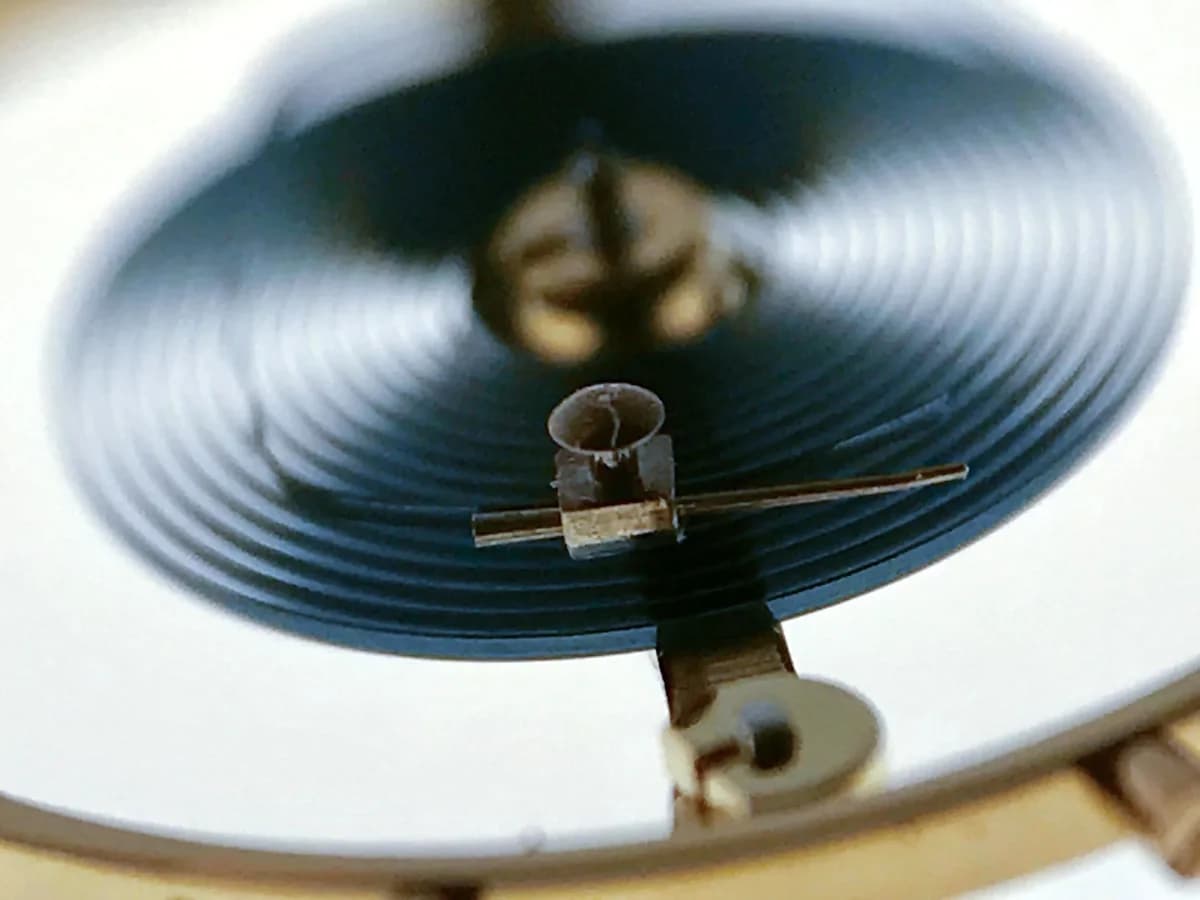
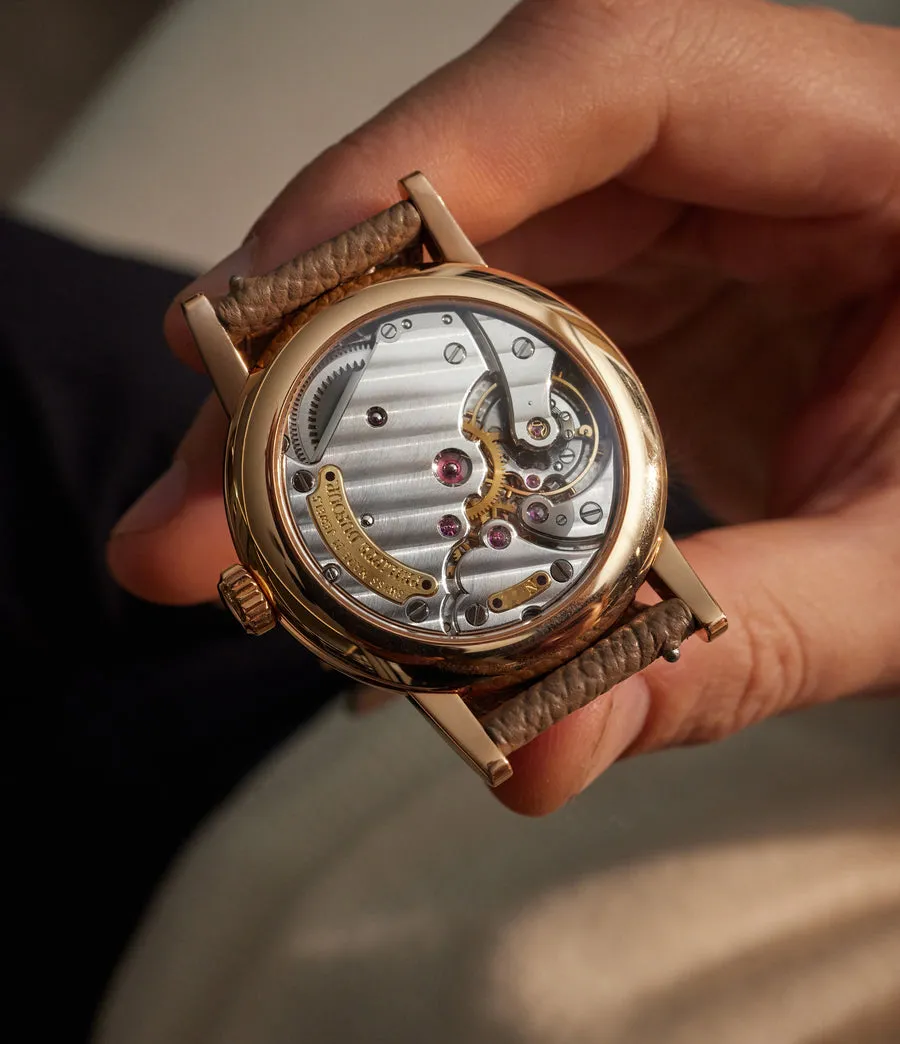
The Caliber 11 is hand-wound, runs at 2.5 Hz (18,000 vibrations per hour), contains 21 jewels, and delivers a 52-hour power reserve. It uses a free-sprung balance with a Breguet overcoil hairspring, which Dufour bends by hand. Bending a Breguet overcoil is one of the hardest skills in watchmaking. The terminal curve of the hairspring is raised and shaped into a specific geometry that allows the spring to breathe concentrically, which improves isochronism (the ability of the watch to keep the same rate regardless of how wound the mainspring is). Getting that curve right, by hand, with tweezers and a loupe, is something most watchmakers never attempt. The movement diameter is 30mm. On paper, these are modest specifications. A Patek Calatrava or a Lange Saxonia would match or exceed them on every line of the spec sheet. But specs are not the point. The point is what happens to every surface before the movement goes into the case. That is where the Simplicity exists in a different category from everything else.
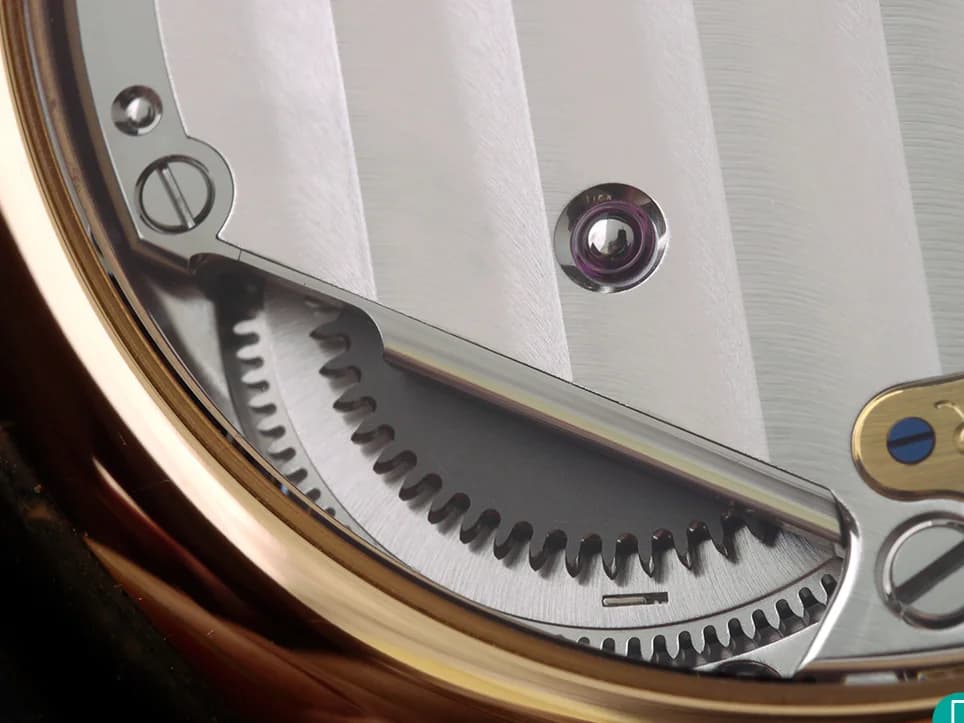
I want to explain what hand-finishing actually means at Dufour's level because the phrase gets thrown around loosely in this industry. Start with the interior angles. Where a bridge meets the mainplate, there is an inside corner. In machine-finished movements, even at the highest Swiss level, these interior angles have a radius. The CNC cutter or the polishing disc cannot reach all the way into the corner, so it leaves a gentle curve. Hand-cut interior angles are sharp. Perfectly vertical creases where the surfaces meet. Dufour achieves this with files and gravers, working under a microscope, on every single bridge. This is the tell that separates handwork from machine work, and it is the first thing any trained eye looks for when evaluating movement finishing. The Naked Watchmaker's deconstruction of the Simplicity confirms what collectors already knew: the anglage is broad, round, and finished on the final pass with gentian wood harvested locally in the Vallee de Joux. That wood produces a surface that no synthetic abrasive can replicate. It is a technique from an era when local materials were all you had.
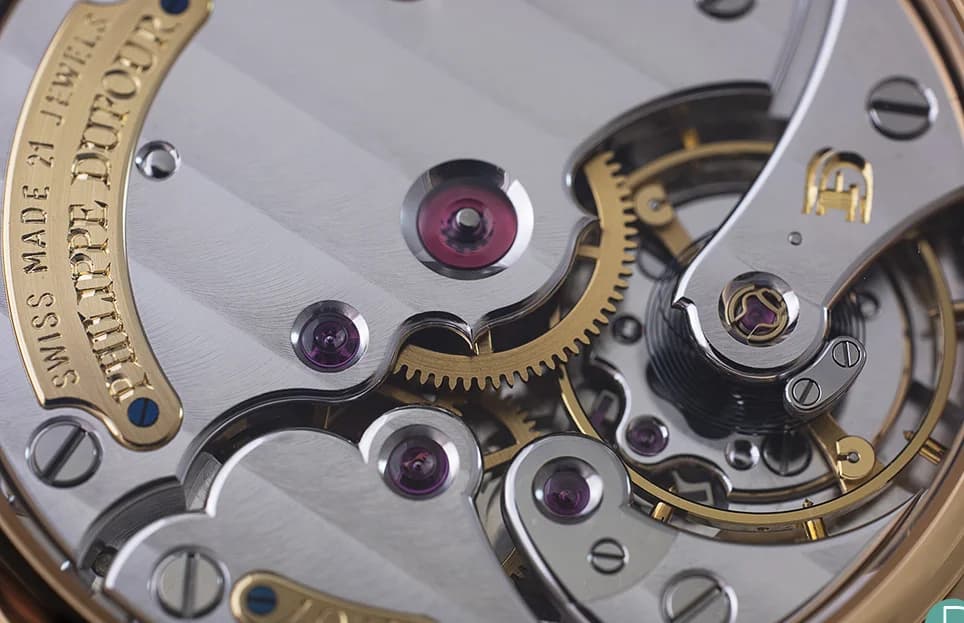
The Geneva stripes on the bridges are applied by hand, not by a lathe with an abrasive disc. The difference is visible under magnification. Machine-applied stripes are perfectly uniform and perfectly lifeless. Hand-applied stripes have a subtle irregularity, a human rhythm that catches light differently as you tilt the watch. Every screw is flame-blued, individually, over an open flame. The color comes from controlled oxidation at a precise temperature. The window between the correct deep blue and ruined brown is seconds. Every bevel is polished to a mirror finish that produces an unbroken reflection along the entire edge of each bridge. This is called black polishing in the trade, and when it is done correctly the polished surface appears almost liquid under magnification. The plates are 18K gold, engraved with the serial number by Kees Engelbarts. The movement goes through double assembly: Dufour builds it once, inspects it, disassembles it completely, cleans every component, and reassembles it from scratch. The first assembly is for function. The second is for presentation. Any fingerprint, any dust particle, any mark left by a tool during the first assembly gets addressed in the second. Most brands skip this step entirely because it effectively doubles the assembly time. Dufour does not skip it.
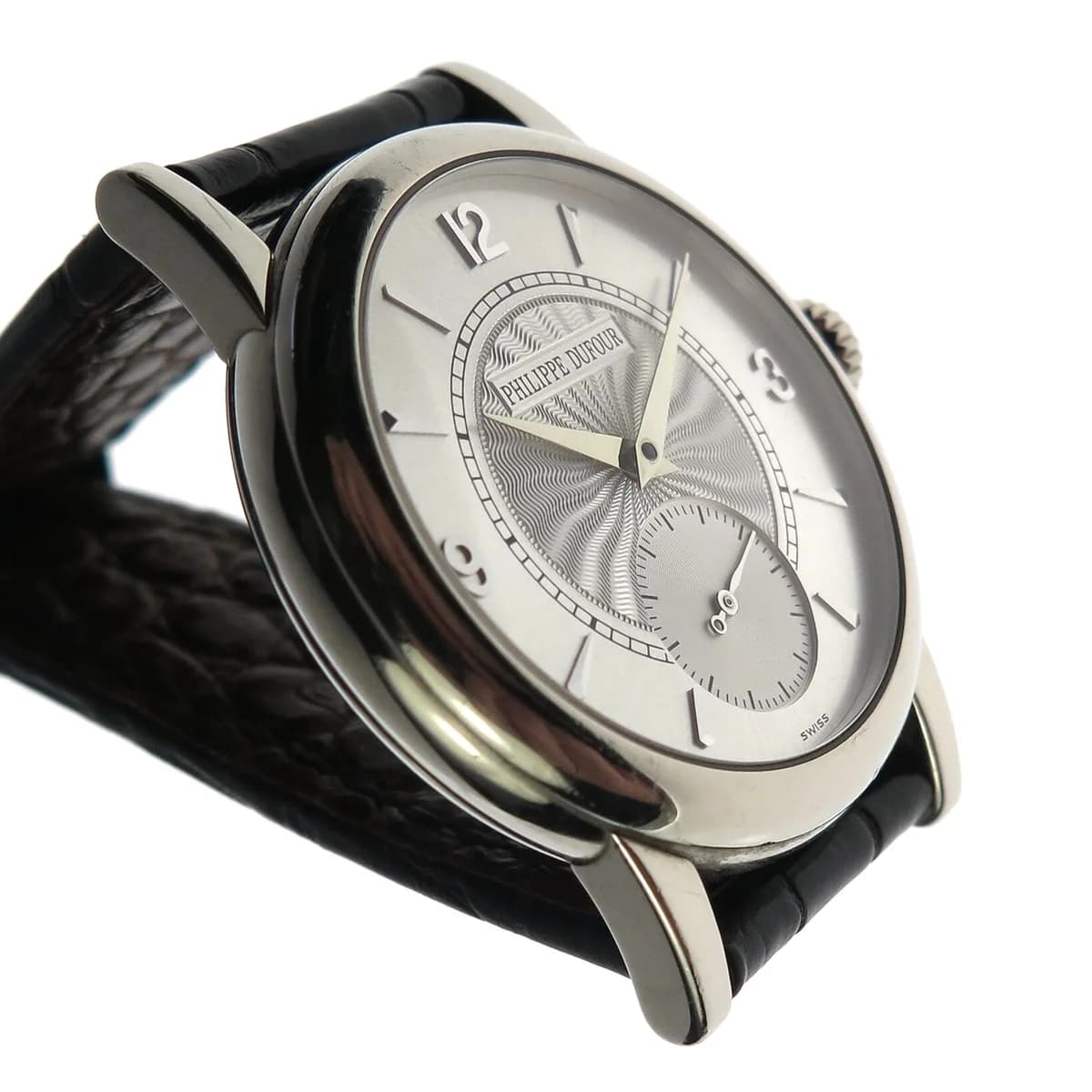
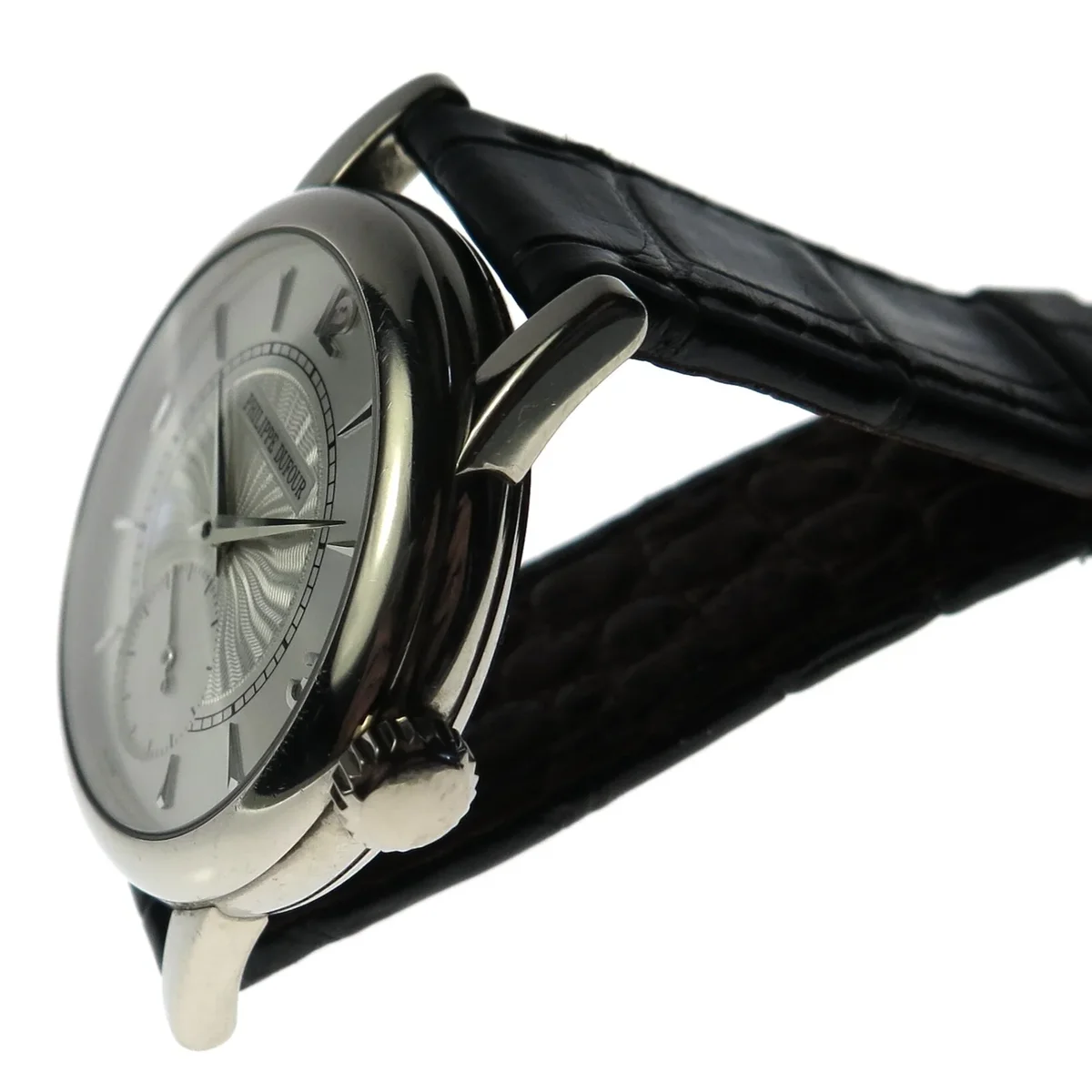
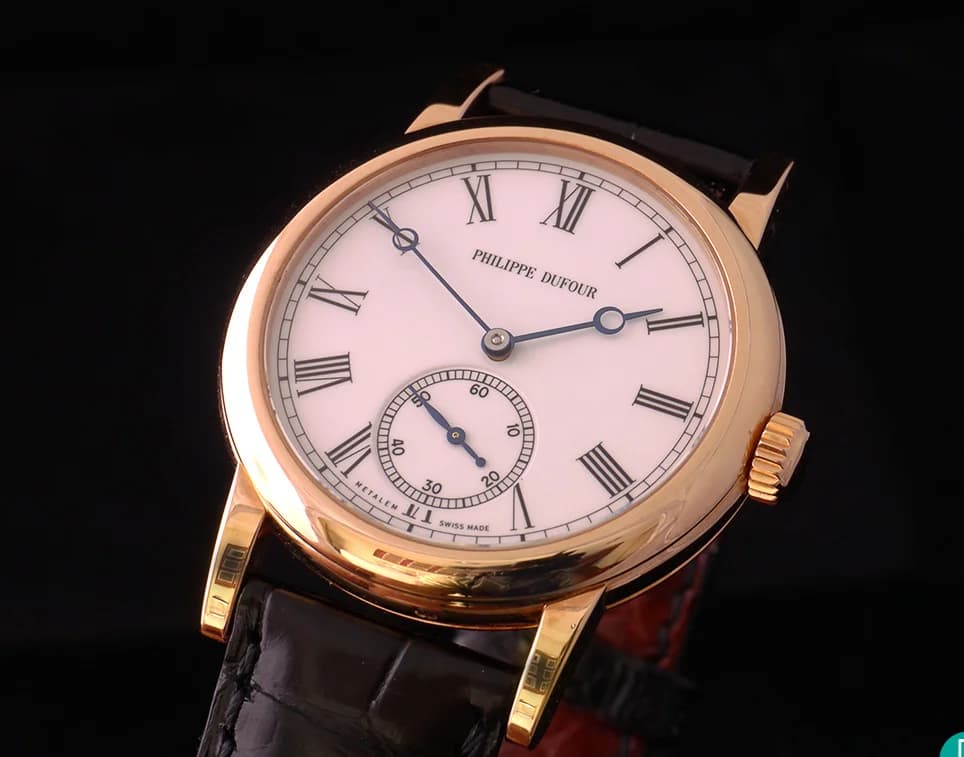
The case comes in two sizes, 34mm and 37mm. The original Simplicity launched in 34mm, and when collectors requested a larger option, Dufour did not simply drop the same movement into a bigger case with a spacer ring. He redesigned the entire movement for the 37mm case. That is the difference between someone who cares about the work and someone who cares about filling an order. Both sizes sit at 8.4mm thick, which for a hand-wound time-only watch in precious metal is exactly right. Not trying to be the thinnest watch on the market. Not unnecessarily thick. Just correct. The cases are available in 18K rose gold, 18K white gold, or platinum. Dufour never offered yellow gold because he did not like the hue. Water resistance is 30 meters, enough to survive a handwash but not a swimming pool. For a watch like this, that is expected. The caseback is sapphire, because the movement is the entire point.
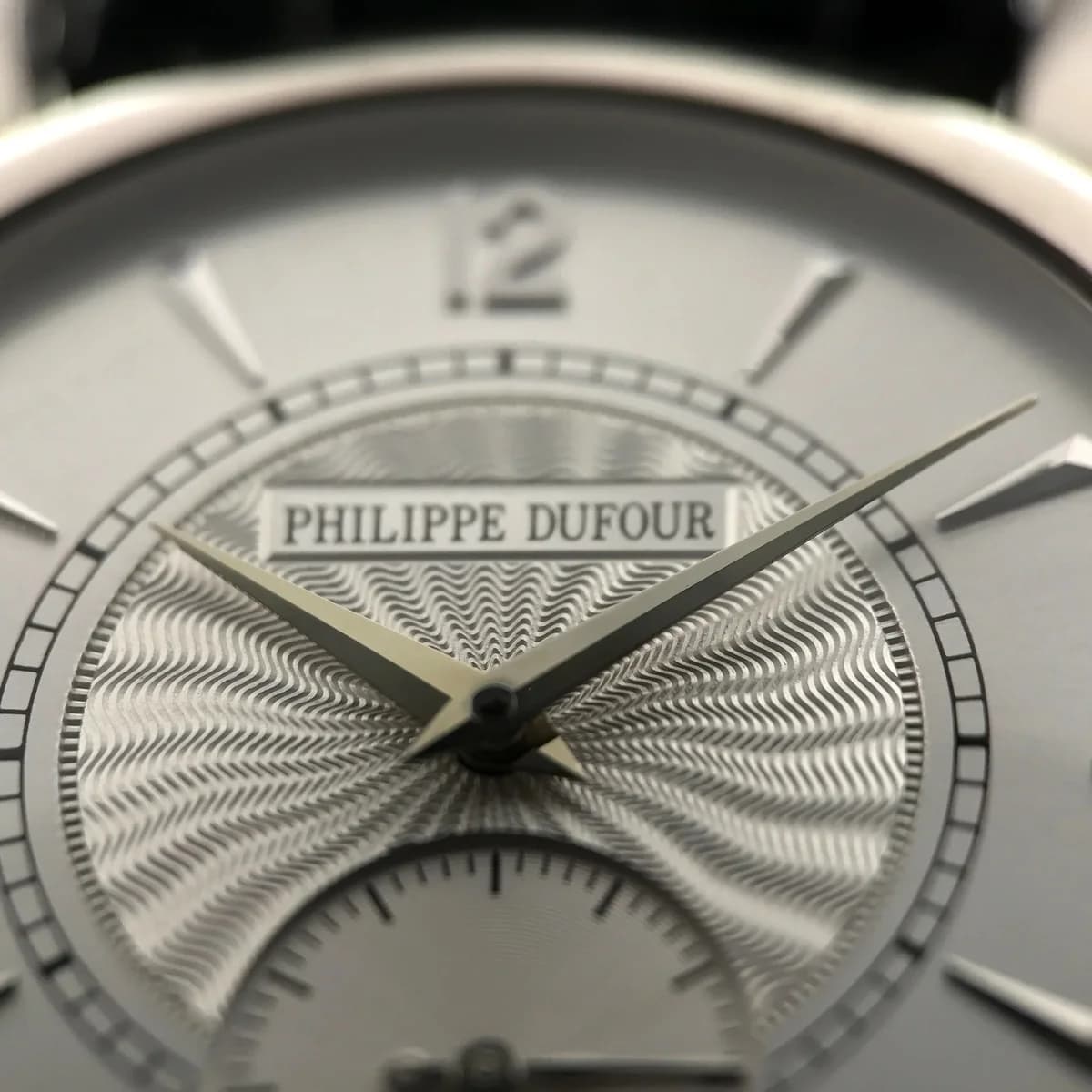
The dial is either white lacquer or hand-guilloche silver, made by Metalem. Dufour lets Metalem print their name on the dial, which in an industry where suppliers are systematically hidden behind brand names is a small act of honesty that I appreciate. It says something about a watchmaker who has nothing to hide. The hour markers are Roman numerals, the hands are flame-blued Breguet style, and the small seconds at six o'clock uses Arabic numerals for the tens and a railroad-style track. There are rare dial variations that collectors obsess over: grey dials with Breguet numerals, and at least one unique steel piece with Eastern-Arabic numerals and a gilt dial delivered in 2020. The 20th anniversary edition, also from 2020, introduced applied Breguet numerals and a large PD emblem at twelve o'clock. Twenty-one pieces were made for that run (seven in rose gold, seven in white gold, seven in platinum), and the first piece, numbered 00/20, sold at Phillips Geneva.
Approximately 200 Simplicity watches were made between 2000 and 2020. Sources vary on the exact count (some say 204, others 206), but the order of magnitude is what matters. That is roughly 10 watches per year. One man. Working alone. Roughly 120 of those went to Japanese collectors, who understood what Dufour was doing long before the Western market caught on. Japan has a deep tradition of appreciating craft for its own sake, the concept of shokunin (craftsman spirit), and Japanese collectors recognized Dufour as a kindred spirit early. Acquiring a Simplicity required a personal introduction to Dufour and vouching from an existing client. There was no boutique, no website with an "add to cart" button, no waiting list you could join by sending an email. In total, between 1992 and 2020, Dufour produced approximately 230 watches across all three models. That is eight watches per year across his entire career. For perspective, F. P. Journe's manufacture in Geneva produces around 900 watches annually with a full team. Dufour produced fewer watches in his entire career than Journe makes in a single quarter. The first Simplicity did not appear at public auction until November 2016, sixteen years after the model launched. Fewer than 30 examples have ever appeared at auction in total. That scarcity is not manufactured. It is the natural consequence of one person making ten watches a year for two decades.
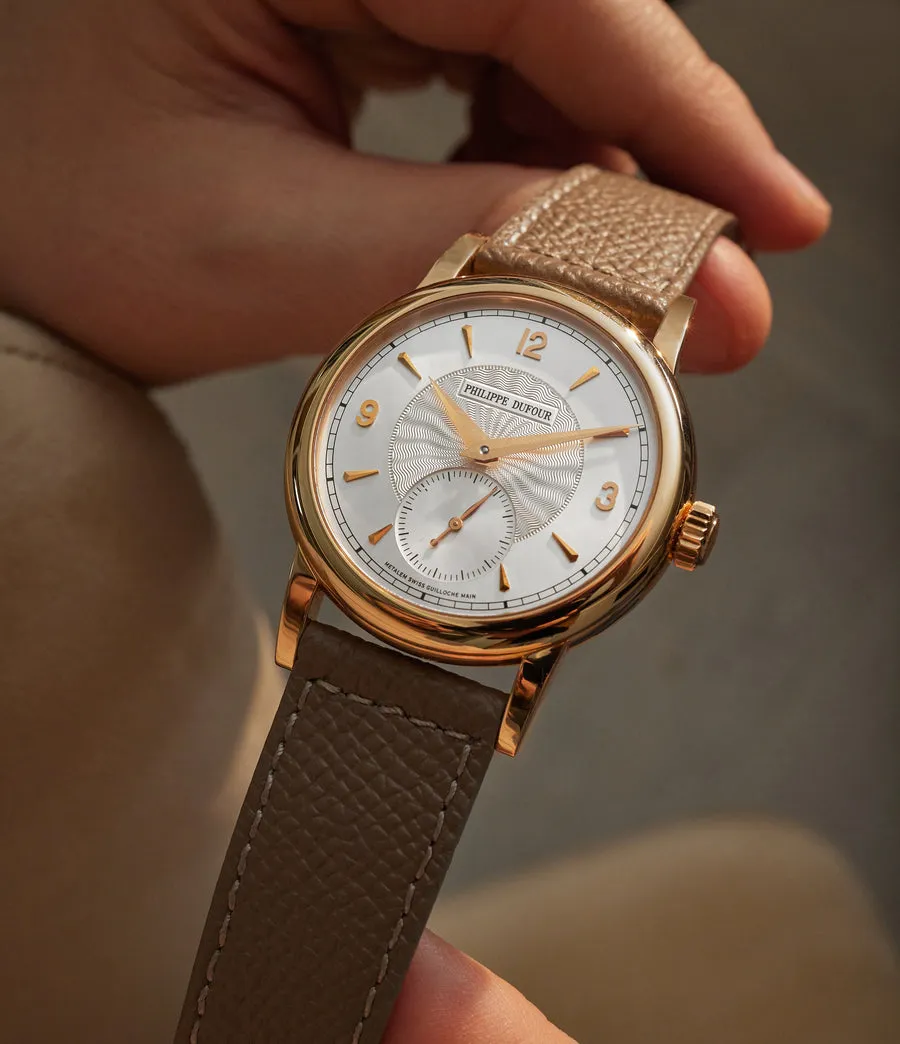
My honest observation about the Simplicity is the 34mm case size. I have a 6.5-inch wrist, and 34mm is a watch that sits small even on me. For anyone with a wrist over seven inches, the 34mm would look undersized, particularly given how much of the case is consumed by the bezel and the relatively narrow dial aperture. The 37mm corrected this, and it wears beautifully, but the earliest Simplicity pieces are the 34mm versions, and those are often the ones that appear at auction. If the proportions of the 37mm had been available from the start, I think the watch would have been even more universally praised from day one. That said, I appreciate that Dufour's response was not to simply upsize the case but to redo the entire movement. That is the kind of detail that separates a craftsman from a manufacturer. The watch also lacks any lume whatsoever, which means reading time in low light requires tilting the dial to catch ambient light. For a dress watch worn primarily at formal dinners and evening events, that is an acceptable tradeoff, but it is worth noting for anyone who expects a watch to be legible in all conditions.
What separates Dufour from even F. P. Journe, who I admire deeply and who sits elsewhere in this collection, is the question of scale. Journe built a manufacture on the Rue de l'Arquebuse in Geneva. He trained a team. He produces hundreds of watches per year using industrial methods refined to an extraordinary standard. But Journe did not hand-cut every interior angle on every bridge himself. He cannot. No one person can do that at production volume. Dufour never scaled. He chose the path of one, and he stayed on it for his entire career. George Daniels did the same thing on the Isle of Man. Roger Smith continues it. There is a lineage here: Daniels, Dufour, and Smith all represent the argument that the highest form of watchmaking is the work of a single pair of hands applied to every surface. Each of them arrived at that conclusion independently, from different traditions (English for Daniels and Smith, Swiss for Dufour), and each produced work that validates the argument. Dufour has been a member of the AHCI since 1987, alongside Daniels, Journe, and the other founders of the independent movement. His workshop in Le Solliat, a former schoolhouse on Rue du Village, is one of the most visited destinations in the Vallee de Joux for collectors and journalists who want to see where the work happens.
What strikes me about the Simplicity is how naturally it pairs with quiet, deliberate dressing. A rose gold Simplicity on a dark brown alligator strap with a Vitale Barberis Canonico merino wool suit in charcoal or navy is one of the most elegant combinations in watchmaking. The polished case and Breguet hands catch light without screaming for attention. The 37mm sits flat under a French cuff without catching on the fabric. The warm tone of rose gold against darker skin is something watch media almost never discusses, but it matters. The Simplicity does not have a bracelet option, which keeps it permanently in dress-watch territory. That is not a limitation for this watch. It is the point. A Simplicity on a rubber strap would be an absurdity. This is a watch that knows exactly what it is and does not pretend to be anything else.
If you ever find yourself in the Vallee de Joux, the drive through the valley is worth the trip on its own. The landscape explains the watchmaking: isolated, quiet, focused. Le Solliat sits at roughly 1,000 meters elevation, surrounded by forest and farmland that has not changed much in centuries. The kind of place where a person could spend forty years at a bench perfecting interior angles without anyone telling them to hurry up. Dufour found that place when he was thirty, and he never left. Many associate him with the rose gold and black-dialled A. Lange & Sohne Datograph, a watch he wore so often it earned the nickname "Dufourgraph." More recently, the greatest living watchmaker has shifted to wearing Rolex as his daily rotation: a Daytona "Panda" ref. 116500LN, a GMT-Master II "Pepsi" ref. 126710BLRO, and an Oyster Perpetual 41 "Coral" ref. 124300. Even a man who finishes every surface by hand reaches for something different when he leaves the bench.
I include the Simplicity in this collection because it is the benchmark. Every other independent watchmaker here, Journe, Gronefeld, Brette, Lederer, Kudoke, Voutilainen, is measured against the finishing standard that Dufour established. Some approach it. None exceed it. The Simplicity proves that one person, working alone, with hand tools and decades of accumulated skill, can produce something that no factory, no team, no amount of capital can replicate. That was true in 2000 when the first one left Le Solliat. It will be true fifty years from now. The work is the proof.
Also in Independent Masters