
George Daniels
Millennium
Millennium
To understand the Millennium, I have to start with the man. George Daniels was born on 19 August 1926 in the East End of London, the second of eleven children, into a family that had almost nothing. He grew up in poverty, working odd jobs as a child, assembling springs in a mattress factory, selling firewood, doing whatever kept the household going. He served in the Second World War, and when he came back to London in the late 1940s, he had no formal education and no obvious path. In 1949, he enrolled in evening classes at Northampton Polytechnic, attending three times a week after work to learn watchmaking. By 1950, he had opened a watch repair shop. That is where the story begins. Not at a Swiss manufacture. Not at a prestigious school. In a repair shop, with a man who taught himself by taking apart other people's watches.
Daniels spent the next two decades restoring antique pocket watches. This is the detail that matters most, and it is the detail that gets passed over too quickly in most accounts of his life. Restoration is not repair. Repair means fixing what is broken. Restoration means understanding what someone built two hundred years ago well enough to return it to its original state. Daniels was holding Breguet movements in his hands, disassembling them, studying how the greatest watchmaker of the eighteenth century solved problems with the tools and materials available to him. He published The Art of Breguet in 1974, a book that is still considered the definitive study of Breguet's work. By that point, he had already completed his first pocket watch in 1969, a tourbillon with a pivoted detent escapement, built entirely by hand. Over his lifetime, he would build roughly two dozen complete pocket watches from raw materials, using tools he made himself. Some sources cite 23 completed pieces, others say 27 unique watches plus prototypes. The exact number matters less than what it represents. Every wheel, every pinion, every bridge, every dial, every hand, every case, made by one person.
In 1974, Daniels designed a new escapement. By 1976, he had incorporated it into his pocket watch number 10, commissioned by the American horological collector Seth G. Atwood. He called it the co-axial escapement, and it is the most important advancement in mechanical escapement technology since Thomas Mudge developed the lever escapement in the eighteenth century. I do not use that phrase lightly. The Swiss lever escapement has been the standard for more than 250 years, and for good reason: it is solid, reliable, and self-starting. But it has a fundamental flaw. Every time the escape wheel delivers impulse to the pallet fork, the teeth slide against the pallet stones. That sliding friction requires lubrication. Lubrication degrades over time. Degraded lubrication means inconsistent timekeeping and increased wear. That is why every mechanical watch needs servicing every five to ten years. Not because the parts wear out, but because the oil does.
The co-axial escapement solves this by delivering impulse radially rather than tangentially. Instead of the escape wheel teeth sliding across the pallet stones, they push against them in a rocking motion that involves almost no sliding friction. The geometry is different. The interaction between the components is fundamentally different. Less sliding friction means less lubricant degradation, which means longer service intervals and more consistent accuracy over the life of the watch. Daniels spent years refining the design and filed for a patent in 1979, which was granted in 1980 as UK Patent GB 2 032 997 A. He then spent the next two decades trying to convince the Swiss watch industry to adopt it.
This is the part of the story that I find most remarkable. Daniels approached Rolex. He approached Patek Philippe. He approached other major Swiss brands. Every single one of them turned him down. The timing was catastrophic. The 1970s and 1980s were the quartz crisis years. Swiss brands were fighting for their survival against Japanese quartz technology. Investing in a new mechanical escapement, one that had never been produced at industrial scale, seemed like an unnecessary risk when the industry was not even sure mechanical watches had a future. Patek Philippe went so far as to build a prototype co-axial movement in 1981, placing it inside a Nautilus case, but ultimately abandoned the project. Rolex showed no interest at all. For nearly twenty years, the most important advancement in escapement technology since the 1700s sat in a workshop on the Isle of Man, where Daniels had moved in 1982, with no manufacturer willing to produce it.
It took Nicolas G. Hayek Sr., the founder of the Swatch Group, to break the impasse. Hayek recognized what the co-axial could mean for Omega, and ETA (the Swatch Group's movement manufacturer) began adapting Daniels' escapement for industrial production. The first Omega watch with a co-axial escapement, the De Ville with Caliber 2500, launched in 1999. That caliber was based on the ETA 2892-A2 ebauche, modified to incorporate Daniels' co-axial escapement. Today, Omega uses the co-axial in virtually every movement they produce. The principle that makes every modern Omega run better was designed by one man, working alone, on an island in the Irish Sea.
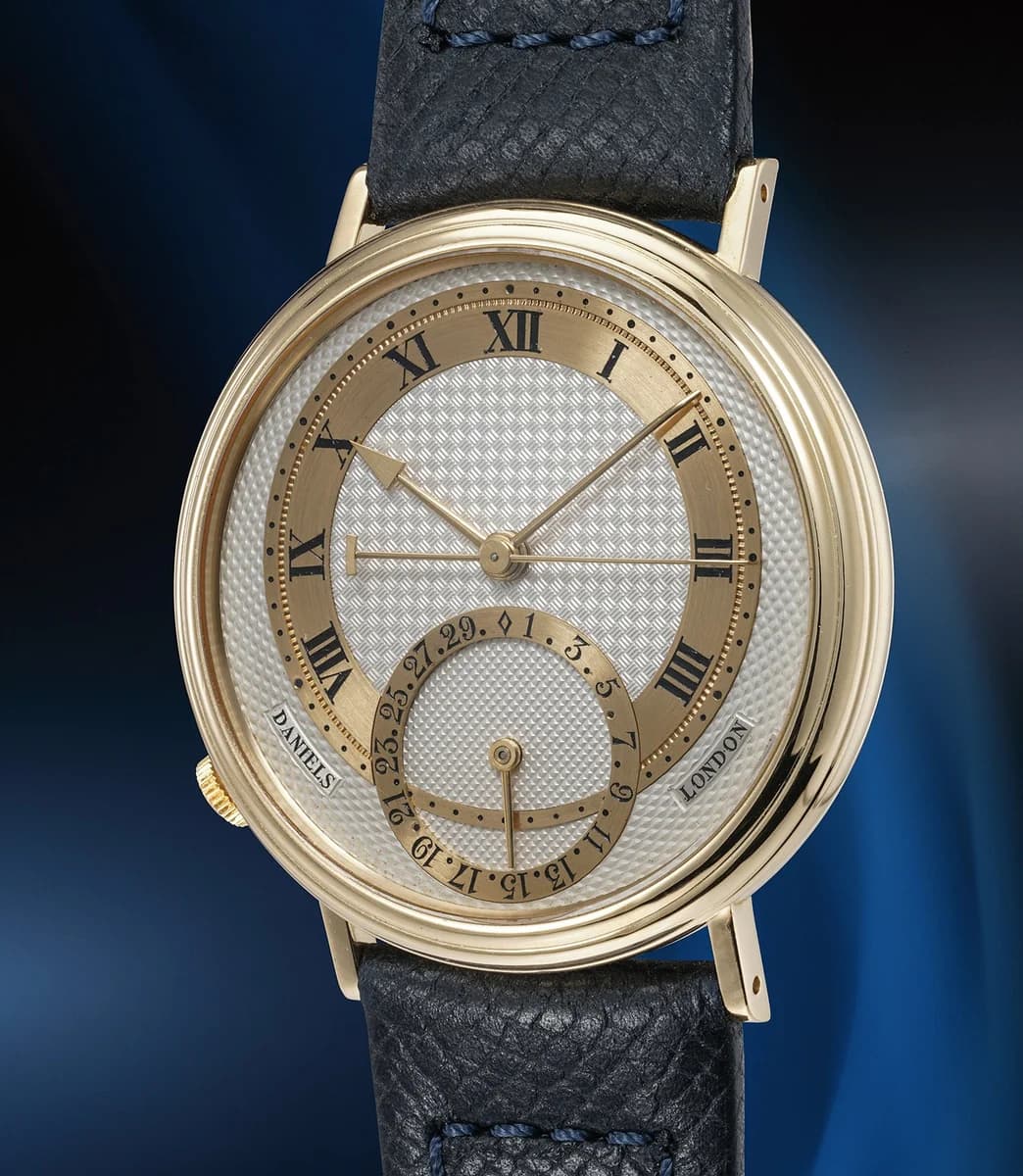
The Millennium wristwatch was created to celebrate that moment. In 1998, Daniels purchased approximately fifty Omega ebauches, the very first production movements to contain the co-axial escapement, and set out to create a small series of wristwatches bearing his own name. He was 72 years old. His original plan was for roughly a dozen pieces, but the project grew. He enlisted Roger Smith, who had approached him in 1997 carrying a pocket watch he had built using the instructions in Daniels' book Watchmaking. That book, published in 1981, is considered the most thorough manual on traditional watchmaking ever written. Smith had taught himself from it, built a complete watch, and brought it to Daniels to show him. Daniels took him on as his only apprentice. Together, over approximately three years from 1998 to 2001, Daniels and Smith finished the Millennium series.
The exact production number is debated. Auction houses and dealers cite different figures. Sotheby's records indicate 47 yellow gold examples. Bonhams references 48 in yellow gold. Other sources cite a total of 50 pieces, with only two or three in white gold. Some references put the total as high as 60. I use approximately 50 as the most commonly cited figure, but the honest answer is that no public source has definitively settled the number. What is certain is that the overwhelming majority are in 18K yellow gold, with a very small number in 18K white gold. Each one is signed Daniels London on the dial.
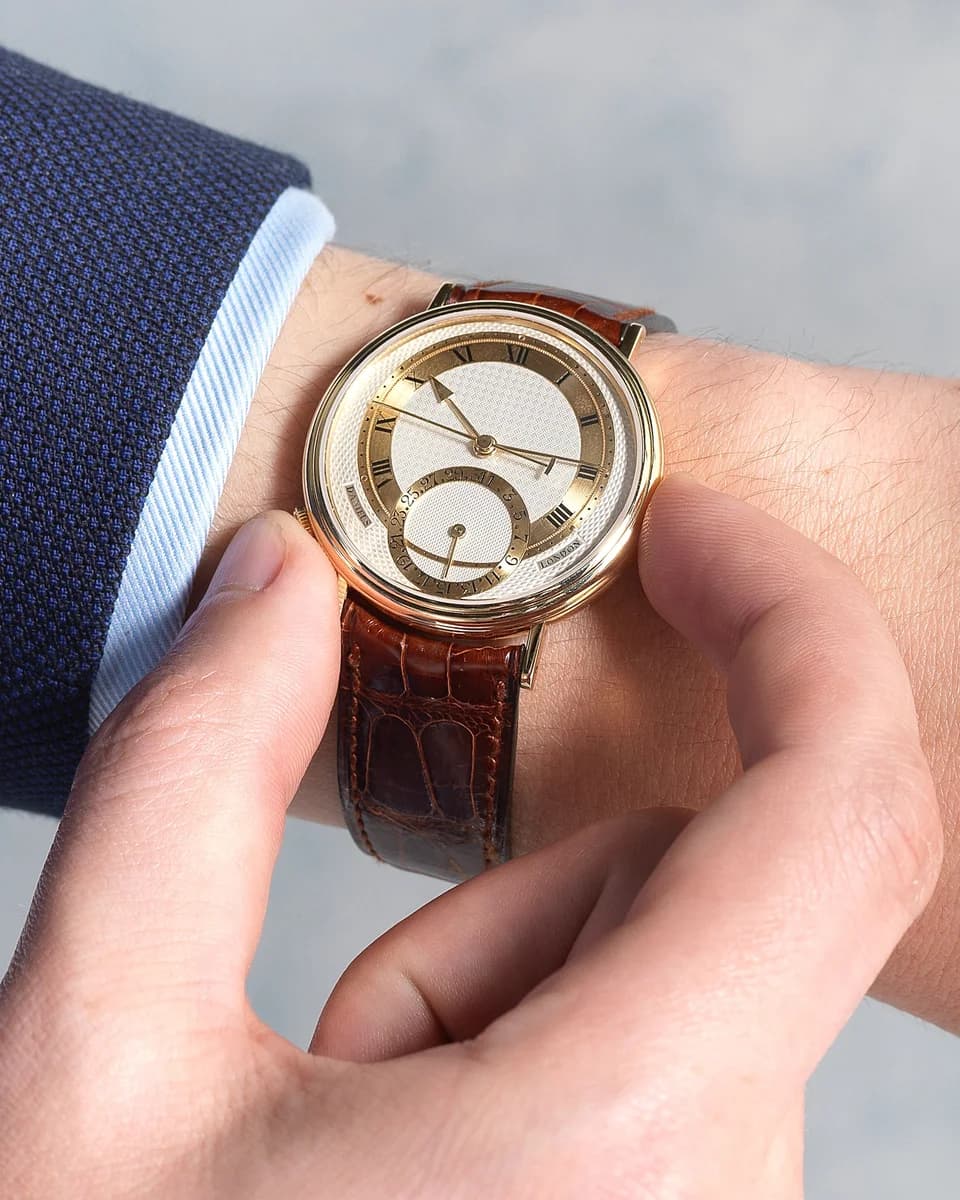
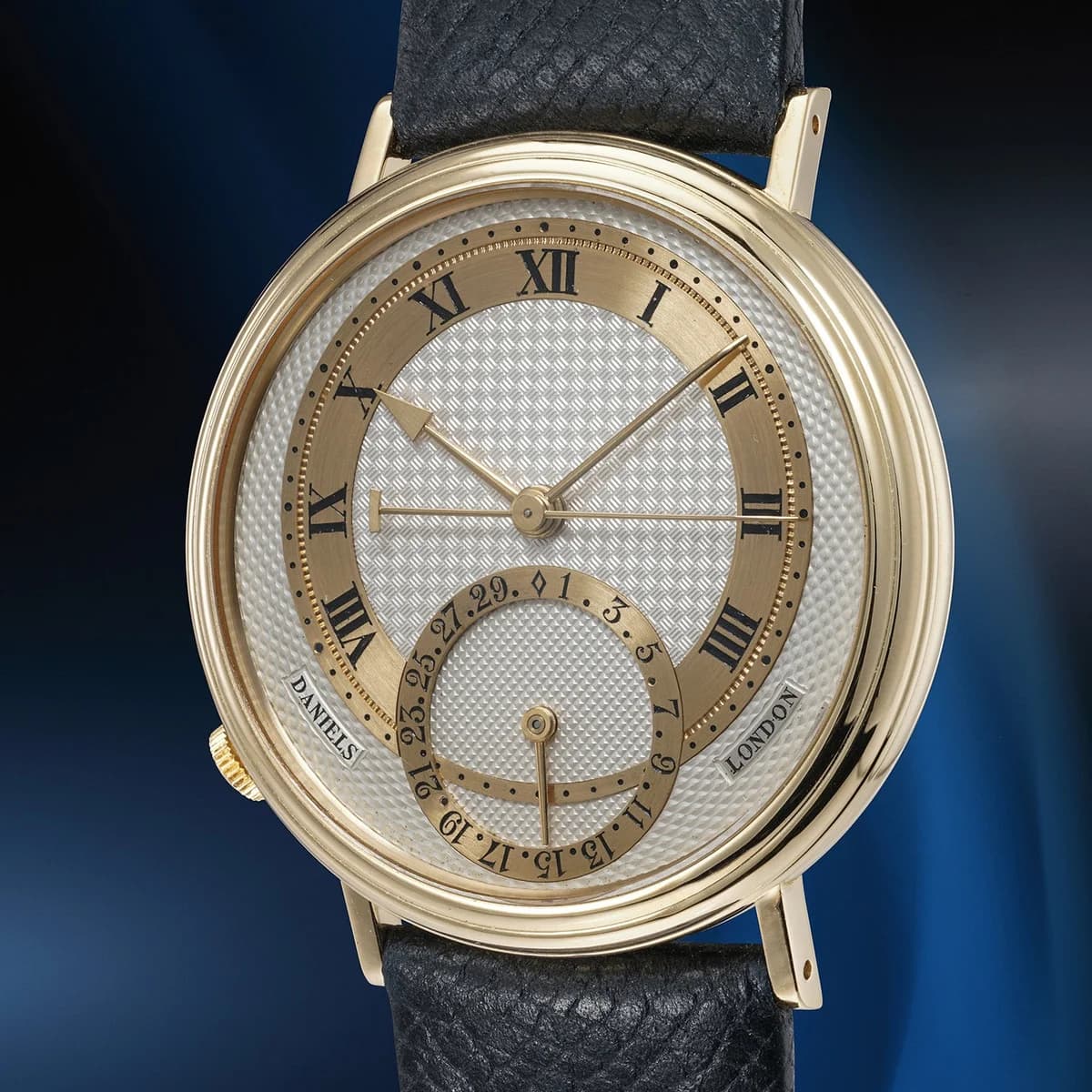
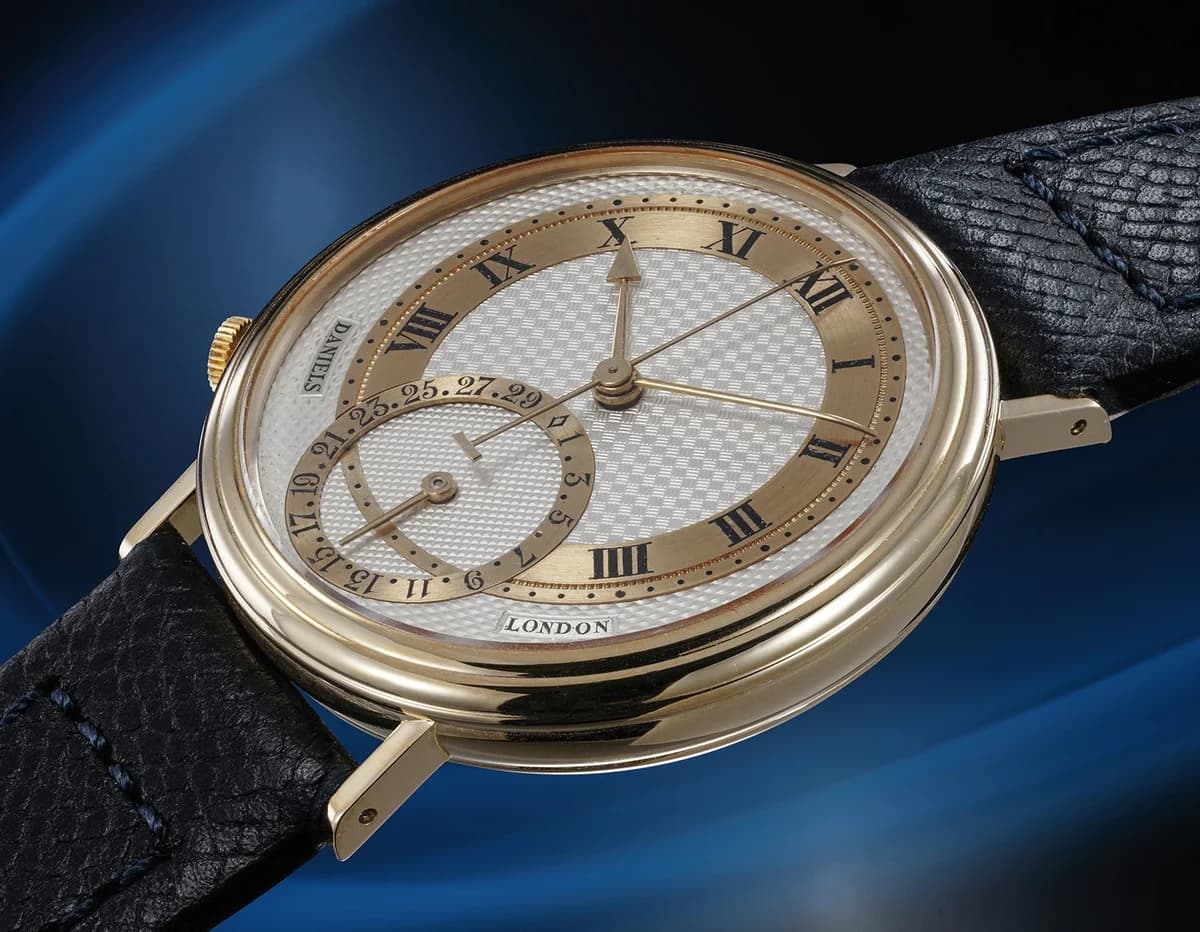
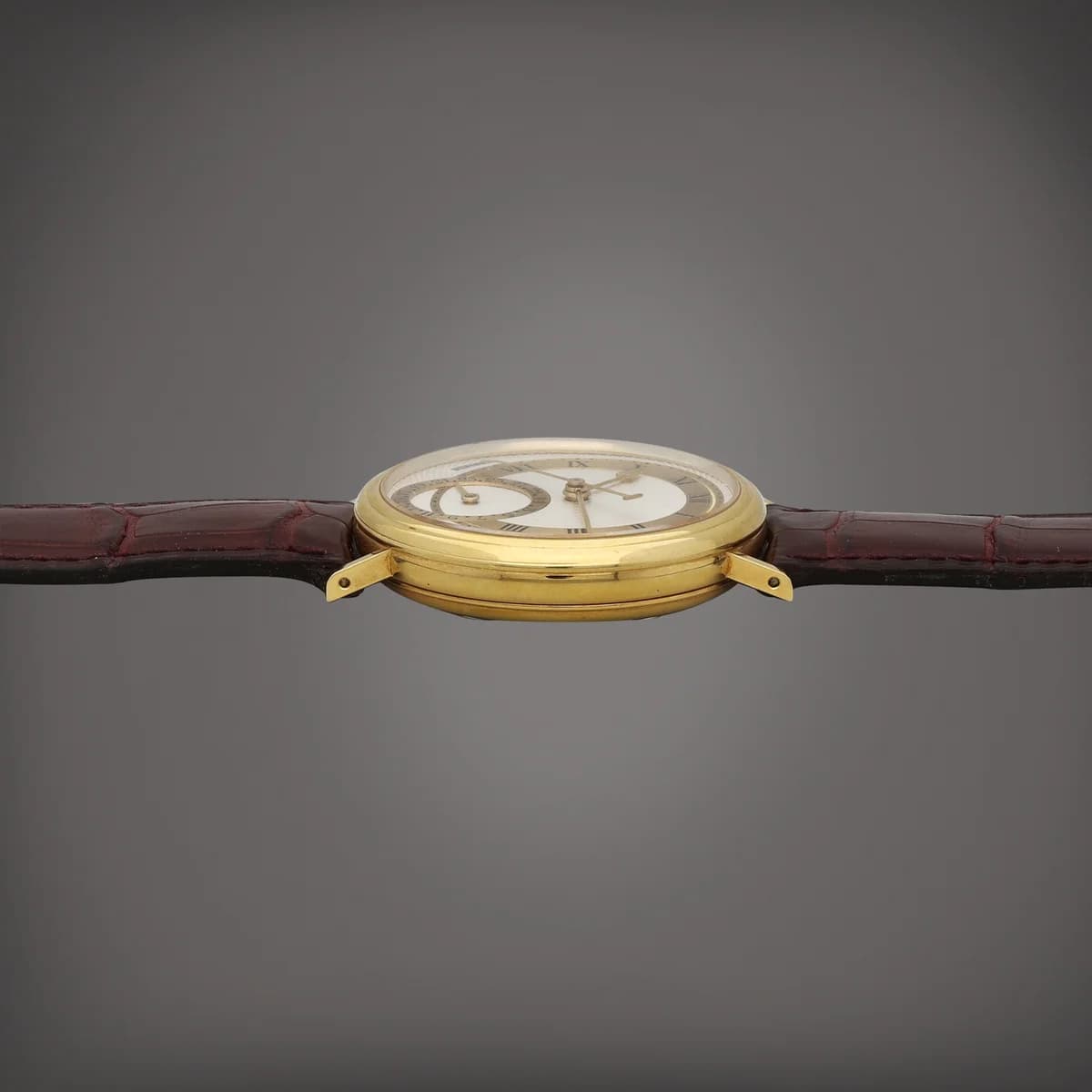
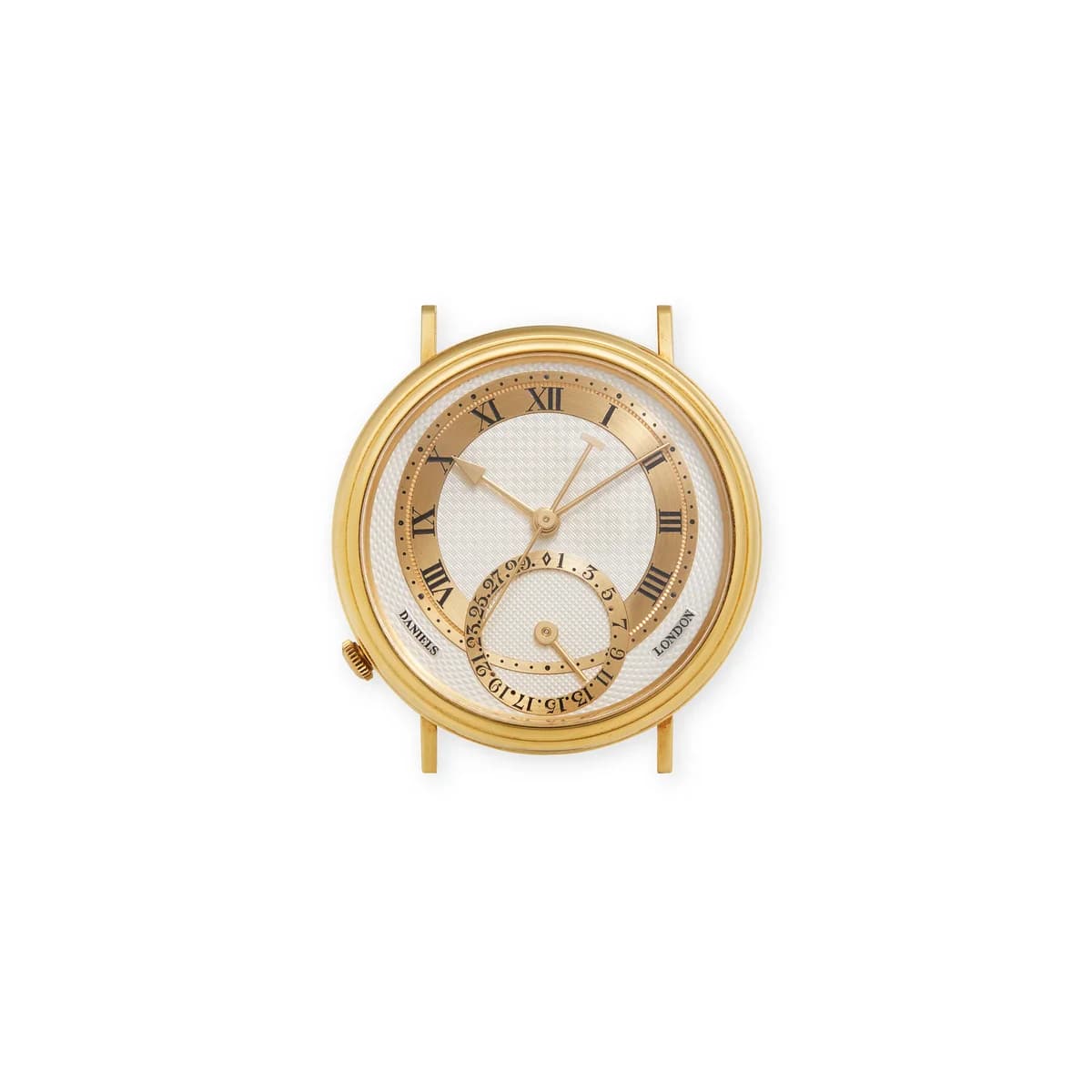
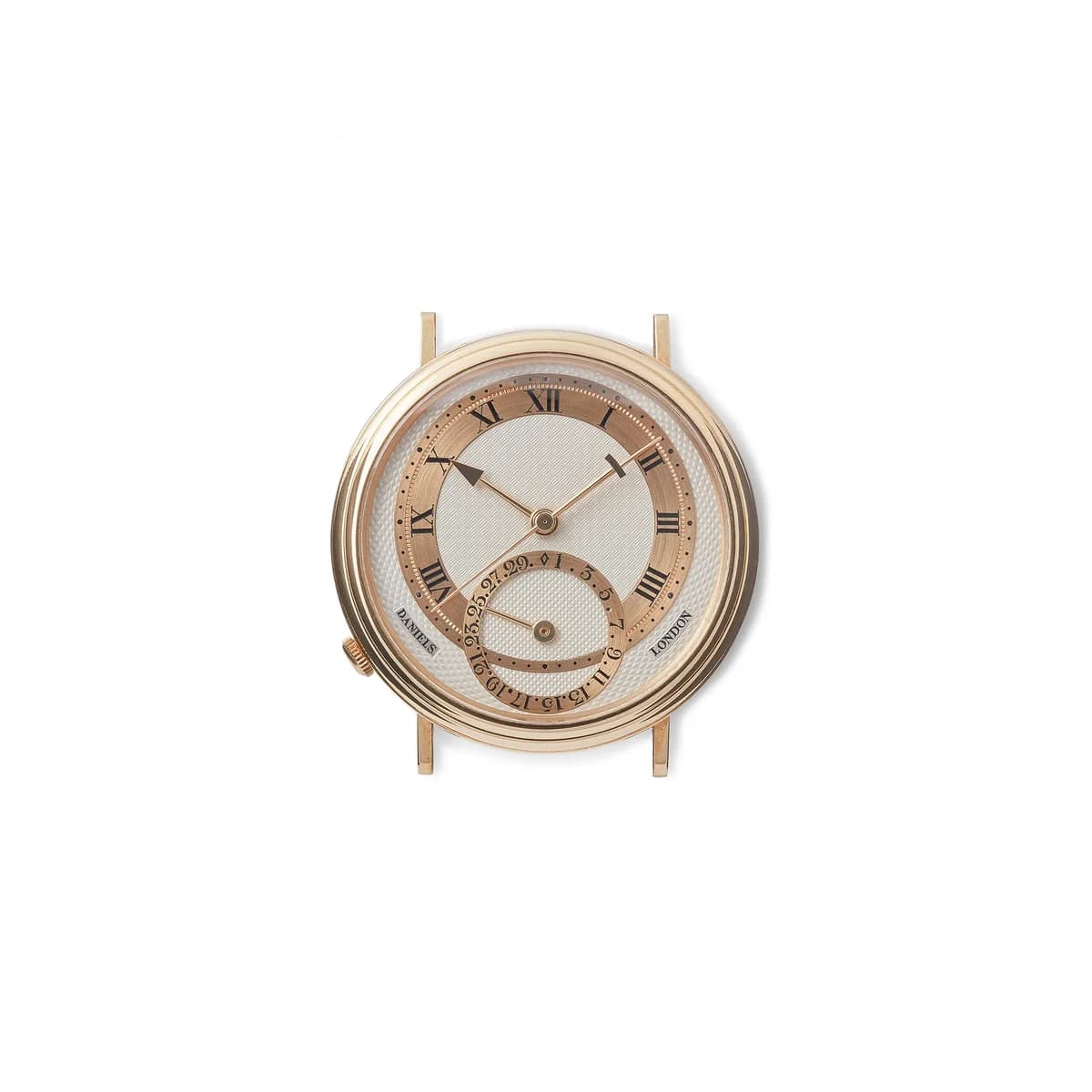
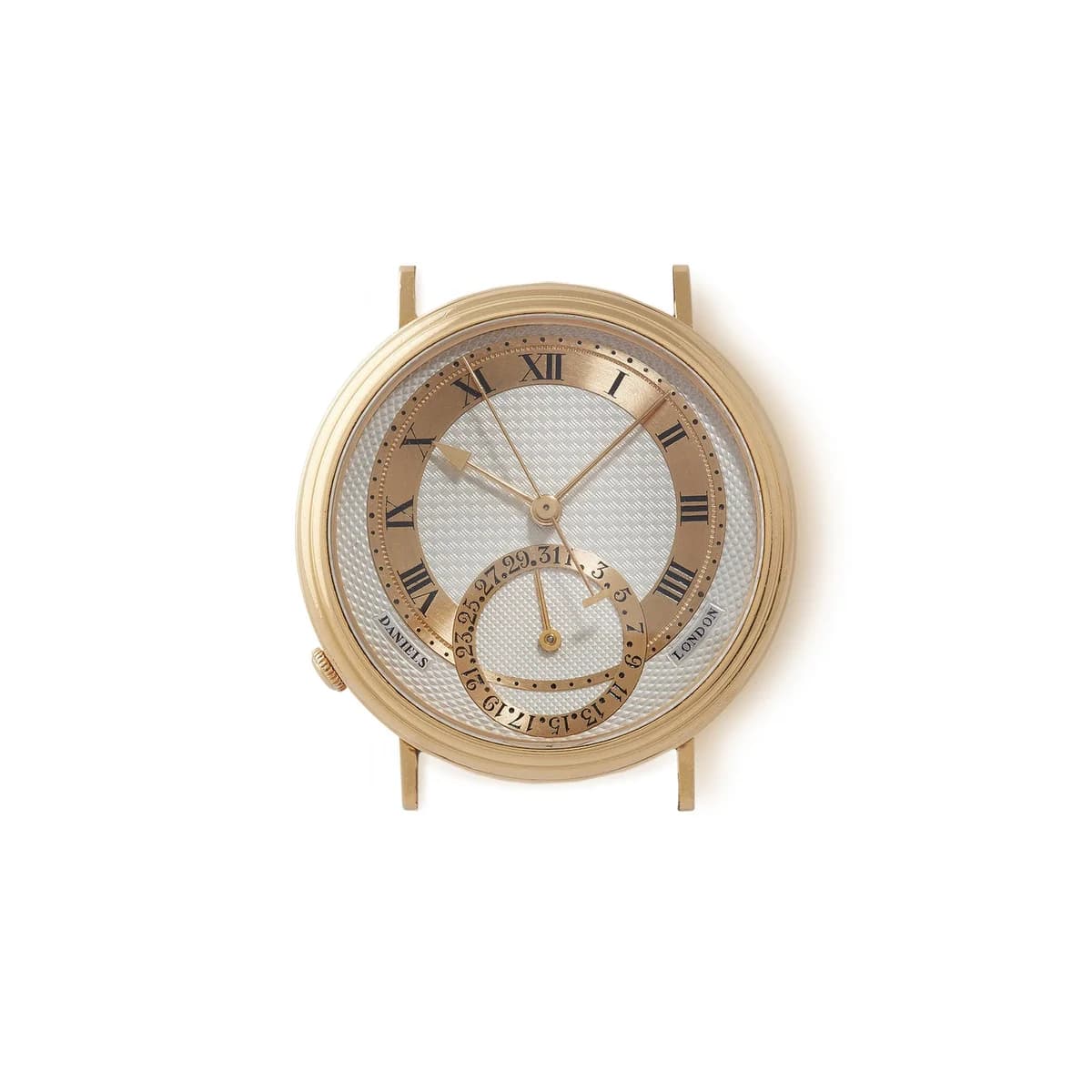
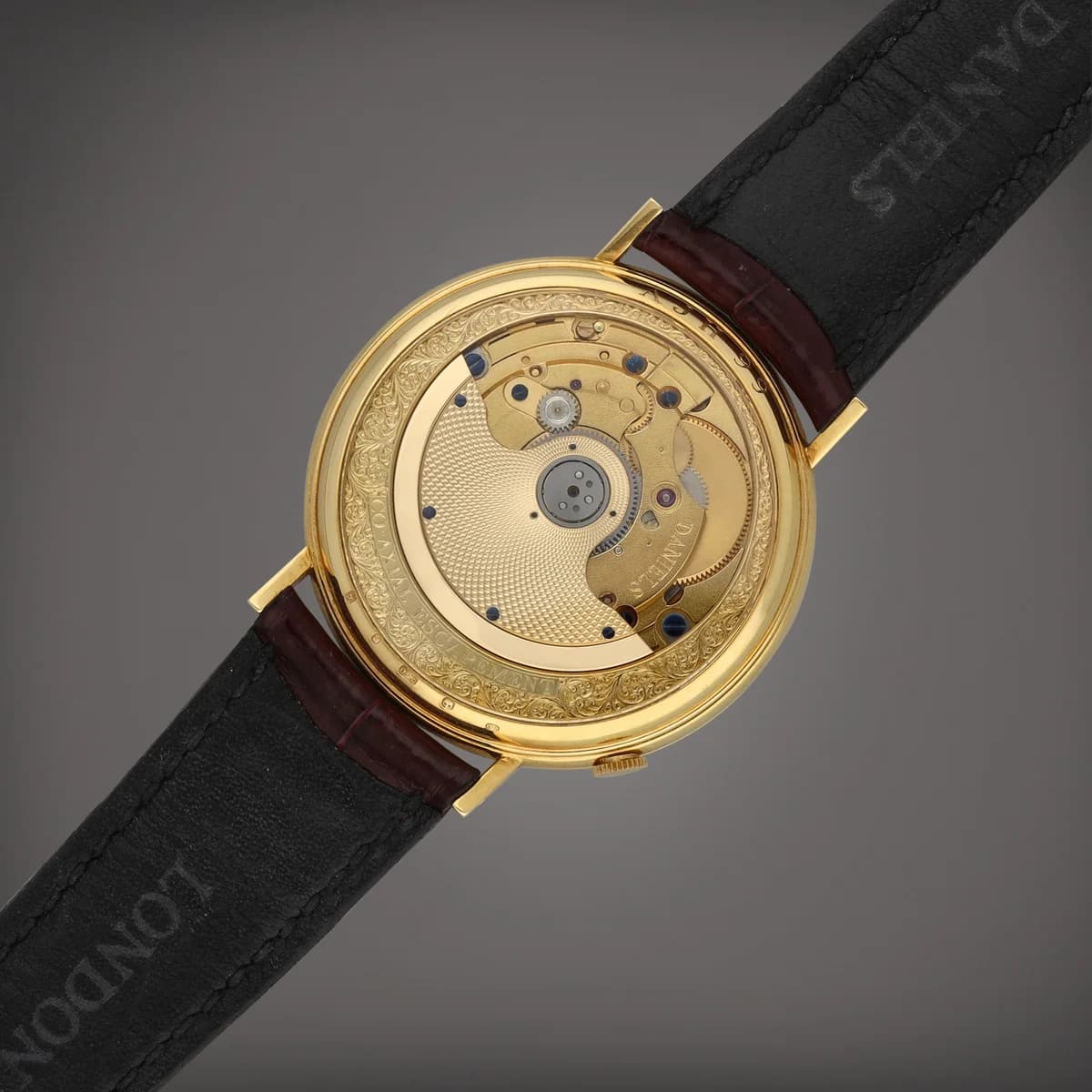
The watch itself is 37mm in 18K gold with a sapphire crystal and an exhibition caseback. The case is polished with wire lugs, giving it a classical silhouette that owes more to Breguet than to anything produced in Switzerland in the 1990s. The dial is engine-turned silver with a gold chapter ring bearing Roman numerals. The centre displays hours, minutes, and a sweep seconds hand, with a date subdial at 6 o'clock that has its own gold chapter ring with Arabic numerals. Two cartouches flanking the lower dial read Daniels and London. The hands are gold, the crown is gold, and the strap is black or brown crocodile leather with a gold buckle stamped with Daniels' mark. At 37mm, it wears small by modern standards, but for a dress watch designed in the late 1990s, it is entirely period-appropriate. The proportions are classical and deliberate.
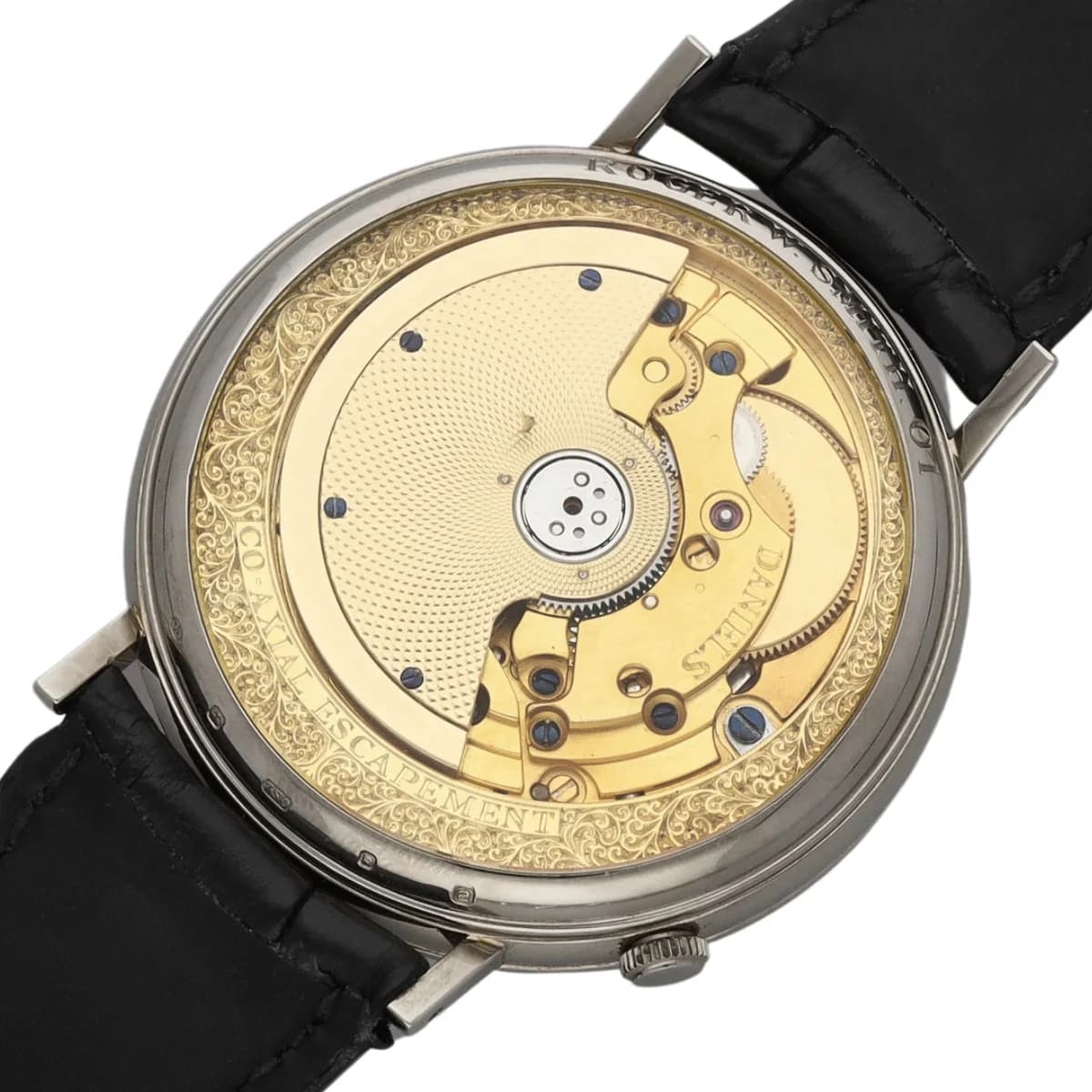
The movement is where the Millennium becomes something more than a commemorative piece. The Omega ebauche, based on the Caliber 2500, was heavily modified by Daniels and Smith in Daniels' workshop on the Isle of Man. The modifications transformed an industrial Swiss movement into something that carries the unmistakable character of English finishing. The movement is gold-plated and decorated with guilloche work on the bridges. The rotor is 18K gold with an engine-turned pattern. The case ring visible through the exhibition caseback is hand-engraved with scrollwork and foliage by Charles Scarr, a master engraver based in Clerkenwell, London. The engraving reads Daniels and Co-Axial Escapement around the periphery. The blued screws, the engine-turned rotor, the hand-engraved surround, these details elevate what was originally an Omega production caliber into something that sits alongside Daniels' pocket watches in terms of decorative ambition. The finishing is in what Daniels called the ornate English style, distinct from the Geneva stripes and perlage of Swiss tradition.
I appreciate that the Millennium exists in a category that is hard to define. It is not a fully handmade Daniels watch in the way his pocket watches were. It starts from an industrial ebauche. But the work that Daniels and Smith performed on each movement, the hand-finishing, the engraving, the decoration, the gold plating, the custom dial and case, all of that is handwork of the highest order applied to a mechanical foundation. It is a collaboration between Swiss industrial precision and English artisan finishing. I think that tension is part of what makes the Millennium interesting. Daniels spent his career arguing that the best watchmaking is the work of a single pair of hands applied to every surface. The Millennium is the one moment where he allowed himself to start from someone else's work and build upon it. The fact that the starting point was the very escapement he invented, now produced industrially by a Swiss brand that had taken decades to adopt it, gives the whole project a satisfying symmetry.
What strikes me about the dial is how much information it communicates without feeling crowded. The engine-turned silver surface catches light differently depending on the angle, shifting between a bright white and a warm silver. The guilloche pattern is a traditional barleycorn weave on the outer section of the dial, transitioning to a different pattern on the subdial at 6 o'clock. Three distinct textures live on one dial surface, each applied by hand. The Roman numerals on the gold chapter ring are engraved and filled with black lacquer. The date subdial uses Arabic numerals in a flowing script that feels more like calligraphy than industrial printing. I notice details like this because they signal how much thought went into the layout. Every element is intentional. Nothing is there because a committee decided it should be.
My honest observation about the Millennium is the 37mm case size. I have a 6.5-inch wrist, and 37mm sits well on me, but for anyone with a wrist over seven inches, this watch would feel small. The gold bezel consumes a meaningful portion of the case diameter, which makes the visible dial area even smaller than 37mm suggests. By modern standards, where 40mm to 42mm has become the default for dress watches, the Millennium can feel undersized on a larger wrist. I understand why Daniels chose this size. He was a classicist. He grew up with pocket watches and small wristwatches. 37mm is historically correct for a dress watch of this era and this tradition. But I wish a 39mm or 40mm option had been available for those who wanted slightly more presence. That said, the watch sits thin on the wrist, which partly compensates. It tucks under a cuff without catching, and the wire lugs follow the wrist contour naturally. There is also no lume on the dial, which means reading time in low light requires angling the watch toward a light source. For a formal dress watch, that tradeoff is acceptable, but it is worth noting.
Daniels wrote four books during his lifetime: Watches in 1965, The Art of Breguet in 1974, Watchmaking in 1981, and his autobiography All in Good Time in 2000. The first three are technical references that remain in print and in use by watchmakers and students today. Watchmaking, in particular, is the book that taught Roger Smith how to build a watch. Think about that for a moment. A man wrote a book so precise and so thorough that another person was able to use it as an instruction manual to build a complete pocket watch from scratch. Smith brought that watch to Daniels, and Daniels recognized in Smith the same obsessive dedication to handcraft that had defined his own career. That encounter led to the Millennium collaboration and eventually to Smith inheriting Daniels' methods and continuing the tradition of English watchmaking on the Isle of Man.
Daniels received the Commander of the Order of the British Empire (CBE) in 2010, a year before his death. He was also awarded the Tompion Gold Medal, the highest honor from the Worshipful Company of Clockmakers, and was a Pastmaster of the Worshipful Company. He was a member of the AHCI (Academie Horlogere des Createurs Independants), the small group of independent watchmakers who have defined artisan horology since the 1980s. He was also an avid collector and restorer of vintage Bentleys and Aston Martins, a passion that reflected the same obsession with mechanical precision that drove his watchmaking. He died on 21 October 2011 on the Isle of Man at the age of 85. His workshop is preserved. There will never be another Daniels watch. What exists is what he made.
The Millennium pairs naturally with quiet, traditional dressing. The yellow gold case on a brown crocodile strap with a dark Holland and Sherry flannel suit in charcoal or midnight navy is one of those combinations where every element reinforces every other element. The warm gold against darker skin catches light beautifully, and the classical dial with its Roman numerals and engine-turned texture reads as confident without being loud. The white gold variant, with its cooler tone and blued steel hands, takes on an entirely different personality, more restrained, more contemporary, more suited to lighter fabrics and silver accessories. Either version sits flat enough under a French cuff to disappear when the arm is at rest and reveal itself with a natural turn of the wrist. That is exactly how a dress watch of this caliber should behave.
I include the Millennium in this collection because Daniels is the reason the co-axial escapement exists. He is the reason Omega's movements are what they are. He is the reason Roger Smith has a career and a tradition to continue. The Millennium is the physical intersection of all of those threads: the escapement he invented, the industrial adoption he fought for across two decades, the apprentice he trained, and the English finishing tradition he championed. It is the only series wristwatch Daniels ever produced, and it contains the very first co-axial movements to come off the Omega production line, finished by the hands of the man who invented the escapement they contain. That will not happen again. The man is gone. The workshop is quiet. The approximately fifty Millennium watches that exist are the only wristwatches that carry his name, his finishing, and his escapement in one object. They are where the tradition of Breguet, filtered through one self-taught Englishman from the East End of London, meets the modern Swiss watch industry that eventually recognized what he had built.
Also in Independent Masters