
Seiko
Prospex SNE586P1
SNE586P1
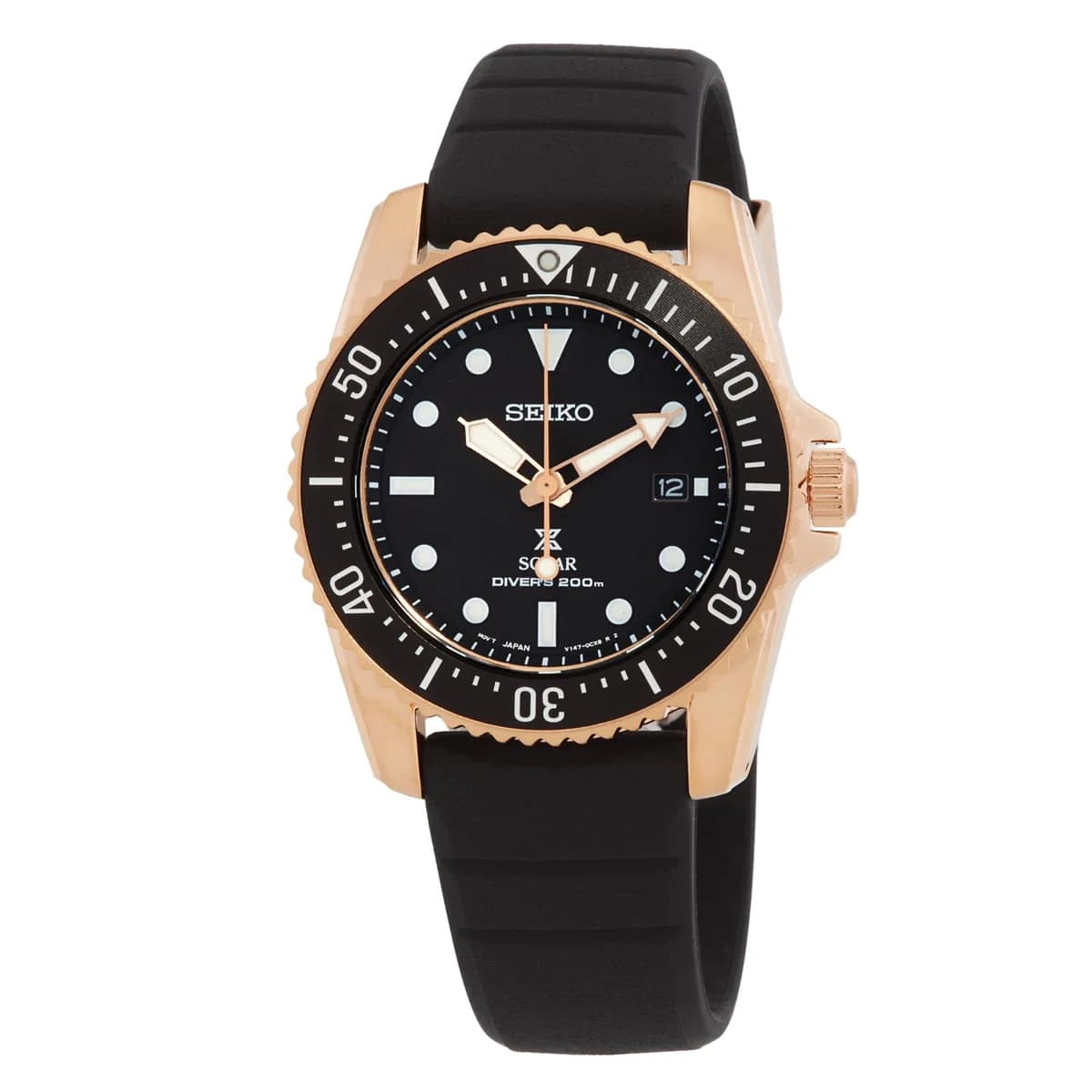
Seiko is one of the only watch manufacturers on earth that produces everything in-house. Movements, cases, dials, crystals, hairsprings, mainsprings, even their own lubricants and alloys. From the raw quartz crystal to the finished product, the entire vertical chain lives under one corporate structure. Rolex does this. Seiko does this. The list is shorter than most people think. I find myself coming back to this point every time I pick up a Seiko, because the depth of their manufacturing capability is genuinely rare in this industry. Seiko was founded in 1881 by Kintaro Hattori as a clock repair shop in Ginza, Tokyo. By 1969 they had produced the world's first quartz wristwatch, the Astron, which disrupted the entire Swiss industry and nearly killed it. The Quartz Crisis of the 1970s exists because of Seiko. They did not apologize for it then and they should not now. The technology in this solar diver is a direct descendant of that moment. The SNE586P1 is my daily watch, and it is one of the most interesting expressions of that capability.
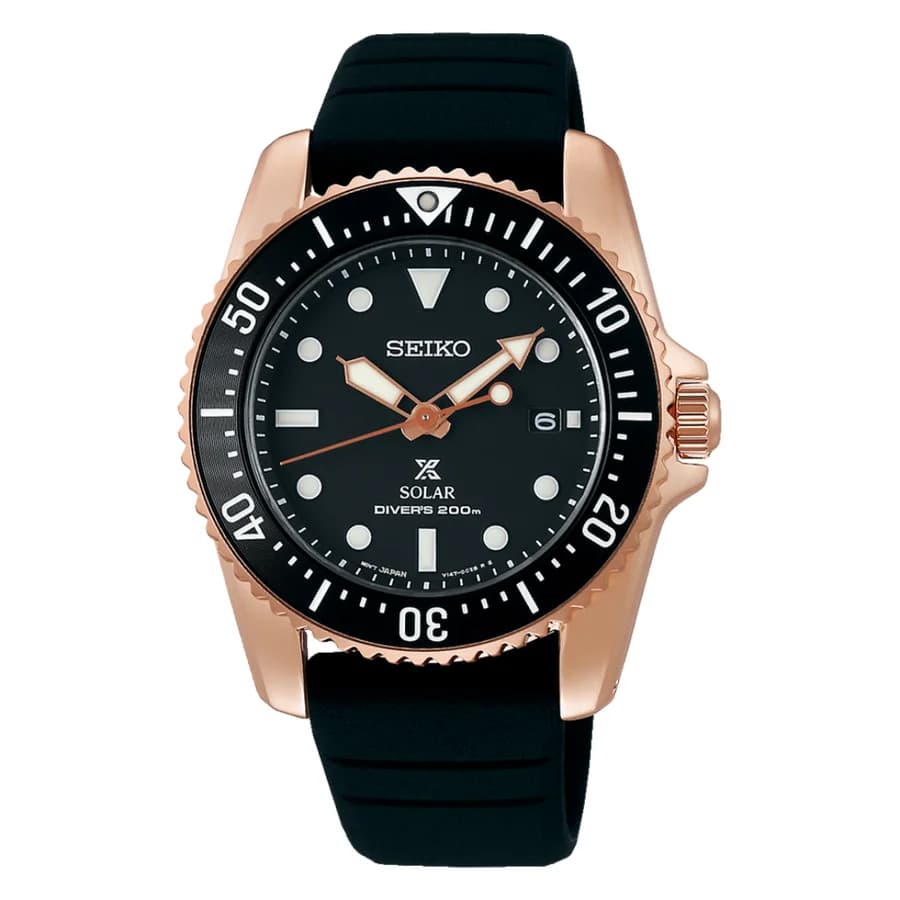
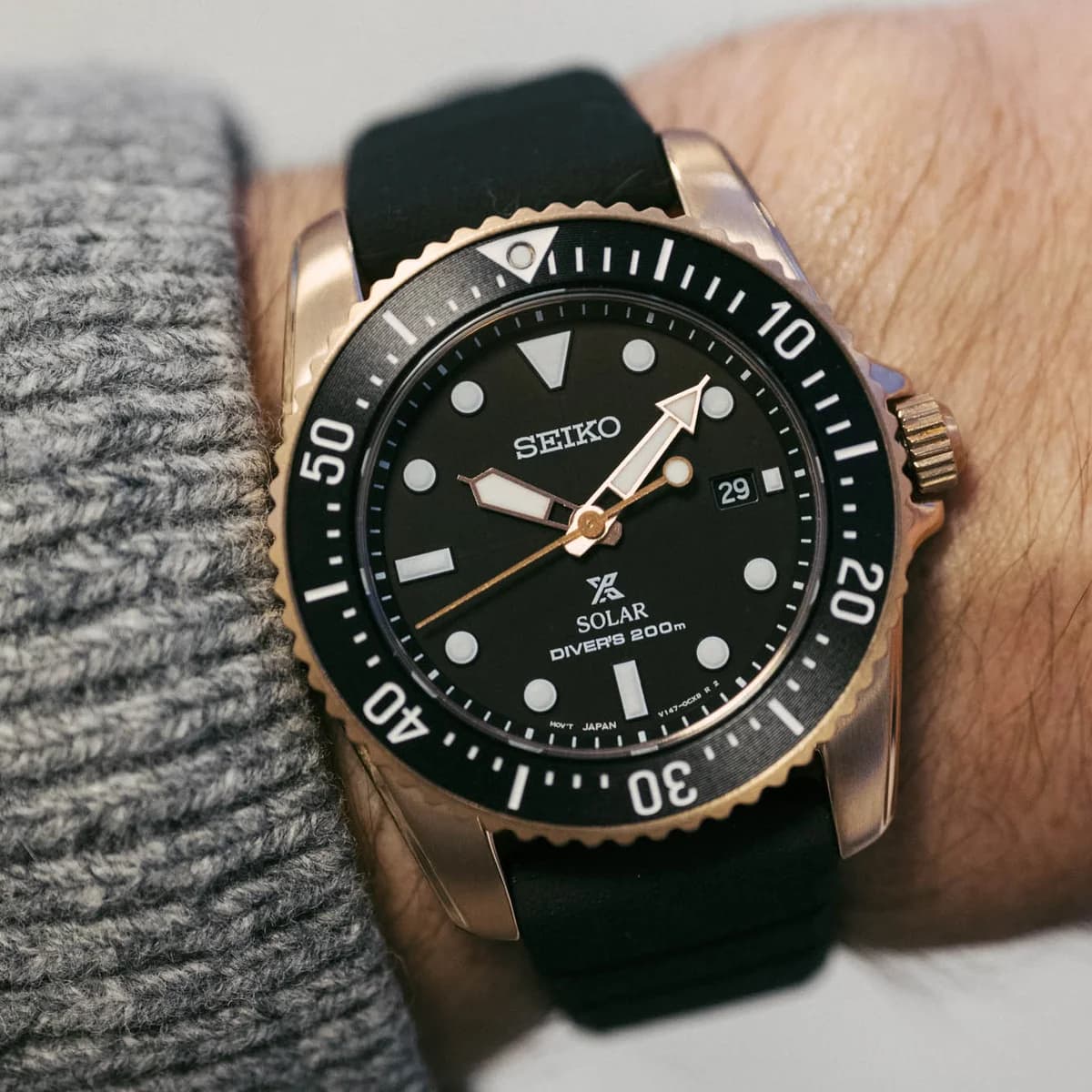
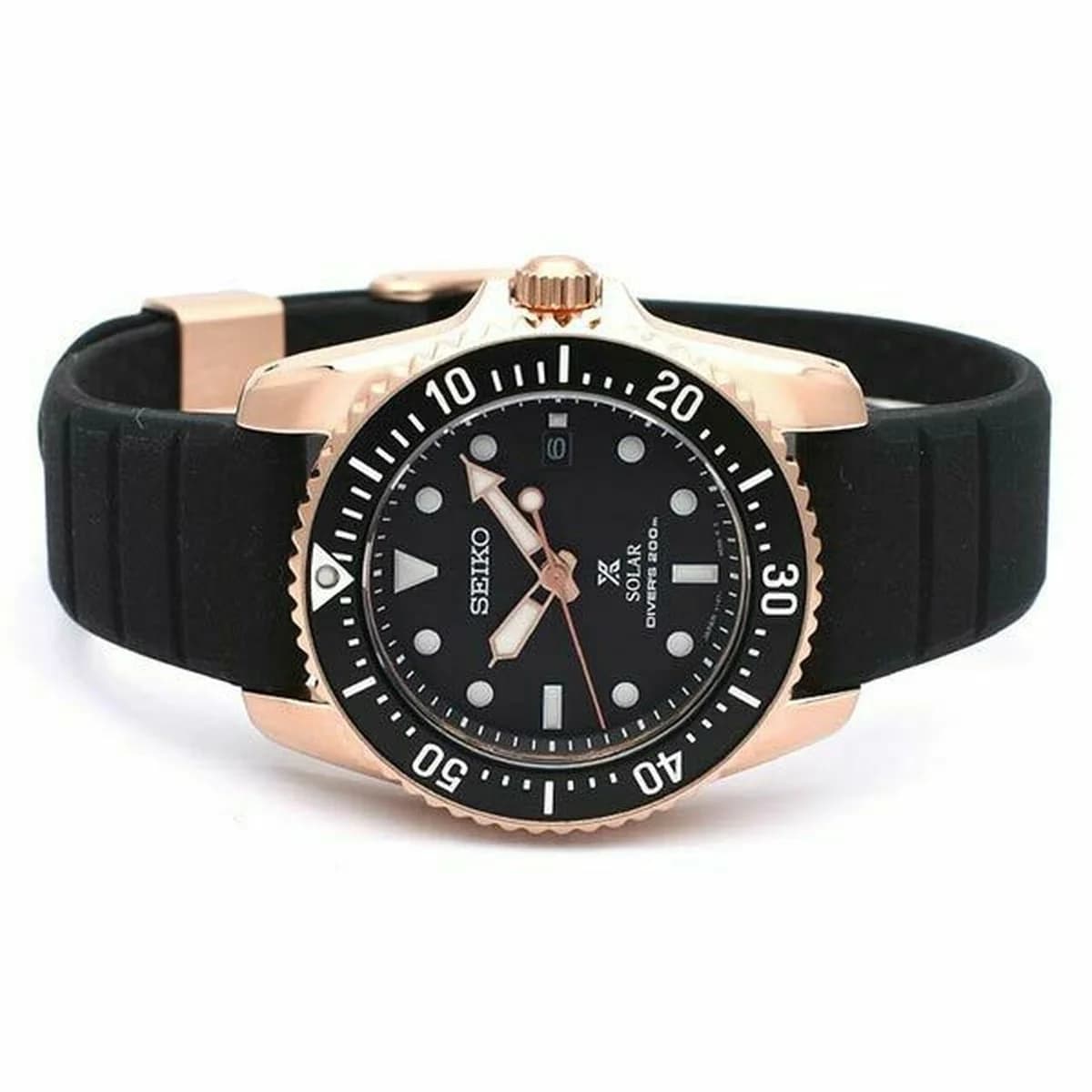
The case is 38.5mm in stainless steel with an iprg finish. Ion Plating Rose Gold. A vacuum-deposited coating where a base layer of titanium nitride is applied at roughly 0.6 microns, followed by a gold-copper alloy layer that gives it the warm rose-gold tone. This is not electroplating. It is a hard PVD coating that resists wear far better than traditional gold plating. At 10.6mm thick with a 46.5mm lug-to-lug and 79 grams on the wrist, it wears compact. I wore this watch daily for months before I fully appreciated how well that 38.5mm case disappears under a shirt cuff. For context, the traditional Baby Tuna is 47.5mm in diameter. This is an entirely different proposition. The 20mm lug width accepts a huge range of aftermarket straps, which matters more than most people realize when the stock option is not ideal for everyday use.
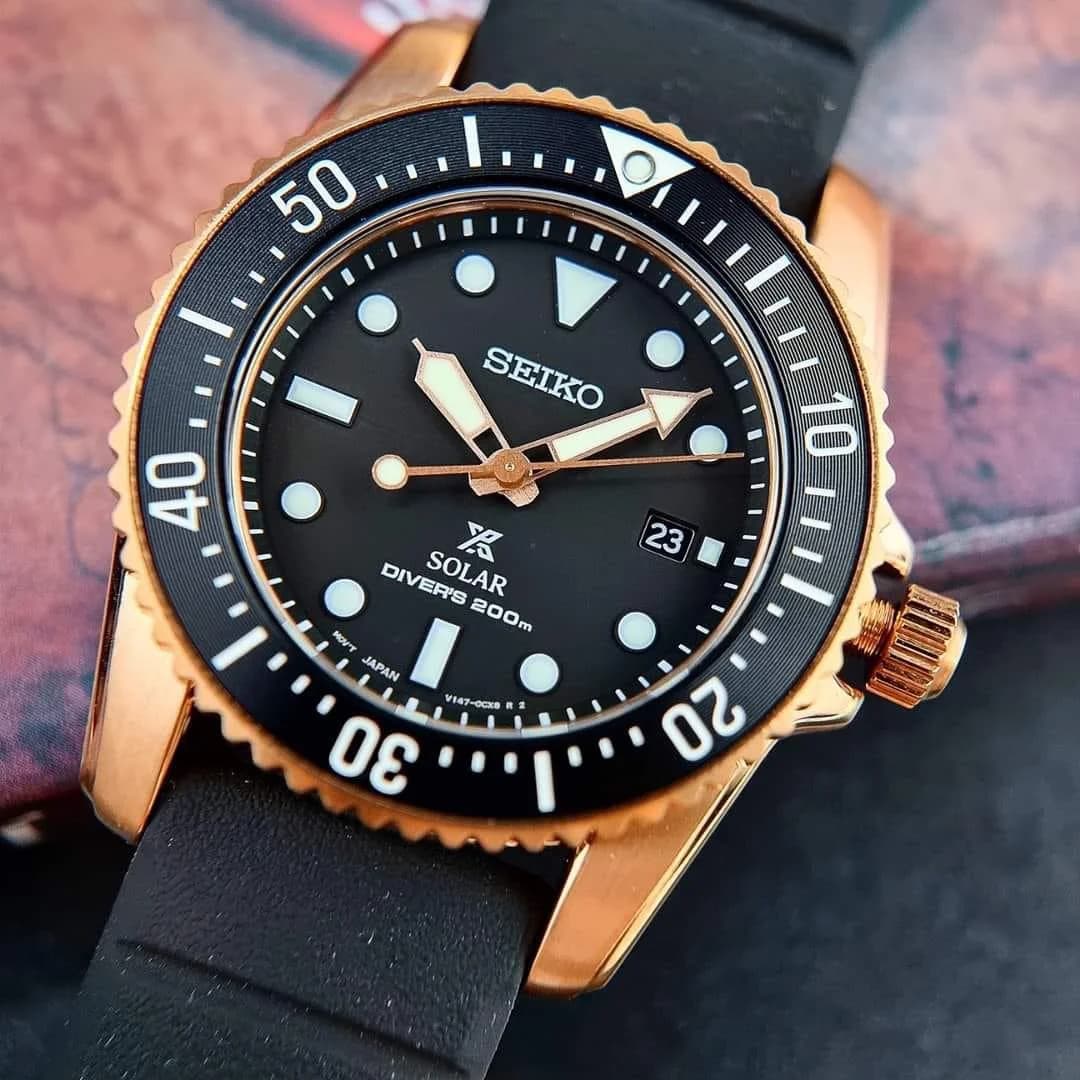
The rose-gold tone against black is one of the most flattering combinations in watches. On darker skin tones especially, the warm copper-gold reads as rich without being flashy. It does not have the coldness of steel or the loudness of yellow gold. It sits in between, and the black dial and strap ground it. In my experience, rose gold on a dark rubber or leather strap is one of the few combinations that works equally well with a navy Brunello Cucinelli wool suit and a plain white t-shirt on a Saturday. What strikes me about this particular shade is how it shifts warmth depending on the light. Under office fluorescents it reads almost bronze. In natural sunlight it opens up into a true rose gold. I think that variability is part of what makes it feel so considered, like someone spent real time calibrating the exact warmth of that tone.
The movement is the V147 solar caliber. A photovoltaic cell sits directly beneath the dial. The dial appears solid black to the human eye, but it is actually a spectrally-tuned semi-transparent layer engineered to pass light at wavelengths that efficiently generate current in the solar cell while blocking wavelengths that would reveal the cell beneath. The light transmissivity at 550nm is roughly 10 to 50 percent. Your eye sees an opaque black dial. The solar cell sees light. That energy is stored in an MT920 manganese titanium-lithium rechargeable capacitor, not a disposable battery. A full charge runs for approximately ten months without any additional light exposure. Accuracy is plus or minus 15 seconds per month at normal temperatures. That is better than most mechanical chronometers. A COSC-certified mechanical movement allows plus or minus four to six seconds per day. The V147 does 15 seconds per month. A mechanical watch that gains one second per day is considered excellent. The V147 does that in two days. Quartz accuracy is not debatable. It is physics.
What I appreciate about Seiko's approach to solar is how invisible the engineering is. The solar cell conversion efficiency on the V147 is rated around 15 to 20 percent for visible light wavelengths. The amorphous silicon photovoltaic cell is layered directly onto the movement, beneath a dial that Seiko engineers specifically tuned to balance aesthetic opacity with light transmission. The stepping motor inside uses a single coil with a rotor magnet that advances the gear train in precise steps. Each tick of the seconds hand is one pulse of current from the integrated circuit to the coil. The entire electronic module, IC, coil, trimmer capacitor, and quartz oscillator, draws less than one microwatt of power during normal operation. That is why ten months of reserve is possible from a capacitor smaller than a shirt button. What makes this a design philosophy and not just an engineering exercise is the decision to hide all of it. Someone at Seiko decided that the dial should look like any other dial. No visible solar cells, no technical indicators, no compromise to the aesthetic. The owner is not supposed to know what is happening underneath. That is a product management choice as much as an engineering one, and it reflects a specific belief about how tools should work: invisibly, reliably, without asking for attention.
When the capacitor is fully depleted and the watch stops, re-exposing it to light above 1,000 lux triggers an instant start. The seconds hand begins moving in two-second intervals. That two-second tick is a diagnostic indicator: the watch is alive but the charge is building. Once adequate energy is stored, the hand returns to normal one-second ticks. There is overcharge protection built into the integrated circuit. You cannot damage the capacitor by leaving the watch in sunlight. The MT920 is rated for thousands of charge cycles. Seiko recommends professional servicing every three to four years as the capacitor's storage capacity gradually degrades with age, but between those intervals the movement is essentially maintenance-free. No winding. No rotor. No mainspring fatigue. No amplitude drop at the end of a power reserve. Solar is one of the most underappreciated technologies in watchmaking. Seiko introduced their first solar analog wristwatch in 1977, the reference 4826-9000 with twelve solar cells visible as a chapter ring around the dial. Citizen actually beat them by a year with the Crystron Solar Cell in 1976. Both companies have been refining the technology for nearly fifty years.
The design carries the DNA of the Seiko Tuna lineage without the external shroud. The SNE586P1 does not have a shroud. It is a conventional case with a rounded cushion profile. But the coin-edge bezel, the bold lume plots, the arrow-tipped hands, the screw-down crown at three o'clock, the proportions, all trace back to 1975. That year, engineer Ikuo Tokunaga completed a seven-year project that started when a saturation diver from Kure City complained that Seiko watches filled with helium and lost their crystals at depth. The result was the Professional Diver reference 6159-7010, the world's first titanium monocoque watch case with a ceramic-coated protective shroud. It achieved 600 meters without a helium escape valve and held over 20 patents. Divers called it the Tuna because the cylindrical case inside the round shroud looks like a tuna can from above. The 1978 Golden Tuna went quartz and pushed to 600 meters. The 2009 Emperor Tuna hit 52mm in an automatic. The 2013 Ultimate Tuna used Spring Drive. The SNE586P1 compresses that heritage into the smallest case the lineage has ever worn. The arc from 1881 clock repair shop to 1965 first Japanese diver to 1969 Quartz Crisis to 1975 Tuna to 1977 first solar analog to this watch is not a marketing timeline. It is a manufacturing evolution where each generation solved a specific problem that the previous one could not.
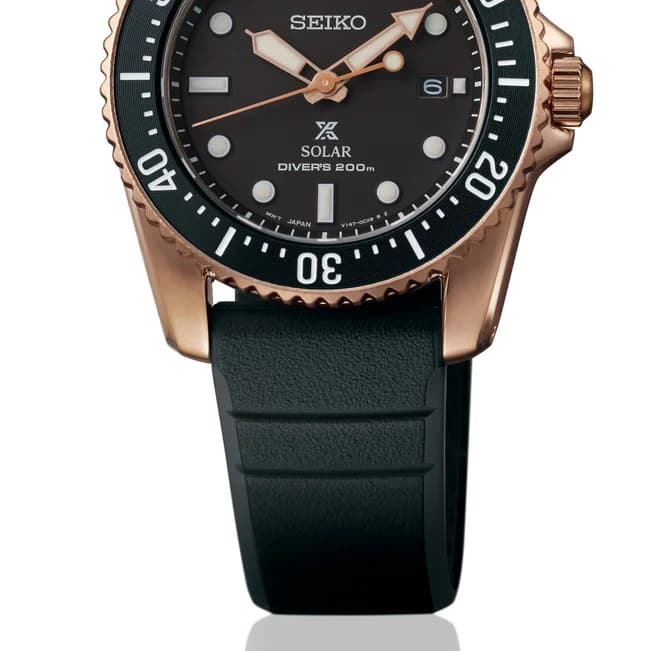
I remember the first time I looked at the bezel on this watch under a loupe. The coin-edge knurling is crisp, each ridge evenly cut, and the 120-click unidirectional action has a satisfying detent that feels precise without being stiff. The bezel is rose-gold toned to match the case, with a black insert that carries a lume pip at twelve. The alignment is dead on, which is something that lesser divers frequently get wrong. When the triangle lines up with the twelve o'clock index, there is no visible offset. That kind of fit and finish in a compact solar diver is a direct result of Seiko controlling the entire production chain.
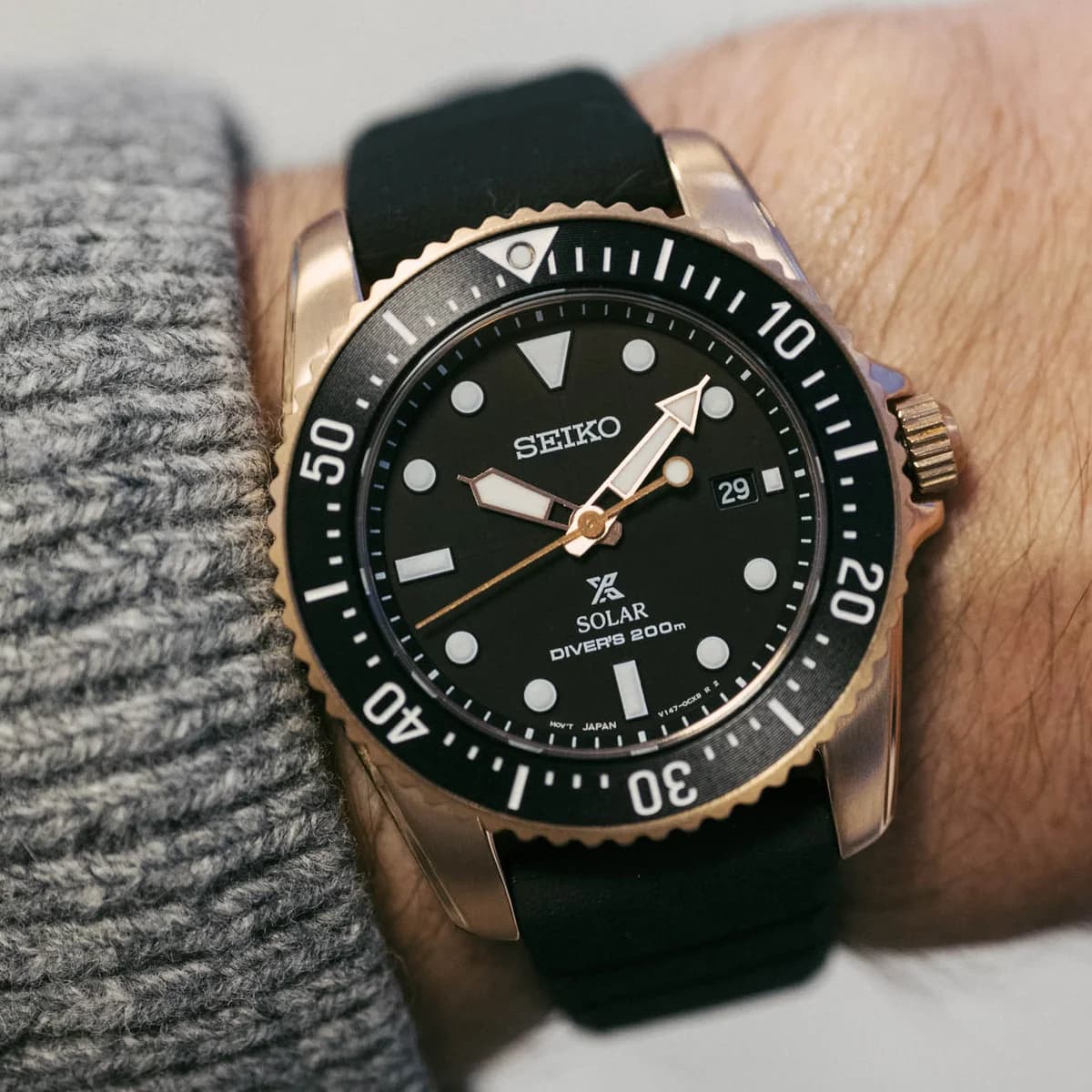
The screw-down crown at three o'clock is signed with an S and operates with a smooth threading action. Two full turns to unscrew, pull to the first position for date, pull to the second position for time setting. I notice the crown guards are integrated into the case rather than being separate protruding elements, which keeps the side profile clean and prevents the crown from catching on a shirt sleeve. The crown itself is proportioned well for the case size. It is large enough to grip without being oversized. Some dive watches at this size have crowns so small they are genuinely difficult to operate, which defeats the purpose of having a tool watch in the first place.
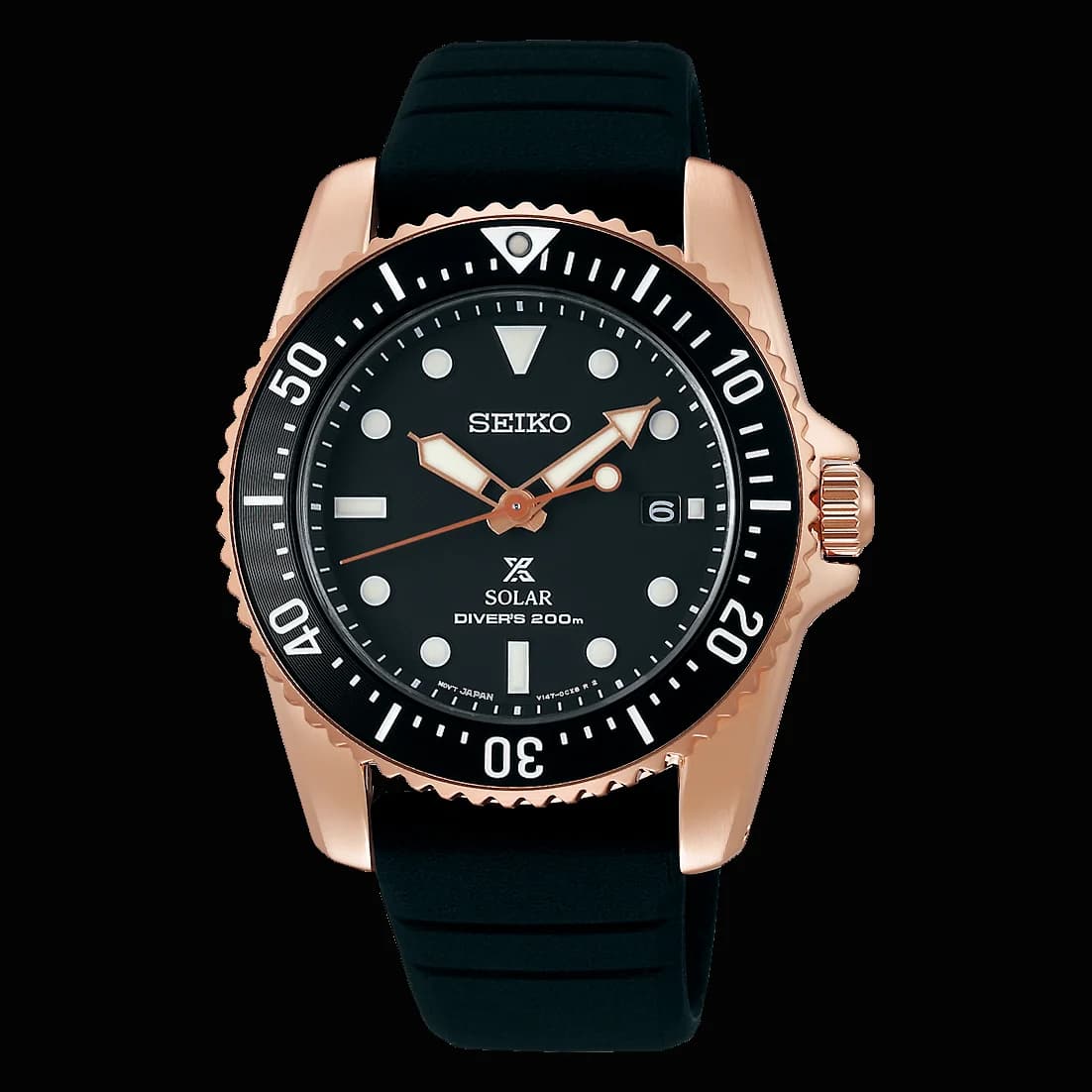
The crystal is sapphire. Flat, scratch-resistant, rated 9 on the Mohs scale. Most solar divers in this size class use mineral glass or Seiko's own Hardlex. Sapphire on a compact solar diver is unusual. The lume is Seiko's LumiBrite, their proprietary phosphor based on strontium aluminate doped with europium and dysprosium. The dysprosium co-doping extends the phosphorescence duration beyond standard SuperLumiNova. LumiBrite is on the hands, the indices, and the bezel markers. The date window at three o'clock has a black background matching the dial with a white date wheel. The dial text reads Seiko at twelve, the Prospex logo beneath it, the solar indicator and diver's 200m rating in the lower half, and the movement origin marking at the bottom. In darkness, the watch is legible for hours.
At 200 meters, this is an ISO 6425-certified diver's watch. The word Diver's on the dial is legally meaningful. Under ISO 6425, only a watch that has passed the full certification protocol can use that designation. The testing includes immersion at 125 percent of rated depth, thermal shock cycling, magnetic field resistance, a 3kg shock impact test, salt water corrosion exposure, and luminescence legibility verification in darkness for 180 minutes. The standard requires every individual production unit to be pressure-tested. Seiko does not disclose their exact testing protocols publicly, but the Diver's designation on the dial indicates compliance.
The Prospex logo on the dial is not a random design. It is the letter P from Professional interlocked with the letter S from Specifications. Prospex means Professional Specifications. That is what Seiko built this line to represent. The same engineering seriousness that produced the 62MAS in 1965, Japan's first diver's watch, a 37mm reference 6217-8000 that was used by the Japanese Antarctic Research Expedition from 1966 to 1969. The first reference was replaced within months because the small crown was impossible to operate with diving gloves. They listened, fixed it, and the 6217-8001 with a larger crown replaced it. That feedback loop, diver complains, engineer solves, next reference ships, has been running at Seiko for sixty years. The same campus in Shiojiri, Nagano Prefecture that produces Grand Seiko Spring Drives also manufactures the V147 caliber. The infrastructure that builds a Grand Seiko Snowflake builds this solar diver.
I have noticed that people who dismiss solar watches tend to be the same people who have never actually worn one for an extended period. The absence of maintenance rituals changes the relationship with the watch entirely. There is no winder on the nightstand, no anxiety about power reserve when it sits in a drawer for a week, no trip to a watchmaker for a battery swap. I leave this watch face-up near a window when I am not wearing it, and it runs. That is the entire maintenance protocol. For someone who rotates through multiple watches, that reliability is genuinely valuable. Every mechanical watch in the rotation needs attention. The SNE586P1 just works.
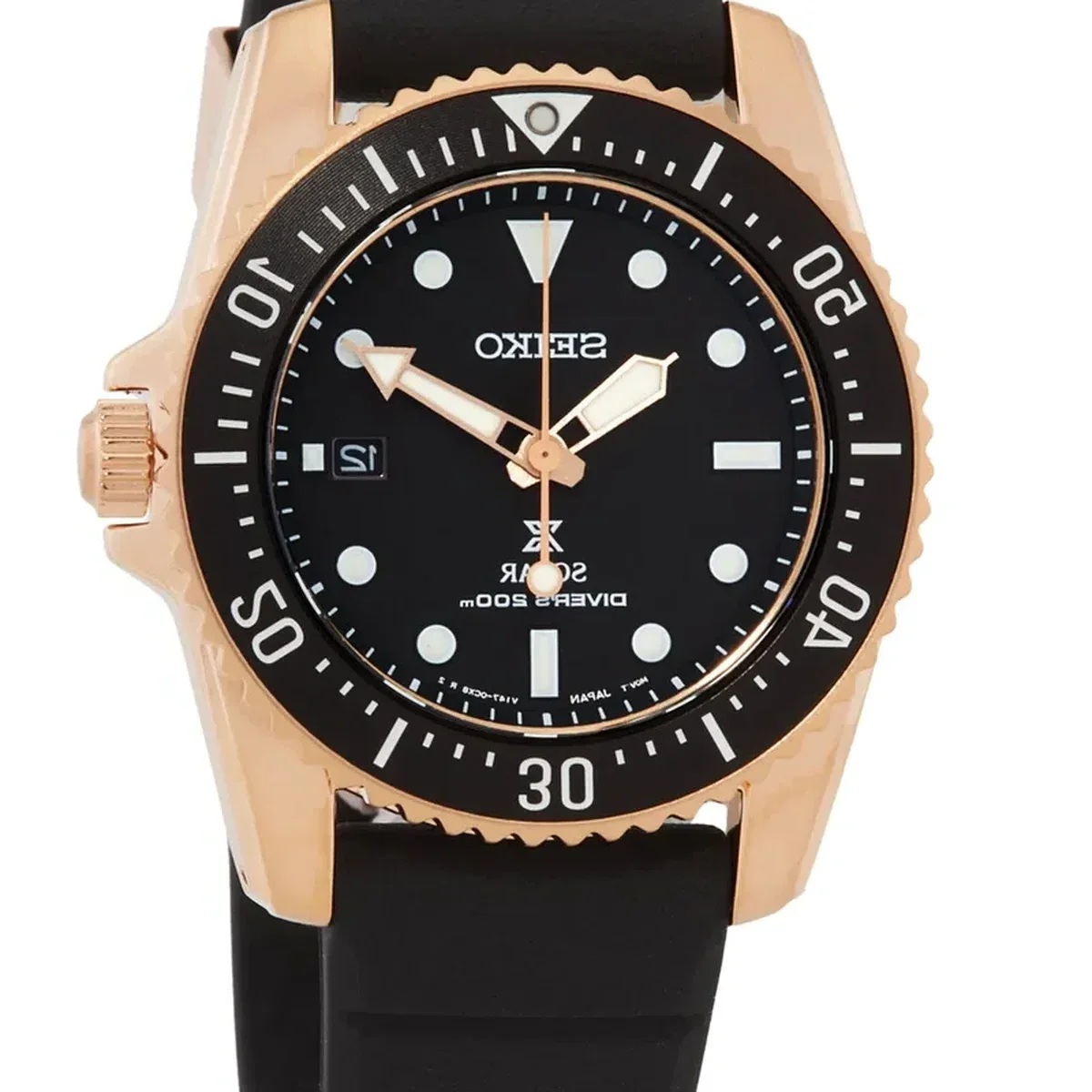
The stock silicone strap is built for work. It is a dive strap. Thick, durable, functional. But if you are not diving every day, I would strongly recommend swapping it for an FKM rubber strap with a quick-attach system. FKM is softer, more flexible, and far more comfortable for daily wear. The drilled lugs on the SNE586P1 make strap changes easy with a standard spring bar tool, and there are excellent aftermarket FKM options with quick-release pins that let you swap in seconds without any tools at all. The honest critique is the stock strap. It is stiff out of the box, takes time to break in, and the deployant clasp adds bulk to the underside of the wrist that some people find uncomfortable for desk work. But that is the strap, not the watch. Do not discount this watch because of the stock strap. The strap is meant for a purpose. If that purpose is not your daily life, change it. The watch underneath is the point.
For me, the SNE586P1 represents something larger about what Seiko does better than almost anyone else in the industry. They take technology seriously at every level of their lineup, not just at the Grand Seiko tier. The same company that hand-finishes Zaratsu-polished cases in Shizukuishi also engineered the solar cell calibration in this diver. The same in-house production philosophy that produces the 9RA5 Spring Drive caliber also produces the V147. That vertical integration, raw materials to finished product under one roof, means quality control at every stage. Seiko does not buy movements from ETA. They do not outsource case production to third-party suppliers. Every component is their responsibility.
The Seiko Prospex lineup operates within the Seiko Watch Corporation, a subsidiary of Seiko Group Corporation. Unlike Swatch Group (which houses Omega, Longines, Tissot, Breguet, and others) or Richemont (Cartier, IWC, Jaeger-LeCoultre, Vacheron Constantin, A. Lange and Sohne), Seiko's corporate structure is more vertically focused than horizontally diversified. Seiko Instruments handles the movement manufacturing. Seiko Epson, originally a subsidiary that grew out of Seiko's quartz watch development, now produces watch movements alongside its printer and semiconductor businesses. The relationship between Seiko Epson and Seiko Watch Corporation is one of the more unusual corporate structures in the watch industry. Grand Seiko operates as a separate brand identity but shares manufacturing infrastructure with the broader Seiko organization. This is relevant because when I say the V147 benefits from Grand Seiko-level infrastructure, I mean it literally. The same factory floors, the same tooling standards, the same quality culture.
There is something worth noting about how this watch handles water resistance in practice. The screw-down crown and caseback are straightforward, but the silicone strap's buckle hardware is also rated for submersion, which not every dive watch strap can claim. I have taken this watch into the ocean, into pools, into showers without a second thought. The 200-meter rating is not theoretical. For recreational use, it is massive overkill, which is exactly what I want from a tool watch. The gaskets are silicone, rated for a wider temperature range than the nitrile rubber gaskets found in many competitors. Seiko's recommendation to have water resistance checked annually is standard for the industry, but the build quality of the sealing system means most owners go years between checks without incident.
This is the watch I reach for most. It runs on light. It is ISO-certified to dive deeper than I will ever go. The sapphire crystal will not scratch. The 38.5mm case fits every situation from a suit to a weekend. And it comes from a company that has been solving real problems for real divers since 1965. There are over a hundred Seiko Prospex references in production at any given time. Automatic divers, Spring Drive divers, solar divers, GMT variants, chronographs. The SNE586P1 stands out because it takes the most practical movement technology, puts it in the most wearable case size, behind a sapphire crystal that most manufacturers would skip at this diameter, with a finish that reads like a flagship product. The SNE586P1 is not the flashiest watch on this page. It is not the most complicated. It might be the most honest.
Also in Tool Watches