
Rolex
Submariner 6538 "Big Crown"
6538
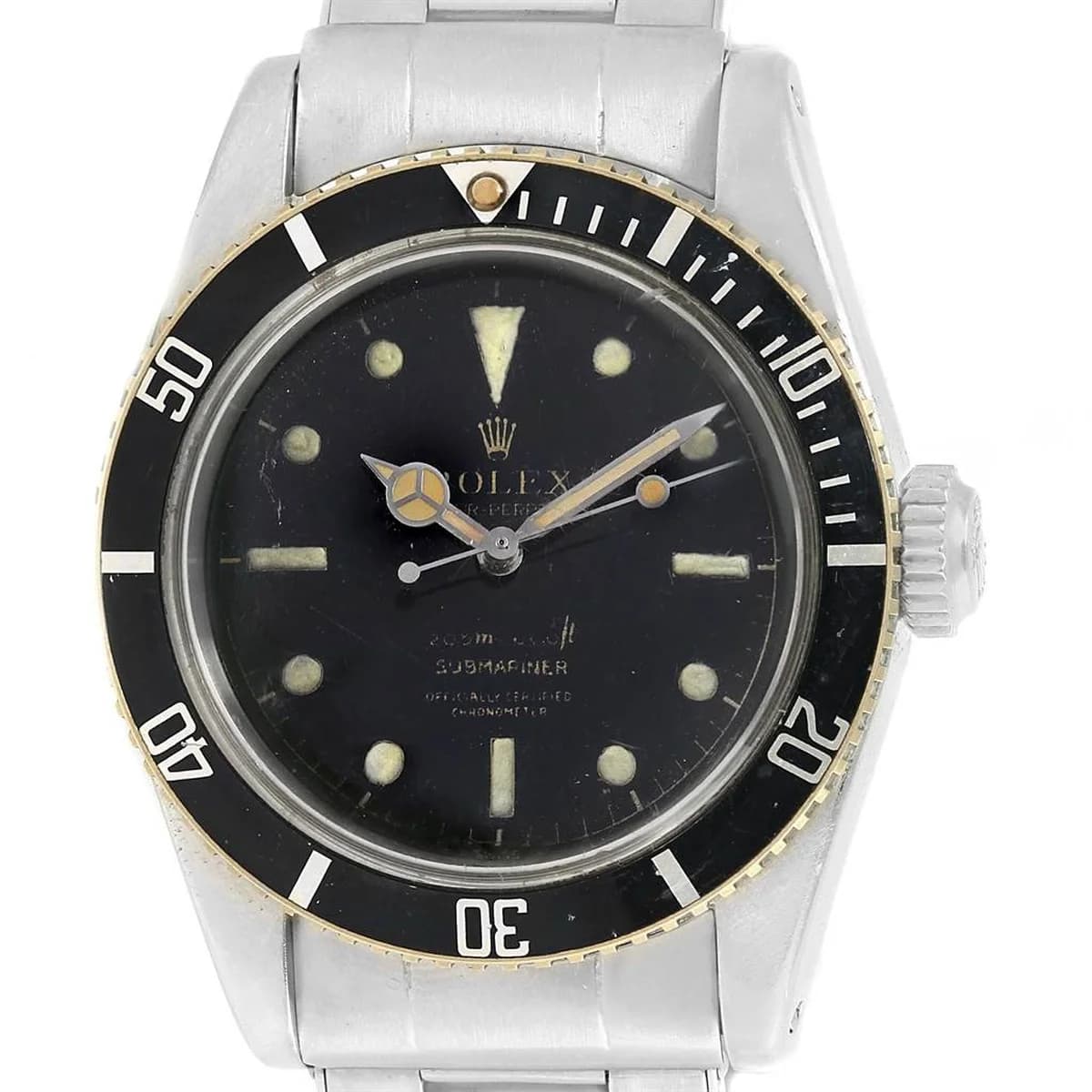
There is a moment in Dr. No, about thirty minutes into the film, where Sean Connery adjusts the cuff of his dinner jacket and you catch a glimpse of stainless steel on his wrist. That is the reference 6538. The watch that made the Submariner famous. Not because of anything Rolex did in their marketing department, but because a film producer named Albert "Cubby" Broccoli pulled the watch off his own wrist and handed it to an actor who was about to become the most iconic spy in cinema history. The prop budget for Dr. No in 1962 did not include a Rolex. So Broccoli improvised. That improvisation changed the trajectory of an entire watch line.
But the 6538 was already something special before Bond ever touched it. To understand why, I need to back up to the early 1950s and explain what was happening in the world of dive watches. Jacques Cousteau had published The Silent World in 1953, introducing recreational diving to mainstream culture. Professional divers, military and scientific, needed instruments that could survive underwater. The problem was straightforward: build a watch that keeps accurate time at depth, tracks elapsed minutes on an external rotating bezel, and does not flood. Blancpain had the Fifty Fathoms in development for the French Navy. Rolex had the Submariner. Both appeared in 1953, and the debate about which one came first has never been fully settled. What has been settled is which one became the most recognized dive watch in history.
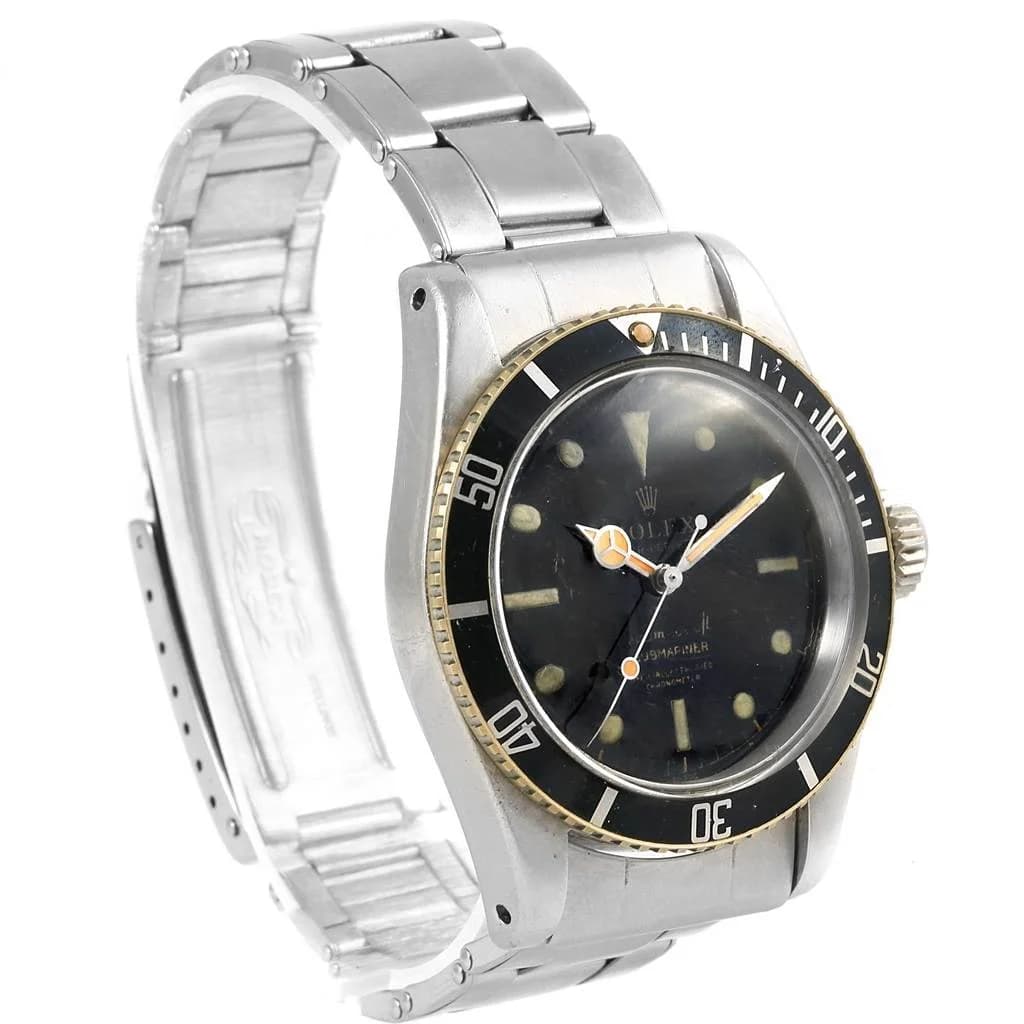
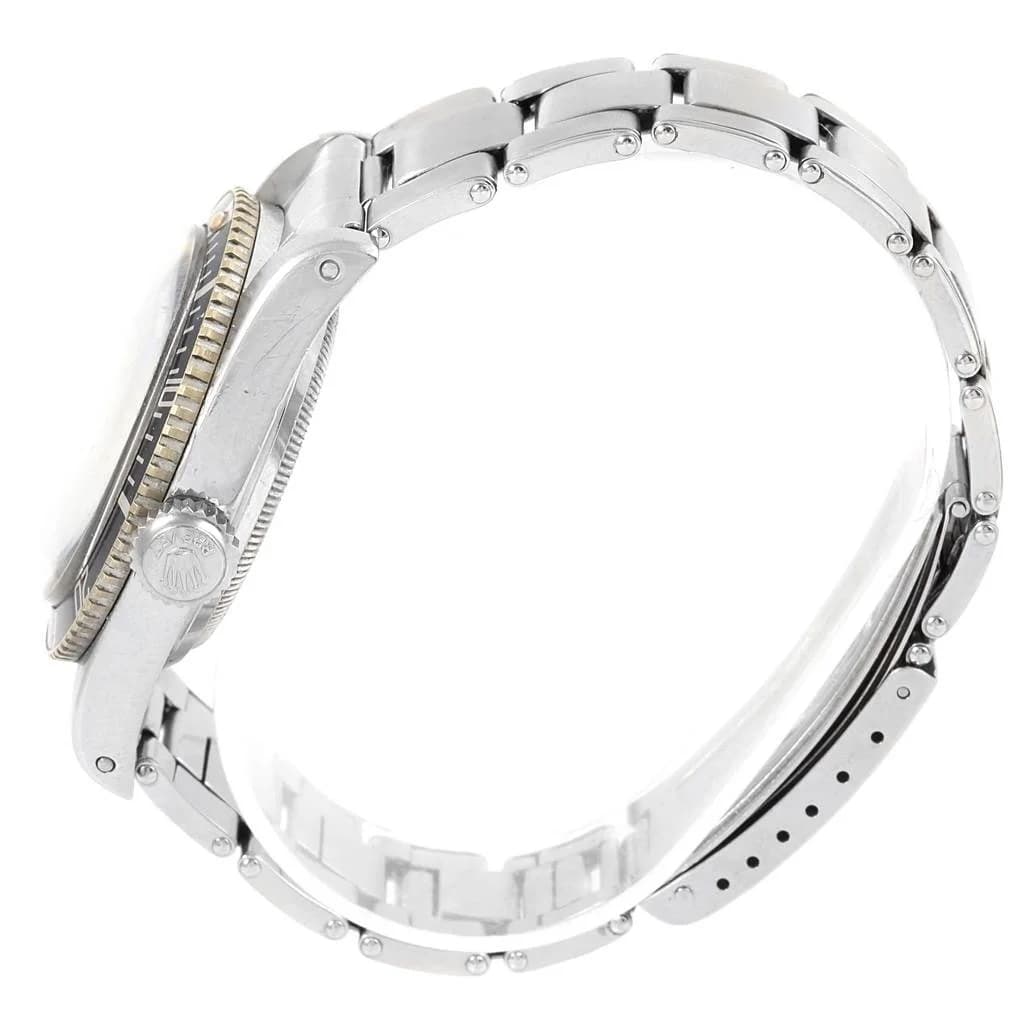
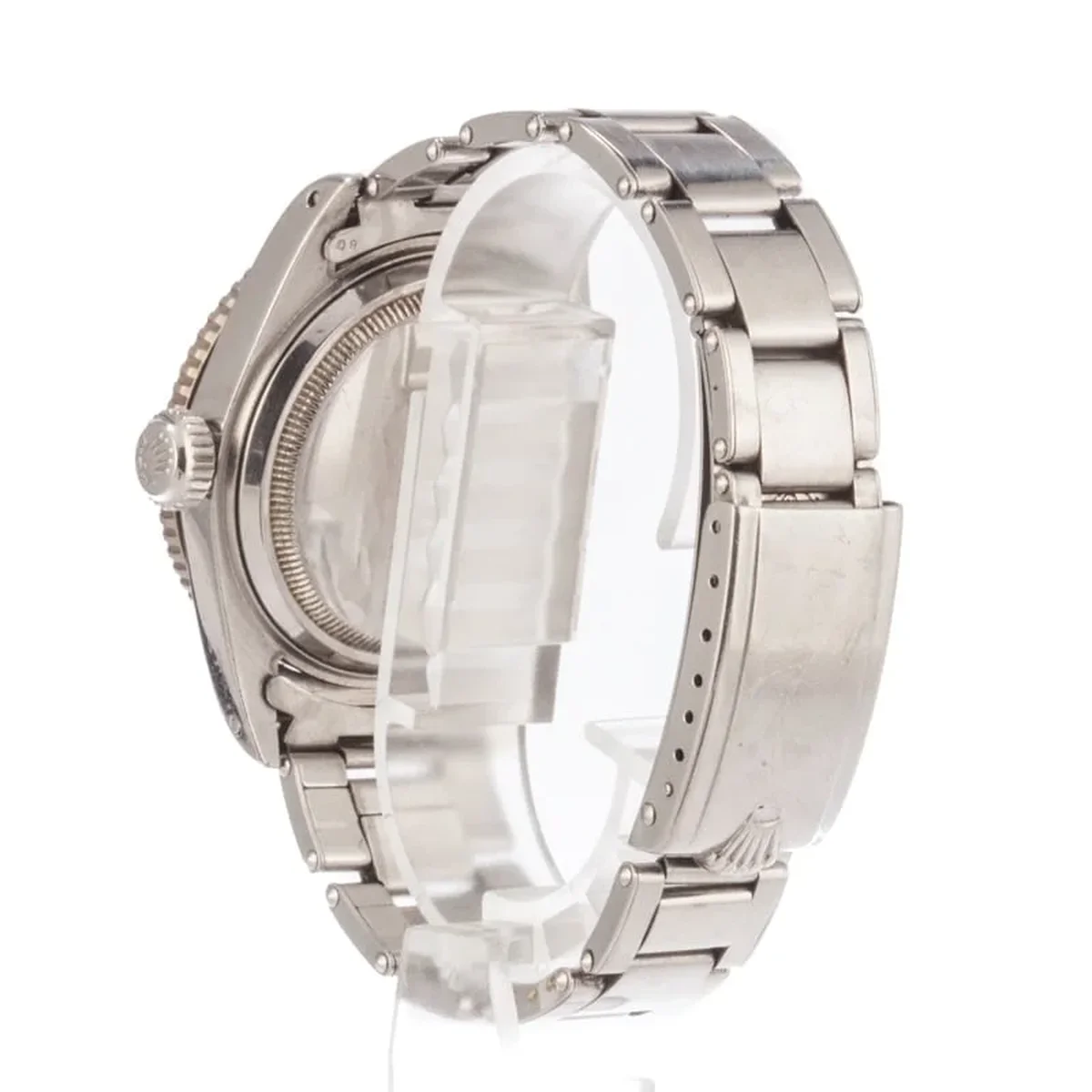
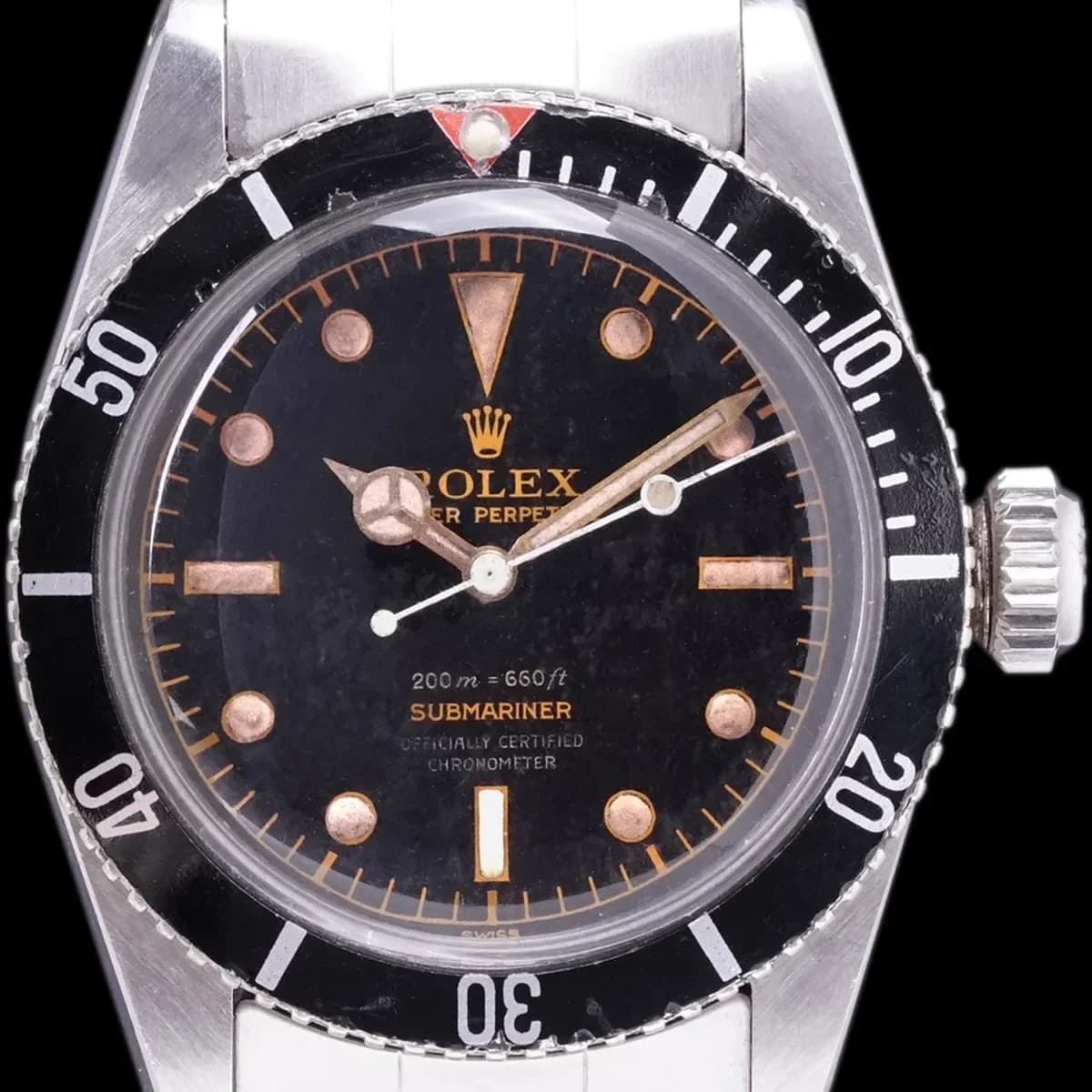
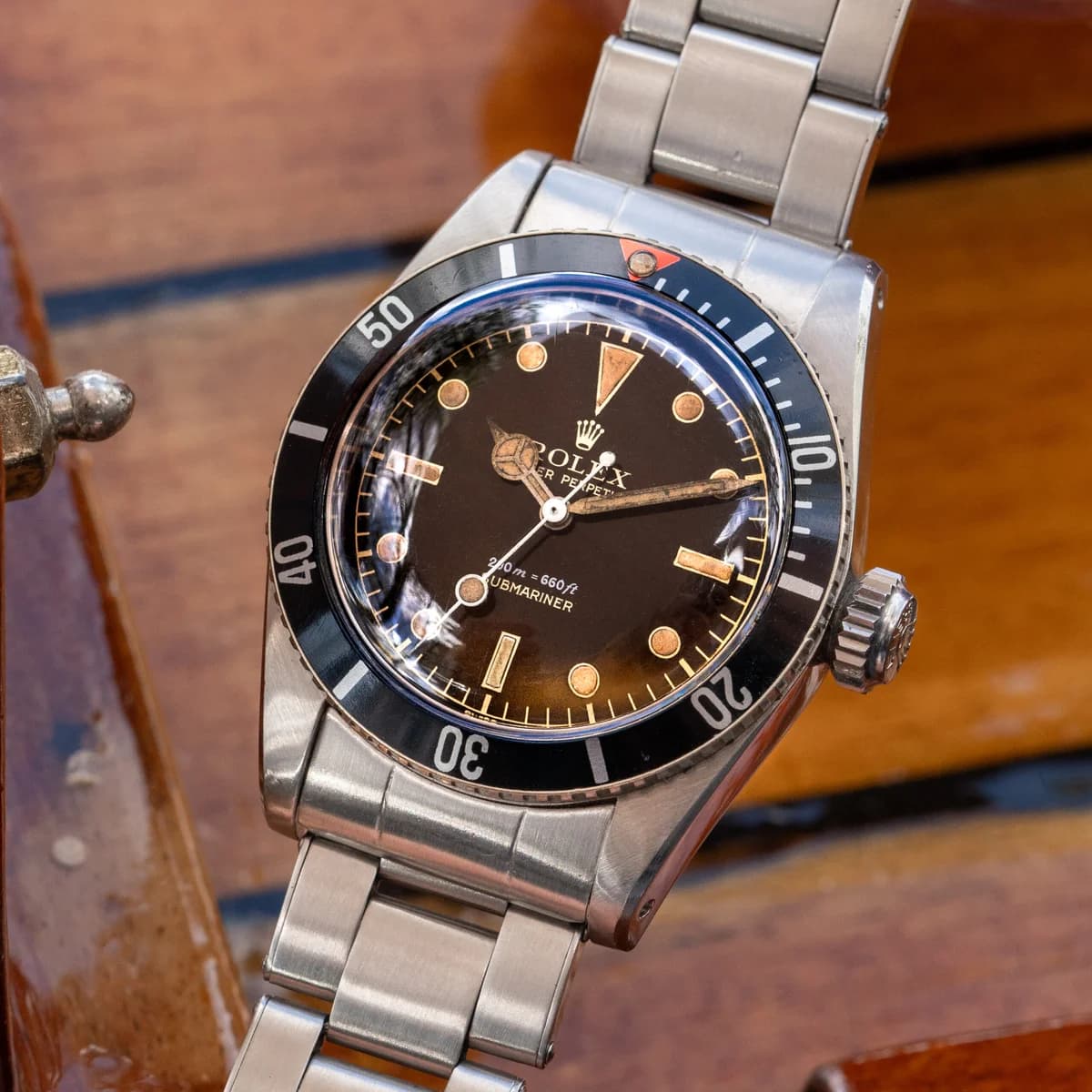
The first Submariner was the reference 6204 in 1953, approximately 37mm, no crown guards, a bidirectional bezel, and 100 meters of water resistance. It was followed by the 6205 and then the 6536, which kept the same small 6mm winding crown. The 6538 arrived around 1955 and changed the equation in two critical ways. First, it doubled the water resistance to 200 meters by fitting an oversized 8mm winding crown, the detail that earned it the "Big Crown" nickname. That crown is roughly a third larger than the 6mm crowns found on most watches of the era, and when you see one in person, the difference is immediately obvious. The crown sits proud of the case without any protective shoulders, exposed and assertive. Crown guards did not arrive until the reference 5512 in 1959. Second, the 6538 was the first Submariner to receive chronometer certification from the Swiss Official Chronometer Testing Institute, and certain examples display this achievement directly on the dial with four lines of text: the depth rating, "Submariner," and "Officially Certified Chronometer." These so-called 4-liner dials are substantially rarer than the standard 2-liner configuration, with collector estimates suggesting that only about thirty percent of 6538 production received certified movements.
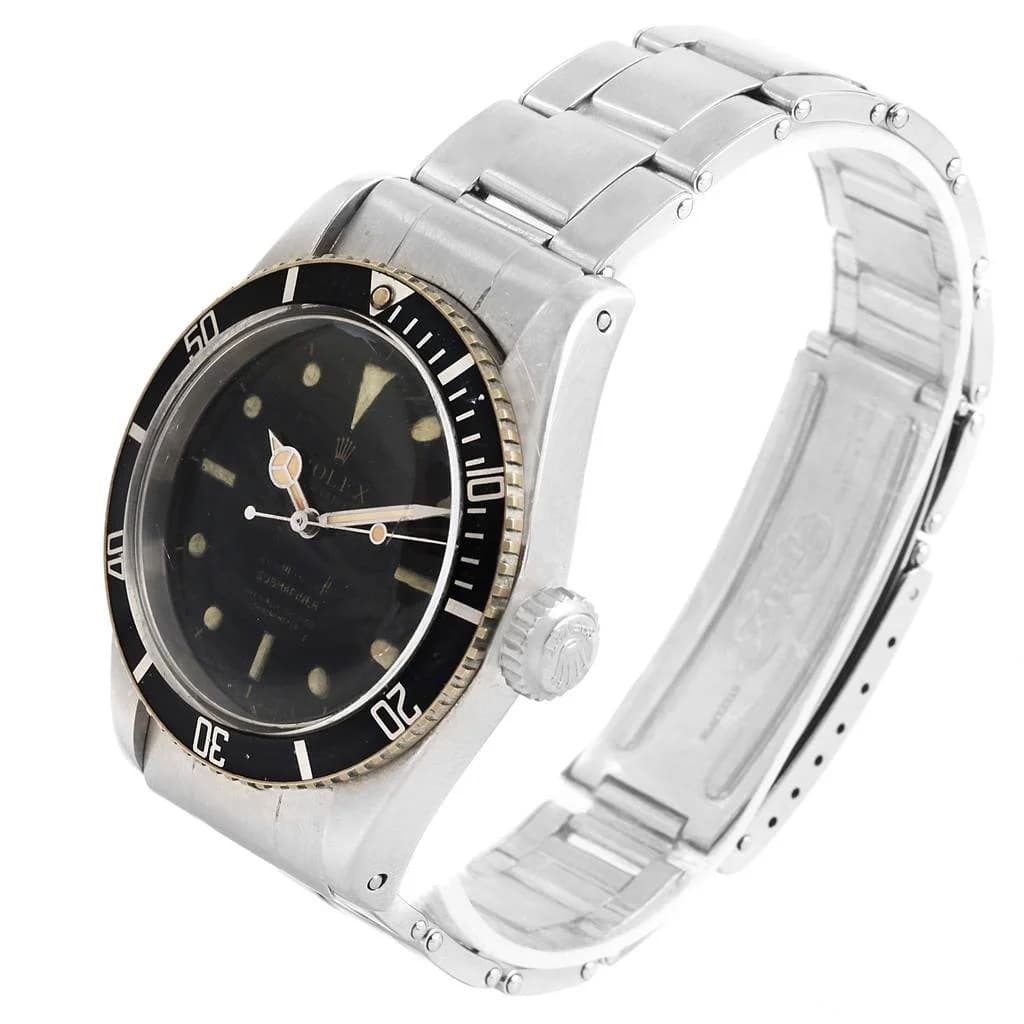
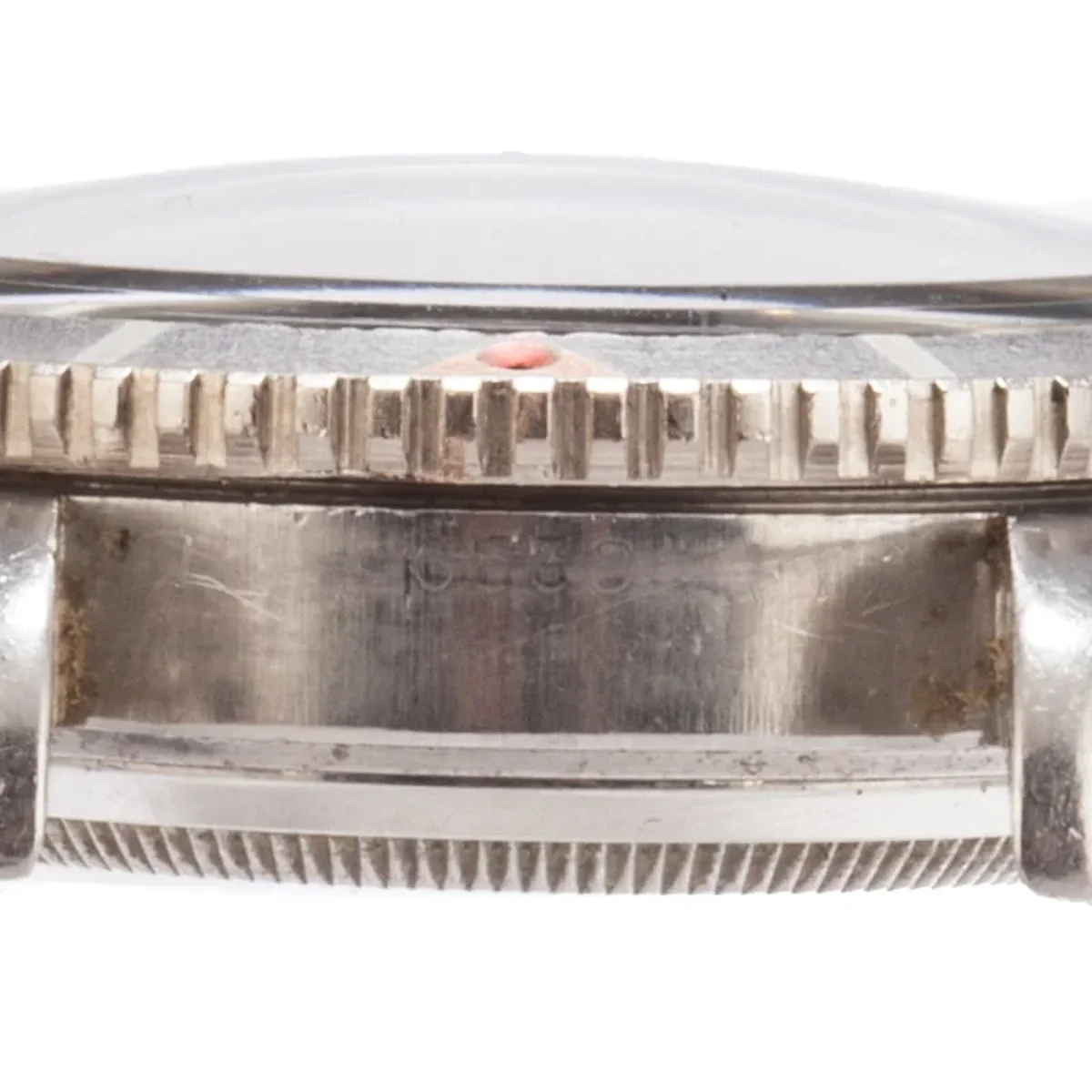
The case measures approximately 38mm in diameter. I say approximately because vintage Rolex cases were not measured with the same consistency as modern production. Some sources cite 37mm, others 38mm. What is not debatable is how it wears. Without crown guards, the case has a clean, almost delicate profile that looks nothing like the 41mm fortress of the modern 124060. The lugs are thinner. The lines are simpler. The plexiglass crystal sits with a gentle dome that catches light in a way that modern flat sapphire does not. Acrylic scratches easily, and almost every surviving 6538 has a crystal covered in fine marks, but the material has a warmth to it that sapphire cannot replicate. There is a reason vintage collectors specifically prefer the look of plexiglass.
I love that the 6538 wears its age honestly. Every surviving example is different. The lume has aged to a different shade. The bezel has faded to a different grey. The crystal has collected its own constellation of scratches. In an era where Rolex produces watches that will look identical in fifty years thanks to Cerachrom ceramic and sapphire, the 6538 came from a time when materials were allowed to change, and that change was part of the experience.
The Caliber 1030 powers the 6538, and this movement holds its own place in Rolex history. It was Rolex's first caliber to feature a bidirectional automatic winding rotor, meaning the rotor winds the mainspring in both directions as your wrist moves, not just one. This was an engineering step forward from earlier Rolex automatics that only wound in a single direction. The movement measures 28.5mm in diameter, carries 25 jewels, and beats at 18,000 vibrations per hour. That frequency, 2.5 Hz, is slower than the 28,800 vph (4 Hz) standard that Rolex would adopt in later calibers like the 1520 and 1530. In practice, the slower beat rate means the seconds hand ticks with a slightly less smooth sweep, and the timekeeping is theoretically less resistant to positional variation than a faster movement. But the 1030 is famously reliable. Watchmakers who work on vintage Rolex will tell you that a well-serviced 1030 still runs within acceptable tolerances after six decades. Power reserve is approximately 42 to 48 hours depending on the individual movement and its service history.
I want to talk about the dial because this is where the 6538 gets genuinely interesting for collectors. There are at least three major dial configurations. The most common is the 2-liner, which displays the depth rating and "Submariner" in gilt lettering on a black lacquered dial. The 4-liner adds the chronometer certification text below. And then there is the rarest variant of all: the Explorer dial, which replaces the standard hour markers with large 3-6-9 Arabic numerals at the quarter positions, similar to the Explorer reference 1016. An Explorer-dial 6538 in original condition is among the most sought-after Submariners ever to cross an auction block. All original dials used gilt (gold-colored) printing and lettering with radium-based luminous material on the hour markers and hands. Over six decades, the radium lume has aged to cream, tan, or sometimes a rich tropical brown color. This aging, called tropicalization by collectors, is considered desirable. Two 6538s sitting next to each other will have completely different lume patina depending on their exposure history. Every one is unique.
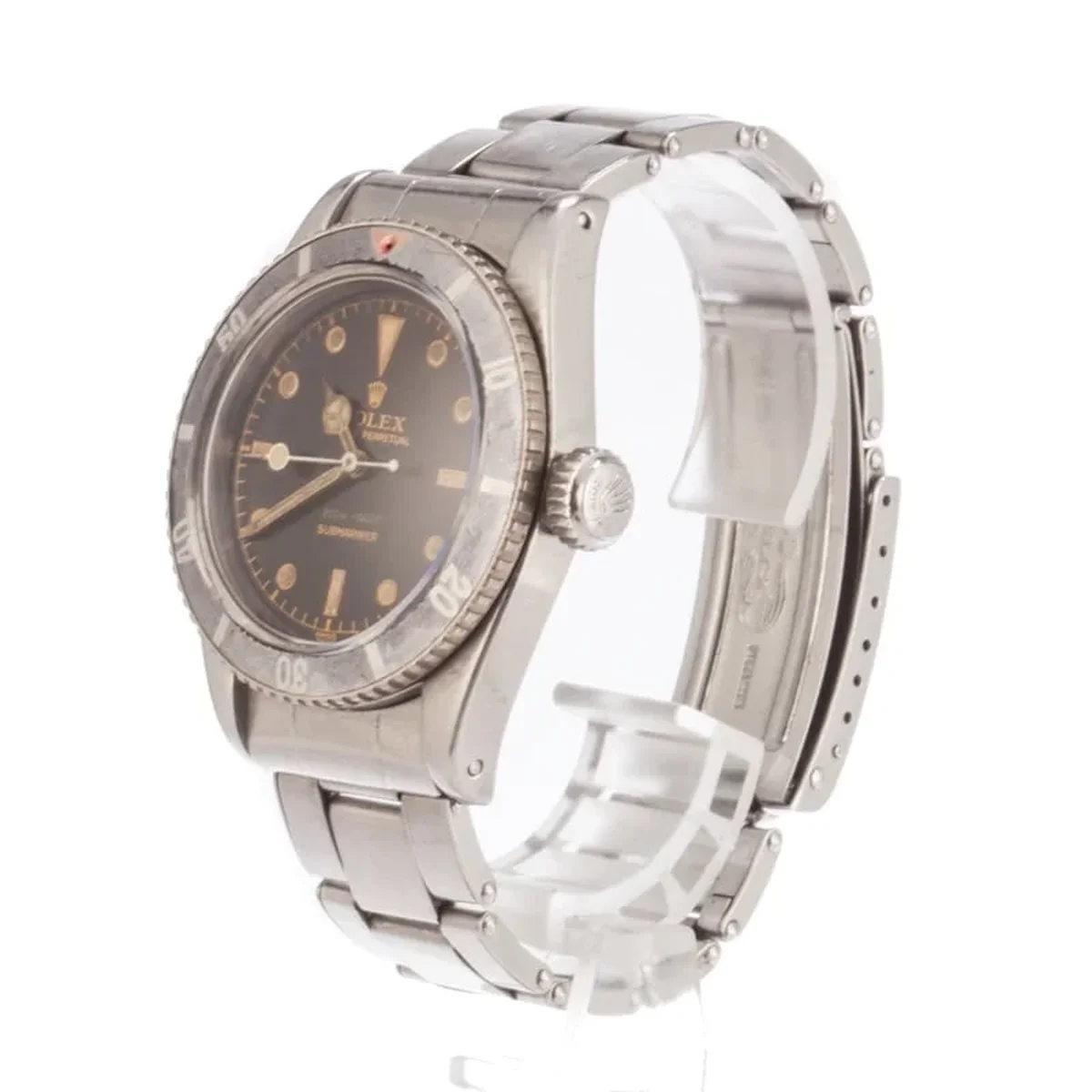
The bezel is bidirectional, meaning it rotates in both directions. Modern dive watches use unidirectional bezels that only rotate counterclockwise as a safety measure, so that if the bezel gets accidentally bumped underwater, elapsed time can only appear to increase, never decrease. The 6538 precedes that convention. The insert is aluminum, black with white graduation markings, and features the iconic small red triangle at the 12 o'clock position filled with luminous material. Over time, the aluminum fades. Some bezels develop a beautiful grey patina. Others turn an almost ghostly silver. Like the dial lume, no two are alike. The knurled edge of the bezel and caseback is a period detail that disappeared from later Submariners. There is something about that knurled texture under your fingertip that connects you to the manufacturing era in a way that a smooth Cerachrom ceramic bezel does not.
The Bond connection deserves a full telling because the story is better than most people realize. When production began on Dr. No in early 1962, the costume department needed a watch for their new spy character. Ian Fleming had written in his novels that Bond wore a Rolex, but the film's modest budget did not allocate funds for purchasing one. Producer Cubby Broccoli solved the problem by removing his own Submariner 6538 from his wrist and handing it to Sean Connery. The watch appeared on screen in Dr. No (1962), From Russia with Love (1963), Goldfinger (1964), and Thunderball (1965). In Goldfinger, the watch was fitted with a narrow striped nylon strap, approximately 16mm wide on 20mm lugs. The strap was apparently a military-style fabric band borrowed from a crew member, possibly to fit the watch over a costume or diving suit. That mismatch between the narrow strap and the wider lugs created an aesthetic that was unintentional and completely iconic. Collectors still replicate the look today. The entire NATO strap movement in watch culture traces a direct line back to that wardrobe improvisation on the set of a 1960s spy film.
The military history of the 6538 runs parallel to its cinema career. In 1957, the British Ministry of Defence wrote to Rolex requesting dive watches for evaluation by Royal Navy divers. Rolex supplied approximately fifty standard 6538 units for field testing. After extended trials on the wrists of the Special Boat Squadron, Clearance Divers, and other diving units, the MOD returned with modification requests. The bezel needed to be easier to grip while wearing thick diving gloves, so Rolex redesigned it with a deeper profile and constructed it from German Silver, an alloy of nickel, copper, and zinc that resisted corrosion better than the standard brass and zinc construction. The resulting watches were designated A/6538. They featured unique 3-6-9 Explorer-style dials with red depth markings, fixed spring bars that prevented the watch from detaching during operations, and military caseback engravings. These A/6538 units served on Royal Navy wrists for approximately ten years until the MOD transitioned to the Omega Seamaster 300 around 1967.
The survival rate of the A/6538 is sobering. From the original batch of approximately fifty watches, only a handful of genuine examples are estimated to survive in any documented condition. Military watches live hard lives. They get banged against steel surfaces, submerged repeatedly, serviced with whatever parts are available rather than original Rolex components, and sometimes cannibalized for parts to keep other watches running. When an A/6538 surfaces at auction with documented provenance, it is a significant event in the vintage watch world.
I find myself drawn to what the 6538 represents in the broader Submariner lineage. The 6204 in 1953 was the proof of concept. The 6205 and 6536 were iterations. The 6538 was the moment Rolex proved the Submariner could be a serious professional tool, not just a recreational accessory. Doubling the water resistance from 100 to 200 meters. Fitting a crown large enough for divers to operate with wet hands or light gloves. Submitting movements for chronometer certification and printing the result on the dial for everyone to see. The 6538 was Rolex saying, this is not a novelty, this is an instrument.
The succession of references after the 6538 tells the story of how Rolex took that instrument and refined it over seven decades. The 5508 arrived in the late 1950s with improved water resistance but kept the small crown. The 5512 in 1959 introduced crown guards for the first time, the protective shoulders flanking the winding crown that became a defining visual element of every Submariner since. The 5513 ran from 1962 to 1989, nearly three decades, making it the longest-produced Submariner reference in history. The 14060 in 1990 brought sapphire crystal. The 114060 in 2012 introduced the Cerachrom ceramic bezel. And the current 124060 in 2020 brought the Caliber 3230 with 70 hours of power reserve and an antimagnetic Chronergy escapement. Every one of those references is a direct descendant of the 6538. The rotating bezel. The Mercedes hands. The lume plots at the hour markers. The depth rating on the dial. All of it started here.
The honest observation about the 6538 is also what makes it fascinating. This watch is, by modern standards, a fragile thing. The plexiglass crystal scratches if you look at it too hard. The bidirectional bezel can be accidentally rotated during a dive, compromising your elapsed time reading. The 200 meters of water resistance, while impressive for the 1950s, is below the 300-meter standard that has been universal since the 5512. The radium lume was eventually recognized as a health concern, and surviving dials were recalled by the MOD to have the radium replaced with safer tritium compound. The 8mm crown, the watch's most distinctive feature, protrudes noticeably without crown guards, making it vulnerable to impacts and creating a potential point of water intrusion if not properly screwed down. None of these are failures. They are the realities of a watch designed in the mid-1950s with the materials and knowledge available at the time. And every single one of these limitations was addressed in subsequent references. Crown guards came with the 5512. Unidirectional bezels became standard. Sapphire replaced plexiglass. Tritium replaced radium. The 6538 is a snapshot of where the engineering was in 1955, and every improvement that followed is a direct response to living with this watch in real conditions.
What strikes me about the Rolex corporate structure is that they never abandoned the Submariner during the quartz crisis of the 1970s and 1980s. Hundreds of Swiss brands collapsed. Rolex kept building mechanical Submariners because they understood that the value proposition was not just accuracy. It was identity. The 6538 established that identity. Bond made it visible. But the engineering made it real. The fact that Rolex still produces a no-date, time-only, rotating-bezel dive watch in 2026 is a direct consequence of the foundation the 6538 laid in the mid-1950s. Seventy years of continuous production, and the core idea has not changed.
I appreciate how the 6538 wears differently from anything in the modern Rolex catalog. At approximately 38mm with no crown guards, it feels compact and elegant on the wrist. My 6.5-inch wrist handles modern 41mm cases without issue, but there is something about the proportions of a 1950s Submariner that just works differently. The watch does not announce itself. It sits quietly. The gilt dial under plexiglass catches light with a depth and warmth that modern matte dials under sapphire do not produce. If I saw someone wearing a 6538 under the cuff of a Cesare Attolini tropical-weight wool suit, I would notice it immediately. Not because it is flashy, but because it radiates a quiet authority that only vintage watches carry. Six decades of patina, of radium aging to amber, of aluminum bezels fading to grey, creates something that no new watch can replicate no matter how much engineering you throw at it. Time is the one material Rolex cannot manufacture.
In my experience, the watches that matter most in any collection are not the ones with the highest specifications. They are the ones with the best stories. The 6538 has the best story of any Submariner ever made. A film producer lending his personal watch to an unknown Scottish actor. Royal Navy divers strapping modified versions to their wrists before descending into cold water. Watchmakers at Herstmonceux Castle replacing dangerous radium with safer tritium in a quiet English workshop. Gilt dials aging to amber under decades of sunlight. Every 6538 that survives carries all of these threads.
The Submariner became the Submariner because of the 6538. Not because of Bond, though Bond certainly helped. Not because of the MOD, though military provenance adds significance. The 6538 mattered because it proved that a dive watch could be a chronometer. That a winding crown could be oversized without making the watch look awkward. That a rotating bezel and luminous hour markers and 200 meters of water resistance could coexist in a case that was still comfortable on a human wrist. Every Submariner made after 1959 is an iteration on the ideas that the 6538 established. The modern 124060 is better in every measurable way. More accurate, more durable, more water resistant, more antimagnetic. But it exists because someone at Rolex in the mid-1950s decided to put an oversized crown on a dive watch, submit the movement for chronometer testing, and print the result on the dial. The 6538 is not the best Submariner ever made. It is the most important one.
Also in Tool Watches