
Rolex
Submariner No-Date
124060
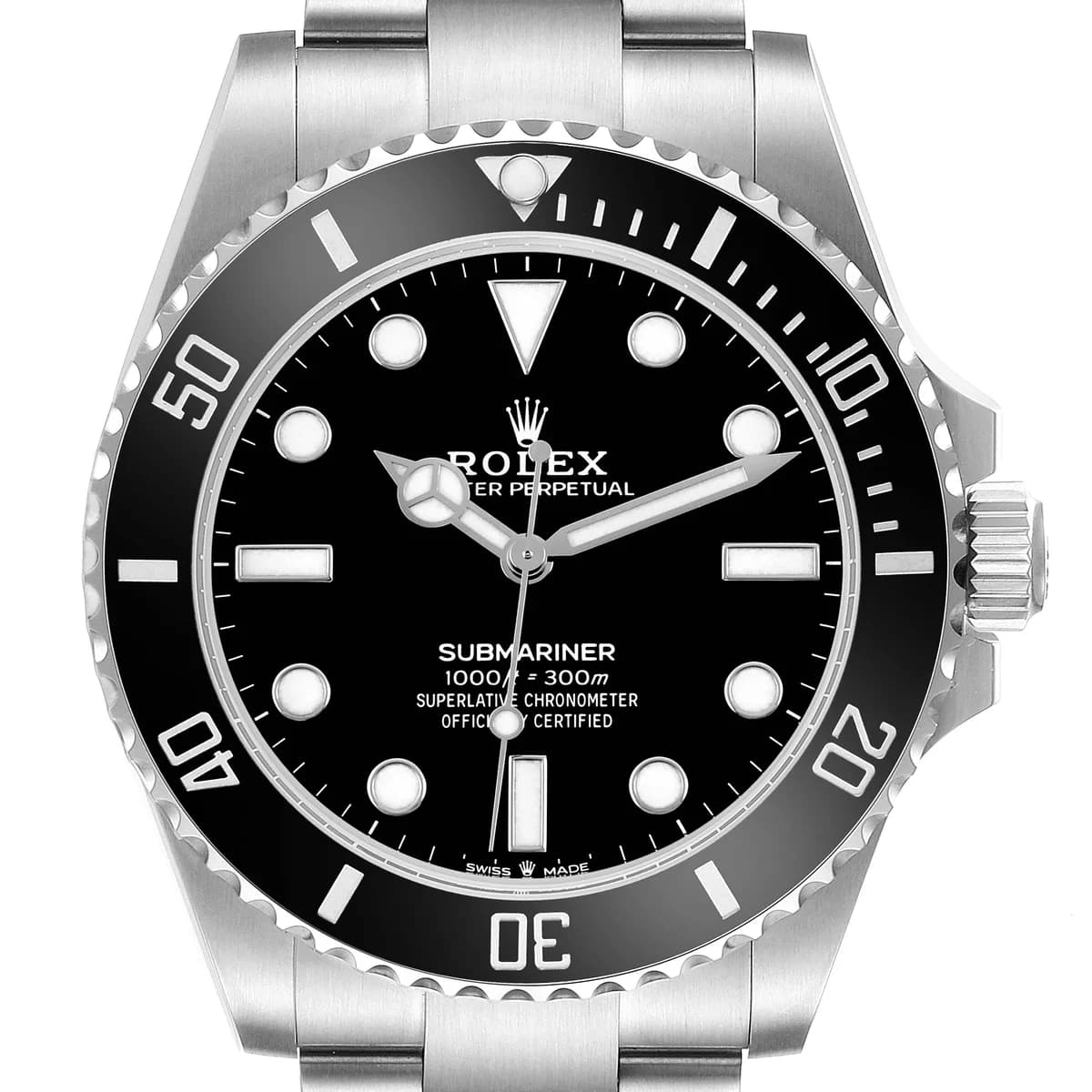
You have to understand what the world of diving looked like in 1953 to appreciate why the Submariner exists. Jacques Cousteau and his team had just published The Silent World, the book that introduced recreational diving to mainstream culture. Auguste Piccard was preparing the bathyscaphe Trieste for its record-breaking descent. Scuba equipment was crude by modern standards, available only to military divers and a handful of scientists. The idea that a wristwatch could survive at depth, keep accurate time underwater, and track elapsed minutes on a rotating bezel was not obvious. It was an engineering problem that nobody had convincingly solved for production. Blancpain had the Fifty Fathoms in development for the French Navy. Rolex had the Submariner. Both appeared in 1953 and the debate about which was truly first has never been settled. What has been settled is which one became the most recognized dive watch in history. That is not even close.
The first reference was the 6204. Approximately 37mm, no crown guards, a bidirectional bezel that could rotate in either direction, and 100 meters of water resistance. It was tested by the Institute of Submarine Research in Cannes across 132 dives before its public debut at the 1954 Basel Watch Fair. Rene-Paul Jeanneret, a Rolex director who was himself a diver, is credited as the driving force behind the project. Hans Wilsdorf, the founder, had spent decades building Rolex around the idea that watches should go where people go. The Oyster case in 1926. The Perpetual rotor in 1931. The Submariner was the logical next step. If a watch could be waterproof on land, it should be waterproof underwater. Wilsdorf did not live to see what the Submariner would become. He died in 1960. But the philosophy he built, that a watch proves itself through real-world performance rather than laboratory certification alone, is the reason Rolex tests every Superlative Chronometer to tolerances that exceed COSC standards.
The no-date Submariner is the purest expression of that philosophy. No date window breaking the dial symmetry. No Cyclops lens disrupting the crystal line. Just hours, minutes, seconds, and a unidirectional bezel to track elapsed time underwater. The date complication was not added to the Submariner until approximately 1966-67 with the reference 1680. Everything before that was time and a dive bezel. Nothing else. The 124060 is the direct descendant of that original idea, and when you hold one, you are holding seventy years of iterative refinement applied to a concept that has not fundamentally changed since Jeanneret and his team strapped a prototype to a diver's wrist in the Mediterranean.
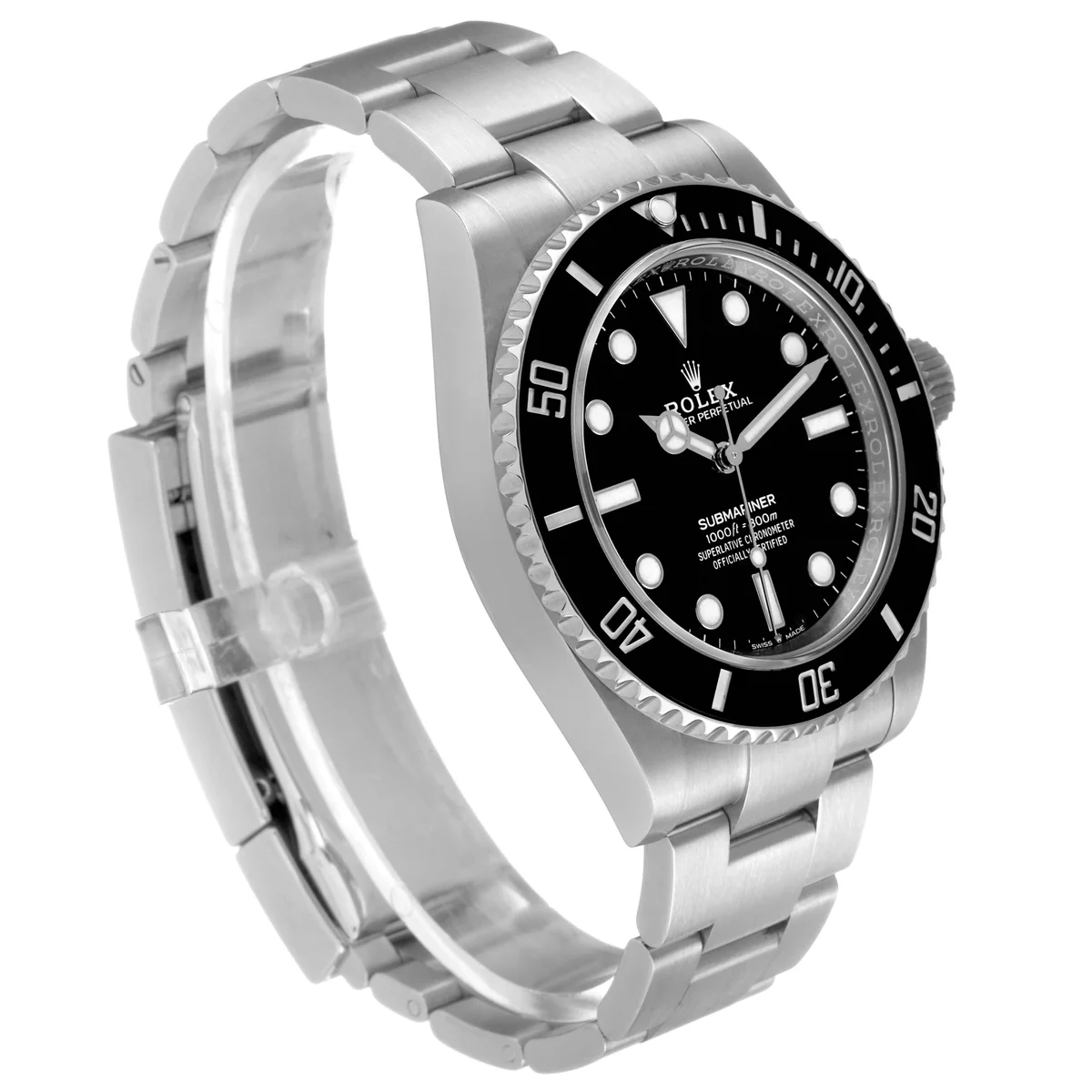
Three-quarter angle: black Cerachrom bezel, Oystersteel case, no Cyclops
I want to walk through the lineage because it matters. The 6204 became the 6205 and then the 6536 within the first few years. The 5508 arrived in the late 1950s with improved water resistance. The 5512 introduced crown guards, the protective shoulders flanking the winding crown that became one of the Submariner's defining visual elements. The 5513 ran from 1962 to 1989, making it the longest-produced Submariner reference in history. Nearly three decades. It was the 5513 that the British Ministry of Defence adapted into the 5517 MilSub for the Royal Navy's Special Boat Service. Those military-issued pieces had fixed lug bars for NATO straps, sword hands borrowed from Omega's design language, a fully graduated bezel, and a brushed case to reduce underwater reflectivity. They were produced between 1971 and 1979, and today they are among the most valuable Submariners in existence. The French Marine Nationale used Submariners as well, and COMEX, the French deep-sea diving company, received custom-modified 5513s with helium escape valves starting in 1970.
The 14060 replaced the 5513 in 1990 and brought sapphire crystal to the no-date Submariner for the first time. Mineral crystal was gone. The 14060M added COSC chronometer certification. The 114060 in 2012 introduced the Cerachrom ceramic bezel, the so-called Sub-C that marked the beginning of the modern era. And the 124060 arrived in September 2020, the current generation, with the Caliber 3230, a 41mm case, and every lesson Rolex had learned since 1953 baked into a single watch.
Sean Connery wore a reference 6538, the Big Crown Submariner, in Dr. No in 1962. It appeared again in From Russia with Love and Goldfinger. Whether it was product placement or Connery's own watch has been debated for decades, but what is not debatable is the effect. The Submariner went from being a dive instrument worn by professionals to being the watch that James Bond wore. That cultural imprint has never faded. Every watch brand in the world has copied the Submariner's design language at some point. The unidirectional bezel with the first fifteen minutes graduated. The Mercedes hands. The lume plots at the hour markers. The combination of brushed and polished surfaces on the case. It is the most copied watch design in history. Some of those copies are respectful homages. Most are not. But the fact that the template has been replicated thousands of times across every tier of watchmaking speaks to how right the original design was.
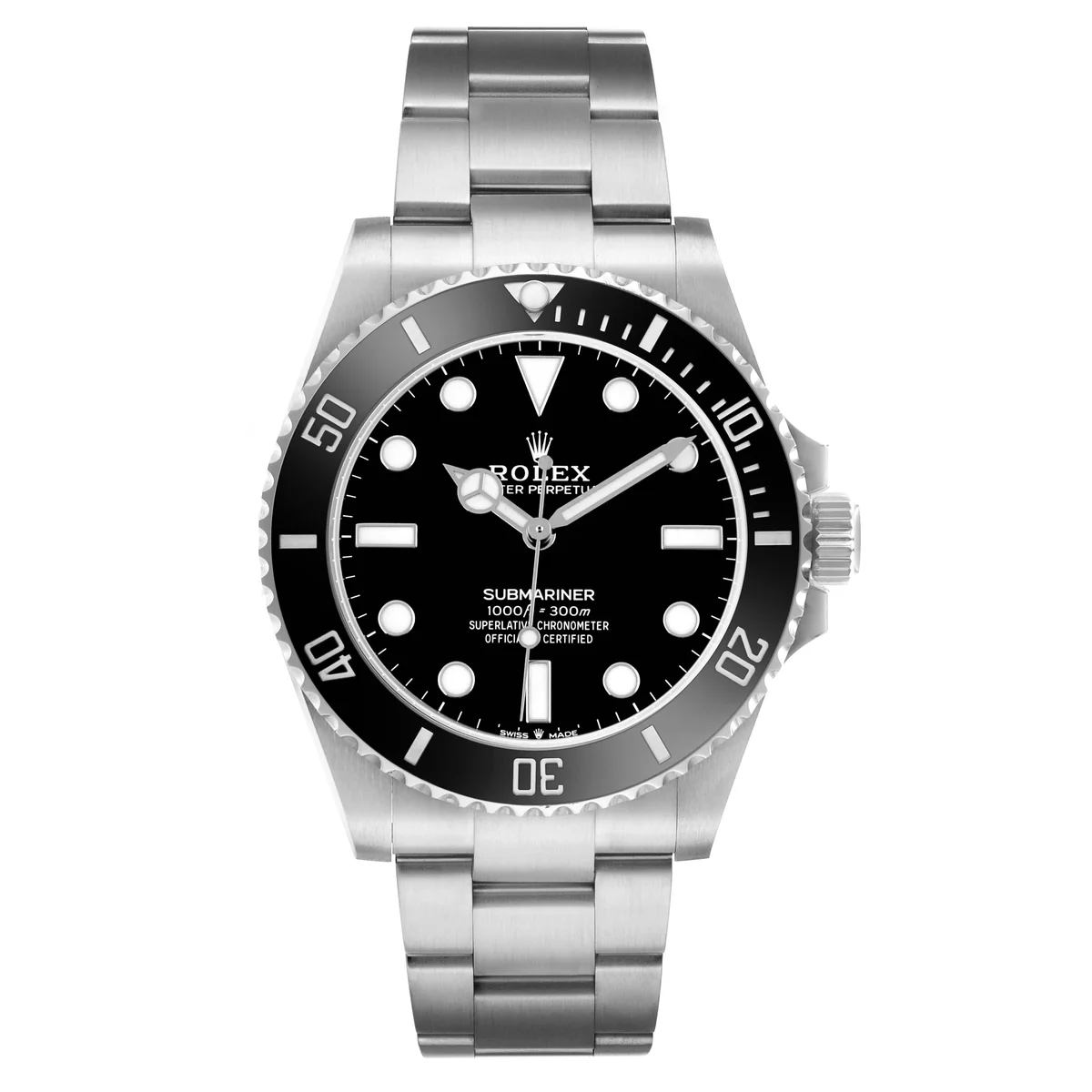
The 124060 in full: 41mm, symmetrical dial, fully brushed Oyster bracelet
Now I want to talk about the 124060 specifically because this is where it gets interesting from an engineering perspective.
The case grew from approximately 40mm to 41mm. That single millimeter does not sound like much on paper, but the change is more subtle than the number suggests. Rolex did not simply scale up the 114060. They redesigned the lugs. The 114060 had what collectors call the Super Case, with broader, squarer lugs that gave the watch a chunky, assertive presence. The 124060 brought back more graceful curves, trimming half a millimeter off each side of the lugs and creating space for a wider bracelet where it meets the case. The bracelet attachment grew from 20mm to 21mm. The result is a watch that is technically larger but wears more elegantly on the wrist. It sits flatter. The proportions are different. Side by side with the 114060, the 124060 looks more refined. It is not a dramatic difference. From three feet away you cannot tell them apart. But on the wrist, you feel it.
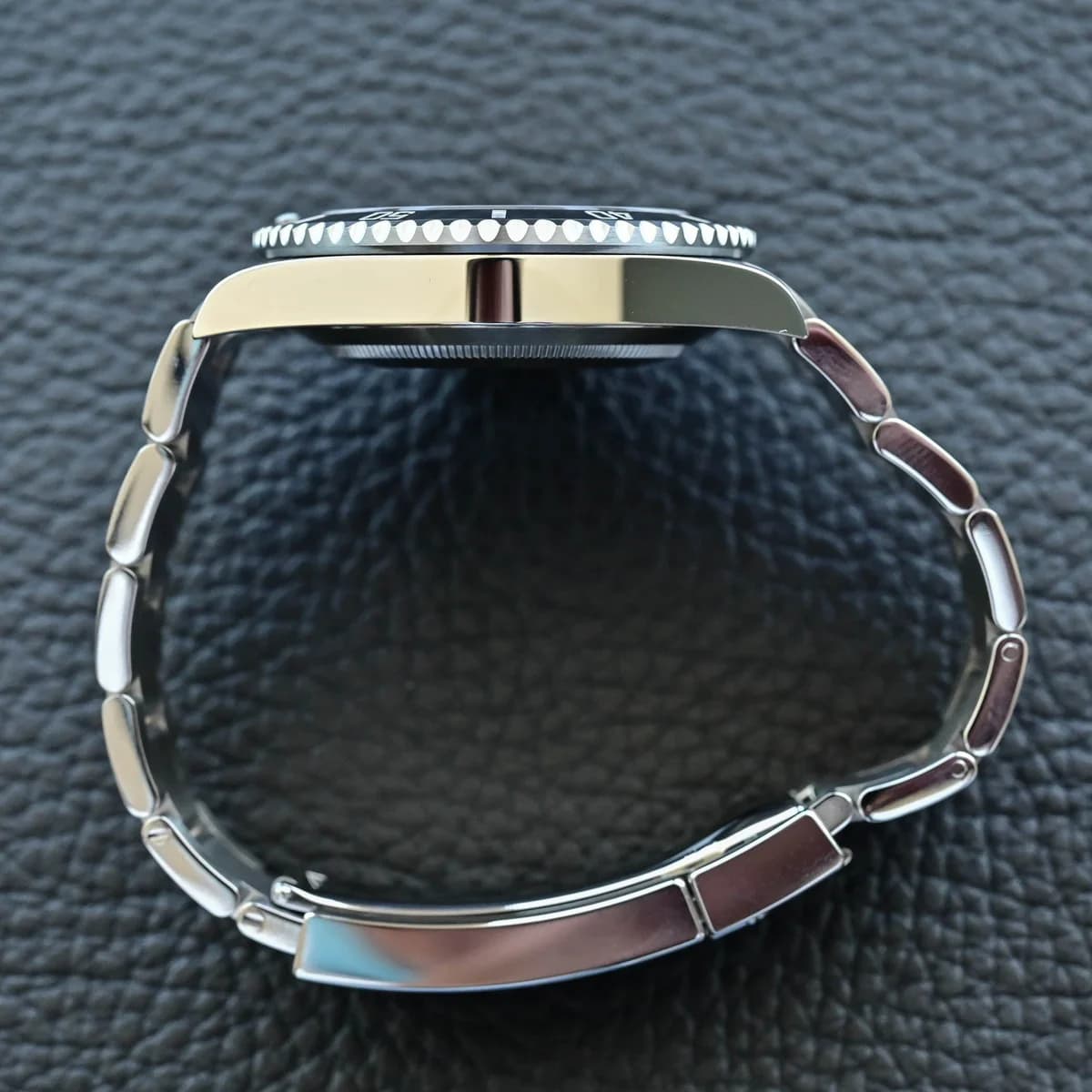
Side profile showing the 12.3mm case thickness and redesigned lugs
The Caliber 3230 is the heart of the 124060 and the reason the power reserve jumped from 48 hours to 70. That is not a small improvement. 48 hours meant you could take the watch off Friday evening and it might still be running Sunday morning if you were lucky. 70 hours means you can take it off Friday and strap it on Monday morning and it is still ticking. The Chronergy escapement makes this possible. Patented by Rolex, it uses nickel-phosphorus components fabricated using LIGA technology, a process that combines lithography, electroforming, and molding to produce parts with microscopic precision. The geometry of the pallet fork horns is wider and the impulse pin is thinner compared to a traditional Swiss lever escapement, reducing energy loss at each oscillation by approximately 15 percent. The nickel-phosphorus alloy is antimagnetic, meaning the escapement is unaffected by the magnetic fields that surround us constantly from phones, tablets, laptop speakers, and even handbag clasps. The Parachrom hairspring is a Rolex-patented alloy of niobium and zirconium that is ten times more resistant to shocks than a conventional hairspring and virtually unaffected by magnetic fields. Combined with the Chronergy escapement, the result is a movement that is accurate, antimagnetic, shock-resistant, and efficient enough to store nearly three days of energy in a single mainspring barrel. Rolex certifies every watch to their Superlative Chronometer standard, which requires accuracy within plus or minus two seconds per day, tested on the wrist in real-world conditions after casing. COSC certifies the raw movement to minus four, plus six. Rolex goes further, and they do it after the movement is inside the case, which adds variables that COSC does not test for.
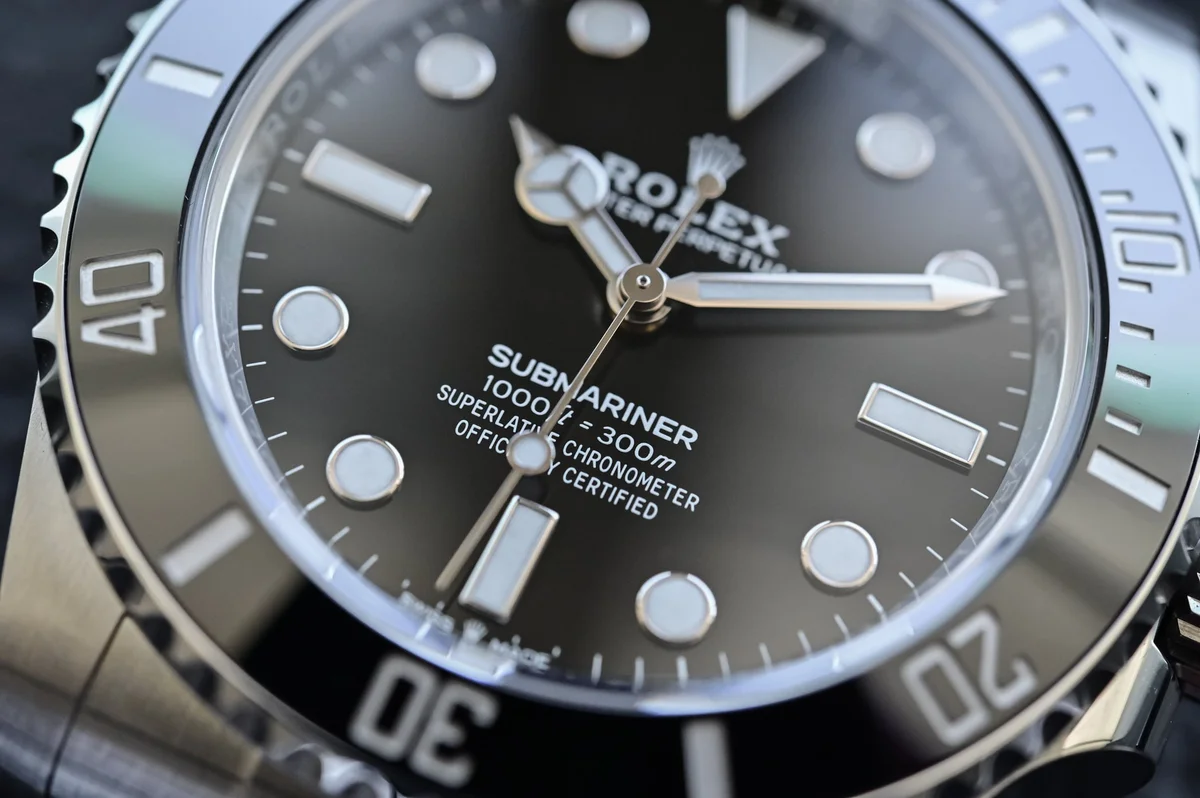
Dial macro: Mercedes hands, Chromalight-filled white gold hour markers
The Cerachrom bezel on the 124060 is zirconium dioxide sintered at approximately 1,600 degrees Celsius. Rolex manufactures these in-house at their facility in Plan-les-Ouates. The process starts with zirconium dioxide powder mixed with a binding agent and pigments, molded into shape, then heat-treated in furnaces until the ceramic reaches its final density and hardness. The binding agent burns away during sintering. What remains is a material that is virtually scratchproof, completely impervious to UV degradation, and resistant to every chemical you will encounter in daily wear including chlorine, saltwater, and sweat. The hardness is approximately 1,500 on the Vickers scale. Stainless steel is roughly 200. That is over seven times harder. The numerals and graduation marks on the bezel are engraved into the ceramic and then coated with platinum using Physical Vapor Deposition. The rest of the surface is polished to remove the platinum from the flat areas, leaving only the recessed numerals filled with platinum. This is why the bezel markings on a modern Submariner have that distinctive metallic shine against the matte black ceramic. Older Submariners used aluminum bezel inserts that would fade, scratch, and develop a patina over years of wear. The Cerachrom insert will look exactly the same in fifty years as it does today. Some collectors miss the character that aluminum developed. I understand the sentiment. A faded bezel on a vintage 5513 tells a story. But the engineering argument for ceramic is absolute. One thing people do not realize about the Cerachrom bezel until they handle one is the click action. 120 clicks per full rotation, which means each click represents 30 seconds of elapsed time. The spring-loaded mechanism underneath produces a tactile feedback that is firm, consistent, and precise. There is no play. There is no wobble. The bezel sits flush against the case with no gap. You can operate it with gloves, which is the point, because this is a dive watch, and divers wear gloves. The luminous pip at 12 o'clock is a Chromalight-filled ceramic insert that is visible in the dark so you can confirm bezel alignment without surfacing. The entire assembly is designed to survive the same 300 meters of water pressure as the case itself. It is overengineered for recreational diving and perfectly engineered for the kind of professional use that most Submariner owners will never put it through. That gap between capability and use is part of the appeal. You are wearing a watch that can do more than you will ever ask of it. There is a confidence in that.
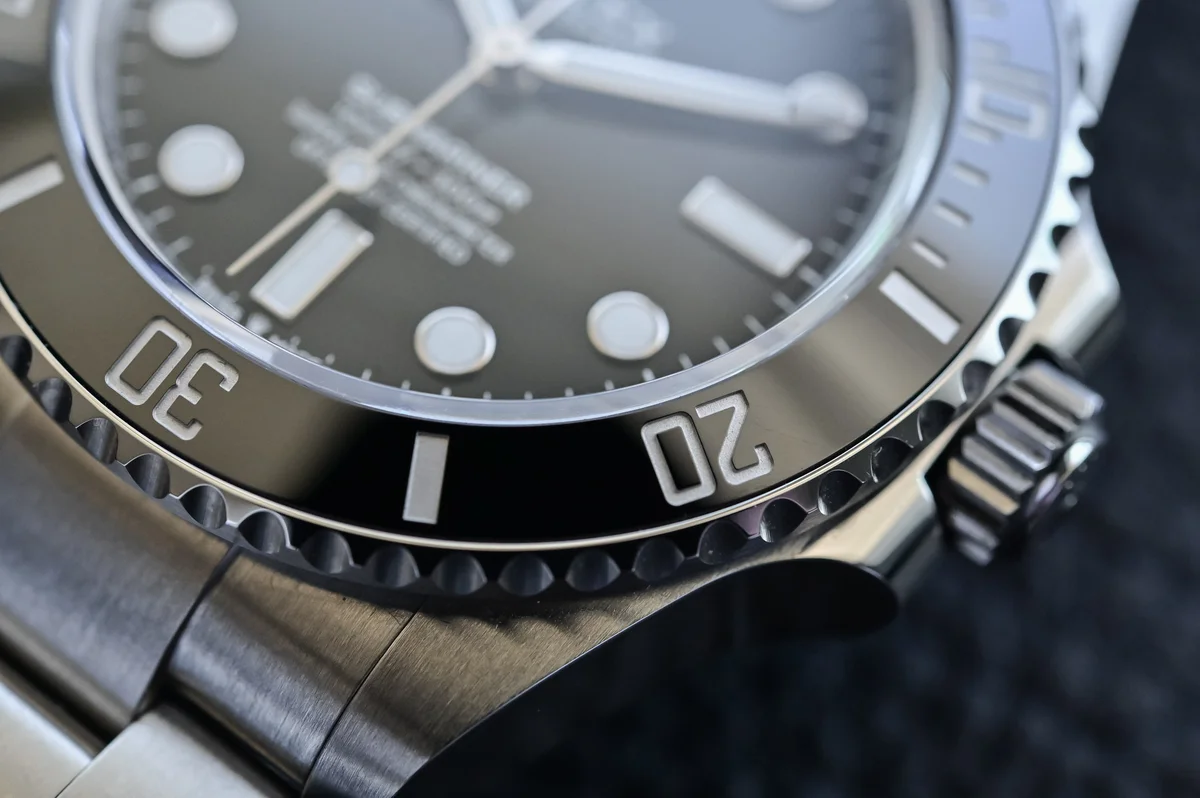
Cerachrom ceramic bezel macro: platinum-filled numerals, knurled edge
The Oystersteel case is 904L stainless steel, which Rolex has branded as Oystersteel. Most watches in the industry use 316L. The difference is in the composition. 904L has much higher percentages of chromium, nickel, and molybdenum, with copper added as an additional alloying element. The total alloying elements represent more than 50 percent of the material by weight. This makes 904L substantially more resistant to corrosion from saltwater, sweat, and acidic environments. It also polishes to a higher luster than 316L, which is why Rolex watches have that distinctive shine that is difficult to replicate. The tradeoff is that 904L is harder to machine and more expensive to source. Rolex has used it since 1985 and operates their own foundry to produce the alloy to their specifications. They are the only major watchmaker that controls the steel supply chain from raw material to finished case.
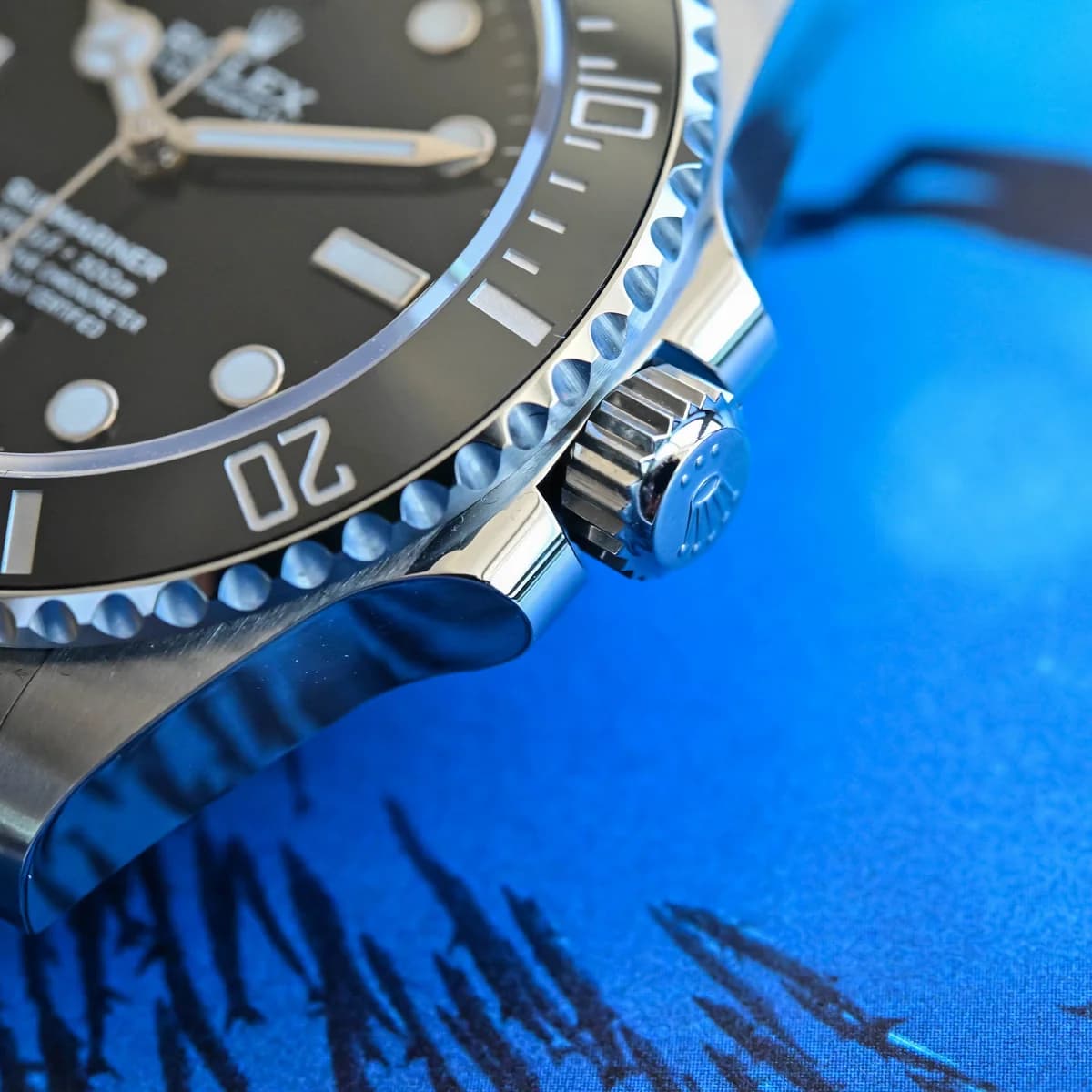
Triplock screw-down crown with Rolex logo between crown guards
The dial is matte black with applied hour markers filled with Chromalight luminescent material. Chromalight is a Rolex-developed phosphorescent compound that glows blue in the dark, as opposed to the green glow of traditional Super-LumiNova. Rolex claims approximately eight hours of visibility after exposure to light. The Mercedes hands are Chromalight-filled as well, and the triangle at 12 o'clock on the bezel insert contains a Chromalight dot. In the dark, the Submariner is immediately legible. The blue glow is cooler and more even than the yellow-green of SuperLuminova, and I find it easier to read in low-light conditions. The dial has no date window, which means the printing is perfectly symmetrical. The SUBMARINER text sits above the depth rating. The Rolex crown logo is applied at 12. The hour markers at 6, 9, and 12 are rectangular batons. The remaining markers are circular plots. All are framed in polished white gold surrounds. White gold, not steel. On a steel sport watch, every hour marker is 18K white gold. That is a detail most people never notice, but it is one of the things that separates Rolex finishing from the competition.
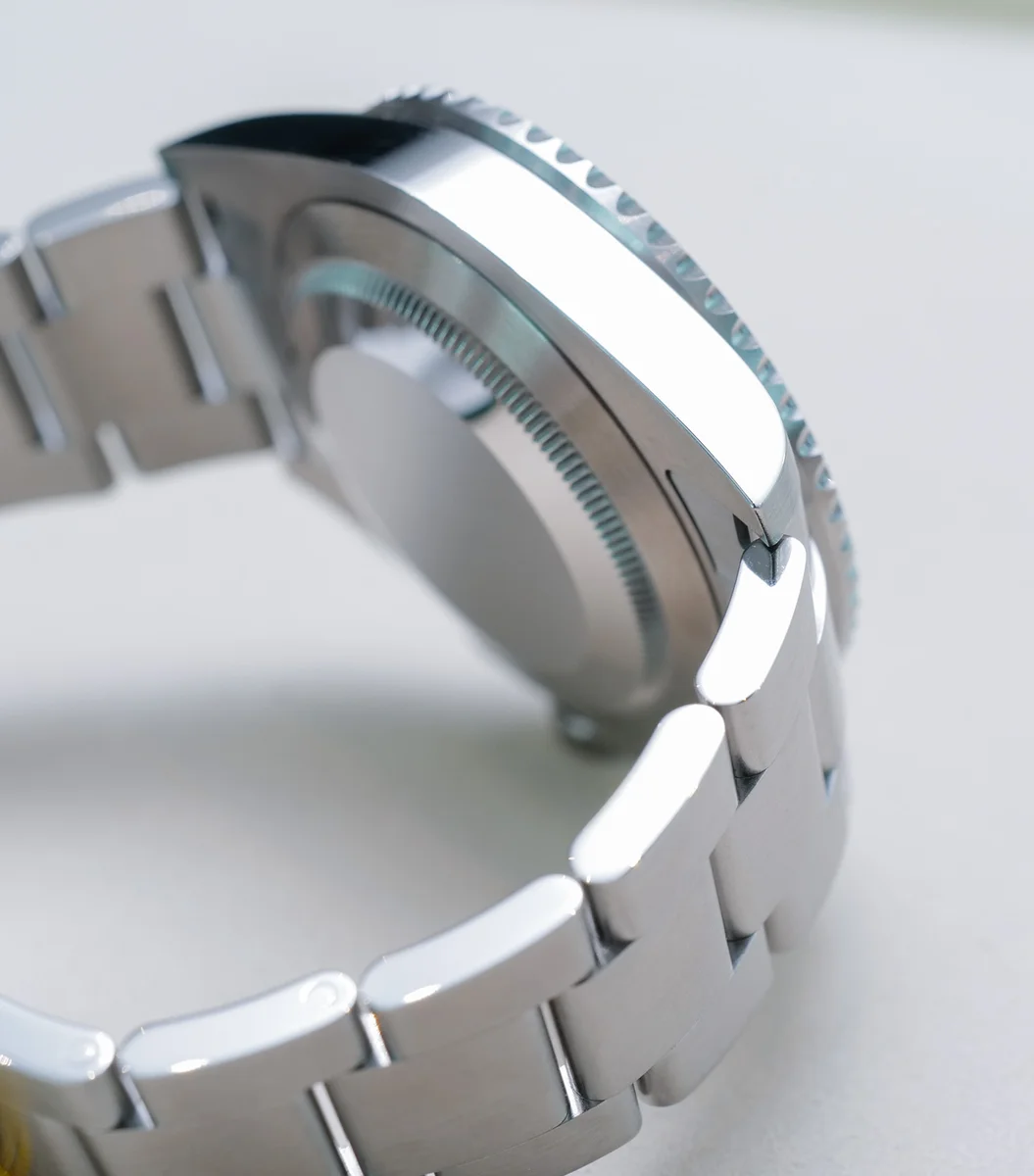
Solid screw-down caseback with knurled edge
The bracelet is the Oyster, reference 97220A, with the Oysterlock safety clasp and the Glidelock extension system. The Glidelock allows approximately 20mm of micro-adjustment in 2mm increments without any tools. You lift a lever inside the clasp, slide the bracelet to your preferred position, and close it. Over a wetsuit, over bare skin in winter when wrists shrink, in summer when they swell. The adjustment is instantaneous. Other brands use screw-based micro-adjustment or half-link removal. Rolex solved it with a mechanism that requires zero tools and zero effort. The bracelet itself is solid 904L with a brushed finish on the outer links and polished center links on the date version, though the no-date Submariner is fully brushed. The end links are solid and fitted to the case with minimal gap. On the wrist, the 124060 at approximately 155 grams is substantial but not heavy. The case is 12.3mm thick. It sits under a shirt cuff. Barely, but it fits.
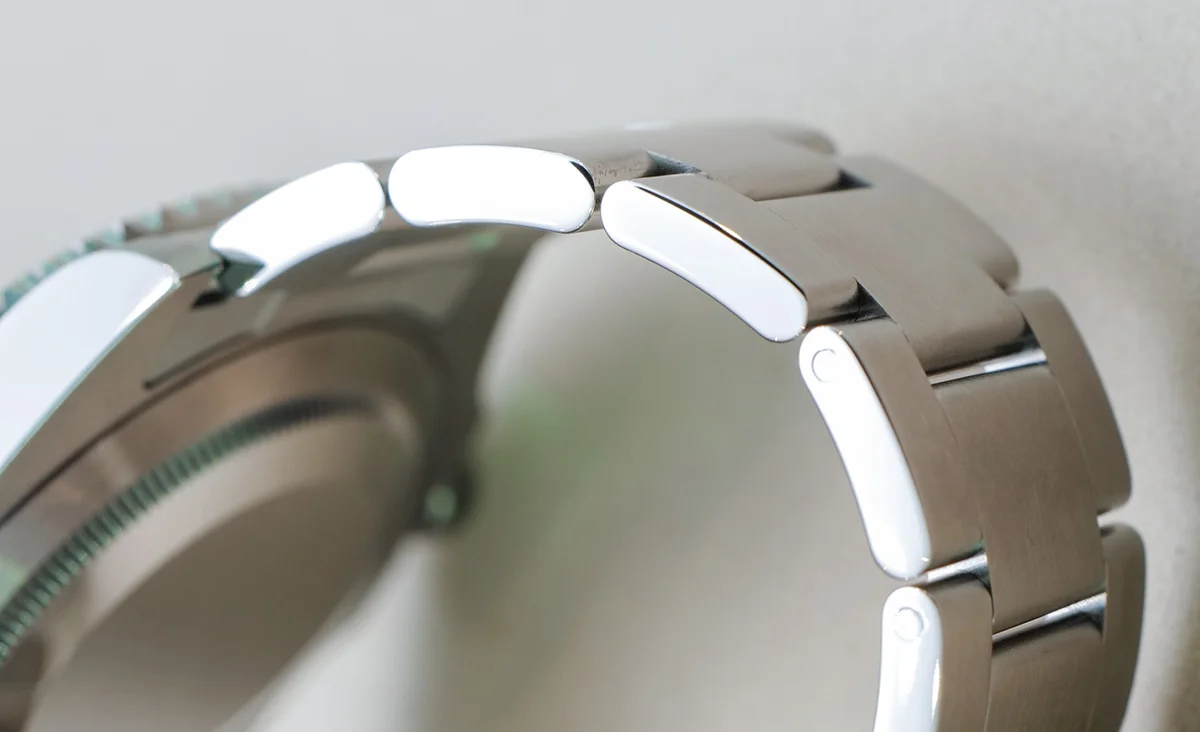
Oyster bracelet link pattern: brushed outer links, solid 904L construction
The water resistance is 300 meters, unchanged since the 5512 in the 1960s. But here is the detail most people do not know: every individual Submariner is pressure-tested at the factory to 375 meters, 25 percent beyond the rated depth. Rolex developed a proprietary hyperbaric tank in partnership with COMEX specifically for this purpose. The Deepsea, rated to 3,900 meters, is tested to 4,875. Every single watch. Not a sample from the batch. Every one. The Triplock crown system uses three sealed zones to keep water out. The crystal is sapphire with no date, no Cyclops, just a clean dome. The case back is screw-down with the Rolex hippocampus engraving, the seahorse motif that Rolex used on Oyster cases from 1926 until the mid-2000s and then brought back on certain models. Actually, the Submariner caseback is smooth with engravings. No exhibition back. You will never see the 3230 movement unless you open the watch for service, which should happen approximately every ten years according to Rolex's current recommendation.
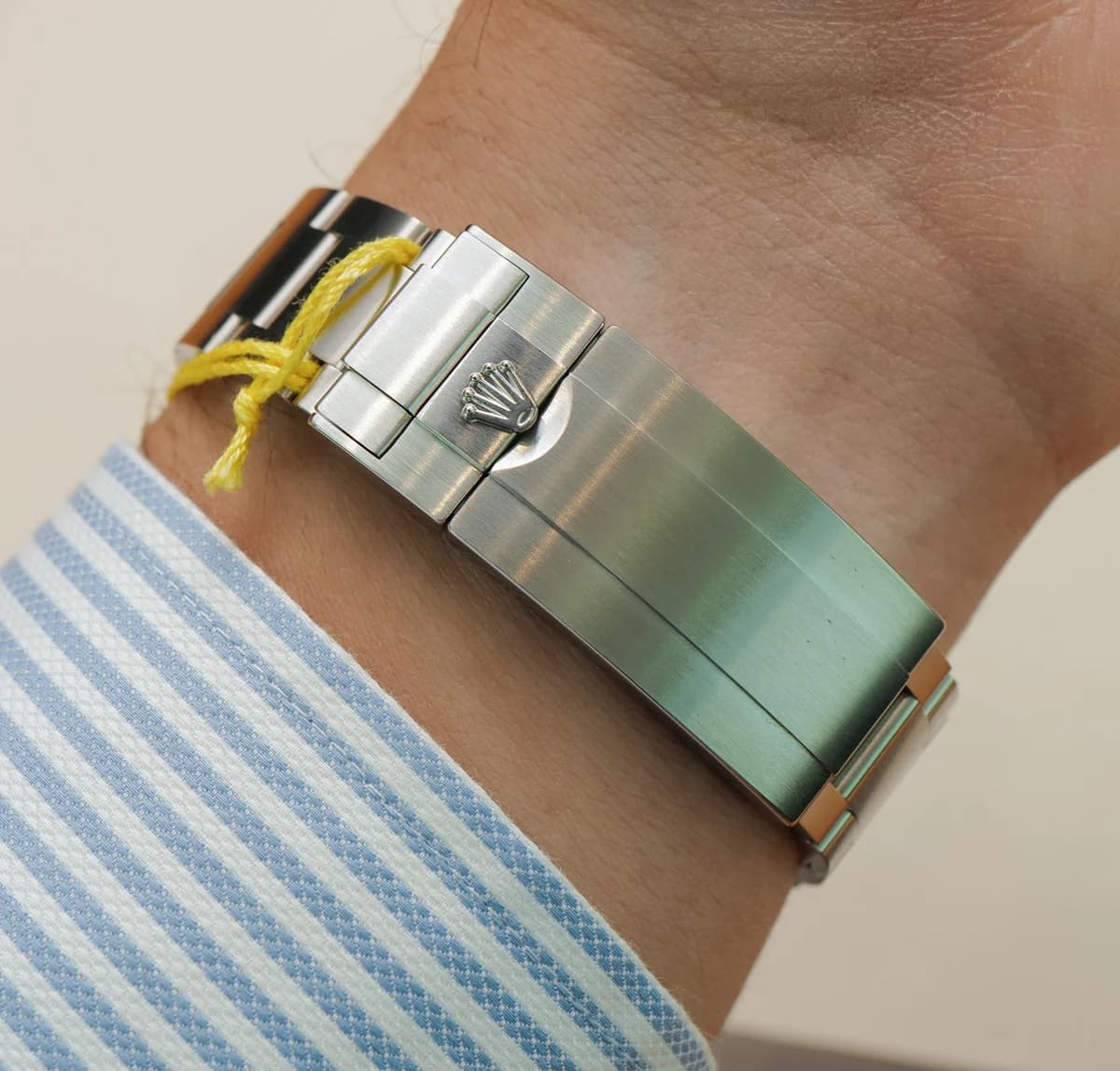
Oysterlock safety clasp with Rolex crown logo
I need to talk about why the no-date matters. Not just as a design choice but as a philosophy. The Submariner Date, the 126610LN, has the Cyclops lens magnifying the date at 3 o'clock. That Cyclops has been on Rolex date watches since 1953 and it is one of the most recognizable design elements in watchmaking. But on the Submariner, it breaks something. The dial of a no-date Submariner is perfectly symmetrical. The 12 o'clock marker balances the 6. The 3 balances the 9. The depth rating text is centered below the hands. Everything is where it should be. Add a date window at 3 and you introduce an asymmetry that some people cannot unsee. The Cyclops lens compounds it by creating a visible bump on the crystal. For collectors who value the Submariner as a tool watch, the date is unnecessary information. A diver does not need to know the date underwater. A diver needs elapsed time, and the rotating bezel provides that. The no-date Submariner is the watch reduced to its essential function. Nothing more, nothing less. That is what attracts people to it. Not the absence of a feature, but the discipline of not adding one.
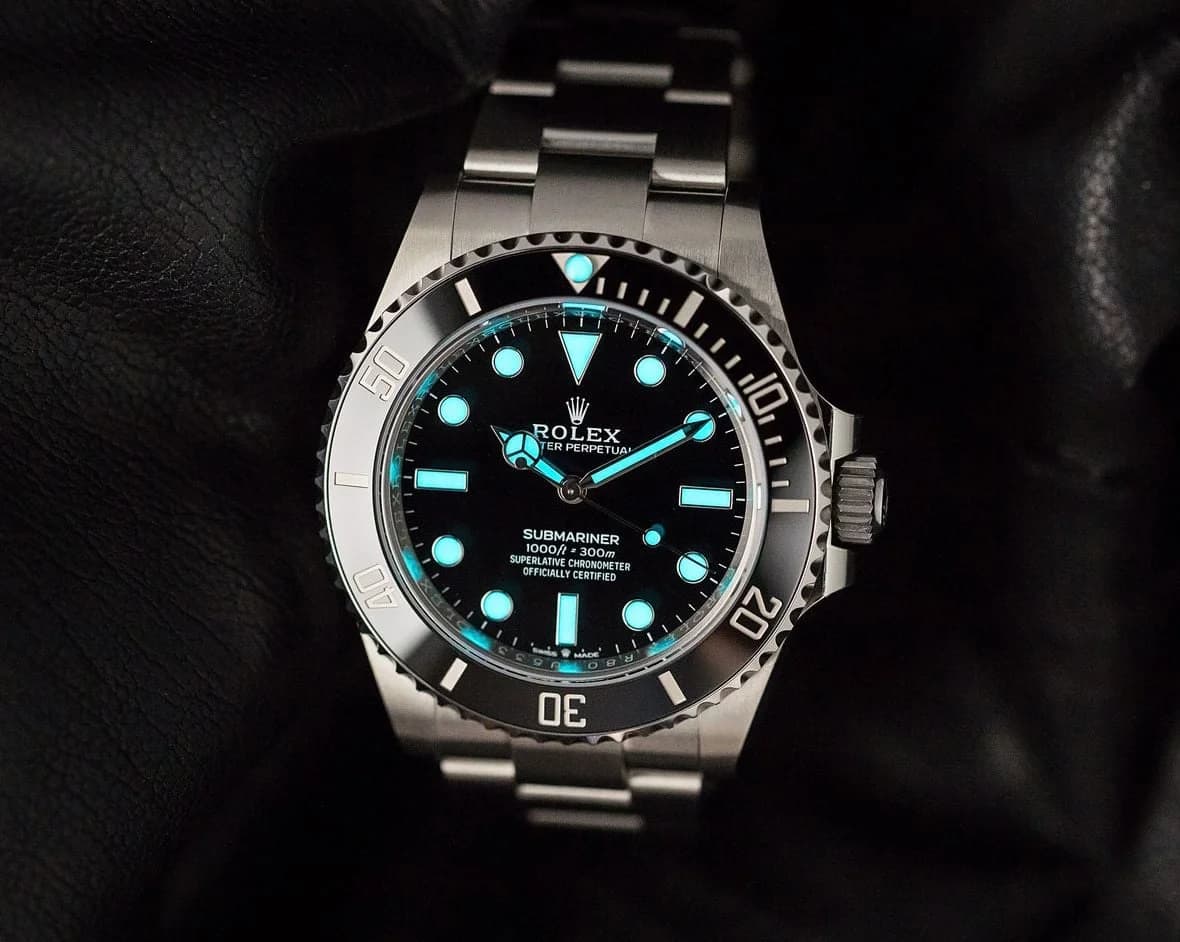
Chromalight blue lume: all indices and hands glow for approximately eight hours
The honest critique of the 124060 is also why some people love it. It is a Rolex. The crown on the dial carries social weight that has nothing to do with the engineering. Some people buy Submariners because they are one of the best-engineered dive watches ever produced. Some people buy them because of what the crown communicates. The 124060 exists in both worlds simultaneously and there is no way to separate them. Waitlists at authorized dealers can stretch for months or years. That scarcity is partly manufactured and partly genuine. Rolex produces roughly one million watches per year across all references, but they distribute them through a network of authorized dealers who allocate based on purchase history. Walking into a boutique and buying a Submariner off the shelf is, for most people, not possible. That dynamic creates a perception of exclusivity that feeds back into demand. Whether this is good or bad for the watch is a matter of perspective. The engineering does not care about any of it. The Caliber 3230 runs the same regardless.
The other critique is that the Submariner is ubiquitous. It is the default choice. The watch you buy when you do not know what else to buy. I push back on that. Being well-known does not make something uninteresting. The Submariner is well-known because the design works. It has worked for seventy years. Every generation of watchmaker at Rolex has refined it without breaking it. The case has grown from 37mm to 41mm over seven decades. The movement has gone from a manually wound caliber to an automatic with 70 hours of power reserve and an antimagnetic escapement. The bezel went from bidirectional aluminum to unidirectional ceramic. The crystal went from acrylic to sapphire. The bracelet went from a hollow riveted construction to solid 904L with Glidelock micro-adjustment. And through all of that, the Submariner still looks like a Submariner. You can put a 6204 from 1953 next to a 124060 from 2020 and the family resemblance is immediate. That continuity is not an accident. It is the result of deliberate design restraint over seven decades.
The Submariner's relationship to the Sea-Dweller and the Deepsea is worth understanding. The Sea-Dweller, reference 1665, appeared in 1967 with a helium escape valve for saturation diving and double the water resistance at 610 meters. It was developed in partnership with COMEX for professional divers who spent extended periods in pressurized chambers breathing helium-oxygen mixtures. During decompression, helium molecules that had permeated the case needed a way out so the crystal would not blow off. The helium escape valve solved that problem. The current Sea-Dweller is 43mm with 1,220 meters of water resistance. The Deepsea goes to 3,900 meters. These are not Submariners with more water resistance. They are purpose-built saturation diving instruments. The Submariner is the recreational dive watch. 300 meters is more than any recreational diver will ever need. The Sea-Dweller and Deepsea are for professionals who work at depths where the Submariner's limits would be tested. Different tools for different jobs, sharing the same DNA.
Rolex approaches watchmaking differently from most brands and it shows in the Submariner. They make their own gold alloys, their own steel, their own hairsprings, their own escapements, their own ceramic bezels, their own luminescent compounds. They control the entire supply chain from raw materials to finished watch. The foundry in Plan-les-Ouates produces the 904L steel and the gold alloys. The hairspring facility makes the Parachrom Blue from raw niobium and zirconium. The Cerachrom bezels are manufactured, engraved, and coated in-house. Chromalight is proprietary. Even the testing exceeds industry standards. COSC certifies the movement. Rolex then puts the movement in the case and tests the finished watch to their Superlative Chronometer standard, which is tighter than COSC by a significant margin. Plus or minus two seconds per day versus COSC's minus four to plus six. That is a level of vertical integration that only Rolex and perhaps two or three other manufacturers can claim.
There is one more thing I want to say about the 124060 and it is the thing that matters most. Every specification I have listed is verifiable. Every dimension, every material, every certification, every historical date. You can confirm all of it. But none of it explains why the Submariner feels the way it does on the wrist. There is a solidity to it. A sense that every surface, every edge, every transition between brushed and polished has been considered. The crown screws in with a precision that is tactile and satisfying. The bezel clicks with 120 positions per revolution, each click firm and consistent. The bracelet drapes over the wrist with a weight distribution that is even from end link to end link. These are not things you can quantify. They are things you feel. And they are the reason that a 70-year-old dive watch design still sells every unit Rolex can produce.
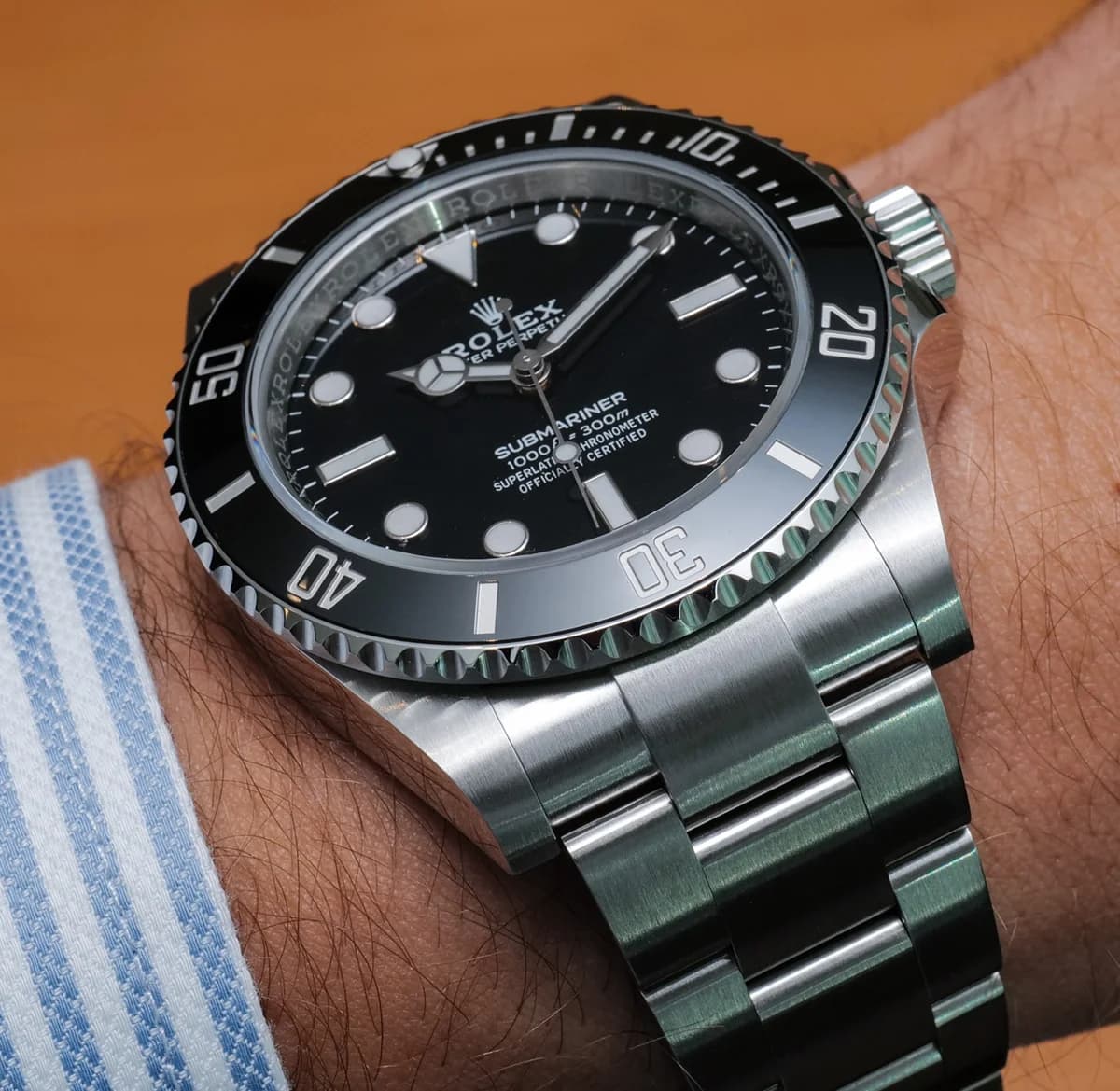
41mm on the wrist with a dress shirt: the Submariner slides under most cuffs
The Submariner survived the quartz crisis of the 1970s and 1980s when Swiss mechanical watchmaking nearly collapsed. Japanese quartz movements from Seiko and Citizen were cheaper, more accurate, and required no servicing. Hundreds of Swiss brands went under. Rolex survived because they had built something that quartz could not replicate: a mechanical object with cultural significance. The Submariner was not just a timekeeping device. It was a statement. It had appeared on the wrist of James Bond, on the wrists of military divers, on the wrists of explorers. Quartz could match the accuracy. It could not match the meaning. By the time the mechanical watch renaissance began in the late 1980s and accelerated through the 1990s, the Submariner was positioned as the definitive sport watch. It had earned that position not through marketing but through seventy years of continuous production and incremental improvement.
The relationship between the Submariner and the Explorer is worth noting because they represent two sides of the same Rolex philosophy. The Explorer is the minimalist. 36mm for decades, now 36 and 40. 3-6-9 dial. No bezel markings. No complications. The Submariner is the tool. 41mm. Rotating bezel. 300 meters. Lume everywhere. Both are time-only steel sport watches. Both are restrained. But the Explorer whispers and the Submariner speaks at a normal volume. There is a reason some collectors own both. They fill different roles. The Explorer slides under every cuff. The Submariner can do the same but it wants you to know it is there.
I want to mention how the 124060 wears with clothing because it is relevant. On the wrist over bare skin in summer, it is comfortable for all-day wear. The bracelet does not pull arm hair the way some bracelets do. The Glidelock lets you adjust for swelling without thinking about it. Under a shirt cuff, the 12.3mm thickness means it catches slightly on tighter cuffs. Not dramatically, but you notice it. With a suit, the fully brushed bracelet is less flashy than the polished center links on the date version, which I think is appropriate. A no-date Submariner under the cuff of a charcoal Holland and Sherry tropical wool suit is one of the most quietly correct combinations in menswear. Nobody will notice the watch unless you want them to. That is the point. The Submariner Date with polished center links catches light. The no-date is fully brushed. It absorbs light. It disappears into the outfit. For someone who wears tailored clothing and does not want the watch to be the loudest thing in the room, the 124060 is the right choice.
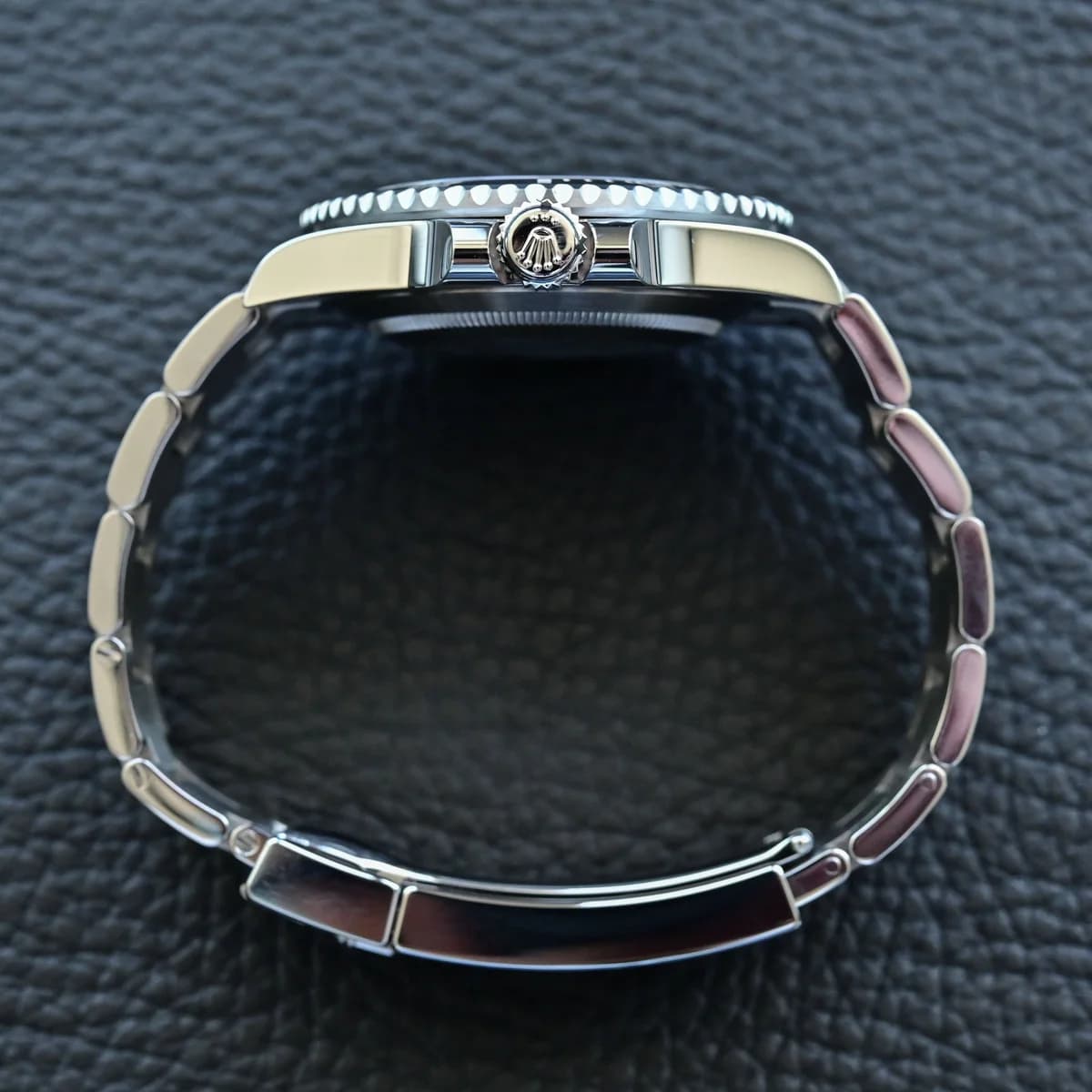
Crown side profile: Triplock crown, crown guards, and caseback edge
The 124060 also represents something rare in modern watchmaking: a watch that is genuinely improved over its predecessor without losing what made the predecessor great. The 114060 was already excellent. The 124060 is better in every measurable way. More power reserve. Better escapement. Tighter accuracy standard. More graceful case proportions. Wider bracelet. And yet it still looks like a Submariner. It still feels like a Submariner. It still communicates the same thing. That restraint, the ability to improve without redesigning, is the hardest thing to do in product development. I have spent twenty-seven years watching technology companies struggle with this exact problem. They improve the specifications and lose the soul. Rolex improved the specifications and kept the soul. The Submariner in 2020 is objectively better than the Submariner in 1953 and it is still recognizably the same watch. That is seven decades of engineering discipline applied to a single idea. No other watch in production has that kind of unbroken lineage with that level of consistency.
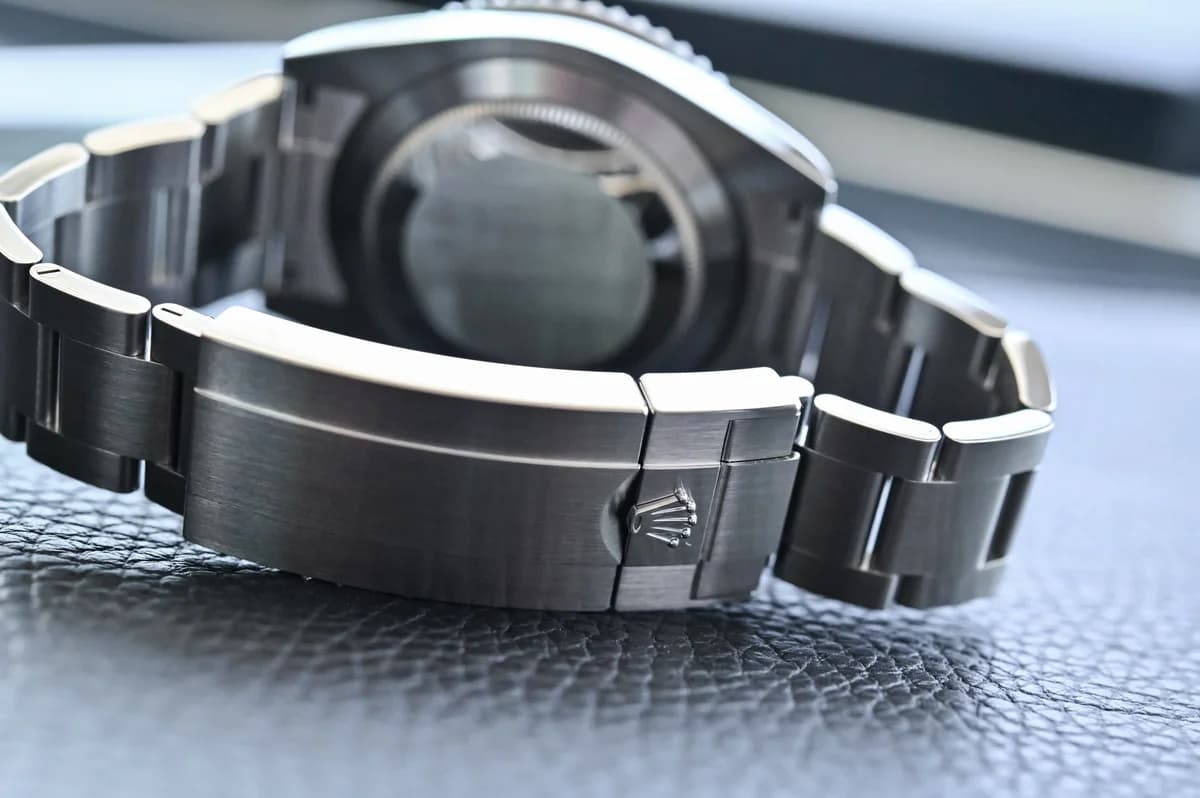
Bracelet rear: solid construction, Rolex crown on deployant clasp
The Submariner No-Date is for the person who wants the watch without the noise. No gold. No diamonds. No color dial. No date window. No Cyclops. Just a black-dial steel dive watch that does exactly what the 1953 original did, with seven decades of engineering refinement behind it. It is the Rolex that does not need to tell you it is a Rolex. The design does that work. The crown on the dial is almost redundant because everything about the watch, the case finishing, the bezel action, the bracelet construction, the way it catches light, communicates what it is before you ever read the name. That is what seventy years of getting it right looks like.
Also in Tool Watches