
Seiko
6139 "Pogue"
6139-6005
To understand why the Seiko 6139 matters, you have to understand what 1969 looked like in the watch industry. Switzerland owned mechanical watchmaking. Not in the way that Germany or France had their own traditions alongside it. Switzerland owned the conversation. If you were a serious watch buyer in the late 1960s, you bought Swiss. Japanese watches were utility objects. They told time. They were affordable. They were not taken seriously by anyone who considered themselves a collector or an enthusiast. That was the assumption, anyway. And in the spring of 1969, a division of Seiko called Suwa Seikosha quietly destroyed it.
Behind the scenes, Seiko had been working on something since 1965 that would challenge every part of that narrative. The project was an automatic chronograph, a self-winding watch with a stopwatch function built directly into the movement. No manufacturer had ever combined automatic winding with a chronograph in a single integrated caliber. Three groups were racing to get there first. Zenith in Le Locle was developing the El Primero. A consortium of Heuer, Breitling, Hamilton, and Dubois Depraz was building what would become the Chronomatic, powered by the Caliber 11. And Seiko's Suwa Seikosha division was engineering the 6139 in relative obscurity. The Swiss groups knew about each other. Neither knew about Seiko. That asymmetry is important because it means Seiko was not reacting to the Swiss. They were solving the same problem independently, from a completely different engineering tradition.
The timeline of 1969 is where the story gets interesting, and where I think honesty matters more than marketing. Zenith announced the El Primero at a press conference on January 10, 1969. The name means "the first" in Esperanto, and Zenith clearly believed they had won the race. The Chronomatic consortium showed their prototype on March 3, 1969, with pre-production samples at the Basel Fair in April. But announcements are not products. On May 21, 1969, while both Swiss projects were still moving toward production, the Seiko 6139 Speed Timer went on sale in Japan. It was the first automatic chronograph that a customer could walk into a store and actually buy. The Chronomatic reached stores in July 1969. The El Primero did not ship to customers until the third quarter of 1969, making it the last of the three to reach the market despite being the first to announce. The question of who was "first" depends on whether you are counting announcements, prototypes, or commercial availability. I count commercial availability because that is the only thing that matters to the person buying the watch. By that measure, Seiko was first. The Swiss industry largely ignored this because the announcement had happened in Tokyo, not Geneva or Basel, and because acknowledging a Japanese company had beaten them to market was simply not something the Swiss establishment was prepared to do in 1969.
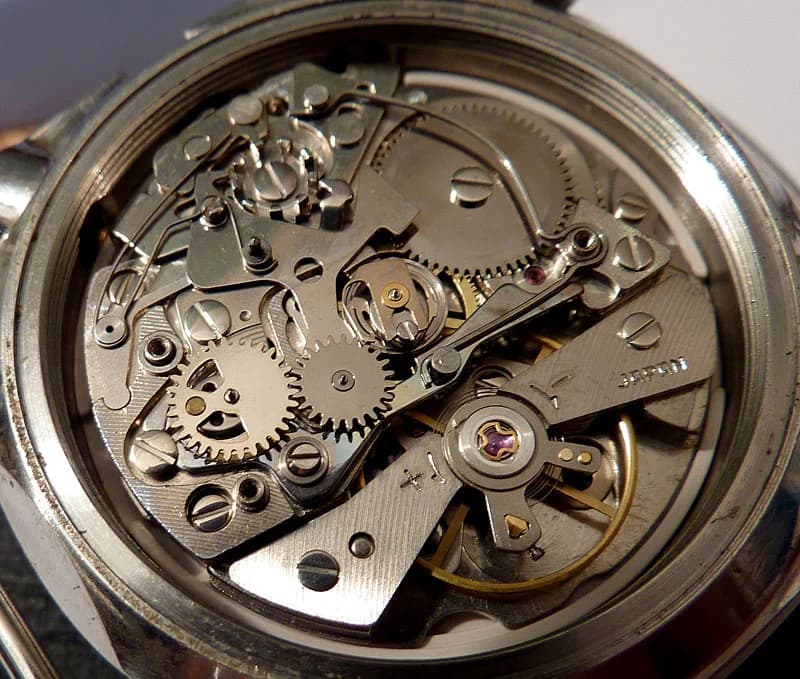
The movement inside the 6139 was genuinely ahead of its time, and I mean that in a very specific technical sense. The Caliber 6139B is a 17-jewel automatic (21 jewels in Japanese domestic models), beating at 21,600 vibrations per hour with a 45-hour power reserve. It measures 27mm in diameter and 7.1mm in height. Those are respectable numbers, but the real story is in the architecture. The 6139 was the first chronograph movement ever to use a vertical clutch for engaging the chronograph seconds hand. In a traditional horizontal clutch chronograph, the chronograph wheel swings laterally to engage with the gear train. That lateral swing requires space, and it produces a small but visible stutter when the chronograph hand starts. A vertical clutch presses straight down, engaging instantly with zero stutter. Every modern chronograph that uses a vertical clutch, including the Rolex Daytona's Caliber 4130 and the Zenith El Primero 3600, traces its concept back to this Seiko. The engineer who designed it, Toshihiko Ohki, created the vertical clutch because the movement's architecture simply did not have room for a horizontal clutch to swing. That constraint produced an innovation that became the industry standard decades later. I love that detail because it perfectly illustrates how great engineering often comes from limitations, not luxury.
The 6139 also uses a column wheel to control the chronograph's start, stop, and reset functions. Column wheels were considered the premium chronograph switching mechanism in 1969, and they still are today. Most affordable chronographs use cam switching instead, which is cheaper to manufacture but produces a less precise tactile feel when operating the pushers. Seiko put the more expensive column wheel into a watch that was positioned well below the Swiss competition. The winding system is Seiko's proprietary Magic Lever, a bidirectional automatic winding mechanism that uses a Y-shaped lever and pawl to convert rotor motion in both directions into mainspring energy. It is compact, efficient, and one of the reasons the movement fits into such a relatively thin case. The movement cannot be wound manually through the crown, which is unusual for a chronograph. If the power reserve runs out, you pick it up and wear it, or give it a few shakes to get the rotor spinning. That is a quirk of the design rather than a flaw, but it does mean you cannot top off the mainspring before putting it on in the morning. For a daily wearer this is irrelevant. For someone who rotates between five watches, it adds a few seconds of ritual.
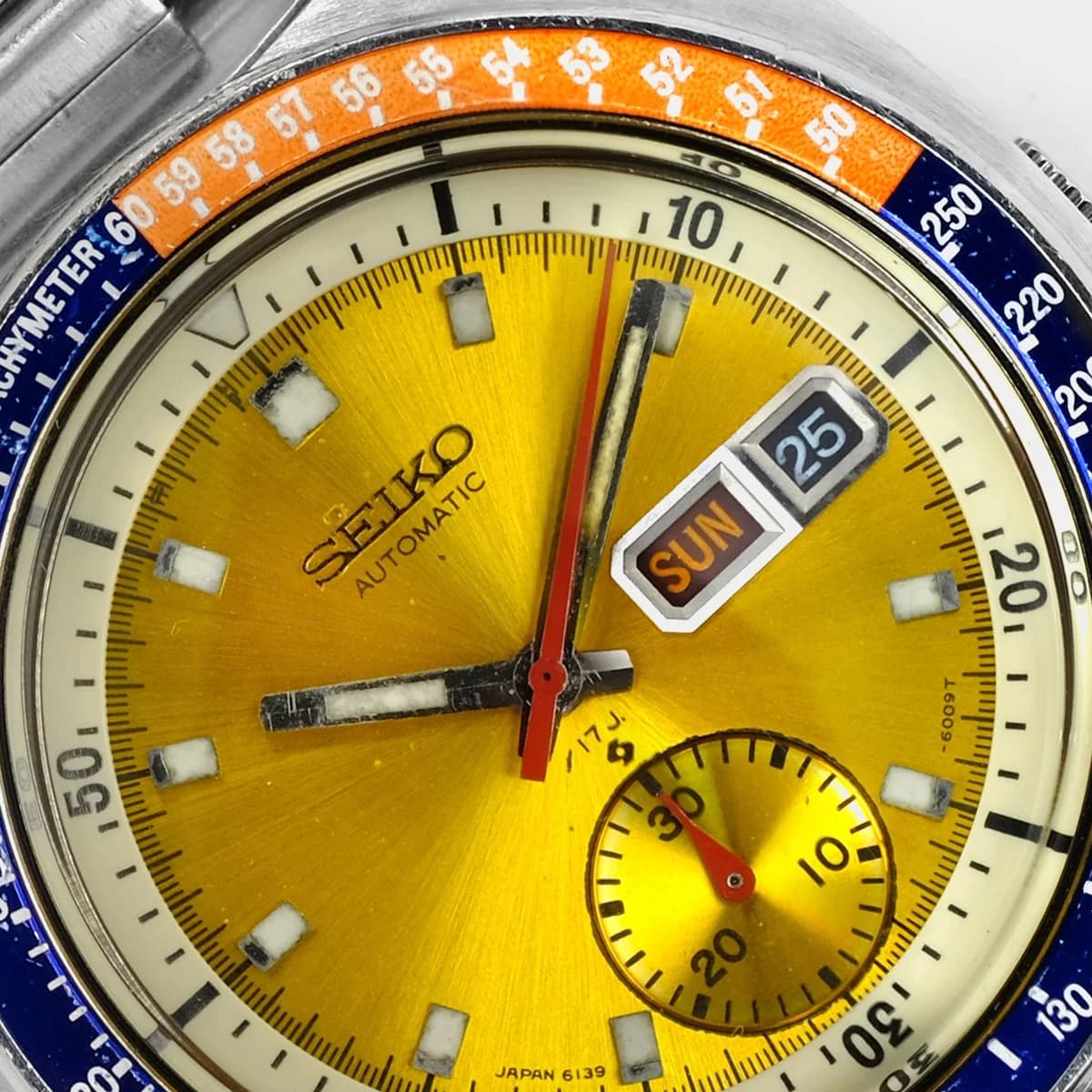
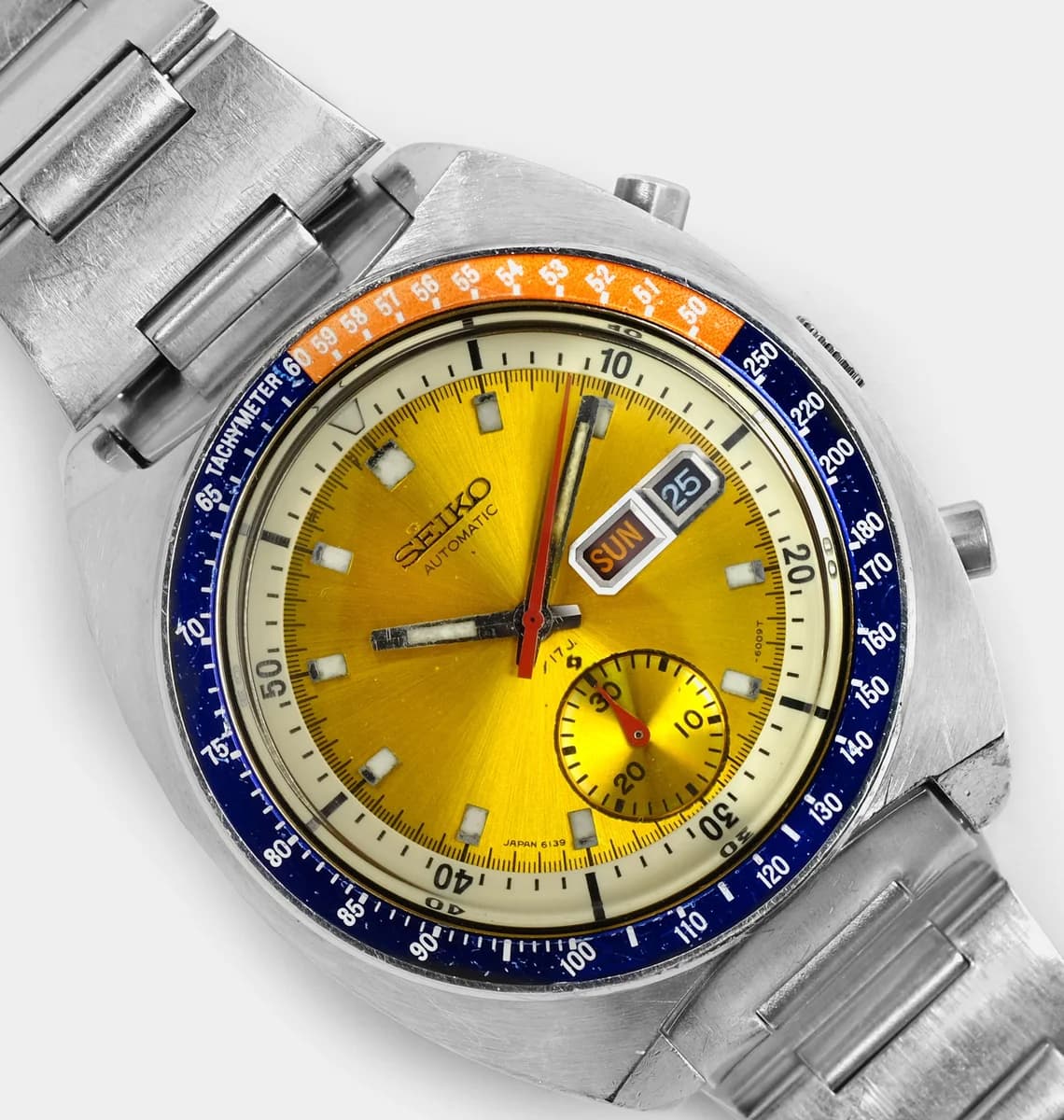
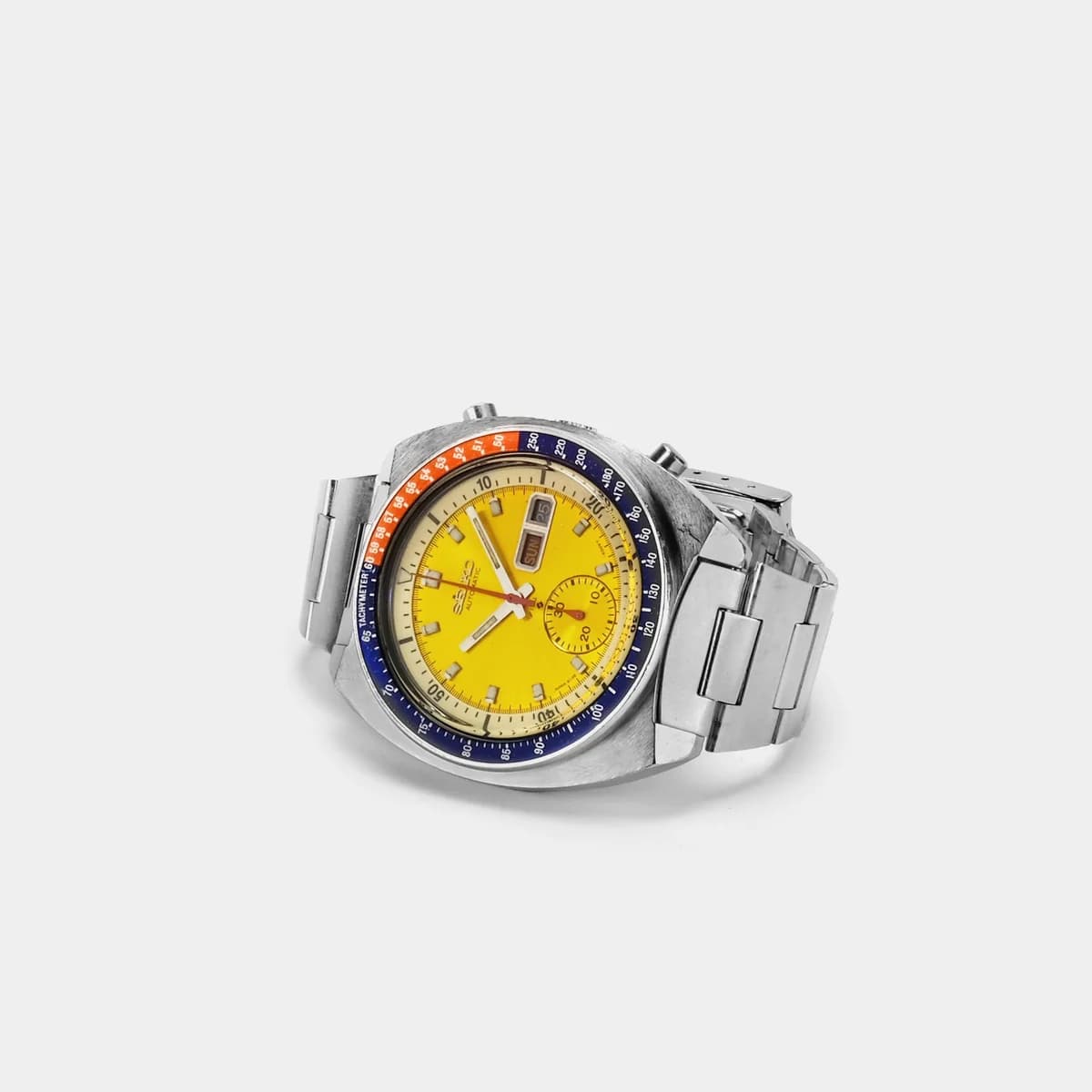
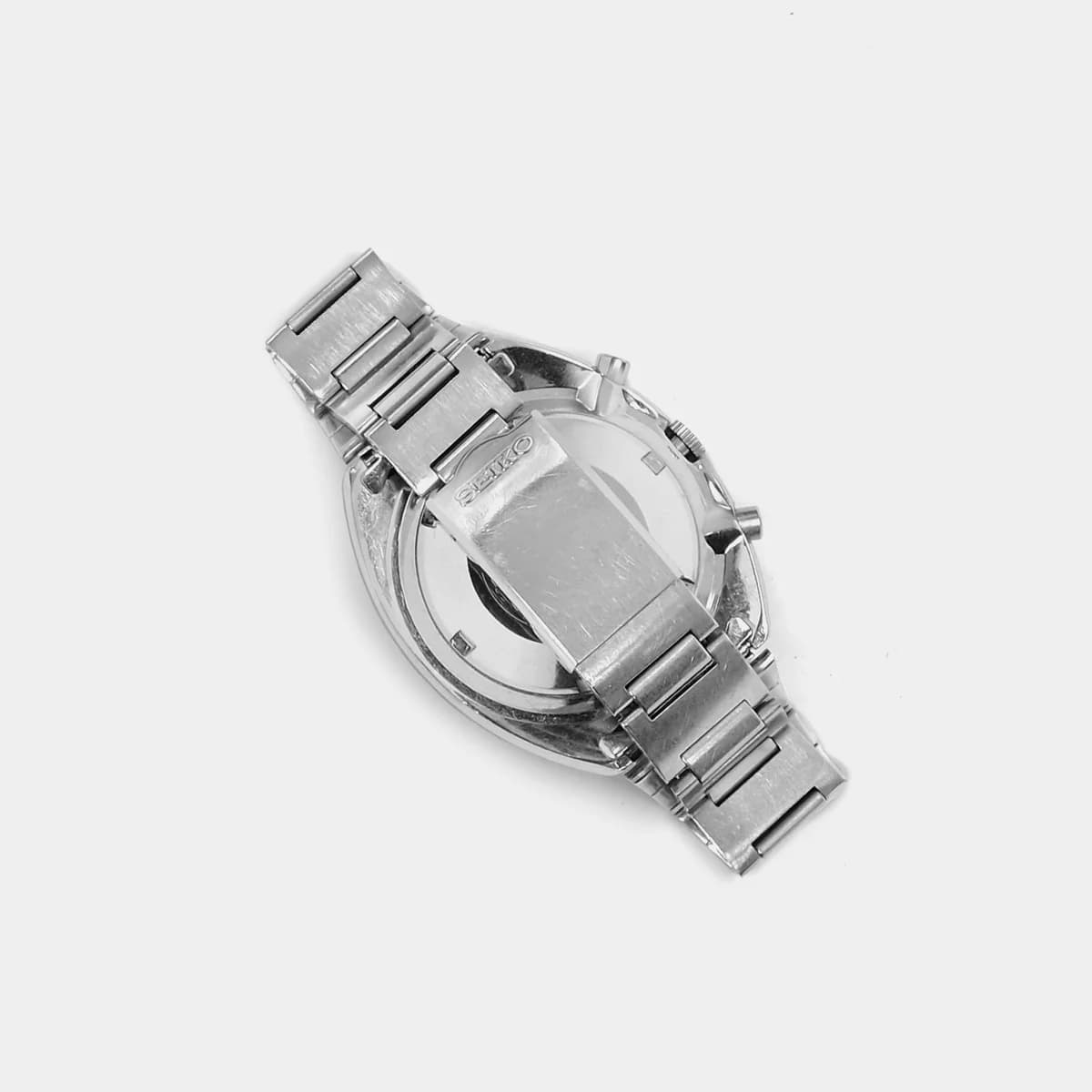
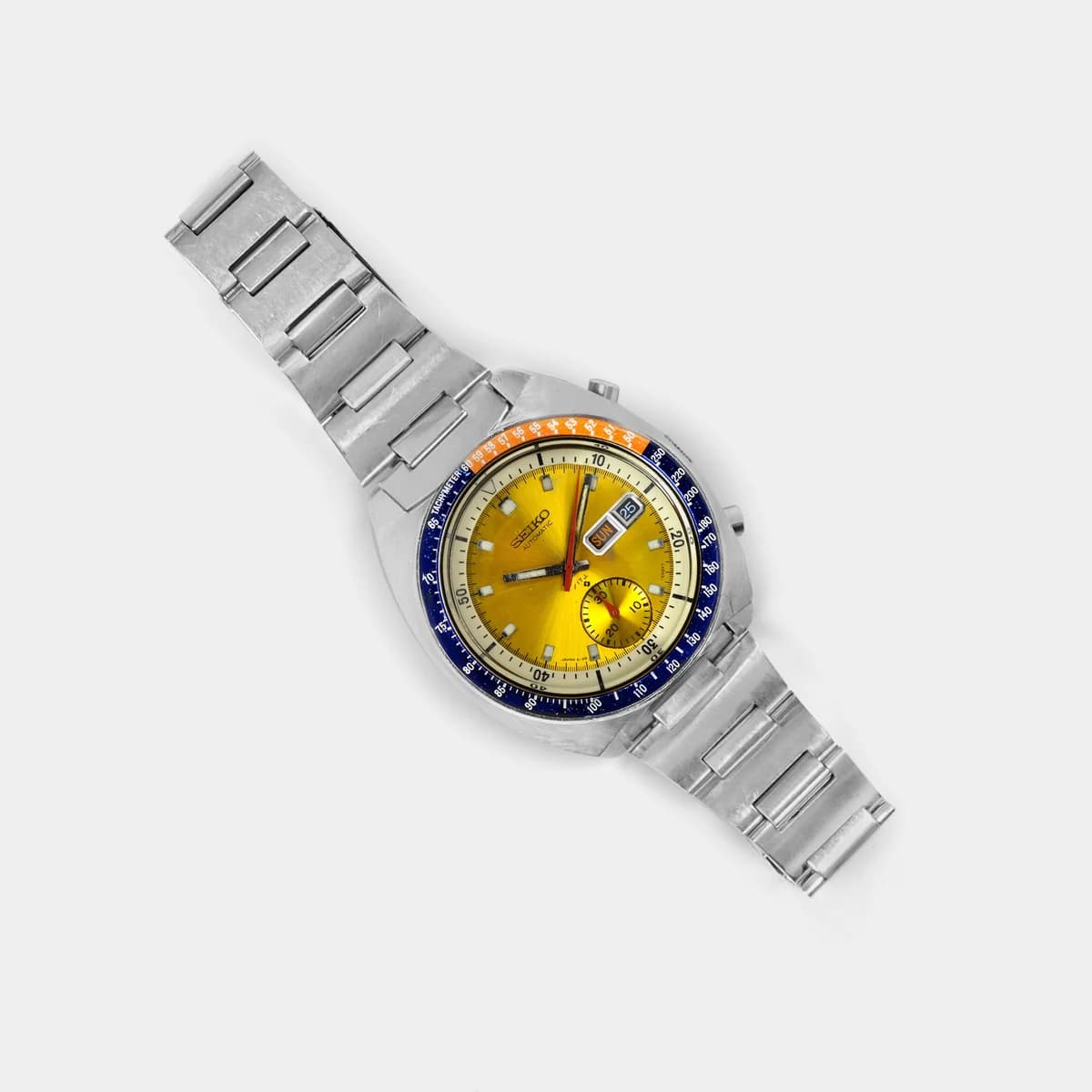
The watch itself is 41mm in stainless steel, 13.2mm thick, with a 46mm lug-to-lug span and 19mm lug width. Those are essentially modern dimensions trapped in a 1969 design, which is part of why the Pogue wears so comfortably on contemporary wrists. The yellow sunburst dial is the signature. I have spent time with plenty of vintage chronographs over the years, and very few dials from this era have the visual presence of a clean Pogue yellow. It catches light differently than gold or champagne dials. It is unapologetically bright in a way that most Swiss dress chronographs would never attempt. The day-date window sits at 3 o'clock with a bilingual day wheel offering both English and Kanji characters, a reminder that this watch was designed in Tokyo, not La Chaux-de-Fonds. The 30-minute chronograph register sits at 6 o'clock. The red and blue Pepsi tachymeter bezel is fixed, not rotating, and provides a speed scale for calculating velocity over a known distance. On the original Japanese domestic models, the dial read "Speed Timer" and the watches carried 21 jewels. On the North American export model, the 6139-6005, the dial read "Automatic" below the Seiko logo with "17J" printed near the center. The early production dials also read "Water 70m Resist" at the bottom, which is the marking that defines what collectors now call the "true Pogue" configuration.
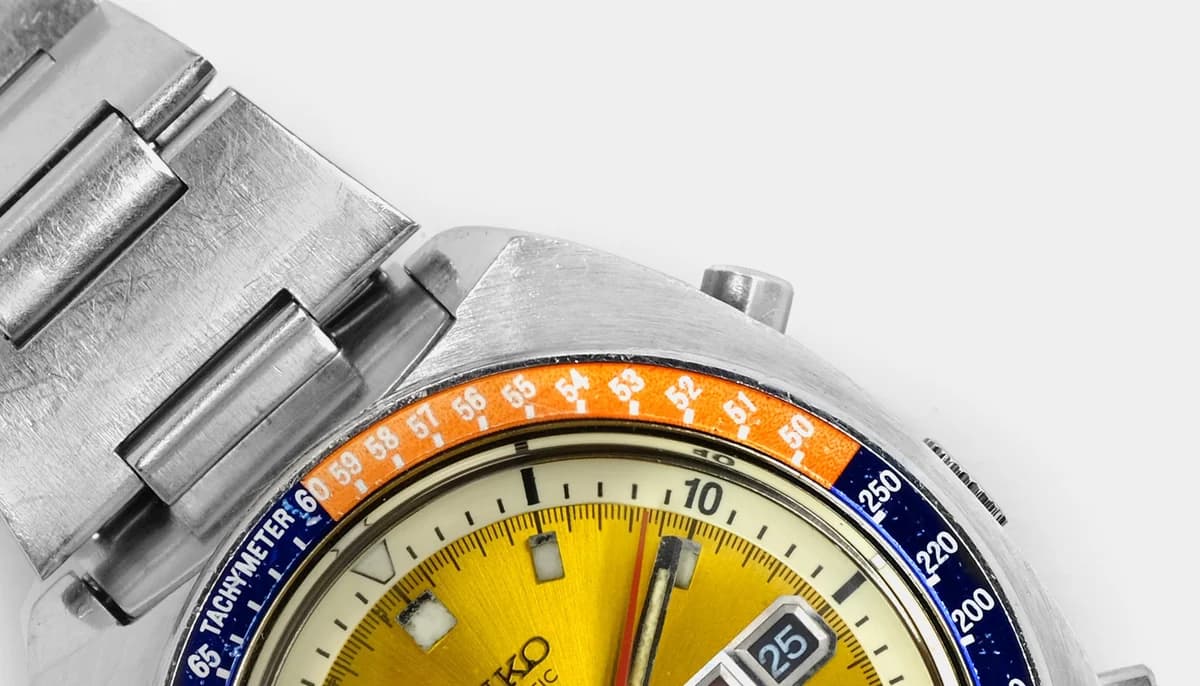
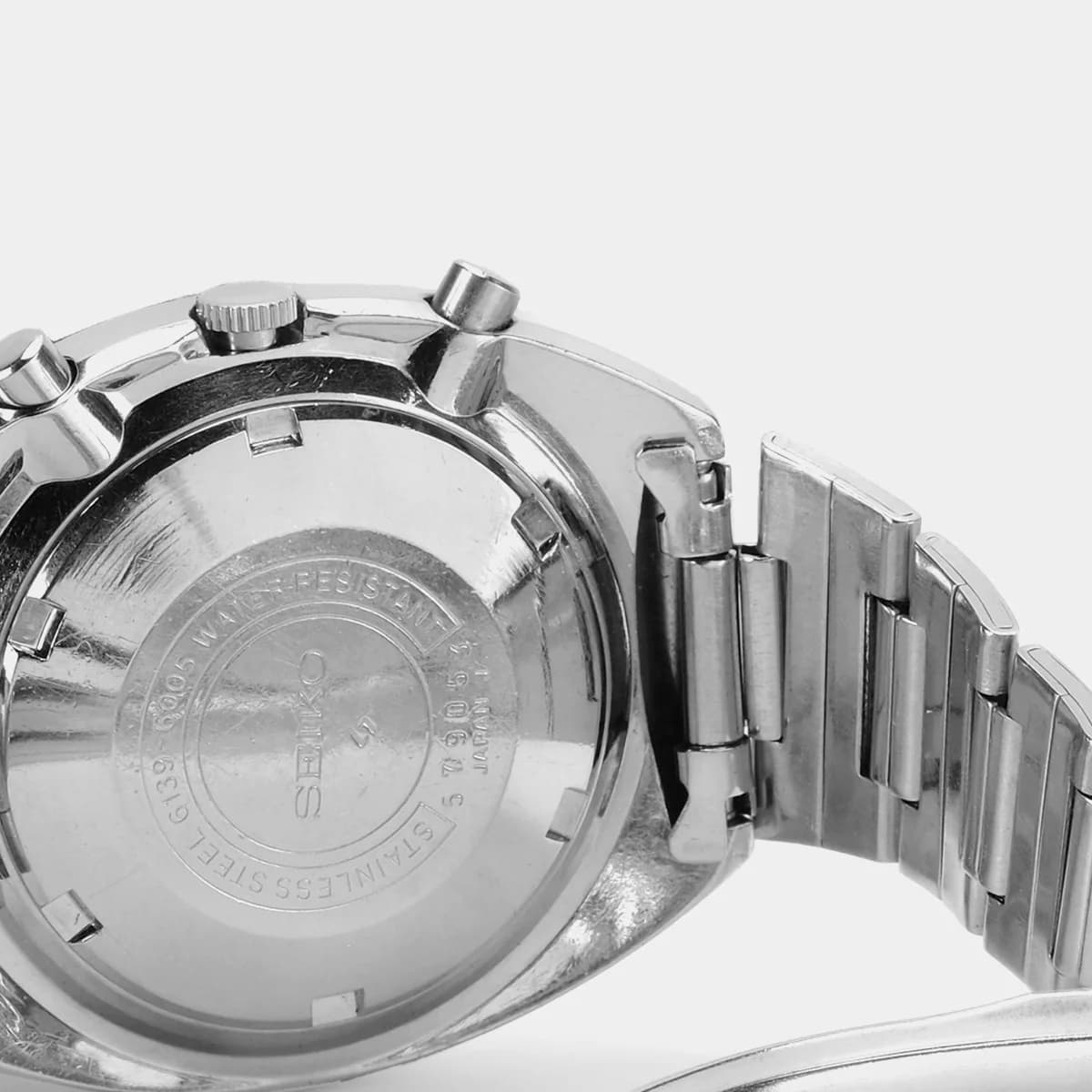
The crystal is Hardlex, Seiko's proprietary tempered mineral glass. I think the crystal choice is one of the most underappreciated details of the 6139. Hardlex is made by tempering mineral glass at extreme heat and then chemically treating it. The result rates approximately 6.5 to 7 on the Mohs hardness scale. For context, standard mineral glass sits around 5 on the Mohs scale, sapphire is a 9, and acrylic is even softer than mineral. Acrylic was the standard crystal material on Swiss chronographs of the era, including the Omega Speedmaster. Hardlex is more scratch-resistant than acrylic and more shatter-resistant than sapphire, which makes it a remarkably practical middle ground. In 1969, while Swiss chronographs were shipping with acrylic crystals that showed wear if you bumped them against a doorframe, Seiko was using a harder, more durable crystal on a watch that cost a fraction of the Swiss alternatives. The water resistance was rated to 70 meters, which was also ahead of most chronographs in that era. Early production dials marked this as "Water 70m Proof," which changed to "Water 70m Resist" around mid-1970, and later versions dropped the marking entirely.
The watch earned its nickname from Colonel William Reid Pogue. In 1973, Pogue was assigned to NASA's Skylab 4 mission as the pilot, alongside Commander Gerald P. Carr and Science Pilot Edward G. Gibson. He held the rank of Lieutenant Colonel in the United States Air Force at the time of the mission, later retiring as a full Colonel. The mission launched on November 16, 1973, and the crew returned to Earth on February 8, 1974, after 84 days, 1 hour, and 16 minutes in orbit. It was the longest crewed spaceflight at that time, and the crew orbited the Earth 1,214 times, covering approximately 34 million miles. NASA issued Omega Speedmaster Professional chronographs to the crew, which was standard procedure for American space missions since Gemini. Pogue brought his personal Seiko 6139 anyway.
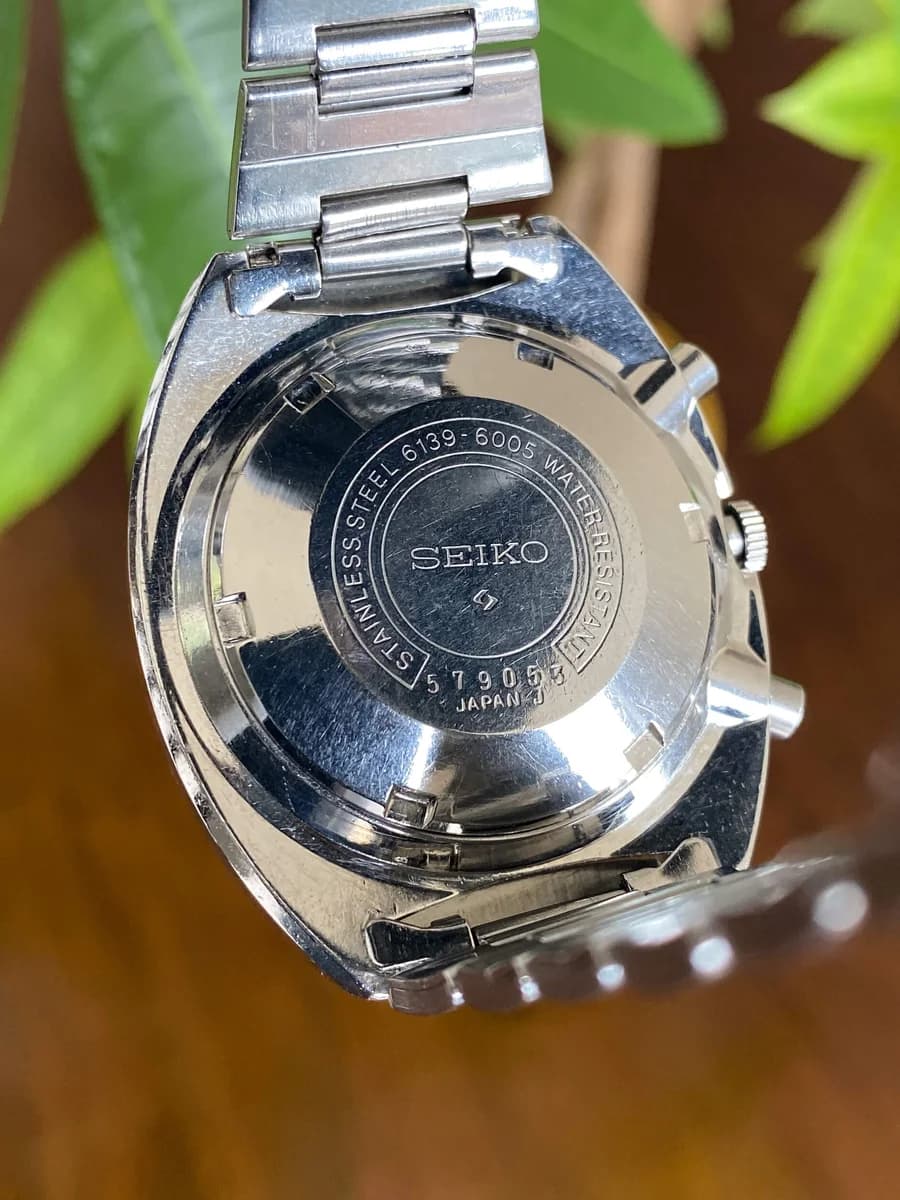
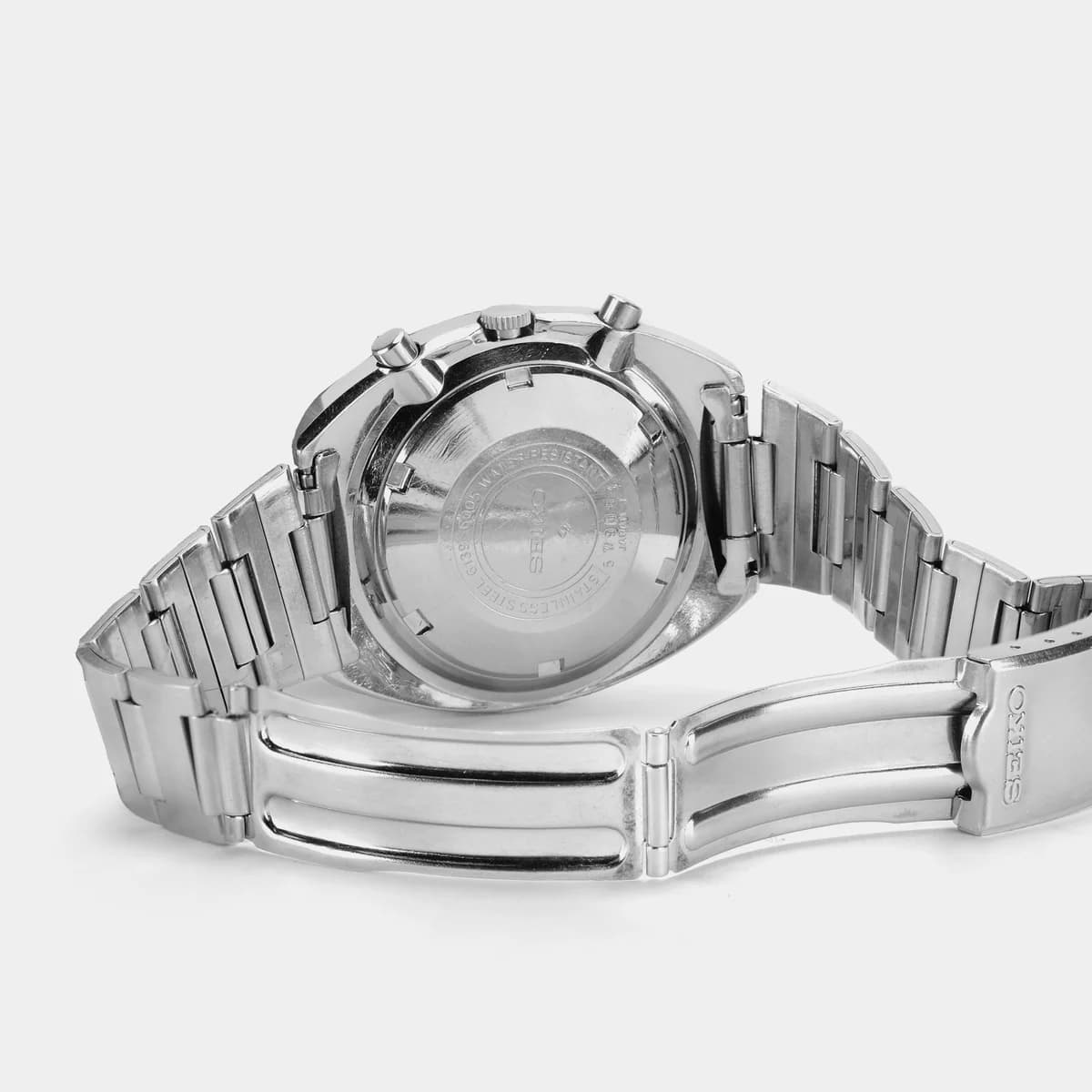
He had purchased the watch on June 13, 1972, from an Army and Air Force PX, after placing it on layaway three days earlier. The serial number on his watch, 190945, indicates it was manufactured in September 1971. It was a 6139-6005, the North American variant, with "Water 70m Resist" on the dial and "Automatic" below the Seiko logo. Those details matter to collectors because they define the "true Pogue" specification, but what matters more is what happened next. Pogue was not officially authorized to take a personal watch on the mission. He placed the Seiko in his spacesuit leg pocket during pre-launch preparations. After launch and getting out of the suit, he put the Seiko on his left wrist and set it to US Central Time. The NASA-issued Omega went on his right wrist. For 84 days, he wore both watches simultaneously in orbit. He had used the Seiko's chronograph to time engine burns during pre-flight training and continued relying on it during the mission itself.
The fact that Seiko's Magic Lever automatic winding system kept the watch running in microgravity for nearly three months is a genuine engineering accomplishment. Automatic movements depend on a weighted rotor responding to wrist motion and gravitational pull. In microgravity, the physics change. The rotor still responds to wrist movements, but the gravitational assist disappears. The 6139 kept running. The Omega Speedmaster was the first manual-wind chronograph on the moon, and that legacy is earned and untouchable. But the Seiko 6139 was the first automatic chronograph in space. Both are legitimate firsts, and I find it telling that one has an entire marketing mythology built around it while the other is mostly known to collectors and enthusiasts. The difference is that NASA funded decades of promotion around the Speedmaster's lunar qualification testing. Seiko never had that opportunity because Pogue's watch was not officially sanctioned. It was a personal choice by an astronaut who liked his Seiko enough to sneak it aboard a spacecraft. In my opinion, an astronaut choosing your watch over the one NASA issued is the highest form of endorsement a tool watch can receive.
In October 2008, Pogue's actual flight-worn Seiko 6139 was auctioned by Heritage Auctions on behalf of the Astronaut Scholarship Foundation. The watch that orbited the Earth 1,214 times and traveled 34 million miles found a new home. It was a remarkable artifact that had earned its place in the history of space exploration.
I need to be honest about the 6139's tradeoffs, because every watch has them and ignoring them would not be fair to anyone reading this. The movement cannot be manually wound through the crown. If you leave it sitting for two days and the power reserve depletes, the only way to restart it is to shake it or wear it. There is no winding crown function. For a daily wearer this is irrelevant, but for someone who rotates between multiple watches it is a genuine inconvenience that Swiss competitors of the same era did not impose. The 30-minute chronograph register limits the stopwatch function to half an hour. Swiss chronographs of the same era, including the El Primero and the Caliber 11, offered 12-hour chronograph registers that could time much longer events. The day-date quickset is controlled by pushing the crown in, lightly for the day and harder for the date, which feels imprecise compared to crown-operated quicksets. And the 19mm lug width is non-standard, which means aftermarket strap options are slightly more limited than the 20mm or 22mm widths that most brands standardized on. The bezel, while attractive, is fixed. There is no rotating bezel function for countdown timing or GMT tracking. These are not reasons to avoid the watch. They are the realities of a 1969 design that prioritized what mattered most, the chronograph mechanism itself, and accepted practical compromises elsewhere.
The 6139 family extends well beyond the yellow Pogue. Seiko produced the 6139 in dozens of case and dial configurations between 1969 and approximately 1979. There are blue Pogues (6139-6005 with blue dials), silver dials, models with pulsation bezels designed for medical professionals (the 6139-6020, sometimes called the Doctor's Watch), and the "Helmet" models (6139-7100 and 6139-7101) with their distinctive cushion cases and internal rotating bezels. The 6138 sister caliber added a second subdial with a 12-hour register, and it powered models like the legendary "Bullhead" (6138-0040), where the crown and pushers sit at the 12 o'clock position for better access while wearing gloves. What I appreciate about this range is that Seiko was not treating the automatic chronograph as a prestige product reserved for wealthy collectors. They were putting their column wheel, vertical clutch chronograph into every possible configuration for every possible user. Doctors, motorsport enthusiasts, divers, and everyday wearers all had a 6139 or 6138 designed for them. That democratization of serious chronograph technology is something the Swiss industry did not match until decades later.
The corporate context matters here. In 1969, Seiko was not a small workshop or an ambitious startup. The company had been founded in 1881 by Kintaro Hattori as a watch and clock shop in Tokyo, and by the late 1960s it had two competing manufacturing divisions, Suwa Seikosha and Daini Seikosha, that deliberately competed against each other internally. The 6139 came from Suwa Seikosha. This internal competition drove innovation at a pace that no single Swiss manufacture could match because no Swiss company was racing against itself. The same internal rivalry would produce the Seiko Astron quartz watch in December 1969, the world's first commercial quartz wristwatch, the device that would nearly destroy the Swiss watch industry in the decade that followed. In a single calendar year, Seiko delivered the world's first automatic chronograph to reach market and the world's first commercial quartz watch. 1969 was not a good year for the argument that Japan could not innovate in horology.
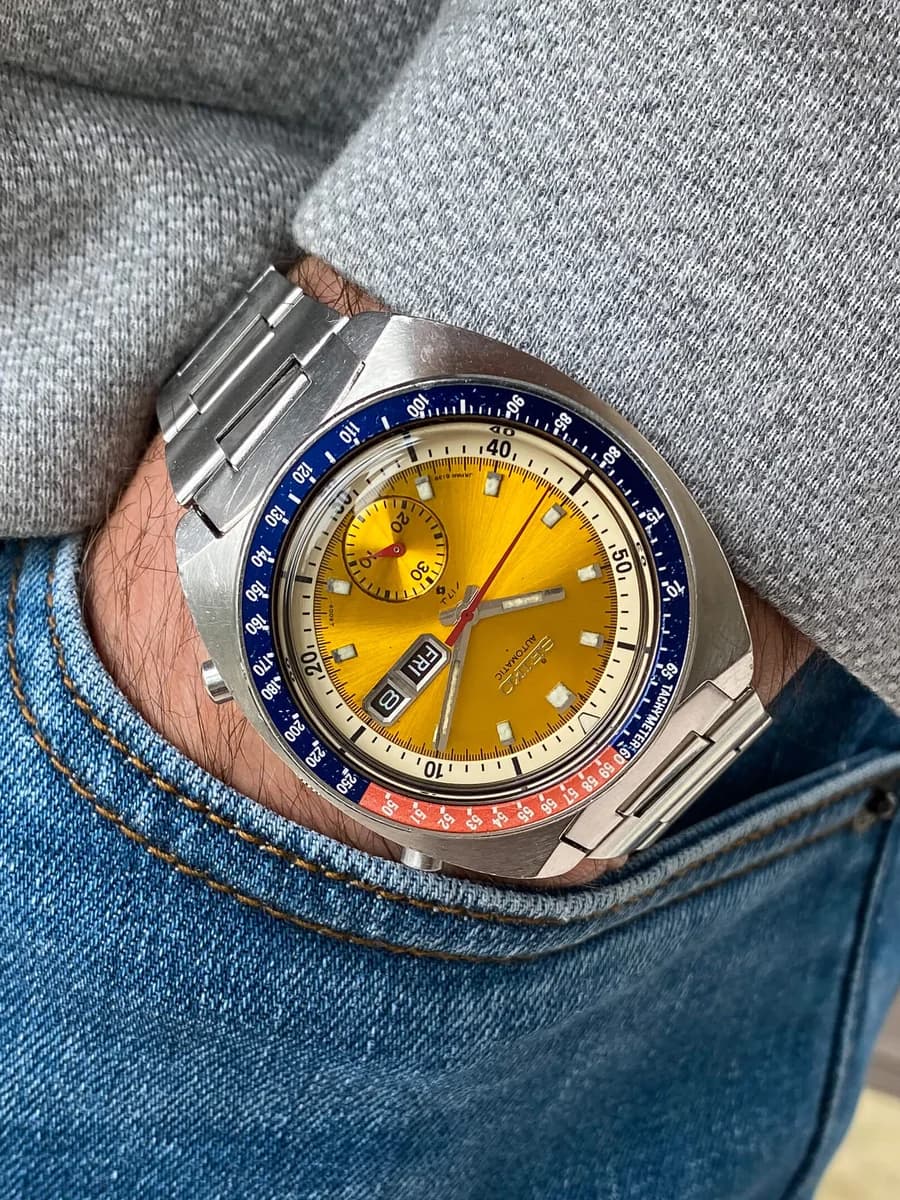
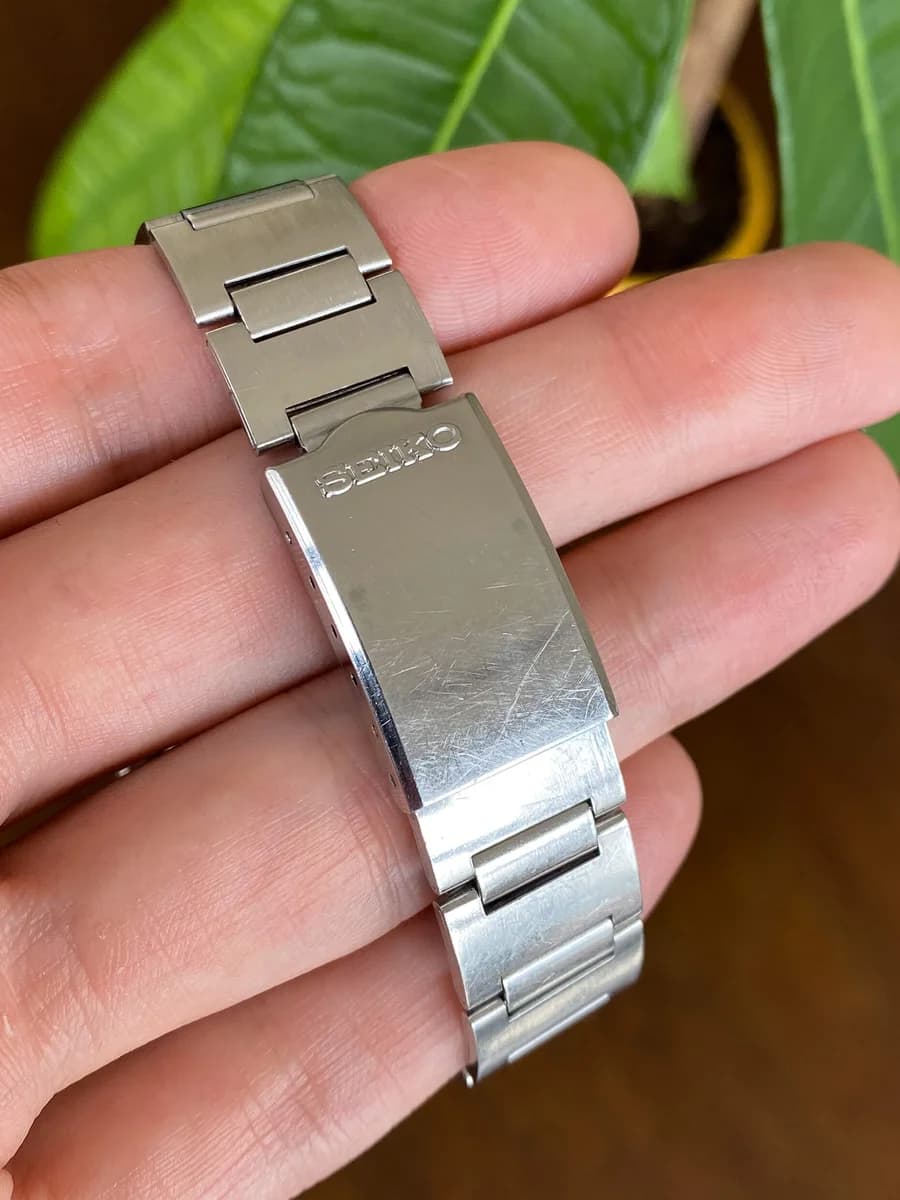
On the wrist, the Pogue is surprisingly comfortable for a 41mm vintage chronograph. The 12mm thickness sits lower than you might expect because the case profile is smooth, without the sharp edges and pronounced crown guards that add visual bulk to many Swiss chronographs of the era. The yellow dial pops against darker skin tones in a way that stainless steel and black dials simply do not. I notice it pairs naturally with casual clothes and rolled sleeves, where the bright dial and Pepsi bezel read as fun rather than formal. Under a cuff, the 12mm thickness is manageable but not invisible. This is a watch that wants to be seen. It works with a Caccioppoli tropical weight wool in navy, where the yellow dial becomes the accent piece that pulls a look together without trying too hard. The original stainless steel bracelet, with its Oyster-style three-link design, is comfortable enough for all-day wear, though the clasp is simple by modern standards and lacks the micro-adjustment that contemporary bracelets offer.
What strikes me most about the Seiko 6139 is the gap between its historical importance and its cultural recognition. The Omega Speedmaster has an entire mythology built around it, with books, limited editions, NASA partnerships, and museum exhibitions. The Speedmaster deserves all of that. But the 6139 introduced the vertical clutch and the column wheel automatic chronograph before anyone else, used a harder crystal than the Swiss competition, rated its water resistance higher, and then one of its watches flew in space on the wrist of a man who chose it over the watch NASA told him to wear. The fact that most of the watch world still does not give the 6139 the same reverence as the Speedmaster or the El Primero says more about marketing budgets and geography than it does about engineering. Seiko built the better mousetrap in 1969. The Swiss just told a better story about theirs.
Also in Tool Watches