
Kudoke
Kudoke 2
Kudoke 2
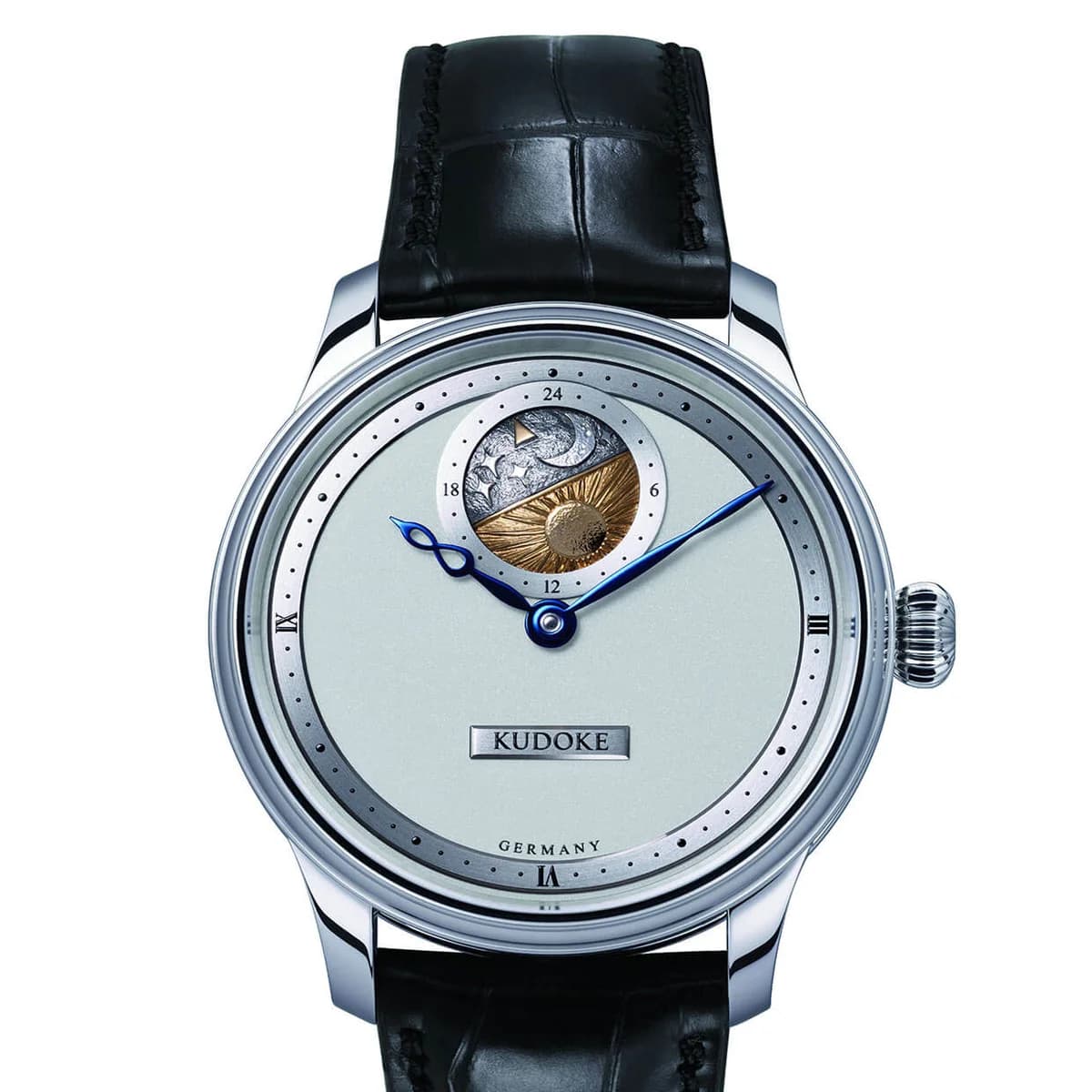
Most people who know anything about German watchmaking know Glashutte. The town is practically synonymous with precision horology in the same way that La Chaux-de-Fonds is for Switzerland. A. Lange and Sohne, Glashutte Original, Nomos, Moritz Grossmann. These are the names that come up when you talk about German watches. What most people do not know is that about an hour east of Dresden, in a small village called Weifa, there is a watchmaker working alone at a bench who won the same international prize that Lange and Patek compete for. Stefan Kudoke. One person. No team of finishers. No outsourced engraving. Just a burin, a microscope, and hands that have been cutting metal since he was a teenager. The Kudoke 2 is the watch that put him on the map, and I think it is one of the most interesting things happening in independent watchmaking right now.
Stefan Kudoke was born in 1978 in Frankfurt an der Oder, on the Polish border. He did not grow up in a watchmaking family. From 1995 to 1998 he trained as a watchmaker at the historic watchmaking school in Glashutte, the same institution that has shaped German horology for over a century. He finished his apprenticeship as the best in the state of Brandenburg and earned a scholarship from Germany's national gifted support program. By 21 he was working in the complications workshop at Glashutte Original, and by 22 he had his master watchmaker certification. He then spent time at Breguet, Blancpain, and Omega through the Swatch Group's prestige brand service division, including a stint in New York. In 2004, Stefan and his wife Ev Kudoke founded their own brand. That path matters because it tells you something about who this person is. The Glashutte watchmaking school is the same institution where Ferdinand Adolph Lange studied in the 1840s before founding A. Lange and Sohne. Kudoke walked the same halls, learned from the same tradition, and then went further. He did not skip steps. He went through a proper German apprenticeship, earned his credentials at the top manufacture in the country, then went to Switzerland and worked on some of the most complicated watches in the world before going out on his own. The engraving, the skill that defines everything he does, he taught himself.
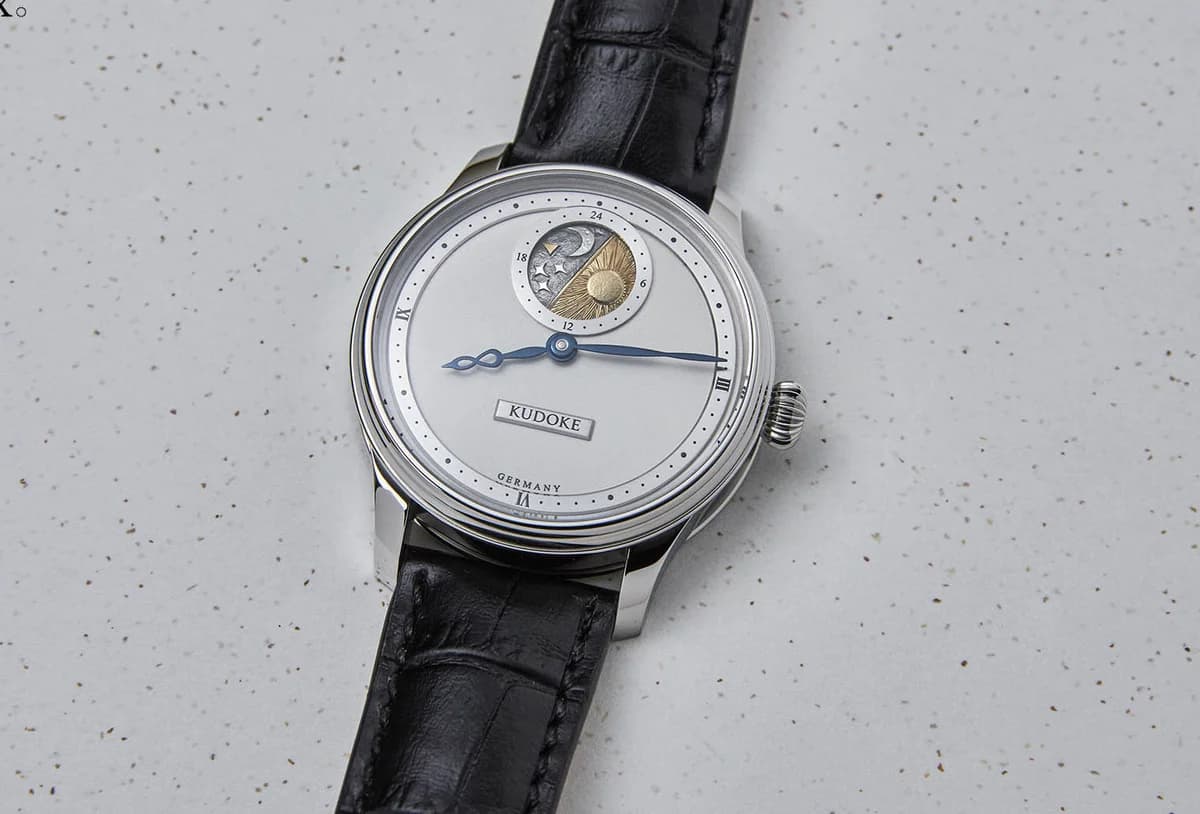
The Kudoke 2 sits in a 39mm case of polished 316L stainless steel, 10.7mm thick, with a 46.5mm lug-to-lug and 20mm lug width. Those dimensions put it in a sweet spot for wrists in the 6 to 7 inch range. On my wrist (6.5 inches) it wears like a properly sized dress watch, sitting flat and low without any lug overhang. The fully polished case catches light from every direction, and the onion-shaped crown with its engraved K logo adds a period-correct detail that connects to the pocket watch aesthetic of the movement inside. Water resistance is 50 meters, which is more than I expected from a hand-finished independent at this level. Sapphire crystal on both sides, front and caseback, so you can see the engraved movement through the back. The screw-down caseback is a nice touch for security. There is also a version in 18K rose gold for those who want something warmer, though the steel version is the one most collectors encounter because the rose gold is produced in very small numbers.
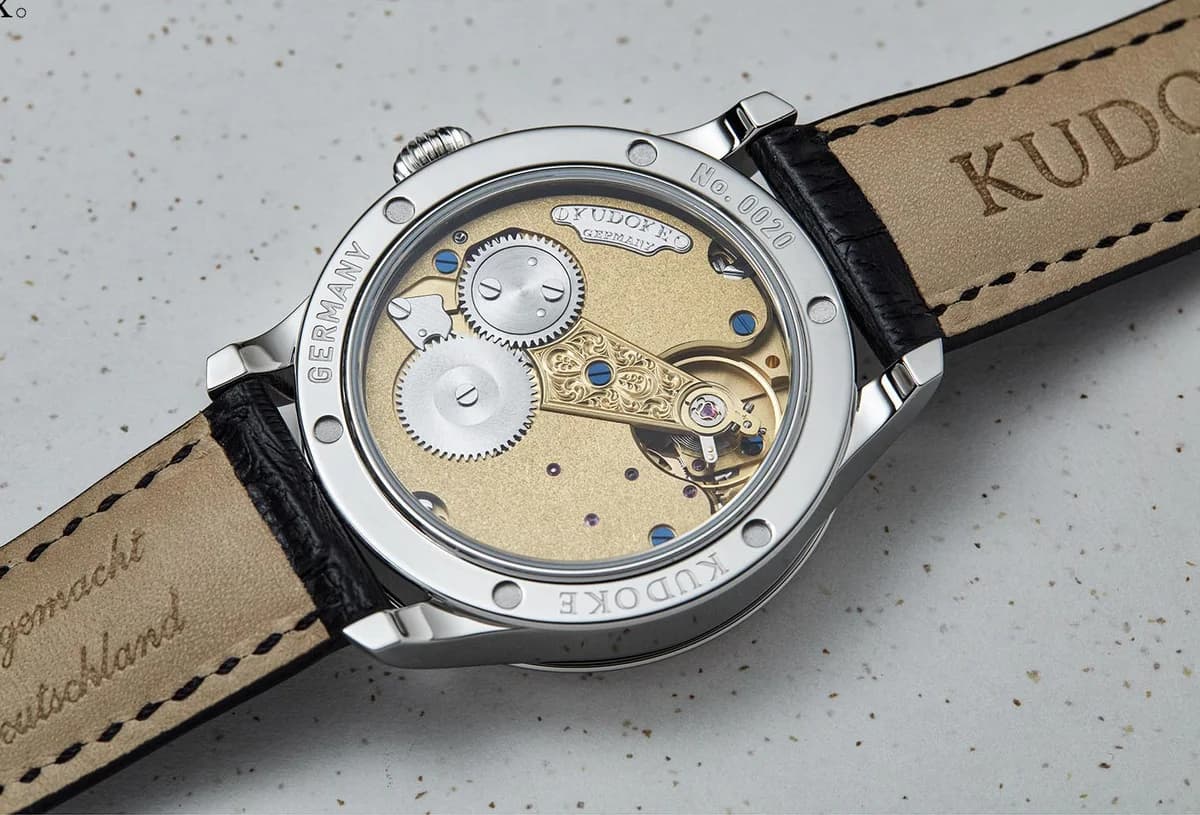
The Kaliber 1-24H is the heart of this watch, and it deserves a proper explanation. It is a hand-wound movement beating at 28,800 vibrations per hour (4 Hz) with an 18-jewel train and a 46-hour power reserve. The movement measures 30mm in diameter and stands 5.05mm tall. It shares its foundational architecture with the Habring2 A11B, developed in collaboration with Maria and Richard Habring in Austria. But the way Kudoke executes it is entirely his own. Habring2 has no involvement in the finishing or decoration. Every surface treatment, every engraved line, every polished edge is done by Stefan at his bench in Weifa. The escapement uses a Kif anti-shock system paired with a Carl Haas balance spring, which makes it amagnetic. That is a practical consideration that a lot of independent watchmakers at this level skip. The Habring2 connection is worth understanding because it explains how a one-person workshop can produce a proprietary movement. Maria and Richard Habring, based in Villach, Austria, developed their own movement architecture that shares tooling lineage with the Valjoux 7750 but is substantially redesigned. Kudoke took that foundation and rebuilt it visually and functionally, adding the 24-hour complication module and finishing every surface by hand. The result is a movement that is mechanically sound and aesthetically distinctive, which is the whole point of an independent caliber.
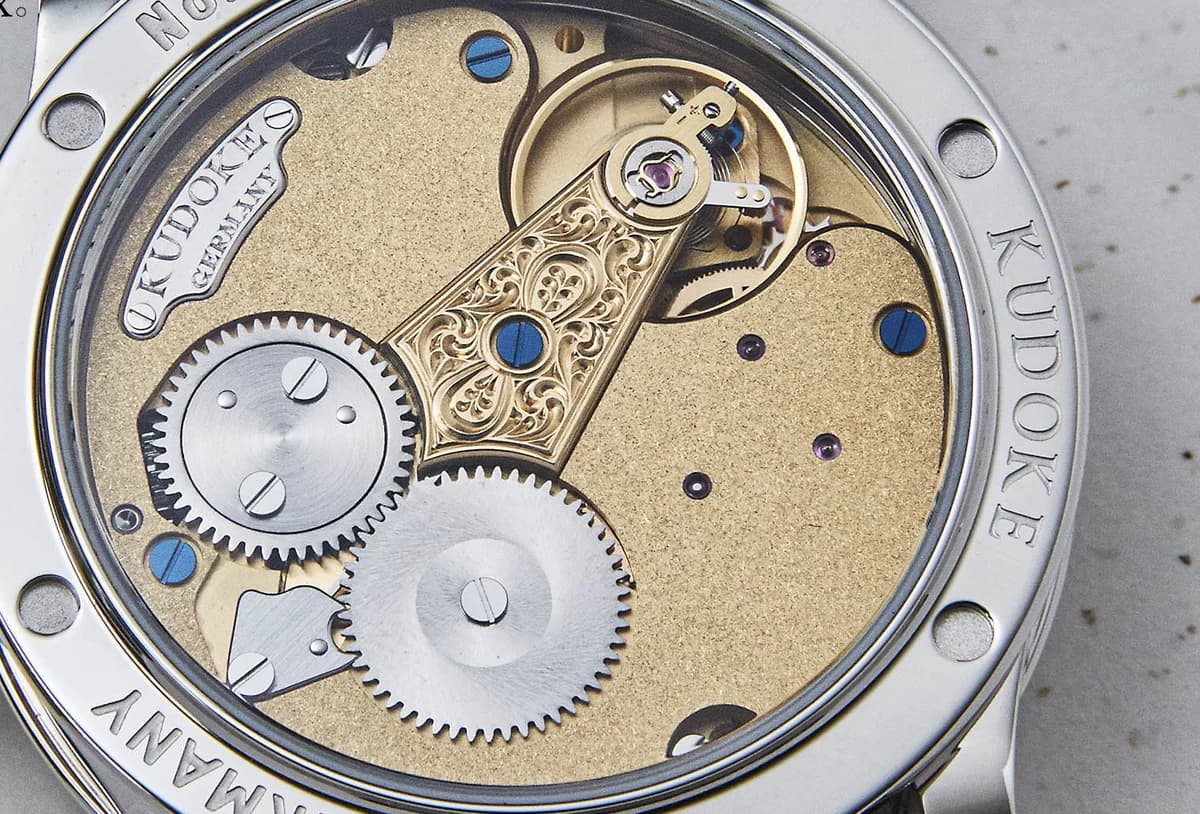
The movement architecture is inspired by English pocket watch calibers from the nineteenth century, and once you see it through the sapphire caseback, the influence is obvious. The three-quarter plate has a flat frosted finish achieved through a technique called abrasive reaming, where a mix of oil and abrasives is brushed across the bridge surface in circular motions. The result is a soft, granular texture that catches light differently depending on the angle. It is the same kind of frosting you see on antique English fusee movements, updated for a modern wristwatch. The plates are rhodiumised and the screws are hand-blued. The barrel ratchet wheel has solarisation finishing, the crown wheel gets circular graining, and the click-spring is hand-polished. None of these details are done by machine. As Quill and Pad documented in their review, all of the finishing steps are performed manually.
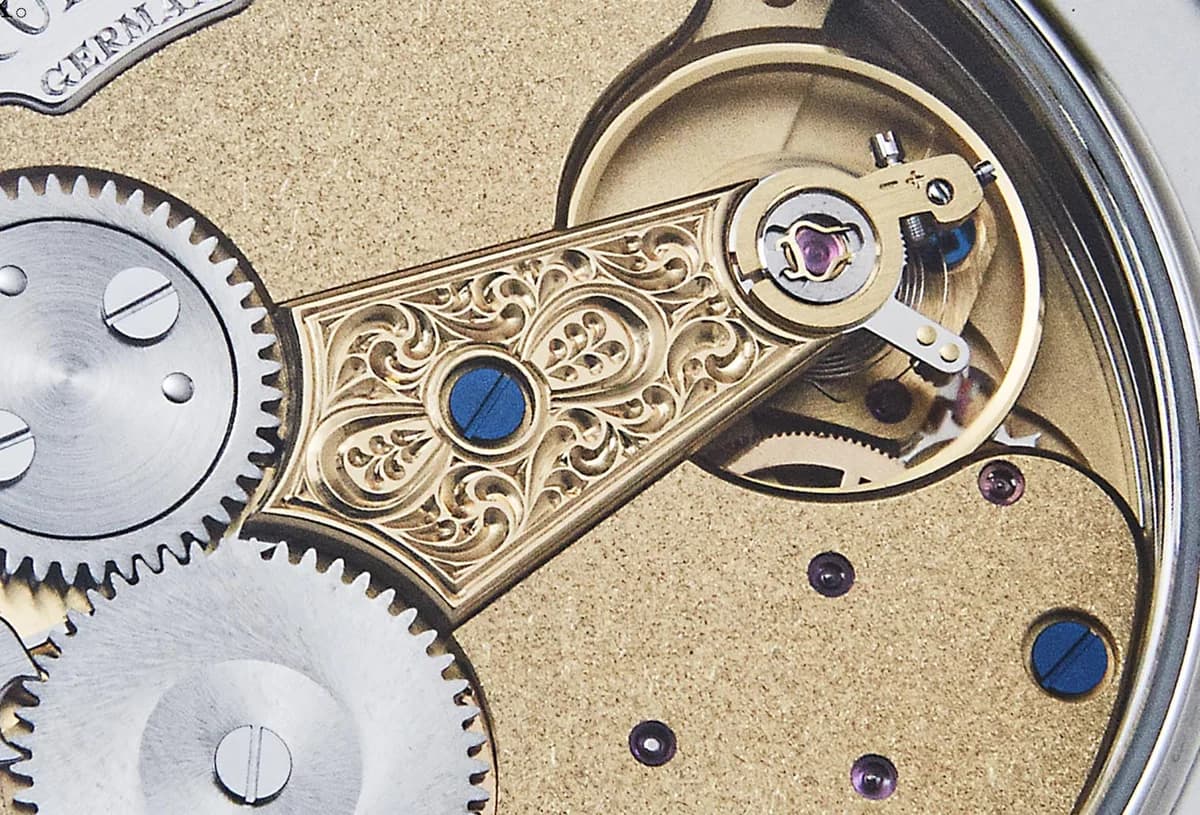
The balance cock is where Kudoke's identity as an engraver really shows. The bridge that holds the balance wheel tapers from the main plate into a sculpted cock, and that entire surface is hand-engraved with a floral motif that incorporates a subtle infinity symbol. The engraving is done with a burin under magnification, one stroke at a time. There is no CNC assist, no laser, no pantograph. This is the same technique that master engravers in the Meisterschule tradition have used for centuries, and Kudoke taught it to himself after his formal training was complete. The contrast between the frosted bridge surface and the polished engraved lines creates a depth that photographs struggle to capture. In person, the engraving seems to float above the frosted plane. Hand-polished convex edges (what the industry calls anglage) run along every bridge and plate edge, adding another layer of light play. I appreciate that Kudoke does not hide any of this behind a solid caseback. The sapphire exhibition back is there because the back of this watch is just as considered as the front.
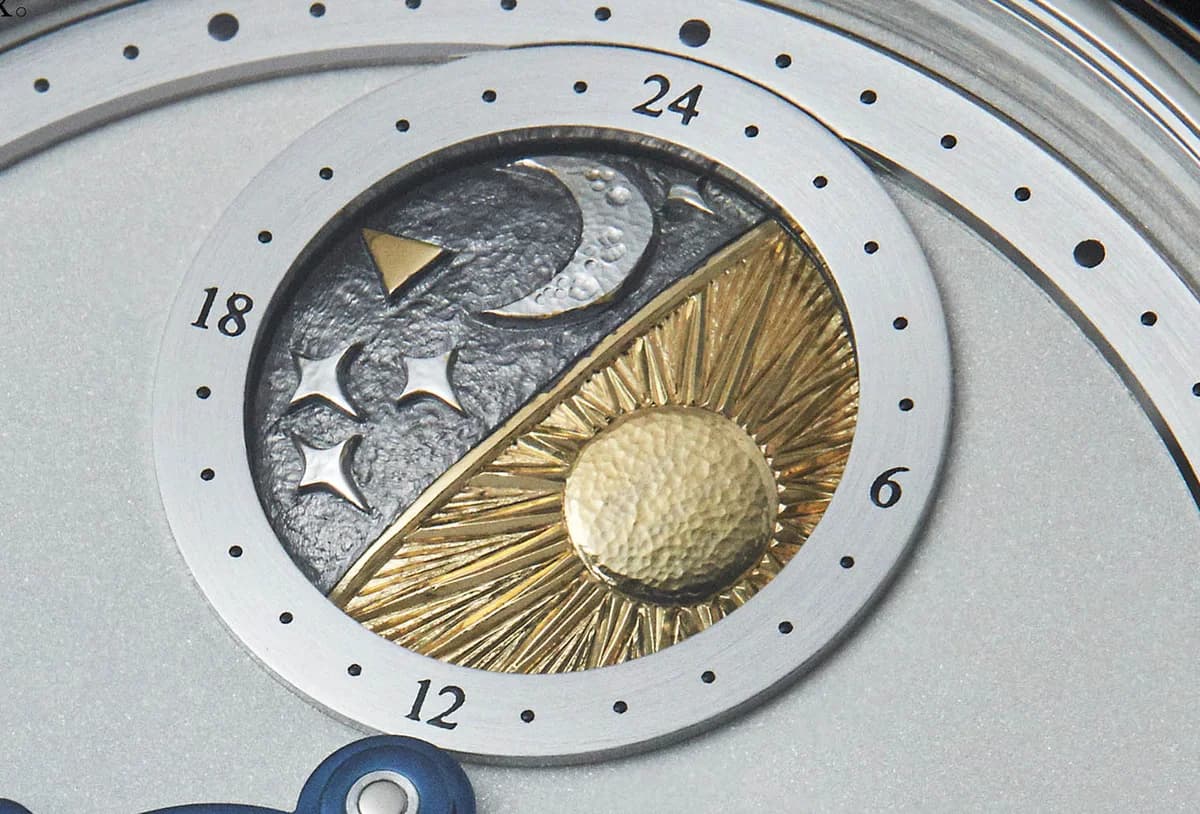
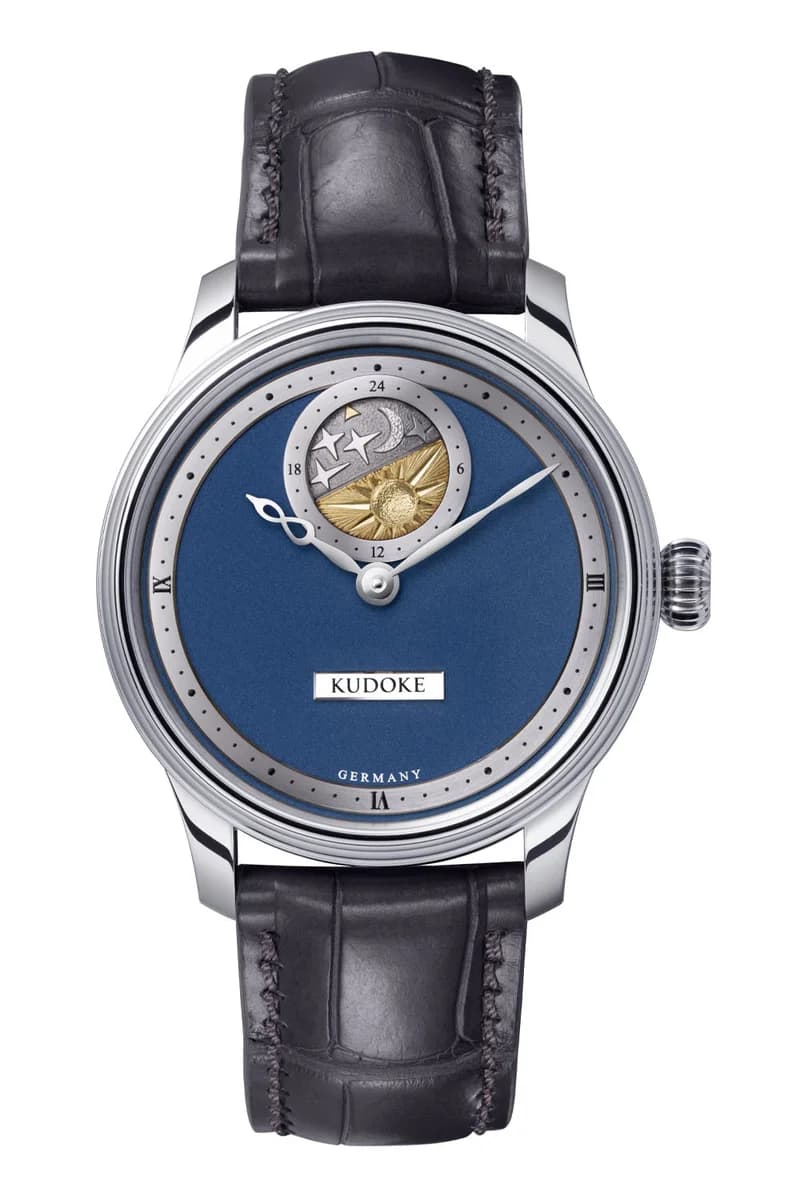
The dial is where this watch becomes something genuinely unusual. Instead of a conventional seconds subdial at 12 o'clock, the Kudoke 2 has a 24-hour rotating day-night disc. It is hand-engraved by Stefan and electroplated in three colors. The daytime half is finished in yellow gold plating with an engraved sun at the center, its surface hand-hammered to create radiating beams of light. The nighttime half is rendered in white and black rhodium, depicting the moon (with hand-hammered craters) and engraved stars against a dark field. The entire disc makes one complete rotation every 24 hours, synchronized with the hour hand. A gold-plated triangle on a brushed, rhodium-plated hour ring indicates the current time against Arabic numerals on the 24-hour scale. The main chapter ring below uses Roman numerals at the quarter hours. The effect is that the dial is never static. The sun rises and sets. The moon and stars appear and disappear. Every time I look at the watch, the celestial scene has shifted. It is a mechanical planetarium on the wrist, and every element of it was engraved by one person.
The GPHG win in 2019 is worth putting in context because it was not just another award. The Grand Prix d'Horlogerie de Geneve is the closest thing watchmaking has to the Oscars, and the Petite Aiguille category specifically recognizes watches in the accessible range. Stefan Kudoke won it with the Kudoke 2, becoming the first independent watchmaker from Germany to win at the GPHG. To be clear about why that matters: A. Lange and Sohne has won GPHG awards before, including the Aiguille d'Or in 2009 for the Zeitwerk. But Lange is a corporate manufacture owned by Richemont with hundreds of employees. Kudoke is one person in a village in Saxony. When the Geneva jury handed that award to Stefan, they were acknowledging that haute horlogerie finishing and mechanical ingenuity are not the exclusive domain of Swiss ateliers or German corporate manufactures. One craftsman with the right training and the right hands can compete at the same level. The fact that he accepted the award in Geneva, the capital of Swiss watchmaking, while representing a workshop in a town that most of the jury had probably never heard of, makes it even more meaningful. In 2021, the Academie Horlogere des Createurs Independants (the AHCI, the same body that counts names like Francois-Paul Journe, Kari Voutilainen, and Vianney Halter among its members) admitted Kudoke as a full member. That is the peer validation that sits alongside the jury validation from Geneva.
Kudoke organizes his output into two collections. The HANDwerk series, which includes the Kudoke 2, centers on the in-house Kaliber 1 and its variants, emphasizing the English pocket watch aesthetic and hand-finished movement decoration. The KUNSTwerk series goes further into decorative territory with elaborate skeletonization and full-surface engraving, including the distinctive KudOktopus model where engraved octopus tentacles wrap around the movement. The Kudoke 1 uses the base Kaliber 1 with a small seconds subdial at 9 o'clock instead of the day-night complication. The Kudoke 3 adds a flake-pattern engraved dial. Each watch in the HANDwerk line shares the same 39mm case and the same commitment to hand finishing, but the dial complications and engraving motifs vary. What I find compelling about this approach is that Kudoke has built a coherent product line from a single movement platform, the way a proper manufacture would, but he does it alone. There is no team of movement assemblers. There is no finishing department. There is Stefan, his bench, and his tools.
The variants of the Kudoke 2 itself show how much range a single craftsman can get from one reference. The Deep Blue edition uses a deep blue dial field behind the engraved day-night disc. The Nocturne reverses the contrast with darker tones. The Tremblage editions (in black rhodium, white rhodium, and yellow gold) apply a tremblage engraving technique to the dial surface, creating a shimmering textured field behind the celestial scene. Each variant is available on special request rather than as a permanent production piece, and annual output across all Kudoke models is extremely small. Stefan produces each watch individually from start to finish. When I say small, I mean genuinely small. This is not a brand claiming exclusivity while producing thousands of units. The entire operation is one craftsman and his wife running the business side. The workshop in Weifa is not a manufacture in the corporate sense. It is a room with a bench, tools, and a microscope. The watches come out when they come out.
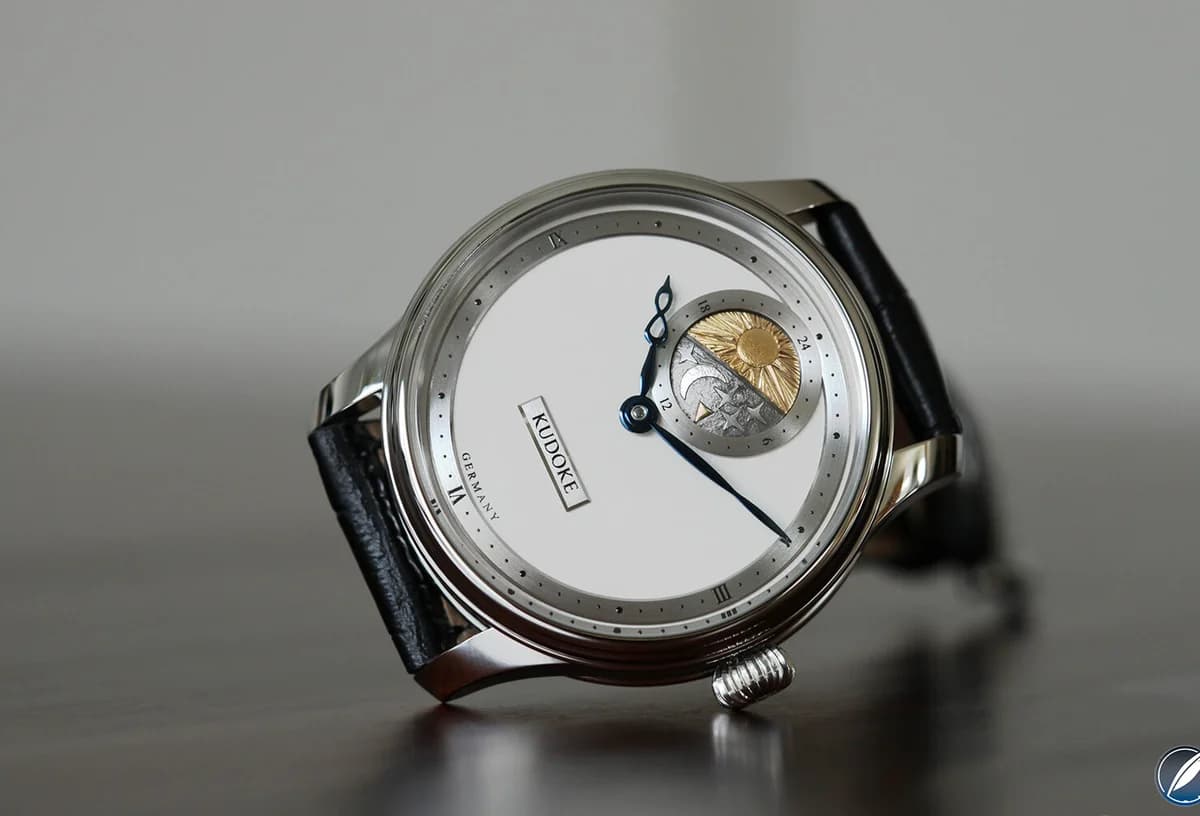
The honest critique is that the Kudoke 2 is not a watch for everyone, and I think Stefan would agree. The engraving is everywhere. The day-night disc is visually dense. The movement decoration is rich. For someone who gravitates toward clean dials and minimal design, this is a lot to take in. The SJX review noted that the mix of Roman numerals on the main chapter ring and Arabic numerals on the 24-hour ring, combined with the stock typography used for those numerals, is the one area where the design could be refined. I agree with that observation. The engraving itself is clearly world-class, but the typography does not quite match that level of craft. Custom-drawn numerals (the way Voutilainen or Dufour approach their dials) would elevate the visual coherence. There is also no lume on this watch. In low light, the dial goes dark. For a watch with a day-night complication that is literally depicting the passage of time through darkness, the absence of any luminescent material is an interesting tradeoff. Adding lume would probably compromise the engraved surfaces, and the dial is so densely decorated that there is nowhere to put luminescent material without disrupting the composition. So I understand the decision. But it is worth noting for anyone who checks the time in bed.
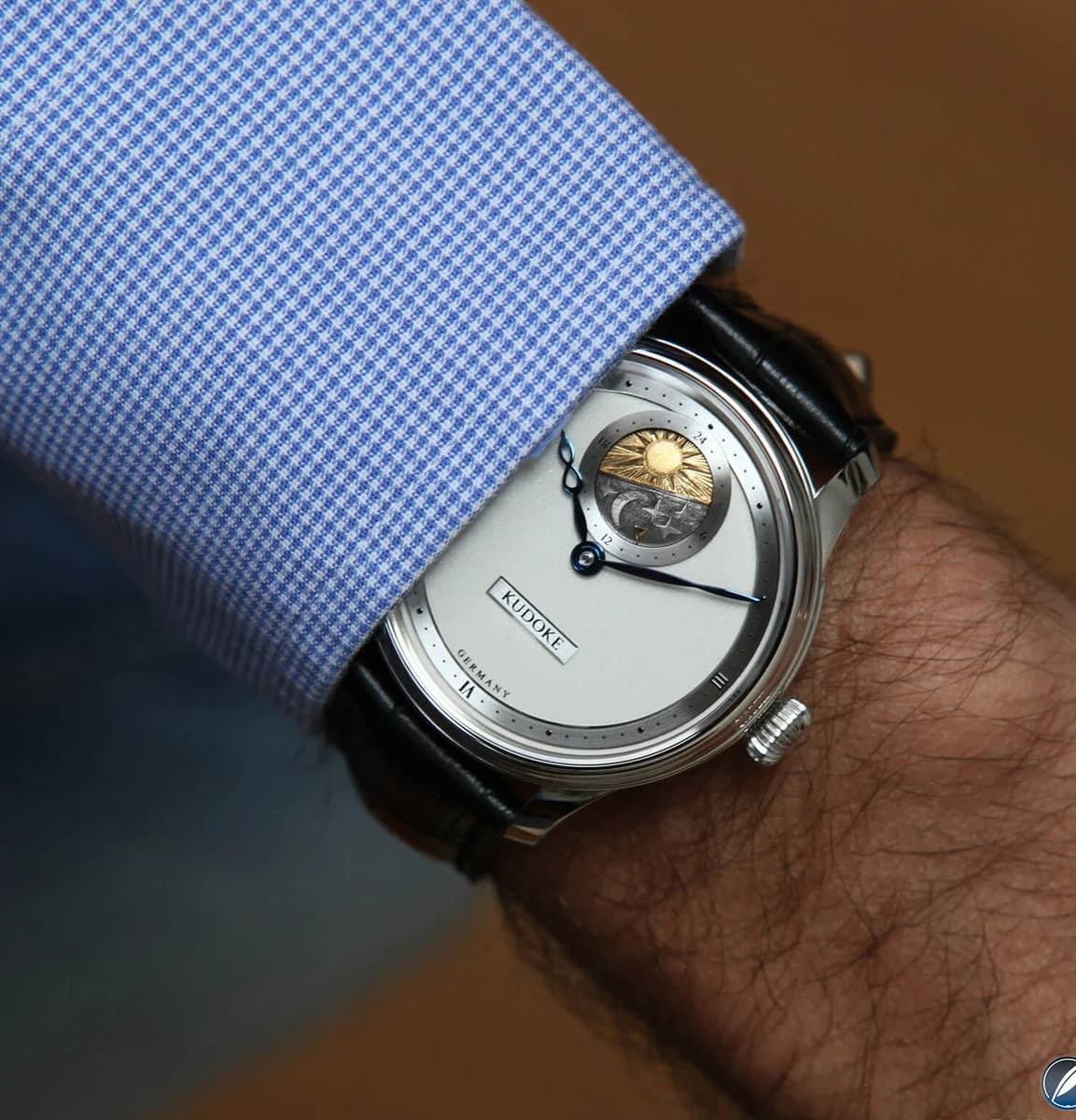
On the wrist, the 39mm case with its 46.5mm lug-to-lug sits quietly under a shirt cuff. At 10.7mm thick, it does not ride up or catch on fabric. The fully polished 316L steel has a presence that works equally well with a Holland and Sherry flannel suit or a weekend linen shirt with rolled sleeves. On darker skin tones, the contrast between the polished steel case and the gold-plated daytime half of the disc is particularly striking. The alligator strap with its polished steel pin buckle feels appropriate for the level of finishing. I would love to see a quick-release spring bar option, though for a watch at this level of hand craftsmanship, traditional spring bars feel more honest. It is not trying to be a strap-swapping lifestyle piece. It is trying to be a work of hand engraving that also tells time. It succeeds at both. The 50-meter water resistance is a practical bonus that means you do not have to think twice about washing your hands or getting caught in rain. For an independently finished watch with a sapphire caseback, that rating is generous. Many Swiss independents at much higher levels offer only 30 meters.
I think about Kudoke in the same breath as Gronefeld, Simon Brette, and Rexhep Rexhepi. Not because the watches are similar. They are completely different. But because all of them represent the same idea: a watchmaker does not need a Swiss address, a corporate budget, or a team of fifty to produce work that competes at the highest level. Gronefeld does it from the Netherlands with twin brothers and a small team. Rexhepi does it from Geneva as a self-taught Kosovar immigrant. Kudoke does it from a village in Saxony with a burin and a microscope. The geography is irrelevant. The training matters. The discipline matters. The hands are what matter.
What stays with me about the Kudoke 2 is not the GPHG award or the AHCI membership, though both are deserved. It is the fact that every surface of this watch, dial side and movement side, was engraved by the same person who assembled the movement, adjusted the regulator, and cased it. There is no division of labor. There is no anonymous finishing department. When you look through the sapphire caseback at the frosted bridges and the engraved balance cock, you are looking at the work of the same hands that engraved the sun and moon on the other side. That level of single-craftsman integrity is vanishingly rare in modern watchmaking, and it is what makes the Kudoke 2 more than just a well-decorated watch. To me, it is a statement about what one person can accomplish at a bench.
Also in Artisan Craft