
Rolex
Day-Date 40mm Everose Olive Green
228235
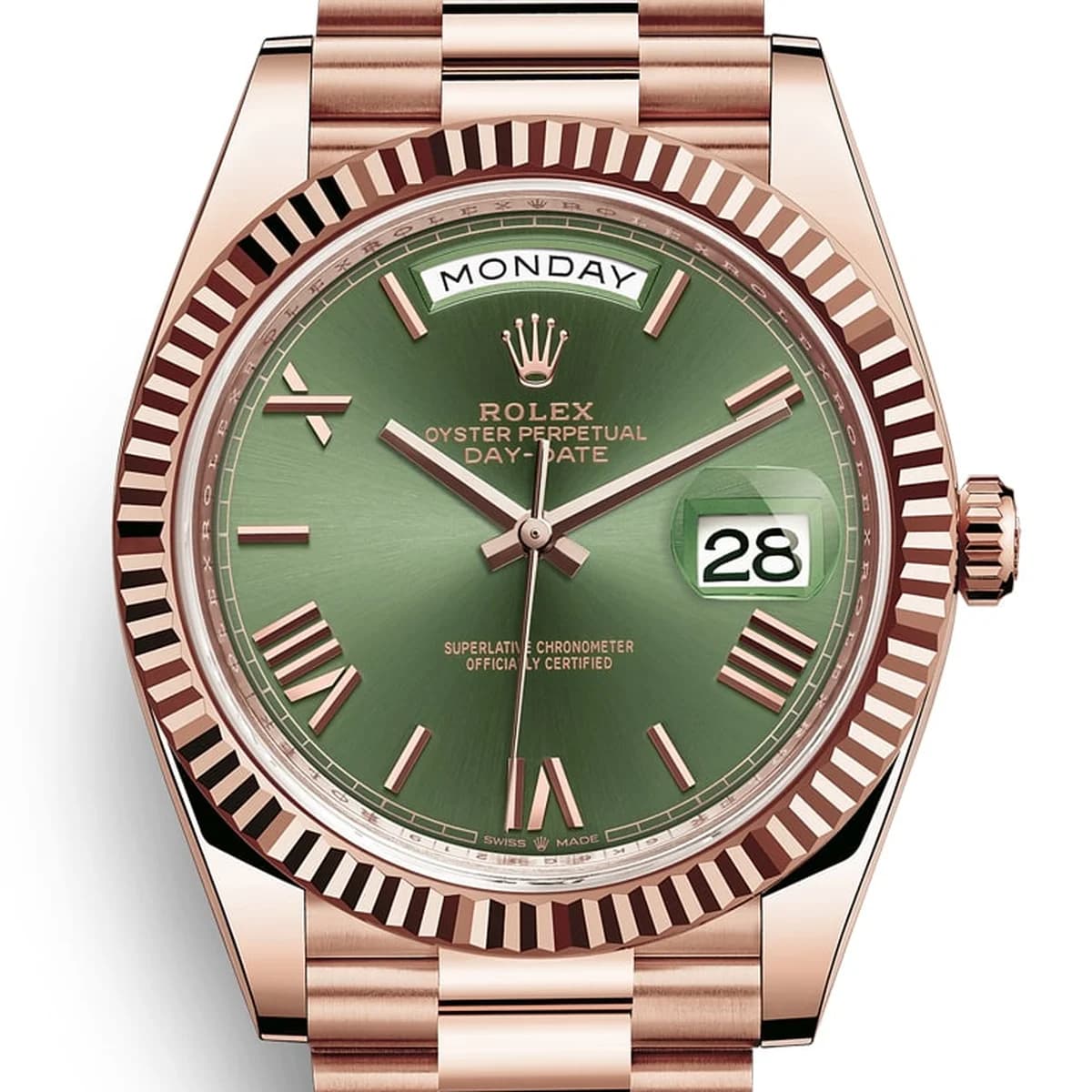
The Rolex Day-Date occupies a position in watchmaking that no other model has ever replicated. Since 1956, it has only ever been produced in precious metals. No steel version. No titanium. No two-tone. If you want a Day-Date, you are buying gold or platinum, and that exclusivity is deliberate. Rolex designed it as the ultimate dress watch, and the material restriction is part of the statement. The Day-Date was also the first wristwatch to display both the day of the week and the date spelled out in full on the dial. That sounds simple today, but in 1956 it was a genuine complication that required a new movement architecture, patented by Rolex engineer Marc Huguenin. The day window at 12 o'clock displays the full name in any of 26 languages. The date sits at 3 o'clock with a Cyclops magnification lens. The combination was unique to Rolex for years.
The association between the Day-Date and the American presidency is one of the most effective marketing stories in luxury goods, and it is also one of the most misunderstood. Eisenhower is often cited as the first president to wear the Day-Date, but he never wore one. In the early 1950s, before the Day-Date even existed, Rolex presented Eisenhower with their 150,000th officially certified chronometer, a yellow gold Datejust reference 6305. He wore it on the cover of Life magazine on July 12, 1952. The Day-Date did not exist until 1956. The actual president who cemented the connection was Lyndon B. Johnson. LBJ wore a yellow gold Day-Date throughout his presidency and was the first sitting president photographed wearing the model. That is where the "President's Watch" nickname came from, and that is where the President bracelet got its name. Nixon, Reagan, and Clinton also wore Day-Dates. The most famous Day-Date story involves Marilyn Monroe and John F. Kennedy. On May 29, 1962, Kennedy's 45th birthday and shortly after Monroe sang "Happy Birthday, Mr. President" at Madison Square Garden, she gave him a gold Day-Date with a caseback engraved "Jack, With love as always from, Marilyn, May 29th 1962." Kennedy reportedly told his aide Kenneth O'Donnell to get rid of it. The watch disappeared for decades before surfacing at auction in 2005, though its authenticity has been questioned because the serial number corresponds to a production date of approximately 1965, two years after Kennedy was assassinated.
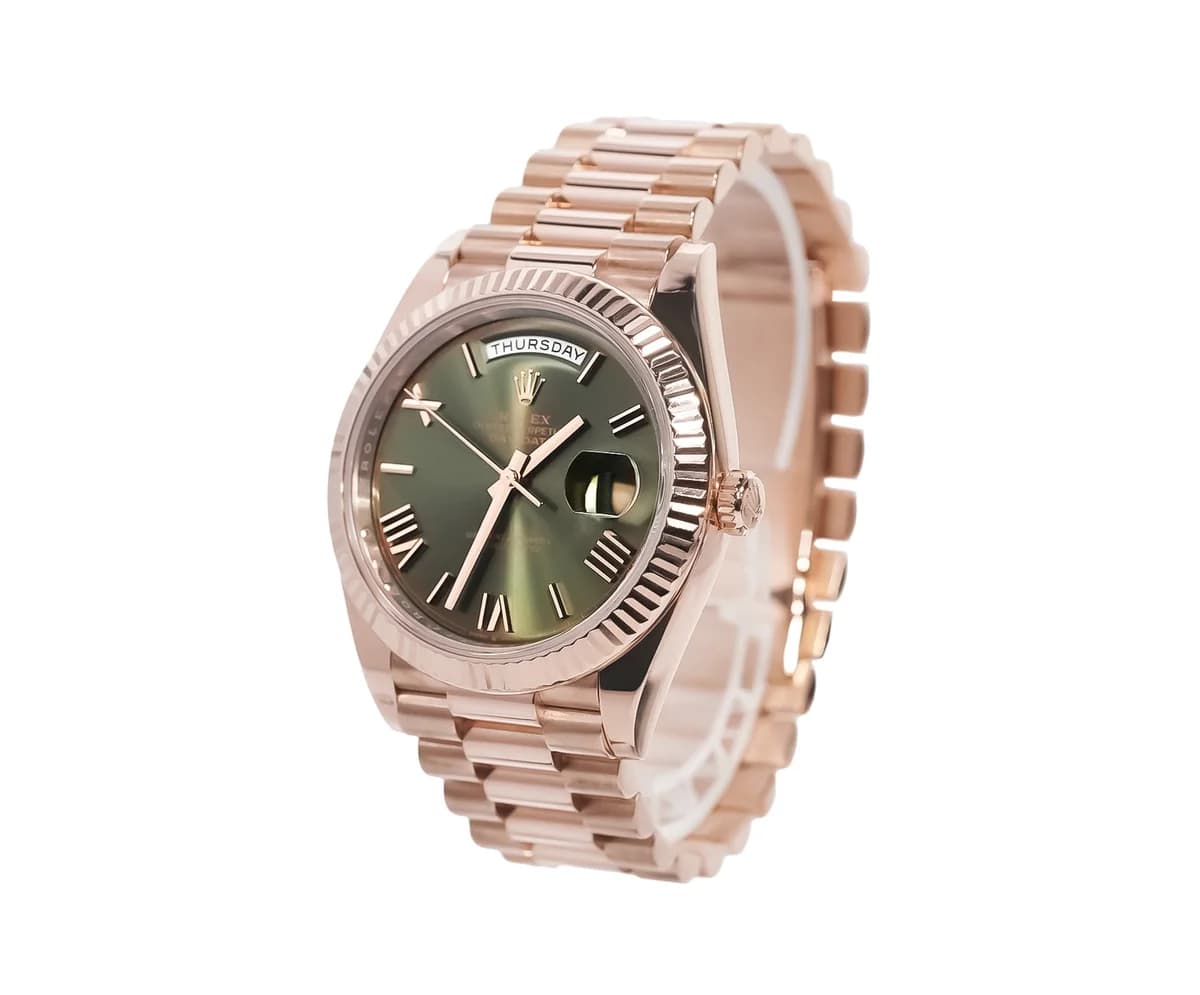
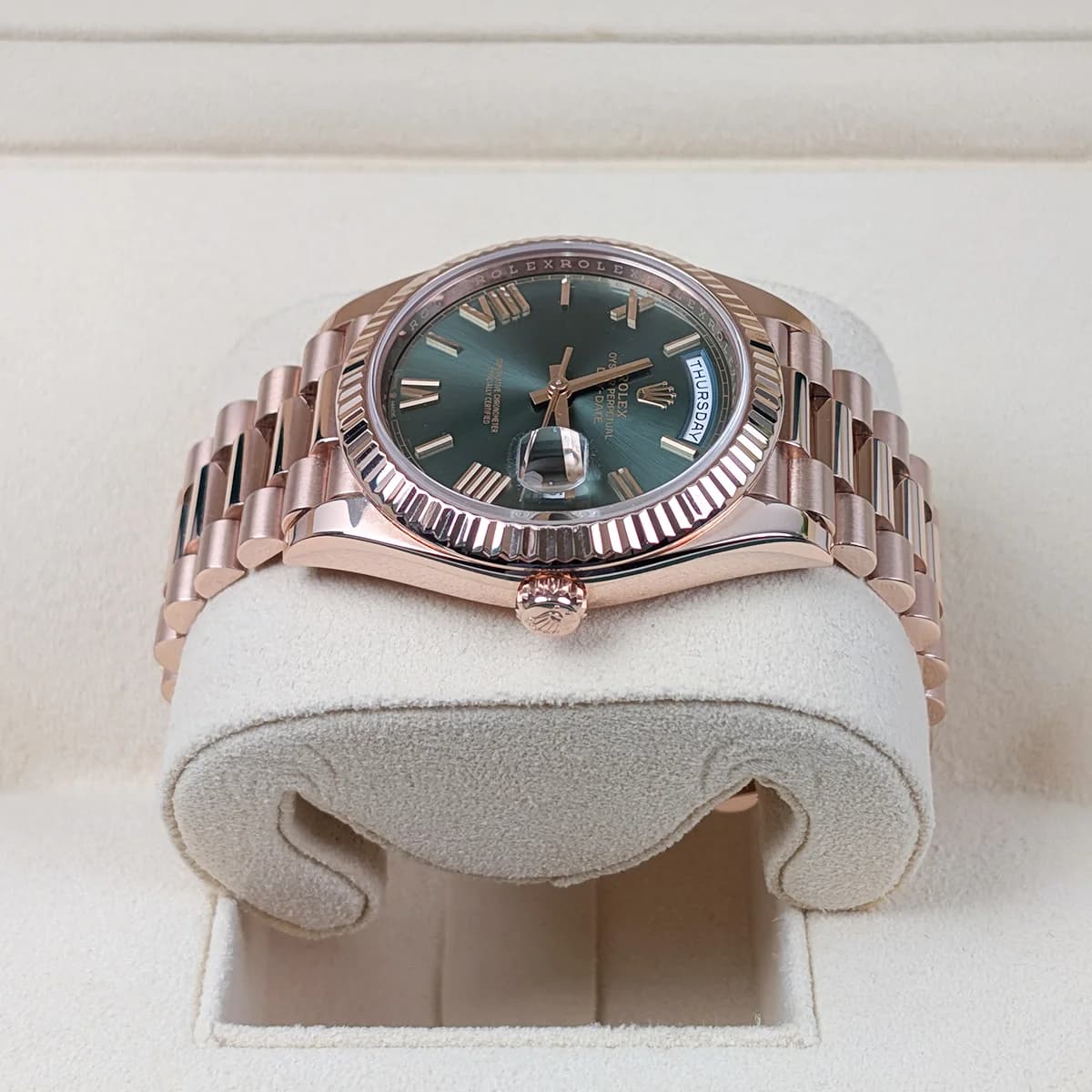
The 228235 is the current generation Day-Date, introduced at Baselworld in 2015 as part of the Day-Date 40 lineup. The case measures 40mm in diameter, 12mm thick, with a 47.1mm lug-to-lug span and 20mm lug width. It is 18 ct Everose gold from the case to the bezel to the bracelet to the crown. The fluted bezel is machined directly from solid Everose gold. That bezel has its own history worth knowing. On the original 1926 Rolex Oyster, the fluted bezel was functional. It screwed down onto the case to complete the waterproof seal, with the fluting providing grip for Rolex's tools. Since 1953, the bezel has been friction-fitted and is purely aesthetic, but the design survived because it became a signature. On the Day-Date, the fluted bezel is always in gold. It catches and refracts light in a continuous shimmer that adds formality without ever feeling stiff.
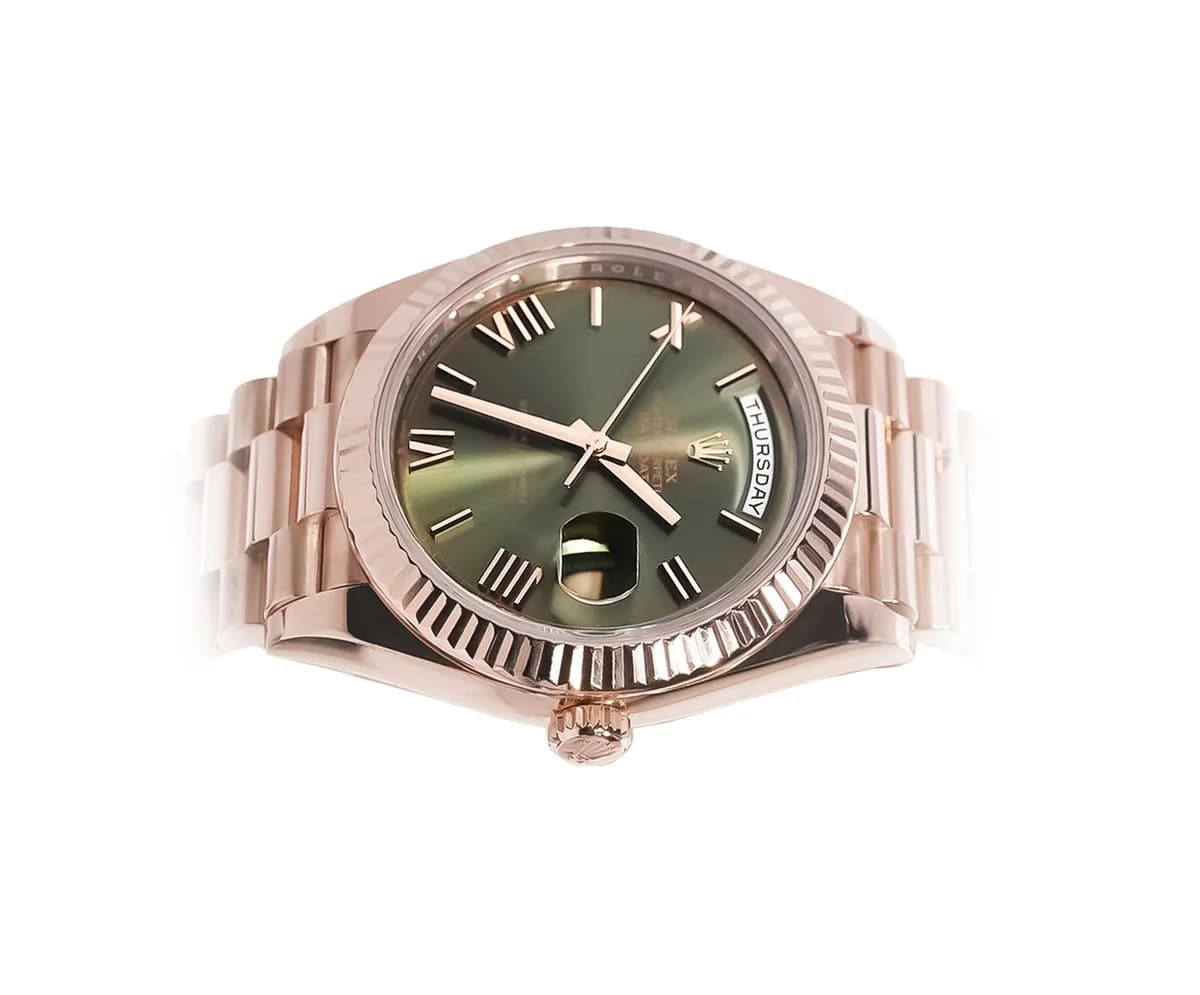
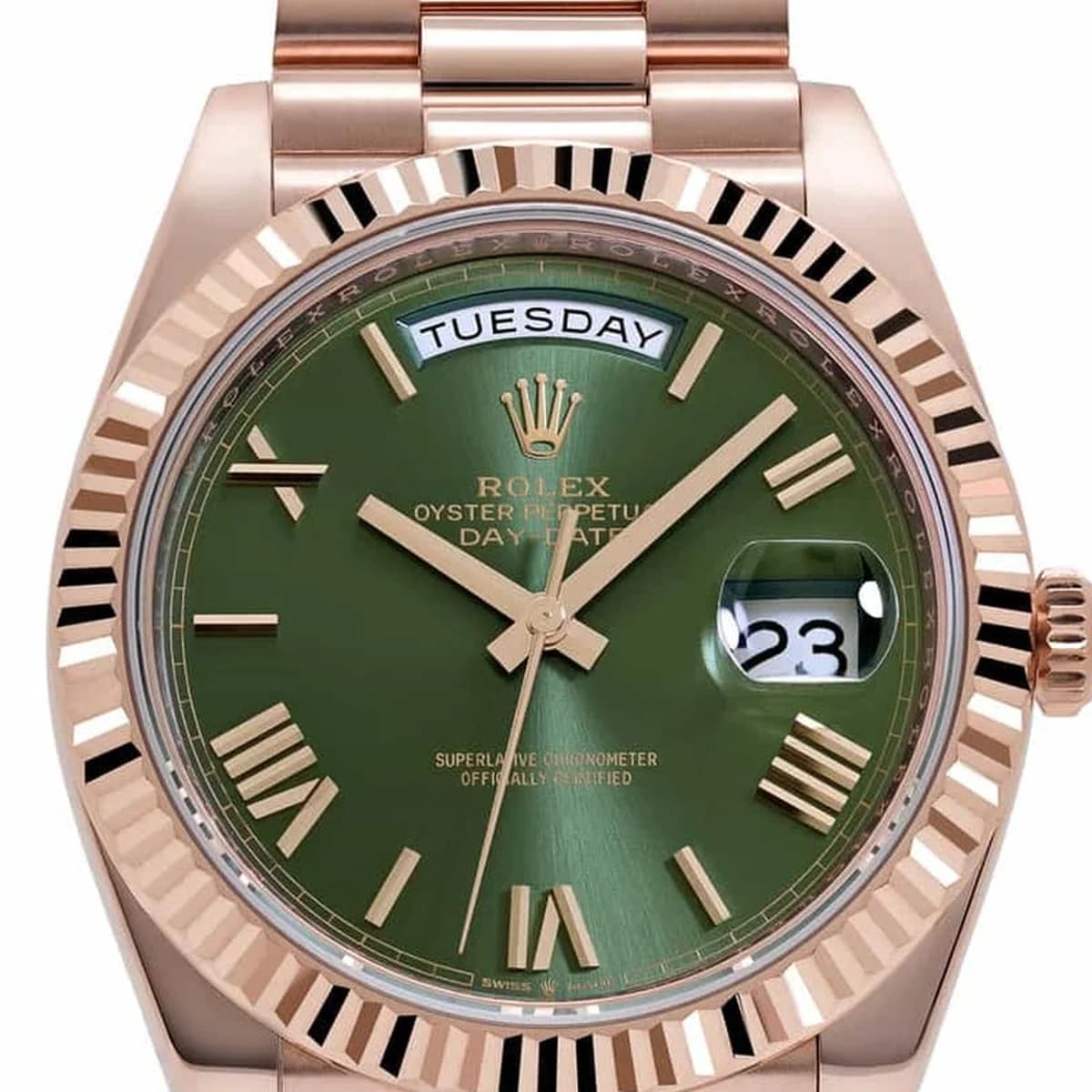
The olive green sunburst dial is what separates this specific configuration from every other Day-Date, and in my experience it is also what makes the 228235 the hardest Day-Date to photograph accurately. I have spent time looking at this dial in different lighting conditions, and it genuinely shifts. Under direct sunlight, the sunburst finish radiates outward from the center and the color reads as a vibrant, almost luminous green. Under softer indoor light, it darkens to a deeper forest green that feels more subdued. At certain angles, the warm pink of the Everose markers and hands against the cool green creates a complementary color contrast that is genuinely unusual in watchmaking. Most brands play it safe with black, white, silver, or champagne dials on gold cases. This does not play it safe. The Roman numeral hour markers are applied in matching Everose gold, and the minute track is a fine railway chapter ring around the perimeter. The Chromalight lume on the hands provides a faint blue glow in low light, though on a watch like this, legibility in true darkness is not the primary design consideration.
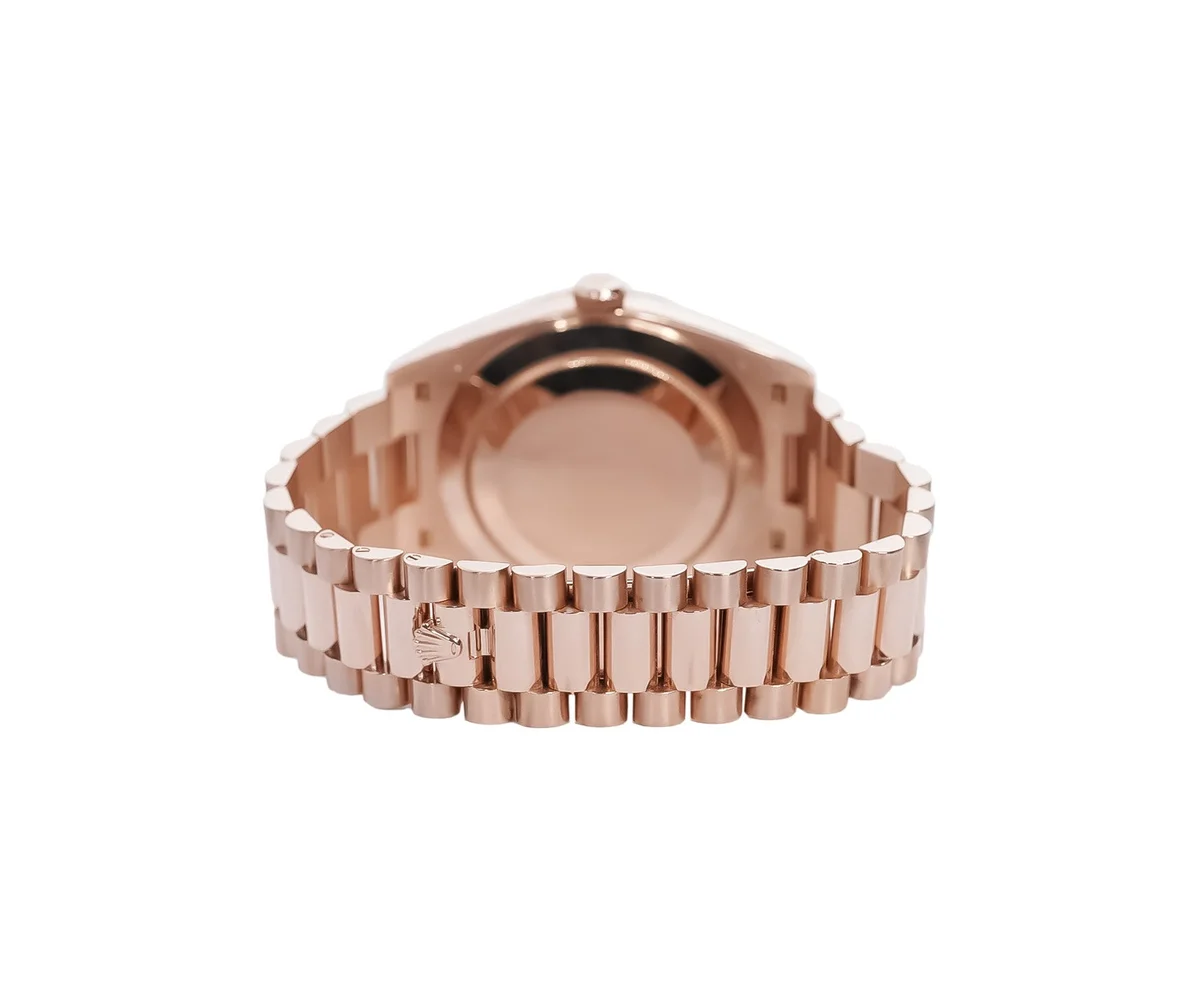
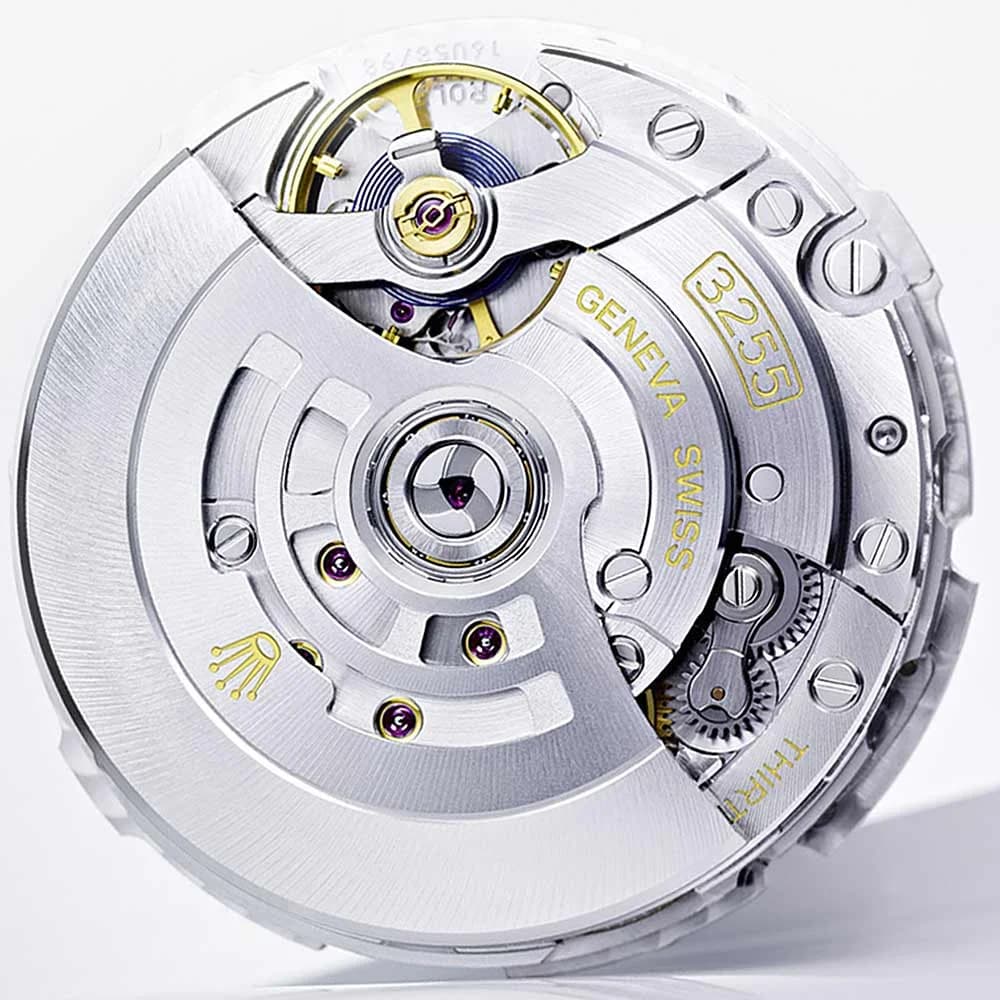
Inside the 228235 sits the Caliber 3255, and this is where Rolex made the biggest technical leap with the Day-Date 40. The previous generation used the Caliber 3155, which was a proven movement but showed its age. Rolex redesigned over 90 percent of the components for the 3255. It has 44 jewels, beats at 28,800 vibrations per hour (4 Hz), and delivers a 70-hour power reserve, which is a 50 percent increase over the previous caliber. That three-day power reserve means you can take the watch off on Friday evening and put it on Monday morning without needing to reset anything. I find the Chronergy escapement to be the key innovation here. It is a patented Rolex design, machined from nickel-phosphorus rather than traditional steel, which makes it completely antimagnetic and approximately 15 percent more energy efficient than a standard Swiss lever escapement. That efficiency gain is where the extra power reserve comes from. The blue Parachrom hairspring is paramagnetic, meaning it resists magnetic fields that would affect a conventional hairspring, and it is far more shock-resistant. The entire movement carries Rolex's Superlative Chronometer certification, which means it is tested to plus or minus two seconds per day after casing. For context, standard COSC certification allows minus four to plus six seconds per day. Rolex tests to double the standard, after the movement is in the case, which is harder. The instantaneous day and date change at midnight is another detail worth noting. Both the day and the date flip simultaneously in a fraction of a second. There is no slow creep starting at 10 PM the way some day-date complications work.
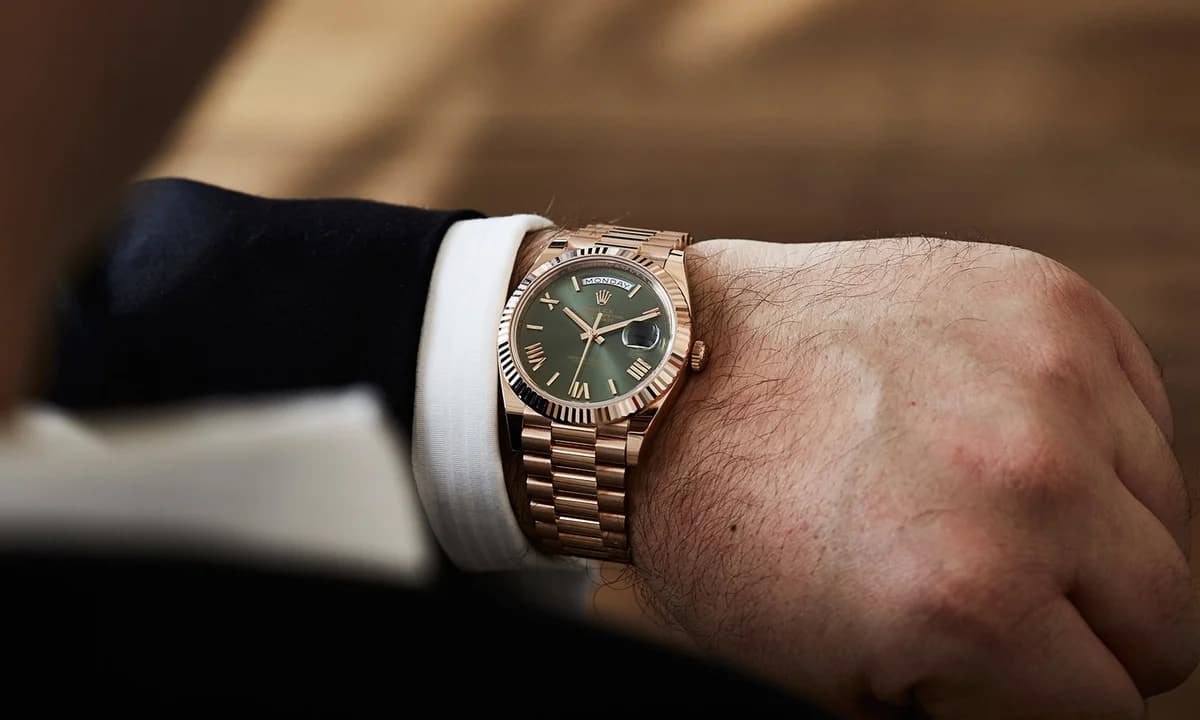
What I love about this watch beyond the dial is the Everose gold itself as a piece of materials science. Rolex patented the alloy in 2005 to solve a real problem with traditional rose gold. Standard 18K rose gold gets its warm pink color from copper in the alloy. Over time, exposure to chlorine, saltwater, sweat, and UV light oxidizes the copper on the surface, causing the color to fade. Vintage rose gold watches from the 1950s and 1960s often show this. The warm pink turns slightly green or loses its saturation. Rolex's solution was to add approximately 2 percent platinum to the alloy alongside the gold and copper. The platinum locks the copper molecules in place at the crystalline level, preventing migration to the surface and blocking oxidation. The result is a rose gold that maintains its exact color indefinitely. It is a small detail, but it is the kind of engineering decision that separates Rolex from brands that simply specify 18K rose gold from an external supplier.
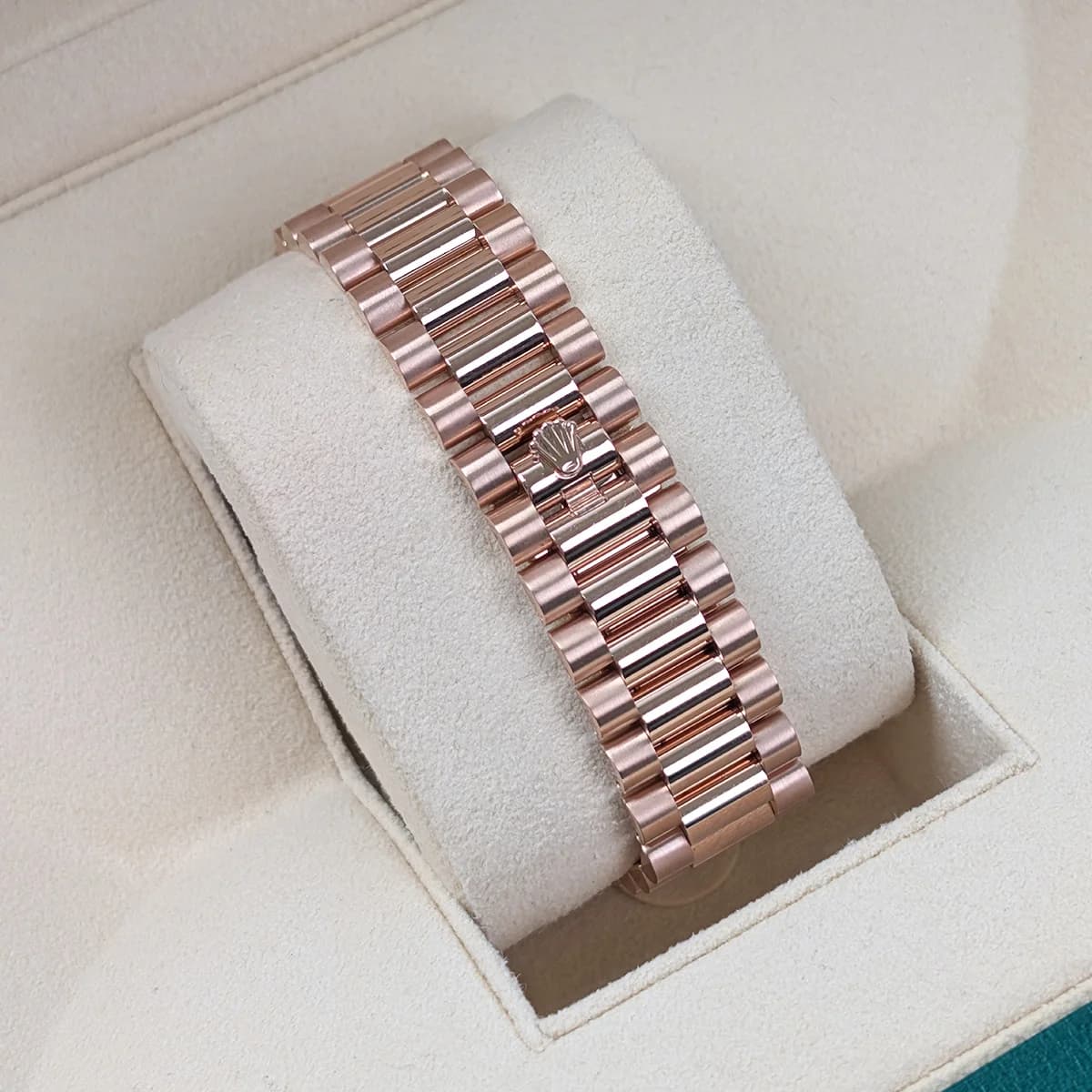
The President bracelet deserves its own discussion because it is as much a part of the Day-Date identity as the dial. The semi-circular three-piece link design was created in 1956 specifically for the Day-Date. It was not adapted from another model or shared across the lineup. It was purpose-built. The links have a distinctive rounded profile that gives the bracelet a smoother, more flowing appearance compared to the angular Oyster bracelet. On the 228235, the bracelet includes ceramic inserts within the links to prevent the metal-on-metal contact that causes stretch over time. This is a direct response to the most common complaint about vintage President bracelets. The concealed Crownclasp folds flat against the bracelet with no visible hardware when closed. A small Rolex crown logo sits at the center of the clasp, flush with the bracelet surface. The overall weight of the watch on the bracelet is approximately 199 grams. That is substantial. For comparison, a Rolex Submariner on steel weighs roughly 155 grams, and that already feels like a real watch. The Day-Date in Everose adds another 44 grams of presence.
The Day-Date family spans an enormous range of configurations. It comes in yellow gold, white gold, Everose gold, and platinum. Dial options include champagne, silver, black, blue, chocolate, ice blue (platinum exclusive), meteorite, and the olive green. There are versions with diamond-set bezels, diamond hour markers, and even full pave dials. The 36mm Day-Date remains in production alongside the 40mm. Within this universe of options, the olive green on Everose occupies a specific niche. It is the configuration for people who want the Day-Date but do not want the traditional Day-Date look. Yellow gold with a champagne dial is the classic image. Platinum with the ice blue dial is the ultimate expression. The olive green on Everose sits between those poles, warm enough to feel approachable, distinctive enough to feel different. Jay-Z helped establish the platinum Day-Date in hip-hop culture in the 1990s. Drake, Federer, and Rihanna all wear Day-Dates. The olive green has found its audience among collectors who understand the reference but want their own variation on it.
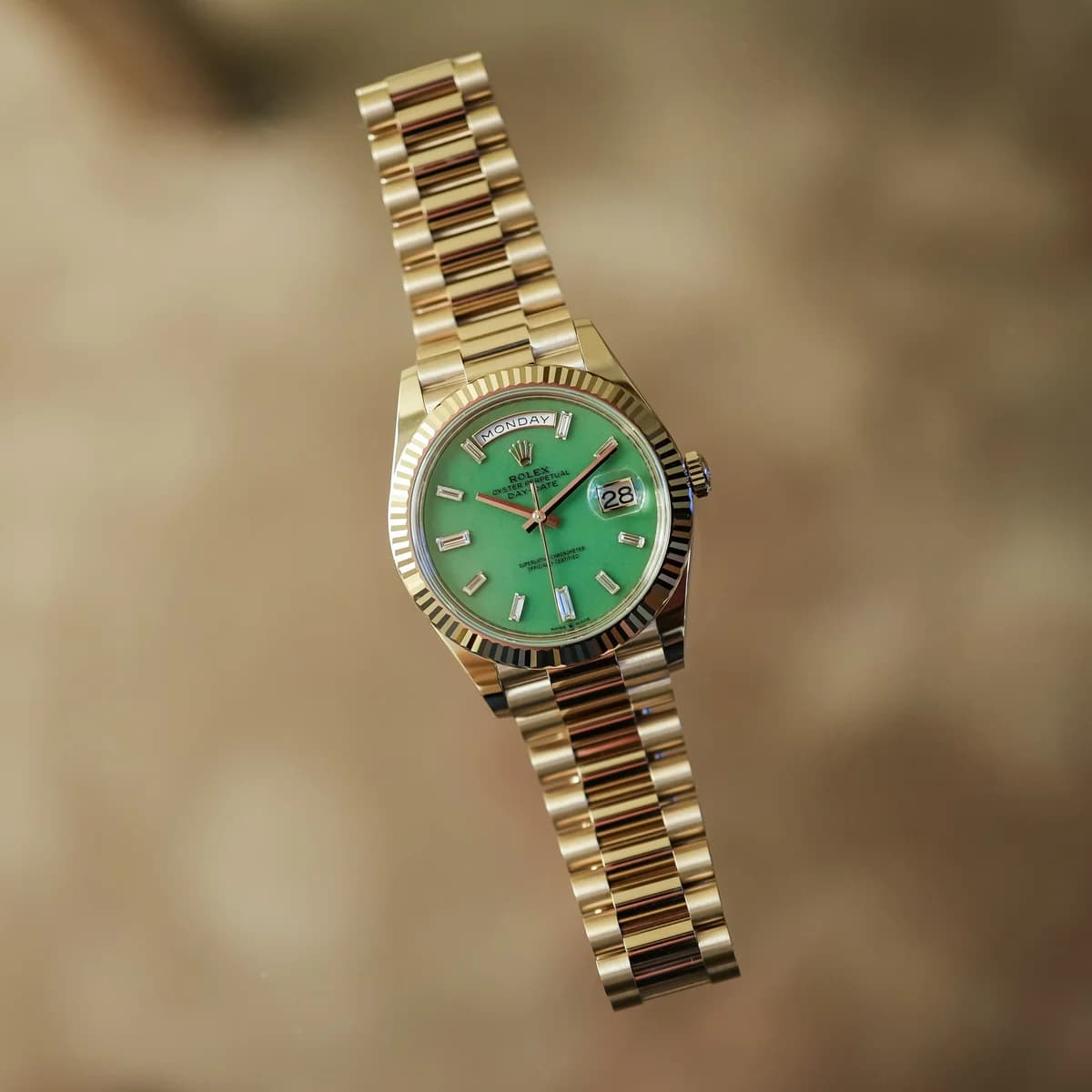
The timeline of the Day-Date tells a story of evolution within consistency. In 1956, references 6510 and 6511 launched the model with either smooth or fluted bezels. The reference 1803, produced from 1959 to 1976, was the last to use an acrylic crystal and the last with the iconic pie-pan dial. The reference 18038 in 1977 introduced the sapphire crystal and the Caliber 3055 with quickset date. The reference 118238 in 2000 transitioned the President bracelet from hollow to solid links, a substantial upgrade in feel and durability. And the current 228 series, launched in 2015, brought the 40mm case size and the Caliber 3255 with its 70-hour power reserve and Chronergy escapement. Through all of these changes, the fundamental identity has remained constant. Precious metals only. Day and date spelled in full. President bracelet. Fluted bezel option. No other Rolex model has maintained such strict parameters for nearly seven decades. That consistency is itself a design decision, and I think it is the right one. The Day-Date does not need to chase trends because the formula has been proven across generations of ownership. Each new reference refines the movement, improves the bracelet, and occasionally introduces a new dial color, but the architecture stays the same.
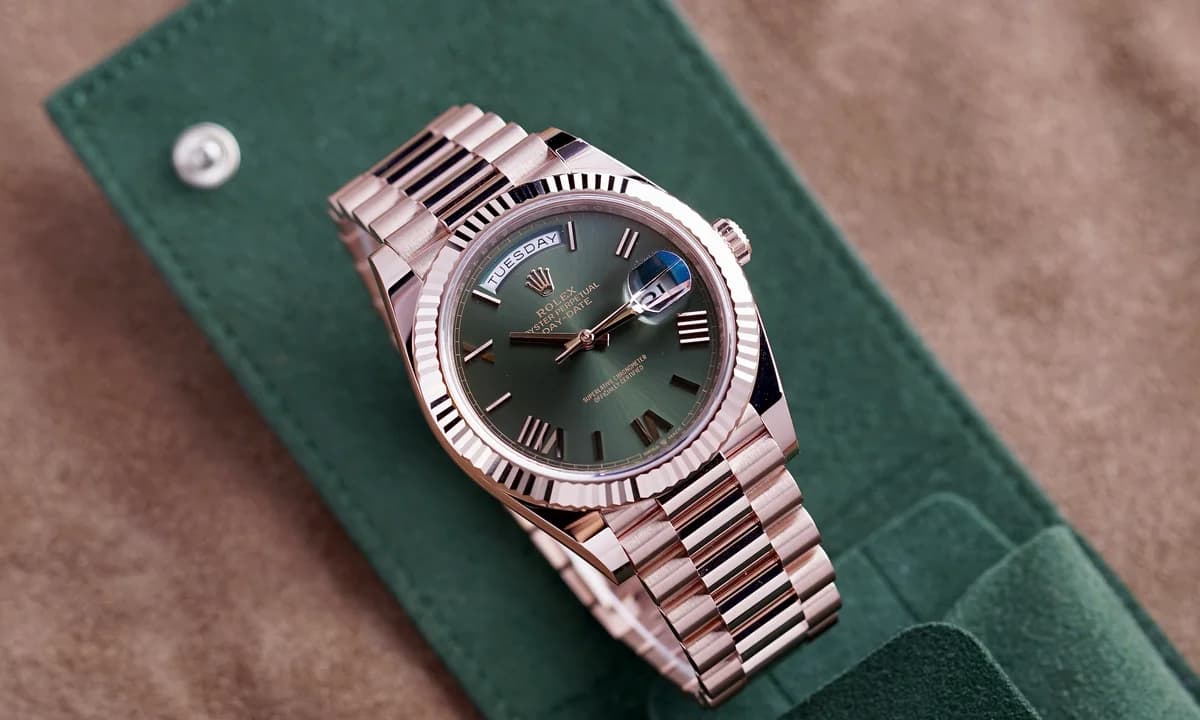
The honest critique of this watch centers on the realities of wearing solid gold daily. 18K Everose gold is 18 parts gold out of 24, which means it sits at roughly 2.75 on the Mohs hardness scale. Stainless steel is between 5.5 and 6.5. The fluted bezel, the polished center links on the bracelet, the polished case sides, and the crown are all going to pick up micro-scratches with regular wear. This is not a defect. It is physics. Anyone who has worn a gold watch daily for a year knows the finish softens. Some people find this adds character. Others find it frustrating and send the watch to Rolex for a polish, which removes a thin layer of metal each time. The weight is the other consideration. At 199 grams, this is not a watch you forget you are wearing. After eight hours it is noticeable. The precious metal heft is part of what makes a Day-Date feel like a Day-Date, but coming from titanium or even steel, the difference is immediate. I also wish Rolex would offer the Day-Date 40 on a leather strap from the factory. The President bracelet is iconic, but for casual settings a green or brown alligator strap would transform the watch. Aftermarket options exist, but an official Rolex strap option would open up the watch's versatility. As it stands, the Day-Date is a bracelet-only proposition, which limits how it adapts to different contexts.
I notice that every time I look at the olive green dial, the color seems to have changed since the last time. That is not an exaggeration. The sunburst finish creates a gradient effect where the center of the dial is lighter and the edges are darker, and depending on the angle of light, the entire range shifts. Morning sun through a window makes it look almost gold-green. Fluorescent office light makes it look flat and muted, which is part of why photos rarely do it justice. Natural afternoon light is where it comes alive, and that is the context most people experience it in when they see one in person for the first time. The gap between how this watch photographs and how it looks on the wrist is wider than any other watch I can think of. That is both a marketing challenge and a genuine delight for anyone who encounters it in person.
The 228235 in olive green on the wrist creates a specific impression that is hard to describe with specifications. The warm Everose against darker skin tones creates a rich contrast that reads as sophisticated without trying too hard. The olive green dial picks up the warmth of the gold and the warmth of the skin and creates a harmony that cooler metals cannot replicate. Under a Zegna wool suit jacket, the watch sits flat enough at 12mm to slide under a cuff without catching. The 40mm case with its 47.1mm lug-to-lug fits well on a 6.5 to 7-inch wrist. With a linen shirt and rolled sleeves, the Everose and olive green read more casual than a yellow gold Day-Date would. That is the specific trick of this configuration, and it is something I appreciate more each time I see it in a different context. It manages to be a gold Rolex that does not look like the gold Rolex from a rap video or a Wall Street cliche. The green cools it down. The Everose warms it up. The result is something that works in more contexts than a traditional Day-Date, which is why collectors who discover it tend to stick with it.
The Day-Date is the watch that defined what a luxury wristwatch could mean in the 20th century. Only precious metals. Only the President bracelet. Only the day of the week spelled out, in any of 26 languages, at the top of the dial. The 228235 with the olive green sunburst dial is the version that takes all of that heritage and pushes it somewhere unexpected. Green on rose gold is not a combination that existed in Rolex's vocabulary for the first 60 years of the Day-Date. The fact that it works so well is a reminder that the best design frameworks are ones that leave room for surprise. This is a watch that photographs poorly and looks extraordinary in person. Every picture I have seen flattens the dial and mutes the Everose warmth. In person, the green shifts, the gold glows, and the whole thing comes together in a way that a screen cannot reproduce. That is not a weakness. That is a quality that only reveals itself when you are standing in front of it, and that is exactly how the best watches are supposed to work.
Also in Design Icons