
Cartier
Santos de Cartier Large
W2SA0009
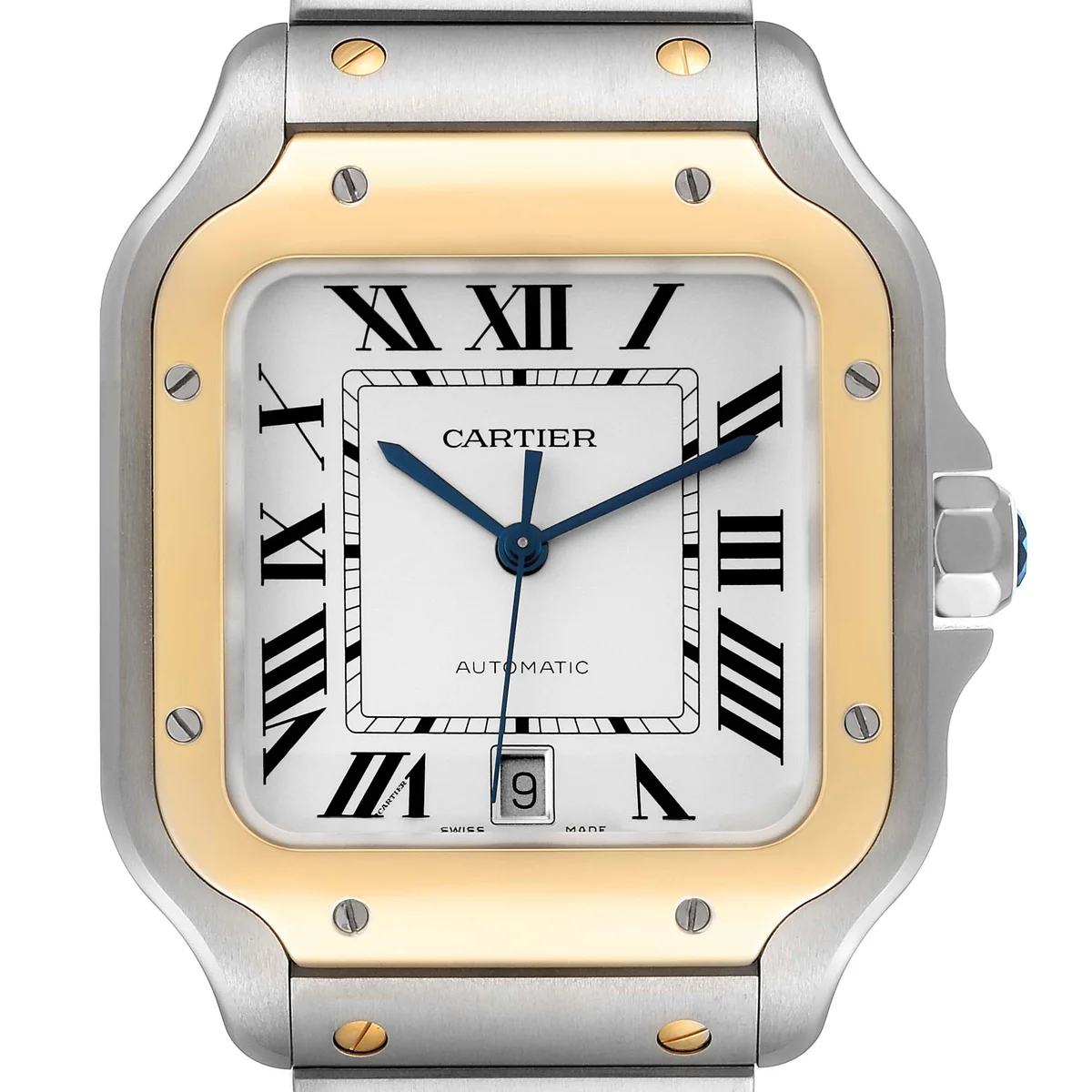
You have to understand what the world of watches looked like before 1904 to really appreciate the Santos. Up until that point, if you wanted to know the time, you reached into your pocket. Pocket watches were the standard. Wristwatches existed in small numbers, mostly as jewelry for women, but nobody had designed a purpose-built wristwatch for everyday practical use. Then Louis Cartier's good friend Alberto Santos-Dumont, a Brazilian aviator living in Paris, told him he had a real problem. He couldn't check his pocket watch while flying an airplane. Reaching into a waistcoat with gloved hands at altitude was impractical and genuinely dangerous. And when I say flying, I need to put this in perspective because people today hear "airplane" and think of a 747 cockpit with autopilot and flight instruments everywhere. That is not what we're talking about. Santos-Dumont's aircraft, the 14-bis, was built from pine and bamboo poles covered in Japanese silk. The frame used aluminum sockets. The pilot stood upright in a wicker basket attached to the fuselage. There was no cockpit, no windscreen, no seatbelt, no instruments. The ailerons were controlled by wires that ran to a piece of metal sewn into the back of his jacket, so he literally steered the airplane by shifting his body weight back and forth. He looked like he was dancing while flying. On November 12, 1906, he flew 220 meters in 21 seconds at an altitude of about 6 meters. That's roughly 10 feet off the ground in a silk-covered bamboo frame, controlling the thing with his shoulders. The closest thing I've experienced to open-air flight is skydiving, and let me tell you, the wind hitting your face at speed with goggles on is a completely different experience from sitting inside an aircraft. If you've never been in an open cockpit, find a flight museum that takes people up and try it. It'll cost you a bit but it's worth it just to understand how raw early aviation really was. This was flight before jets, before enclosed cockpits, before instruments. This is the context in which checking the time was a life-threatening distraction. Reaching into your pocket meant taking a hand off the controls of an aircraft that could kill you if you shifted your weight wrong.
Historical context
3 images· tap to view
So Louis Cartier, working alongside master watchmaker Edmond Jaeger, designed something completely new: a flat, square-cased watch that strapped directly to the wrist. The exposed screws on the bezel weren't decorative. They were structural, holding the bezel to the case. Santos-Dumont wore it exclusively for seven years before Cartier offered it to the public in 1911. That flight on November 12, 1906 was the first time a person was filmed in an airplane in flight, and he was wearing this watch. That is where the modern wristwatch begins. And it's a Cartier.
I want to talk about Cartier's watchmaking for a second, because I think the brand gets unfairly dismissed. People love to say "Cartier is a jewelry house, not a real watchmaker." That's a lazy take and it doesn't hold up when you look at what they actually do. Cartier operates a 33,000-square-meter manufacture in La Chaux-de-Fonds, a city I'd encourage anyone with an interest in horology to visit next time they're in Switzerland. It sits at 1,000 meters altitude in the Jura mountains, and the entire city is a UNESCO World Heritage Site because the urban layout was literally designed around the watchmaking industry. The streets are in a grid pattern to maximize natural light for the ateliers. The Musee International d'Horlogerie has over 4,000 pieces from sundials to atomic clocks, and you can tour the Zenith manufacture in nearby Le Locle. It's a beautiful city and there's something about walking through a place where the entire infrastructure was built to serve this one craft that puts watchmaking in a completely different perspective. Cartier's manufacture there employs over 120 specialized professions. They produce movements, cases, bracelets, hands, dials, and crystals in-house. Between 1998 and 2008, the CPCP (Collection Privee Cartier Paris) revived some of the most beautiful case shapes in watchmaking history. The Tank Cintree, the Tortue, the Tonneau, all with movements sourced from Piaget, Jaeger-LeCoultre, and Frederic Piguet. Under watchmaker Carole Forestier-Kasapi, they developed the Astrotourbillon and the Astroregulateur. These are serious, serious complications. And again, the first purpose-built wristwatch in history is a Cartier. The pedigree is right there.
What I also appreciate about Cartier is the range of iconic shapes they've created over the decades. The Tank from 1917, inspired by the aerial view of Renault tanks on the Western Front. The Crash from 1967, which legend says came from a Cartier Baignoire that was deformed in a car accident in London and brought to Jean-Jacques Cartier, who saw beauty in the distortion. Whether that story is true or just great myth, the melted, asymmetric case design became one of the most talked-about watches in history. Some people compare it to Salvador Dali's melting clocks, though Cartier says there's no direct connection. Then there's the Baignoire, the Tonneau, the Pasha, the Ballon Bleu. Each one with a completely distinct case shape and personality. Not many houses have that kind of design vocabulary. The Santos sits right at the top of that family tree as the original.
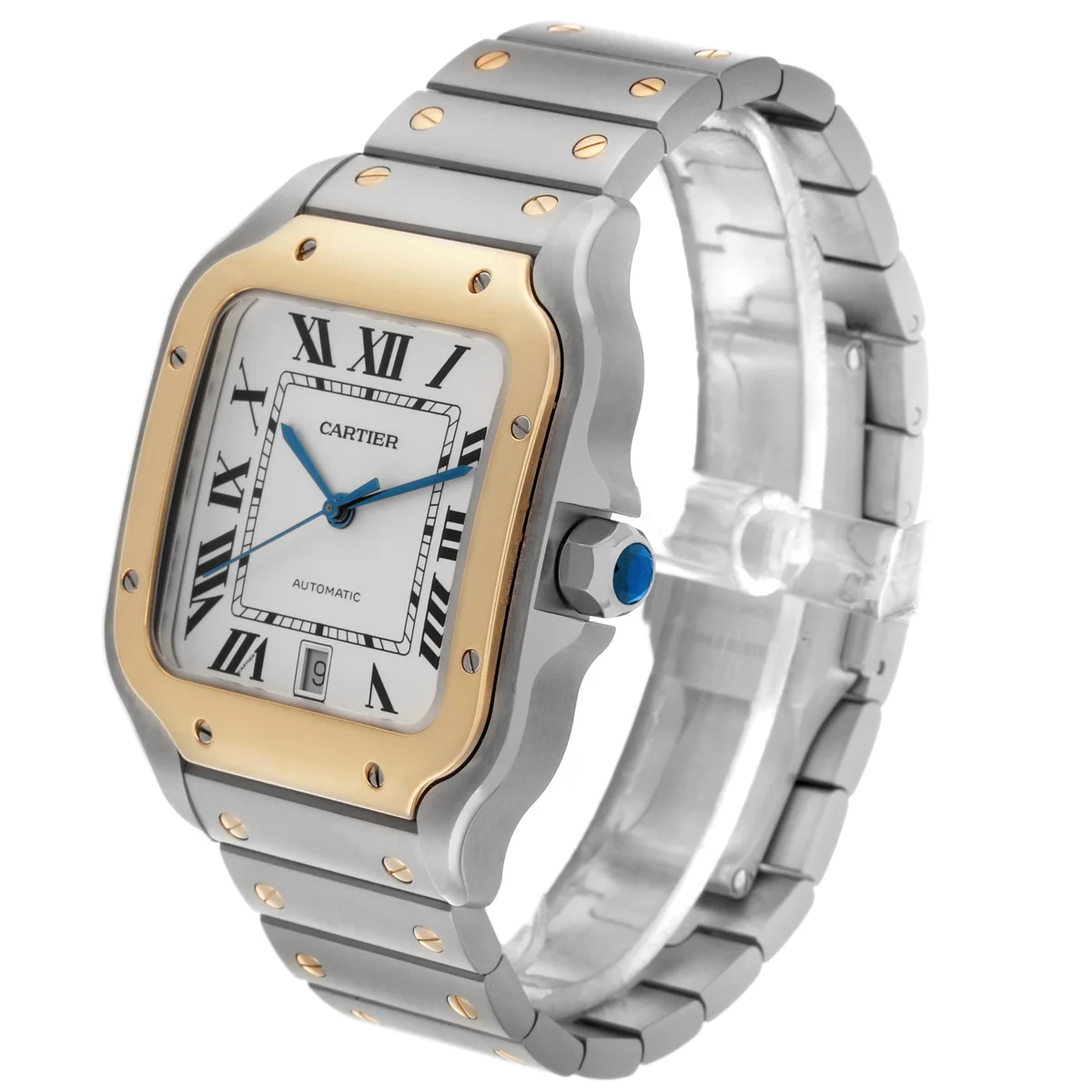
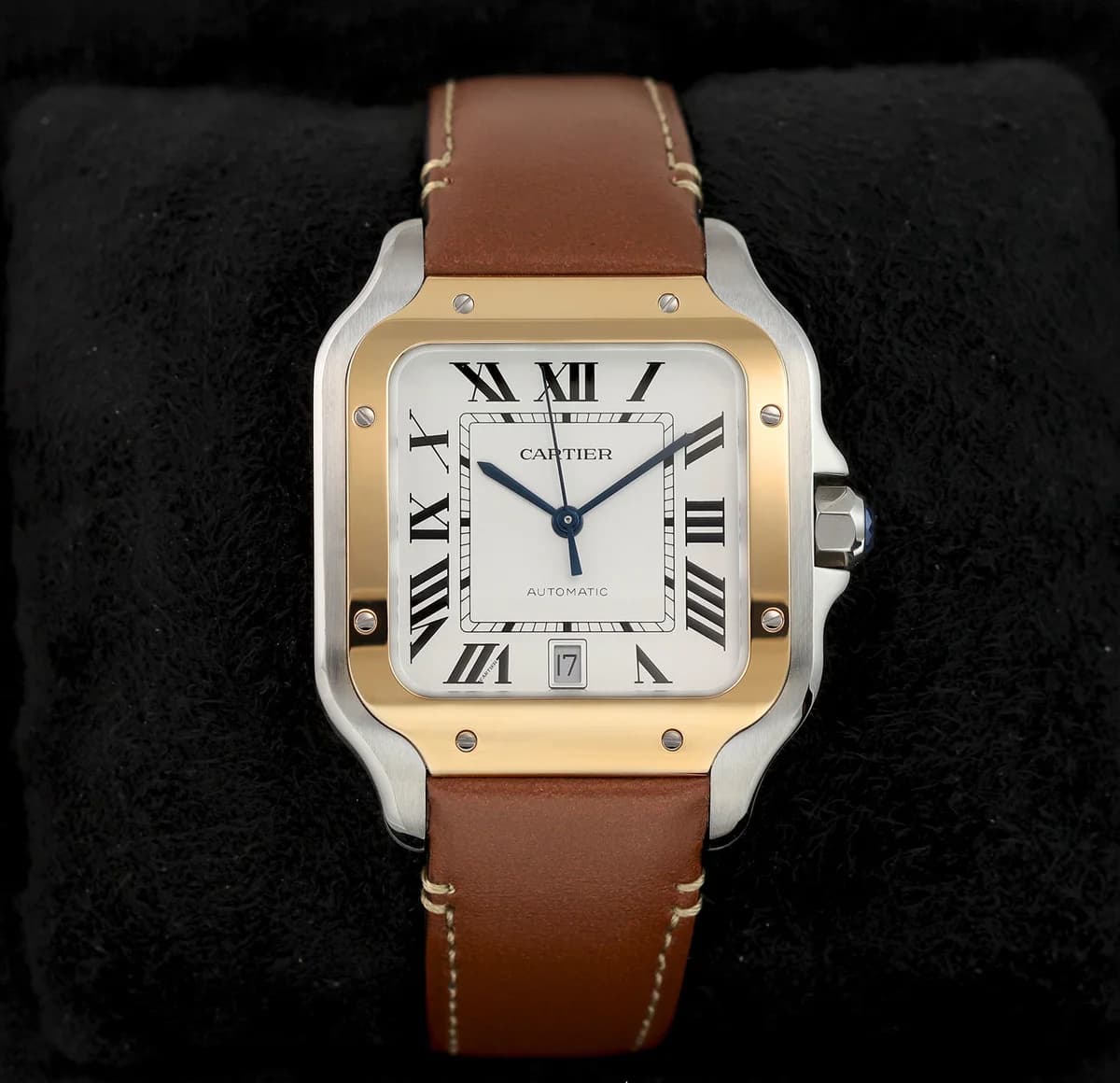
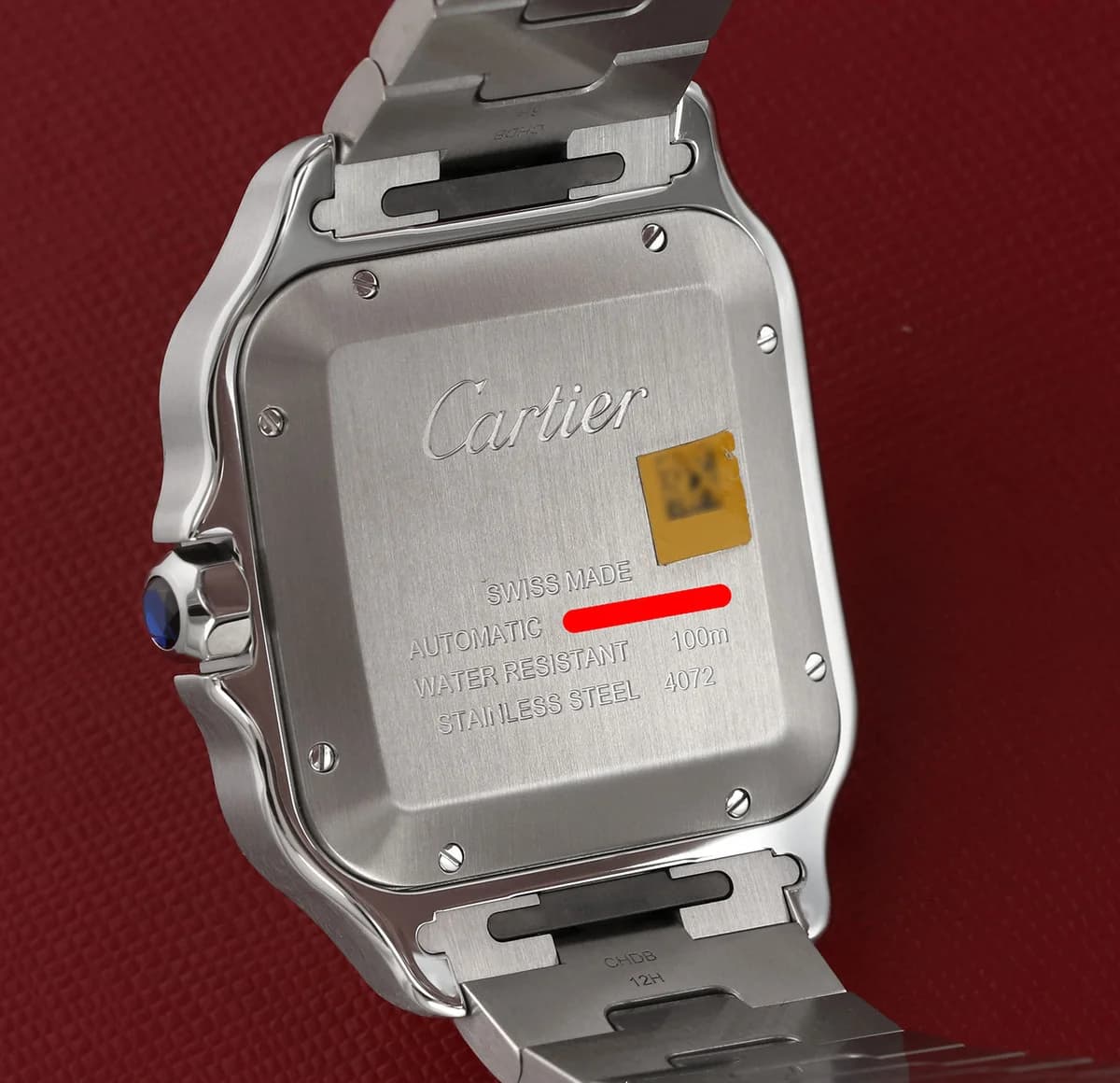
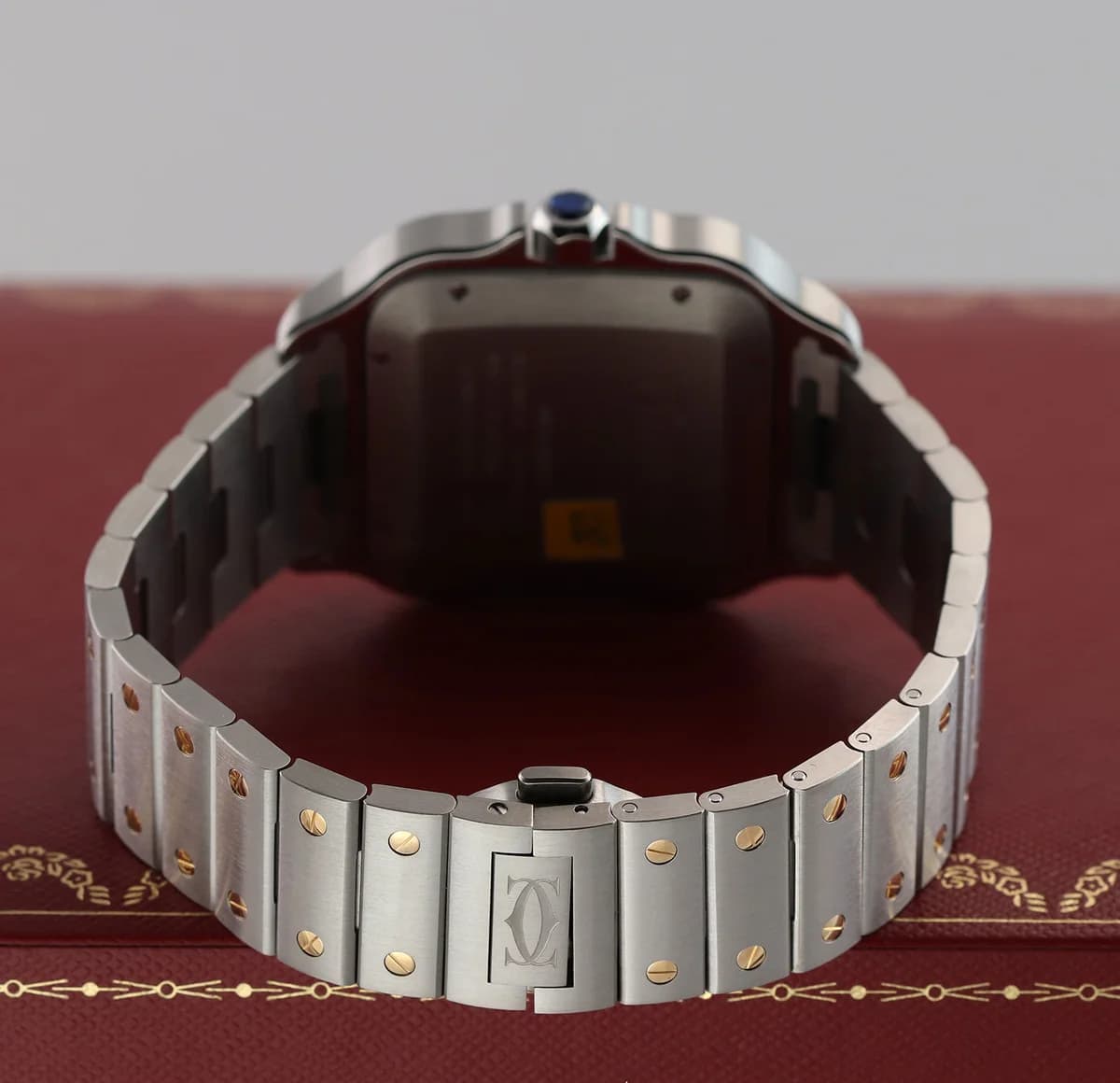
Now, the current two-tone Santos de Cartier Large, reference W2SA0009. This is the watch I keep coming back to, and I think the reason is that I genuinely can't find anything wrong with it. The case is stainless steel with a solid 18K yellow gold bezel. Not plated, not gold-tone. Solid 750/1000 fineness gold. The bezel screws are also gold. On the bracelet, the alternating center links are 18K yellow gold with steel outer links, and the way the two metals flow together is really beautifully done. At 39.8mm wide and only 9.38mm thick, it sits incredibly flat on the wrist. For perspective, an Audemars Piguet Royal Oak is 10.4mm. That thinness comes from the Caliber 1847 MC, Cartier's in-house automatic movement named after the year the house was founded. It stands just 3.765mm tall with 165 components, 23 jewels, beating at 28,800 vph, delivering about 40 hours of power reserve. For a sport watch rated to 100 meters of water resistance, sitting under 10mm on the wrist is really impressive.
The two-tone also just wears beautifully with everything, and I think this is something worth talking about because the watch is an extension of how you dress. On the bracelet with a charcoal wool suit, the gold catches light against the steel in a way that's present but never loud. Swap to the alligator strap with a navy linen for dinner and it transforms into something completely different, quieter and more refined. The yellow gold against darker skin tones in particular creates a contrast that really pops, and this is something that honestly doesn't get talked about enough in watch media. Warm metals like yellow gold and rose gold tend to look incredible on darker complexions because of how the tones complement each other. If you're someone who pays attention to fabrics and tailoring, the Santos is one of those watches that responds to what you put it next to. It's not a one-note piece. The bracelet is sporty, the leather is elegant, and it works with everything from Canali to rolled-up sleeves on a weekend. That kind of versatility in a single watch is hard to find. And this is where the QuickSwitch system becomes more than just a technical feature. If you change your outfit three times in a day for different events, you don't need to carry a watch roll with three different watches. You need one Santos and a couple of straps in your bag. Bracelet for the morning meeting, leather for the dinner, rubber if you're out on the weekend. Five seconds to swap each time. I know some guys love the watch roll life, and that's their thing, nothing wrong with it. But there's something to be said for a single watch that can genuinely adapt to whatever you're wearing without looking out of place. A lot of watches claim versatility. The Santos actually delivers it because the strap change system makes it effortless instead of theoretical.
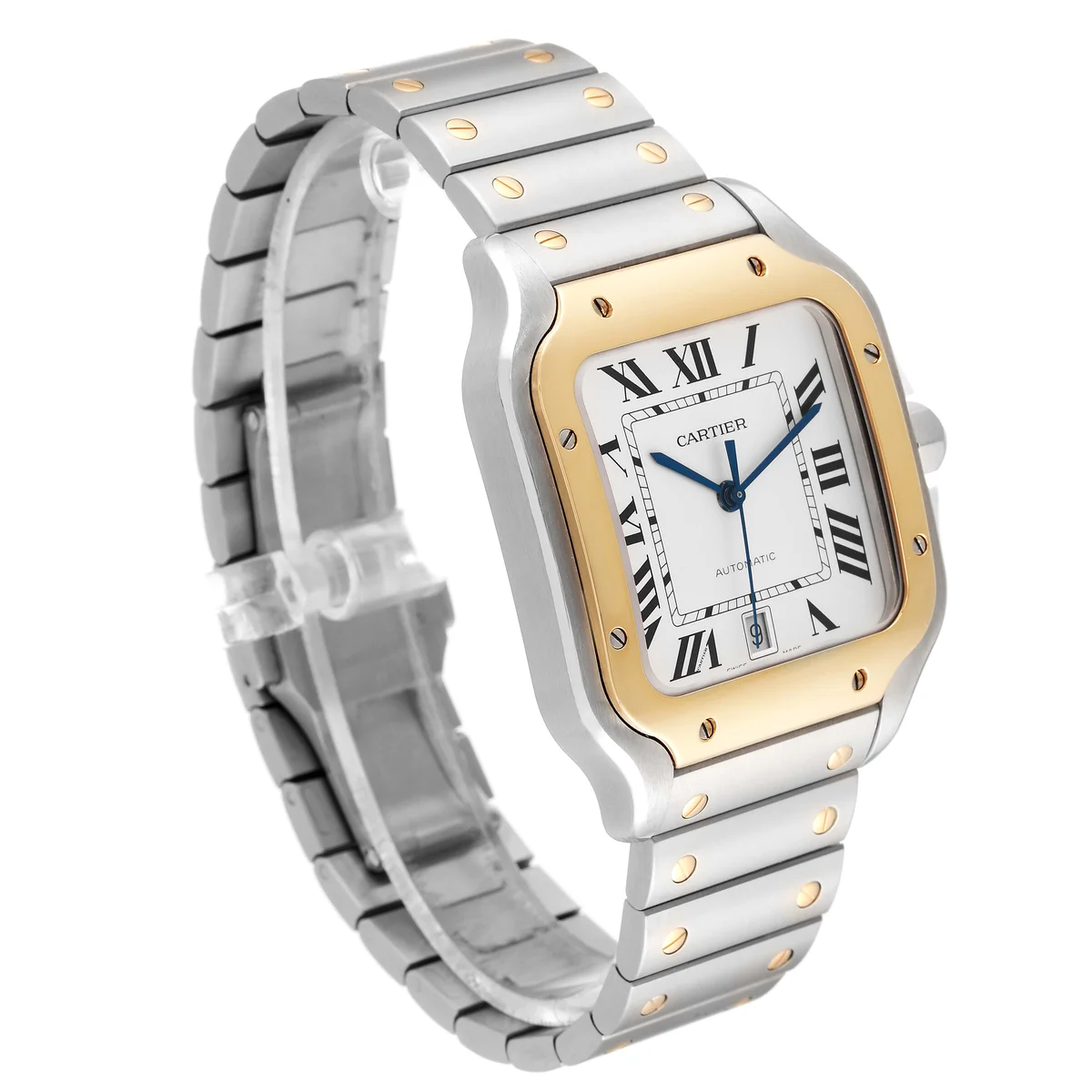
What really gets me excited about this watch is the bracelet engineering, and I say that as someone who has spent a lot of time at a watchmaker's desk dealing with the old way of doing things. Over the past 25 years I've gone through so many spring bar tools. Started with cheap ones, upgraded to better ones, and eventually landed on Bergeon tools like real watchmakers use. The 6767-F with that fine forked tip. I've had spring bars fly across the room, I've scratched lugs, I've dealt with all of it. So when Cartier introduced QuickSwitch and SmartLink with the 2018 Santos redesign, I really appreciated what they were doing from a hands-on perspective.
QuickSwitch is elegant in its simplicity. There's a small rectangular button integrated into the underside of the case near each lug. Press it, the attachment bar disengages, the bracelet slides free. Align a new strap, press it in until it clicks, done. Seconds. No spring bar tool, no Bergeon, no risk of scratching anything. Every Santos ships with both the metal bracelet and an alligator leather strap with a deployant clasp, both fitted with QuickSwitch adapters. You can also get a rubber strap. I swap straps fairly often, and the fact that I can go from the two-tone bracelet to leather for a dinner in literally five seconds without pulling out any tools is genuinely satisfying.
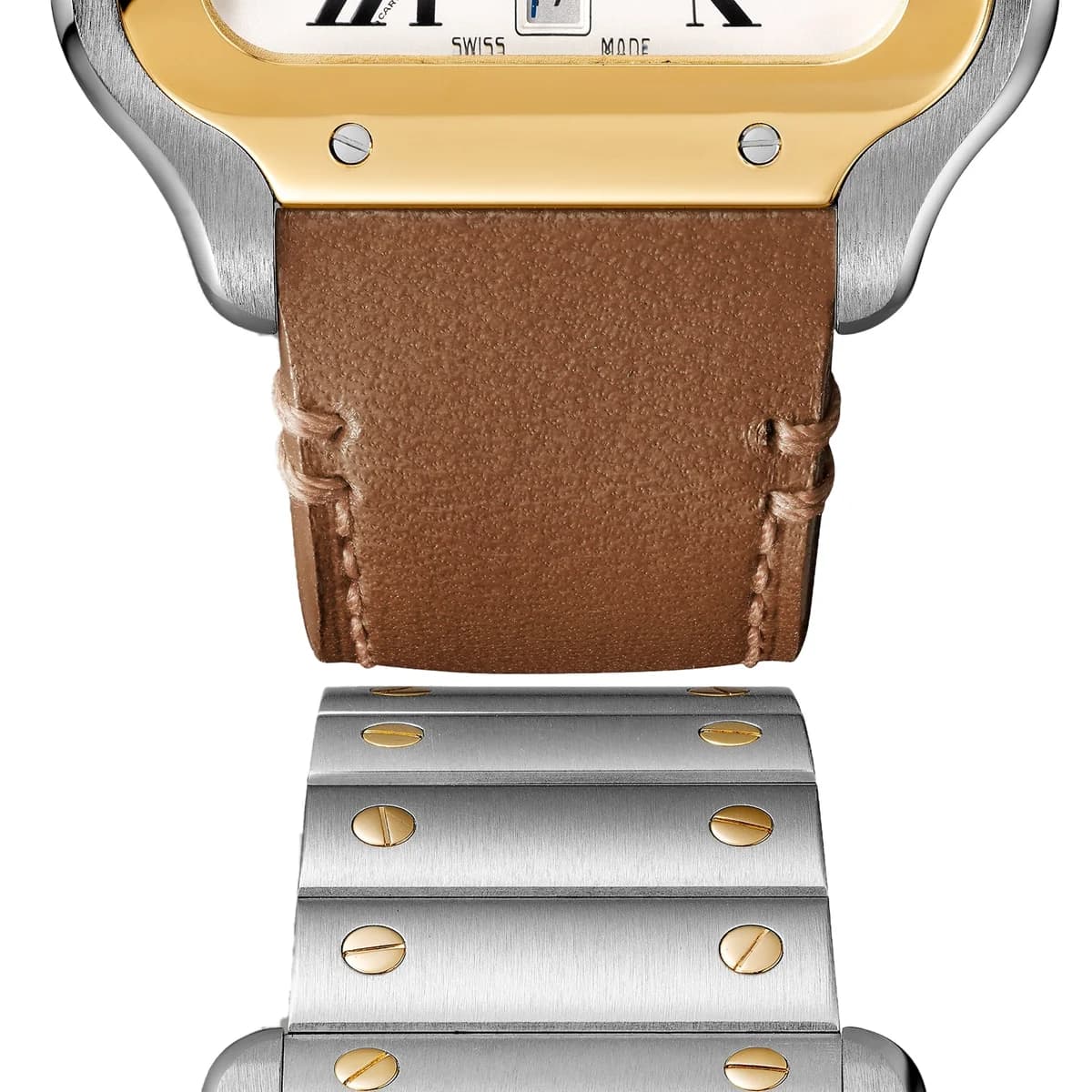
I used to travel with watch screwdrivers in my bag. Specifically the Bergeon 6899, the violet 1.6mm, because something always seemed to come loose on vacation or I'd want to swap a strap out while I was traveling. It was just part of how I packed. Screwdrivers, spare spring bars, a little pouch of tools. With the Santos, none of that is necessary anymore. No tools in the luggage, no worrying about a spring bar popping on a trip. Just press, slide, click. That might sound like a small thing, but if you've spent years carrying watchmaker's tools around with you, it's a genuine quality of life improvement.
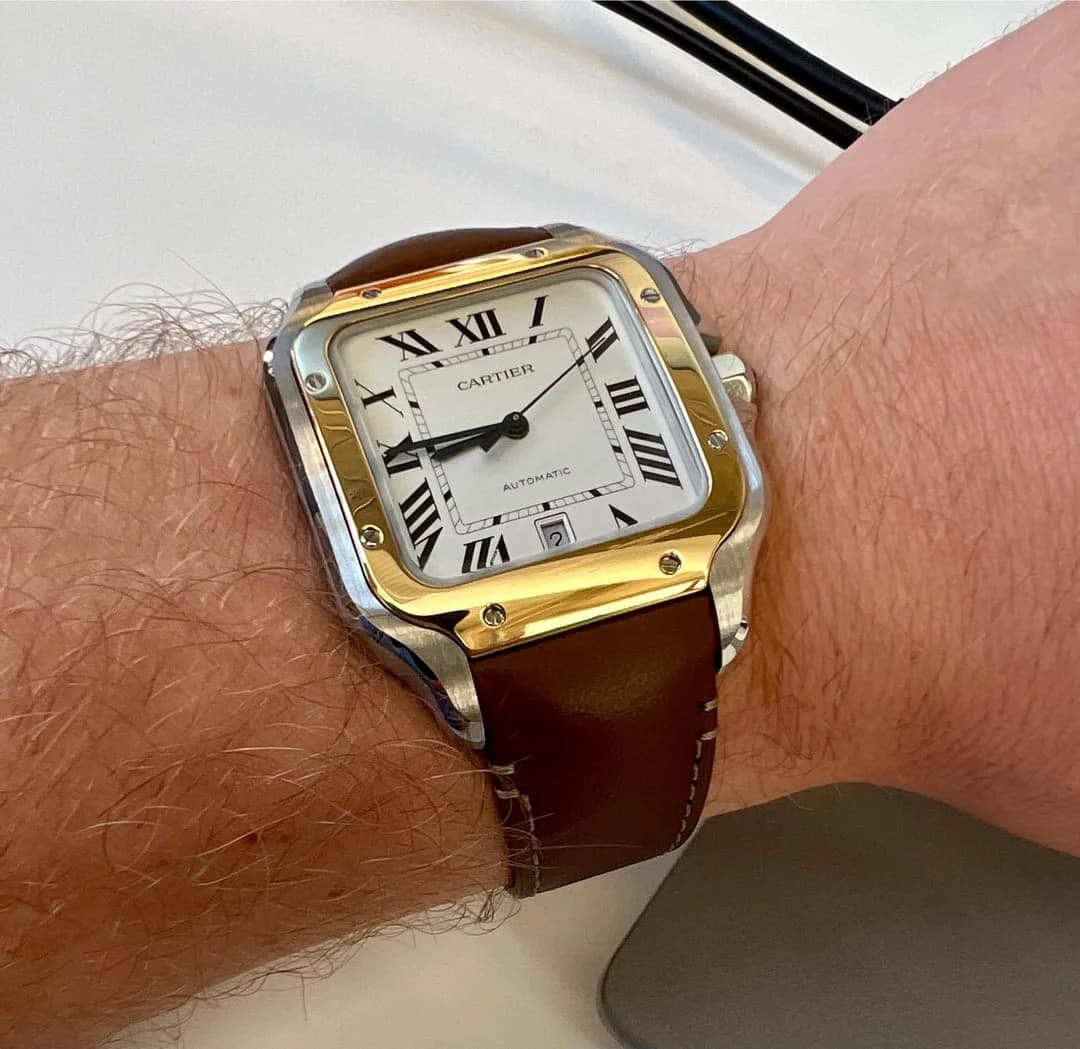
But I don't want to make it sound like the convenience is the point, because it's not. What actually impresses me is how Cartier's product design team pulled this off. They took the aesthetic of a watch that dates back to 1904, one of the most recognizable case shapes in history, and built all of this modern engineering into it without it ever looking or feeling modern. The QuickSwitch mechanism is invisible. The SmartLink system is invisible. Nothing about the Santos looks like it has quick-release anything. It still looks and feels like the classic it's always been. They preserved the essence of the original design and integrated these contemporary conveniences in such a fluid, natural way that you wouldn't even know they were there unless someone showed you. That's what remarkable product design looks like. It's not about removing the need for a screwdriver. It's about the fact that they managed to do it without compromising a single thing about what makes the Santos a Santos. You only really appreciate that if you've lived in the older world where changing a strap meant tools and patience, and you can see how seamlessly they bridged it to the new world while keeping everything that matters intact.
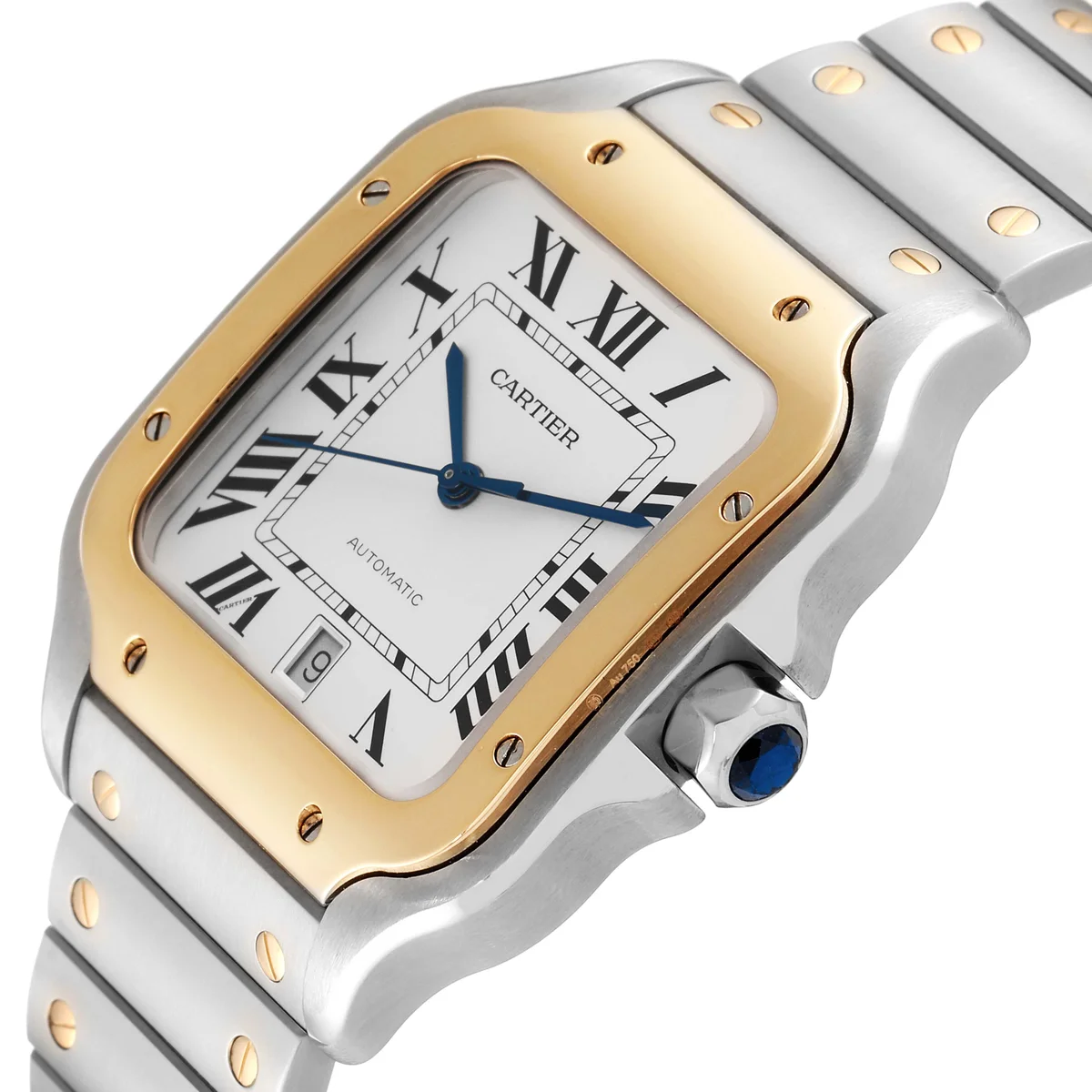
It's worth mentioning that Panerai, which is also a Richemont brand like Cartier, used to have you dealing with screw-down bars on their classic Luminor cases. The old system involved a small screwdriver, careful alignment, and patience. They eventually moved to a quick-release system on the newer 1950-style cases, but for years, changing a Panerai strap was a whole process. The Santos QuickSwitch makes all of that feel archaic. Cartier wasn't the first brand to do quick-release, but they implemented it with a level of grace and seamlessness that I think sets the standard.
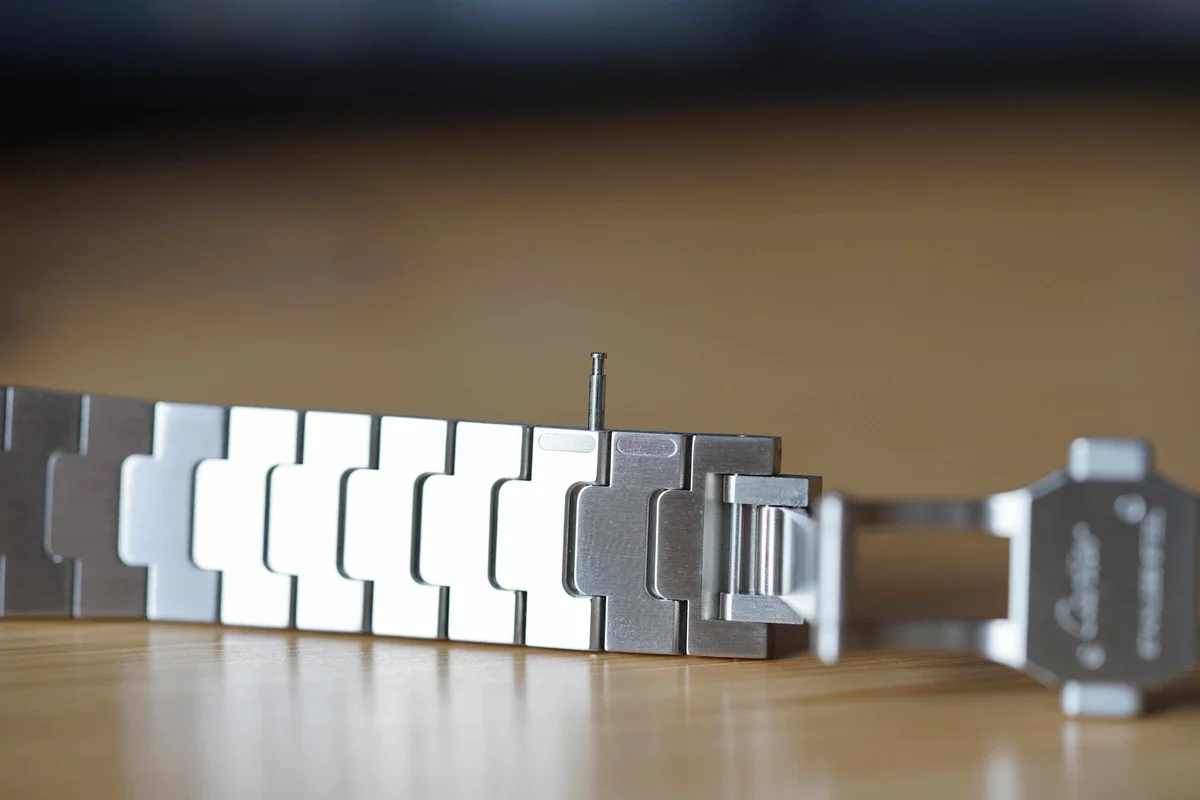
The second system is SmartLink, and this is honestly the one that impresses me the most. Each removable bracelet link has a small oval-shaped push-button on its underside. Press it and an internal retaining bar releases through spring energy. The link pops right out. The retaining bar is captive, meaning it can't separate from the link, so you can't lose parts. To put it back, press the link into position until it clicks. You can size this bracelet at home, traveling, wherever. No pin pusher, no trip to the jeweler. And here's the thing that really gets me. You would never know by looking at it. The integration is completely seamless. That kind of engineering hidden inside something this beautiful is exactly the kind of thing I love about watches. It's not just that they solved the problem. It's that they solved it invisibly.
The dial has a quality I'd describe as typographic. The elongated Roman numerals radiating outward from the center, the chemin de fer minute track (that's the double railroad-line pattern that's been a Cartier signature since the early 1900s), and the silvered opaline finish with its subtle circular graining. It has this newspaper-like quality and I mean that as a real compliment. The hands are blued steel, and they're not painted blue. They're heat-treated through thermal oxidation to achieve that deep metallic blue that shifts and changes depending on the angle of light. On the seven-sided crown sits a faceted synthetic blue spinel, and that little flash of blue against the gold and steel catches your eye every time. It's one of those details you never stop noticing.
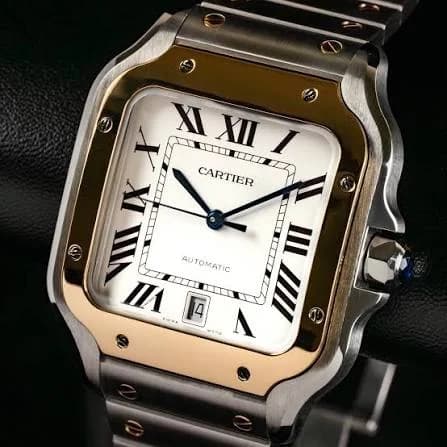
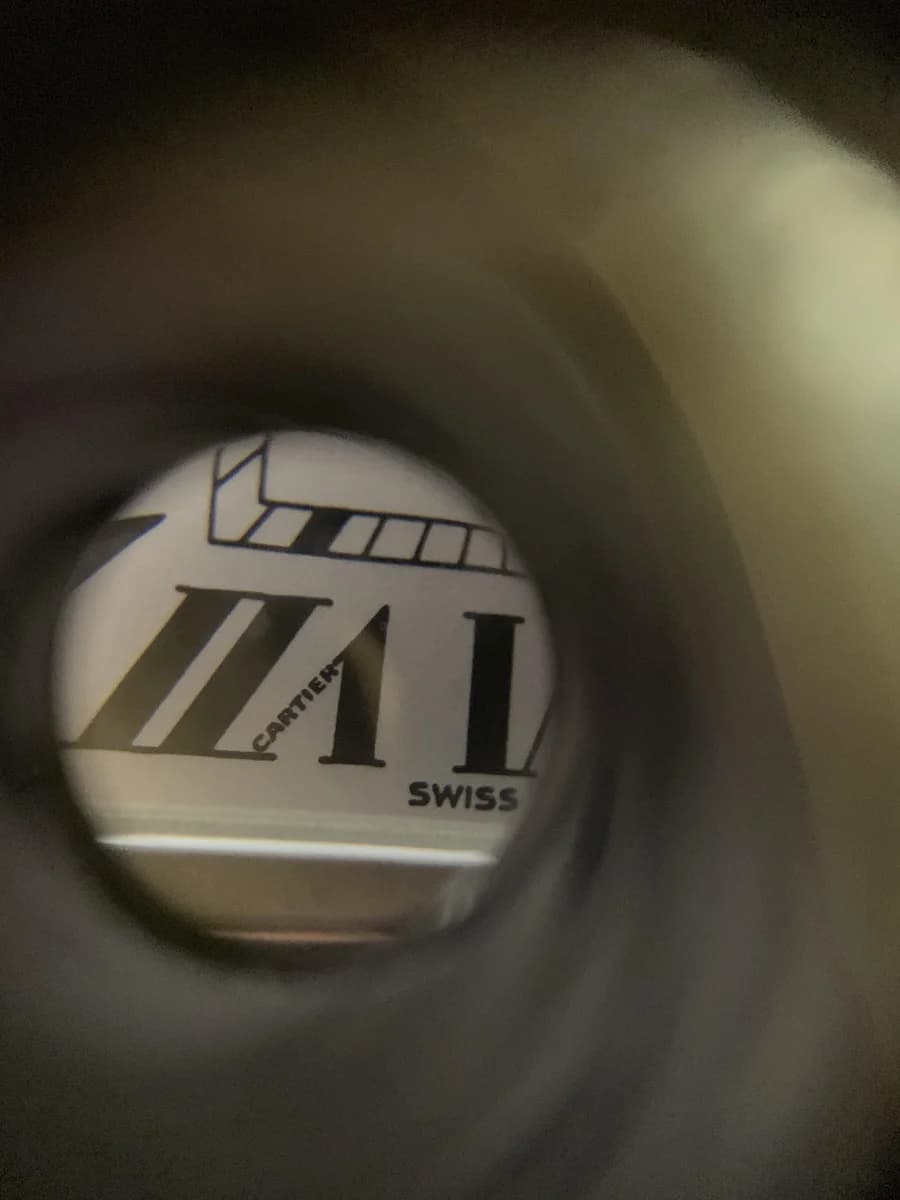
There's also a hidden detail that most people never discover. Look closely at the Roman numeral VII at 7 o'clock and you'll find the word CARTIER engraved in microscopic lettering. It's a secret signature, an anti-counterfeiting practice that Cartier has been doing since the 1990s across most of their major collections. Hiding in plain sight. I love discovering things like that.
It's worth stepping back and looking at how the Santos has evolved over the past 120 years, because the journey itself is part of what makes the current watch so impressive. The original 1904 piece was a private commission, manual wind, leather strap only. Cartier didn't sell it commercially until 1911. By the mid-20th century, World War II had shifted demand toward round military watches and the Santos faded into the background. Then in 1978, under CEO Alain-Dominique Perrin, Cartier relaunched the Santos de Cartier with two major firsts: an automatic movement and a metal bracelet. That two-tone steel and gold bracelet look that's so iconic today started right there. In 1987, the Santos Galbee softened the angular case into a curvier, more ergonomic shape (galbee is French for curvy) and became hugely popular. The Santos 100 arrived in 2004 for the centennial, a larger and more radical version. And then in January 2018 at SIHH, Cartier unveiled the modern Santos de Cartier that we have today.
The 2018 redesign was overseen during Cyrille Vigneron's tenure as CEO of Cartier International. His philosophy captured it perfectly: "Everything we do starts with the design and then the technology has to support that design." He also said something I think about often: "Beauty is the key to being timeless yet timely." The creative direction of Cartier's watches during this period was led by Marie-Laure Cerede, who returned to the house in 2016 as Creative Director of Watchmaking. Her approach to redesigning icons was, in her words, "not remaking icons simply like they were before, but also improving them." Every design at Cartier starts with hand sketches, never computers, because as she put it, "that's where emotion is born." Pierre Rainero, Cartier's Director of Image, Style, and Heritage for over four decades, has described Cartier's design DNA as rooted in "essential shapes, the pure geometry of squares, rectangles, and ovals" that gave birth to the Santos, the Tank, and the Baignoire. He calls Cartier "the watchmaker of shapes," and when you look across the catalogue, that description is hard to argue with. On the movement side, Carole Forestier-Kasapi served as Director of Movement Creation from 2005 to around 2020, masterminding approximately 20 original calibers including the concept watches ID One and ID Two. She won the Best Watchmaker Prize at the Grand Prix d'Horlogerie de Geneve in 2012. The Caliber 1847 MC that powers the current Santos was introduced during her tenure in 2015. Cartier didn't publicly credit the individual engineers behind QuickSwitch and SmartLink, which is how the house operates. I genuinely wish I knew who they were, because they deserve recognition for how beautifully they implemented this. It's one of those situations where the behind-the-scenes people made something truly great and the public may never know their names. I hope they get their spotlight someday. They earned it.
It's worth noting that Cartier wasn't the first to do quick-release. IWC, another Richemont brand, pioneered button-release bracelet links back in the 1990s with their pilot watch bracelets. Vacheron Constantin's Overseas has had an interchangeable strap system as well. Panerai eventually moved to quick-release on their newer 1950-style cases after years of screw-down bars. So the concept wasn't new within the Richemont family or the industry. But what Cartier did with the Santos was implement it with a level of refinement and invisibility that I think sets the standard. The QuickSwitch mechanism is completely hidden. The SmartLink system is undetectable. Other brands solved the same problem, but Cartier solved it in a way where the solution itself disappears into the design. That's the difference.
The Santos family is also much deeper than most people realize. Full steel, two-tone in yellow or rose gold, full precious metal, skeleton with the 9629 MC caliber, green and blue dials, a titanium version with a black Super-LumiNova dial, and an entire Santos-Dumont line of thinner manual-wind dress watches. There's even a platinum Rewind limited edition with reversed numerals and reversed hand direction. You could genuinely build an entire collection within just the Santos family, the same way you could build one around the Tank or the Pasha.
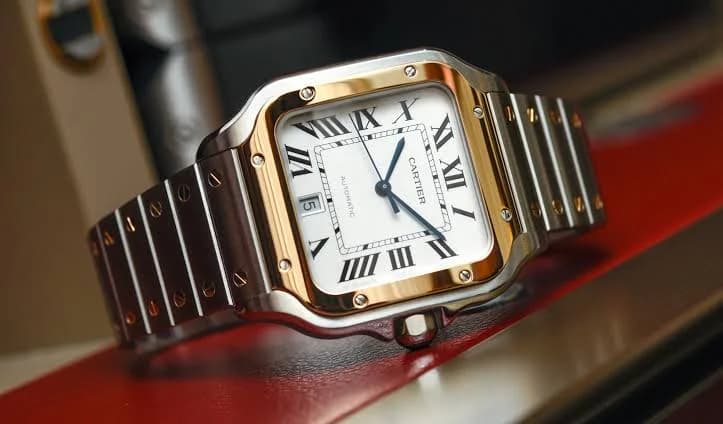
If I had to find one thing, and I really have to reach here, it would be the lack of lume. This particular reference doesn't have any luminous material on the dial or hands. There are variations in the Santos family that do, but this one doesn't. Part of me thinks it would've been nice to have some kind of luminous coating on those small black rectangular indices, or even just a subtle treatment on the hands, just enough to help with readability in low light. But then I think about what that would actually look like on the dial, and I'm not sure it wouldn't take away from that clean typographic quality during the day. It might even distract from it. The white dial with black numerals and blued hands already gives you decent contrast in low light, and honestly, who's reading their watch in complete darkness these days. So it's not really a complaint. It's more of a "hey, it would've been nice, maybe" kind of thought. And the fact that this is genuinely one of only two things I can think of says a lot about the watch.
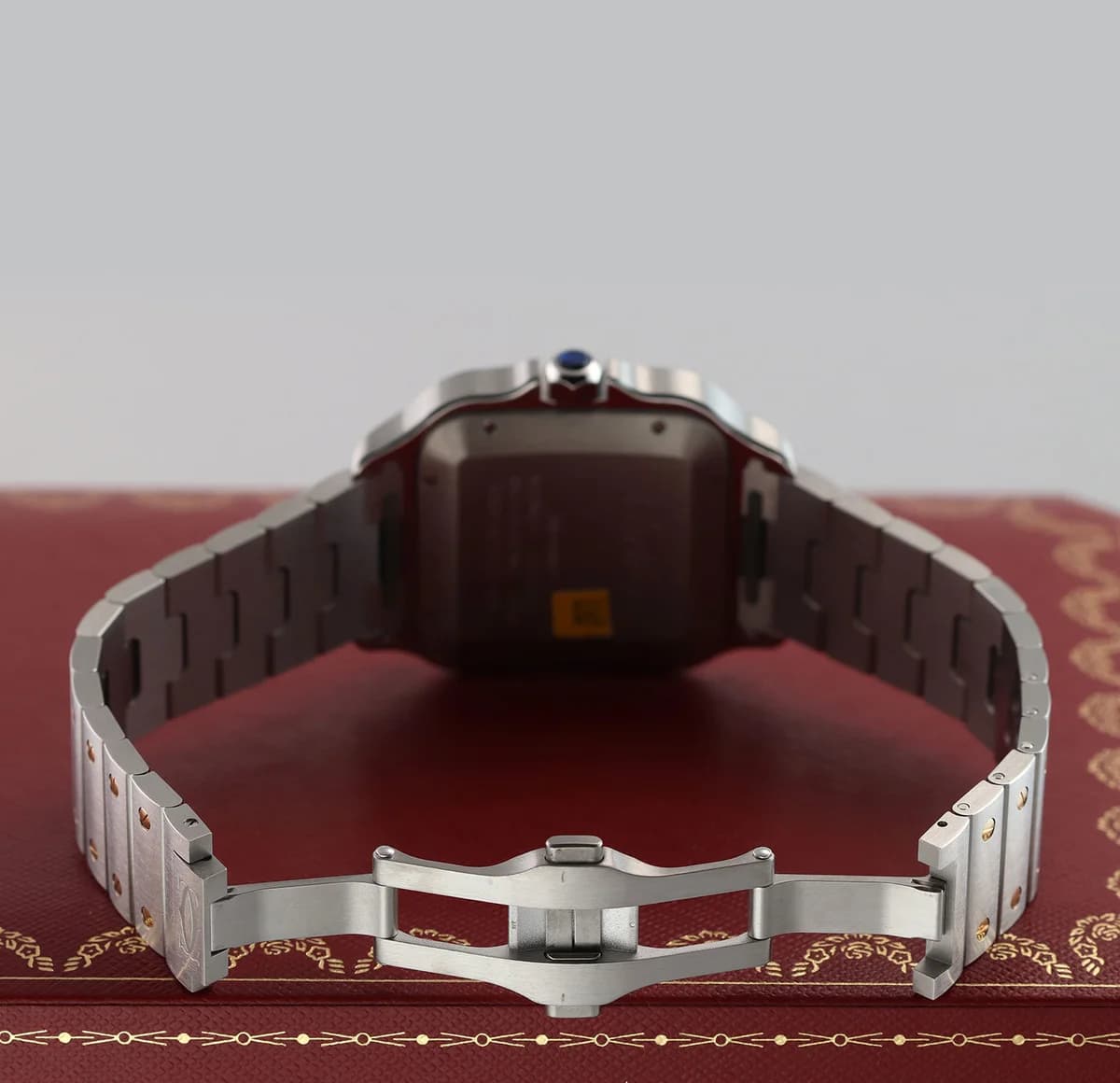
The other thing, and this one is more practical, is the gold. 18K yellow gold sits at about 2.75 on the Mohs hardness scale. Stainless steel is 5.5 to 6.5. That's a significant difference. The gold bezel on the Santos is raised above the steel case, and because of that elevation it's the first thing that makes contact with anything. Door frames, desk edges, seatbelt buckles, whatever. It's going to pick up micro-scratches. It's going to happen even if you baby it, even if you barely breathe on it. After a year of regular wear, you'll see them in certain light. It's also a fingerprint magnet. That's just the nature of precious metals at this karat. 18K rose gold, which Cartier also offers the Santos in, has the same Mohs rating but the copper content can make it marginally more forgiving in practice. And of course there are full steel versions if this bothers you.
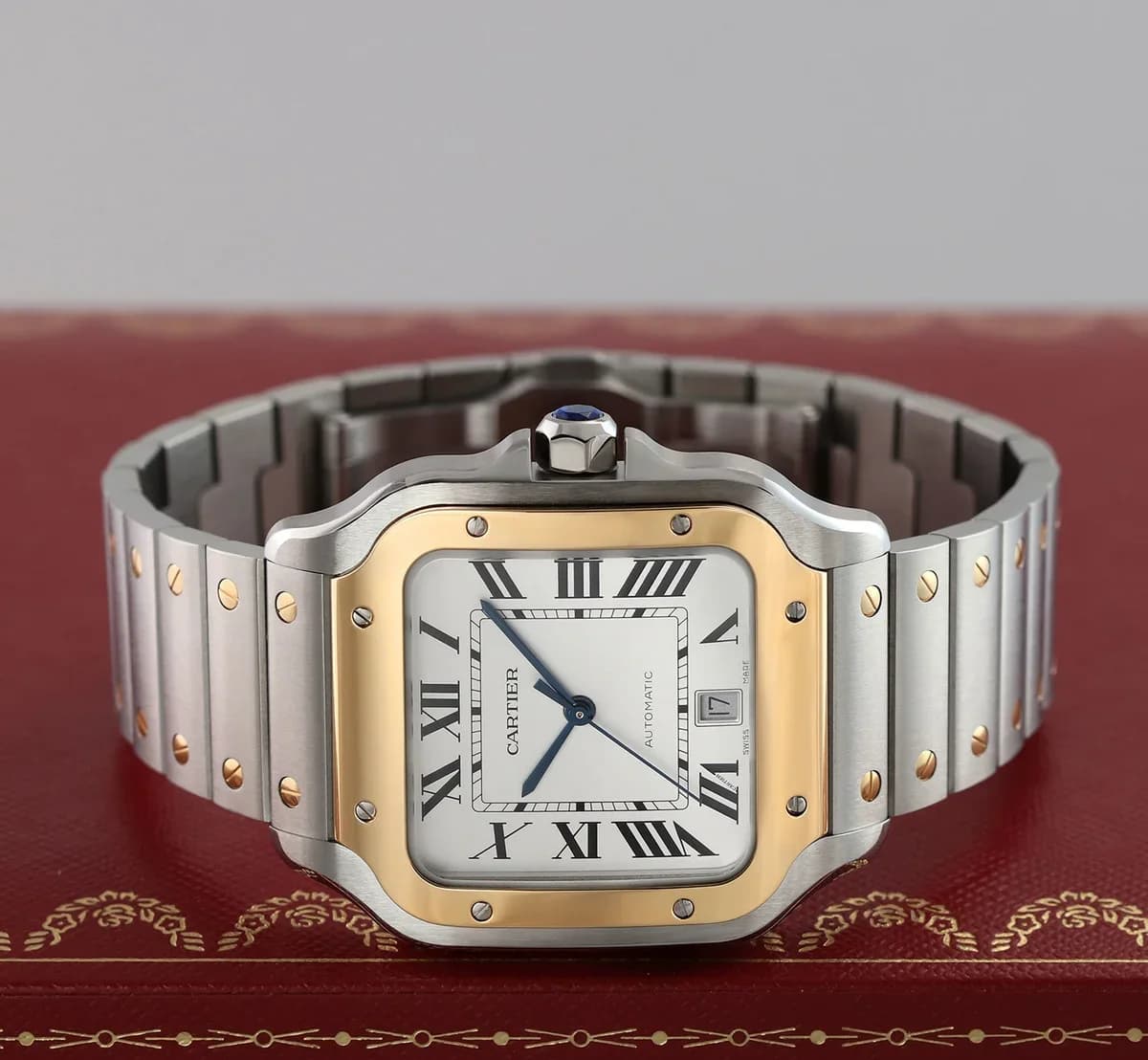
I don't consider it a real negative. It's just something to know going in. What you see on display in the boutique under perfect lighting is not what the watch will look like after real-world wear. But honestly, I think the patina adds character. The micro-scratches tell a story. If you're someone with a very detailed eye, and most people into watchmaking are, you'll notice them and it might bother you at first. My advice is to just let it go. It doesn't distract from the watch at all. It's just part of living with gold. If that's a dealbreaker for you, there are plenty of other Santos configurations in different materials. But if you can make peace with it, the warmth of the yellow gold against the steel is worth it.
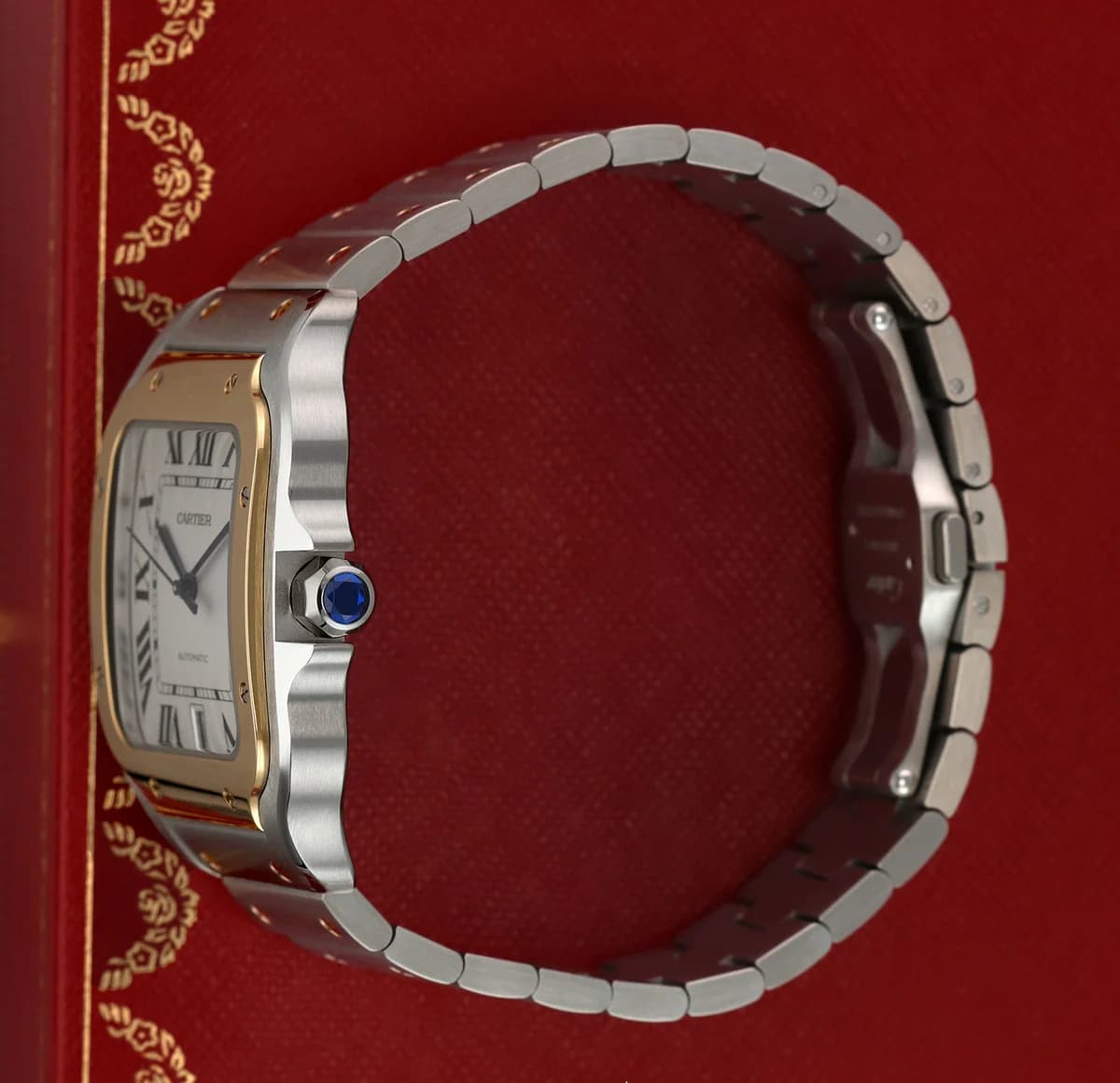
But this particular configuration, the large two-tone with its gold bezel, blued hands, and that blue spinel on the seven-sided crown, is the one I keep coming back to. It dresses up beautifully on the alligator strap, dresses down on the bracelet, and the engineering behind the whole system is something I find myself wanting to show people every time I talk about it. After spending real time with this watch, I can't think of a single thing I'd change. And here's what really stays with me. They took something timeless and made it even more timeless by building modern features into it so seamlessly that you'd never know they were there. Someone will hold this exact watch 20 years from now and say the same things I'm saying right now. That's the true mark of great engineering and great product design. That doesn't happen by accident.
Also in Design Icons