
Audemars Piguet
Royal Oak 15300OR
15300OR.OO.D002CR.01

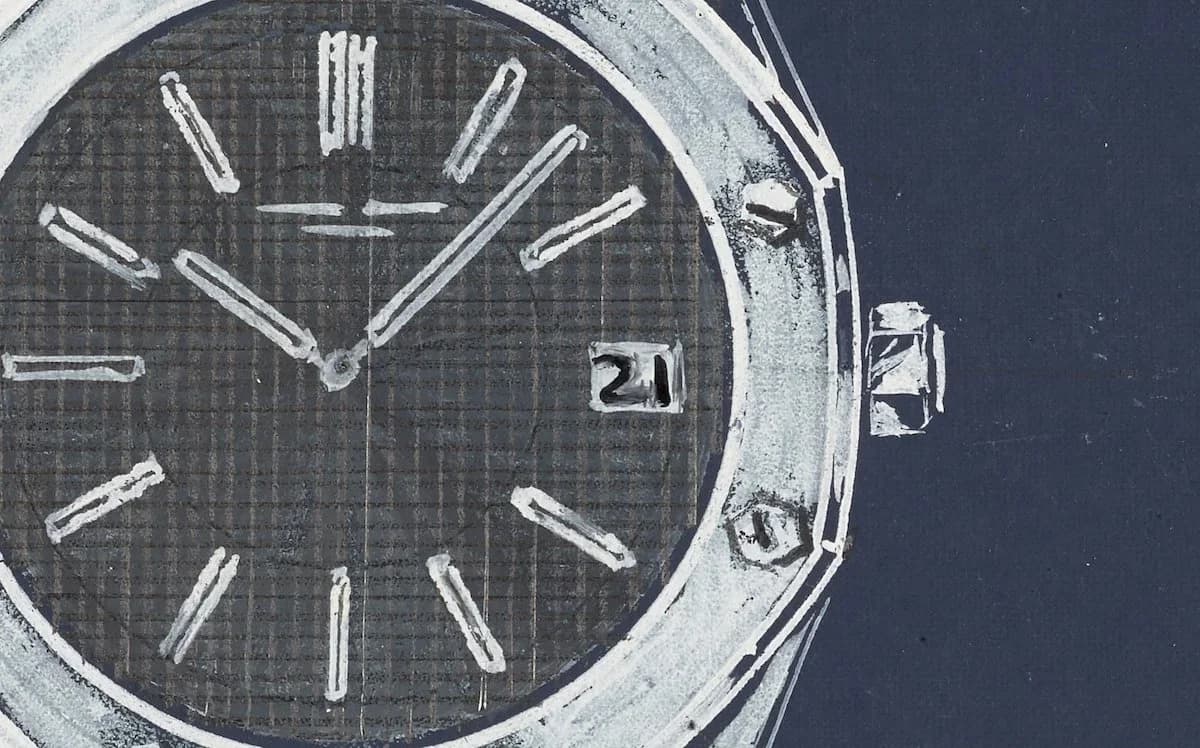
Gerald Genta designed the Royal Oak in a single overnight session on April 10-11, 1970. Georges Golay from Audemars Piguet called him the evening before the Basel fair with less than 24 hours notice and said he needed something new. Genta sketched the octagonal bezel, the integrated bracelet, the exposed screws, and the tapisserie dial in one sitting. He drew inspiration from a Royal Navy diver's helmet he remembered seeing as a child on Geneva's Pont de la Machine. The octagonal ring of bolts securing a rubber gasket against water. That industrial aesthetic, translated into a luxury wristwatch, became one of the most recognizable designs in the history of horology. I find it remarkable that the most consequential sketch in modern watchmaking was produced under duress, with no time to overthink it. The original reference 5402 launched in 1972, more expensive than a gold Rolex Submariner. The market was scandalized. A steel sports watch costing more than a gold Rolex Submariner broke every convention the industry had. The first batch of 1,000 pieces sat unsold for months. Retailers did not know what to do with it. A steel watch with no complications, no precious metal, priced like a gold dress watch from Patek or Vacheron. It made no sense. And then it made all the sense in the world. The Royal Oak did not compete with existing watches. It created a category that did not exist. The luxury steel sports watch. Everything that came after, the Nautilus, the Overseas, the Aquanaut, exists because of what Genta drew on a napkin that night.
The 15300OR is the rose gold version of the reference that brought the Royal Oak back to its original 39mm diameter with a modern in-house movement. The 15300 was introduced at SIHH in 2005 and produced until roughly 2012. It replaced the 36mm reference 14800 and was itself replaced by the 41mm 15400. The OR designation means or, French for gold, specifically 18K rose gold. The OO in the reference means no integrated bracelet. The D002CR means black dial on crocodile strap. A second rose gold variant exists: the 15300OR. OO. D088CR.02 with a silver Grande Tapisserie dial on brown alligator. Same case, same movement, different personality. The black dial is the more dramatic of the two. The silver is quieter, more traditional, and shows the pyramid texture of the tapisserie more clearly because the light and shadow contrast is higher on a lighter surface. Every AP reference number tells you exactly what you are looking at if you know how to read it. The rose gold AP uses is their proprietary alloy. 18K by definition is 75% gold. The remaining 25% is copper and silver in proportions that give it that specific pink warmth. Different maisons use different alloy recipes. Rolex's Everose includes platinum to resist fading. AP's rose gold has a warmer, more traditional tone that develops character over time. The 18K gold case is softer than steel at roughly 2.75 on the Mohs hardness scale versus 5.5 for stainless. It will pick up micro-scratches. Some people see that as damage. I see it as the watch recording its own history.

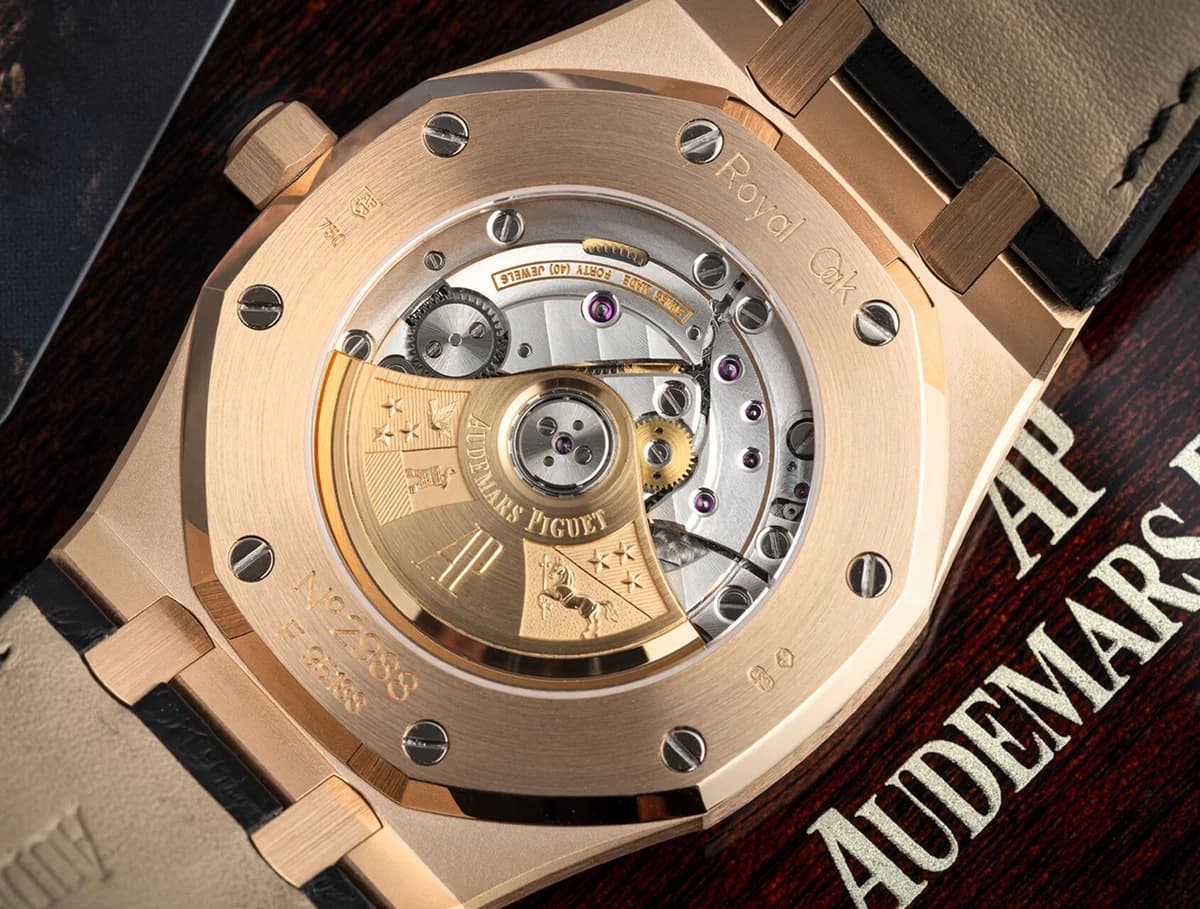
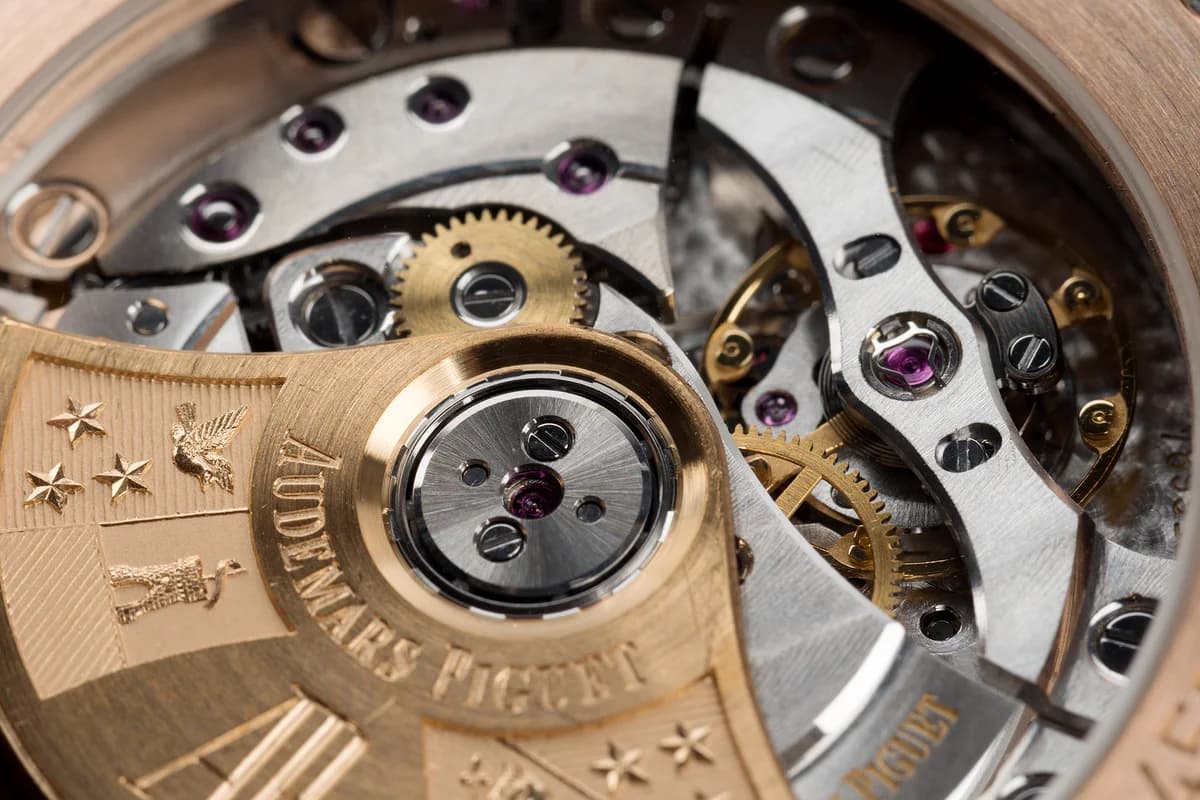
Inside is the Caliber 3120, one of AP's finest movements. Fully in-house, 40 jewels, 280 components, 21,600 vibrations per hour at 3 Hz, with 60 hours of power reserve. The rotor is a single block of 22K gold on ceramic ball bearings. The balance is a free-sprung Glucydur with Gyromax variable inertia, the same regulating system Patek Philippe uses in its advanced movements. At 4.26mm thick, the 3120 keeps the case at 9.4mm, which is remarkable for a movement with running seconds and quickset date. The bridges are beveled with diamond-graved finishing and inverted snailing. Through the exhibition caseback, the decoration is worth the visit. I have spent more time than I care to admit just staring at the rotor through the sapphire crystal, watching the 22K gold mass swing as my wrist moves. The finishing on the bridges is not Geneva Seal level, but it is genuinely beautiful work. The Cotes de Geneve on the rotor and the circular graining on the mainplate have a depth that catches light from every angle. What I appreciate most about the 3120 is that it was built to be a workhorse, not a showpiece, and AP decorated it to a standard that most brands reserve for their flagship complications.
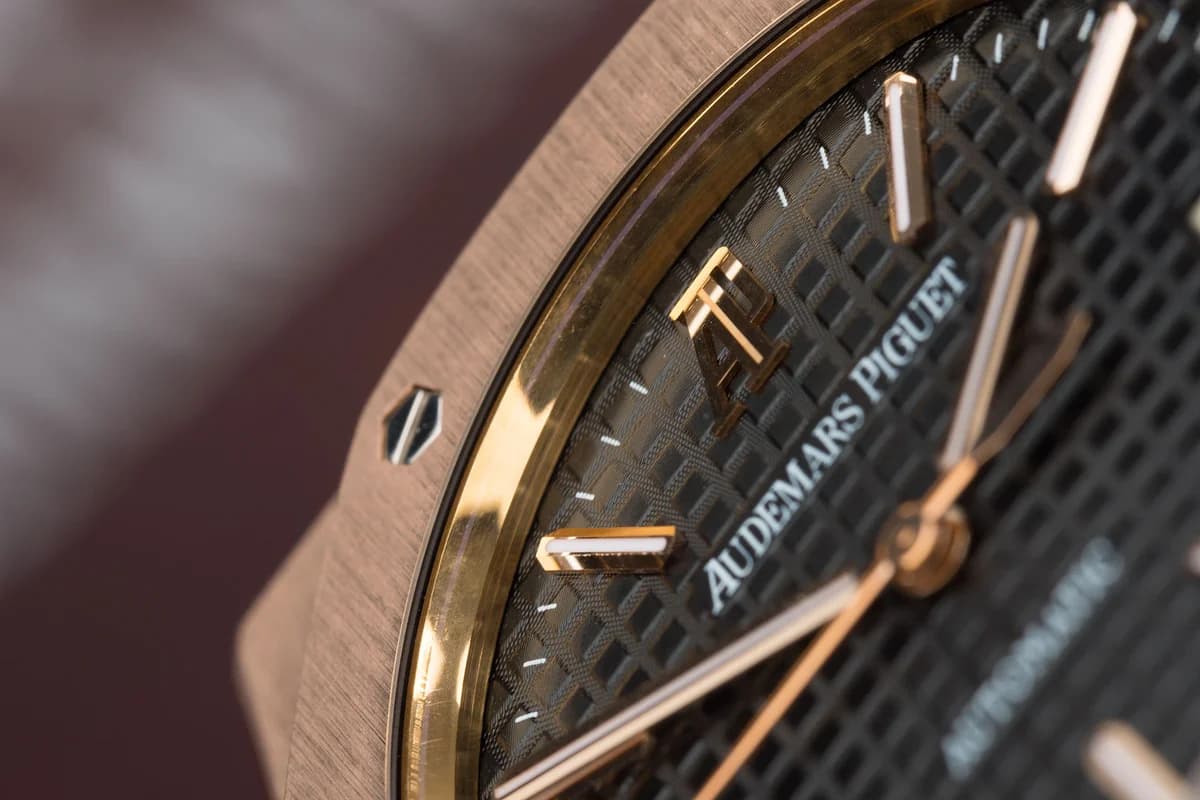
The dial is Grande Tapisserie, the larger-pyramid variant of AP's guilloche pattern. Roughly 380 truncated pyramids catch and release light across the surface. The technique goes back to 1970 when Roland Tille at Stern Freres in Geneva demonstrated 13 guilloche samples to Genta. Pattern T21 became the Petite Tapisserie on the original Royal Oak. Grande Tapisserie was introduced in 1999 for improved legibility. The pyramids are cut by antique Lienhard and Gudel pantograph machines dating to 1895. Eleven rotations of the machine cover one millimeter of dial surface. When Stern Creations was acquired by Richemont in 2000, AP brought dial production in-house. They now maintain 49 of these antique machines. No modern CNC replicates what they do.
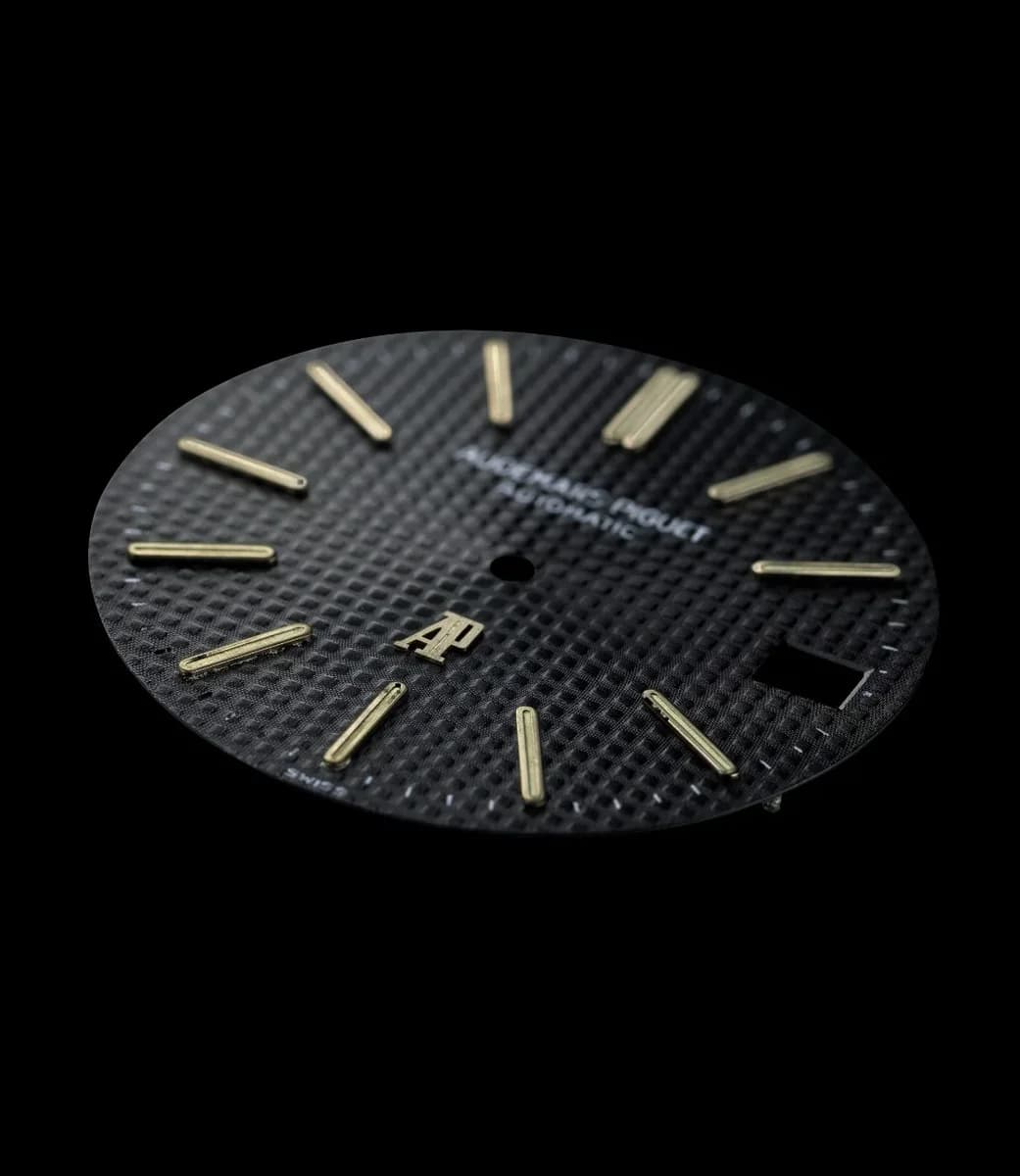
The precision required is extraordinary. Each pyramid must be identical in height, angle, and spacing. A misalignment of even a few microns is visible because the light catches incorrectly. The dial is first stamped with the Tapisserie pattern, then galvanically treated for color, then the indices are applied by hand. The applied AP logo at twelve o'clock is 18K white gold, polished to a mirror finish, then set by hand with tweezers and adhesive under magnification. The applied indices are separately manufactured in 18K rose gold, matching the case. Each one has small feet on the underside that are pressed through corresponding holes drilled in the dial plate, then riveted on the back. Not glued. Mechanically fastened by hand with paper-covered tweezers to avoid scratching the polished surfaces. Luminescent material is filled into the recessed inner face of each index after attachment. There is no star anywhere on a Royal Oak dial despite what some listings claim. The stars are in the Audemars and Piguet family crests, which appear on the movement's rotor, not on the dial face. The black color itself comes from PVD, physical vapor deposition, where a substance is vaporized in a vacuum chamber and deposited atom by atom onto the dial surface. AP originally used galvanic electroplating but switched to PVD for consistency across production batches. The depth you see in the black Grande Tapisserie is the combination of the chromatic PVD coating over the three-dimensional relief of the truncated pyramids. The pyramid faces catch light at varying angles. The tiny diamond-shaped facets between them refract light differently. The color and the texture work together to create a surface that is never static. What strikes me about the black Grande Tapisserie is how different it looks from the silver version. On the silver dial, the tapisserie is the main event, the texture fully visible and three-dimensional. On the black, the pyramids almost disappear until light hits them at the right angle, and then the entire surface ignites. I love that moment. It is the reason the black dial version is the one I keep coming back to. Every Royal Oak dial is a manufacturing exercise that most brands at this level have given up trying to do in-house.
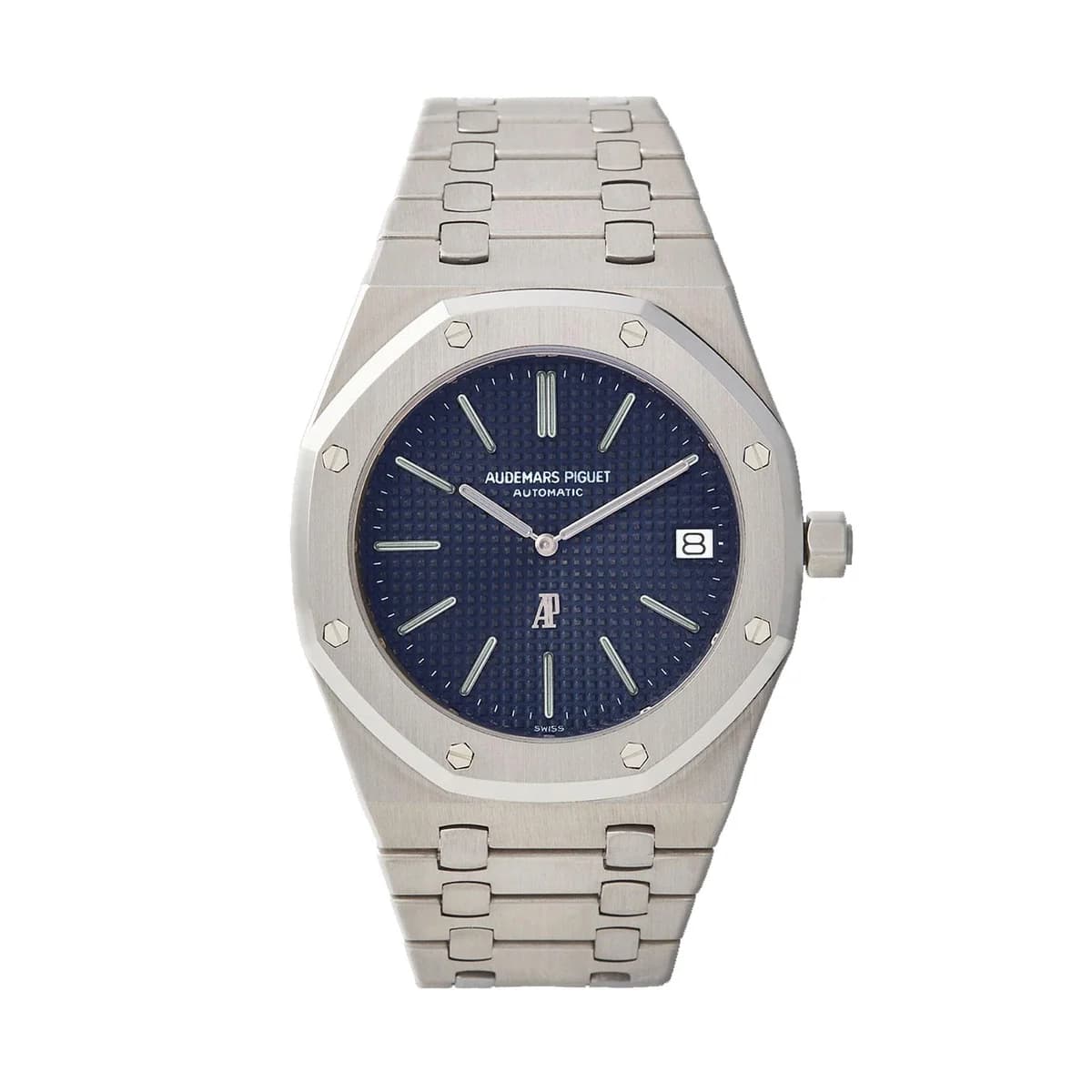
At 39mm, the 15300 sits at what many collectors consider the sweet spot for the Royal Oak. The original 5402 was 39mm. The current 15500 is 41mm. That two-millimeter difference changes how the watch wears more than the numbers suggest. The 15300 at 9.4mm thick sits closer to the wrist than the 15400 at 9.8mm and dramatically flatter than most sport watches in its category. On my wrist, 39mm with the integrated lug design reads as perfectly proportioned. The bezel-to-case ratio is slightly different from the 15202 Jumbo, which means the 15300 actually wears a touch smaller than the Jumbo despite sharing the same diameter. I think the 39mm is the most balanced expression of the Royal Oak design. At 41mm, the bezel starts to dominate the face. At 36mm, the proportions feel compressed. At 39mm, the octagon, the tapisserie, and the indices all have room to breathe.
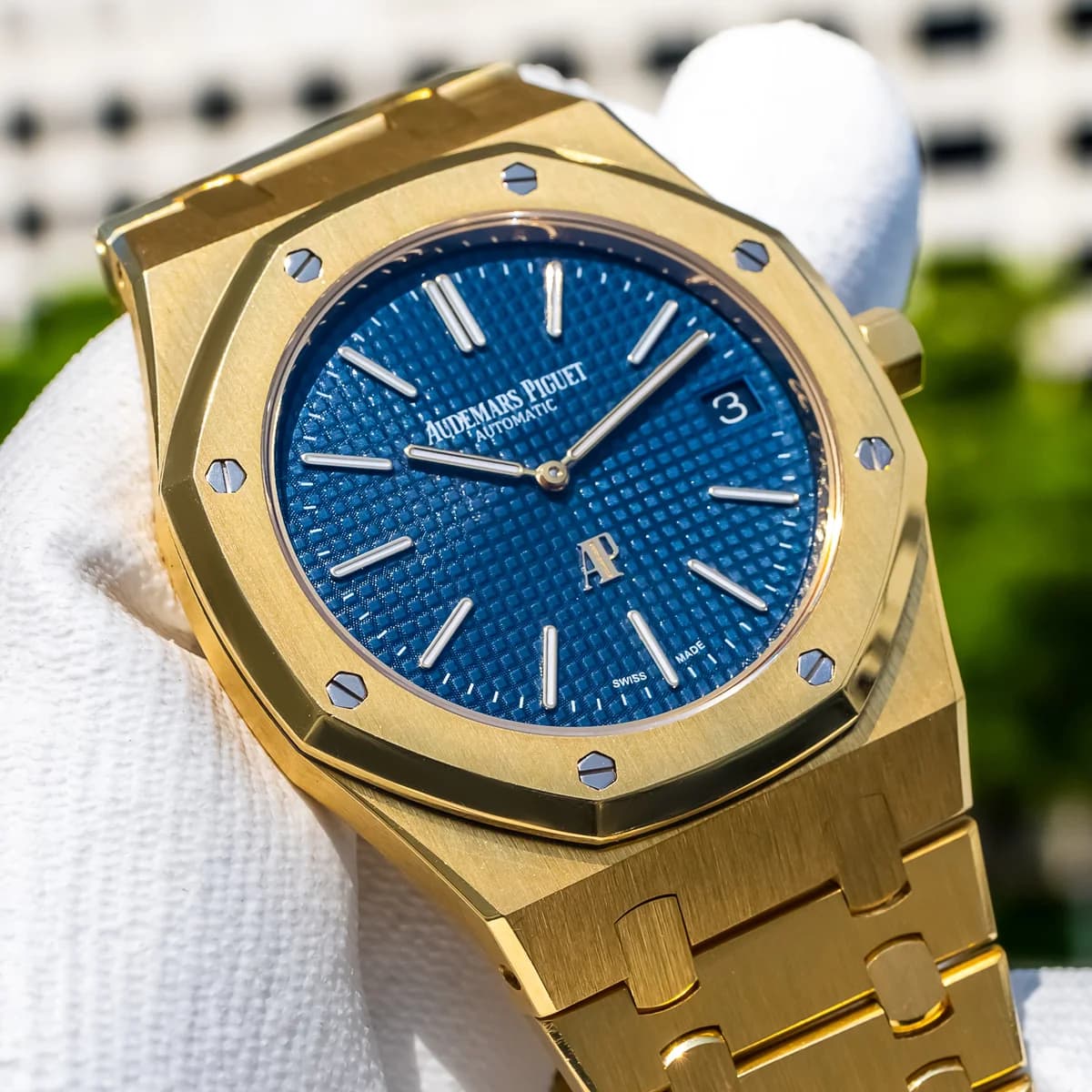
The 15300 versus the 15202 Jumbo is a conversation every Royal Oak collector has eventually. The Jumbo uses the ultra-thin Caliber 2121, derived from a Jaeger-LeCoultre ebauche, running at just 3.05mm thick. That is what gives the Jumbo its legendary 8.1mm case height. But the 2121 has no running seconds hand, no quickset date, and only 40 hours of power reserve at 19,800 vibrations per hour. The 15300's Caliber 3120 adds the seconds hand, quickset date, and 60-hour reserve at the cost of 1.3mm of additional thickness. The Jumbo uses Petite Tapisserie with roughly 680 to 740 pyramids. The 15300 uses Grande Tapisserie with 380. They are two different philosophies of the same watch. The Jumbo is the purist's choice. The 15300 is the daily-wear choice. I have worn both, and I prefer the 15300 for exactly the reasons the purists dismiss it. The running seconds hand gives the dial life. The quickset date saves time. The 60-hour reserve means I can take it off Friday evening and pick it up Monday morning without resetting. Both are right. Both are made in Le Brassus, in the Vallee de Joux, where AP has operated since 1875. The valley is one of the coldest inhabited places in Switzerland. Watchmaking took root there because farmers needed skilled work to fill the long winters. AP is the oldest continuously operating haute horlogerie manufacturer, still owned by the founding families. The Audemars and Piguet lineages maintain control to this day. No conglomerate, no private equity, no Richemont, no LVMH, no Swatch Group. That independence is rare at this level and it shows in the decisions they make.

In 18K rose gold on the crocodile strap, the 15300OR has a warmth that the steel version does not approach. The rose gold bezel and those eight hexagonal screws catch warm light in a way that photographs never fully capture. On darker skin tones, rose gold is one of the most flattering metals there is. I notice this every time I wear it. The warm pink gold against brown skin creates a contrast that is quietly striking, and it is a pairing that gets almost no attention in mainstream watch media. The weight of rose gold on the wrist is noticeably different from steel. Gold is denser. The 15300OR has presence that you feel before you see. Under a suit cuff, the polished bezel catches light at the edges. Here is what most people get wrong about the Royal Oak bezel. The eight hexagonal bolts are not screws. They do not hold the bezel on. The bezel is secured from underneath by internal fasteners you never see. The eight hexagonal bolts are real through-fasteners. Each one runs from the front face of the bezel, through the case middle, to the caseback, where a round nut is torqued on the back. They compress a gasket between the bezel and the monocoque case to create the water seal. But the visible hexagonal head on the front cannot be rotated. It sits fixed in its socket. The tightening happens from the back, invisible. The face you see is functional in structure but decorative in presentation. That is the design genius. The bolts do real work, but the visible evidence of that work is pure aesthetics. On steel models, the bolts are 18K white gold. The first 300 Royal Oaks in 1972 had steel bolts that corroded in saltwater. AP switched to white gold permanently. Even on a steel sports watch, the bolts are precious metal. Every brand that has put visible bolts on a bezel since 1972 is referencing this watch. The 15300OR was never produced in high volumes. It has been discontinued for over a decade. The 39mm rose gold Royal Oak with the Caliber 3120 is a closed chapter.
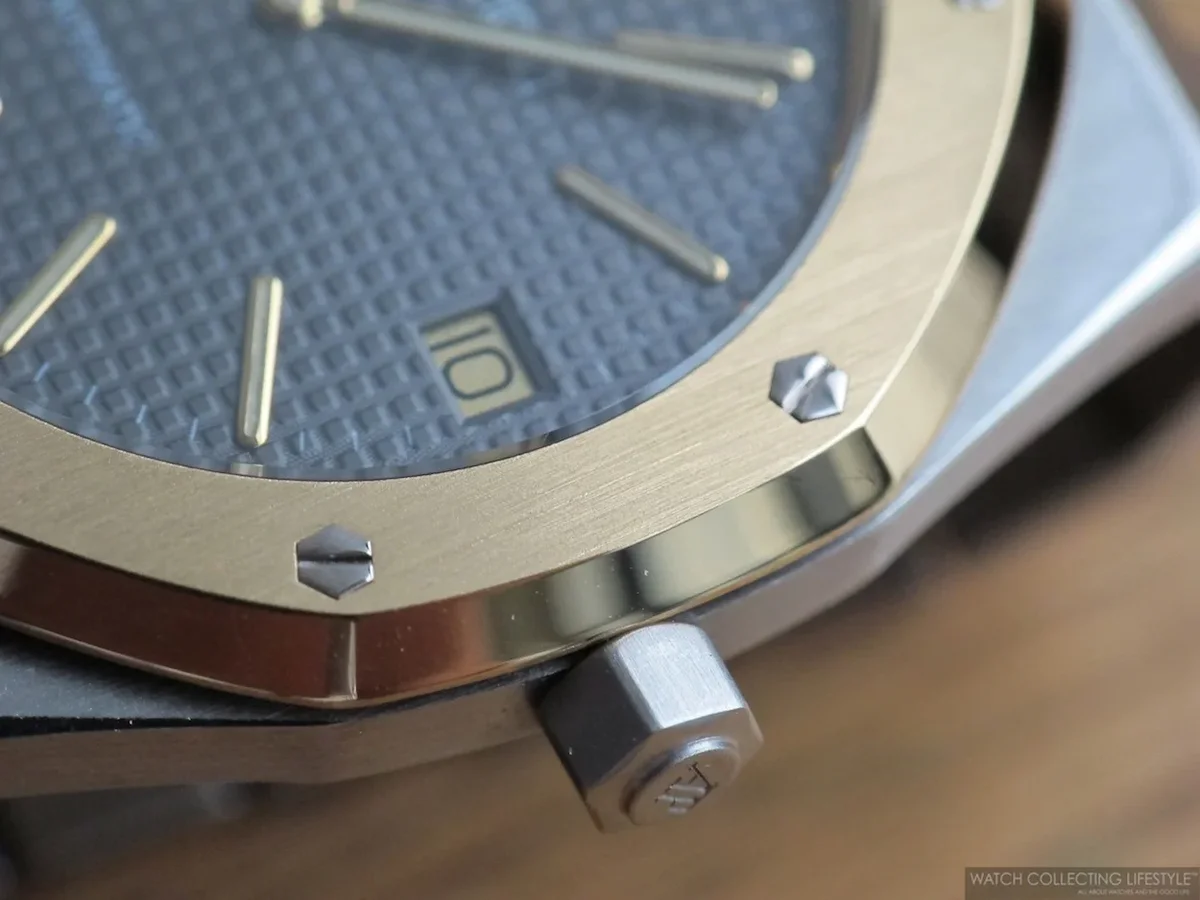
The honest critique is the strap-only configuration in rose gold. The integrated bracelet is the Royal Oak's defining feature, and the 15300OR was not offered with a rose gold bracelet from the factory. You get the crocodile strap with a rose gold deployant clasp, which is beautiful but is not the same experience as the steel bracelet version with its tapered links flowing from the case. The bracelet is what Genta designed. The strap is the compromise. For daily wear in rose gold, the strap is arguably more practical because 18K rose gold bracelet links would scratch, stretch, and require expensive service over time. But the bracelet is the soul of the design. I also wish the date window had a more refined integration. At three o'clock, the date aperture cuts into the tapisserie pattern, and while it is functional and well-placed, the transition between the date cutout and the surrounding pyramids is abrupt. It is a minor thing, but on a dial where every other detail has been obsessed over, the date window feels like the one element where function won over form. The Jumbo avoids this entirely because the 2121 positions the date at the same location but with a slightly different frame treatment. For me, it is not a dealbreaker, just a detail I notice.
In low light, the 15300OR reveals another side of its character. The luminescent material on the indices and hands glows a soft green, just enough to read the time in a darkened room. I find this useful rather than impressive. The lume is not as aggressive as what Rolex achieves with Chromalight, and it fades faster. But on a rose gold dress-sport watch, the restrained approach is correct. A blazing lume plot would feel out of place on something this refined. The sapphire crystal over the dial is flat with no anti-reflective coating on the exterior, which means it can flash white in direct sunlight. AP applies AR coating on the interior surface only. In my experience, the readability is excellent in most conditions, and the lack of exterior coating means fewer visible scratches on the crystal surface over time. The trade-off is that one occasional sun flash, which I have learned to live with.
The 15300 lineage tells the story of AP finding its way back to the original proportions. The 14800 at 36mm was too small. The 15400 at 41mm was too large for collectors who cared about the 1972 original. The 15300 at 39mm was the one that got it right. And then they discontinued it. That is the watch industry. The best references are always the ones they stop making. I think about this watch the way I think about certain buildings or certain pieces of music. It is not trying to be anything other than what it is. An octagonal bezel, a tapisserie dial, eight bolts, and the weight of rose gold on my wrist. Genta drew it in one night. AP has been refining it for over fifty years. The 15300OR is the version where those two timelines converge in a way that I find personally difficult to improve upon.

Also in Design Icons