
Cartier
Tank Louis Cartier
WGTA0011
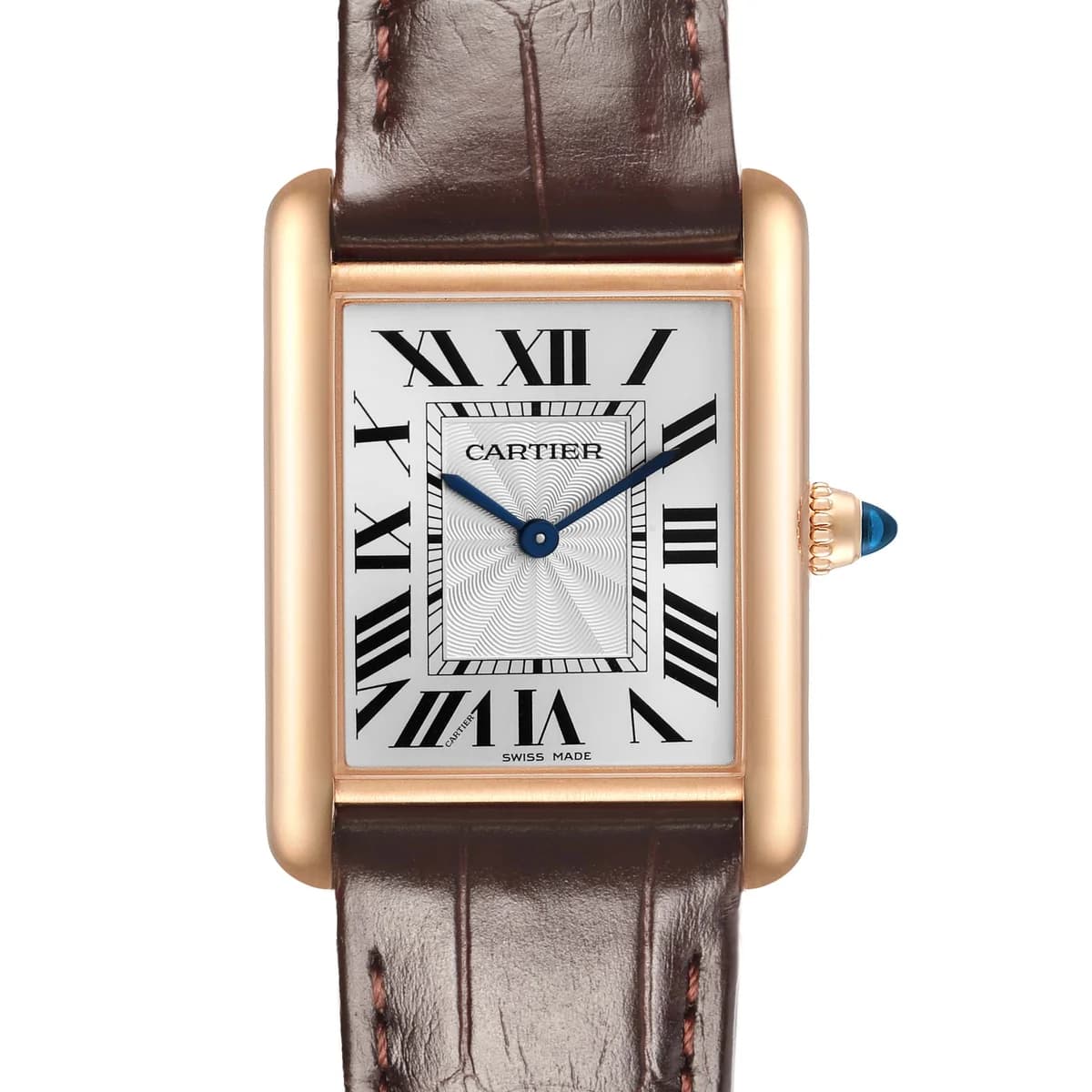
There is something about the Tank that I find genuinely difficult to articulate. Most watches earn their reputation through technical innovation, through complications or depth ratings or chronometric precision. The Tank earned its reputation by being a shape. A rectangle with two vertical bars extending downward. That is it. And somehow, over a century later, that shape still stops me every single time I see it on a wrist. No other watch design has that kind of immediate, universal recognition. The Submariner comes close. The Royal Oak comes close. But the Tank was doing this before either of those watches existed, before the entire concept of the modern wristwatch had been fully worked out.
To understand why the Tank matters, I think it helps to understand what wristwatches looked like in 1917. They were, to put it kindly, primitive. Most were essentially small pocket watches with wire lugs soldered onto the case so a leather strap could be threaded through. The lugs were an afterthought, a crude mechanical solution to attach something round to something flat. The transition from pocket to wrist was still in its early stages, and the aesthetic language of the wristwatch had not been invented yet. Nobody was thinking about how a watch case should flow into a strap, or how the proportions of a rectangular case could complement the shape of a human wrist. Those conversations simply did not exist.
Louis Cartier changed that. The story goes that he saw Renault FT-17 tanks on the Western Front and was struck by the geometry. Viewed from above, a tank is a series of nested shapes. The circular turret inside the rectangular body, flanked by the parallel treads. Cartier translated that geometry directly into a wristwatch. Two vertical bars, which the French call brancards, formed the sides of the case and extended downward to become the strap attachments. The strap was no longer bolted to the case through wire lugs. It was a fluid, continuous extension of the case itself. That single design decision, the integration of case and strap into one flowing form, was the real innovation. It was not about complications or precision. It was about proportion, geometry, and the understanding that a watch is something people look at as much as they read.
Louis Cartier gave one of the first prototypes to General John J. Pershing, commander of the American Expeditionary Force in Europe. The Tank entered commercial production in 1919 with six pieces. And it immediately became a cultural touchstone. Rudolph Valentino wore his Tank in The Son of the Sheik in 1926 and refused to take it off during filming even though it did not belong to the period. Fred Astaire bought a Tank Cintree in 1928. Clark Gable wore one. Gary Cooper wore one. The Duke and Duchess of Windsor had matching Tanks. By the mid-twentieth century, the Tank was the watch that defined elegance in a way that transcended fashion trends and decades.
Andy Warhol captured it perfectly. He said, "I don't wear a Tank to tell the time. In fact, I never wind it. I wear a Tank watch because it's the watch to wear." That quote gets repeated a lot, but I think it actually contains a real insight. Warhol understood that the Tank had become something beyond a functional object. It was a design statement. A cultural artifact. The watch equivalent of a Le Corbusier chair or a Porsche 911. Something where the form is so resolved, so complete, that it exists in its own category.
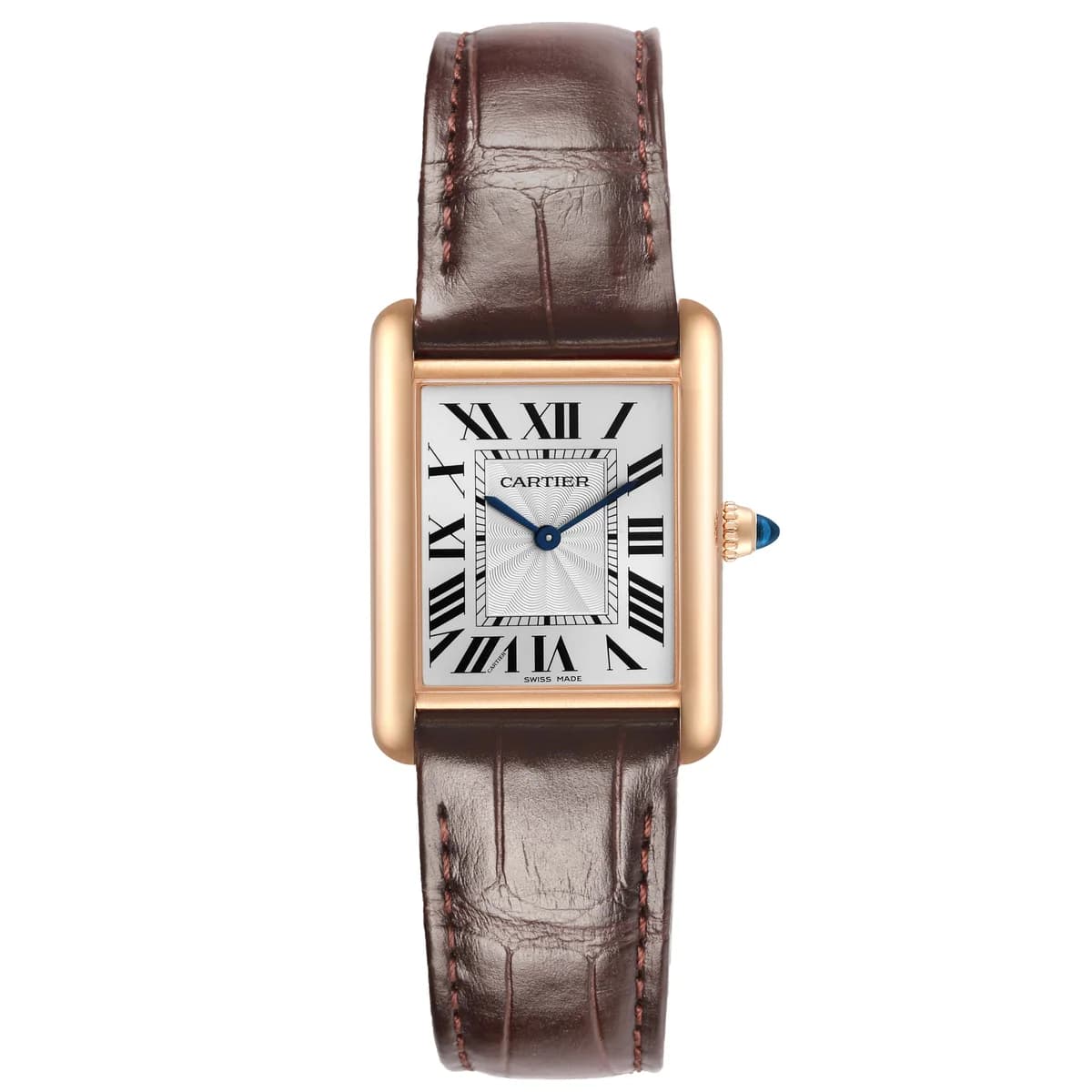
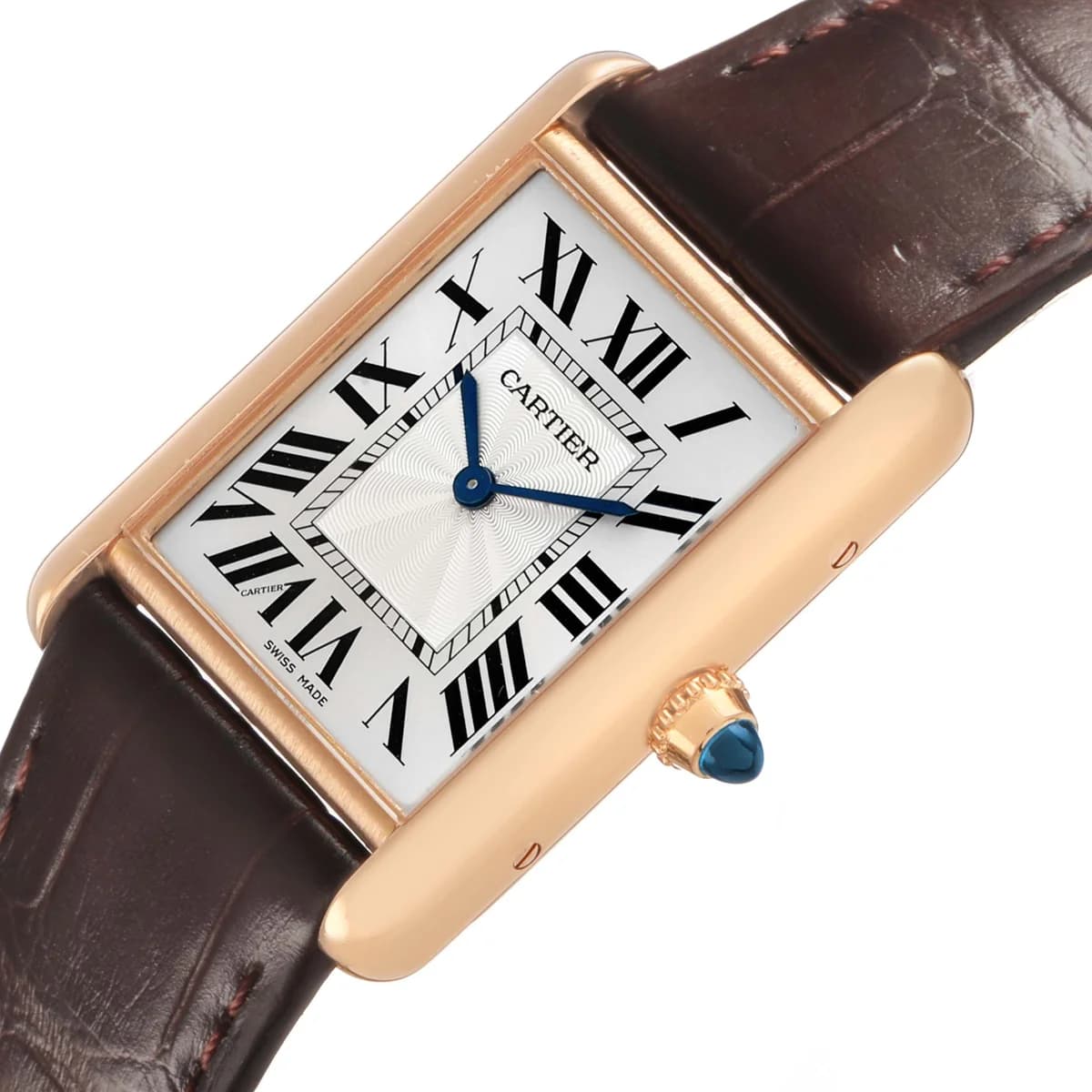
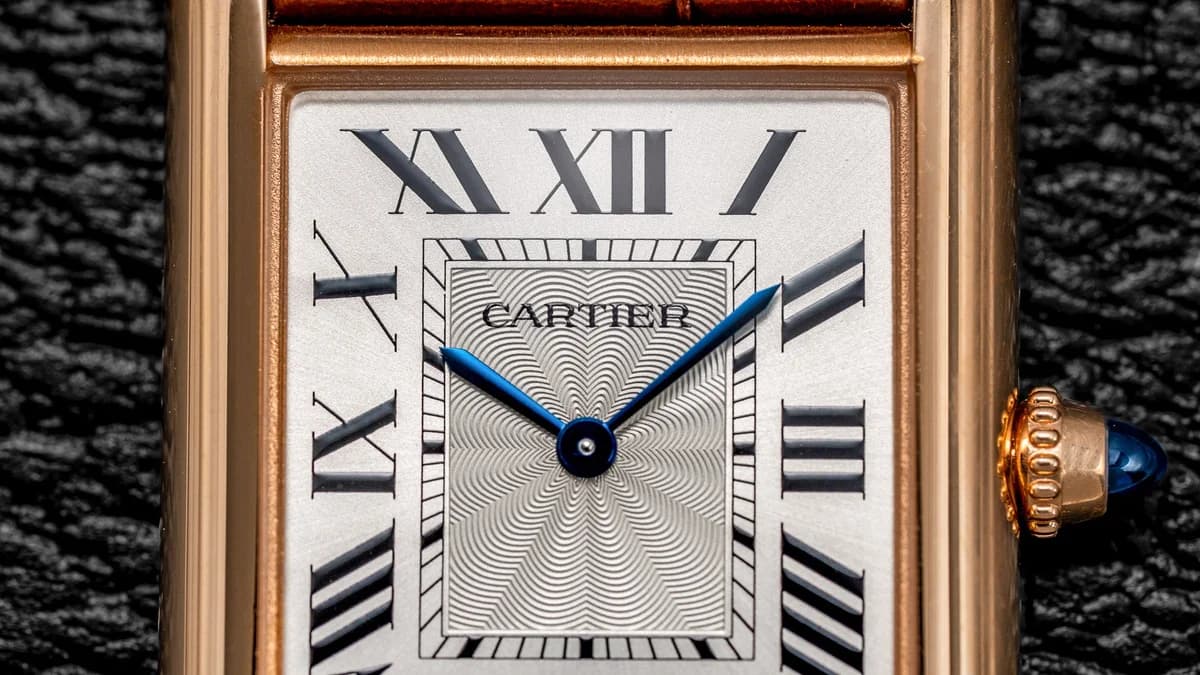
The original Tank, now called the Tank Normale, had angular brancards with sharp corners. Five years later, in 1922, the Tank Louis Cartier arrived and refined everything. The brancards became rounded and more delicate. The proportions were softened without losing any of the geometric clarity. It became the definitive expression of the Tank concept, the one that most people picture when they hear the name. Roman numerals radiating outward on the dial. Blued steel sword-shaped hands. A sapphire cabochon set into the beaded crown. Those elements have remained essentially unchanged for over a century because they do not need to change. The Tank Louis Cartier is one of the very few watches in the history of this craft that was right the first time.
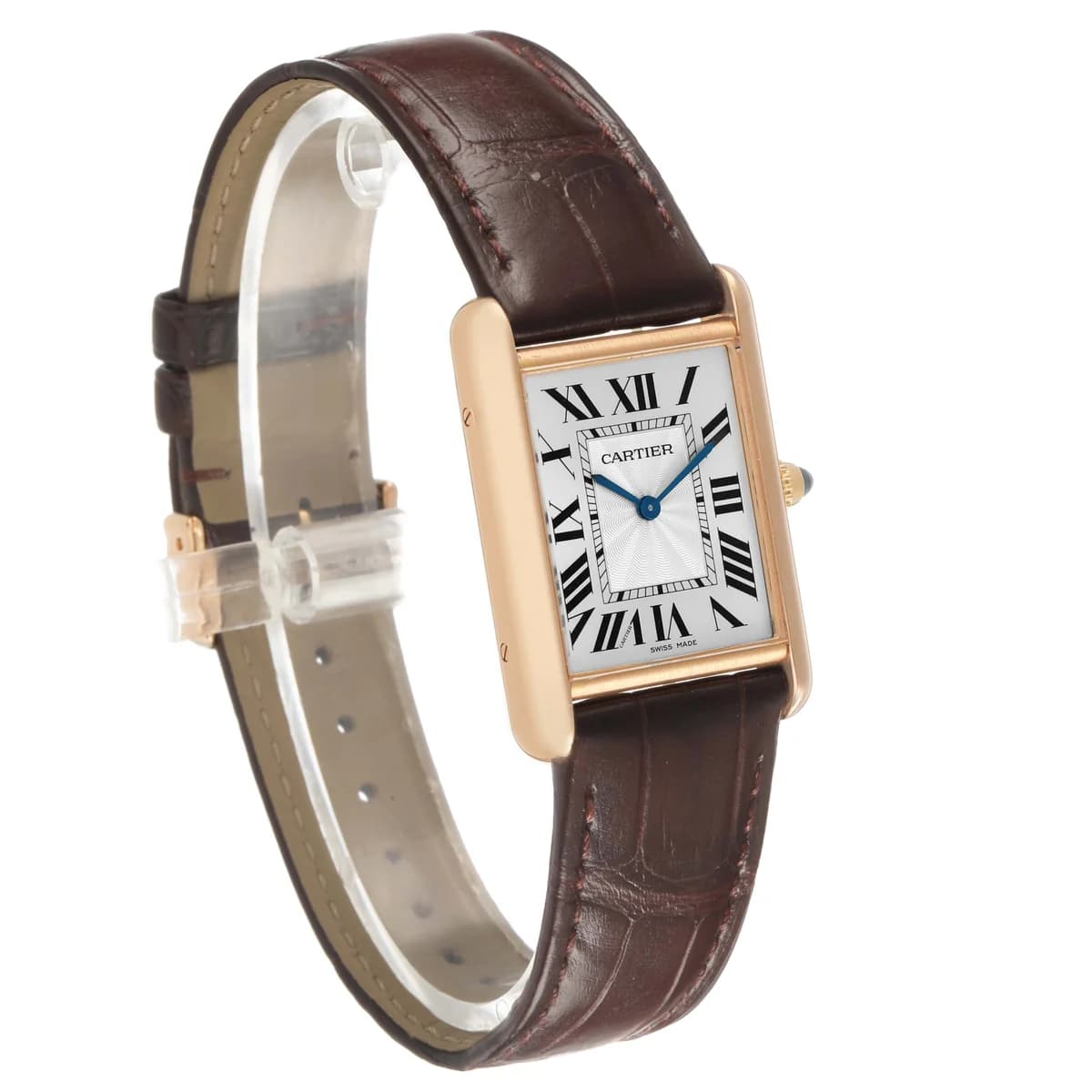
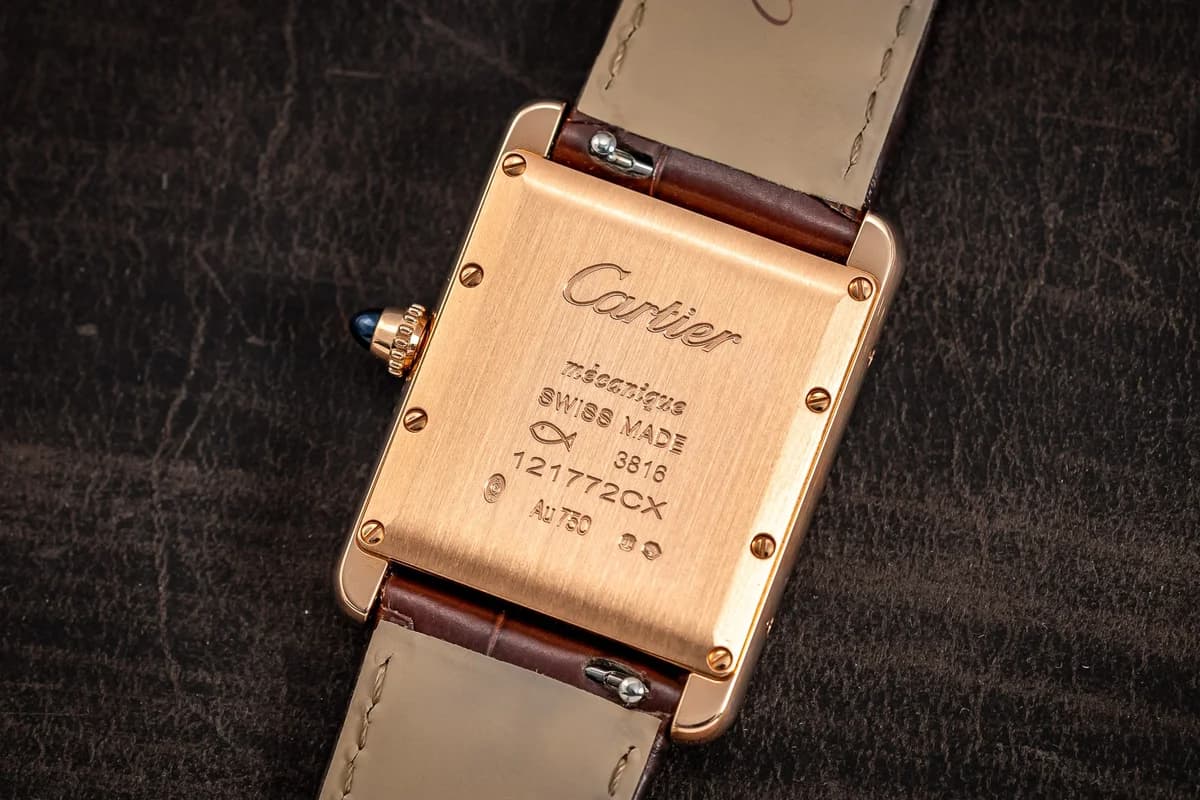
The current reference I keep coming back to is the WGTA0011, the large model in 18K rose gold with the Caliber 1917 MC. The reference number of the movement itself is a nice touch. Cartier named it after the year Louis Cartier designed the original Tank, which connects every current production piece back to that moment of inspiration on the Western Front. The 1917 MC is a hand-wound movement with 19 jewels, beating at 21,600 vibrations per hour (that is 3 Hz, which is slower than the 4 Hz you find in most modern Swiss movements). It delivers 38 hours of power reserve. The movement is tonneau-shaped, measuring just 12.9mm by 16.4mm, standing under 3mm tall. That shape is the key. Fitting a round movement into a rectangular case wastes space and adds thickness. The tonneau shape follows the contour of the case, which is why the Tank Louis sits at a remarkably slim 6.6mm on the wrist. For perspective, a Patek Philippe Calatrava 5196R, which I consider one of the finest round dress watches ever made, sits at about 8mm. The Tank Louis is nearly 1.5mm thinner than that. On a 6.5-inch wrist, that difference is not just numbers on a spec sheet. It is the difference between a watch that vanishes under a shirt cuff and one that catches on the fabric.
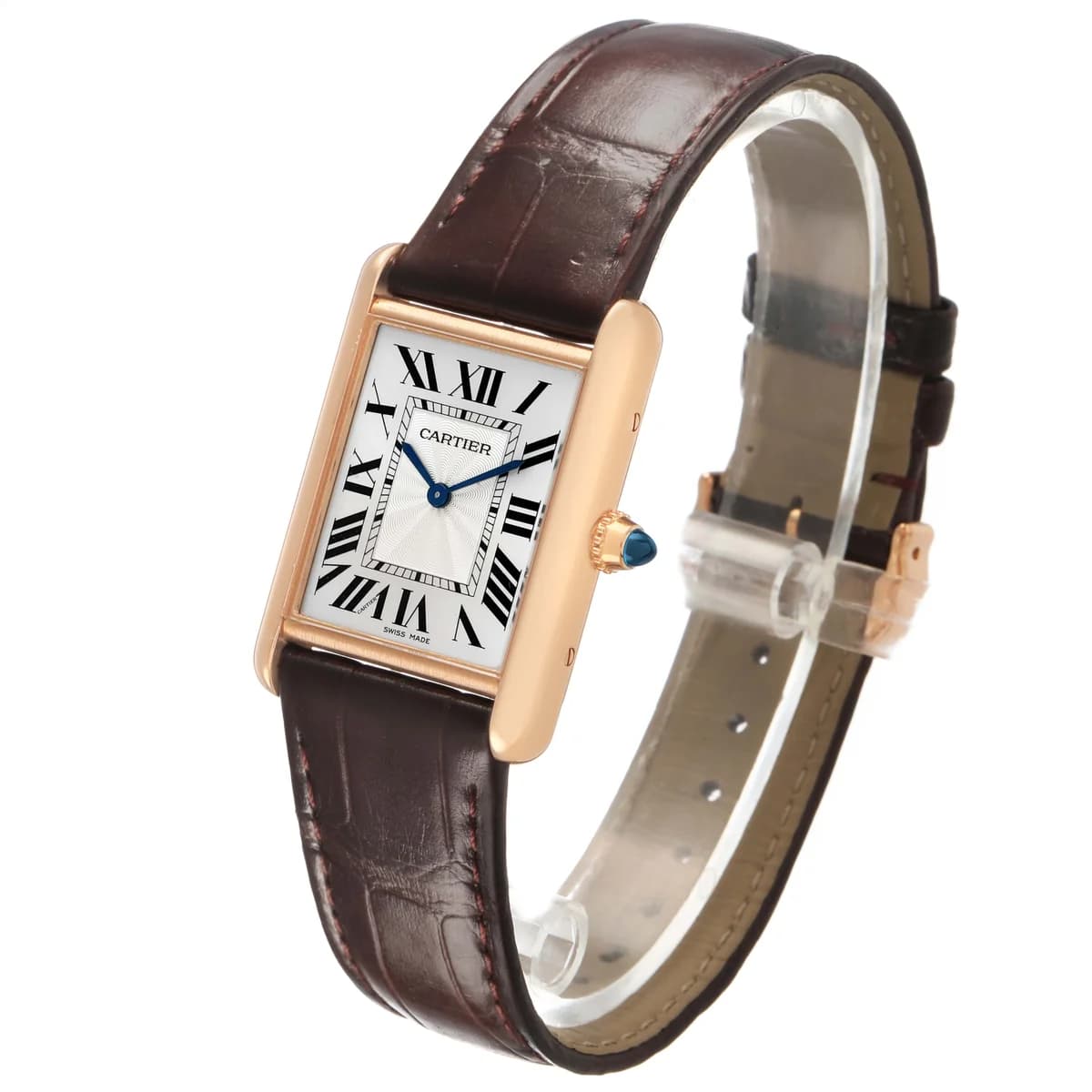
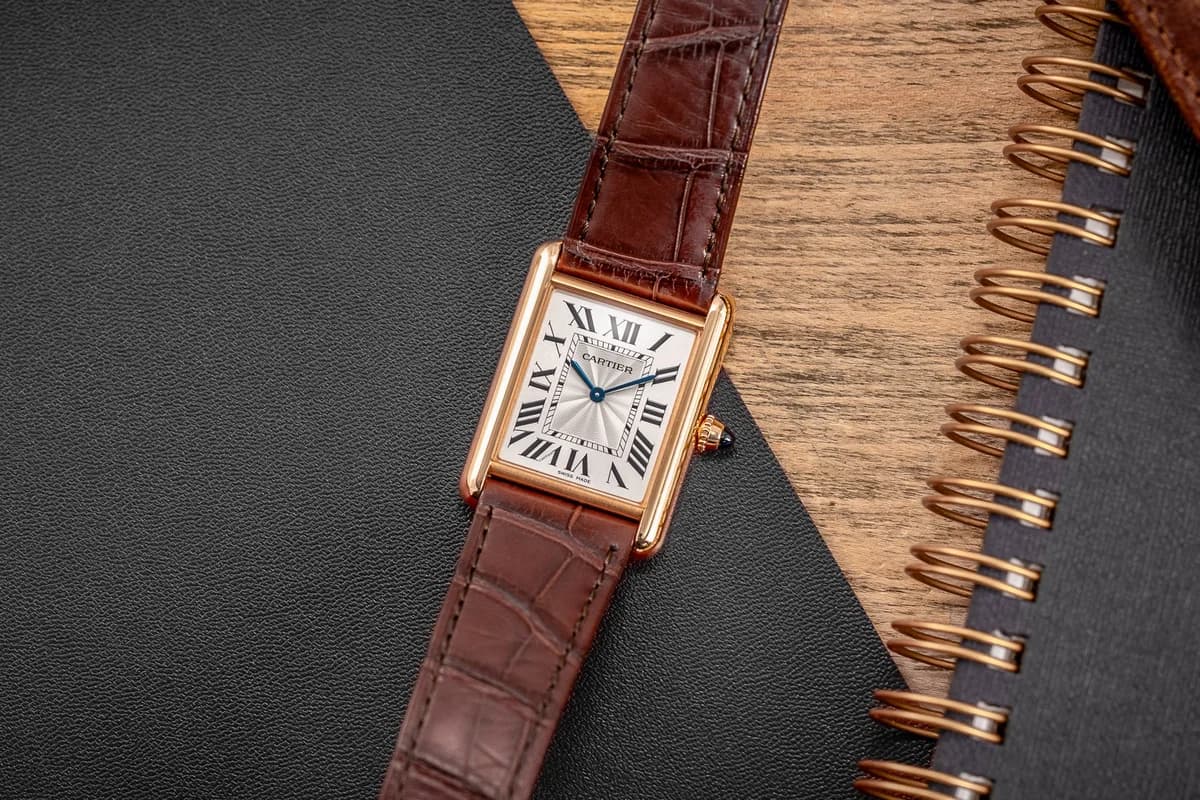
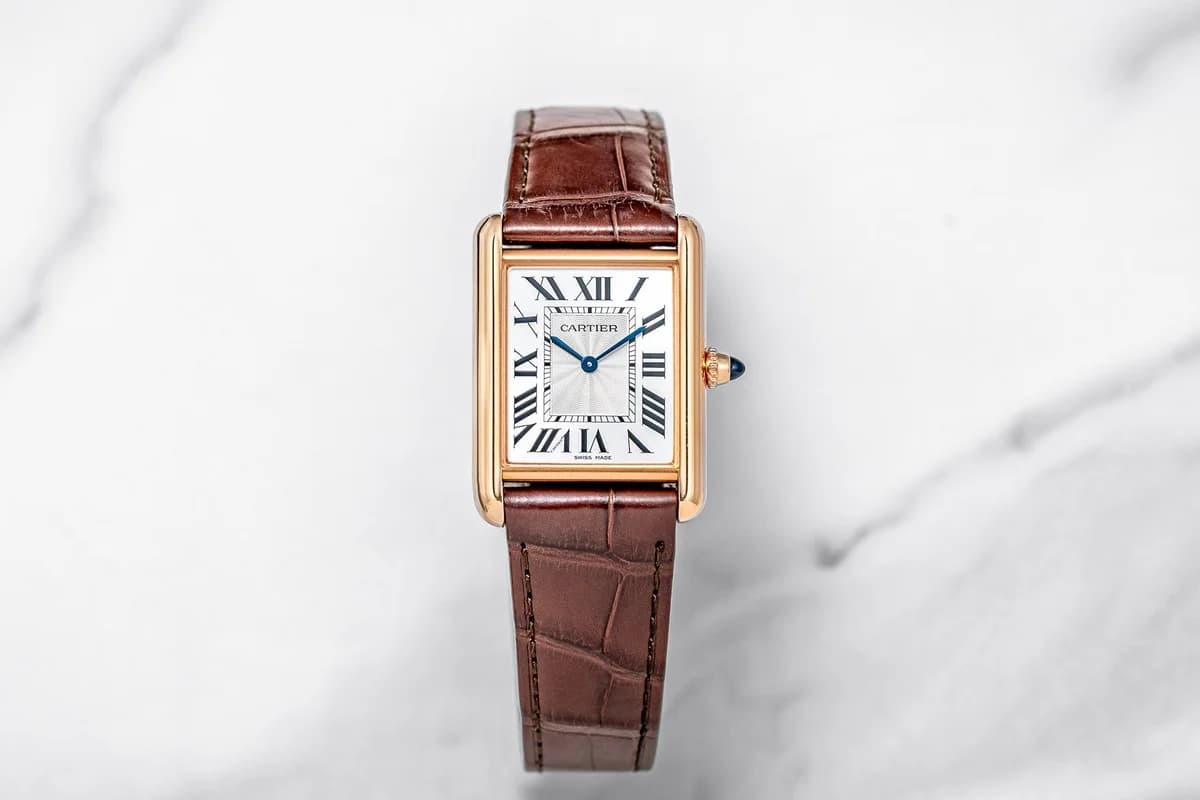
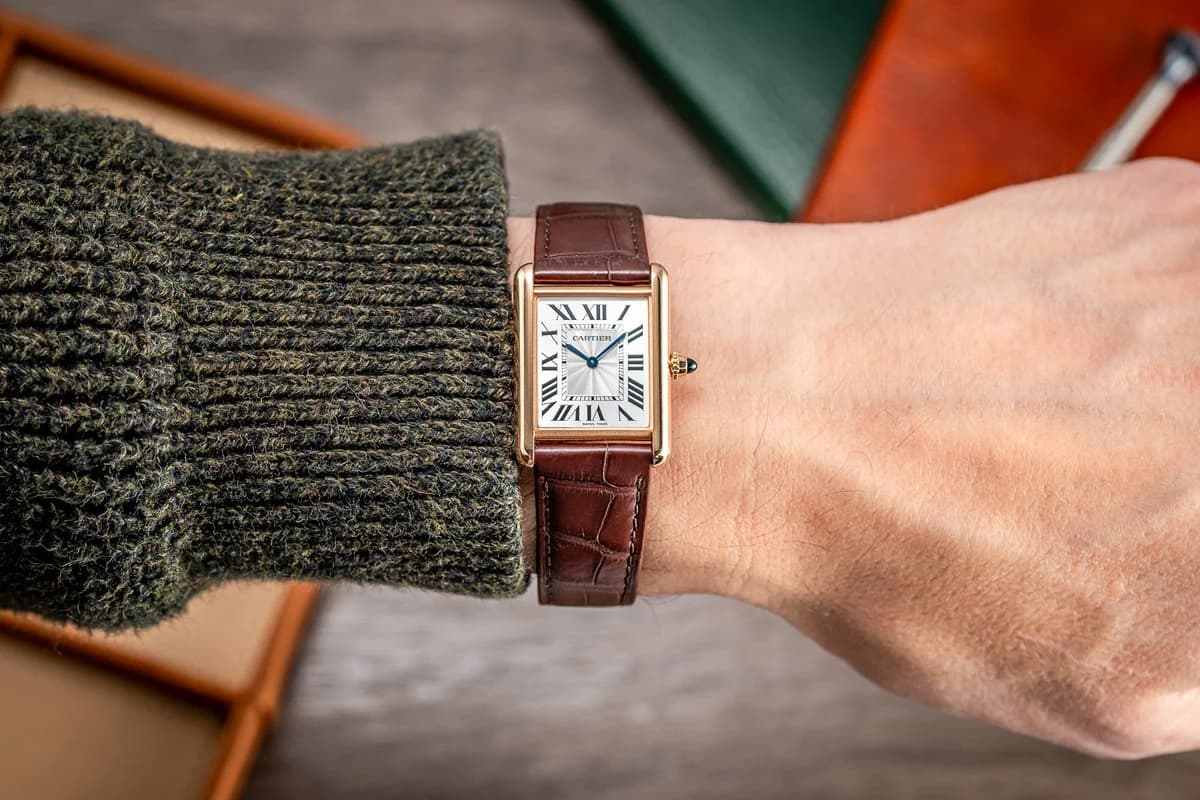
The case measures 33.7mm by 25.5mm. Those dimensions have been the proportions of the Tank Louis for generations, and I think that consistency is part of what makes it so enduring. At 33.7mm in length, it occupies the wrist with authority without overwhelming it. The 25.5mm width gives it a vertical emphasis that is flattering on almost any wrist size. The rose gold, 750/1000 fineness, catches light in a way that steel simply cannot. There is a warmth to it. The brancards frame the dial like columns, and the way they curve gently into the strap creates a visual flow that I find endlessly satisfying. The design has a kind of architectural quality. It looks like someone thought very carefully about every line, every radius, every transition. Because someone did.
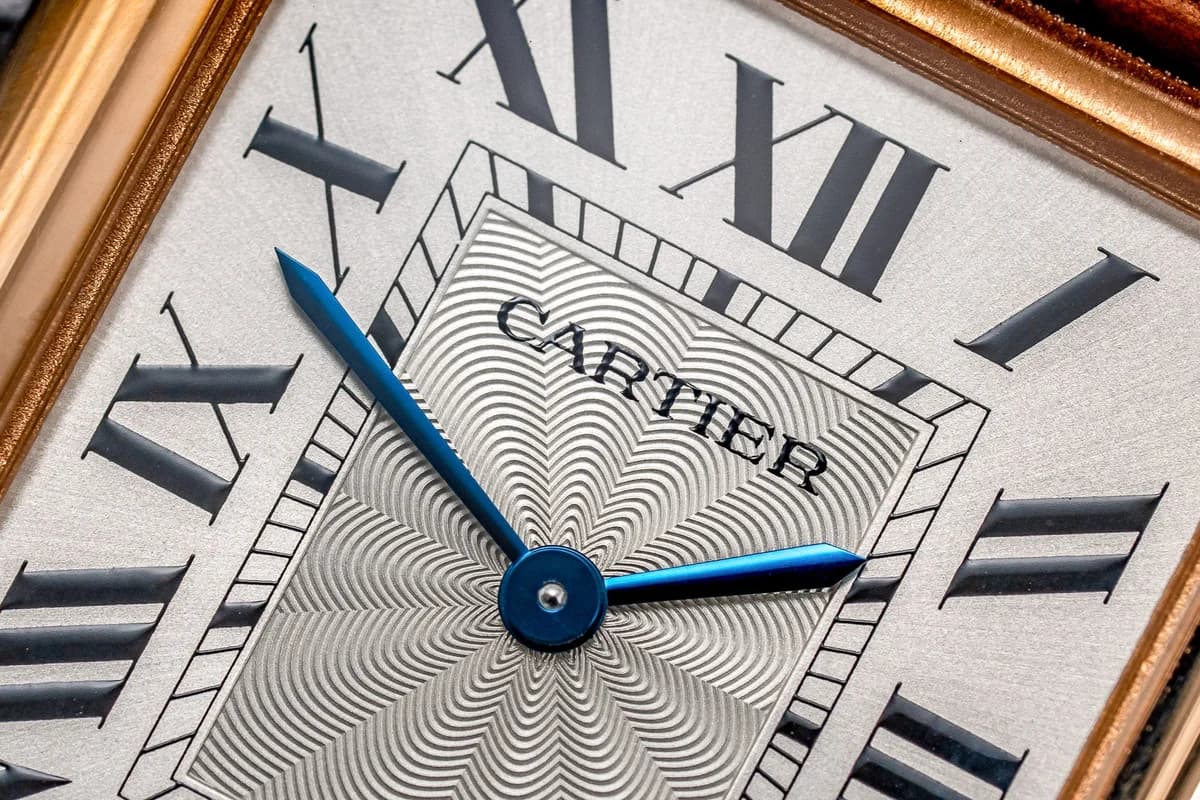
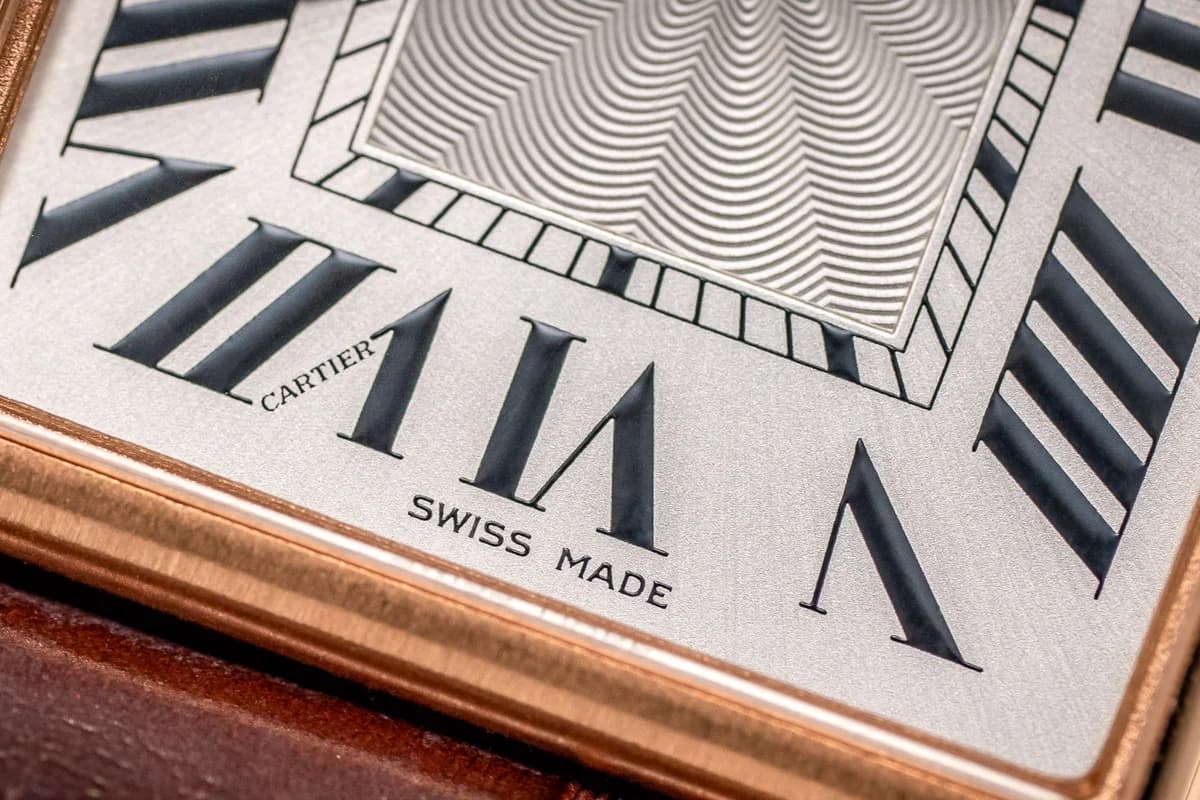
The dial is where the Tank Louis does something I appreciate more every time I look at it. The Roman numerals are not printed in a conventional font. They are elongated, almost stretched vertically, and they radiate outward from the center following the shape of the dial. The result is this typographic quality that I can only describe as feeling like a beautifully set page of text. The chemin de fer minute track, that double railroad-line pattern around the perimeter, has been a Cartier signature since the early 1900s. The hands are blued steel, achieved through thermal oxidation rather than paint. That deep metallic blue shifts depending on the angle of light, sometimes appearing almost black, sometimes catching a flash of vivid blue. It is one of those details that never gets old. And then there is the crown. The beaded crown sits at 3 o'clock with a cabochon-cut blue sapphire set into it (on the gold models, it is genuine sapphire, not the synthetic spinel used on steel Cartier watches). That little gem is a direct connection to Cartier's identity as a jewelry house, and it adds a flash of color that catches your eye every time you reach for the crown to wind the movement.
Speaking of winding. I genuinely enjoy winding this watch. With an automatic, you strap it on and forget about the movement entirely. With a hand-wound piece like this, there is a ritual. Every morning, you pick it up, feel the resistance of the mainspring through the crown, and wind it until it stops. Thirty or so turns. It takes about 15 seconds. And in those 15 seconds, you are physically connected to the mechanism that keeps the watch alive. I think that ritual is part of why hand-wound watches still have such a devoted following. It forces a moment of intentionality at the start of the day. You are choosing to wear this watch. You are choosing to give it energy. There is something meditative about that.
I want to talk about Cartier's watchmaking credibility for a moment, because the Tank Louis sits at the intersection of two things Cartier does better than almost anyone: case design and movement architecture for shaped cases. The challenge that most brands face with rectangular or shaped watches is fitting a movement into the case without wasting space. If you drop a round movement into a rectangular case, you end up with dead space in the corners and a watch that is thicker than it needs to be because the movement sits on a platform rather than nestling into the case contour. Cartier solved this by developing tonneau-shaped and rectangular movements specifically designed for their case shapes. The 1917 MC is decorated with Cotes de Geneve striping, uses an Incabloc anti-shock system, and has an Etachron regulator. These are not haute horlogerie finishing standards (this is not a hand-engraved Lange caliber), but they are solid, well-executed Swiss watchmaking. The movement does exactly what it needs to do. It is thin, reliable, and shaped to fit the case it lives in.
Cartier operates a manufacture in La Chaux-de-Fonds, the UNESCO World Heritage city in the Jura mountains where the entire urban grid was designed around maximizing natural light for watchmaking ateliers. Zenith is nearby in Le Locle. It is a part of Switzerland where watchmaking is not just an industry but the reason the city exists. Cartier produces movements, cases, dials, hands, and crystals there. Between 1998 and 2008, the Collection Privee Cartier Paris revived some of the most beautiful shaped watches in their archives, including the Tank Cintree, the Tortue, and the Tonneau. Under Carole Forestier-Kasapi, who served as Director of Movement Creation from 2005 to around 2020, Cartier developed approximately 20 original calibers including serious complications like the Astrotourbillon and the Astroregulateur. She won the Best Watchmaker Prize at the Grand Prix d'Horlogerie de Geneve in 2012. These are not things a jewelry house does. These are things a serious watchmaker does. The distinction matters because people love to dismiss Cartier as "just a jeweler," and that take does not survive contact with what they actually produce.
The Tank family itself is much deeper than most people realize. The original Tank Normale in 1917. The Tank Cintree in 1921, which tapered and curved the brancards. The Tank Louis in 1922. The Tank Chinoise the same year, inspired by Chinese temple gates. The Tank Basculante in 1932, which swiveled to protect its crystal, preceding the Jaeger-LeCoultre Reverso concept by a year (though the Reverso hit commercial production first in 1931, the two houses clearly had parallel ideas about protecting watch crystals through rotating cases). The Tank Asymetrique in 1936, which rotated the entire case 45 degrees so drivers could read it with their hand on the steering wheel. The Must de Cartier Tank in 1977, which brought the Tank to a wider audience with vermeil (gold-plated silver) cases and quartz movements. The Tank Americaine in 1989 with its elongated, curved case. The Tank Francaise in 1996 with its integrated bracelet. Each one took that original rectangle and explored what else it could become. That kind of sustained design vocabulary across an entire century of production is genuinely rare.
Pierre Rainero, Cartier's Director of Image, Style, and Heritage for over four decades, has described Cartier's design DNA as rooted in "essential shapes, the pure geometry of squares, rectangles, and ovals" that gave birth to the Santos, the Tank, and the Baignoire. He calls Cartier "the watchmaker of shapes." When you look across the catalogue, from the round Ballon Bleu to the Crash (that melted, asymmetric case inspired by a deformed Baignoire found after a car accident in 1960s London), that description is hard to argue with. No other house has created as many distinct, recognizable case shapes that have endured for decades. The Tank Louis is the purest expression of that philosophy. A rectangle. Two lines. A sapphire. Done.
Now, I want to be honest about the tradeoffs, because there are real ones and I think any credible discussion of this watch has to acknowledge them. The first is the crystal. The Tank Louis uses mineral glass, not sapphire. In a world where virtually every Swiss watch above a certain threshold uses sapphire crystal, the mineral glass on the Tank Louis is a deliberate, opinionated choice. Mineral glass has a slightly domed profile that gives the dial a beautiful, almost glowing quality. It does not cast the same hard reflections that sapphire does, and there is no blue-tinted anti-reflective coating to interfere with the view. The dial just looks right through mineral glass. But mineral glass is softer than sapphire, sitting around 5.5 on the Mohs scale versus 9 for sapphire. It will pick up scratches over time, and while Cartier can replace the crystal during a service, it is something to know going in. I have talked to owners who have worn theirs daily for over 15 years with no crystal issues, and I have talked to owners who scratched theirs within the first month. It depends on how you live. For what it is worth, I think Cartier made the right call. The visual clarity of mineral glass on this particular dial is part of what makes the Tank Louis look the way it does.
The second tradeoff is water resistance. At 30 meters (3 bar), this is essentially a splash-proof watch. Do not swim with it. Do not shower with it. If you get caught in the rain, dry it off and move on with your day, but do not submerge it. This is a dress watch in precious metal. It was designed for shirt cuffs and dinner tables, not swimming pools. But I do wish the rating were at least 50 meters, which would give a little more peace of mind for accidental exposure. Then again, increasing water resistance usually means adding gasket thickness and case bulk, and at 6.6mm thin, there is not much room to play with without changing the proportions that make the Tank Louis what it is. I understand the tradeoff.
The third is the gold itself. 18K rose gold sits at about 2.75 on the Mohs hardness scale. Stainless steel is 5.5 to 6.5. That is a meaningful difference. The gold case and brancards on the Tank Louis will pick up micro-scratches from daily wear. Desk edges, door frames, buckles, all of it leaves traces. After a year of regular wear, you will see a soft patina developing across the surfaces. Some people find this distressing. I personally think it adds character. A gold watch that looks perfect after years of wear was not being worn. But if the idea of scratches on a gold case genuinely bothers you, Cartier does not make the Tank Louis in steel. That is a feature of the Tank Must or the Tank Francaise. The Tank Louis has always been a precious metal watch, and that comes with the realities of living with precious metal.
The fourth is the lack of luminous material. There is no lume on the hands, no lume on the indices, nothing that glows in the dark. In low light, the blued hands against the dial can be difficult to read. This is not a watch designed for checking the time at midnight. The contrast between the hands and the dial is good enough in ambient light, but in genuine darkness, it disappears. I notice it occasionally, and part of me wishes there were the faintest touch of luminous coating on the tips of the hands. But I also recognize that adding lume to those impossibly thin, heat-blued sword hands would change their character. The purity of the blued steel, uninterrupted by paint or coating, is part of what makes them beautiful. So I accept it.
And the power reserve at 38 hours is modest by modern standards (the Rolex Caliber 3235 delivers 70 hours, for context). Wind it every morning and it will be fine. Forget for a day and a half and you will find it stopped. For a daily-wear piece, the morning winding ritual handles this naturally. It only becomes an issue if you rotate through multiple watches and let it sit for a couple of days.
What I love about the Tank Louis, and what keeps me coming back to it, is that it represents a completely different philosophy of watchmaking than almost everything else I write about. Most watches I appreciate are technical achievements. Movements with hundreds of components, power reserves measured in days, water resistance measured in hundreds of meters. The Tank Louis is none of those things. It is a design achievement. The engineering serves the aesthetics, not the other way around. The movement is thin because the case needs to be thin. The movement is tonneau-shaped because the case is rectangular. Every technical decision was made in service of how this watch looks and feels on the wrist. That inversion of priorities is what makes it special. In a world full of watches trying to impress you with their specifications, the Tank Louis impresses you with its proportions.
The watch also pairs beautifully with tailored clothing, which is something I care about. The warm rose gold against a charcoal Drapers flannel is a combination that just works. The slimness of the case means it slides under a shirt cuff without catching, without creating that bump that thicker watches produce. On darker skin, the rose gold creates a warm contrast that I find really striking, and this is a nuance that gets almost zero attention in mainstream watch media. Rose gold on darker complexions has a richness to it that photographs and videos rarely capture properly. You have to see it in person to understand why warm metals and warm skin tones complement each other so naturally. The alligator strap in brown adds warmth, but swap it for a black or tan strap and the whole mood shifts toward something more relaxed without losing any of the elegance. Unlike the Santos with its QuickSwitch system, the Tank Louis uses traditional spring bars, so strap changes require a spring bar tool and some patience. I keep my Bergeon 6767-F in the travel pouch for exactly this reason.
After spending real time with the Tank Louis, what stays with me is the quiet confidence of it. It does not try to impress. It does not have a rotating bezel or a tachymeter scale or a moonphase complication. It does not need any of that. It is a rectangle, two lines, Roman numerals, blued hands, and a sapphire on the crown. Louis Cartier got it right in 1917. His house refined it in 1922. And here we are, more than a century later, and those proportions still feel perfect. The Jaeger-LeCoultre Reverso, the Patek Philippe Gondolo, every rectangular watch that came after exists in a conversation that the Tank started. I think that is the highest compliment a design can receive. Not that it is the best of its kind, but that it invented the kind.
Also in Design Icons