
Parmigiani Fleurier
Tonda PF Micro-Rotor
PFC914-1020001-100182
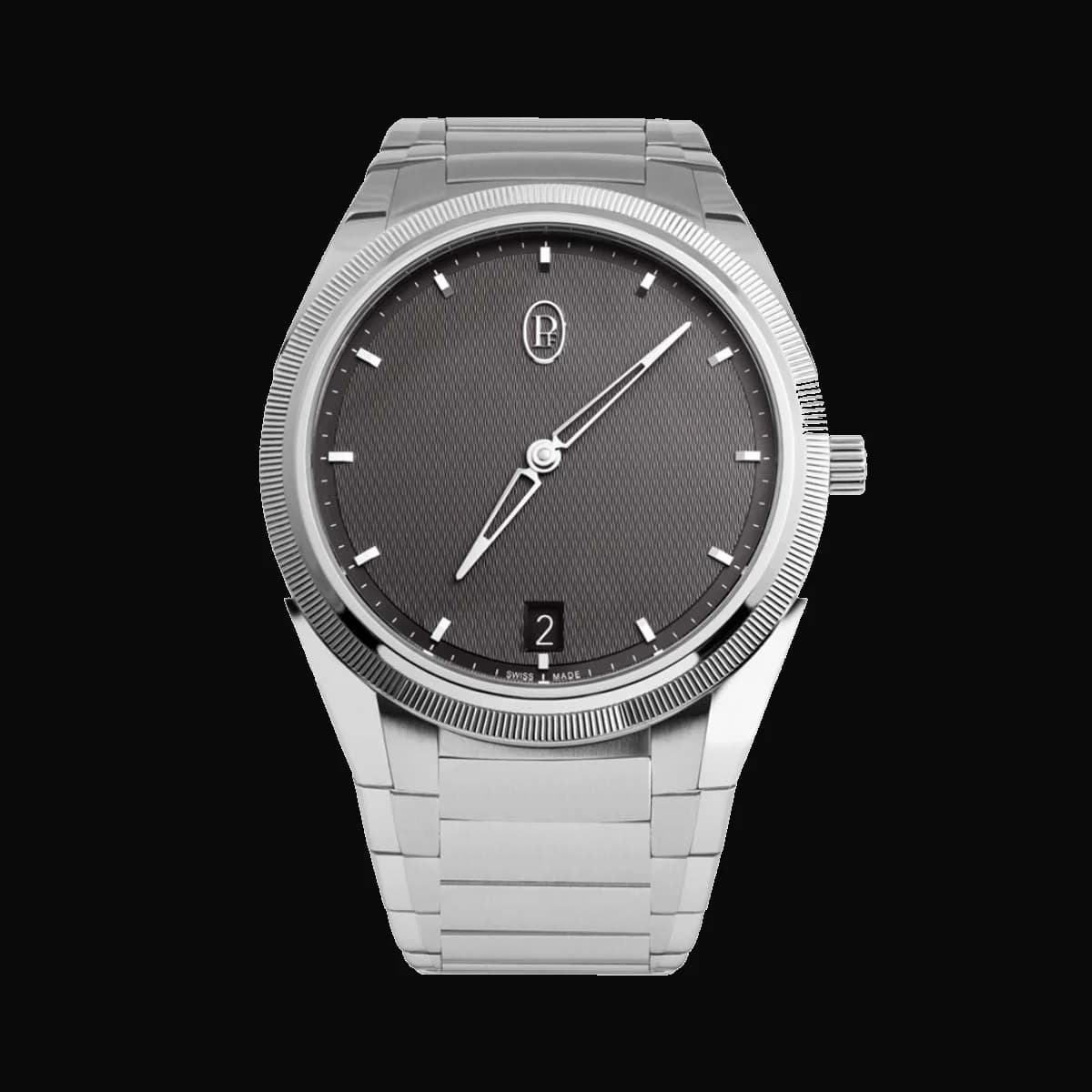
Most people in the watch world have never heard of Parmigiani Fleurier. I find that fascinating, because when I look at what this brand actually controls, what it actually builds, and who actually founded it, the gap between reputation and substance is one of the widest in the industry. Michel Parmigiani opened his restoration workshop, Mesure et Art du Temps, in the village of Fleurier in 1976. That was the height of the Quartz Crisis, when Swiss workshops were closing and the mechanical watch looked like it might not survive. While others were pivoting to quartz or shutting down entirely, Parmigiani chose the opposite direction. He dedicated himself to restoring antique clocks and watches for collectors and museums, working on pieces that spanned centuries of horological history.
In 1978, Parmigiani began restoring the Sandoz Family's collection of rare watches and automata. The Sandoz Family Foundation is the philanthropic legacy of Edouard-Marcel Sandoz, the Swiss industrialist whose chemical company eventually merged into what became Novartis. That restoration work introduced Parmigiani to 500 years of horological history, piece by piece, mechanism by mechanism. He was not reading about historical watchmaking. He was physically disassembling it, understanding it, and bringing it back to life. That is a fundamentally different kind of education than what most modern watchmakers receive. The relationship with the Sandoz Foundation grew, and in 1996, with the Foundation's financial backing, Michel Parmigiani founded his own watch brand in Fleurier.
What makes Parmigiani Fleurier unusual is not just that it is independently owned (the Sandoz Family Foundation, not a conglomerate like LVMH or Richemont or Swatch Group), but that it is one of the most vertically integrated manufactures in Switzerland. The brand controls five subsidiary companies that together handle nearly every component of its watches. Vaucher Manufacture Fleurier builds the movements. Atokalpa produces the escapement components and hairsprings. Elwin handles precision micro-mechanics like pinions, wheels, and screws. Les Artisans Boitiers makes the cases. Quadrance et Habillage produces the dials. Few brands at any level control this much of their supply chain. Patek Philippe and Rolex do. A. Lange and Sohne does to a large extent. But at Parmigiani's production volumes, the commitment to vertical integration is remarkable. They produce a few thousand watches per year. The entire operation exists in and around Fleurier, a village in the Val-de-Travers region of Neuchatel.
I appreciate what Fleurier represents in the Swiss watchmaking landscape. It sits in a valley that most watch enthusiasts never visit because the bigger names draw attention to Geneva, the Vallee de Joux, and Glashutte. But Fleurier has its own watchmaking heritage, and in 2004, Parmigiani co-founded the Qualite Fleurier certification alongside Chopard, Bovet, and Vaucher Manufacture. The Qualite Fleurier stamp is one of the most demanding quality certifications in Swiss watchmaking. A watch must first pass COSC chronometer certification, then survive the Chronofiable test (which simulates years of real-world wear through shocks, magnetism, and environmental stress), and then pass the Fleuritest, which evaluates accuracy over multiple days in multiple positions. On top of that, the entire watch must be manufactured in Switzerland, and the movement must meet aesthetic finishing standards evaluated under magnification. It is the kind of certification that most brands would not voluntarily subject themselves to because the failure rate is high and the process is expensive.
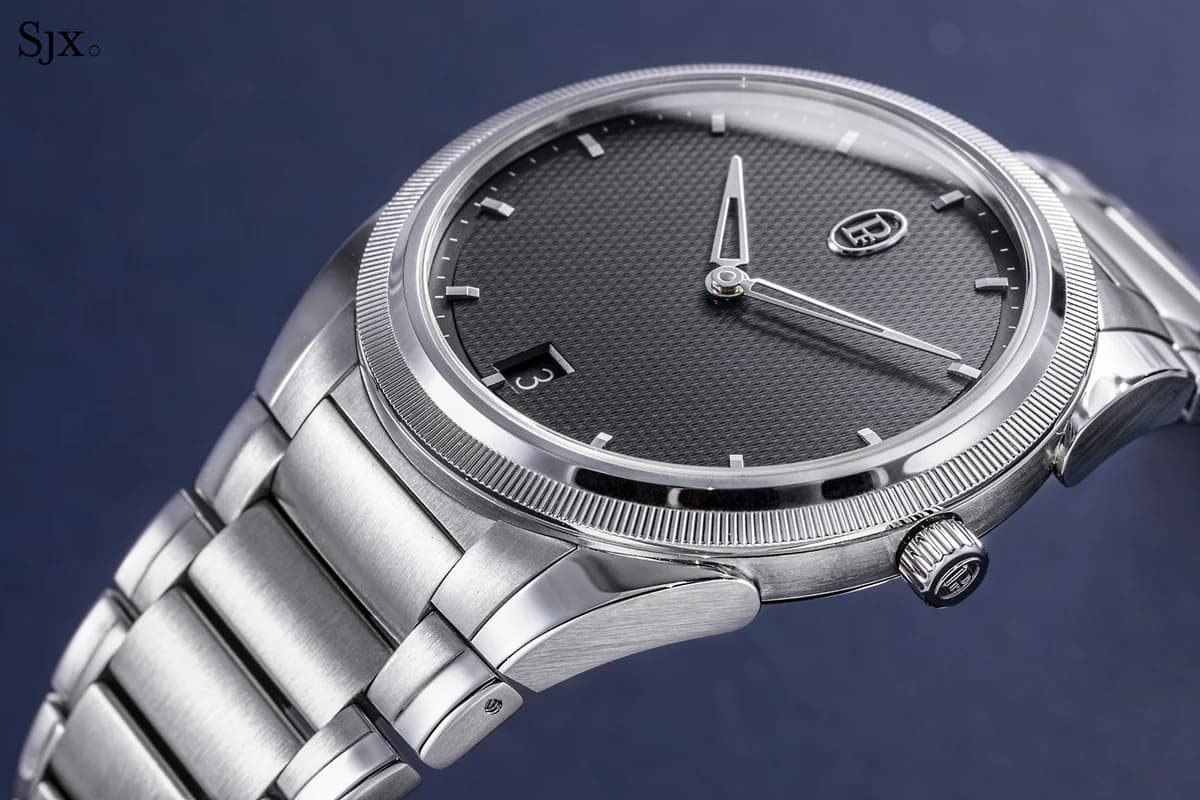
The Tonda PF launched at Geneva Watch Days in 2021, shortly after Guido Terreni took over as CEO. Terreni came from Bulgari, where he had spent years building the Octo Finissimo into one of the most respected collections in contemporary watchmaking. What he did at Parmigiani was decisive. He looked at a brand with 25 years of extraordinary horological substance but limited commercial traction, and he refocused it around a single collection. During the first 25 years after Parmigiani's founding, the brand had aged with its original clientele. Terreni recognized that the way people live, dress, and wear watches had become far more informal, and the product needed to reflect that. The Tonda PF is Parmigiani's entry into the integrated-bracelet luxury sports watch category, the territory defined by the Royal Oak and the Nautilus. But it does not copy them. I think that is what makes the Tonda PF interesting. The tear-drop lugs, the hand-knurled 950 platinum bezel, and the grain d'orge guilloche dial give it a baroque character that neither AP nor Patek offers. The PF logo at 12 o'clock replaced the full Parmigiani Fleurier name on the dial, a deliberate rebrand that signaled a new chapter. Sales tripled and production doubled after the launch. The watch community noticed.
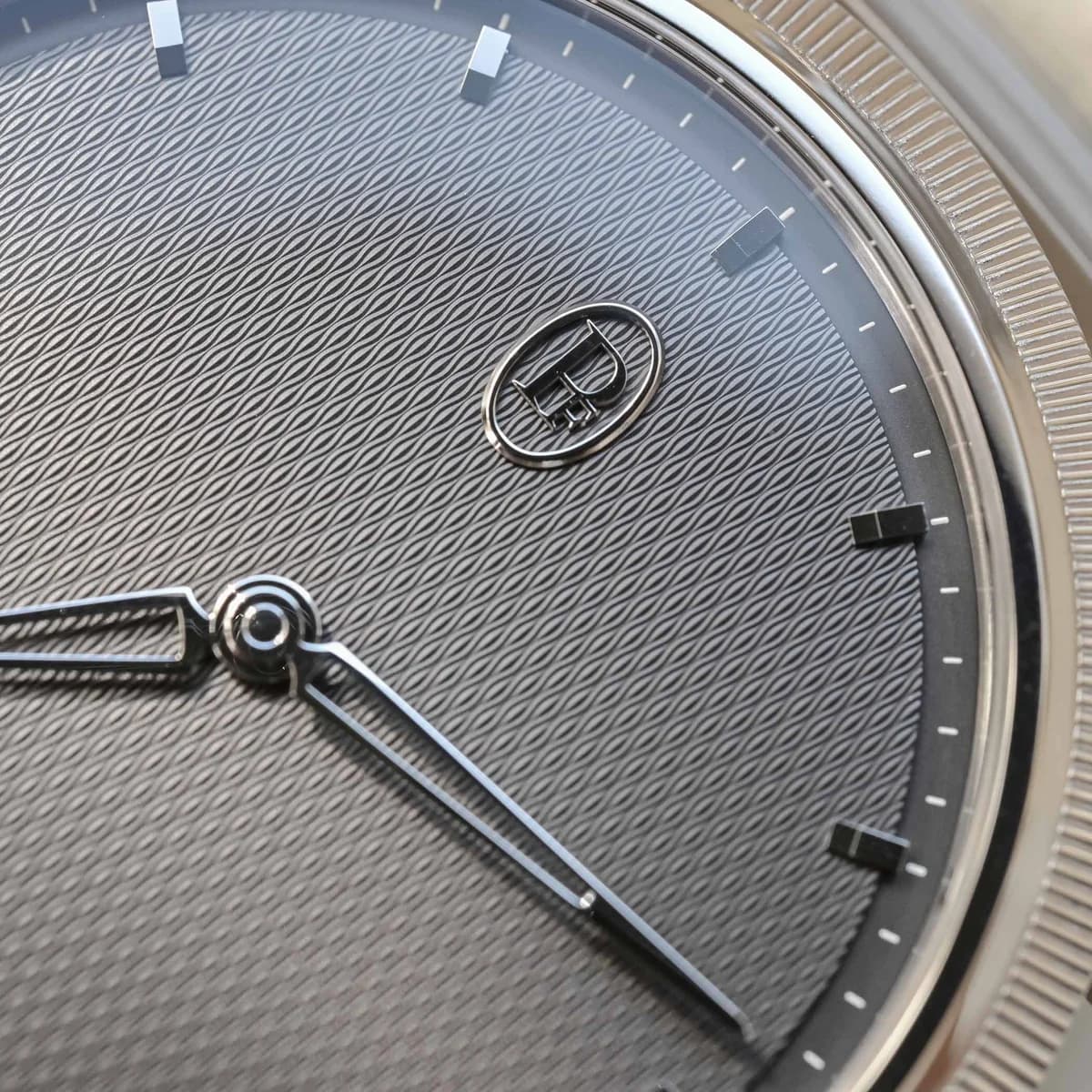
Grain d'orge is French for barleycorn. It is a hand-guilloche technique where tiny diamond-shaped facets are engraved into the dial surface using a rose engine lathe. Each facet catches light independently, creating what Parmigiani describes as almost textile vibrations on the dial surface. In person, the effect is subtle but unmistakable. The dial looks different from every angle because each facet reflects light at a slightly different trajectory. It is a living surface. The warm grey dial on this reference (PFC914-1020001-100182) is particularly effective because the neutral tone lets the texture do the work rather than competing with a strong color. The applied hour markers are rhodium-plated and the hands are skeletonized delta shapes in 18K gold with rhodium plating, giving the dial a coherent metallic warmth that reads as understated from a distance but rewards close inspection.
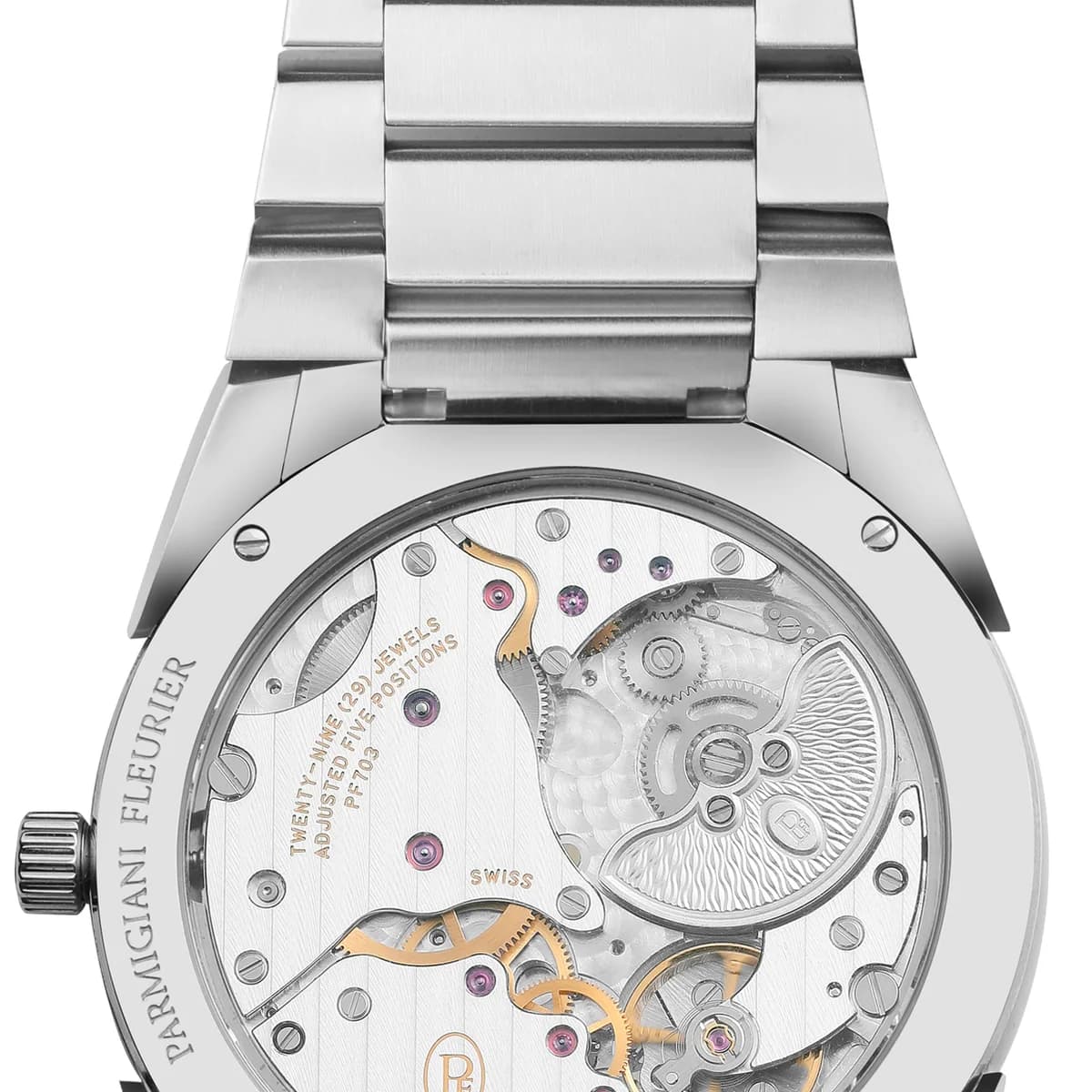
The Calibre PF703 is the heart of the Micro-Rotor variant and what separates it from the regular Tonda PF Automatic. The standard Tonda PF Automatic uses the Caliber PF770, a center-rotor movement with a 22K gold skeletonized rotor. The PF703 takes a completely different approach. Instead of a full-size rotor that sits on top of the movement, the PF703 uses a 950 platinum micro-rotor that is integrated into the height of the movement itself. That is the key engineering decision. By sinking the rotor into the movement rather than stacking it on top, the PF703 stands just 3mm tall. That enables a case thickness of 7.8mm, which is remarkably slim for a 40mm automatic with a date complication. For context, a Royal Oak 15500 is 10.4mm thick. A Nautilus 5711 is 8.3mm. The Tonda PF Micro-Rotor at 7.8mm is thinner than both, and it has a date window at 6 o'clock.
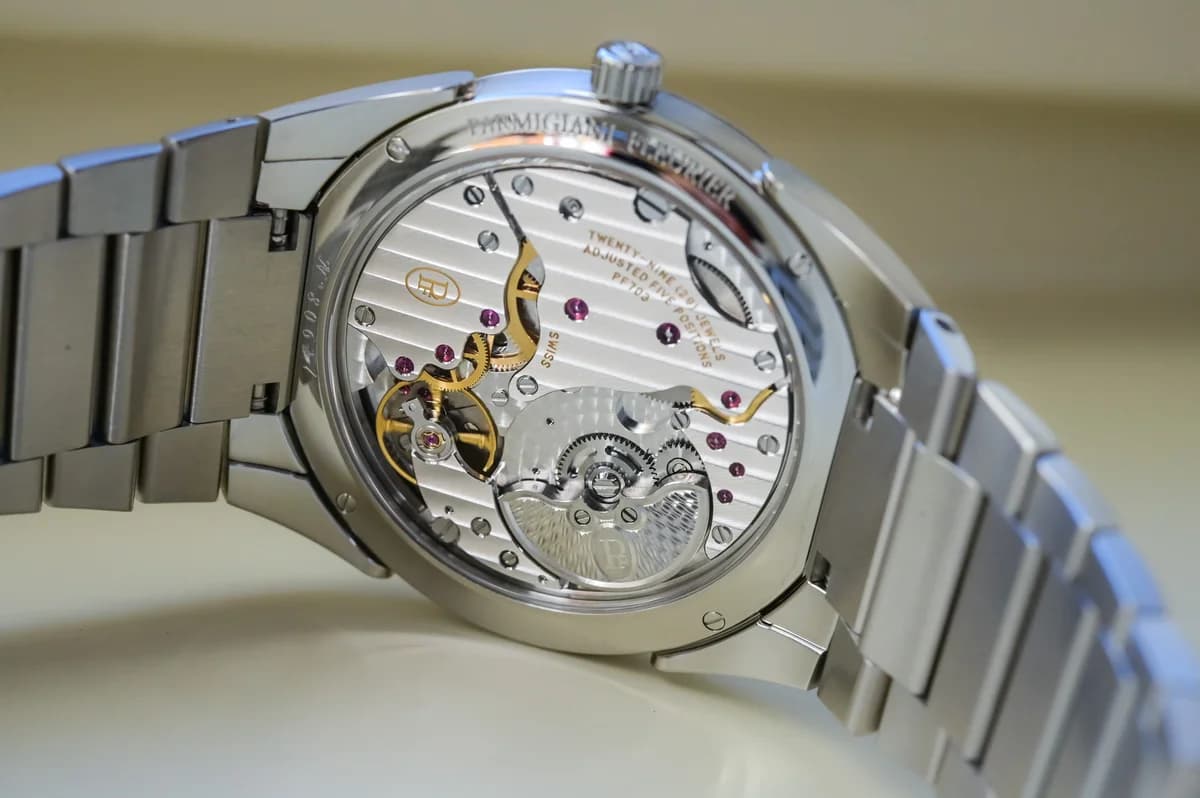
Platinum is one of the densest metals available, roughly 21.45 grams per cubic centimeter. That density is why it works as a micro-rotor material. A smaller rotor needs more mass to generate adequate winding torque, and platinum delivers that mass in a compact footprint. The movement runs at 21,600 vibrations per hour (3 Hz) with 29 jewels and 176 components, delivering 48 hours of power reserve. Those are honest, real-world specifications. Not the fastest frequency, not the longest power reserve, but reliable and well-engineered. The movement is visible through the sapphire caseback, and the finishing is genuine. Cotes de Geneve on the bridges, perlage on the mainplate, beveled edges. This is not a movement that relies on the caseback being solid to hide shortcuts. Michel Parmigiani has designed 33 original movement calibers over his career. The PF703 is one of his best because it solves a real engineering problem (thinness) without compromising reliability.
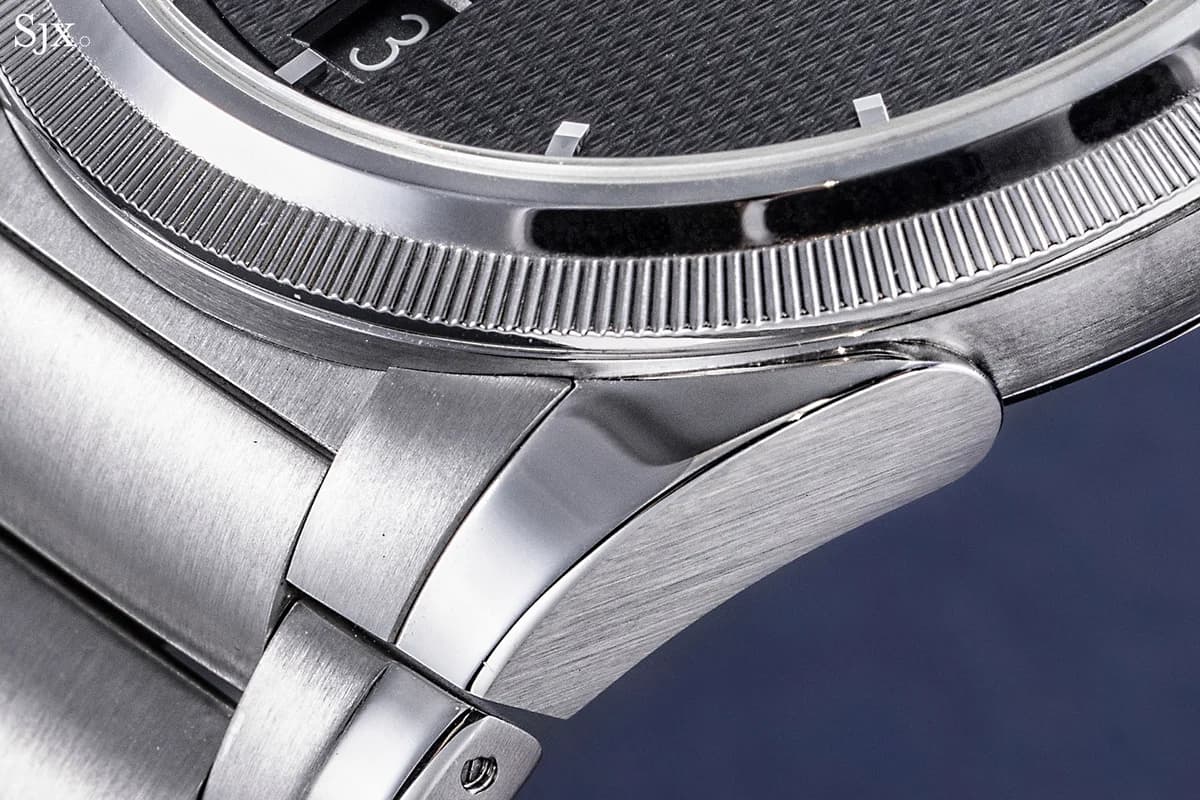
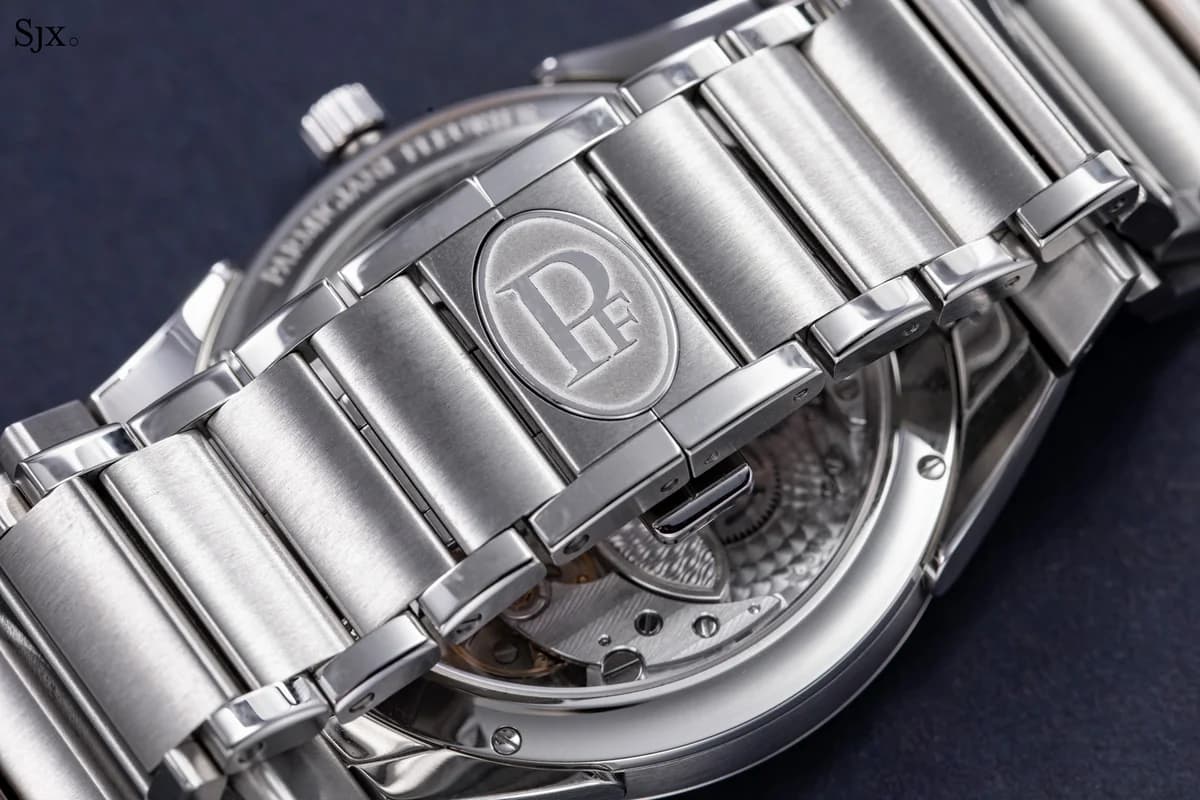
The case itself is 40mm in stainless steel with a 950 platinum bezel. That combination is unusual and worth understanding. The bezel is not just polished platinum sitting on steel. It is hand-knurled, a process where tiny raised nodes are individually formed on the surface using a specialized tool. The knurling gives the bezel a tactile quality and a visual texture that catches light in a way that a smooth polished surface does not. It also provides a visual contrast with the brushed steel case sides. Platinum is heavier than steel, so the bezel adds a subtle top-weight to the case that gives the watch a sense of density on the wrist. The integrated bracelet flows from the tear-drop lugs with a tapered three-link configuration, brushed on the outer surfaces and polished on the chamfered edges. Each link transitions smoothly into the next, and the overall effect is a bracelet that looks like it grew out of the case rather than being attached to it. The clasp is a concealed triple-folding design that keeps the underside of the bracelet clean. Water resistance is 100 meters, which is appropriate for a luxury sports watch. The screw-in crown adds security without bulk. The sapphire crystal on the front has an anti-reflective coating, and the sapphire caseback allows a full view of the PF703 movement.
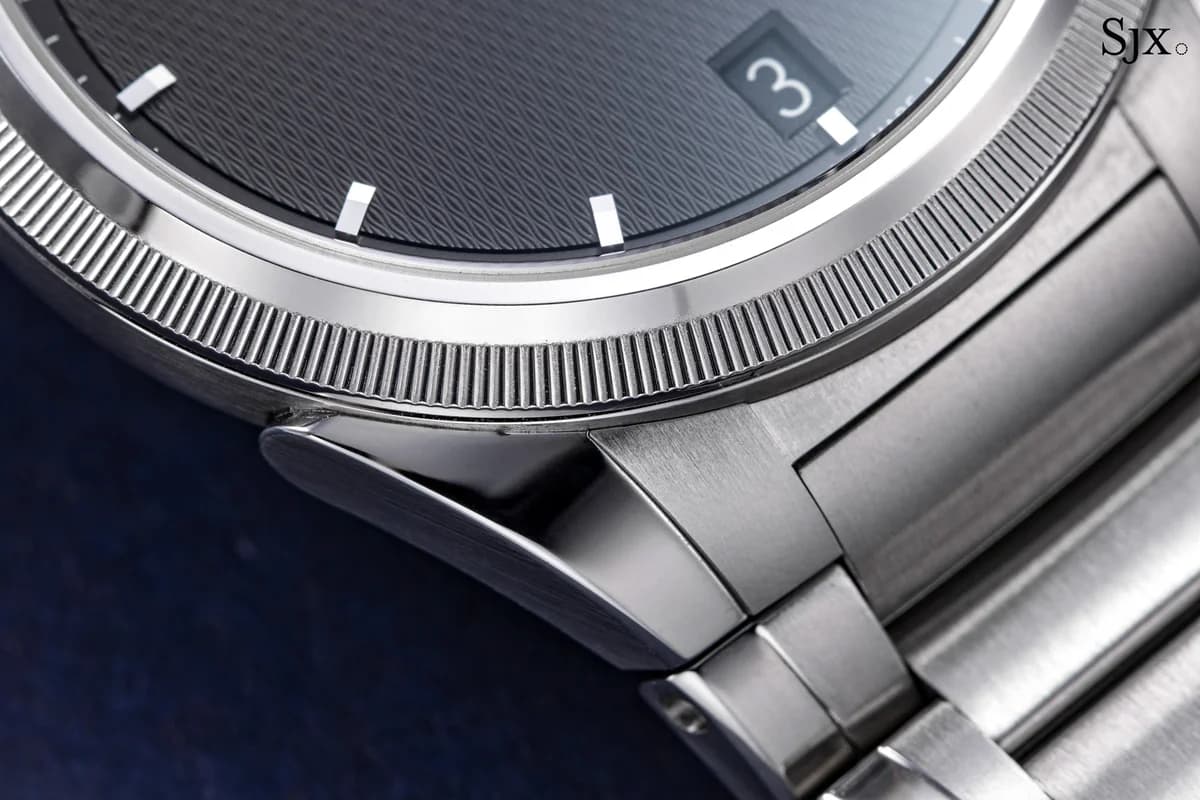
I love how the bracelet wraps around the wrist on this watch. Multiple reviewers and owners have noted the same thing. The ergonomics are outstanding. The taper from the end links to the clasp is well-proportioned, and the links articulate smoothly without pulling arm hair, which is a detail that sounds minor until you have worn a bracelet that does it constantly. At 7.8mm thick, the watch sits remarkably flat. Under a shirt cuff, it disappears. That is something I value because a watch that constantly catches on fabric becomes a source of irritation rather than pleasure. The 40mm diameter on a 6.5-inch wrist reads as perfectly proportioned, neither too large nor too small. The weight distribution is balanced despite the platinum bezel, and the overall wearing experience is closer to a dress watch than a sports watch despite the 100-meter water resistance and integrated bracelet construction.
What I find compelling about the broader Parmigiani story is the restoration background. Most brand founders come from one of two paths. Either they train as watchmakers and build movements, or they come from business and build brands. Michel Parmigiani came from restoration, which means he spent decades understanding how the greatest watchmakers of the past solved problems. He physically handled mechanisms built by Breguet, by the English makers, by the Geneva and Jura Valley traditions going back centuries. He disassembled repeaters, automata, pocket watches with complications that modern watchmakers study in textbooks but never touch. When he finally built his own movements, he was drawing on a kind of empirical knowledge that no formal training program can replicate. That shows in details like the micro-rotor architecture, the guilloche dial work, and the overall philosophy that a watch should be finished and engineered to the same standard on every surface, whether visible or hidden. The restoration discipline teaches you that shortcuts eventually surface, often centuries later when someone opens the case to repair it.

The Tonda PF exists in a competitive landscape that includes watches from brands with far greater market recognition and far longer waiting lists. The Royal Oak, the Nautilus, the Overseas, the Laureato, the Aquanaut. What Parmigiani offers that those brands do not is full vertical integration at a scale where every component is genuinely controlled in-house, combined with a founder who spent his career understanding historical horology before building modern watches. The GPHG (Grand Prix d'Horlogerie de Geneve) has recognized the brand multiple times. In 2017, Parmigiani won two prizes, the Chronograph Watch Prize for the Tonda Chronor Anniversaire and the Travel Time Watch Prize for the Toric Hemispheres Retrograde. In 2022, the Tonda PF Automatic 36mm won the Ladies' Watch Prize. The industry respects what Parmigiani builds even when the broader market has not fully caught up.
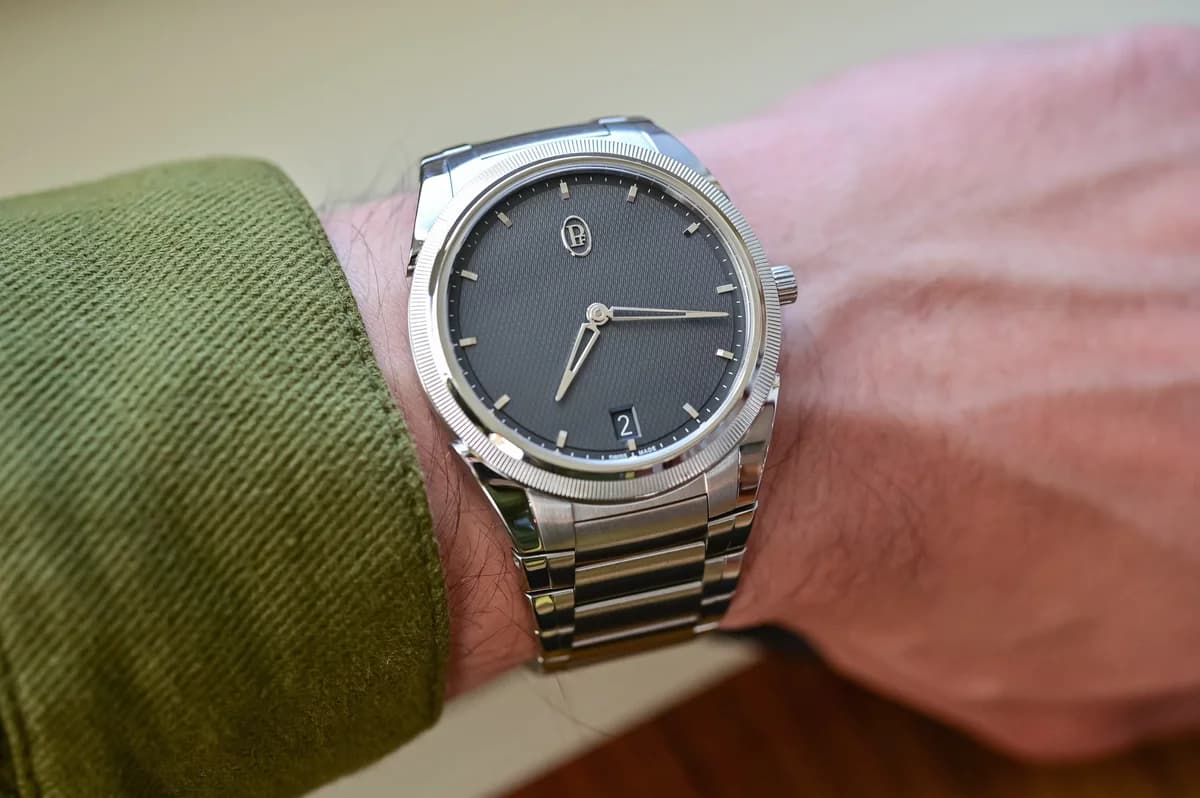
The honest critique on the Tonda PF Micro-Rotor is the lume situation. The standard Tonda PF Micro-Rotor has minimal to no luminous material on the hands and indices. In low light, legibility becomes a challenge. I understand the design rationale. Luminous material on the skeletonized hands and polished indices would compromise the visual purity of the dial, and this is a watch that prioritizes aesthetic refinement over tool-watch functionality. But 100 meters of water resistance suggests a watch that might accompany its owner through varied conditions, and being unable to read the time in a dim restaurant is a practical limitation. The Tonda PF Sport models address this with luminous hands, but the standard Micro-Rotor sacrifices that readability for visual coherence. I wish Parmigiani offered an option with subtle lume that did not disrupt the dial design. It is a tradeoff, and it is worth knowing before committing.
The 48-hour power reserve is another area where the Tonda PF Micro-Rotor sits behind some competitors. The Royal Oak 15500 with Caliber 4302 offers 70 hours. The Overseas with Caliber 5100 offers 60 hours. At 48 hours, the PF703 will stop if left unworn over a long weekend. That is the tradeoff of a 3mm-thin movement. Thinner movements have less space for mainspring barrel capacity, and the micro-rotor architecture devotes some of that space to integrating the winding mechanism within the movement height. For a daily wearer, 48 hours is perfectly adequate. For someone who rotates through several watches, a winder becomes more necessary.
In my experience, the watches that earn the deepest respect over time are the ones that come from genuine substance rather than marketing momentum. Parmigiani Fleurier is a brand where the substance has always exceeded the awareness. The Tonda PF, and particularly this Micro-Rotor variant, is the first watch from the brand that has closed that gap in a meaningful way. The warm grey grain d'orge dial under a Zegna wool suit cuff, the platinum bezel catching afternoon light, the 7.8mm case that sits like it was designed for exactly this wrist. These are details that register physically, not just intellectually. On darker skin tones, the warm grey and polished platinum combination has a quiet richness that photographs do not fully capture. The dial shifts between silver-grey and a warmer taupe depending on the light source, and the knurled platinum bezel provides just enough visual weight to frame the dial without overwhelming it.
Parmigiani Fleurier is not a brand that most people will recognize when they see it on a wrist. That is part of the appeal, and I think Guido Terreni understood that when he refined the branding. For someone who values the craft more than the recognition, the Tonda PF Micro-Rotor is one of the most compelling integrated-bracelet watches available from any brand at any level. The movement is genuinely thin, the dial finishing is genuinely handmade, the vertical integration is genuinely complete. Those are not marketing claims. They are engineering facts backed by five subsidiary companies and 33 original calibers.
The Tonda PF collection has expanded since 2021, adding a chronograph, a GMT rattrapante, a skeleton, and the Sport variants with slightly larger cases and more solid styling. The Micro-Rotor remains the purest expression of the original concept. Thin, refined, baroque without being ornate, and genuinely different from everything else in the category. It is a watch for someone who has already been through the Rolex phase, the Omega phase, possibly even the AP or Patek phase, and who now wants something with genuine substance that most people will walk past without recognizing. That is not a weakness. That is the entire point. The watch community is starting to notice, and for good reason.
Also in Haute Horlogerie