
MB&F
Legacy Machine Sequential EVO
09.ZR.OR
Max Busser does not call himself a watchmaker. He calls himself a creative director. MB&F stands for Maximilian Busser and Friends, and the friends are the master watchmakers, engineers, and artisans that Busser commissions to build machines that happen to tell time. The Horological Machines look like spacecraft. The Legacy Machines look like Victorian scientific instruments. Nothing in the MB&F catalog looks like a conventional watch, and that is the entire point. Busser spent seven years as CEO of Harry Winston Rare Timepieces, where he created the Opus series by pairing the Harry Winston name with independent watchmakers who would never have had that platform on their own. He left on July 15, 2005, and founded MB&F ten days later. The concept was simple: instead of a brand commissioning watchmakers in the background, what if the watchmakers were the whole story? What if the brand was just the framework that let them build whatever they wanted?
I find that idea fascinating because it inverts the entire structure of the Swiss watch industry. Most brands have a house style, a design language, a set of rules. MB&F has none of that. Each machine starts with a question. What would a watch look like if it were designed by someone who had never seen a watch? What if we built a three-dimensional engine instead of a flat movement? What if the chronograph were two chronographs? The answers are wild, sometimes absurd, and always technically serious. Before MB&F, Busser spent seven years at Jaeger-LeCoultre, so the man knows what traditional watchmaking looks like. He chose to walk away from it. That takes a certain kind of confidence, and the results have justified it at every step.
The Legacy Machine Sequential EVO won the Aiguille d'Or at the Grand Prix d'Horlogerie de Geneve in November 2022. The Aiguille d'Or is not a category award. It is the grand prize, the best watch of the year, selected by a jury of watchmakers, collectors, journalists, and historians. In a year that included entries from Patek Philippe, Audemars Piguet, A. Lange and Sohne, and every other name in haute horlogerie, the jury chose an MB&F. That is not nothing. That is a statement about where watchmaking is going.
The man behind the movement is Stephen McDonnell, and his story is one of the more unusual ones in contemporary watchmaking. McDonnell was born in Belfast in 1972. He studied Theology at Oxford. Not engineering, not microtechnology, not horology. Theology. After graduating, he went back to Belfast and started repairing clocks for jewelers and antique dealers because he was obsessed with mechanical things and there was no watchmaking industry in Northern Ireland to join. In January 2001, he went to Switzerland for a 20-week refresher course at the Watchmakers of Switzerland Training and Educational Program. They asked him to stay on as an instructor, and he spent about six and a half years there. He eventually returned to Northern Ireland and set up his own workshop, where he designs and builds movements from scratch. He is one of those rare watchmakers who can conceive a movement, model it in 3D, prototype it, and finish it, all in his own shop. McDonnell previously designed the MB&F Legacy Machine Perpetual, which launched in 2015, and the LM Sequential EVO is his second major collaboration with Busser. It was MB&F's 20th caliber in 17 years and their first chronograph ever.
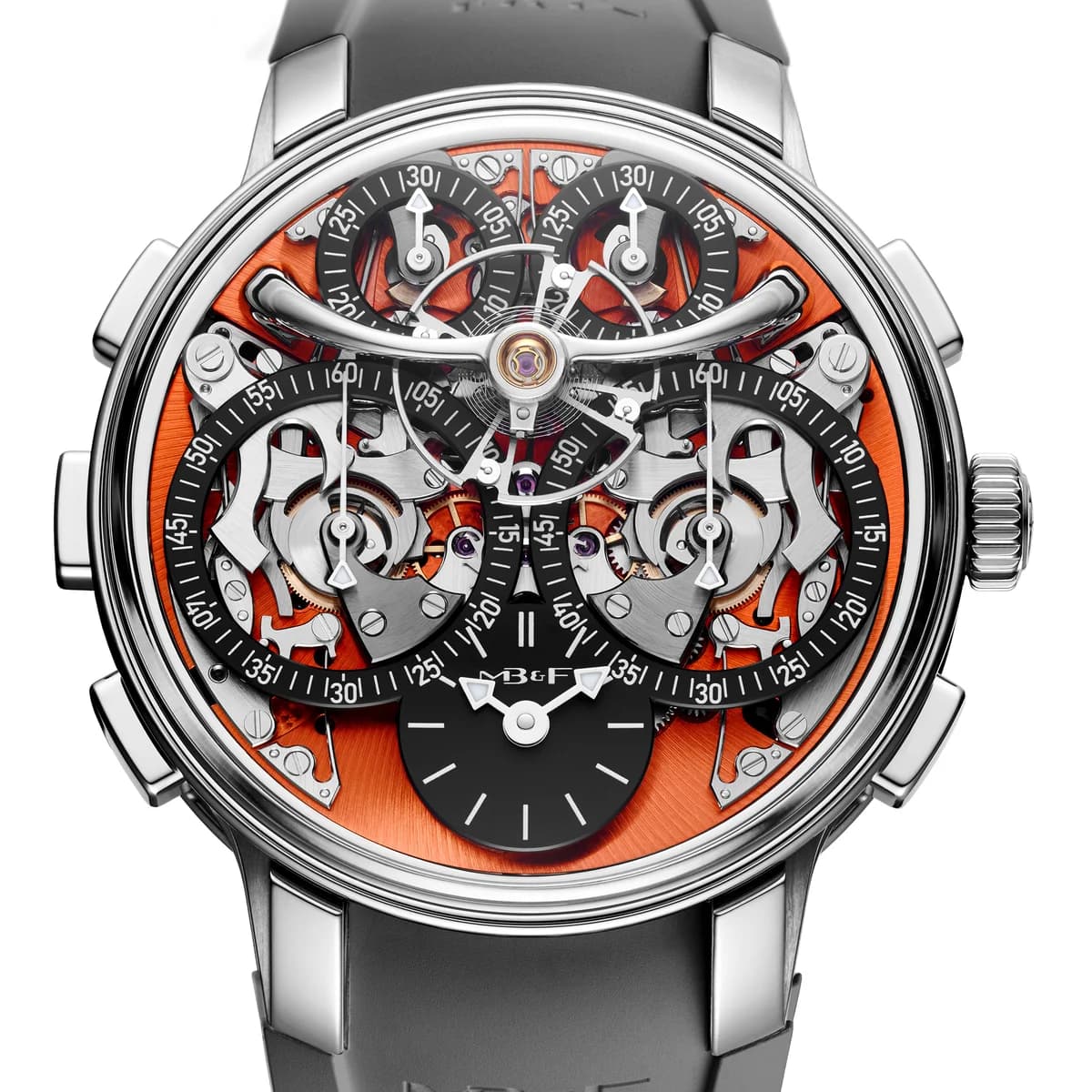
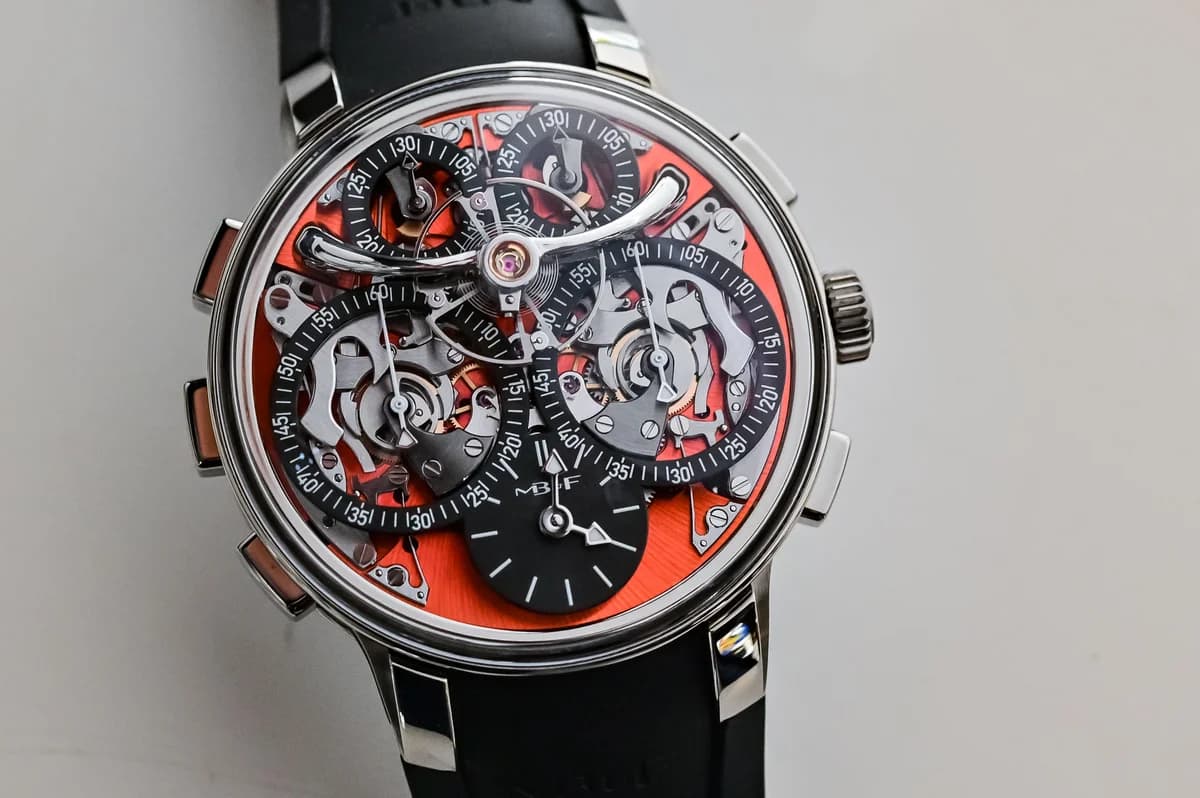
The movement contains 585 components and 59 jewels. It beats at 21,600 vibrations per hour, which is 3 Hz, and it has a 72-hour power reserve from a double mainspring configuration. Those numbers are interesting on their own, but what makes this watch genuinely different is the architecture. Instead of one chronograph mechanism, McDonnell built two complete, independent column-wheel chronographs arranged in perfect 180-degree rotational symmetry. Each chronograph has its own column wheel, its own vertical clutch, its own 60-second counter, and its own 30-minute totalizer. The left chronograph displays at 9 and 11 o'clock. The right displays at 3 and 1 o'clock. They share a single flying balance wheel, suspended above the dial on a polished bridge that spans from 11 to 1 o'clock, beating in the open air with a Breguet overcoil and regulating screws. Below the balance wheel, the time display sits at 6 o'clock.
I appreciate how McDonnell solved the interaction problem between the two chronographs. Each one has its own pair of pushers for start/stop and reset, which is straightforward. But the breakthrough is the Twinverter, a single pusher at 9 o'clock that simultaneously actuates both column wheels and inverts their states. If both chronographs are stopped, pressing the Twinverter starts both. If one is running and the other is stopped, the Twinverter swaps them, stopping the running one and starting the stopped one. This binary switching mechanism, which sounds almost digital in concept, creates four distinct timing modes from purely mechanical components. Independent mode lets each chronograph run separately. Simultaneous mode starts and stops both together. Cumulative mode lets one chronograph pick up where the other left off, like a relay. And sequential mode, which gives the watch its name, works as a lap timer, with one chronograph freezing its time while the other continues, then swapping on the next press.
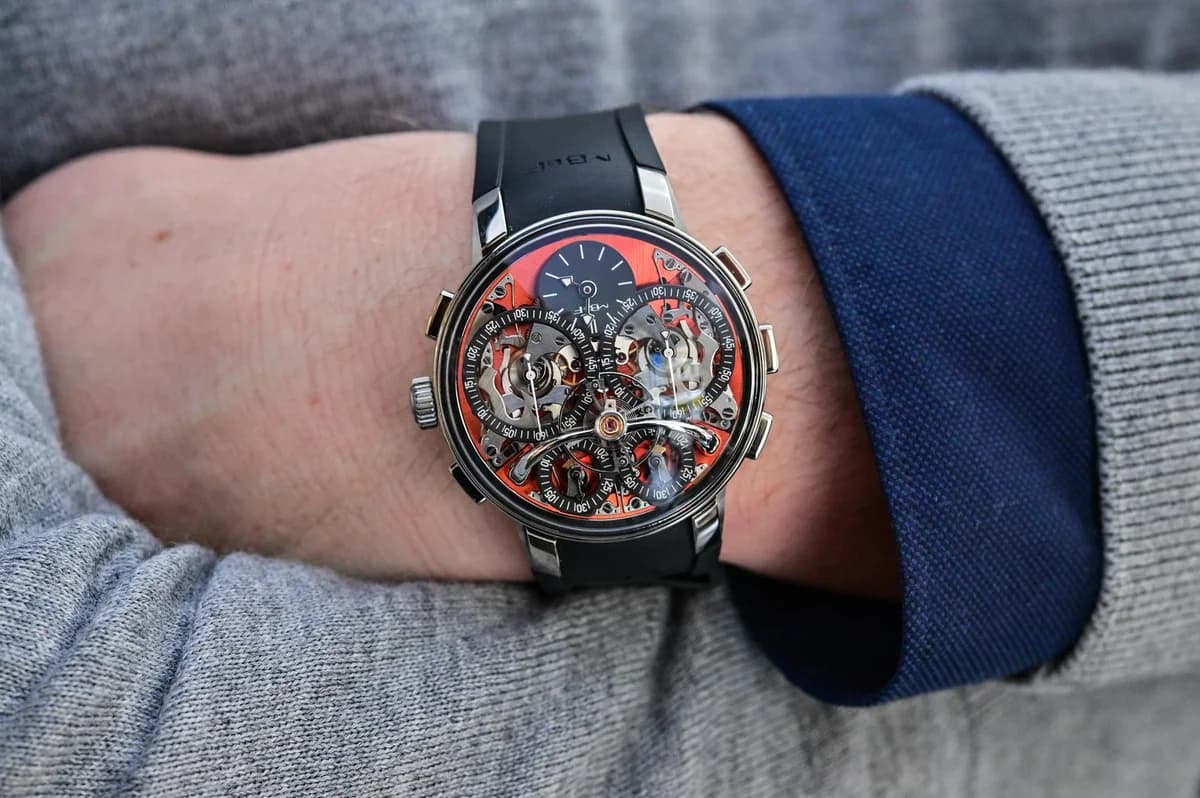
The case is 44mm in diameter and 18.2mm thick, which is a large watch by any measure. It is made from zirconium, a material that is lighter than stainless steel and harder than titanium. Despite the substantial dimensions, the steeply arched lugs direct the integrated rubber strap down rather than out, which helps it wrap around the wrist rather than sitting on top of it. I notice that on wrist shots, the watch wears better than the numbers suggest. The domed sapphire crystal on both front and back has anti-reflective treatment, and the screw-down crown gives it 80 meters of water resistance, which is more than most haute horlogerie chronographs offer. The EVO designation in MB&F's lineup means the case incorporates their FlexRing system, an annular dampener fitted between the case and movement that provides shock protection along vertical and lateral axes. This is a watch designed to actually be worn, not just admired in a safe.
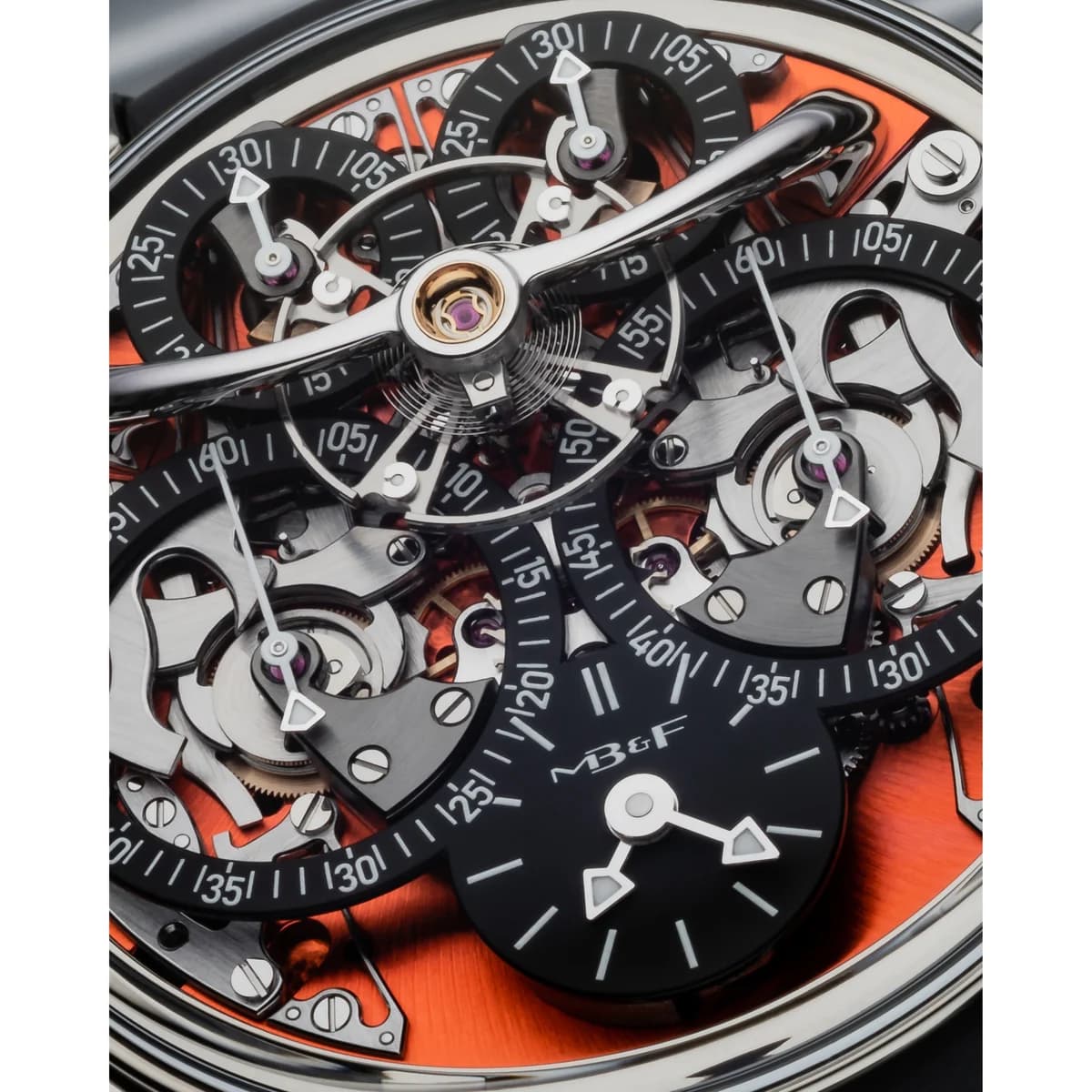
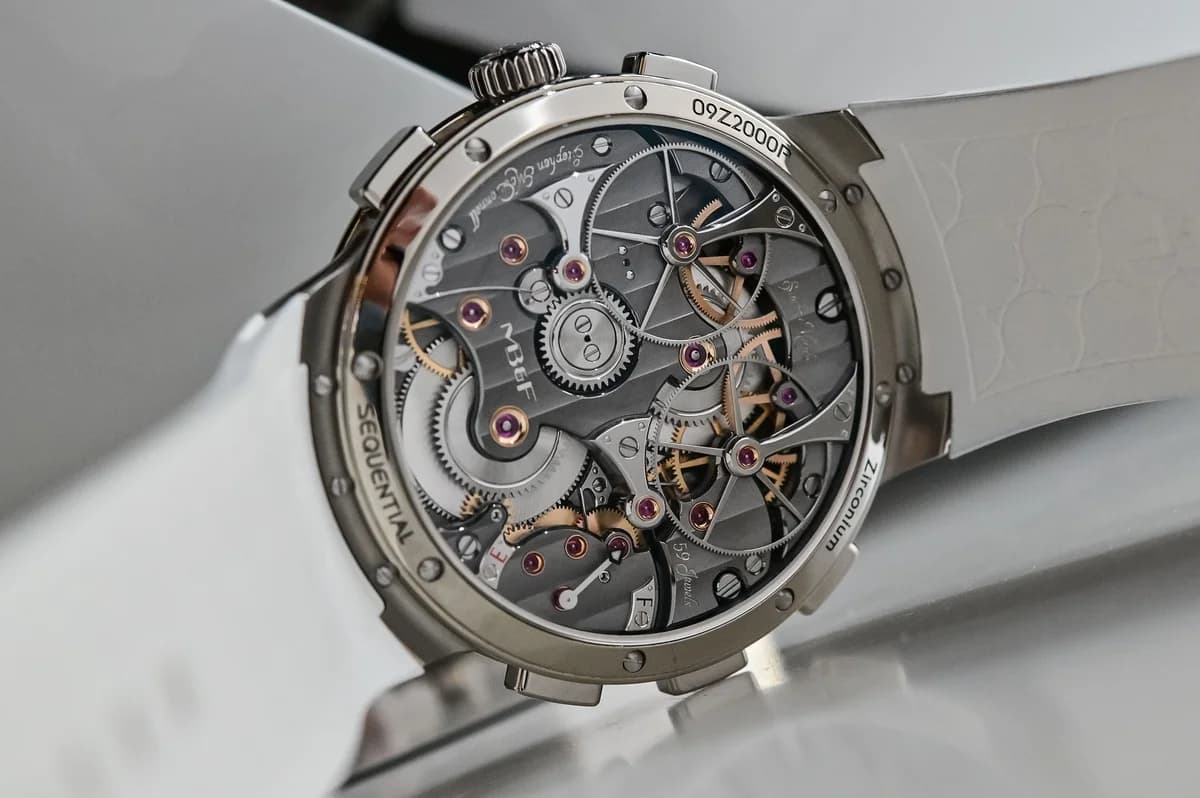
The finishing on the movement is beautiful in a way that is specifically MB&F. Through the sapphire caseback, the bridges are darkened with a NAC coating and decorated with Geneva waves. The bevels are polished by hand, and the internal bevel angles are executed at precise widths that highlight the handcraft. The caseback is engraved with Stephen McDonnell's signature, which I think is a thoughtful touch. Most brands do not credit the individual movement constructor on the watch itself. MB&F does, because the friends in the name are supposed to matter.
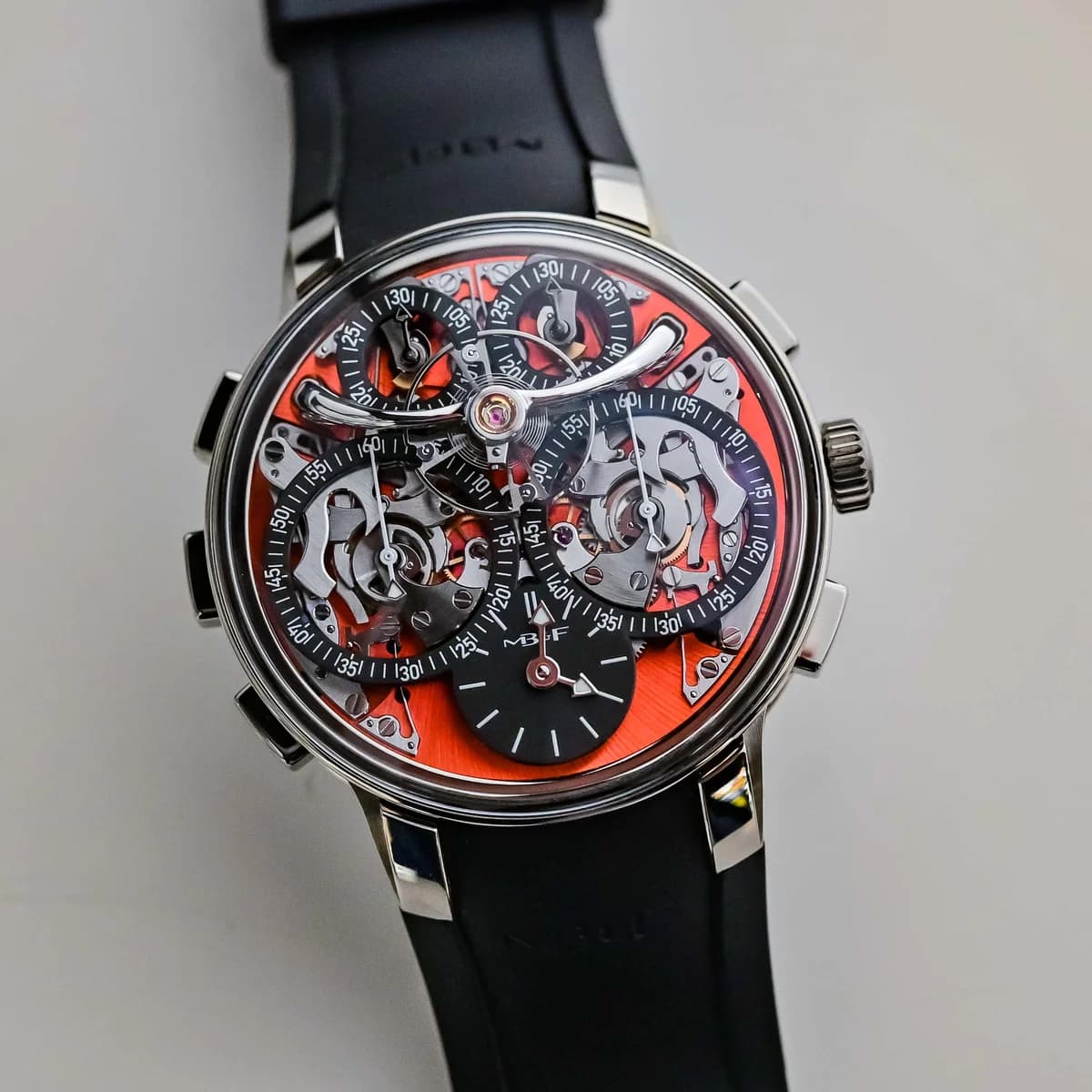
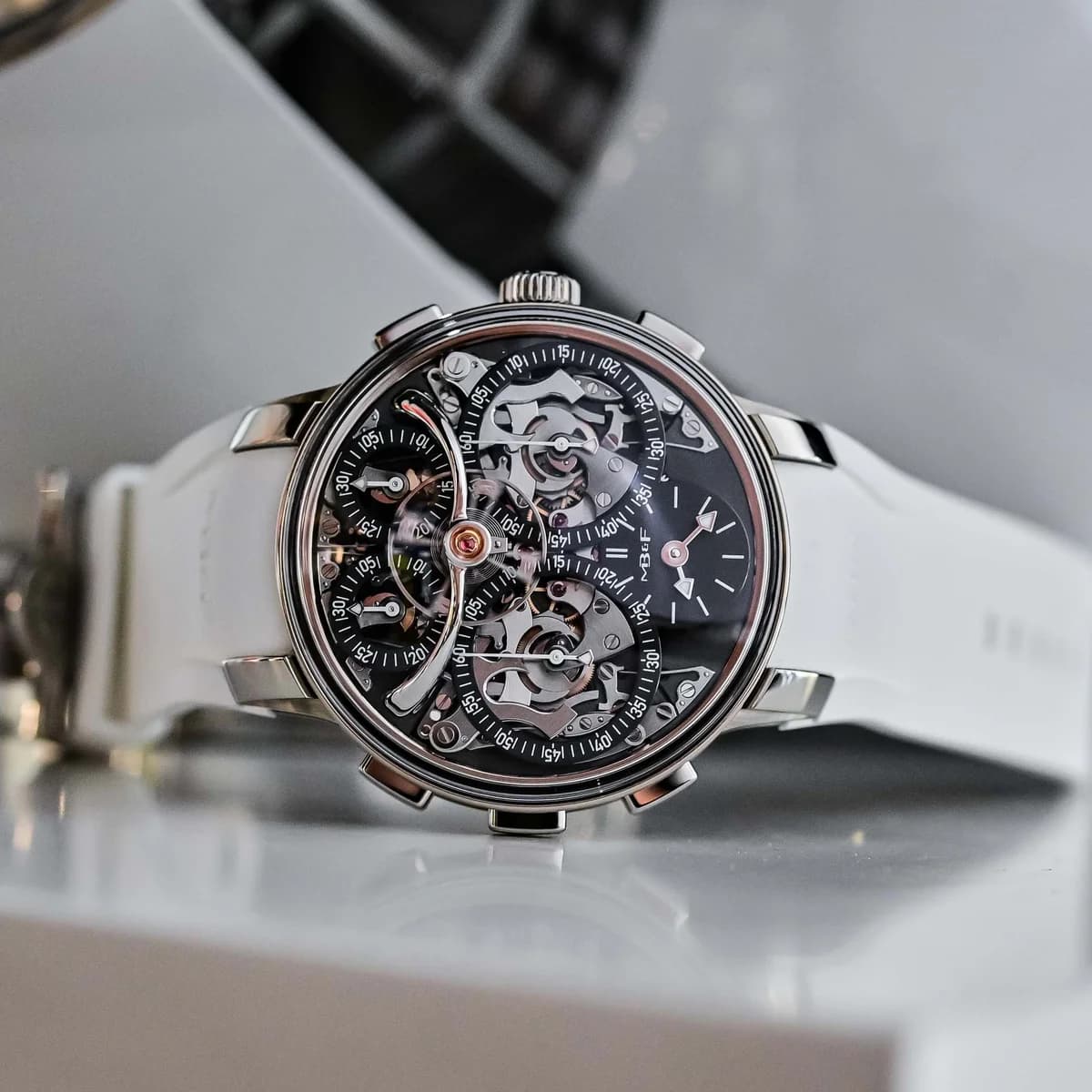
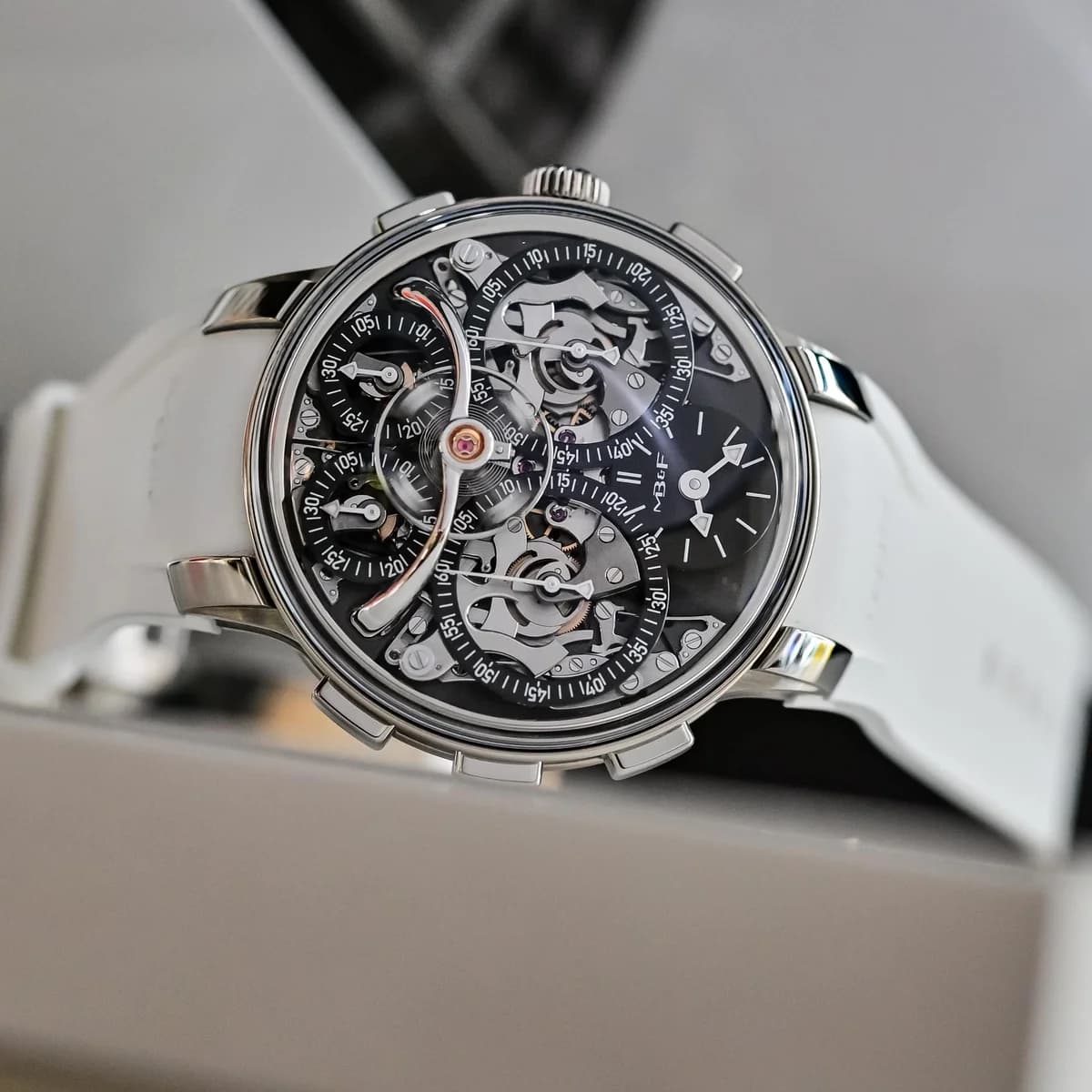
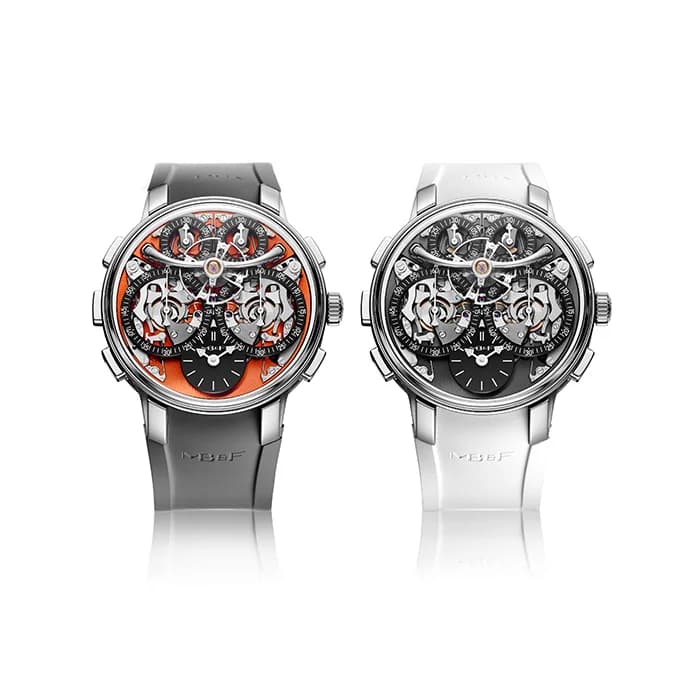
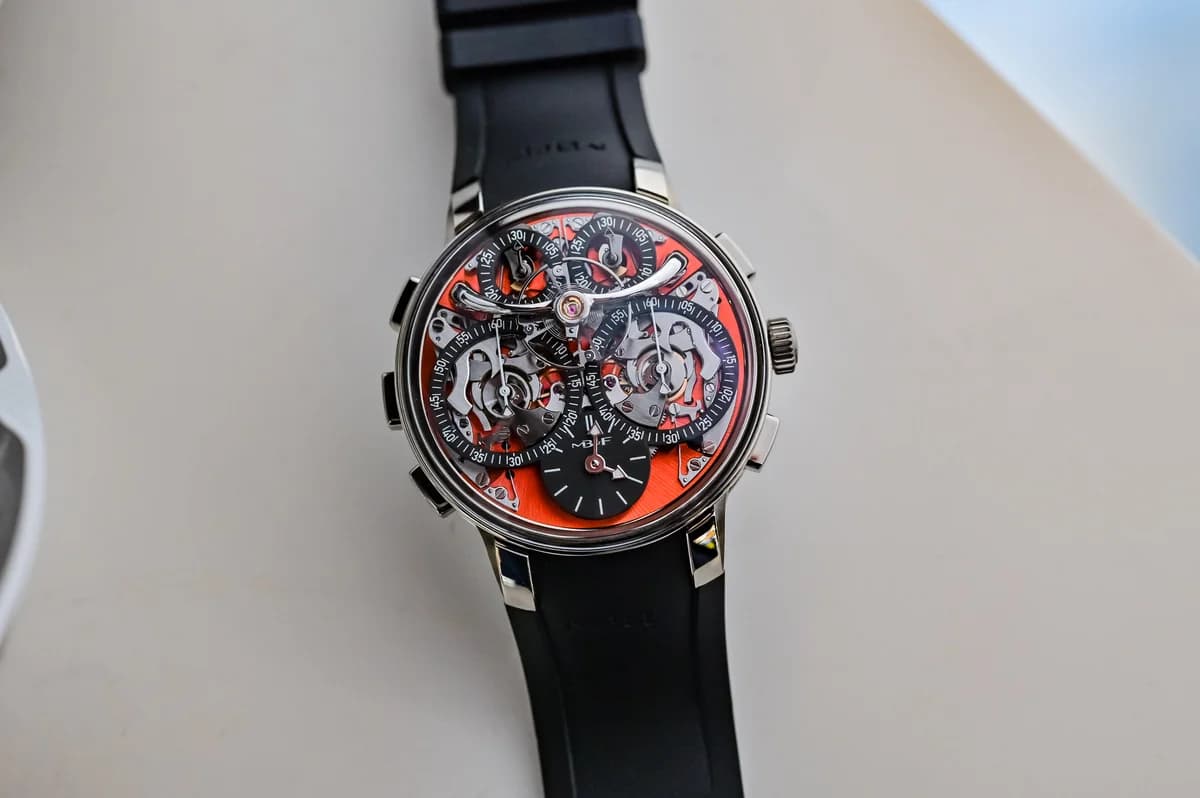
The watch is available in two dial configurations. The atomic orange version (reference 09. ZR. OR) has a CVD-coated orange dial plate with a black rubber strap. The coal black version (reference 09. ZR. BL) has a PVD-coated black dial plate with a white rubber strap. Both feature Super-LumiNova-treated hands. The orange is the one that won the Aiguille d'Or and it is, in my opinion, the more striking of the two. That orange base plate glowing through the open-worked movement, with all those polished steel bridges and column wheels layered on top, creates a depth of field that photographs simply do not capture. The black version is more subdued and lets the architecture speak for itself, which has its own appeal.
I want to talk about the broader MB&F context because it matters for understanding what this watch represents. When Busser founded MB&F in 2005, the idea of a horological concept laboratory sounded like marketing. But he has spent two decades proving that it is a real operating model. The Horological Machines, starting with HM1 in 2007, are three-dimensional sculptures that tell time. The Legacy Machines are a parallel line that takes traditional watchmaking conventions, the suspended balance wheel, the dome crystal, the classical layout, and reinterprets them. The co-creations pair MB&F with artists, musicians, and other watchmakers for one-off projects. MB&F produces somewhere between 250 and 500 pieces per year across all references, depending on the year and the complexity of the lineup. That is tiny by any standard. Each piece is finished by hand.
For me, the Sequential EVO sits at an interesting crossroads in MB&F's evolution. It is their first chronograph, which means McDonnell was not iterating on an existing MB&F complication. He started from scratch, and instead of building a conventional single chronograph, he built something that had never existed before. The closest comparison in concept is a rattrapante, a split-seconds chronograph, but the mechanism here is fundamentally different. A rattrapante uses a single movement with an overlay system. The Sequential EVO uses two entirely independent movements that can interact. The distinction matters because it means there is no physical coupling between the two chronograph trains except through the Twinverter. Each train is complete unto itself. I have spent time looking at the interaction between the two chronograph trains through the open dial, and what strikes me is how the symmetry works. The left and right sides of the movement mirror each other precisely. It is not just visually balanced. It is mechanically balanced. The torque distribution, the gear meshing, the energy flowing through both trains simultaneously, all of it is engineered so that running both chronographs does not starve the balance wheel of energy or affect timekeeping accuracy. That is not a trivial problem to solve, and McDonnell solved it within a 72-hour power reserve envelope, which is respectable for a hand-wound movement with this level of complication.
The honest observation I would make about this watch is the thickness. At 18.2mm, this is not a watch that slides under a shirt cuff. It sits proudly on the wrist and it makes its presence known. For a Legacy Machine, which historically has been about elegance and classical proportions, 18.2mm is a real commitment. I understand why. You cannot stack two complete chronograph mechanisms, a flying balance wheel, and four chronograph subdials into a thin case. The complexity demands the volume. But it does limit how the watch can be styled. This is a rolled-sleeves watch, a casual blazer watch, maybe something to pair with a Tom Ford knit polo and a lightweight jacket. It is not going under the cuff of a fitted dress shirt. On darker skin tones, the zirconium case has a beautiful contrast. The grey metallic finish against warm skin creates a visual weight that polished steel does not. Combined with the orange dial, which has an almost amber quality in warm light, the watch has a presence that works with earth tones and neutrals. I can see this with olive, charcoal, or navy. That is a tradeoff I can live with because what is happening inside that 18.2mm of vertical space is worth looking at from every angle.
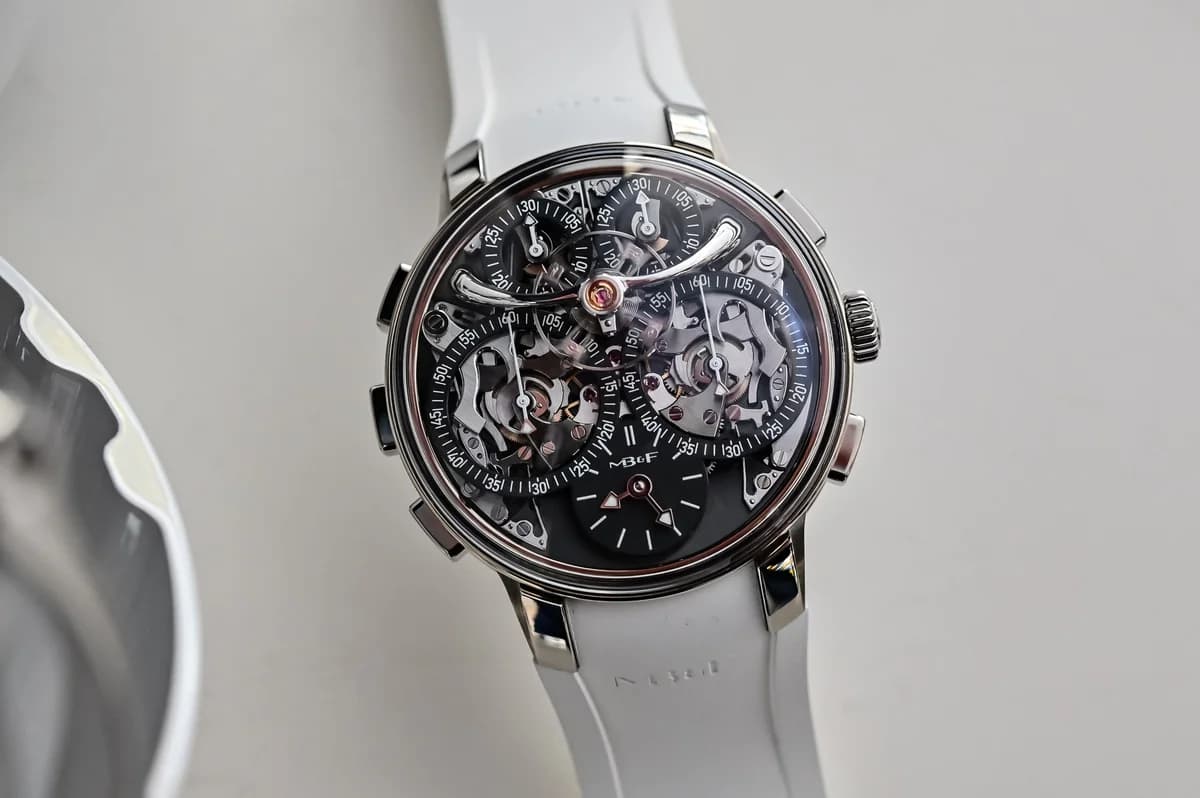
The five pushers are another adjustment. Two on the upper left, two on the upper right, and the Twinverter at 9 o'clock. Operating the watch requires understanding which pusher does what, and there is a learning curve. This is not a grab-and-go chronograph like a Speedmaster where one button starts and stops and another resets. The complexity of the interaction model matches the complexity of the mechanism. I find that honest. The watch does not pretend to be simpler than it is. There is a period of sitting with it, understanding which pair of pushers controls which chronograph, getting comfortable with the Twinverter logic. Once it clicks, the system is elegant. But the learning curve is real and I think anyone considering this watch needs to know that going in.
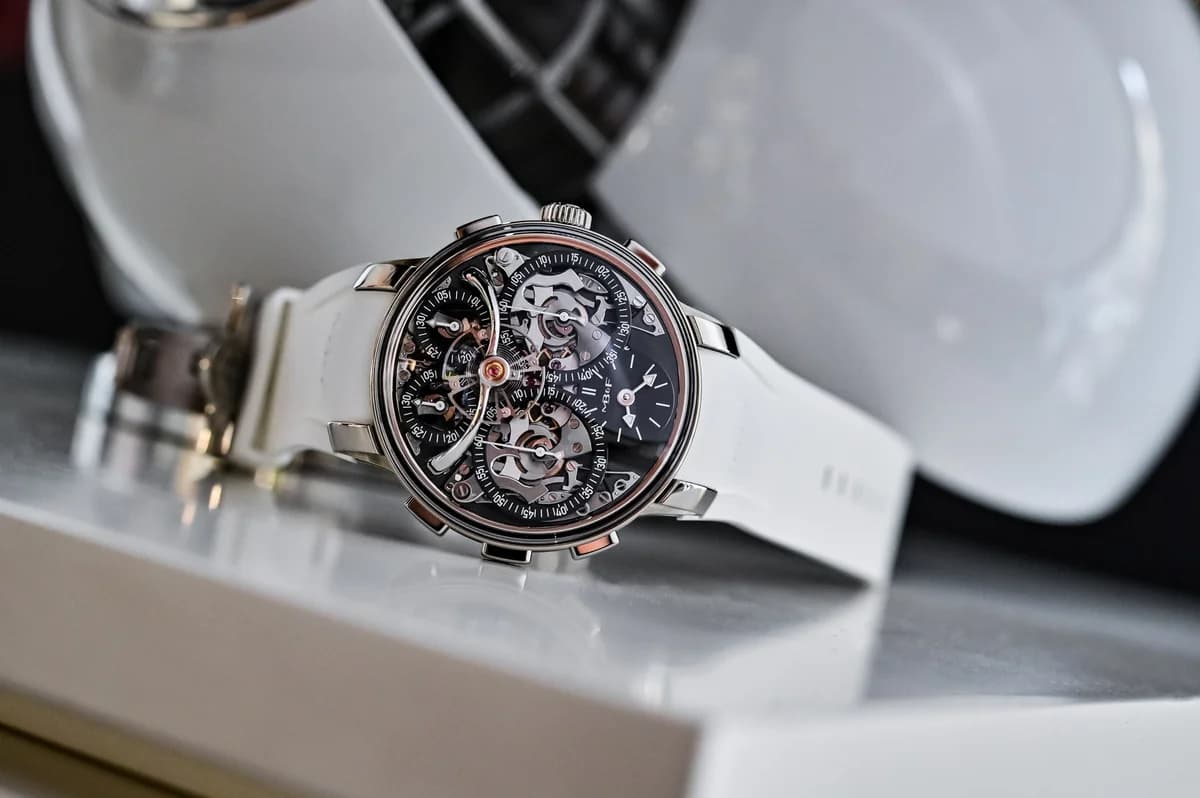
The zirconium case deserves a note because it is an unusual material choice. Zirconium is not ceramic and it is not titanium. It is a metallic element that develops a dark grey oxidation layer, giving it a color that falls somewhere between polished steel and matte gunmetal. It is hypoallergenic, exceptionally corrosion-resistant, and has a hardness that makes it resistant to the kinds of micro-scratches that polished steel and gold accumulate over time. For a watch at this level of complication, having a case material that will actually hold up to daily wear is a practical consideration that I appreciate.
The watch connects to a broader story about independent watchmaking that I think is important. For decades, the GPHG was dominated by the established names. Patek, Lange, Vacheron, Audemars Piguet. The fact that MB&F won the top prize, and that a watchmaker from Belfast designed the winning movement, says something about how the center of gravity in watchmaking is shifting. The best movement design in 2022 did not come from the Vallee de Joux or from Geneva or from Glashutte. It came from a workshop in Northern Ireland, built by a man who studied Theology and taught himself how to make watches. That is an extraordinary story, and it is the kind of story that only happens when someone like Busser builds a platform specifically designed to let it happen.
I love that the caseback tells you everything about who made this watch. Turn it over and there is Stephen McDonnell's name engraved on the movement, alongside the MB&F logo, the word Sequential, and the material designation. The Geneva waves flow across the bridges, the jewels catch light through the sapphire crystal, and the twin column wheels are visible in their full mechanical glory. It is like looking at the engine of a car through a glass hood, except this engine was hand-assembled by a Theology graduate from Belfast.
The LM Sequential EVO is not a limited edition, which is worth noting. In an era where limited production runs and artificial scarcity drive the independent market, MB&F chose to keep this watch in regular production. The constraint is not an edition number. The constraint is that MB&F produces a few hundred watches per year total, across all models, each one assembled and finished by hand in their Geneva workshops. The scarcity is real, not manufactured. When you are building 585-component hand-wound chronographs with twin column wheels and individually polished bevels, production volume is limited by the number of hands available, not by a marketing decision.
When I look at this watch, I see two things at once. I see a chronograph that does something no other chronograph has ever done, with a mechanism that is genuinely new. And I see the MB&F philosophy distilled into a single object. The friends are the point. Stephen McDonnell is the point. The movement carrying his engraved signature on the caseback is the point. Busser built a company where the watchmaker gets his name on the watch, and the watchmaker delivered something that won the highest prize in the industry. That is what MB&F means when they say friends. And that is why this watch, more than any other in their catalog, deserves to be the one that won the Aiguille d'Or. It is not just a machine that tells time. It is a collaboration made visible, a friendship made mechanical, and the best chronograph I have ever seen.
Also in Independent Masters