
The FundamentalsLesson 9 of 10 · 4 min read
Certifications, Standards, and What They Actually Test
COSC, Superlative Chronometer, Master Chronometer, Qualite Fleurier, the Geneva Seal, and the watchmakers who skip all of them

You will see certification stamps and labels on a lot of watches. Some of them mean something. Some of them are marketing. Here is what the major ones actually test.
COSC
COSC (Controle Officiel Suisse des Chronometres) is the baseline. It is an independent Swiss testing body that certifies uncased movements over 15 days in five positions and three temperatures. The tolerance is negative 4 to positive 6 seconds per day. That sounds wide, but it filters out a percentage of submitted movements. A COSC-certified movement is a good movement. It is not an extraordinary one. It means it passed a standardized accuracy test that has been running since 1973.

Rolex Superlative Chronometer
Rolex's Superlative Chronometer is tighter. After COSC certifies the bare movement, Rolex cases it, adds the dial, hands, and bracelet, and then tests the complete watch to plus or minus 2 seconds per day. This is significant because casing a movement changes its behavior. The mass of the dial and hands affects the balance. The gaskets and case geometry affect how the movement sits. Testing the finished watch rather than the bare caliber is a higher standard. Rolex's tolerance is roughly twice as strict as COSC.
Omega Master Chronometer
Omega's Master Chronometer certification is done by METAS (the Swiss Federal Institute of Metrology). It tests the finished watch for accuracy (0 to plus 5 seconds per day), magnetic resistance up to 15,000 gauss, water resistance, power reserve, and accuracy in six positions. The magnetic resistance test is the standout. 15,000 gauss is a genuinely strong field, well beyond what any normal consumer would encounter. Previous "antimagnetic" watches were rated to 1,000 gauss. This certification was designed around Omega's silicon components and co-axial escapement.
Qualite Fleurier
Qualite Fleurier is the most thorough. Established in 2001 by Chopard, Parmigiani, and Bovet (all based in the town of Fleurier), it requires the watch to first pass COSC certification, then pass additional aesthetic and finishing criteria, and then pass the Chronofiable test. Chronofiable is a week of simulated daily wear: shocks, magnetic fields, water exposure, temperature cycles. On top of that, every component must be finished to a specific visual standard, and the entire watch must be 100% Swiss-made. Chopard's L.U.C collection carries this mark. It is arguably the most demanding quality certification in watchmaking.
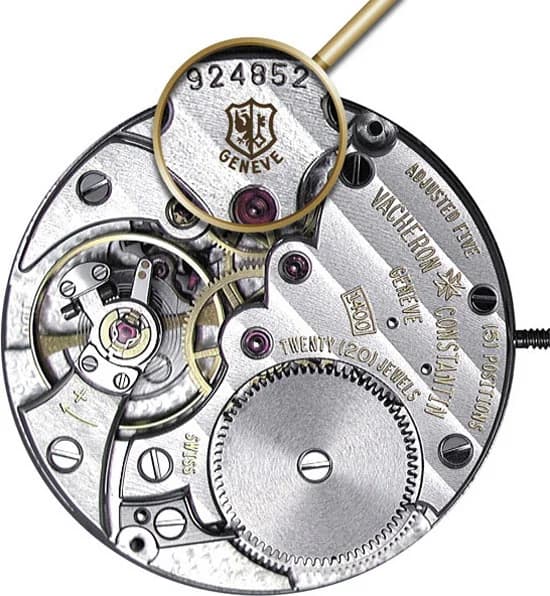
The Geneva Seal
The Geneva Seal (Poincon de Geneve) is both a quality mark and a geographic indicator. The movement must be assembled, cased, and adjusted in the Canton of Geneva. It also requires specific decorative finishing standards: beveled and polished edges, polished screw heads, Geneva stripes or perlage on all visible surfaces. The criteria were updated in 2012 to include chronometric performance testing, closing a long-standing criticism that it was purely cosmetic. Vacheron Constantin and Roger Dubuis carry it.
No Certification at All
And then there is no certification at all. Philippe Dufour does not submit to COSC. Neither did George Daniels. Neither does F.P. Journe for most references. At that level, the maker's name on the dial is the certification. They do not need a third party to validate their work. The work speaks for itself. When you have spent weeks finishing a single movement by hand, a 15-day accuracy test at a lab in La Chaux-de-Fonds is not really the point.

What Matters Most
The certification that matters most depends on what you care about. If you care about accuracy in a finished watch, Rolex's Superlative is hard to argue with. If you care about magnetic resistance, METAS is the gold standard. If you care about total quality including finishing and durability, Qualite Fleurier is the most thorough. If you care about the craft itself, the name on the dial tells you more than any stamp.