
Laurent Ferrier
Square Micro-Rotor Evergreen
LCF013.R5.VR1
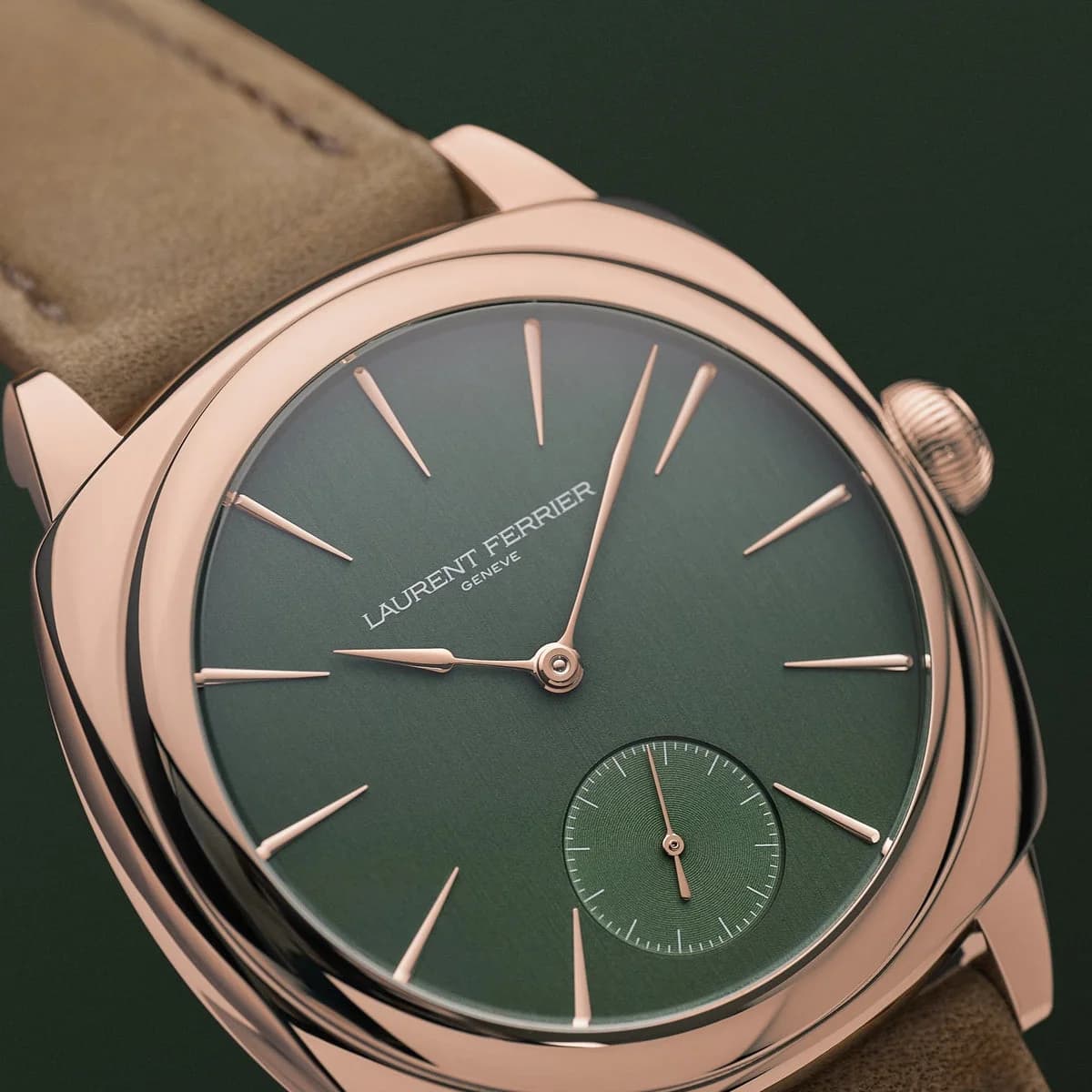
Laurent Ferrier spent 37 years at Patek Philippe. He started in 1968 as a top graduate of the Geneva School of Watchmaking and rose to Technical and Product Director, heading the department that developed cases, dials, hands, crystals, and bracelets for every watch Patek produced. He helped transform Gerald Genta's two-dimensional Nautilus drawings into a three-dimensional reality, working through the engineering challenges of waterproofing and manufacturing an integrated bracelet sport watch in a case shape nobody had attempted before. He worked through the Quartz Crisis without ever doubting that mechanical watchmaking would survive. During the late 1970s, while Japanese quartz movements threatened to render Swiss mechanical watches obsolete, Ferrier stayed at his bench in Geneva refining the craft that his father and grandfather had practiced before him. He is a third-generation watchmaker. Then at 63, he left to build his own brand. His first watch won the Grand Prix d'Horlogerie de Geneve in 2010, taking the Men's Watch Prize for the Galet Classic Tourbillon Double Spiral. That does not happen. Nobody wins the GPHG with their debut piece. Laurent Ferrier did.
But the watchmaking is only half the story. During his Patek years, Ferrier negotiated four-day work weeks so he could race cars. He competed at the 24 Hours of Le Mans seven times. In 1979, driving a Kremer-prepared Porsche 935 as car number 40, he finished third overall with his co-drivers Francois Servanin and Francois Trisconi. All three were amateurs racing against professionals. Paul Newman finished second in the car directly ahead of them, sharing a Dick Barbour Racing Porsche 935 with Rolf Stommelen. The top three finishers were all Porsches. After the race, Ferrier took his prize money and bought Servanin a Patek Philippe Nautilus, engraved on the caseback with "Le Mans 1979." That evening, Servanin told him: one day we will create our own watch brand. It took 30 years, but they did. Servanin bankrolled the company. Ferrier built the watches. His son Christian, a fourth-generation watchmaker who had been developing movements at Roger Dubuis and later at La Fabrique du Temps, joined to handle movement construction. The family legacy continued.
The Square Micro-Rotor is the watch that put Laurent Ferrier on the map. Originally called the Galet Square when it debuted in 2015, galet being French for pebble, the name described exactly what the case is. It sits in your hand like a smooth river stone. The cushion shape has no hard angles, no facets, no sharp transitions. Every surface curves into the next. The domed sapphire crystals on front and back follow the same organic flow. The ball-shaped crown sits flush. It is the anti-Royal Oak. Where Genta's octagon is architectural and industrial, Ferrier's cushion is tactile and natural. You want to hold it. You want to turn it over in your hand. That is not accidental. The design references 19th-century pocket watches, the kind that were made to be held, not just worn. The GPHG recognized this case shape immediately, awarding Laurent Ferrier the Horological Revelation Prize in 2015, the same year the Galet Square debuted.
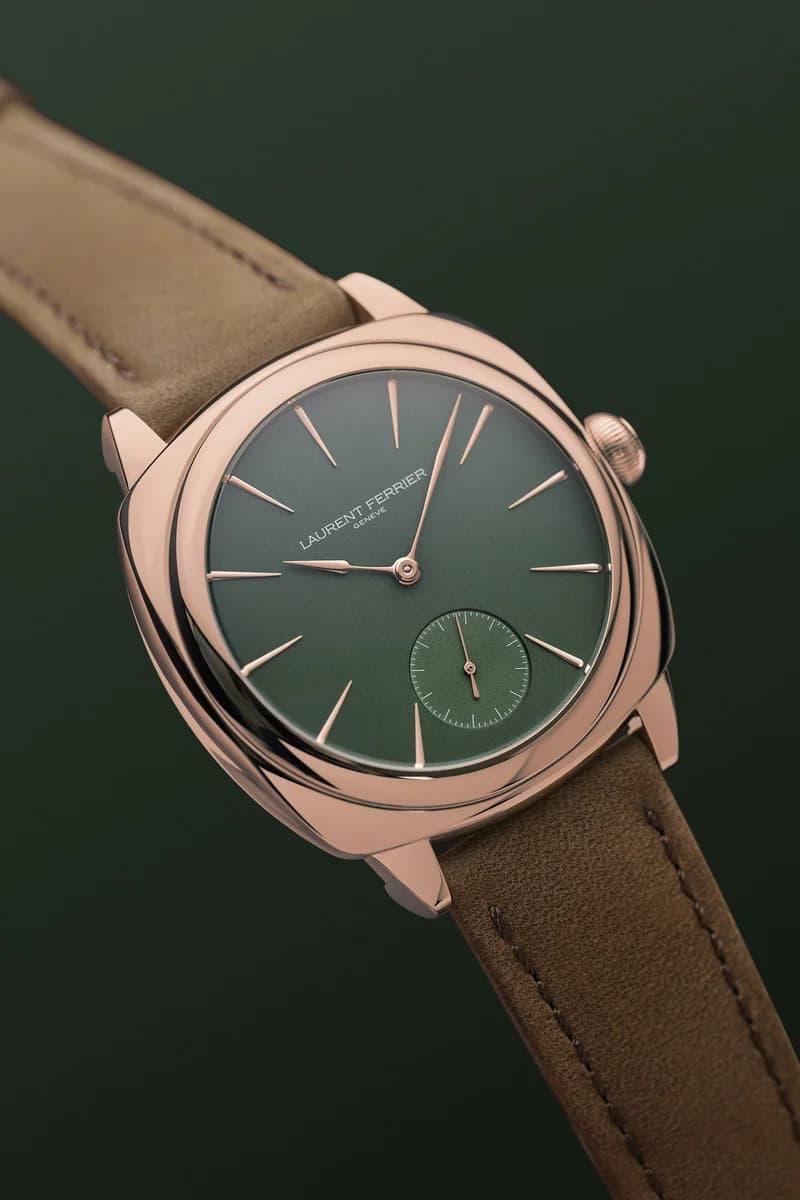
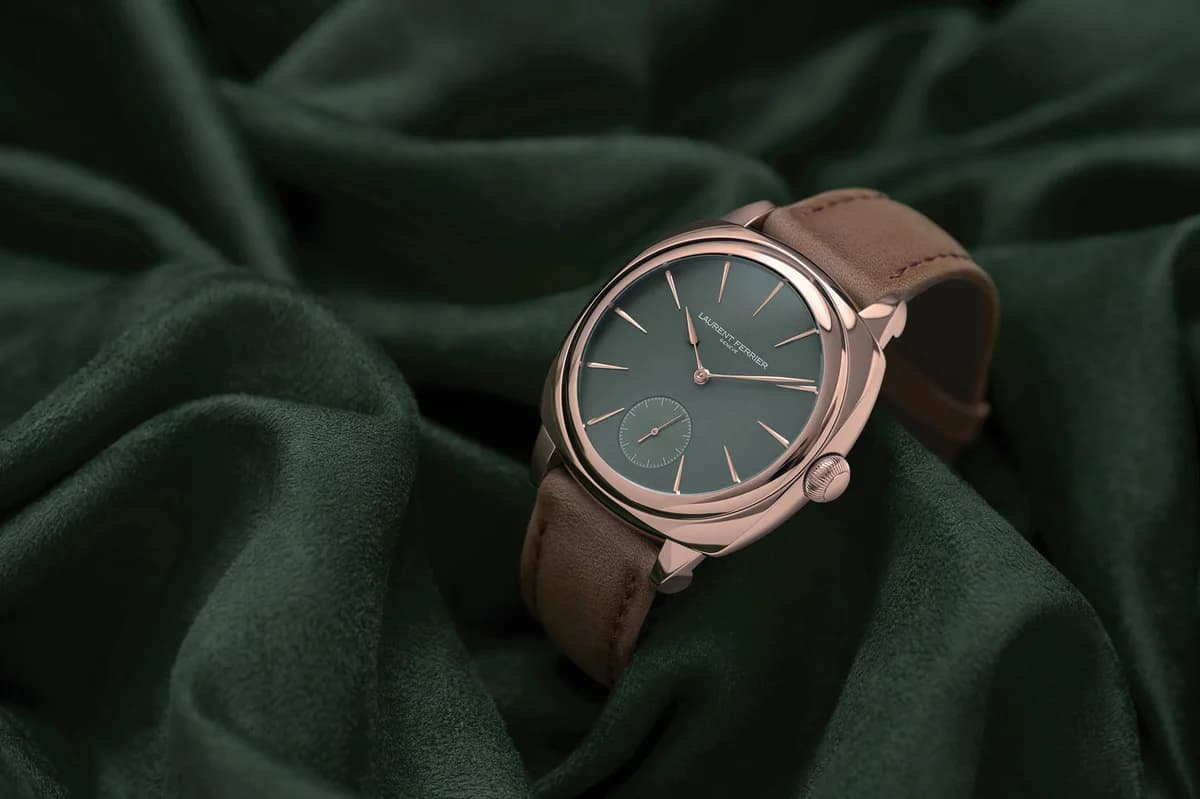
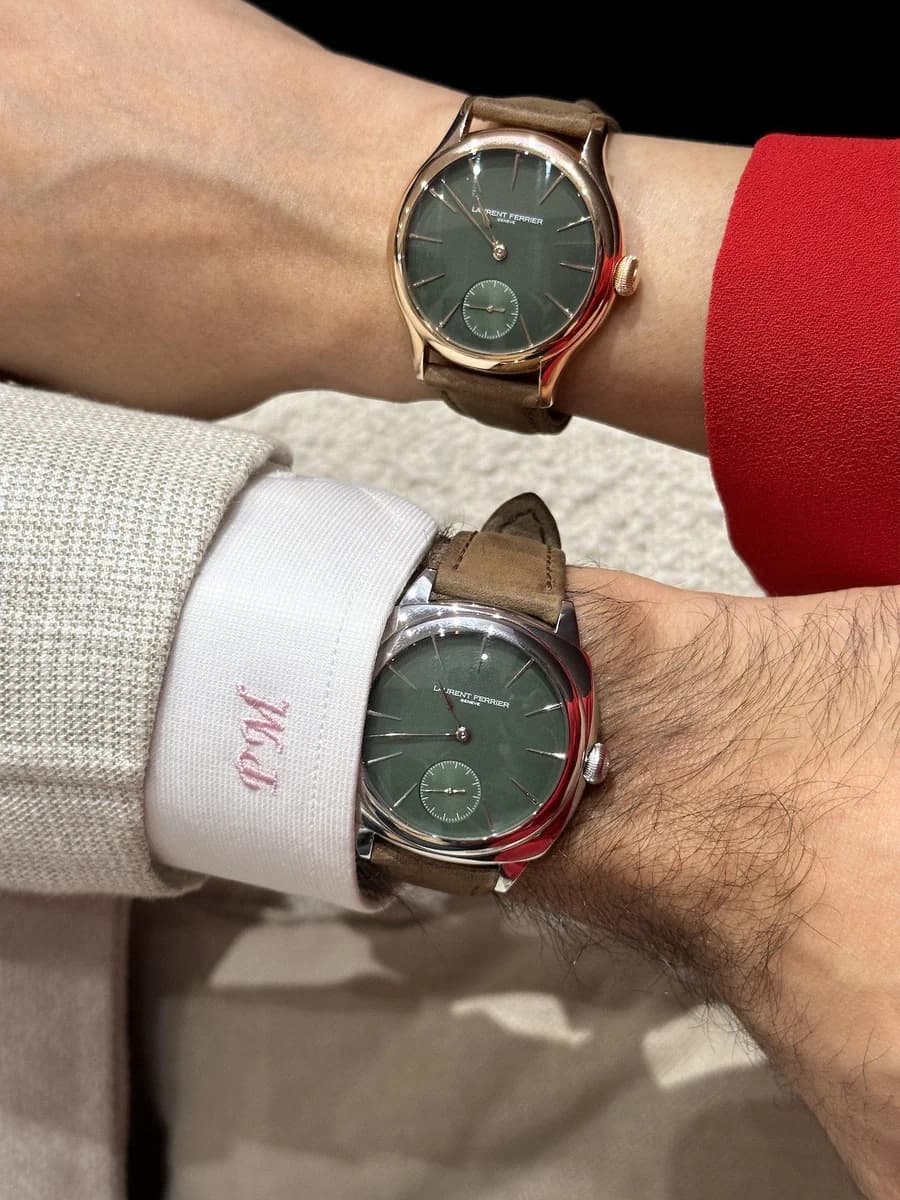
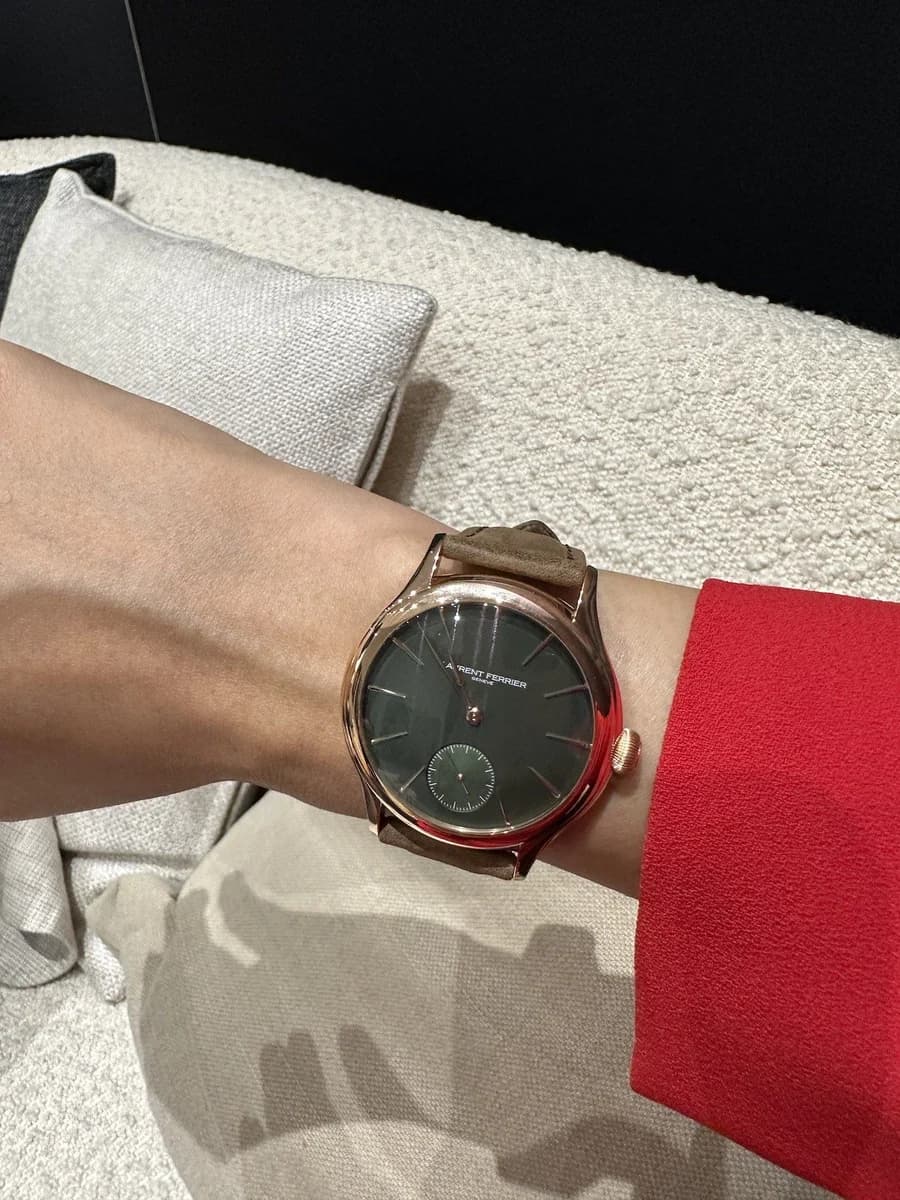
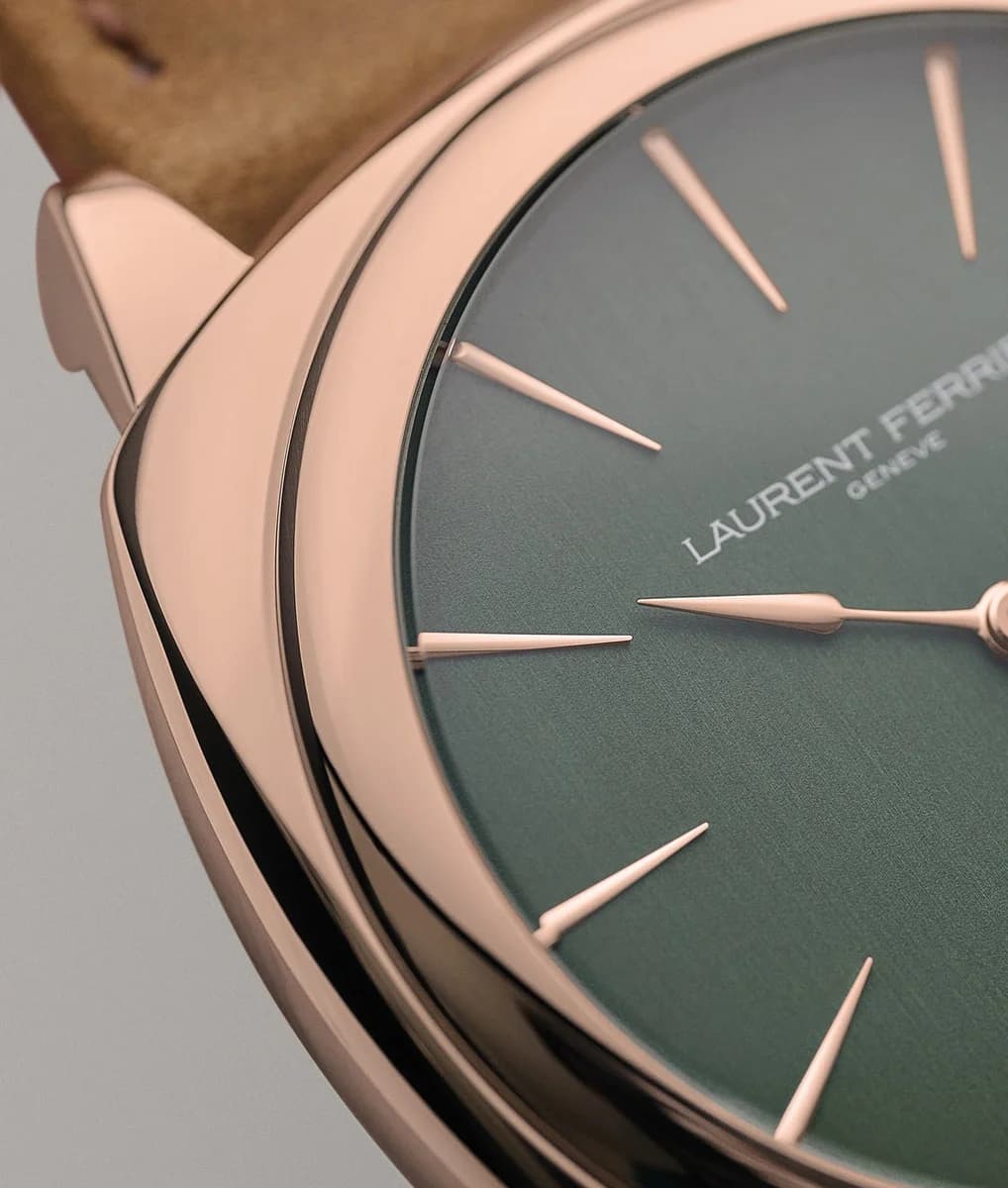
The Evergreen dial in deep green with a vertical satin-brush finish shifts from forest green to near-black depending on the light. The 18K 5N red gold case, indices, and Assegai-shaped hands create a warm contrast against the green that is genuinely striking. 5N is the reddest standard gold color designation on the ISO 8654 scale, achieved by maximizing the copper content in the alloy. The high copper content gives it a depth and warmth that standard rose gold does not achieve. On darker skin, this combination is exceptional. The deep red gold against green against dark skin creates layers of warmth that cooler metals cannot touch. The Assegai hands, named after the African throwing spear, are long, thin, and taper to a sharp point. They have been Laurent Ferrier's signature since the first watch in 2010. What I appreciate about these hands is how much personality they give the dial. What strikes me is how distinctive the Assegai shape is compared to anything else at this level. Most independents at this level use dauphine or leaf-shaped hands. The Assegai is distinctly Laurent Ferrier. If you know watches, you can identify one across a room just from the hand shape.
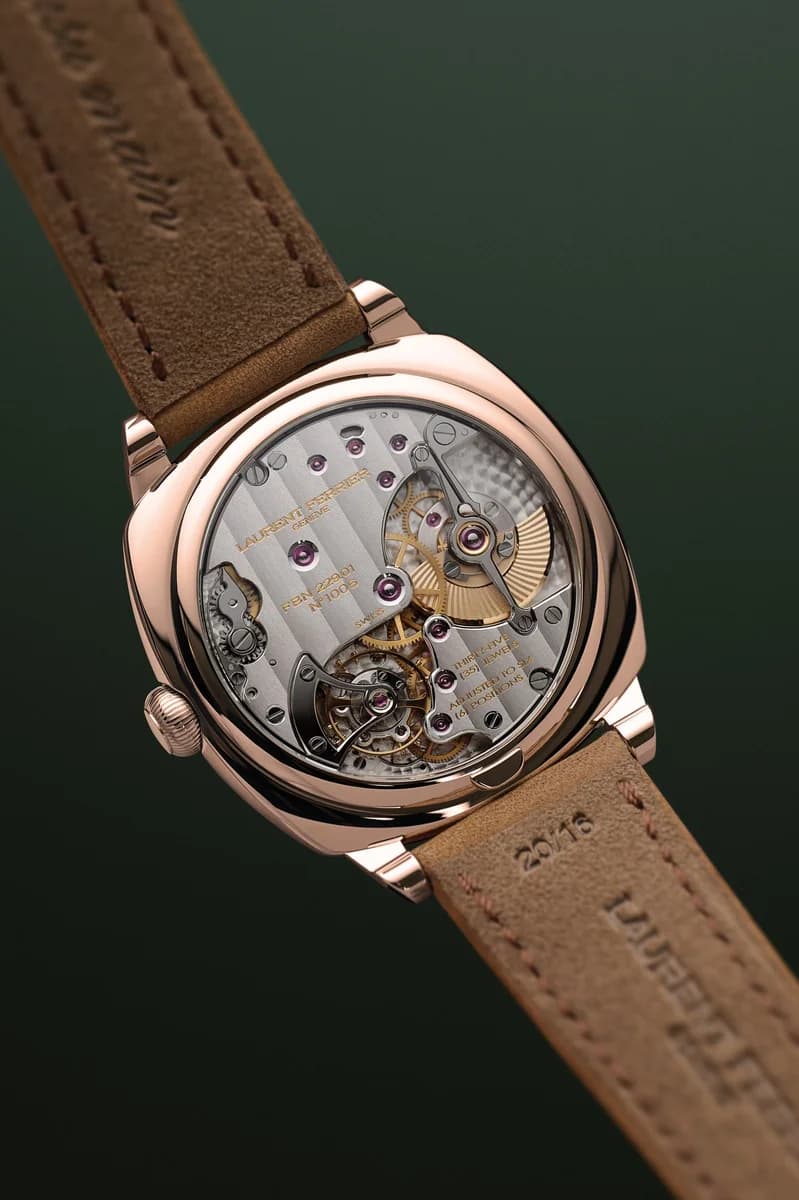
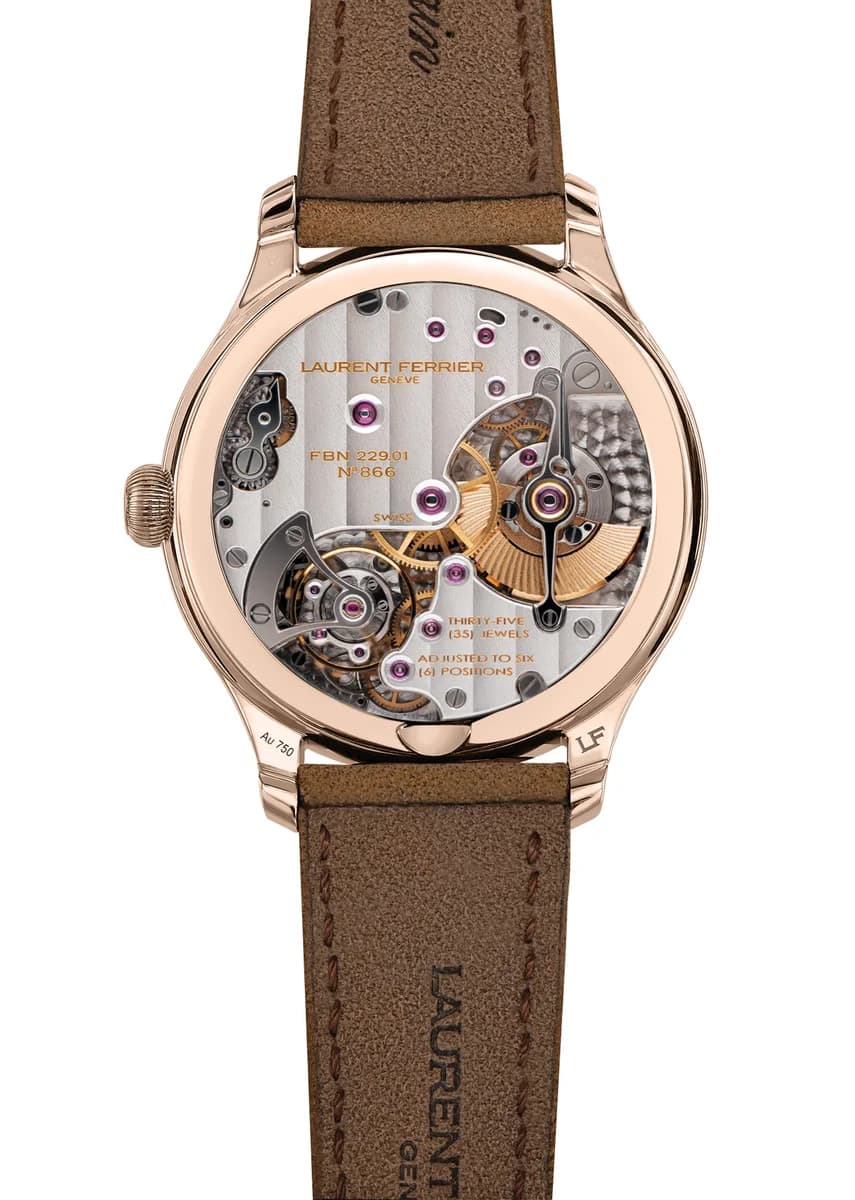
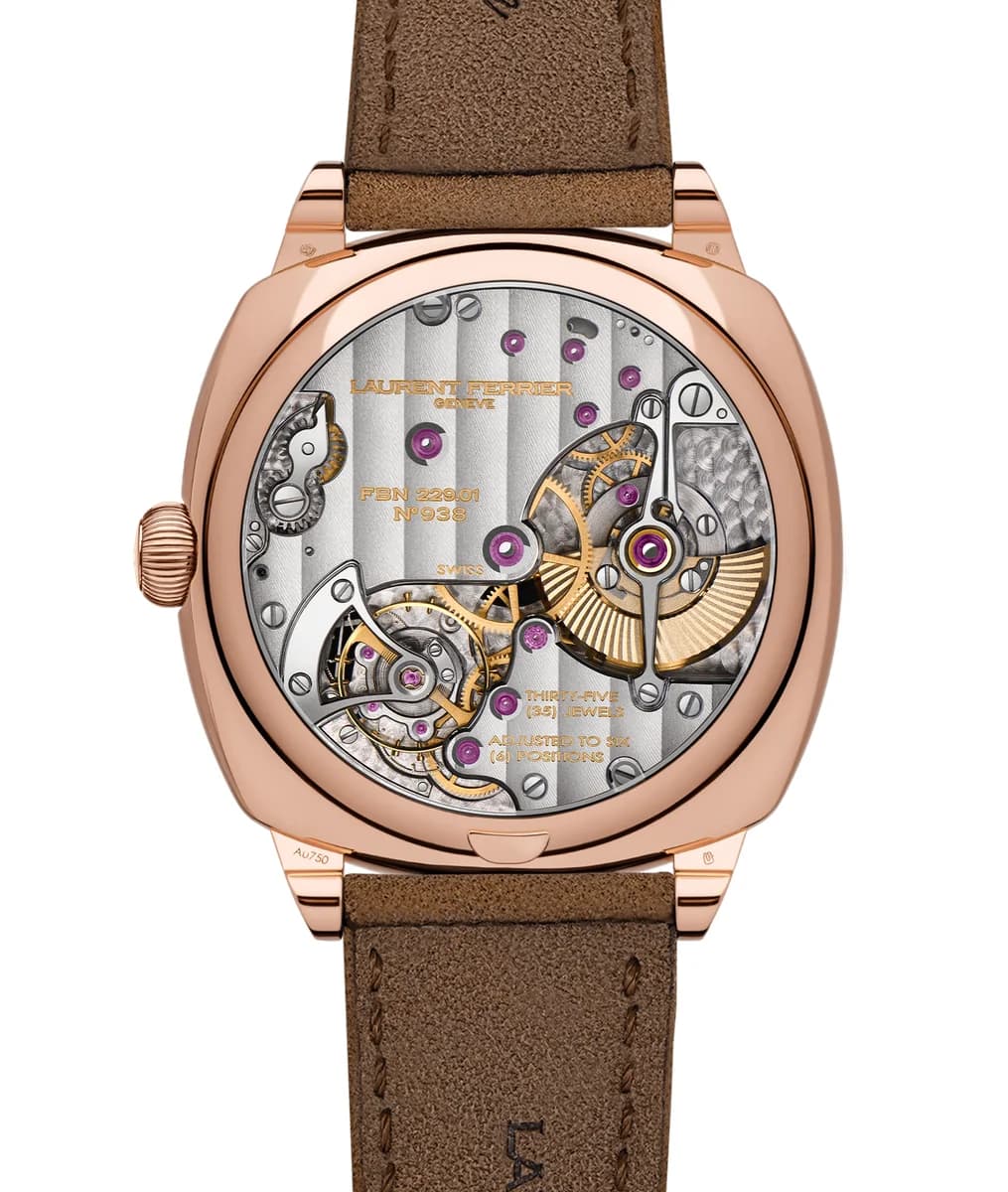
Inside is the Caliber FBN229.01, and this is where the watch becomes something extraordinary. It houses the natural escapement. In 1789, Abraham-Louis Breguet conceived an escapement that used two escape wheels to deliver impulses to the balance in both directions of its oscillation. Think of two people pushing a swing from opposite sides instead of one person pushing and waiting for it to come back. The advantage is efficiency. Double direct impulse means less energy lost per oscillation, less friction, less need for lubrication. In a standard Swiss lever escapement, impulse is delivered in only one direction, and the other half of the oscillation is essentially wasted motion. Breguet's design eliminates that waste. He installed this escapement in about 20 pocket watches starting around 1802, when the first was sold to the Duc de Praslin, but the manufacturing precision of his era could not produce the tolerances required for reliable serial production. The escapement had inherent shortcomings, primarily backlash in the motion of the wheels, that made it impossible to commercialize at scale. The idea sat dormant for over 200 years. Laurent Ferrier and his son Christian brought it back using silicon for the detent lever, manufactured via deep reactive-ion etching, and nickel-phosphorus for the escape wheels, produced through UV-liga technology as three-dimensional components with tolerances measured in microns. The liga process uses ultraviolet light to create microscopic molds, effectively growing the escape wheel columns with an aspect ratio and precision impossible to achieve through conventional CNC machining. Silicon's self-lubricating properties mean the escapement requires no oil or grease except at the pivot points of the axes. The silicon detent lever is also antimagnetic, which means the escapement is resistant to the magnetic fields from phones, tablets, and laptop speakers that can affect traditional steel components. Modern materials solved the problem Breguet could not. The result is a 72-hour power reserve from a micro-rotor automatic. That is remarkable. Most micro-rotor watches struggle to hit 48 hours because the small rotor generates less winding torque than a full-size rotor. The natural escapement's efficiency makes the difference.
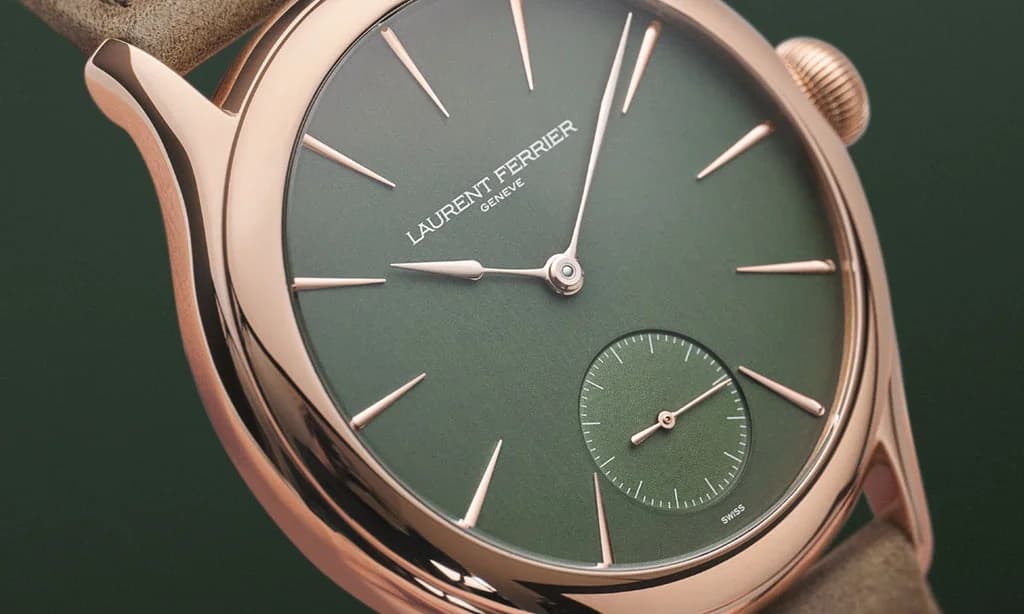
The micro-rotor itself is 950 platinum, the densest precious metal, chosen because you need maximum mass in the smallest possible footprint. It sits between the mainplate and the micro-rotor bridge, wound by a pawl-fitted system that is unidirectional and more efficient over time than bidirectional alternatives. A silent block shock protection system cushions the rotor assembly. The entire movement measures 31.60mm in diameter, stands 4.35mm tall, contains 186 components and 35 jewels, and beats at 21,600 vibrations per hour. Through the sapphire caseback, you see everything. There is no full rotor blocking the view. The three-quarter plate, the Cotes de Geneve, the perlage, the black-polished steel, the hand-beveled anglage on every edge. Over 139 manual finishing operations go into each movement. The anglage alone, the chamfering and polishing of every interior edge on every bridge and plate, is done by hand with files and wood pegs coated in abrasive paste. The result is a mirror polish on the sloped surfaces that machine finishing cannot replicate. Laurent Ferrier applies perlage in three different sizes, with the smallest pearls reserved for the most delicate areas beneath the balance and spring barrel. Collectors on the forums put Laurent Ferrier's finishing above Patek Philippe and Vacheron Constantin, in the same conversation as F. P. Journe and Kari Voutilainen. That is not marketing. That is what the people who buy these watches say after they have held them.
I have spent time in the Plan-les-Ouates district outside central Geneva where Laurent Ferrier's workshop sits, and walking through that area gives you context for how independent watchmaking in Geneva actually works. This is not a gleaming manufacture campus like Patek's or Rolex's. It is a focused atelier where every person in the building touches the watches. The watchmakers spend roughly 30 percent of their working time on decoration, finishing the steel components of the movements they assemble and test. That dual role, watchmaker and decorator, is unusual. Most larger manufactures separate those functions entirely. At Laurent Ferrier, the person who assembles your movement is also the person who polished the bridges. That level of individual craftsmanship is something you can feel when you hold the watch, even if you cannot articulate why it feels different from a watch that came off a more segmented production line.
At 41mm and 11.10mm thick, the Square Micro-Rotor is not a thin dress watch. It has presence. The cushion case amplifies the visual footprint beyond what 41mm suggests because the corners extend the silhouette, pushing the diagonal measurement to 45.35mm. On a 6.5-inch wrist, it fills the space without overhanging. The weight in 18K red gold is substantial but not heavy. It feels like quality. The brown calf leather strap with Alcantara lining is soft immediately, no break-in period, and the red gold pin buckle or folding clasp finishes the package cleanly. Water resistance is 30 meters, which means splashes and rain. This is a watch you wear with intention, not a watch you forget about. I find the cushion case particularly comfortable because there are no sharp lug tips pressing into the top of my wrist. The curves distribute the weight across a wider contact area, and the sapphire crystal domes follow the same radius as the case sides, so there is nothing to snag on a cuff edge.
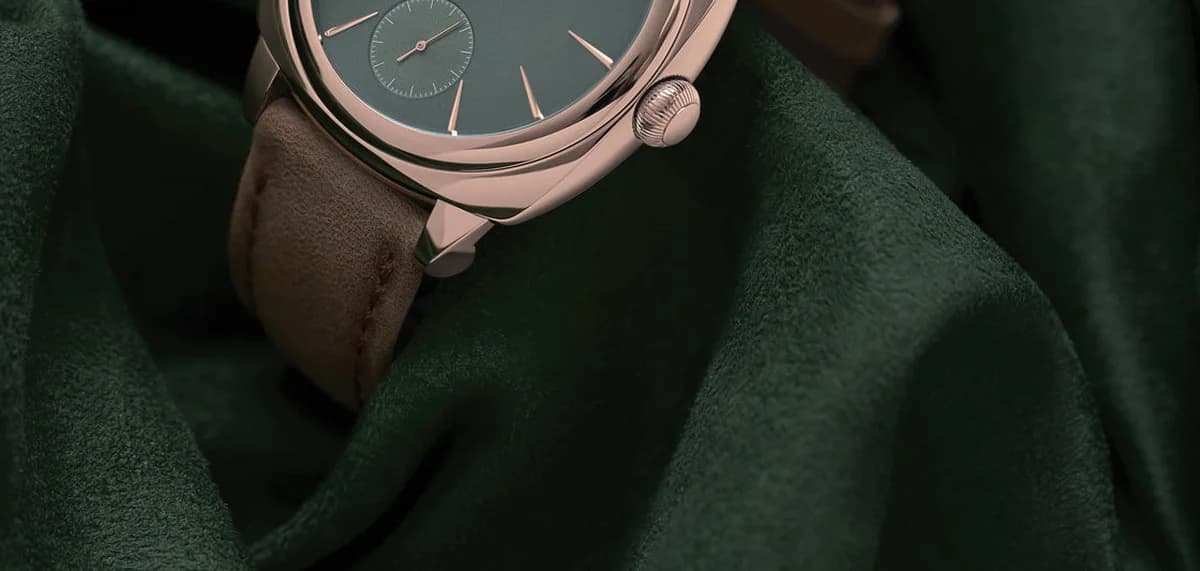
The Square Micro-Rotor in red gold Evergreen is a watch for Isaia double-breasted blazers, for Harrisons of Edinburgh flannel trousers, for evenings where the suit is dark and the shirt is open at the collar. The deep green dial against red gold is one of those combinations that photographs well but looks genuinely better in person, because the vertical satin-brush finish catches light differently at every angle. On darker skin tones, the warmth of 5N red gold creates a richness that white gold and steel cannot match. The cushion case sits flat enough under a cuff to disappear when it should, but the green flash when the sleeve pulls back is enough to catch the eye of anyone paying attention. I notice that green dials in general have become more common in the last few years, but the depth of this particular green, somewhere between forest and emerald depending on the light, sets it apart from the trendier offerings.
Laurent Ferrier produces roughly 200 to 300 watches per year across all collections. That is not a marketing number. That is the output of a workshop in Plan-les-Ouates with watchmakers and decorators who put 139 hand-finishing operations into every movement. For context, Patek Philippe produces around 70,000 watches per year. A. Lange and Sohne produces about 5,000. Laurent Ferrier produces 300. When you put the Square Micro-Rotor on your wrist, you are wearing something that fewer people will ever own than almost any Patek, any Lange, any Vacheron. Not because of artificial scarcity. Because a small team in Geneva can only make so many watches when every movement requires that level of hand finishing. The anglage on a single bridge can take a decorator an entire day. Multiply that across every bridge, every plate, every component visible through the caseback, and the math on production capacity becomes very clear very fast.
The honest critique is visibility. Laurent Ferrier does not have the brand recognition that Patek or Lange carries. If you wear this watch, most people will not know what it is. That is either a problem or the entire point, depending on what you want from a watch. Water resistance at 30 meters is minimal. The power reserve of 72 hours is excellent for a micro-rotor but nothing special compared to modern automatics with full rotors that push past 70 hours routinely now. And servicing an independent brand always carries the question of long-term infrastructure, though Christian Ferrier's active involvement in the company and his deep technical knowledge provide some reassurance on continuity. The lack of lume is worth noting. In a dim restaurant, reading the time requires catching the right angle of light. This is entirely a daytime watch, or an evening watch in well-lit rooms. The crown, while beautifully executed as a ball shape, is small and sits flush with the case band, which makes it slightly harder to grip for time-setting than a more pronounced crown would be. That is the tradeoff for the clean silhouette.
The Square Micro-Rotor exists in several dial variants. The Evergreen comes in both red gold and stainless steel. There is an Autumn in white gold with warm copper tones, a Blue in white gold, and archived versions including the Ice Blue in steel and a Retro in red gold with Arabic numerals. Limited editions have included collaborations with Revolution magazine and artist Herve Di Rosa. Laurent Ferrier now has three GPHG wins: 2010 for the debut tourbillon in the Men's Watch category, 2015 for the Galet Square with the Horological Revelation Prize, and 2018 for the Galet Annual Calendar School Piece. Three GPHG wins in under a decade for an independent brand that did not exist before 2009 is a record that speaks for itself. For context, Laurent Ferrier sits in a peer group that includes F. P. Journe, Kari Voutilainen, Philippe Dufour, and the Groenefeld brothers. These are the independents who make collectors reconsider what matters in a watch. Laurent Ferrier is not the most famous name on that list, but the natural escapement and the level of hand finishing put him squarely in the conversation.
I think about what this watch represents. A man spent 37 years at the most prestigious watch company in the world. He raced at Le Mans seven times and stood on the podium. He waited until he was 63 and then built exactly the watch he wanted to build, with his son, financed by his racing partner from 1979. The natural escapement inside is a concept that Breguet dreamed up in 1789 and nobody could make work reliably until silicon and liga technology caught up with the idea. The cushion case is shaped like a stone from a riverbed. The green dial shifts in the light. The red gold glows warm against skin. And the whole thing is made by a small team in Geneva who finish every surface by hand, including the ones nobody will ever see. What you are paying for is not a brand name. It is a life's work. And in a world where most luxury watch brands are owned by three or four conglomerates, where product decisions are made by marketing departments and approved by boards of directors, a watch made by a family of watchmakers who answer to nobody but themselves is worth paying attention to. The Square Micro-Rotor Evergreen is the kind of watch that a person discovers and never forgets. The green dial, the red gold, the natural escapement ticking away inside, Breguet's 1789 idea finally alive and reliable after two centuries of waiting. It is quiet and it is confident and it is exactly what Laurent Ferrier set out to make when he left Patek Philippe and started from zero.
Also in Independent Masters