
Kari Voutilainen
Vingt-8 / 28SC
28SC
Kari Voutilainen is Finnish. That matters because Finland has no watchmaking tradition. There is no Finnish Vallee de Joux, no Finnish Glashutte, no Finnish school of horology that has been producing watchmakers for centuries. He was born in 1962 in Kemi, a harbour town in Finnish Lapland, about as far from the Swiss watchmaking valleys as a person can be while still living in Europe. He graduated from the Kelloseppakoulu, the Finnish School of Watchmaking, in 1986. Then he worked as a watch repairer in Kemi for two years. In 1988 he went to Switzerland and trained in complications and restoration at Wostep, the Watchmakers of Switzerland Training and Educational Program. That move changed everything. He went from repairing watches in the Arctic Circle to studying the most complex mechanisms in the Swiss tradition, and he never went back.
After Wostep, Voutilainen joined Parmigiani Mesure et Art du Temps in 1990, where he spent nine years restoring complicated and rare watches. Parmigiani's restoration department is where the most intricate antique mechanisms end up when nobody else can fix them. Spending nearly a decade disassembling, studying, and rebuilding movements from the 18th and 19th centuries gave Voutilainen something that no formal education can provide. He learned how the old masters thought. He saw their solutions to problems that modern watchmakers rarely encounter. He crossed paths with Vianney Halter during this period, another future independent legend working at the same level. In 2000, Voutilainen left Parmigiani to teach at Wostep, where he became head of the complicated watchmaking department. He spent two years training the next generation of master watchmakers while building his own watches in his free time. By 2002, the pull of his own work became too strong, and he established his independent workshop in Motiers, in the Val-de-Travers region of Switzerland.
Motiers is a small town in the Neuchatel canton, tucked into a valley that feels distinctly different from the more famous watchmaking cities. Voutilainen initially took on contract work for other brands to fund his own tools and equipment. His first complete watch under his own name, a decimal minute repeater, was finished in 2005. In 2006 he was accepted into the Academie Horlogere des Createurs Independants (AHCI), the invitation-only association of independent watchmakers. By 2009 he had relocated to a 19th-century manor in Motiers, and in 2021 he moved the entire operation to a facility called Le Chapeau de Napoleon, a building overlooking the Val-de-Travers that now houses his watchmaking atelier, dial production, and case finishing under one roof. His team has grown to around 30 employees, producing approximately 50 to 60 watches per year.
The Vingt-8 is the watch that established Voutilainen's reputation among collectors and within the industry. It debuted at Baselworld in 2011 featuring the Caliber 28, Voutilainen's first fully in-house movement. The name is straightforward. Vingt-huit means twenty-eight in French, after the caliber number. What made this watch immediately significant was not just that it was his own movement (that alone would be noteworthy for any independent), but what he did with the escapement. The Caliber 28 uses a direct-impulse escapement with two escape wheels. This is Voutilainen's interpretation of Breguet's natural escapement, a concept Abraham-Louis Breguet developed in the early 19th century but that virtually nobody uses in modern watchmaking. In a conventional Swiss lever escapement, energy from the mainspring passes through the lever to reach the balance wheel, and some energy is lost to friction in that transfer. In the direct-impulse system, two escape wheels work together to deliver energy directly to the balance wheel through the impulse roller, bypassing some of the friction losses inherent in the lever design. The result is a system that requires less energy from the mainspring to maintain the same amplitude, which translates to more consistent timekeeping over the full power reserve. It is roughly 30 percent more efficient than a standard Swiss lever escapement.
The inspiration for this escapement came from Voutilainen's time at Parmigiani. During the 1990s, he worked on a Breguet tourbillon pocket watch that used a natural escapement. That experience planted the seed. Years later, when he had the freedom and the skill to design his own movement, he returned to that concept and adapted it for a wristwatch. The Vingt-8 was the first watch to use two escapement wheels in this specific configuration, delivering direct impulse to the balance through the impulse roller. It was not a reproduction of Breguet's design. It was a modern reinterpretation built with contemporary materials and tolerances.
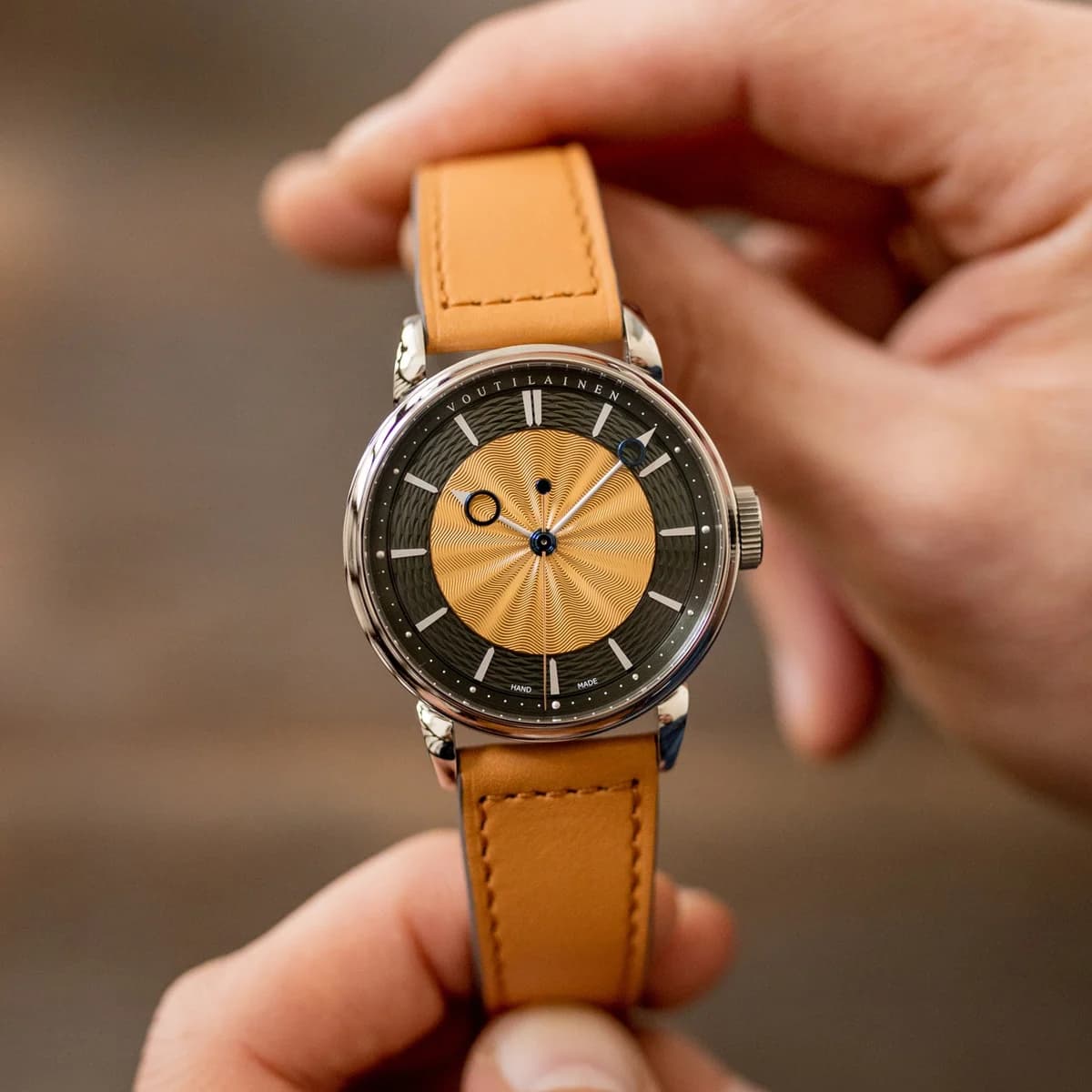
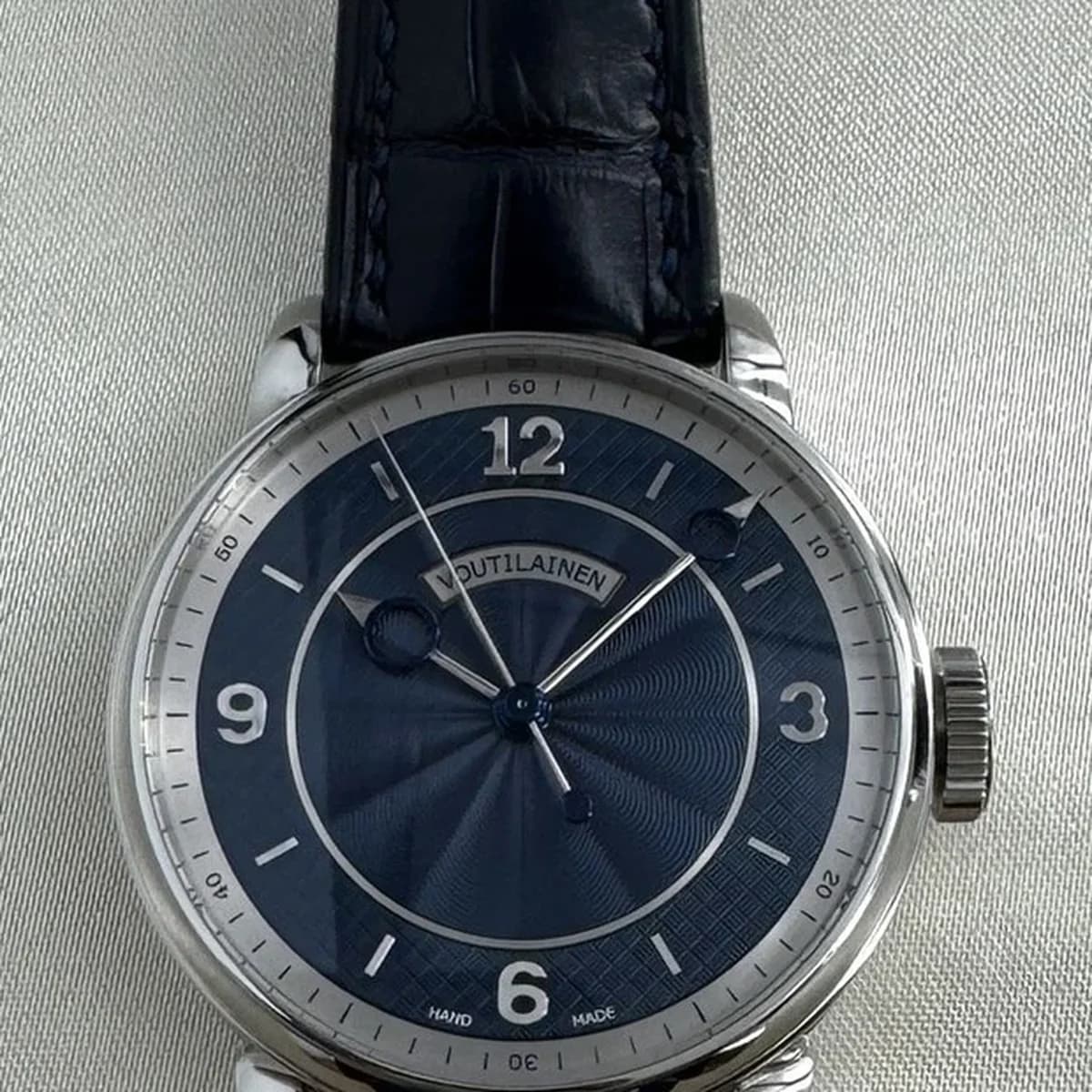
The 28SC took the Vingt-8 platform and added central seconds. That sounds simple, but it was the first time Voutilainen moved the seconds indication from a small subdial at 6 o'clock to the center of the dial. The SC stands for Seconds Central. This is the version that won the GPHG Men's Watch Prize in 2020, and it represents the maturity of the Vingt-8 concept. The case measures 38.5mm in diameter and 13.3mm thick. The Caliber 28 inside is hand-wound with 22 jewels and 202 components. It beats at 18,000 vibrations per hour (2.5 Hz), which is deliberately slow. That low frequency allows the balance wheel to be large, 13.5mm in diameter, which improves the moment of inertia and contributes to rate stability. The balance is free-sprung with rose gold timing weights and uses a hairspring with a Phillips terminal curve on the outside and a Grossmann curve on the inside. That combination of curves is rare. Most modern watches use either a Breguet overcoil or a flat hairspring. Voutilainen uses both terminal curve types simultaneously because each addresses different aspects of isochronism, the hairspring's ability to maintain consistent oscillation regardless of amplitude. The power reserve is 65 hours.
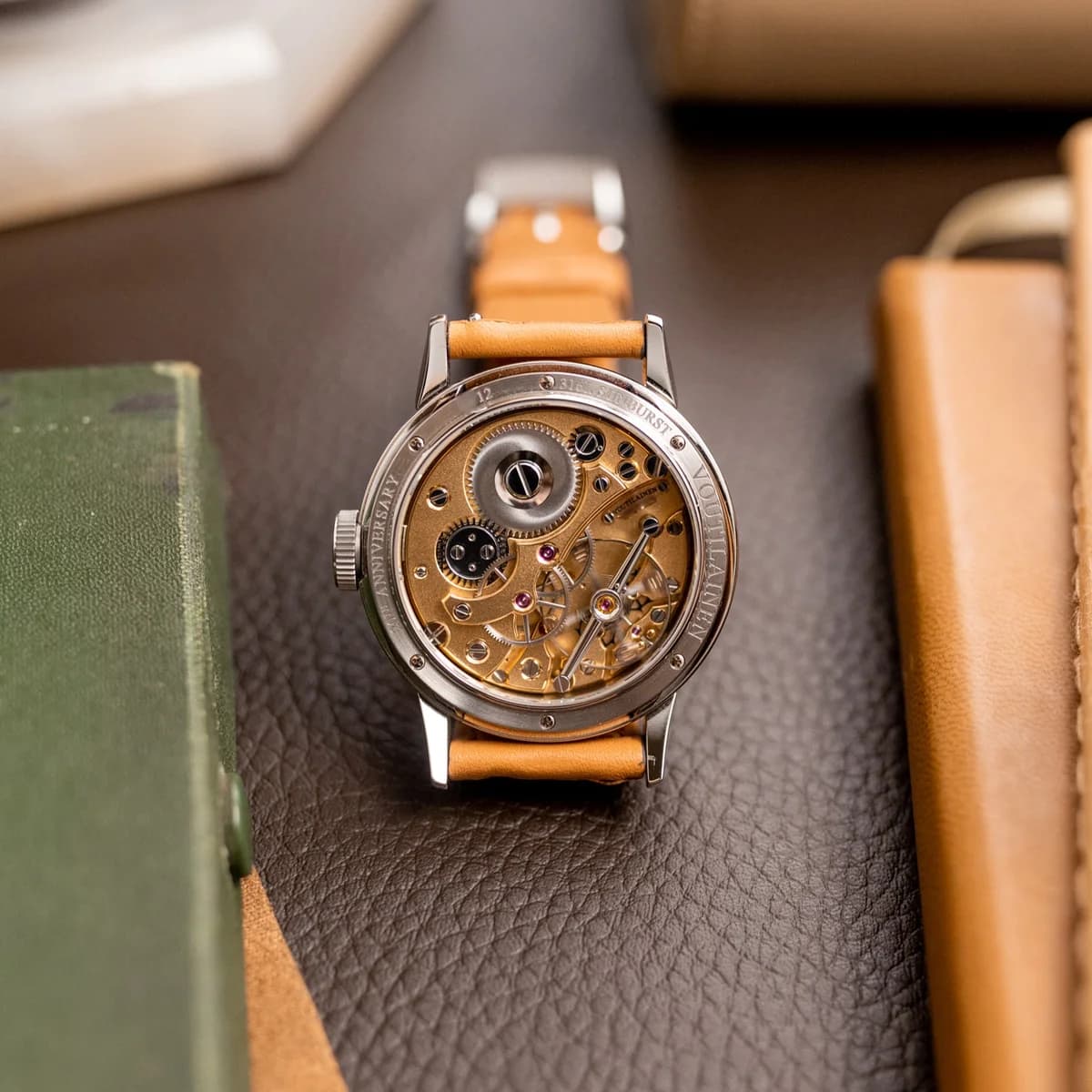
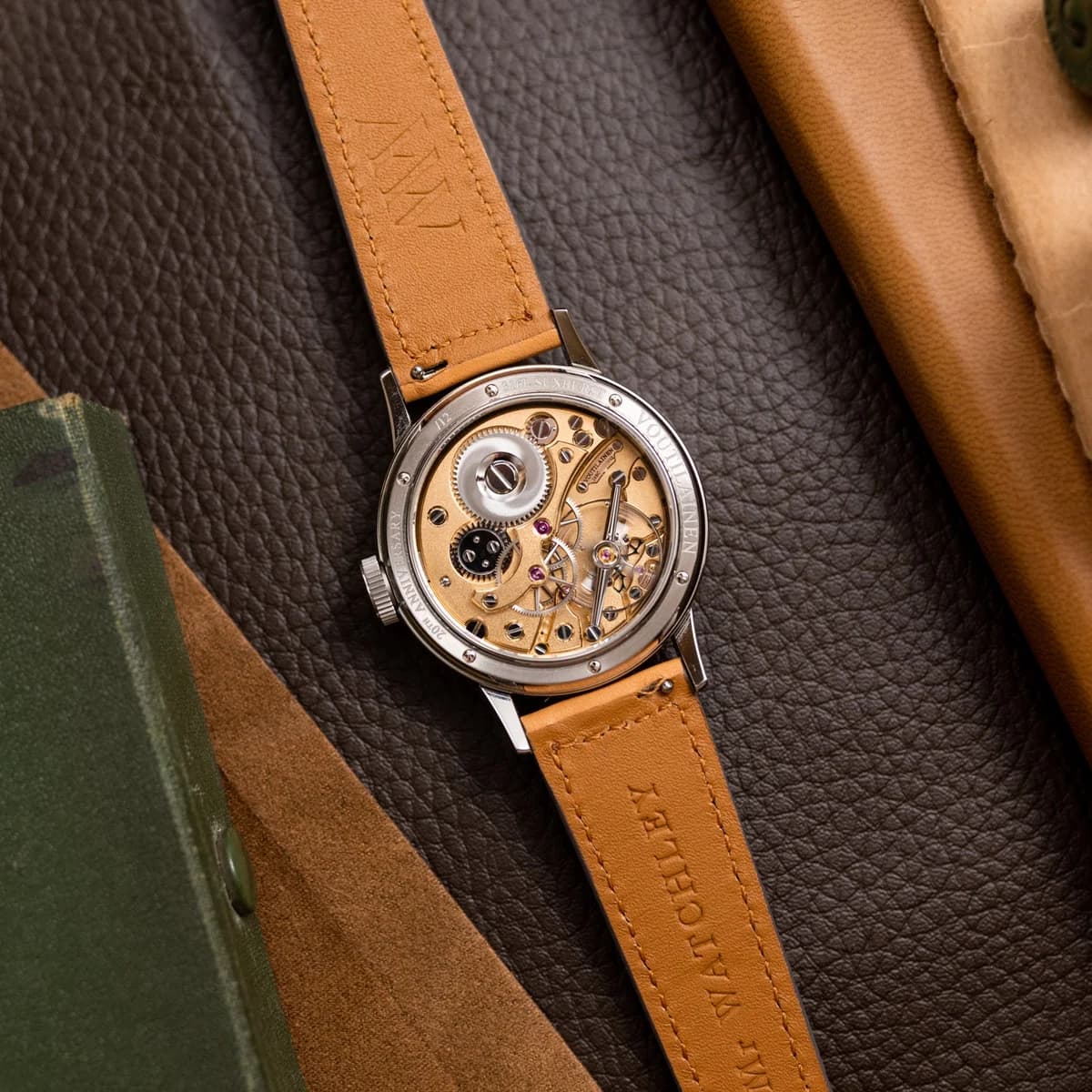
The movement construction reflects Voutilainen's philosophy of making as much as possible in-house while using the finest traditional materials. The main plate and bridges are German silver. The visible gear train wheels are solid 18K gold. The escapement wheels are steel. The case and crown are made in-house. Sapphire crystals front and back, both with anti-reflection treatment, so the movement is fully visible through the caseback. The finishing is where Voutilainen's reputation lives. Hand-applied Geneva stripes on the bridges. Mirror-polished bevels on every edge. Interior angles cut by hand with a file, the same technique that defines the work of Philippe Dufour. Interior angles are the benchmark of hand finishing because they cannot be done with a straight polishing tool. Each concave corner requires the watchmaker to shape a custom tool and work the angle by hand until the bevel catches light uniformly. The screws are flame-blued. The gold chatons holding the jewels are hand-pressed. None of this is visible when the watch is on the wrist. All of it is visible through the caseback, and all of it is there because Voutilainen believes the quality of what is hidden defines the integrity of the whole.
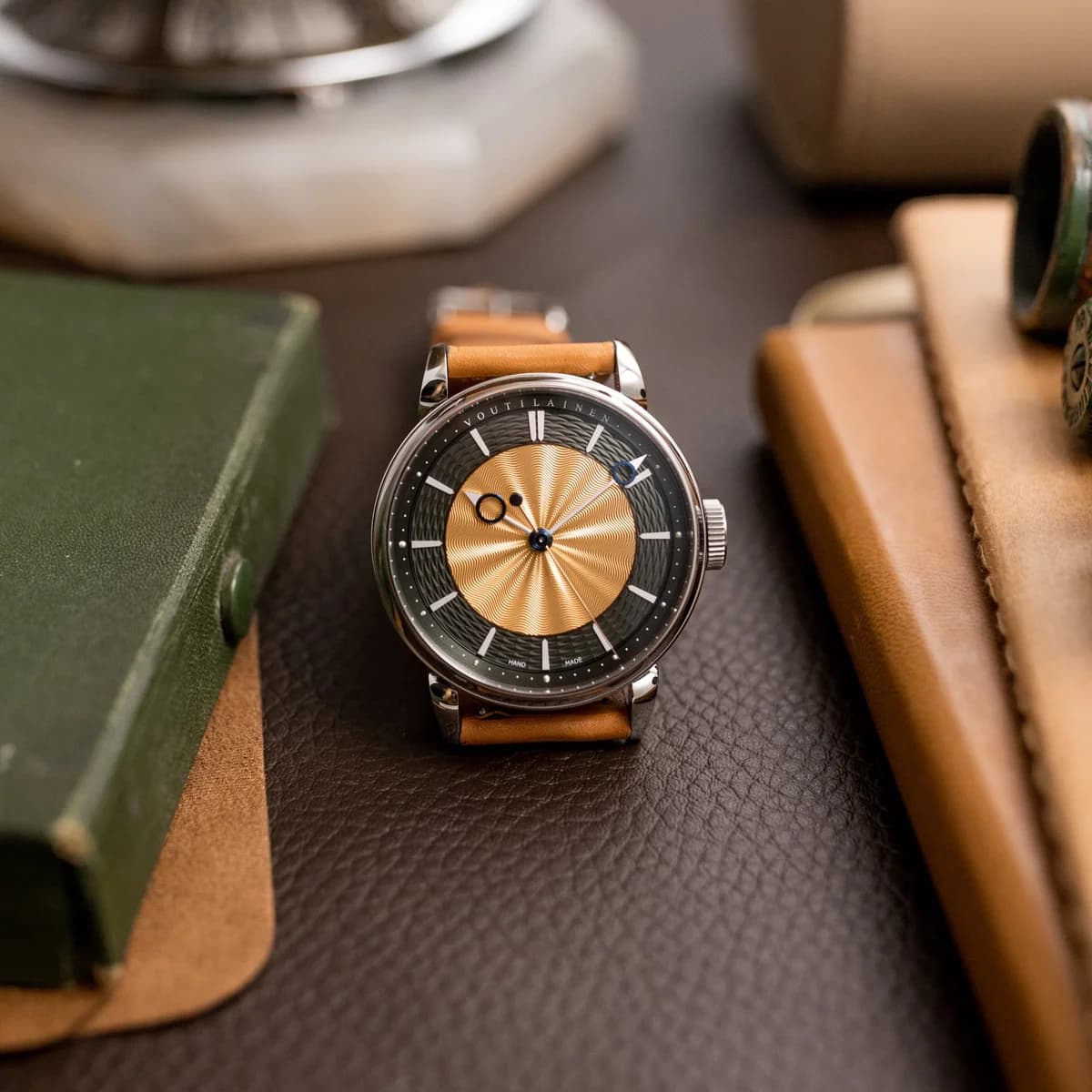
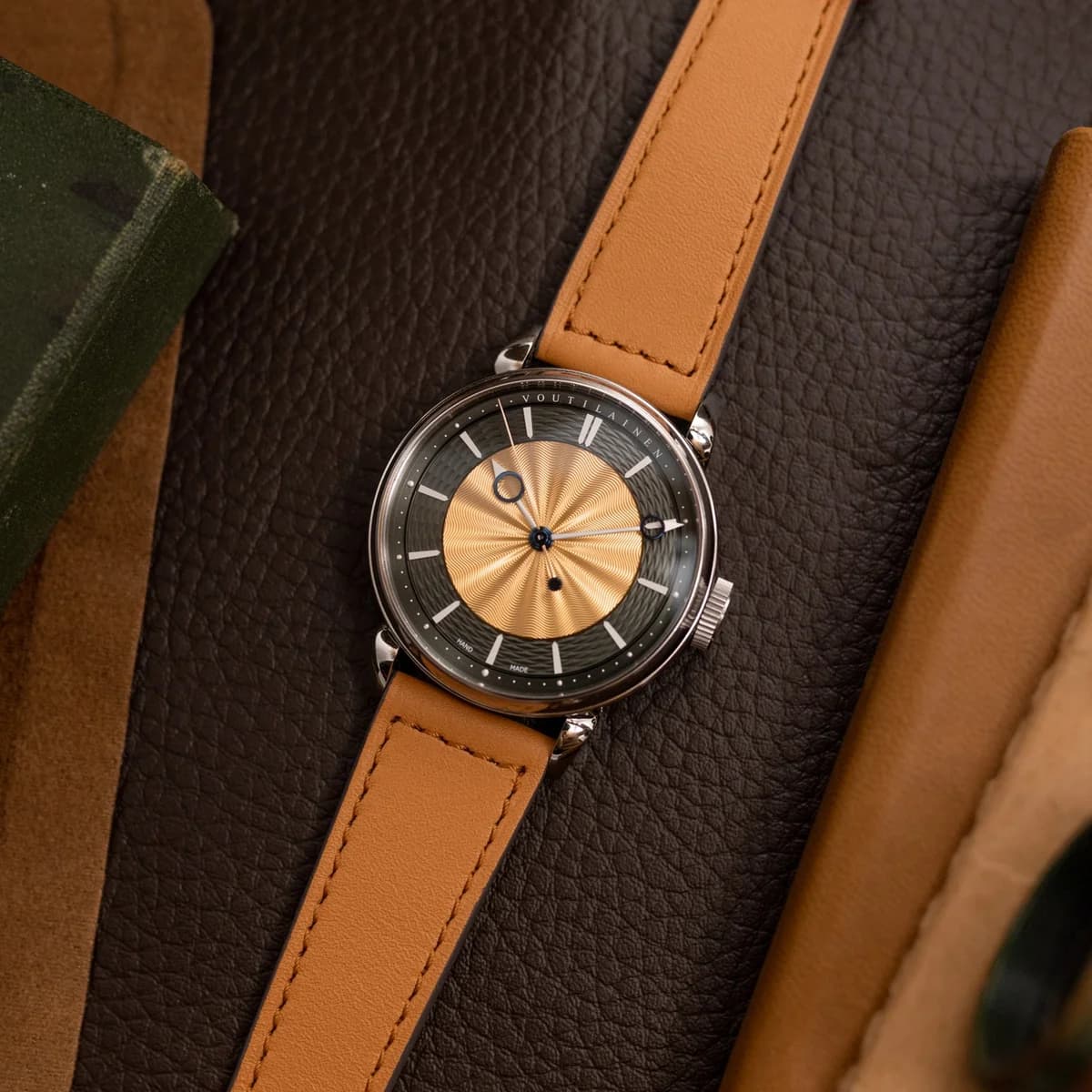
The 28SC is available in several case materials depending on the series. There have been editions in 18K rose gold, 18K white gold, platinum, titanium, and aisi 316L grade 4441 recycled steel. The steel version was produced in a limited edition of 12 pieces. The titanium edition was limited to 10 pieces. Each reference is typically produced in small runs of 10 to 30 pieces across different metals. The water resistance is rated at 30 meters, which is standard for a dress watch of this caliber. This is not a tool watch. It is not meant to go swimming. The 30-meter rating provides enough protection for daily life and the occasional splash. The case design itself deserves attention. The 28SC introduced redesigned lugs with a concave form, different from the teardrop lugs that characterized earlier Vingt-8 models. The bezel is also concave, curving inward toward the sapphire crystal. That concavity catches light differently than a flat bezel, creating a shadow line that visually slims the profile despite the 13.3mm thickness. It is a subtle but effective piece of case design. Voutilainen makes his cases in-house, which means these details are not dictated by an external case manufacturer's capabilities but by what the design requires.
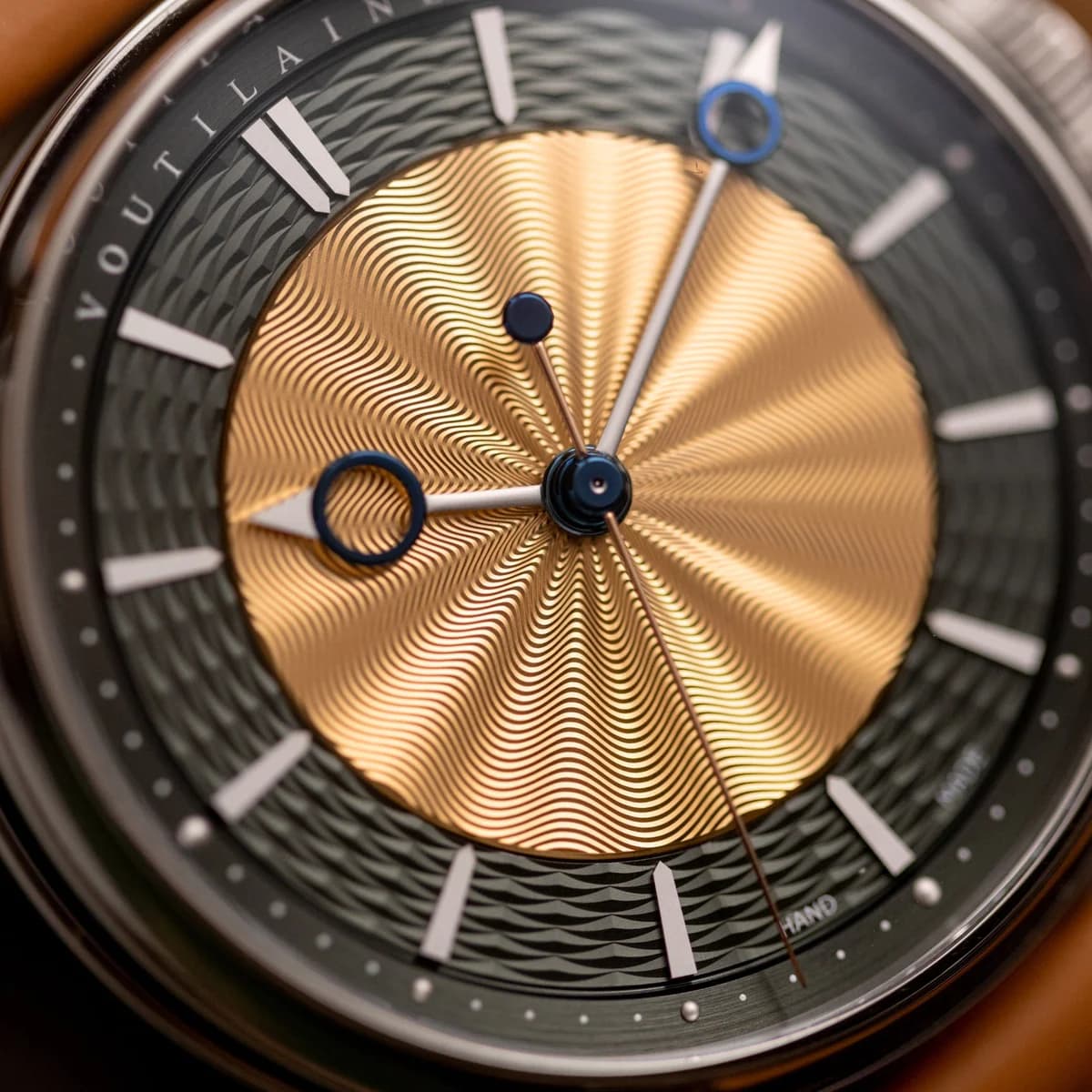
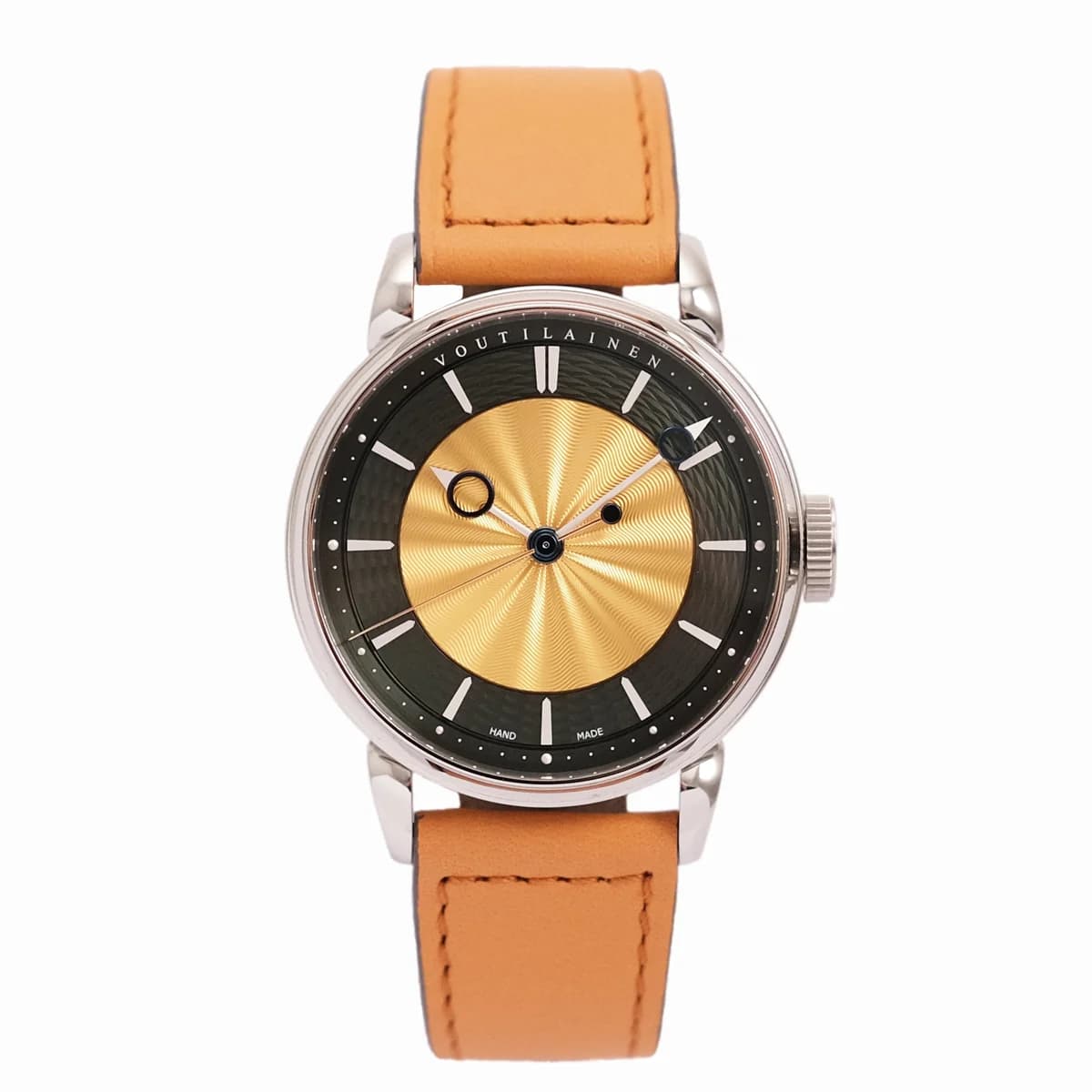
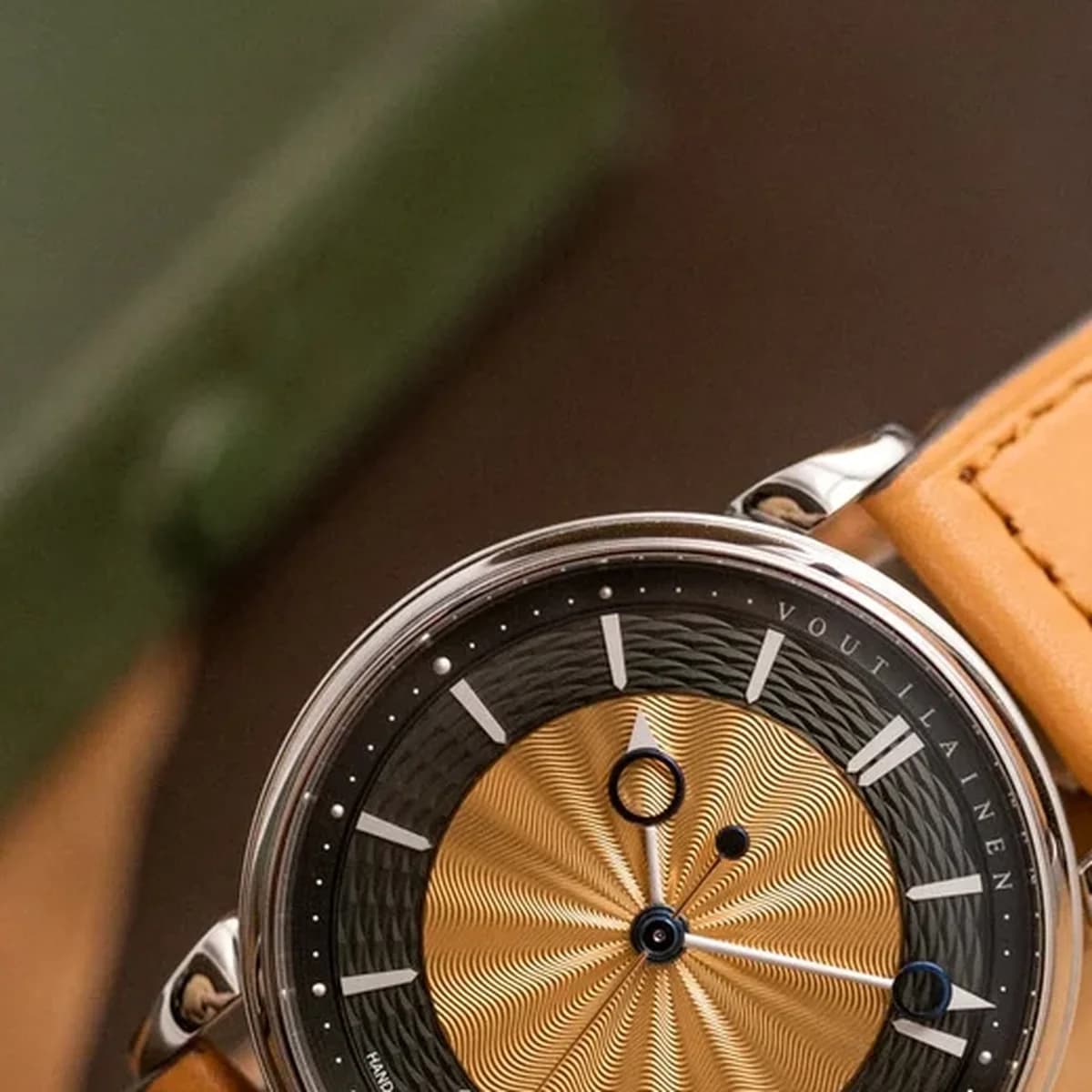
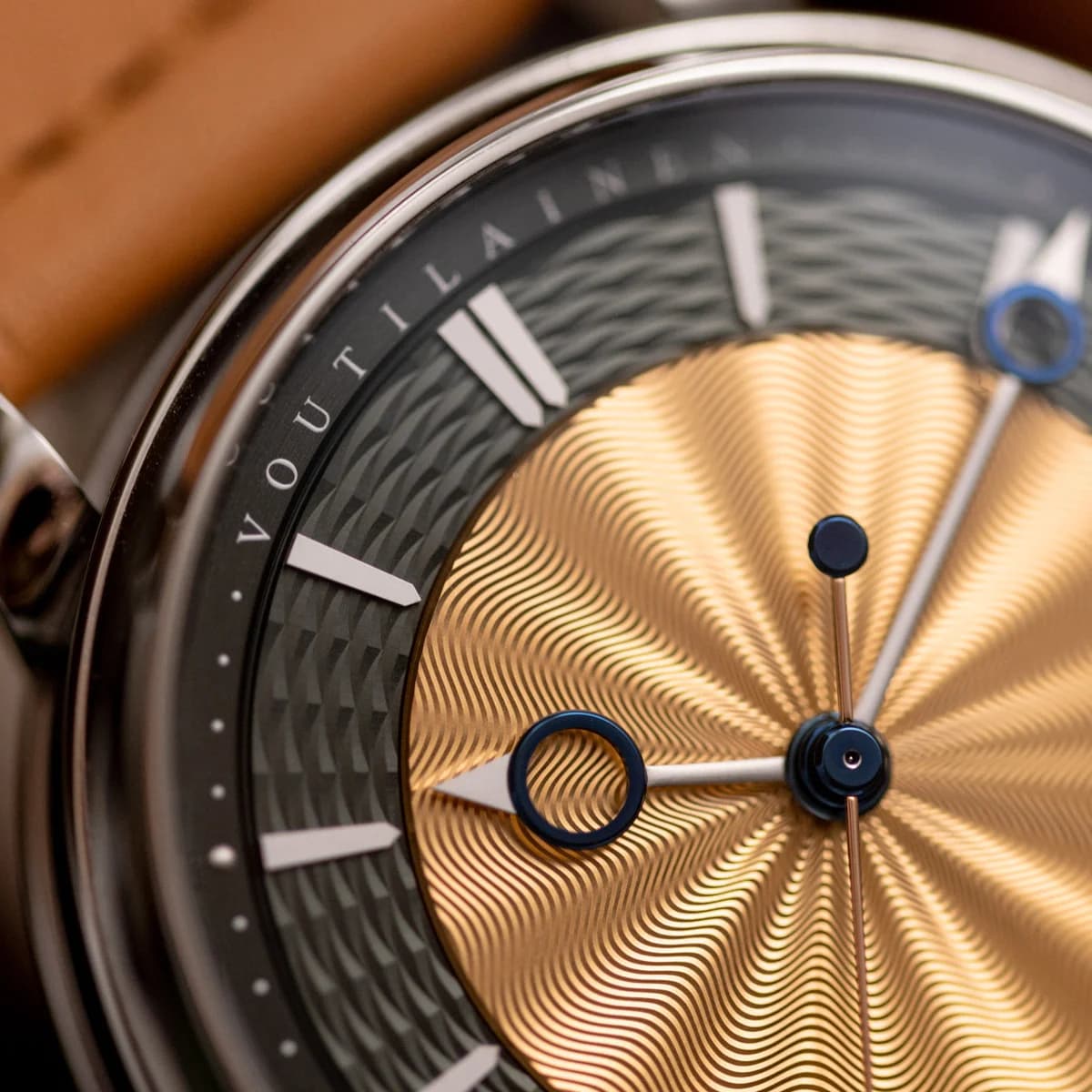
What separates Voutilainen from other independents at this level is his approach to the dial. He does not outsource this to a generic dial supplier and he does not treat it as secondary to the movement. In 2014, Voutilainen acquired Comblémine, a high-end dial manufacturer, bringing dial production entirely in-house. In 2022, he acquired Brodbeck Guillochage, the workshop of renowned guillocheur Georges Brodbeck. Between Comblémine's 26-person team and the Brodbeck workshop with its more than 30 machines (including four straightline and four rose engine turning lathes at the main facility alone), Voutilainen controls every aspect of dial creation from raw metal to finished surface. The guilloche patterns on a Voutilainen dial are not decoration. They are architecture. Light moves across a Voutilainen dial the way light moves across water. The depth, the rhythm, the way each line catches and releases light creates a surface that is alive in a way that printed or lacquered dials simply cannot replicate. The 28SC dials I find most compelling are the hand-guilloche silver dials with two-tone patterns, where two different guilloché textures (often hobnail for the hour track and a spiral wave for the center) create a dialogue between regularity and movement. The gold applied Arabic numerals and the gold and blued-steel hands are all finished in-house, hand-polished to match the quality of the movement finishing.
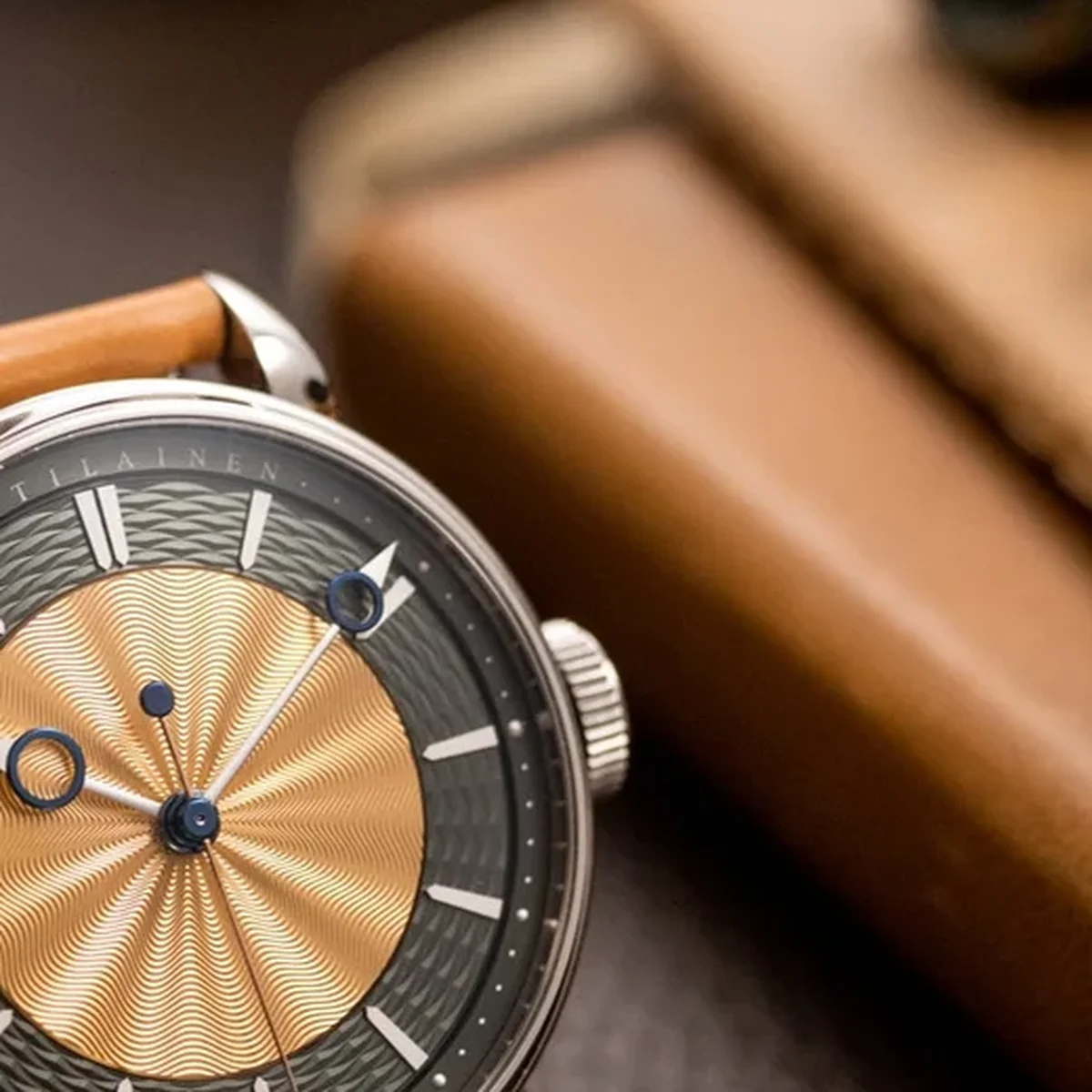
I appreciate that Voutilainen offers genuine dial customization. Clients can work with his team to select guilloche patterns, enamel colors, and numeral styles. This is not the kind of customization where a brand lets you pick from three preset options. This is a conversation between a watchmaker and a client about what the dial should look like. The 28SC has been produced with grand feu enamel dials, lacquer dials, hand-guilloche silver in various patterns, and two-tone guilloche combinations. Each dial variant requires different artisan skills and different machines. The fact that Voutilainen owns the entire dial production chain means he can offer this level of personalization without compromising quality or introducing external variables.
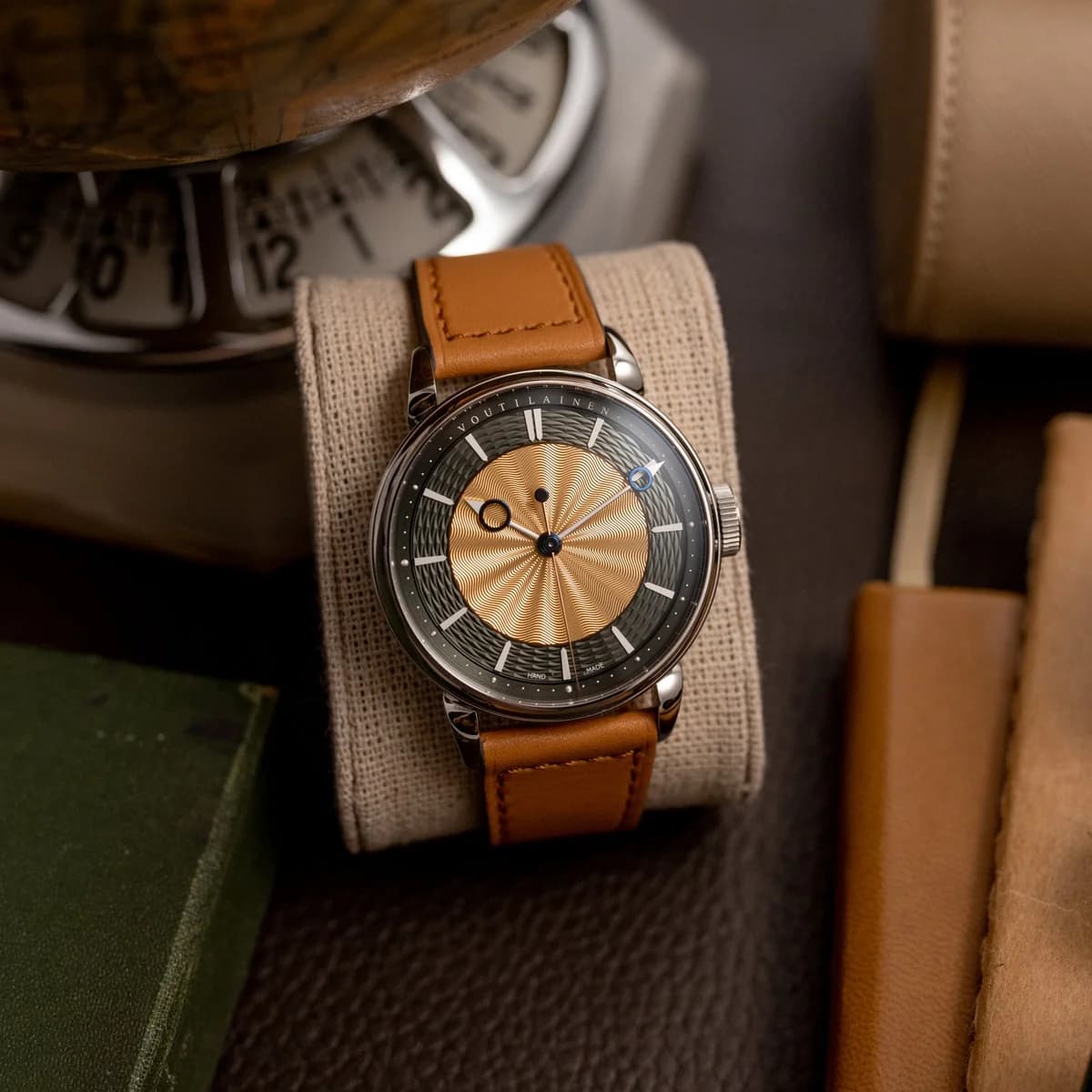
The 38.5mm diameter hits a sweet spot for a watch of this type. On my wrist (6.5 inches), a 38.5mm dress watch sits with authority without overwhelming the hand. The lugs curve downward enough that the watch hugs the wrist rather than sitting on top of it like a puck. The hand-sewn alligator strap is the only option. There is no bracelet. For a watch at this level of craft, that is the right call. A bracelet would add weight, complexity, and a design challenge that would distract from what the watch is about. The strap uses a traditional tang buckle, which means strap changes require tools, but this is not a watch that benefits from quick-release convenience. It is the kind of watch where the strap selection is part of the commissioning process and stays on for years.
The GPHG track record tells the story of how the industry views Voutilainen's work. He has won the Men's Watch Prize in 2015 for the GMR, in 2019 for the 28ti, in 2020 for the 28SC, and in 2024 for the KV20i Reversed. He won the Artistic Crafts Watch Prize in 2017 for Aki-No-Kure and in 2019 for Starry Night Vine. He also received the Prix Gaia in 2014 for Craftsmanship and Creation. That is an extraordinary record. Ten GPHG wins across multiple categories for a workshop producing 50 to 60 watches a year. For context, most major brands with thousands of employees and massive R&D budgets would be thrilled with a single GPHG win. Voutilainen has ten, earned with a team of 30 people in a small Swiss town.
If I have one honest observation about the 28SC, it is the thickness. At 13.3mm, this is not a thin watch. The direct-impulse escapement with its large 13.5mm balance wheel needs vertical space, and the central seconds complication adds to the movement height compared to a time-only caliber without seconds. It sits noticeably on the wrist. Under a French cuff on a Holland & Sherry tropical weight wool suit, the 28SC will make its presence known. It will not slide under the cuff the way a Dufour Simplicity at 8.4mm does. That is the tradeoff for the escapement architecture and the large balance wheel. A thinner case would mean a smaller balance, a faster frequency, or a compromise on the direct-impulse system, and none of those would be the right call. The thickness is a consequence of doing what Voutilainen believes is correct, and I respect that even if it means the watch works better with a rolled sleeve than a buttoned cuff.
The comparison to Philippe Dufour is one that comes up constantly in the independent watchmaking world, and it is earned. Both men produce time-only watches with hand-finished movements at a level that most brands cannot approach. Both cut interior angles by hand. Both use traditional materials (German silver plates, gold chatons, flame-blued screws). The key difference is the escapement. Dufour uses a conventional Swiss lever escapement executed to perfection. Voutilainen uses his direct-impulse system, which is more technically ambitious but also less proven over centuries of use. The Dufour Simplicity is 37mm and 8.4mm thick. The Voutilainen 28SC is 38.5mm and 13.3mm thick. The Simplicity is thinner because a time-only watch without central seconds and with a conventional escapement can be much more compact. Both are correct approaches. Dufour's genius is in showing that absolute perfection of a simple architecture can be the ultimate statement. Voutilainen's genius is in showing that a more complex escapement system, executed at the same finishing standard, can push the conversation forward. I do not think one is better than the other. They are two answers to the same question about what independent watchmaking can achieve when there are no constraints except the watchmaker's own standards.
The Vingt-8 series is approaching the end of its production life. Voutilainen has announced that the caliber will be retired at the end of 2025, with the 28MPR (a variant adding moon phase and power reserve display) serving as the final interpretation. That means the 28SC, the specific reference that won the GPHG, is already part of a closed chapter. The watches that exist are the watches that will ever exist. For an independent producing in these numbers, that is not a marketing strategy. It is simply how the math works when one workshop with 30 people produces 50 to 60 watches per year and has multiple references in the lineup.
I love that Voutilainen's story starts in Finnish Lapland and ends at the GPHG podium. There is no inherited workshop. No family name in watchmaking. No Swiss birthright. He repaired watches in Kemi, studied in Switzerland, restored masterworks at Parmigiani for nine years, taught the next generation at Wostep, and then built his own caliber from scratch. The Vingt-8 was the first fully in-house Voutilainen movement, and the 28SC was the version that the industry recognized as being at the absolute summit of contemporary independent watchmaking. Finland to Motiers to the GPHG podium. That trajectory tells you everything about what is possible when skill is applied at the highest level, consistently, for decades.
Also in Independent Masters