
Jaeger-LeCoultre
Reverso
Q3988482
In 1930, a Swiss businessman named Cesar de Trey was in India when British polo officers presented him with a challenge. They needed a wristwatch that could survive a polo match. Crystals shattered. Cases dented. No watch on the market could handle the sport. De Trey was not a watchmaker. He manufactured dentures for a living. But he was also a watch collector and trader, and he recognized a real problem when he heard one. Upon returning to Switzerland, he connected with his friend Jacques-David LeCoultre III, the third-generation leader of the LeCoultre manufacture in Le Sentier. LeCoultre in turn partnered with the Paris-based firm Jaeger S. A. to develop the case concept. A French engineer named Rene-Alfred Chauvot, contracted by Jaeger, designed the mechanical solution. He filed patent FR 712.868 on March 4, 1931, at 1:15 PM at the French patent office in Paris. The Swiss patent, number 159,982, followed on February 16, 1932. The patent described a case that could slide along grooved rails, pivot 180 degrees on a hinge, and slide back to present either the dial or a solid metal back to the world. In July 1931, de Trey purchased the rights to Chauvot's patent designs. In November, he registered the trademark name Reverso and established Specialites Horlogeres S. A. with LeCoultre to distribute the watches. The first Reversos did not actually use JLC movements. They used Tavannes-made movements. JLC introduced its own proprietary calibers, the 410 and 411, for the Reverso in 1933. That detail matters because it shows how the Reverso started as a case innovation, a mechanical problem solved by Chauvot's patent, and the movement was secondary. It was only after the case proved itself that JLC committed its own calibers to the project. 95 years later, nobody has improved on the idea.
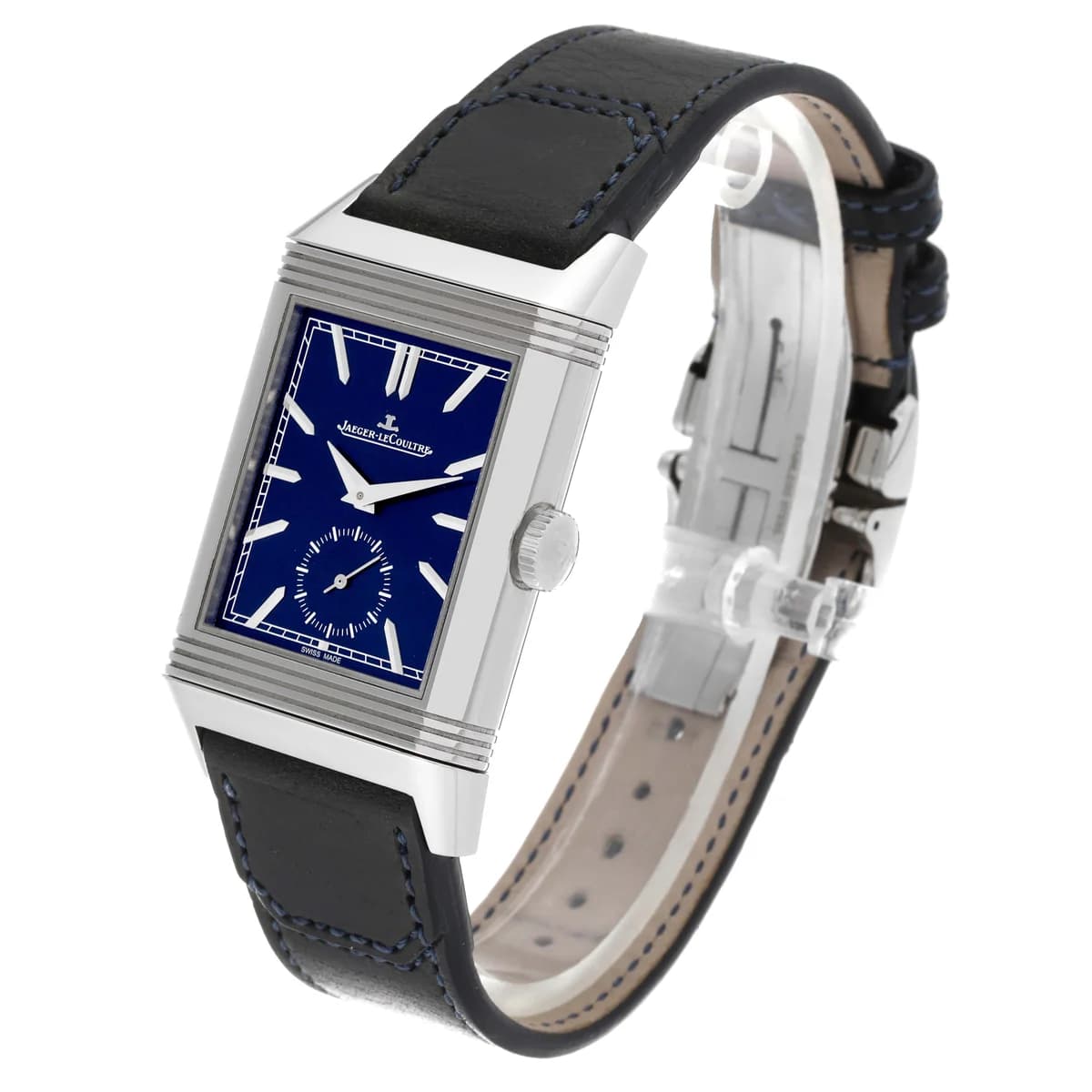
The reversing mechanism uses approximately 50 components in its current form. The original 1931 version used roughly 30. The case capsule slides along a grooved cradle, pivots on a central hinge, and locks into position via spring-loaded pins. Three gadroons, the horizontal ridges along the case edge, serve as grip points for your thumb and finger when you turn it. The fit between capsule and cradle is so precise that at first glance there is no evidence the case can move at all. That precision is not an accident. The proportions follow the golden ratio, approximately 1 to 1.618, and every line on the watch reinforces Art Deco geometry. The rectangular case, the railway-style minute tracks, the triple gadroons, the dauphine hands, the guilloched dials. None of it has changed in 95 years. That is not a lack of innovation. That is a design so right that there was never a reason to touch it.
I want to talk about that Art Deco design language because it is central to why the Reverso endures. Art Deco as a movement was defined by geometric forms, clean lines, and a discipline that rejected ornamentation for its own sake. The Reverso is arguably the most prominent example of Art Deco design still in active production in the watch industry. Every element serves a purpose. The gadroons are functional grip points that happen to be beautiful. The straight edges create a case that sits flat against the wrist and slides cleanly in its cradle. There are no curves, no rounded edges, no softness anywhere. And while other watches from the 1930s have been redesigned dozens of times over, the Reverso silhouette from 1931 is instantly recognizable in every current model. That kind of design permanence across 95 years is almost unheard of. The Cartier Tank comes close. I cannot think of a third.
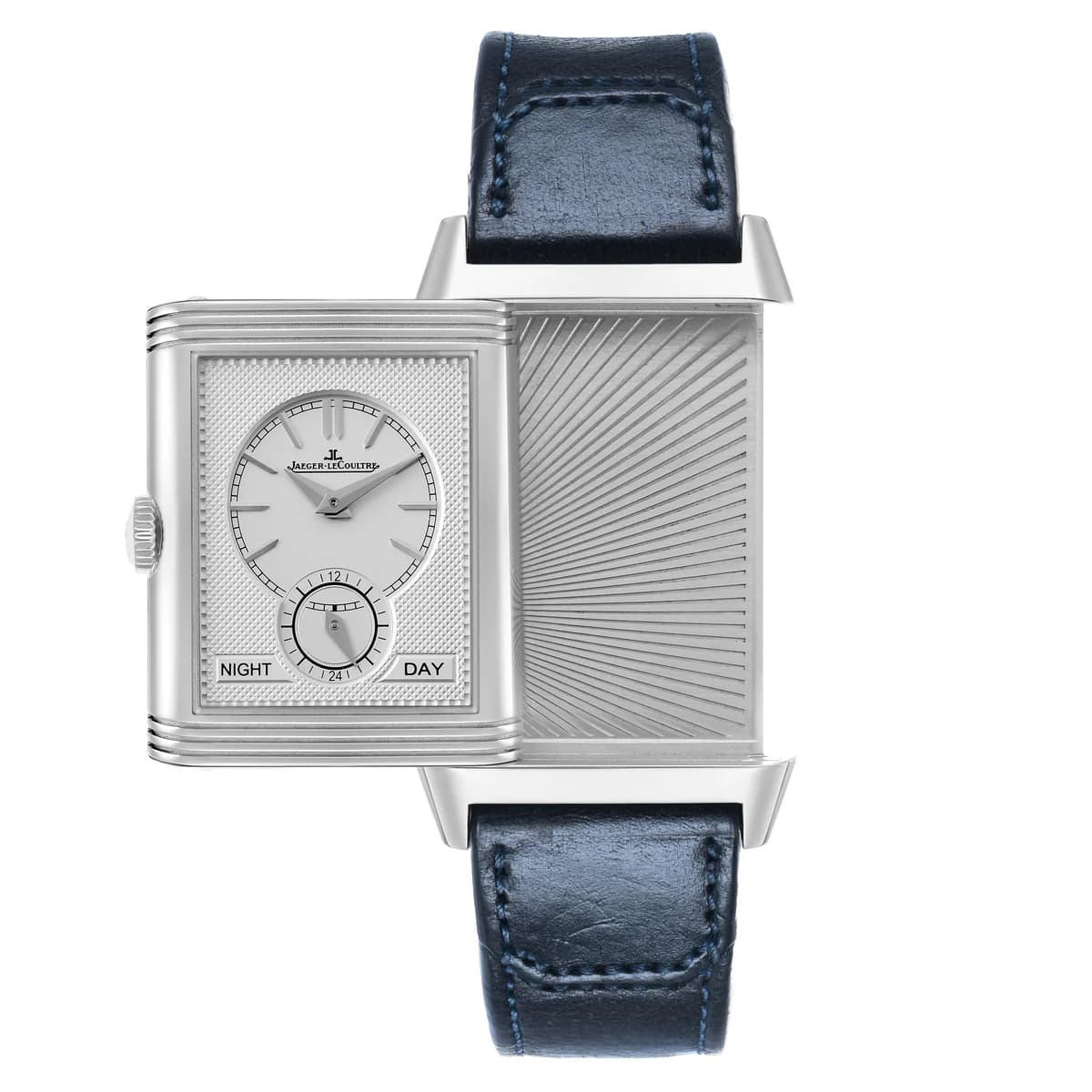
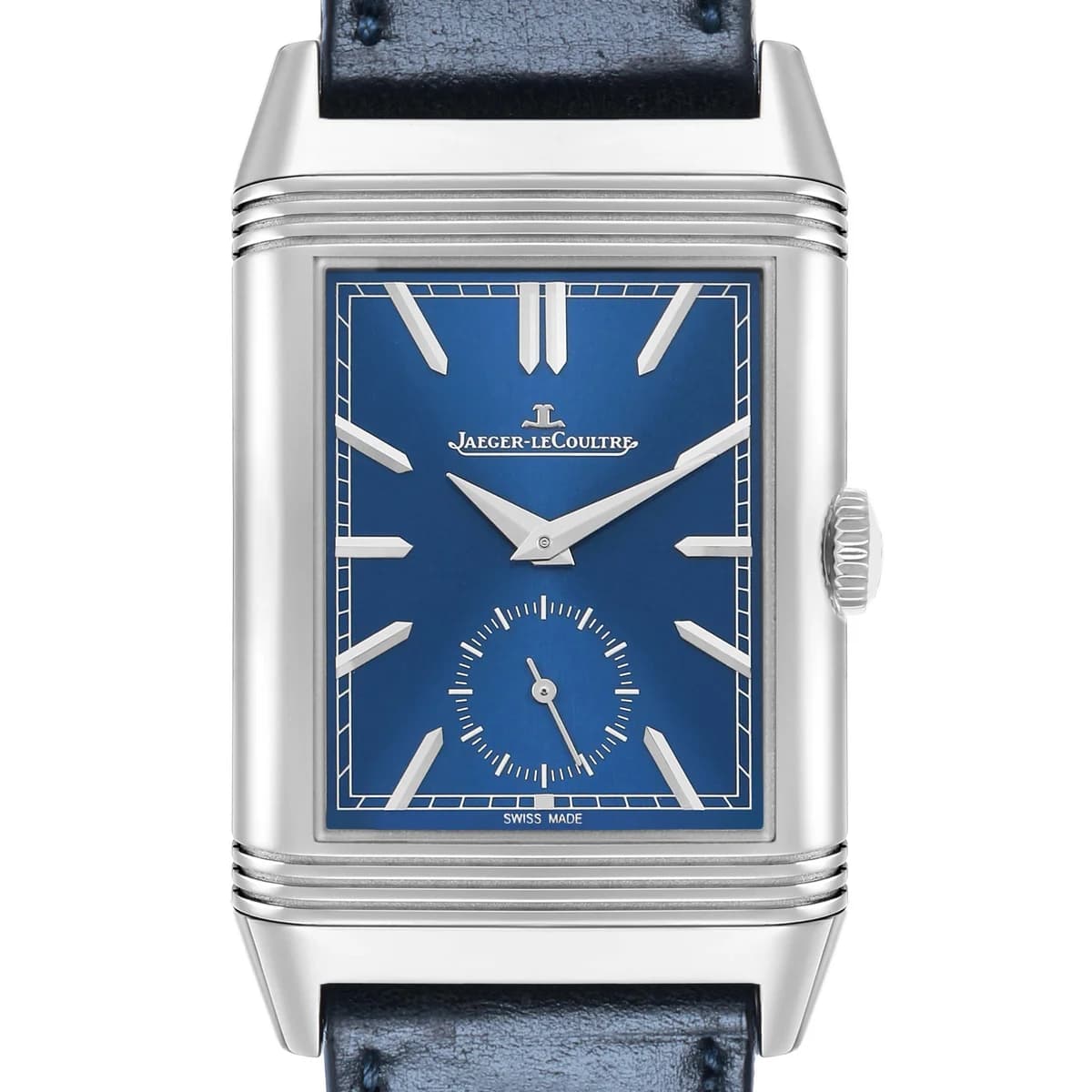
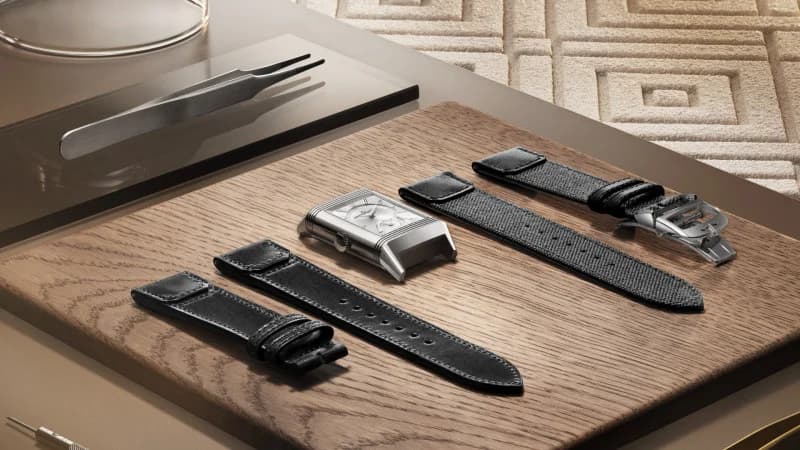
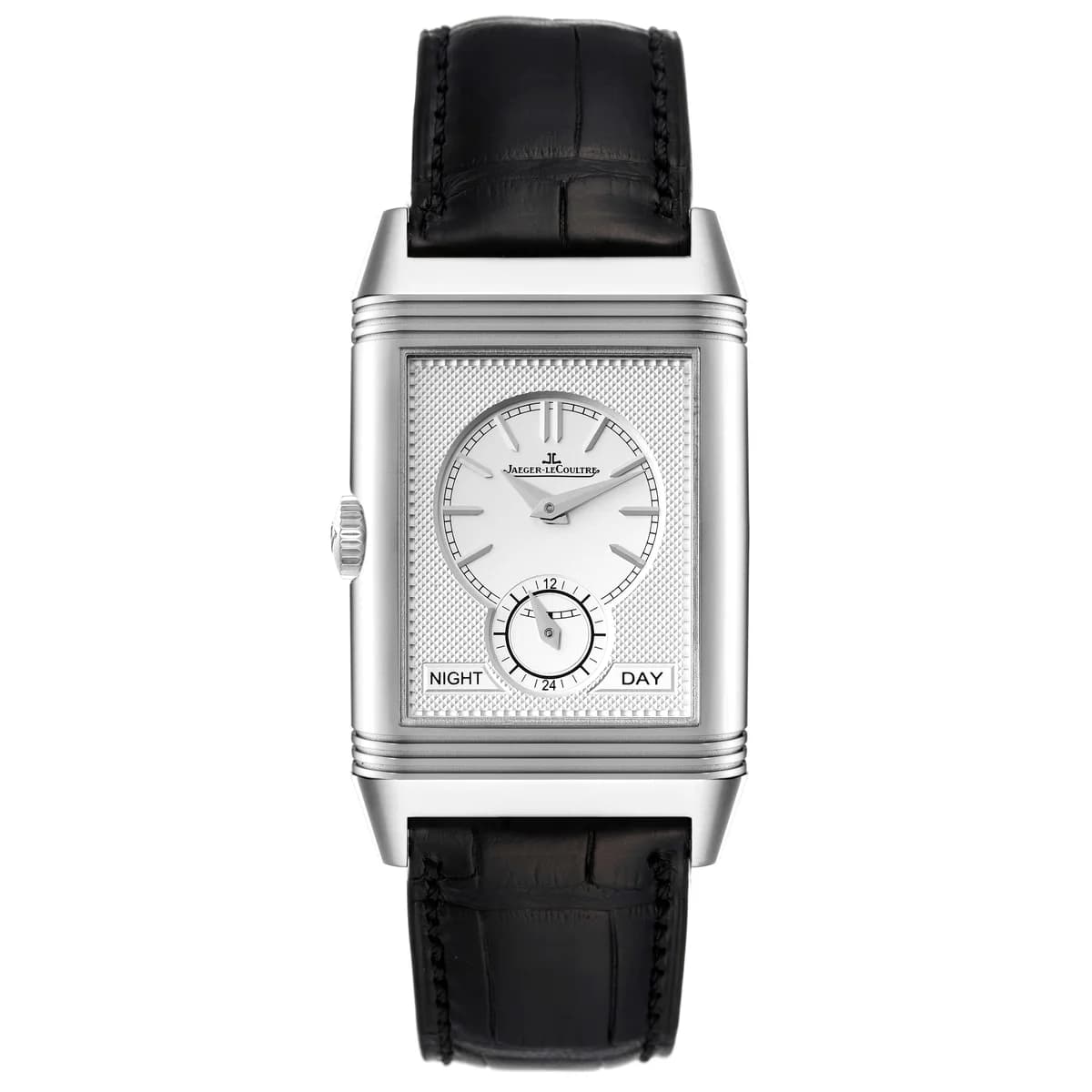
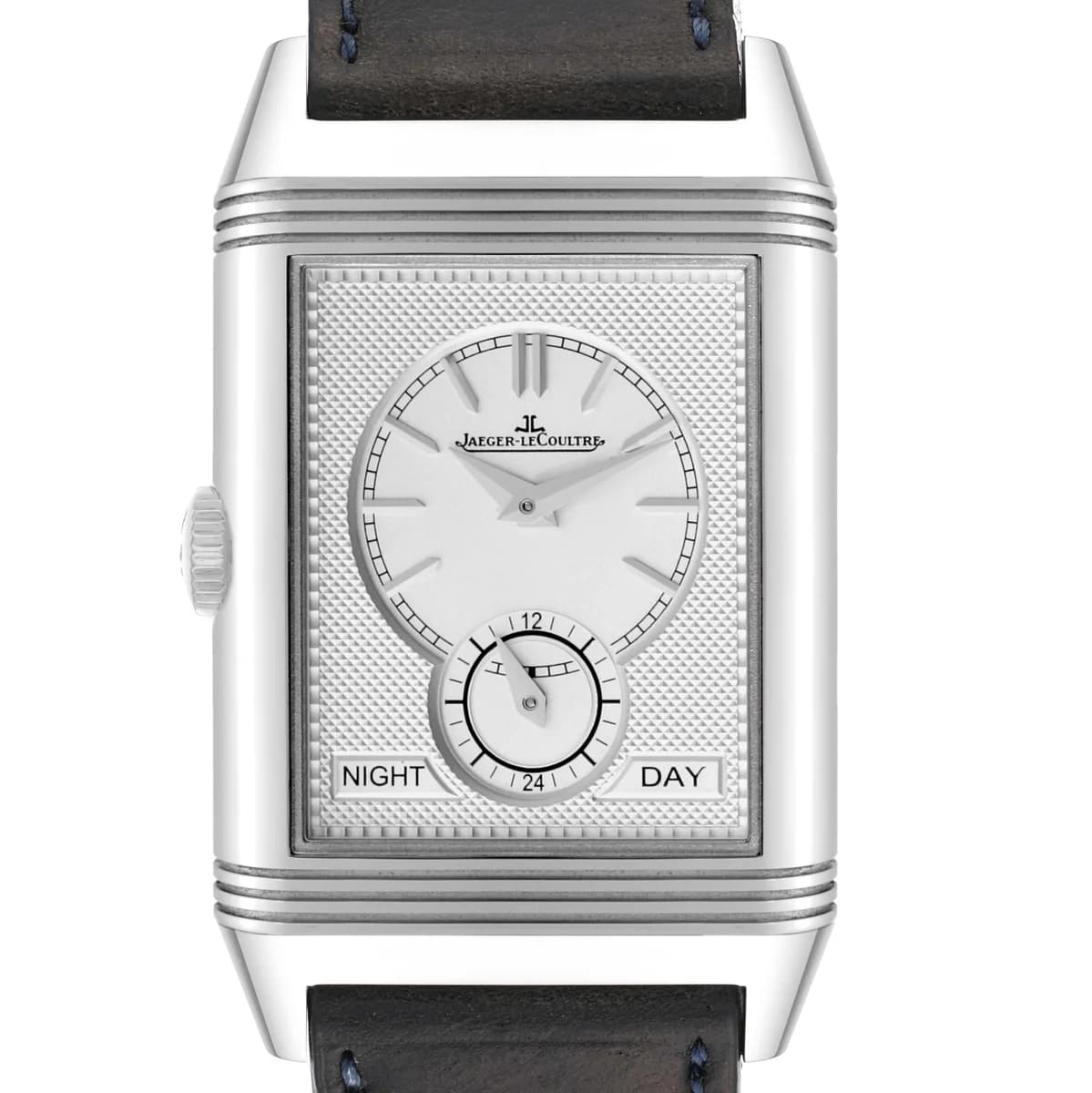
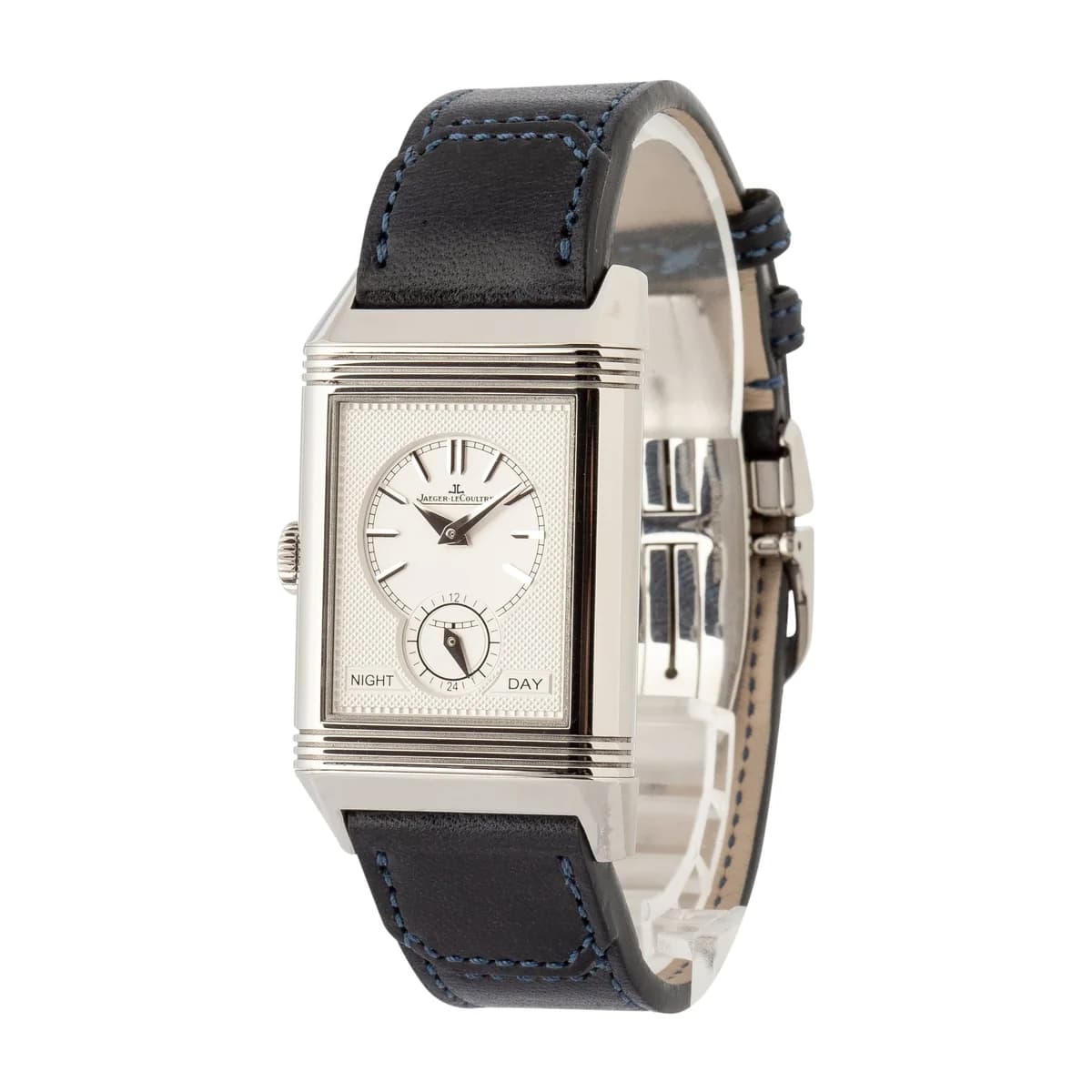
The Reverso Tribute Duoface Small Seconds is the one I would point to. Reference Q3988482. 47 by 28.3mm in stainless steel, approximately 10.3mm thick, hand-wound Calibre 854A/2 beating at 21,600 vibrations per hour with 42 hours of power reserve. Two fully finished dials, one on each side, both driven mechanically by the same single movement. Turn the watch over and you have a second face with a different time zone, different color, different character. It is two watches in one case. The front is a sunray blue lacquer dial with blued steel dauphine hands and a small seconds at 6. The back is a silver-grained dial with a second time zone and its own small seconds. The sapphire crystal is scratch-resistant. The case comes with two Casa Fagliano calfskin leather straps, one all-calf and one with a leather-canvas blend, and a stainless steel double folding clasp. Casa Fagliano is an Argentine leather house that has made polo boots since 1892, which connects back to the Reverso's origin story in a way that feels intentional and right.
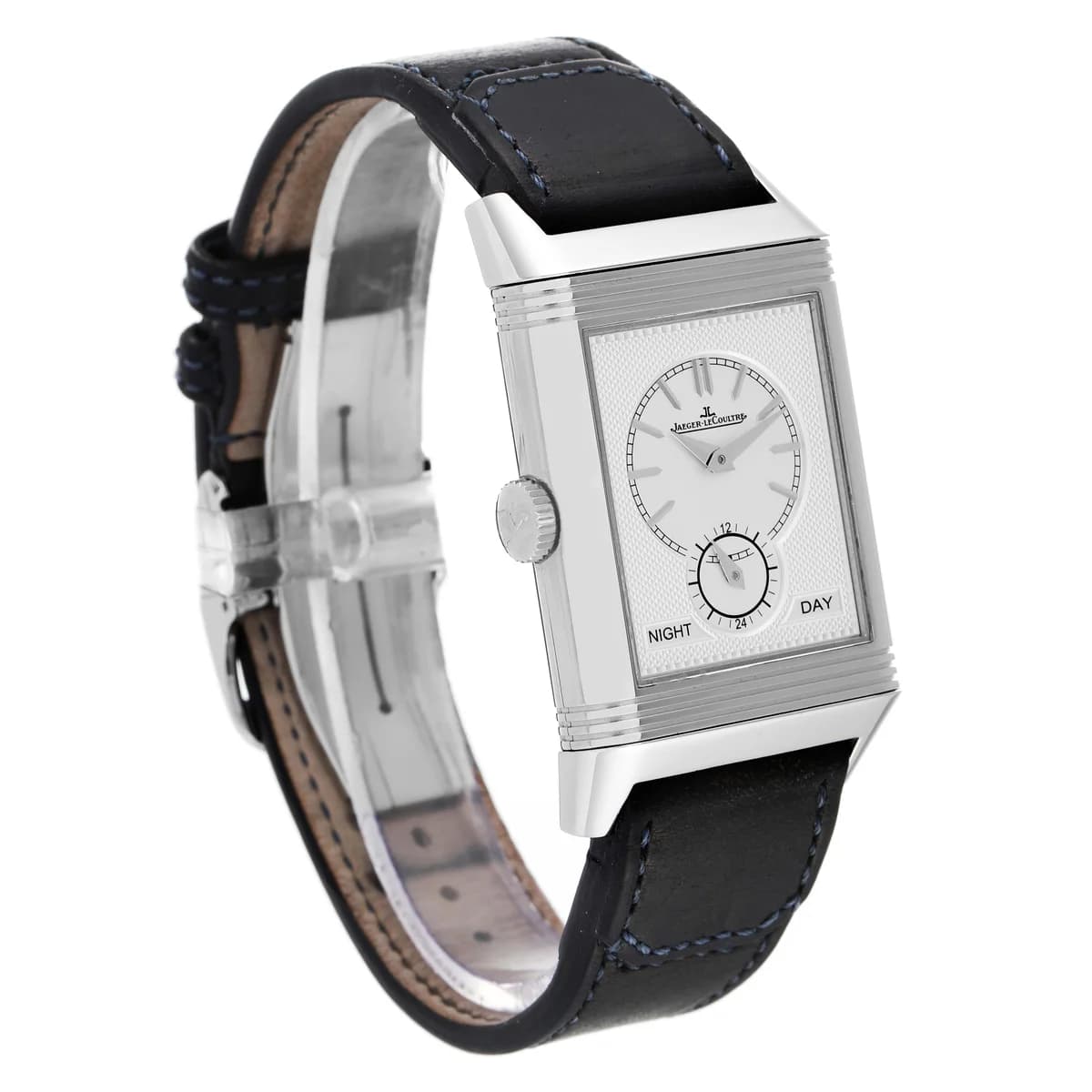
The Duoface concept itself arrived in 1994 and it changed what the Reverso could be. Before that, the reverse side of a Reverso was either a blank metal caseback for engraving or a protected surface. The 1994 Duoface was the first watch to place a second fully finished dial on the reverse side, and a single hand-wound movement drives both displays. That is not two movements stacked in a case. It is one caliber powering two independent time zone displays on opposite faces. Once you understand that, the Reverso stops being a watch with an interesting case and becomes something genuinely unique in horology. No other watch architecture in the world does this. The reversible case was designed to protect a crystal during polo. Sixty-three years later, JLC turned that same mechanism into a platform for dual-timezone complications, and the idea fits so naturally that it feels like it was always the plan.
That blank caseback that preceded the Duoface concept has its own history worth knowing. In the 1930s, Indian maharajahs commissioned enamel miniatures and family crests on their Reverso casebacks. Polo players had their team colors and emblems engraved. Amelia Earhart received a commemorative Reverso in 1935, which now sits in the JLC museum. General Douglas MacArthur owned an engraved Reverso that is also in the museum collection. The Atelier des Metiers Rares, JLC's rare handcrafts workshop, continues this tradition today. JLC is one of the very few watch manufactures to maintain a rare handcrafts workshop entirely under its own roof. They perform grand feu enamel fired at over 800 degrees Celsius across multiple layers, miniature enamel painting using the Geneva technique, guillochage, paillonnage (gold leaf applied under translucent enamel), hand engraving, and gem-setting. A single miniature enamel caseback requires approximately 80 hours of work. Recent editions include the Reverso Tribute Enamel Hokusai Waterfalls Series from 2023, featuring miniature reproductions of Katsushika Hokusai woodblock prints. The Reverso's back is not just protected metal. It is real estate. It is a canvas that no other watch case in the world provides.
Jaeger-LeCoultre is the watchmaker's watchmaker, and the Reverso is where most people discover that. The manufacture has been in Le Sentier, in the Vallee de Joux, since Antoine LeCoultre transformed his family's small barn into a watchmaking atelier in 1833. That was the beginning of one of the most vertically integrated watch manufactures in the world. Under one roof, JLC performs movement design and production, case manufacturing, dial production, hand making, assembly, quality control, the rare handcrafts atelier, and research and development. In 1844, Antoine LeCoultre invented the Millionometre, the first instrument capable of measuring to one micron, one-thousandth of a millimeter. That was the world's most precise measuring instrument at the time and was essential for refining the manufacture of watch parts to tolerances that had previously been impossible. The manufacture has produced over 1,300 unique calibers and filed more than 430 patents. In 1967, JLC created the Calibre 920, the world's thinnest automatic movement with a full-sized rotor at just 2.45mm thick. That movement ended up inside the Audemars Piguet Royal Oak, the Patek Philippe Nautilus, and the Vacheron Constantin 222. All three members of the Holy Trinity, running on the same JLC movement, and JLC never put the Calibre 920 in a single watch of their own. It is the only movement in history used by all three Holy Trinity brands simultaneously. Between 1870 and 1910, LeCoultre supplied nearly all ebauches to Patek Philippe, roughly 40,000 movements in the first two decades of the 20th century alone. When people say JLC punches above its weight, they are underselling it. JLC built the movements that other brands put their names on.
JLC also produces the Atmos clock, which is powered by temperature and atmospheric pressure changes and never needs winding or batteries. The Atmos has been in production since 1928. I mention this because it says something about the range of a manufacture that can build a clock powered by air temperature, a wristwatch with four display faces and eleven complications, and everything in between. That range is why the Reverso sits in the collection it does. The Reverso is not just carried by its own design. It is carried by the manufacture behind it.
The Reverso nearly died. Production ceased in 1948 as round watches and dive watches dominated the market. The rectangular case fell out of fashion, and the Reverso might have been forgotten entirely if not for an Italian distributor named Giorgio Corvo. In 1972, Corvo visited the JLC factory and discovered 200 forgotten Staybrite steel Reverso cases. He had JLC complete them with Calibre 840 movements. All 200 sold within months, which was remarkable given that JLC's total annual sales in Italy were only about 200 units at the time. That single discovery reignited interest in the Reverso. I find it remarkable that an entire watch line, one that would go on to become a pillar of the brand and one of the most recognized rectangular watches in the world, survived because one person walked into a factory at the right moment and asked the right question. In 1975, JLC reintroduced the watch, initially as a quartz ladies' model. In 1981, an engineer named Daniel Wild redesigned the case, expanding it from the original 23 components to 55 with improved water resistance and modern specifications. The Reverso Classique launched with the new 55-part case in 1985. In 1991, under Gunter Blumlein's direction, JLC introduced the Soixantieme for the 60th anniversary, the first Reverso with complications (a date display and power reserve indicator), featuring a solid-gold movement. By 1993, JLC had fitted a tourbillon inside the reversing case, the Calibre 828 designed by Sylvain Golay, which was the first series-produced tourbillon in watch history. The 1994 Duoface changed everything again. That same year, JLC also introduced a Reverso minute repeater, the Calibre 943, which was the smallest rectangular minute repeater ever made at 306 parts. The 2021 Quadriptyque, released for the 90th anniversary, pushed the concept to its logical extreme. Four functioning display faces, eleven complications including a perpetual calendar, a minute repeater, and a one-minute flying tourbillon, limited to ten pieces in white gold. A pin extends from the main case movement and activates a mechanical corrector built directly into the cradle, which drives the displays on the cradle itself. No additional movement plates needed. The engineering required to make complications function across two separate physical structures, the case and the cradle, connected by a single pin, is extraordinary. The Reverso centennial arrives in 2031. I am genuinely curious what JLC will build for it.
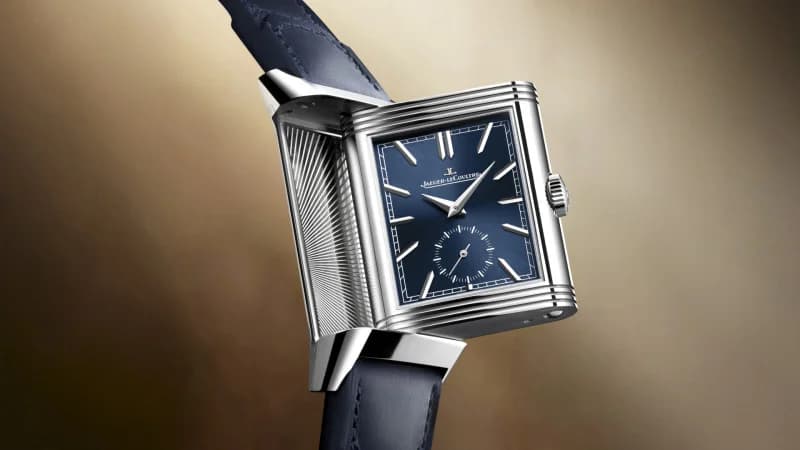
The Reverso is the watchmaker's rectangle. The Cartier Tank is the jeweler's rectangle. Both are foundational watches. The Tank was designed in 1917, inspired by the Renault tanks of World War I, and Louis Cartier gifted the first one to General John Pershing in 1919. The Reverso arrived in 1931, born from polo fields in British India. Both have barely changed. But they serve different masters. The Tank is a jeweler's watch. It emphasizes elegance and fashion. The brancards (side bars) extend to form the lugs in one continuous line. It sits flatter on the wrist. It starts with a quartz model and is primarily a design object. The Tank is about how it looks. The Reverso is about what it does. It is a watchmaker's watch. The reversing case IS the complication. The case is the mechanism. Every current Reverso model uses a mechanical hand-wound movement. The Reverso is available with haute horlogerie complications that the Tank never approaches: tourbillon, minute repeater, perpetual calendar. The two watches represent different philosophies of what a rectangle on the wrist should accomplish, and serious collectors often own both.
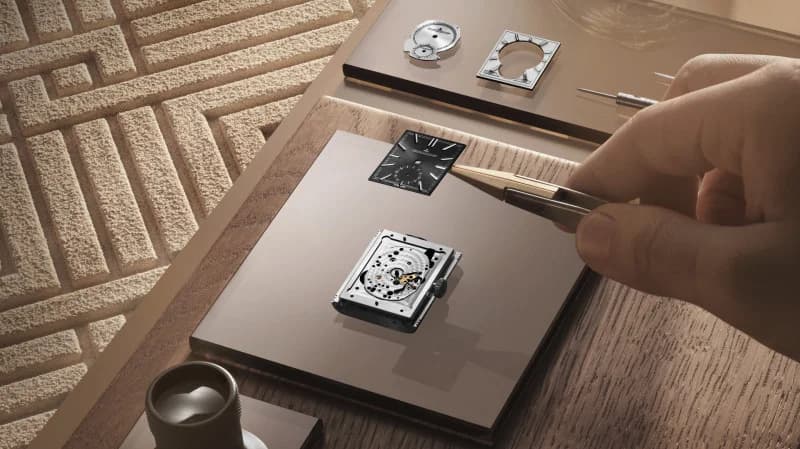
The honest critique is the steel. The Reverso in stainless steel scratches easily. For a watch designed to survive polo, this is ironic. The case finishing shows wear quickly, especially on the polished surfaces and the sliding cradle. The cradle itself picks up marks from the reversing mechanism over time as the case slides back and forth across its surface. Regular polishing is needed to keep it looking new, and every polish removes a microscopic layer of steel. Water resistance at 50 meters is adequate but not exceptional. And the 42-hour power reserve on the Tribute Duoface means you wind it every day. For a watch at this level, I wish JLC had pushed the power reserve closer to 65 or 70 hours. That said, there is something about the daily winding ritual on a Reverso that connects you to the watch in a way that an automatic never does. You pick it up each morning, feel the crown between your fingers, and wind it back to life. These are minor complaints against a watch that has been in continuous production for 95 years, carries the same manufacture that powered the Royal Oak and the Nautilus, and does something that no other watch in the world can do.
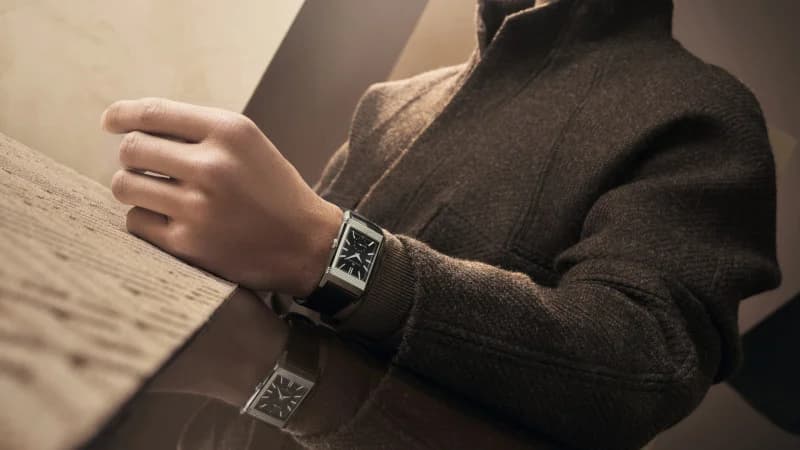
On my wrist, the 47 by 28.3mm rectangular case sits differently from anything round. The proportions, governed by the golden ratio, create a visual footprint that reads longer and narrower than the numbers suggest. On a 7-inch wrist, it sits with a quiet authority that round sport watches never achieve. The blue sunray dial picks up navy, charcoal, and midnight fabrics naturally. On darker skin tones, the stainless steel case and blue dial create a cool-toned contrast that reads clean and deliberate. I would pair it with a dark E. Thomas wool suit and a white shirt, or with a navy linen jacket and open collar. The rectangular geometry works with structured tailoring in a way that round watches do not. Under a cuff, the flat profile disappears. With rolled sleeves, the Art Deco lines catch light at angles that a round case never produces. The Casa Fagliano strap adds warmth and texture that softens the steel case just enough. It is a watch that rewards getting dressed with intention. The Reverso is not the loudest watch in any room. It is the one that people who know watches will notice first. And when they ask about it, and they will, you get to show them the second dial. That moment, when someone sees the reverse face for the first time, never gets old. It is one of the few genuine surprises left in watchmaking.
Also in Design Icons