
IWC
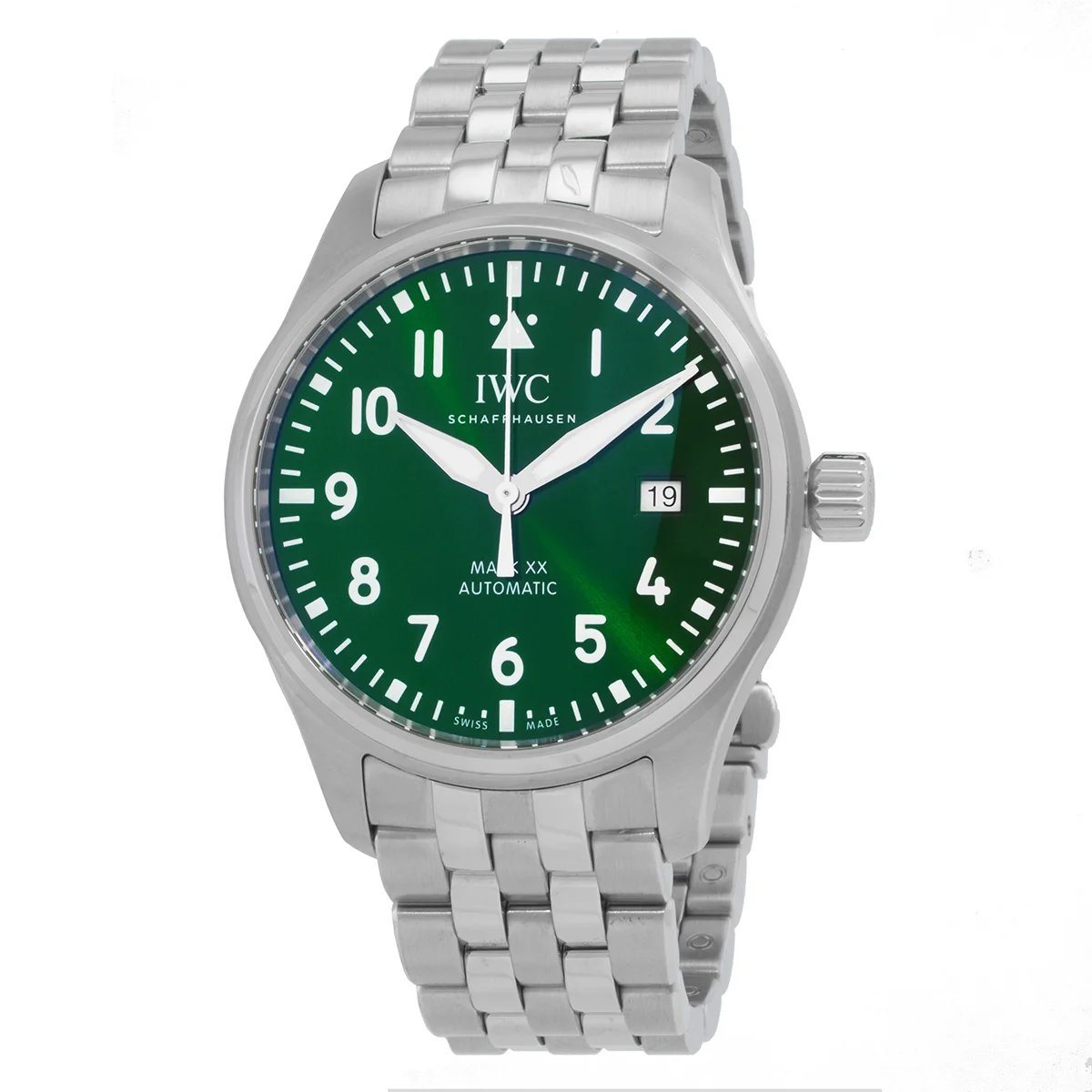
Pilot Mark XX Green Dial
IW328206
IWC has one of the most unusual origin stories in Swiss watchmaking. In 1868, a man named Florentine Ariosto Jones left his position as a director at E. Howard & Co. in Boston, traveled across the Atlantic, and set up a watch factory in Schaffhausen, Switzerland. An American. Building a Swiss watch company. His idea was to combine the industrial manufacturing systems he knew from American watchmaking with the handcraft skills of Swiss artisans. He chose Schaffhausen specifically because the Rhine River provided hydropower to run his machinery. What makes this even more interesting is where he chose to build. Schaffhausen is in the German-speaking part of Switzerland, far from the French-speaking watchmaking centers of Geneva, the Vallee de Joux, and La Chaux-de-Fonds. To this day, IWC remains the only major Swiss watch manufacturer in the German-speaking region. That geographic separation has given IWC a distinct identity and a slightly different manufacturing philosophy from the rest of the Swiss industry. Jones himself didn't last. Rising wages, US import duties, and shareholder pressure forced him back to America by 1875. The company passed to the Rauschenbach family, whose stewardship kept the manufacture running through two world wars. The connections in this industry run deep.
If you want to visit, Schaffhausen is worth the trip. It's a small medieval city on the Rhine, about 36,000 people, near the German border and just a few kilometers from the Rhine Falls, the largest waterfall in Europe. IWC's museum is inside the original 19th-century factory building with views of the river, and they offer a Fan Tour that takes about four and a half hours. You walk through the museum, then into the modern Manufakturzentrum that they opened in 2018 and watch them build watches from raw metal bars to finished pieces. A knowledge ambassador walks you through everything. It's a completely different experience from visiting Geneva. Quieter, more industrial, more focused. I appreciate Schaffhausen for the same reason I appreciate IWC: it does its own thing and doesn't try to be something it's not.
Historical context
1 image· tap to view
The Mark series is where IWC's pilot watch heritage lives, and it starts in 1948 with the Mark XI. The British Ministry of Defence needed a watch for Royal Air Force navigators and they went to IWC to build it. The specs were demanding: the watch had to be highly accurate, readable at a glance in a dark cockpit, and resistant to magnetic fields from aircraft instruments. IWC delivered a 36mm steel watch with the Caliber 89, which is still considered one of the greatest manual-wind movements ever produced. The dial had white Arabic numerals on a black background, luminous hands, and an inverted triangle at 12 o'clock flanked by two dots. That triangle wasn't decoration. A pilot in a dark cockpit, pulling G-forces, possibly disoriented, needs to know which direction is up on the dial without reading numbers. The triangle tells you instantly where 12 is with a single glance. A soft-iron inner case shielded the movement from magnetic interference. The Mark XI entered RAF service in 1949 and wasn't decommissioned until 1981. Thirty-two years of active military service for a wristwatch. Every Mark that followed carries DNA from that original.
The lineage after the Mark XI is worth understanding because each generation refined the formula. The Mark XII in 1993 was the first civilian Mark, adding automatic winding and a date window. The Mark XV in 1999 bumped the case from 36mm to 38mm. IWC skipped the Mark XIII and XIV because those numbers are considered unlucky in some cultures. The Mark XVI went to 39mm, the Mark XVII jumped to 41mm with a triple date window that some fans felt was too large, and the Mark XVIII in 2016 dialed it back to 40mm with a cleaner, more symmetrical dial. Then in 2022, the Mark XX arrived, and IWC skipped the XIX too. The Mark XX is the most significant upgrade the series has seen in years.
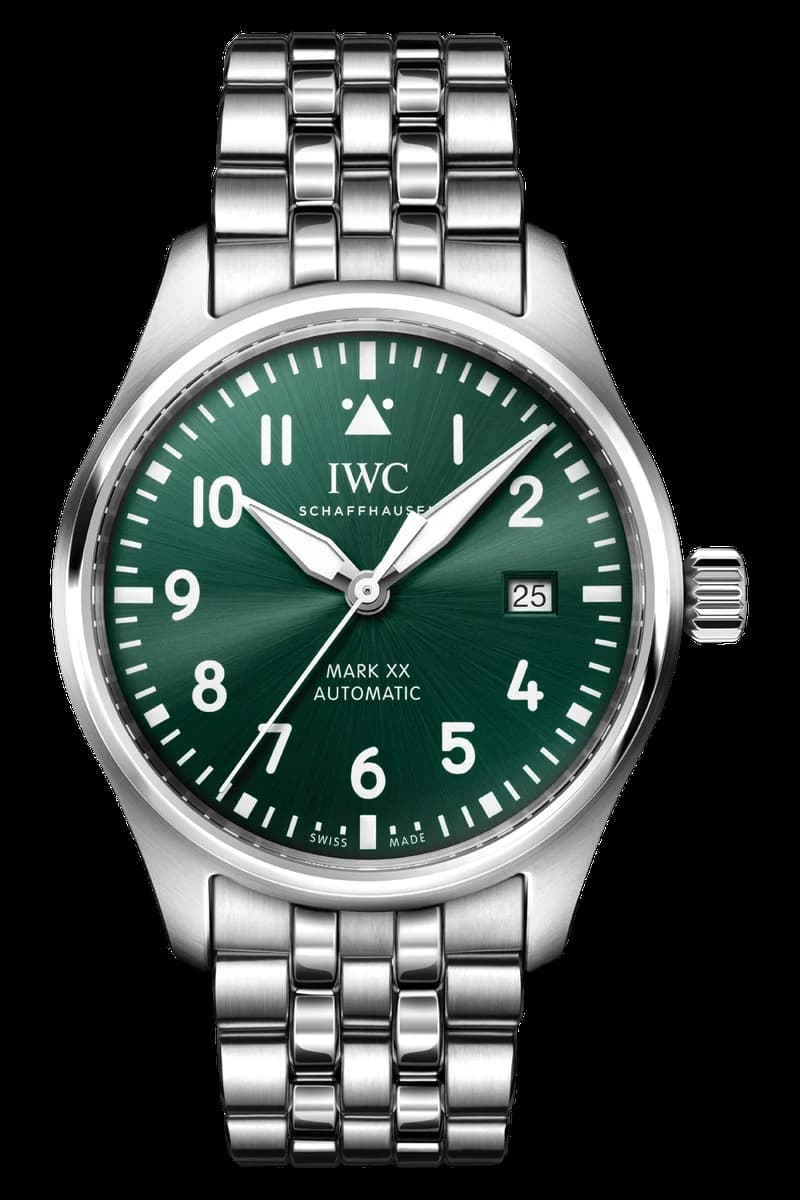
The big improvement is the Caliber 32111. The previous Mark XVIII ran on a movement with 42 hours of power reserve. The 32111 delivers 120 hours. Five days. You can take the watch off on Friday evening and put it on the following Wednesday morning and it's still running. That's a dramatic leap. It runs at 28,800 vibrations per hour with 21 jewels, has a bidirectional pawl winding system, hacking seconds for precise time setting, and an ETACHRON regulator. The movement is produced by Val Fleurier, which is within Richemont's own manufacturing ecosystem alongside IWC, so it's not outsourced in the way a third-party ETA movement would be. There's a debate in the collector community about whether this counts as "in-house," and I think reasonable people can disagree on that. What's not debatable is that 120 hours of power reserve in a 10.8mm case is genuinely impressive engineering, and it works beautifully in practice.
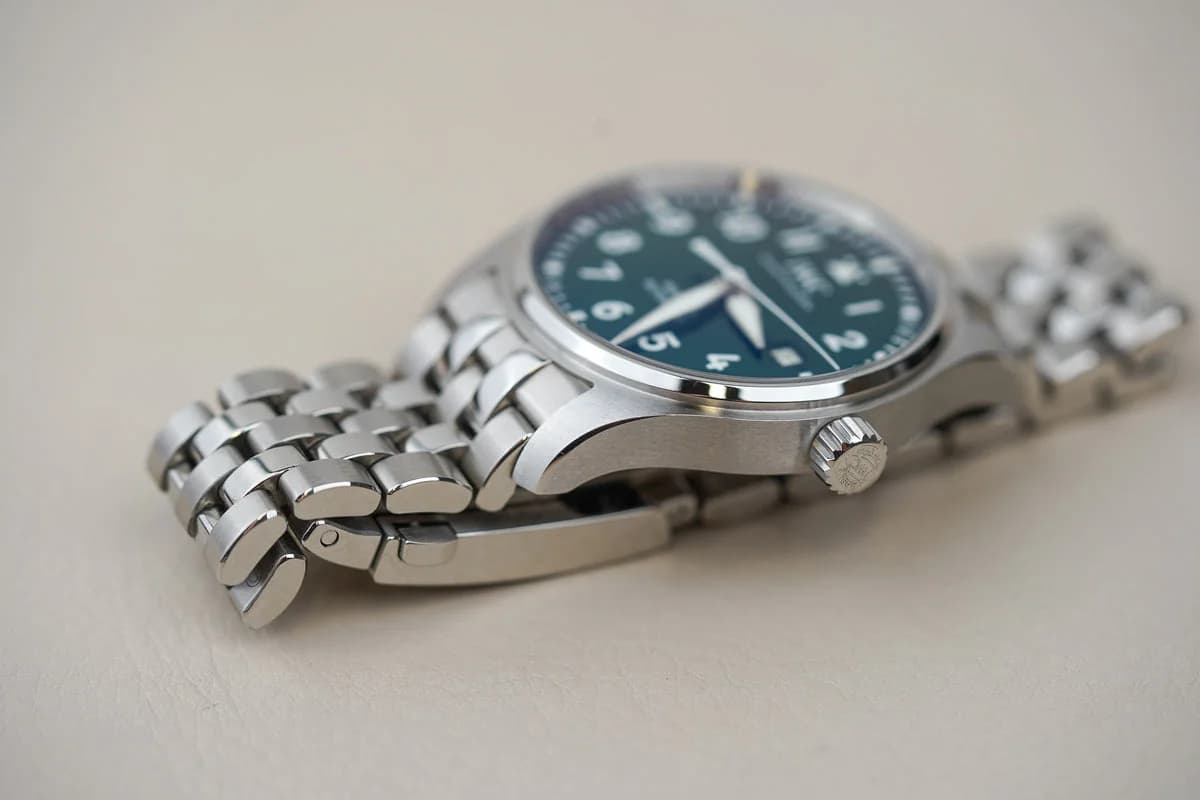
The watch itself is 40mm wide, 10.8mm thick, with a 49.2mm lug-to-lug. Those numbers matter. The Mark XVIII was 11mm thick with a 51mm lug-to-lug. So the Mark XX is thinner and sits shorter on the wrist, which translates to noticeably better comfort under a shirt cuff. At 40mm, it has enough presence to be a proper daily watch without overwhelming smaller wrists. Water resistance went up from 60 meters to 100 meters, which doesn't sound like much on paper but in practice it means you genuinely don't have to think about it in rain, washing your hands, or getting caught in a pool. The sapphire crystal is scratch-resistant, and the caseback is solid steel to accommodate the soft-iron inner case for anti-magnetic protection, carrying forward one of the Mark XI's original military requirements.
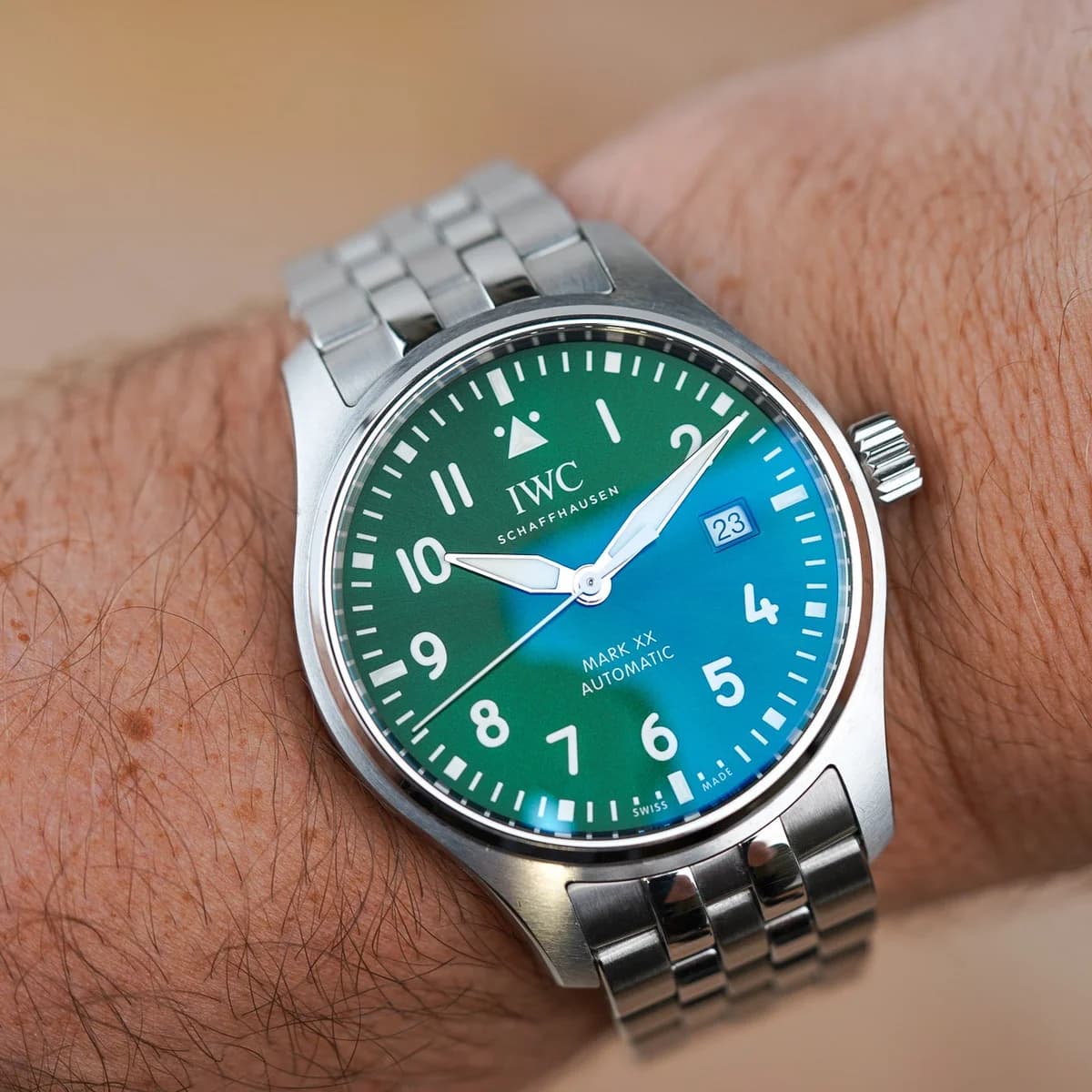
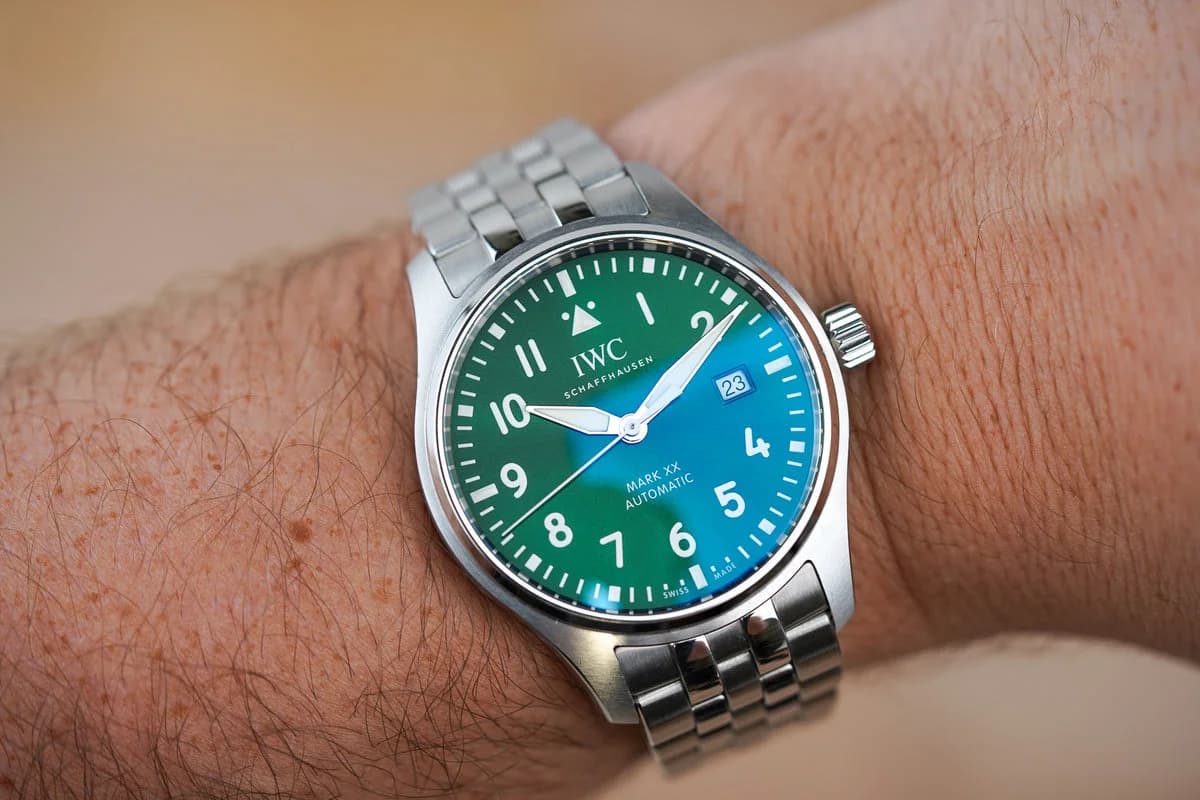
Now, the green dial. IWC launched the Mark XX in mid-2022 with black and blue sunburst dials, then added the green in October 2022. The green sunburst finish radiates from the center of the dial, and the way it catches light is what makes it special. In direct sunlight it brightens to an almost emerald tone. In lower light or at angles it deepens toward a rich forest green. It's not a flat military green. It shifts. And on a stainless steel case with steel bracelet, it creates this combination of cool metal and warm color that just works.
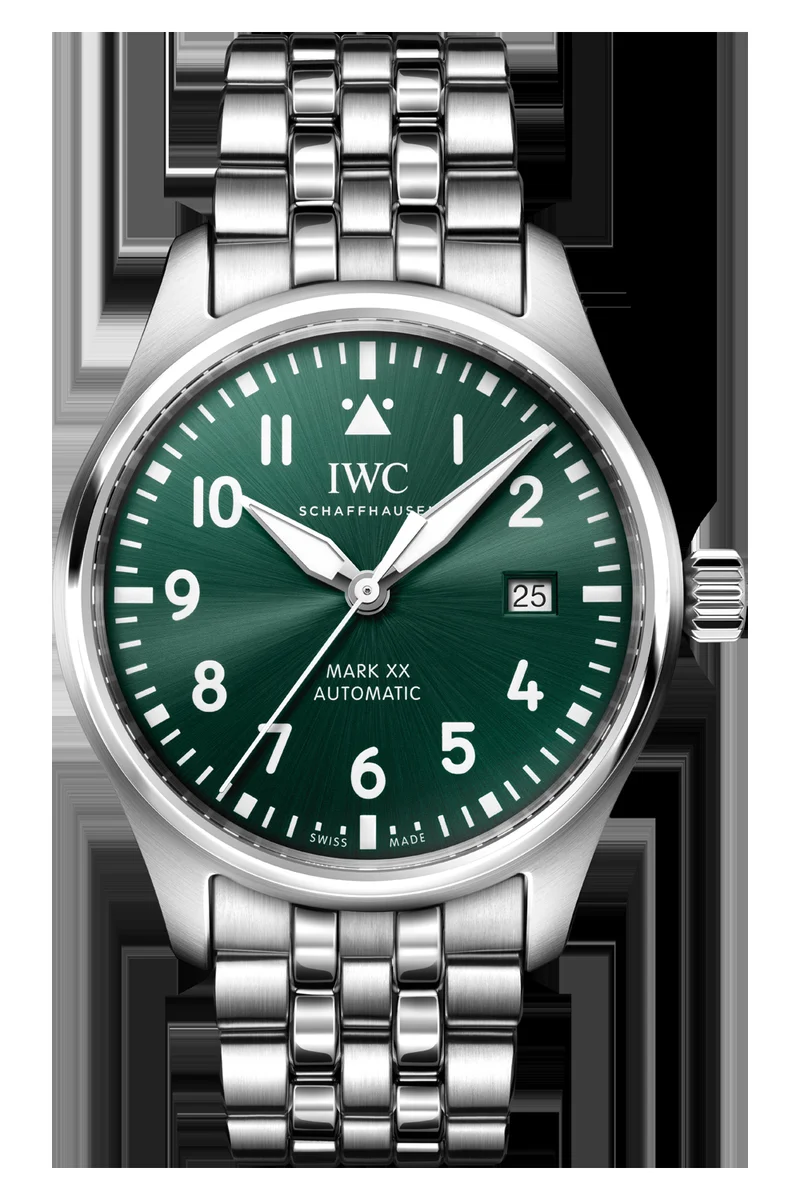
I've seen the green dial craze work its way through the industry over the past several years. You can trace the modern wave back to the Rolex Submariner "Hulk" in 2010, but it really exploded around 2019 when Patek Philippe released a green Aquanaut. When Patek does a color, the industry pays attention. By 2021, Patek dropped the olive-green Nautilus 5711, Rolex introduced the "Starbucks" Submariner, and green went from trend to permanent fixture. Breitling, IWC, and dozens of others followed. What I appreciate about IWC's green is that it doesn't feel like bandwagon jumping. Green has genuine military and aviation heritage. On a pilot watch with a lineage back to the RAF, green actually makes historical sense.
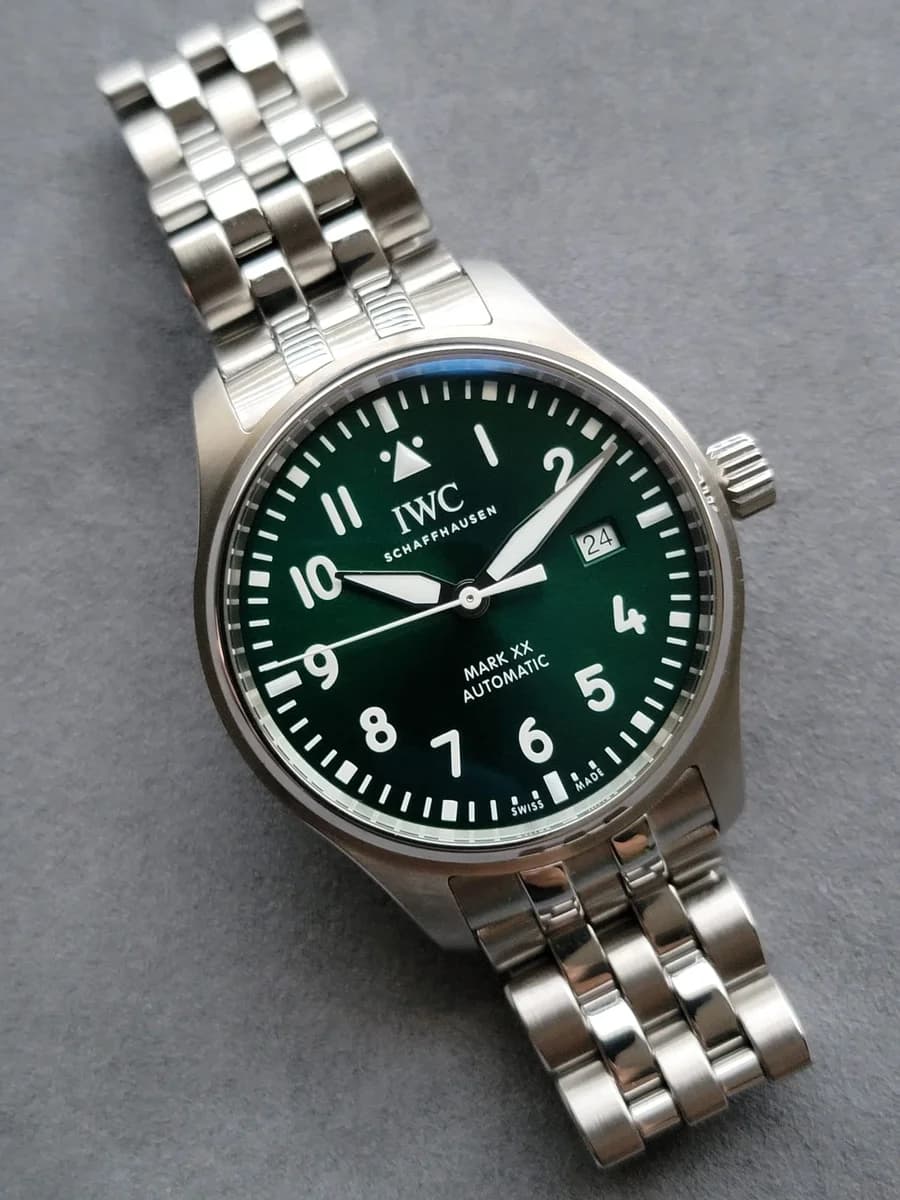
The blue dial is unquestionably IWC's most popular color, and there's a good reason for that. The Le Petit Prince editions, named after the Antoine de Saint-Exupery novel, use a deep midnight blue that represents the night sky through which the Little Prince travels. Saint-Exupery was himself a pilot who disappeared during a reconnaissance flight in 1944, so the connection between his story and IWC's aviation heritage is real, not marketing. The blue became so popular that IWC made it a permanent colorway across the Mark lineup. It looks great, especially with a brown strap. But for me, on my complexion, the green just hits differently. The warmth of the green against darker skin creates a contrast that the blue and black don't. It's earthy without being casual, military without being literal. It's the same reason I gravitate toward the Rootbeer's Everose gold or the olive green Day-Date. Warm tones and darker skin just work together, and this is something that doesn't get talked about enough in watch media.
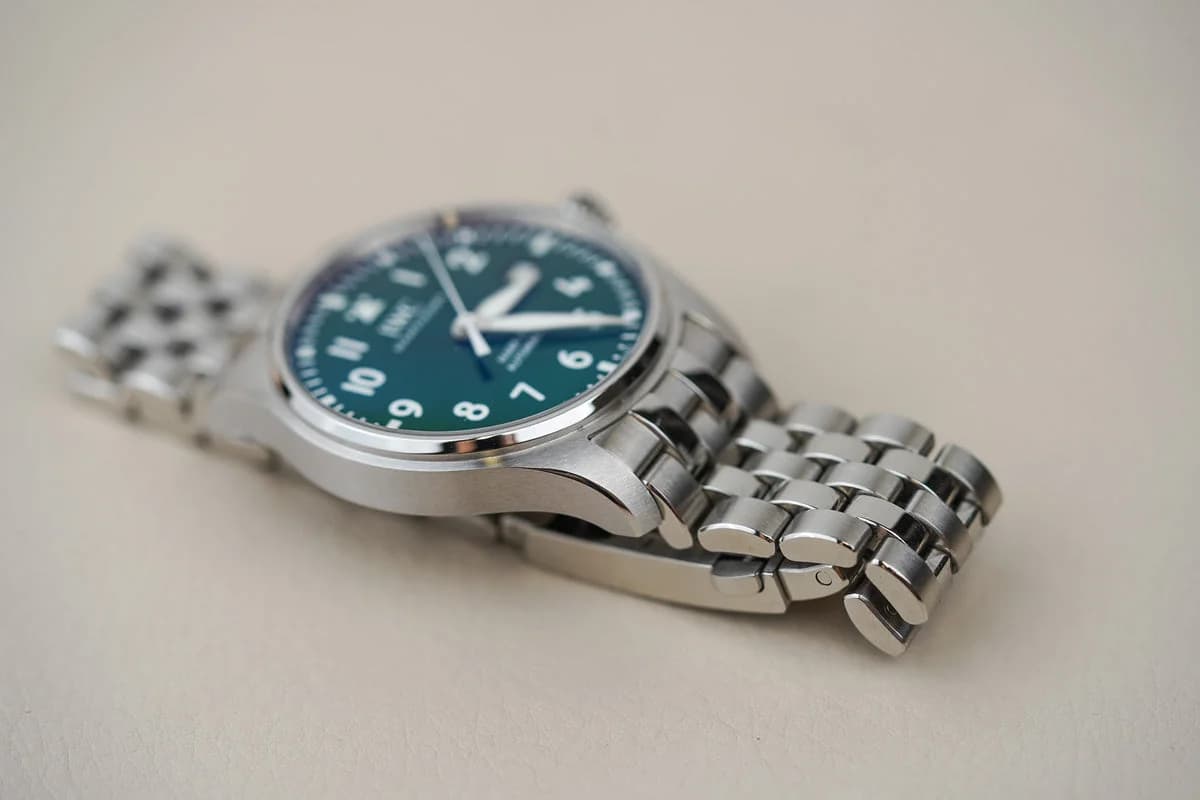
Readability is where IWC genuinely separates itself. I've worn a lot of watches from a lot of brands, and something about IWC dials just clicks. You glance down and the time registers instantly. No processing, no squinting, no figuring it out. The combination of the high-contrast white numerals on the dark dial, the propeller-shaped rhodium-plated hands, the triangle at 12, and the Super-LumiNova on everything creates a visual hierarchy that your brain interprets without effort. Other brands are readable. IWC is instant. The lume glows mint-green in the dark, and because the triangle, numerals, and hands are all coated, you get complete legibility day and night. These design elements weren't created for aesthetics. They came out of military specifications where readability was a life-or-death requirement. And they've been refined across 75 years and nine generations of the Mark series. That's what heritage engineering looks like.
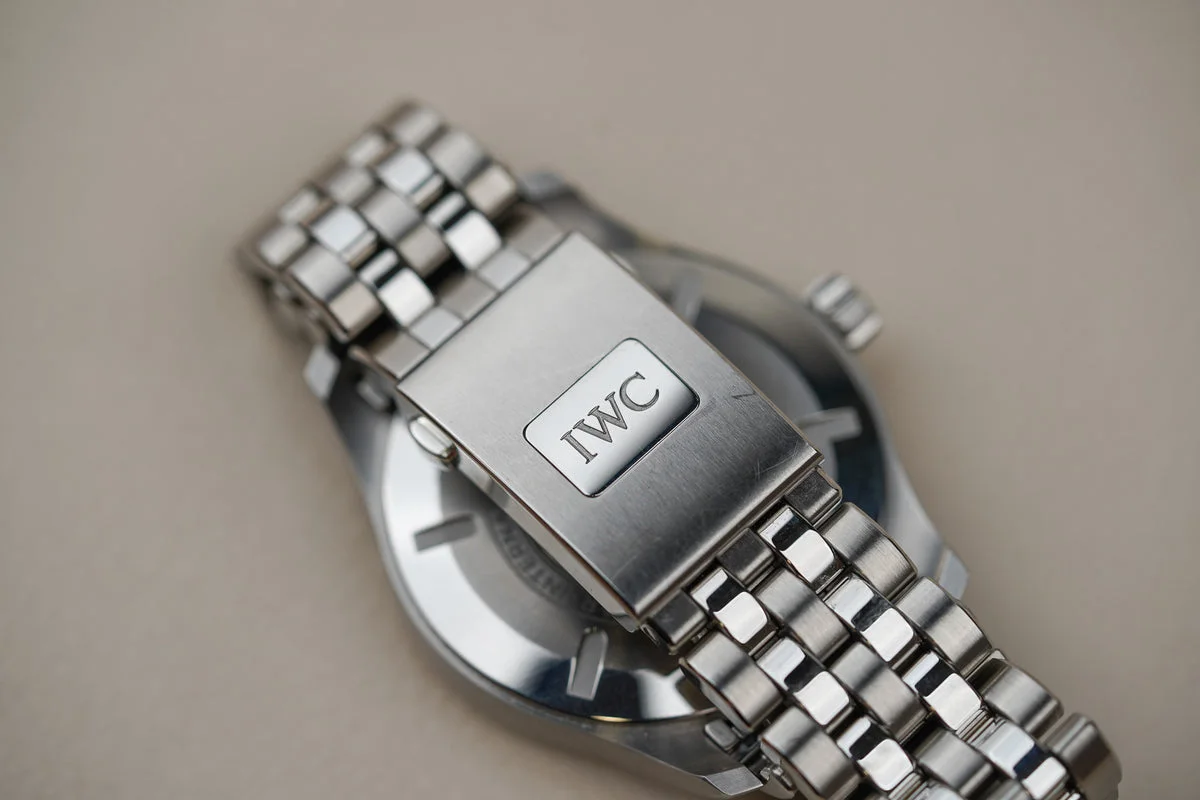
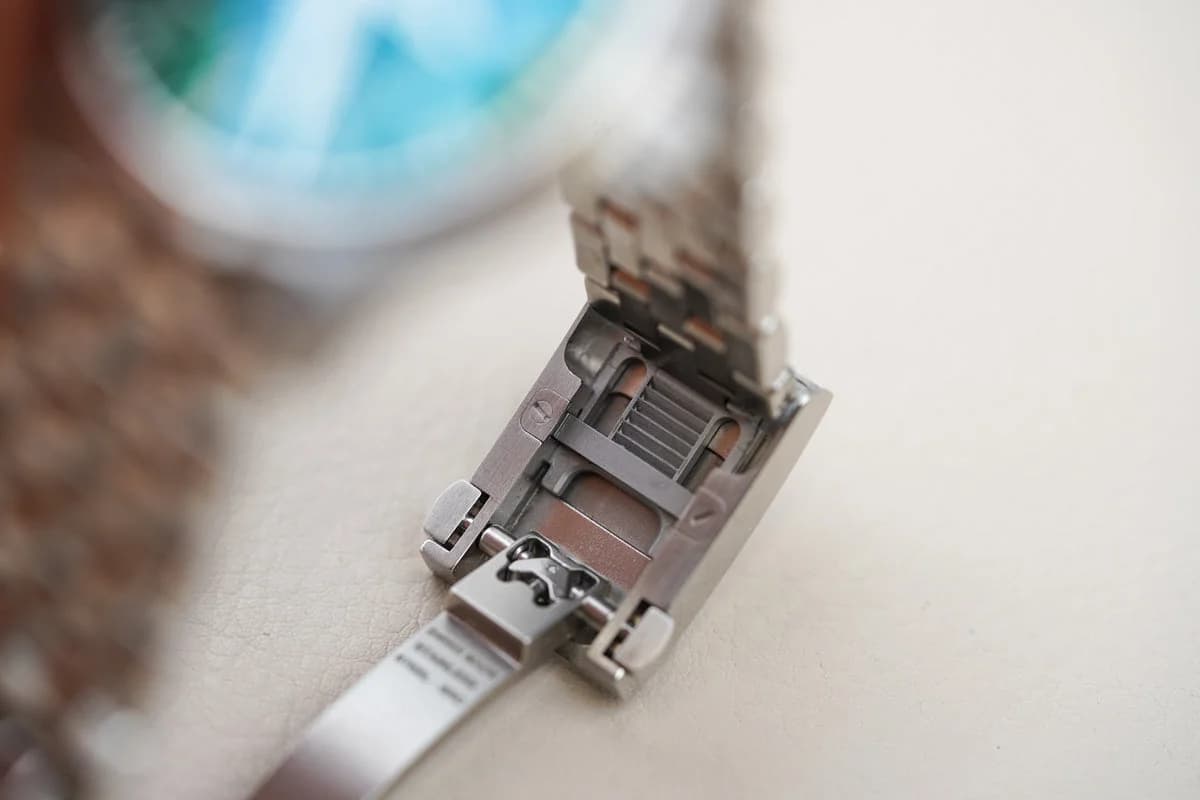
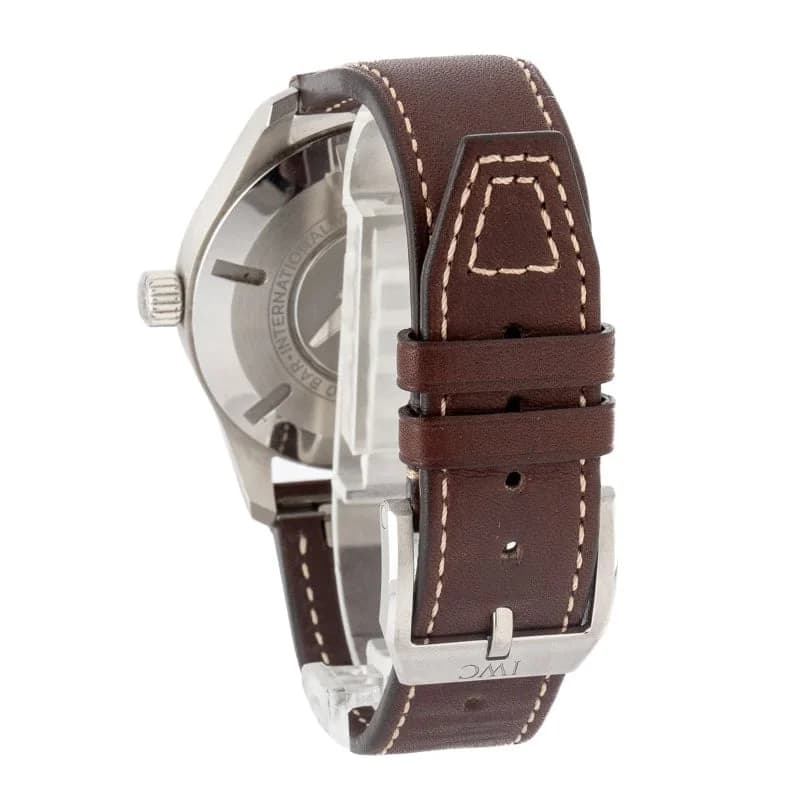
The bracelet deserves mention because IWC nailed it on the Mark XX. It's a five-link steel design with brushed wide links and mirror-polished beveled shoulders on the narrower connecting links. It has micro-adjustment for sizing, and owners who've worn it daily for over a year consistently say it's one of the best bracelets in its price class. IWC also introduced the EasX-change system, a quick-release mechanism that lets you swap between the bracelet, a leather strap, a rubber strap, or their sustainable MiraTex material in seconds without tools. Sound familiar? Same concept as the Santos QuickSwitch. The downside is that it's a proprietary system, so aftermarket strap options are more limited than a standard 20mm spring bar setup. But IWC sells colored rubber straps, brown calfskin, and textile options, so the ecosystem is there.
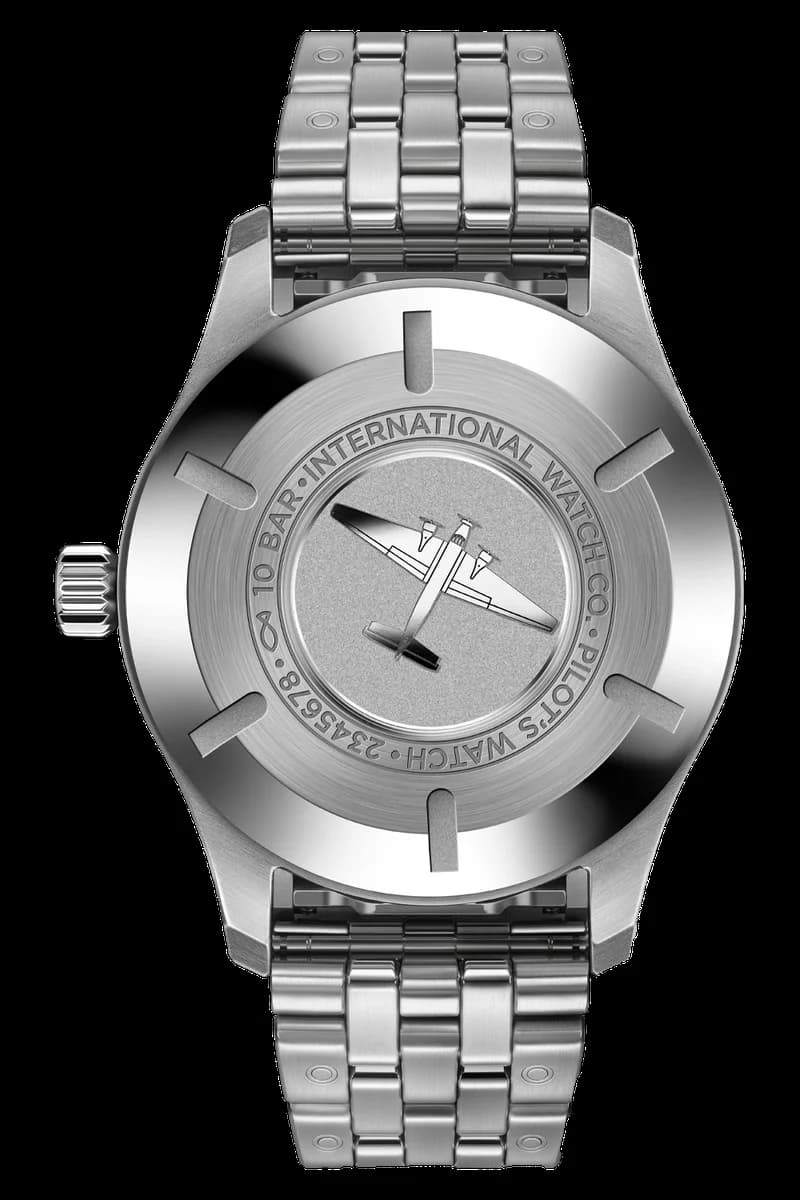
If I had to find something to criticize, it would be the movement transparency. The caseback is solid steel because of the soft-iron inner case, which means you can't see the movement. I understand the engineering reason. Anti-magnetic protection requires the iron cage, and the iron cage requires a closed caseback. But on a watch with a movement that has Cotes de Geneve finishing, it would be nice to see it. Rolex has the same closed-caseback philosophy, so IWC isn't alone here. It's a tradeoff: magnetic protection versus visual access. But when I think about the Lange caseback with the hand-engraved balance cock visible through sapphire, or even an Omega Seamaster with its display back, I do wish I could see what's going on inside. The engraved airplane motif on the caseback is a nice touch though. It's a small acknowledgment that there's something worth looking at underneath, even if you can't.
IWC does not get the same attention as Rolex or Omega from the general public, and I think that actually works in its favor. It is an insider's brand. The people who know watches respect IWC deeply for its movement engineering, its aviation heritage, and its design restraint. You get a 120-hour power reserve, a genuinely comfortable bracelet with quick-release, a case that wears perfectly at 40mm, and a dial that was designed over 75 years of iterative refinement by people who started with literal military specifications. It is not the watch that turns heads at a party. It is the watch that another watch person notices on your wrist and nods.
The accuracy of the Mark XX in real-world use is worth reporting honestly because specs and reality don't always match. Reviewers who wore the Mark XX for extended periods consistently found average gains or losses in the range of one second per day. In a 40mm watch without COSC certification, that's genuinely impressive. The ETACHRON regulator allows for fine adjustment of beat rate without disassembling the movement. The regulator consists of two pins that clamp the active coil of the hairspring, and moving them changes the effective length of the spring, which adjusts the rate. A trained watchmaker can bring a movement to within fractions of a second per day this way. For a daily wear watch, one second per day is essentially perfect. You will never feel the drift. You will never need to reset the time more than once a week, if that.
The soft-iron inner case deserves more explanation than it usually gets because it is a genuinely unusual piece of engineering in the modern watch world. Most manufacturers address magnetic fields through the use of silicon or nickel-phosphorus components in the movement, materials that are inherently non-magnetic. IWC takes the opposite approach on the Mark line: enclose the entire movement in a cage of soft iron, which conducts and redirects magnetic field lines around the movement rather than through it. The tradeoff is structural. The soft-iron cage requires a solid caseback, which is why you cannot see the Caliber 32111's Cotes de Geneve finishing through the back of the watch. The engraved airplane motif on the caseback is a small acknowledgment that there's more underneath. The Mark XX resists magnetic fields up to 16,000 A/m, compared to the standard ISO 764 requirement of 4,800 A/m. For anyone who works near electromagnetic equipment, medical devices, or speaker systems, that margin matters in practice.
The Le Petit Prince angle is something I think about every time someone asks me why IWC made the blue so popular. Antoine de Saint-Exupery was a French aviator and author who disappeared on a reconnaissance mission over the Mediterranean in July 1944. His aircraft simply did not return. No debris, no signal, no trace for decades. His remains and some personal effects were eventually recovered near Marseille in 2000. He wrote "The Little Prince" in 1943, one year before he vanished. The connection between that story and IWC's aviation heritage is not marketing gloss. It is a real link between a pilot who wrote about stars and a watch company that has been making pilot watches since 1948. The blue dial honors that connection. I understand why the blue is the most popular color. I still reach for the green. The green does not carry the same narrative. It carries something different: the sense that you chose it because it is right for you, not because a story told you to. And sometimes that's the better reason.
This is a watch I can wear with a suit, with jeans, with a linen shirt, and it never feels wrong. The green sunburst adds just enough personality to keep it from being anonymous, but it's never loud. Paired with the brown calfskin strap it's warm and elegant. On the steel bracelet it's clean and professional. It's the kind of piece you put on in the morning and forget you're wearing until someone asks you what it is. And then you get to tell them about Florentine Ariosto Jones, the American who built a Swiss watch factory on the Rhine River in 1868 because he wanted to combine two worlds. That's a good conversation to have. The green dial tells none of that story. It lets the watch carry the conversation on its own terms, which is what the best pilot watches have always done.
Also in Tool Watches