
IWC
Ingenieur
IW323902
I want to start with something that does not get enough attention in watch conversations. In the 1950s, engineers and scientists were spending their days around equipment that generated serious magnetic fields. Electric motors, generators, medical imaging equipment, industrial machinery. The magnetic fields from these devices could magnetize the hairspring inside a mechanical watch, which would cause the coils to stick together and throw the timekeeping off by minutes per day. A magnetized watch is not broken, but it is useless until a watchmaker runs a demagnetizer over it. For the people who worked around this equipment every day, a standard mechanical watch was a liability. IWC, working out of Schaffhausen in northeastern Switzerland, decided to solve the problem.
The solution was elegant in its simplicity. Albert Pellaton, IWC's technical director since 1944, oversaw the development of the first Ingenieur, reference 666, introduced in 1955. The approach was not to build a movement that resisted magnetism. It was to build a cage around the movement that deflected magnetic field lines before they could reach the sensitive components inside. A soft iron inner case, essentially a Faraday cage, wrapped around the movement and redirected external magnetic fields. The original Ingenieur could protect the movement from fields up to 80,000 amperes per meter. To put that in context, the average smartphone generates roughly 3,000 A/m. The Ingenieur was engineered for environments that were orders of magnitude more hostile than anything a typical person encounters today.
The first Ingenieur was a modest watch by today's standards. The case measured 36.5mm in diameter and 13.2mm thick, powered by IWC's automatic caliber 852, which beat at 19,800 vibrations per hour and featured a self-compensating Breguet balance spring. Pellaton's contribution went beyond the antimagnetic case. He invented the Pellaton winding system, a bidirectional automatic mechanism that became one of IWC's signature engineering achievements. The system uses a heart-shaped eccentric cam connected to the rotor that drives a rocking bar back and forth. Two pawls on the rocking bar engage the winding wheel, and here is what makes it clever: both pawls pull on the barrel rather than one pushing and one pulling. Most automatic winding systems, including the Seiko magic lever, use one pawl to push and one to pull. The Pellaton design where both pawls work in the same direction is inherently more efficient at converting wrist motion into stored energy. There is another benefit that is easy to overlook: the pawl arrangement isolates the gear train from shocks transmitted through the rotor. If the watch takes an impact, the energy is absorbed by the pawl mechanism rather than being transmitted directly into the delicate gear train. IWC continued to develop this system over the decades, eventually producing modern versions with ceramic pawl components in zirconium oxide that are virtually wear-free. Pellaton died in 1976, the same year Genta's Ingenieur SL launched, but his winding system remains at the heart of IWC's in-house calibers to this day.
Then Gerald Genta got involved. In 1973, IWC salesman Hannes Pantli met with Genta, who was the only known independent watch designer at the time, and commissioned a redesign of the Ingenieur. Pantli gave Genta specific constraints: the watch had to be round, it had to accommodate a soft iron inner case and the existing caliber 8541 movement, and it needed an integrated bracelet. Genta completed the design in 1974 and IWC released it in 1976 as the Ingenieur SL, reference 1832. This was the same year Genta's Nautilus design launched at Patek Philippe, and four years after his Royal Oak had reshaped the entire industry at Audemars Piguet. Three of the most important sports watch designs in watchmaking history, all from one designer, all within a four-year window.
The Ingenieur SL featured five circular recesses on the bezel, an integrated bracelet with H-shaped links, rubber shock absorbers inside the case, and the soft iron inner cage that had defined the collection since 1955. It was bold and distinctly Genta. But it did not sell well. IWC produced fewer than 600 automatic examples, with only 55 in solid gold. The quartz crisis was devastating the Swiss industry during those years, and a luxury steel sports watch was a difficult proposition when Japanese quartz alternatives cost a fraction and kept better time. The Royal Oak had Audemars Piguet's prestige behind it. The Nautilus had the Patek Philippe name. The Ingenieur had IWC, which was respected but not yet the cultural force it would become under Gunter Blumlein's leadership in the late 1980s. The SL became a collector's piece precisely because so few were made.
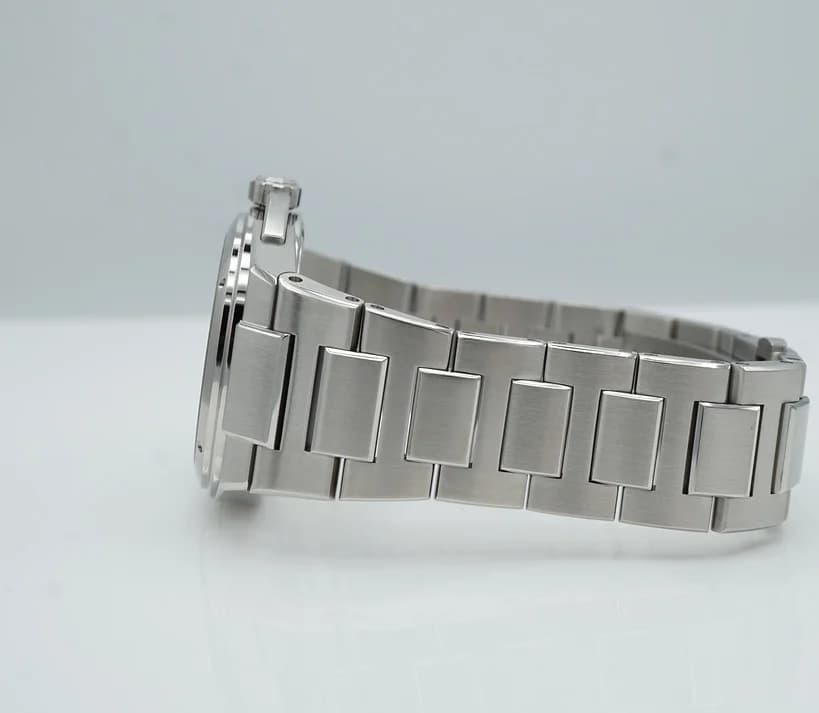
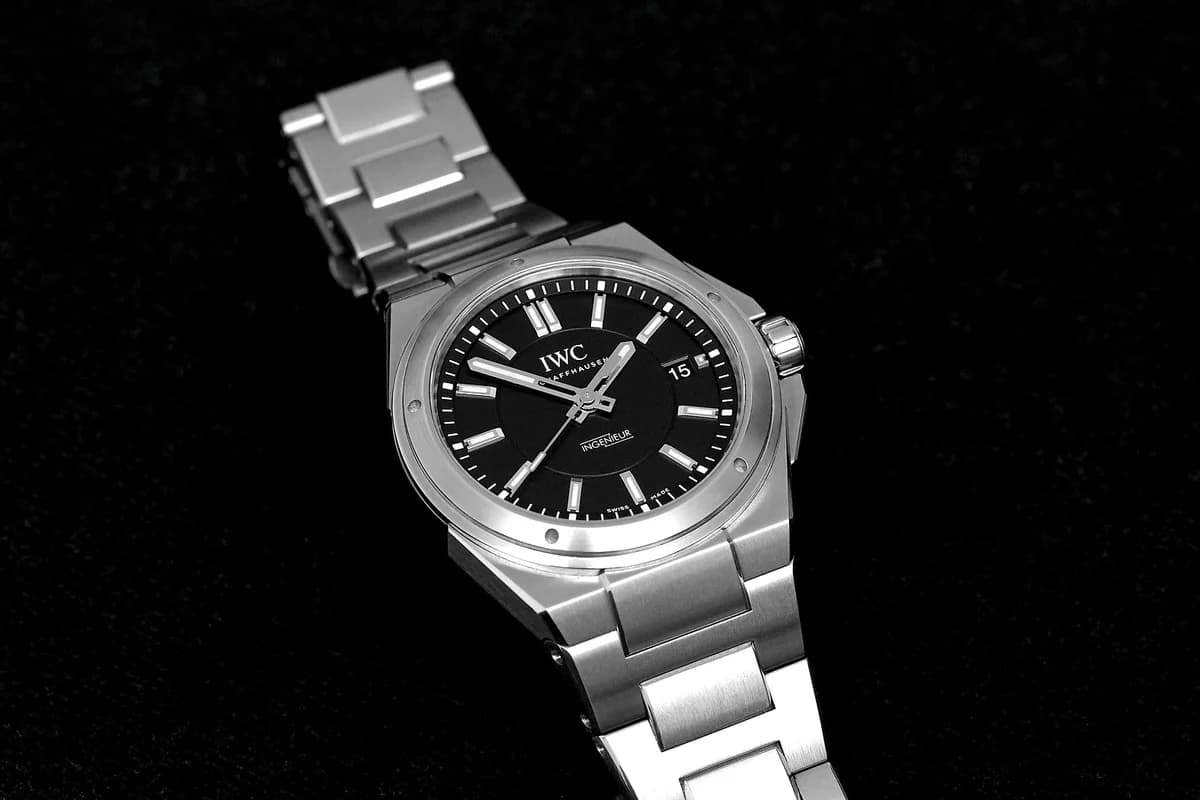
The reference IW323902 picks up that thread. Released in 2013, it is a 40mm stainless steel watch with an integrated bracelet that returns to the Genta design language of the 1976 SL. Five circular recesses on the bezel. Clean lines. The proportions feel right at 40mm because the integrated bracelet creates visual continuity from lug to lug, making the watch wear smaller than its diameter suggests. At 10mm thick, it sits flat on the wrist. For context, the Audemars Piguet Royal Oak 15500 is 41mm and 10.4mm thick. The Patek Philippe Nautilus 5711 is 40mm and 8.3mm thick. The Ingenieur falls between its Genta siblings in thickness and right in the middle on diameter. It is a well-proportioned watch that does not announce itself from across the room.
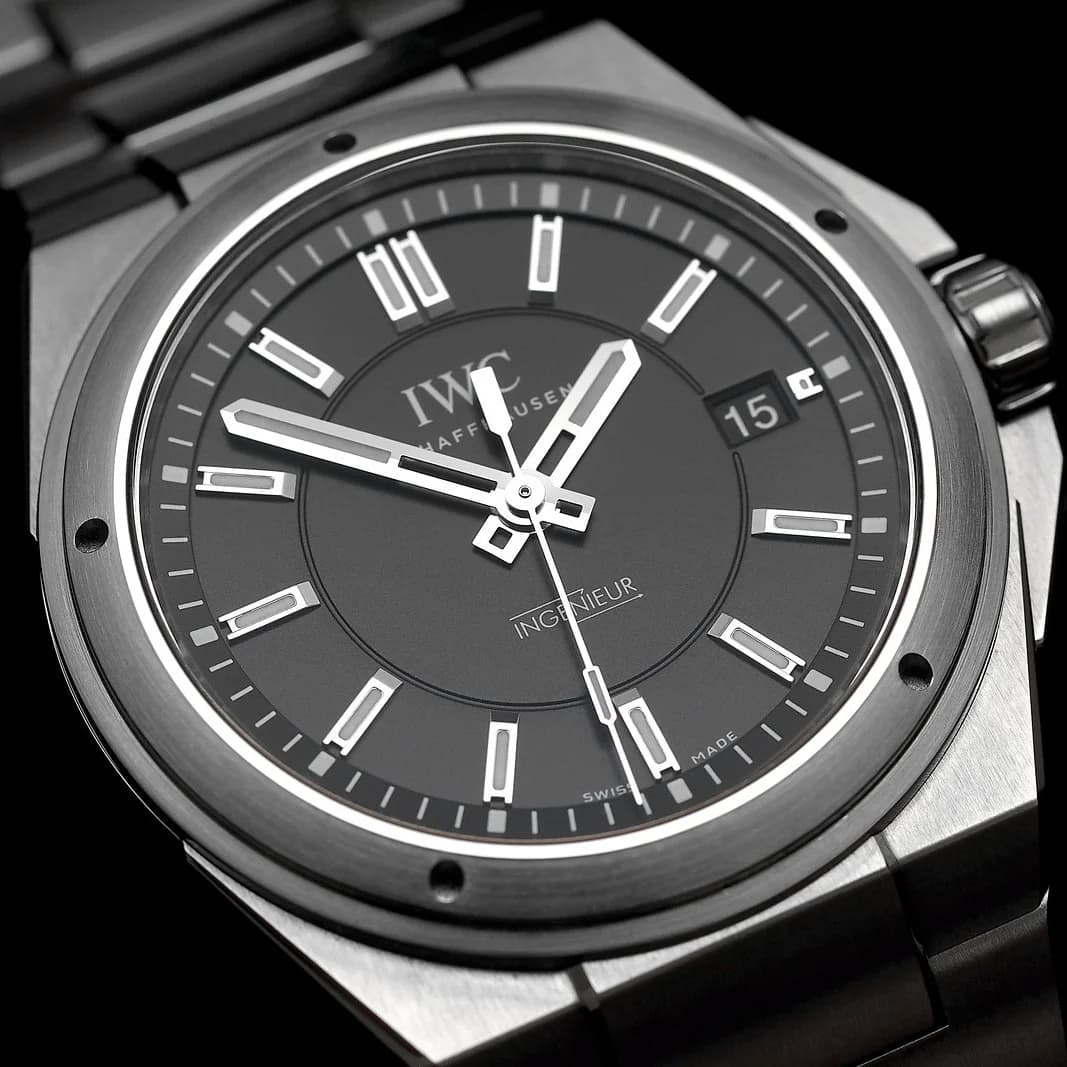
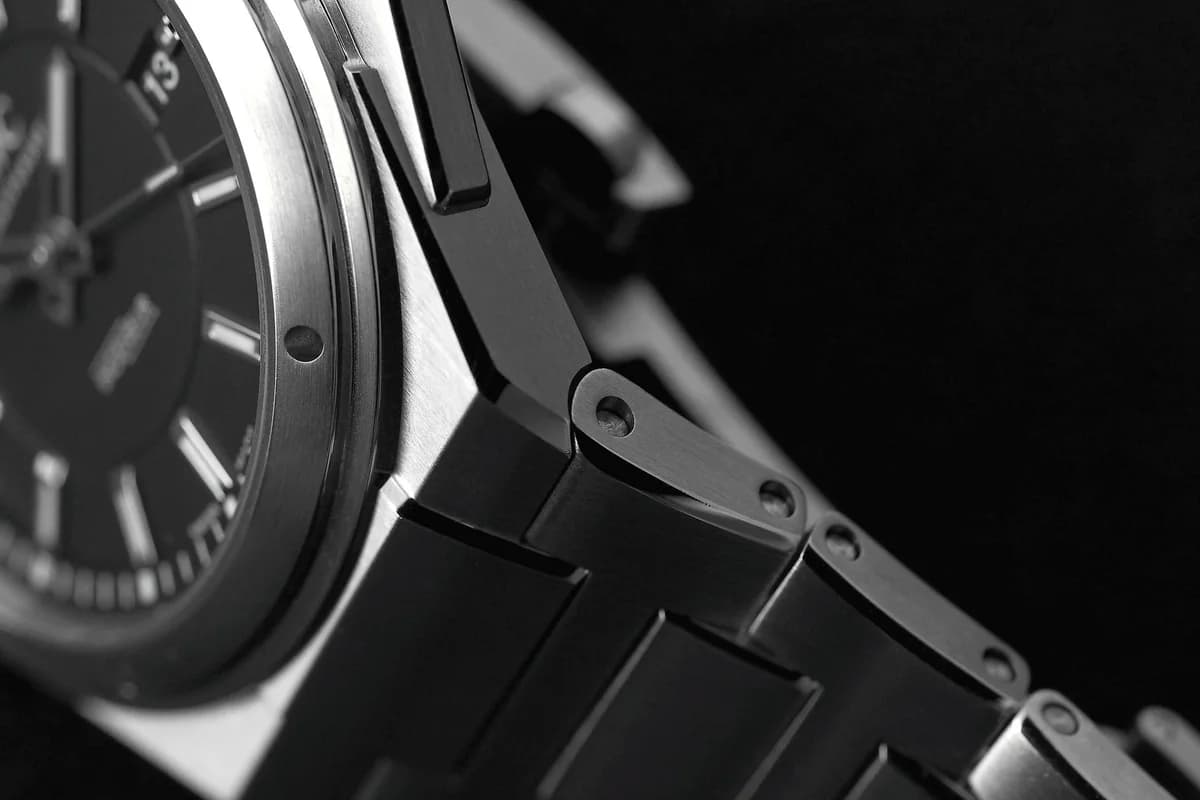
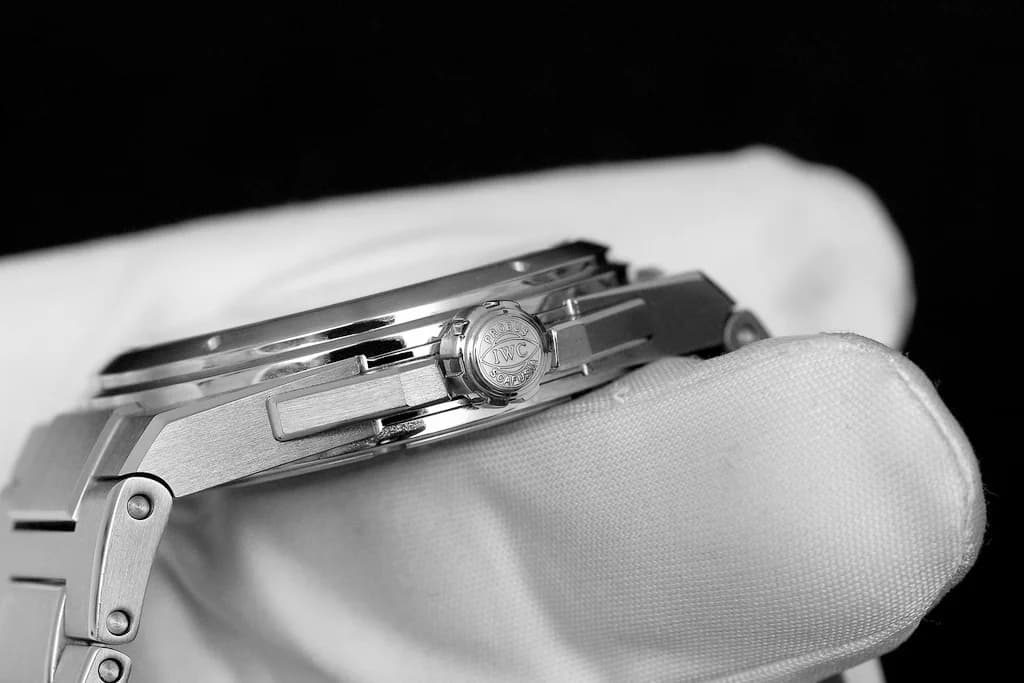
The dial is a two-tiered glossy black surface with applied polished stainless steel indices filled with luminous material. The hour and minute hands are partially skeletonized with lume fill, and the seconds hand sweeps smoothly at 28,800 vibrations per hour. The date window sits at 3 o'clock with a black background that matches the dial, which is a detail I notice because many watches at this level use a white date disc that breaks the visual consistency. IWC got this right. There is a raised silver flange between the inner and outer dial sections with a printed minute track that adds visual depth without making the dial feel busy. I appreciate that the dial reads cleanly at a glance. The Ingenieur text sits at 6 o'clock, and the IWC Schaffhausen branding at 12. Nothing extra. Nothing missing. The sapphire crystal is glareproofed on both sides, which keeps reflections minimal even in direct sunlight. Water resistance is rated to 120 meters, which is more than adequate for a sports watch that will never see serious dive depth but means it handles rain, swimming, and the occasional shower without concern. The screw-in crown provides that water resistance rating, and the crown itself is engraved with the IWC Probus Scafusia mark, the company's traditional quality commitment symbol.
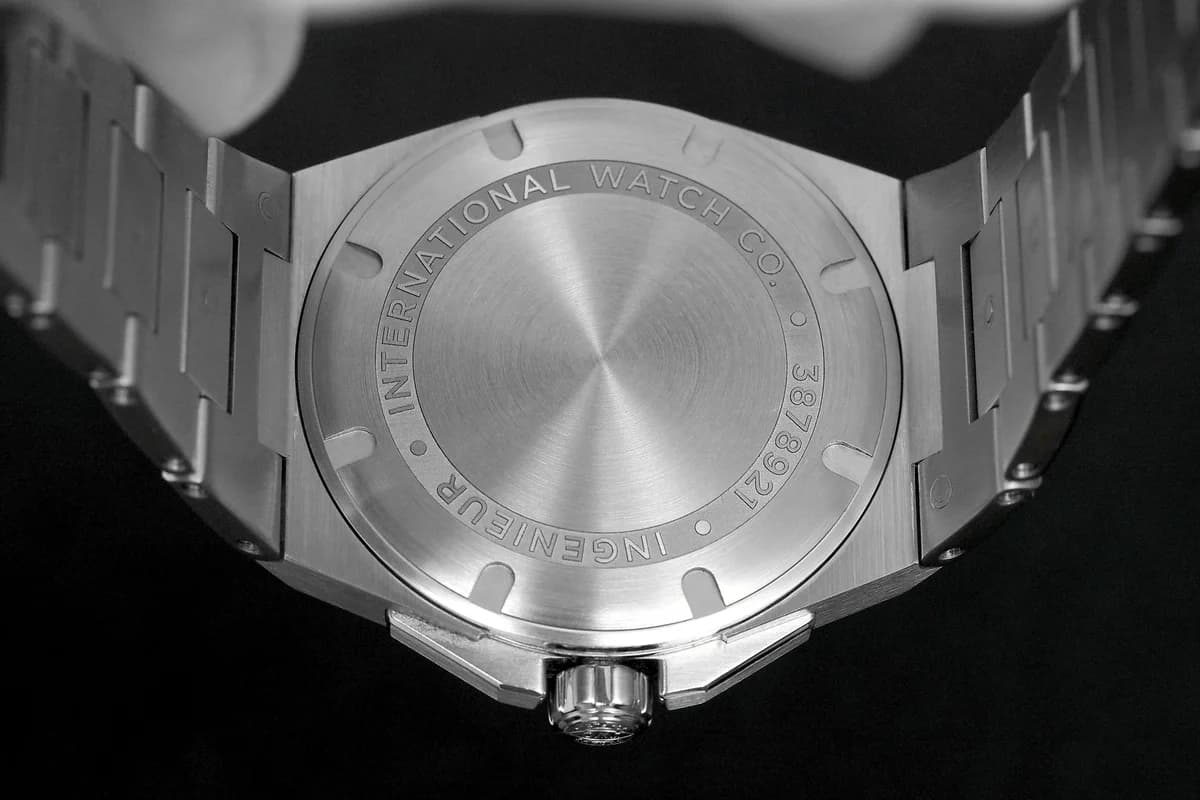
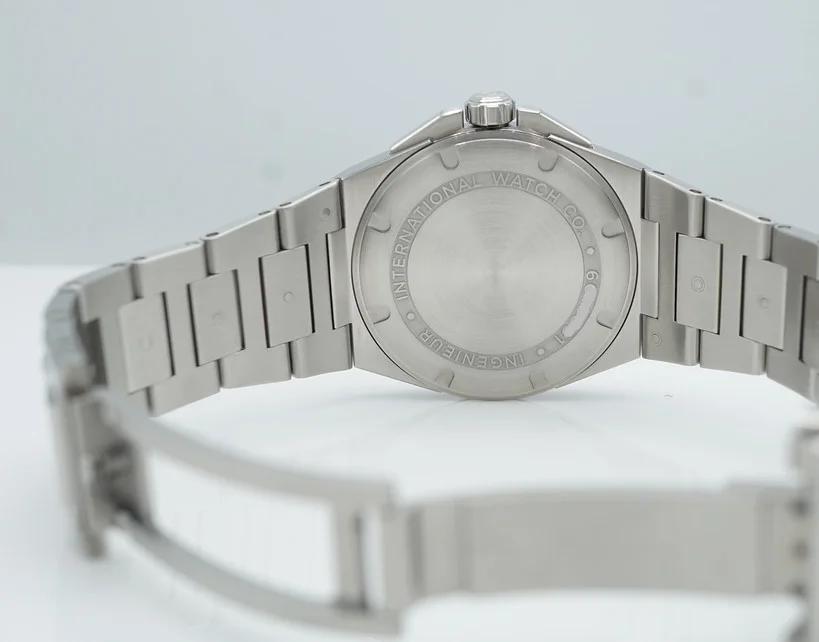
Inside the solid caseback sits the caliber 30110, based on the ETA 2892-A2 and enhanced to IWC specifications. It has 21 jewels and delivers approximately 42 hours of power reserve. I want to be direct about this: the 30110 is not an in-house movement. It is an ETA base caliber that IWC has modified and finished. The ETA 2892 is one of the most proven automatic movements in Swiss watchmaking, thin, reliable, and well-suited to the Ingenieur's 10mm case height. IWC's in-house caliber 80110, which was used in the larger 42.5mm Ingenieur references, would not have fit in a case this thin. The choice to use the 30110 was a case geometry decision, not a corner-cutting one. And behind the movement sits the soft iron inner case that protects against magnetic fields up to 40,000 A/m. This is lower than the original 1955 Ingenieur's 80,000 A/m rating, which used a more elaborate double-case construction, but 40,000 A/m is still far beyond what any normal environment will produce.
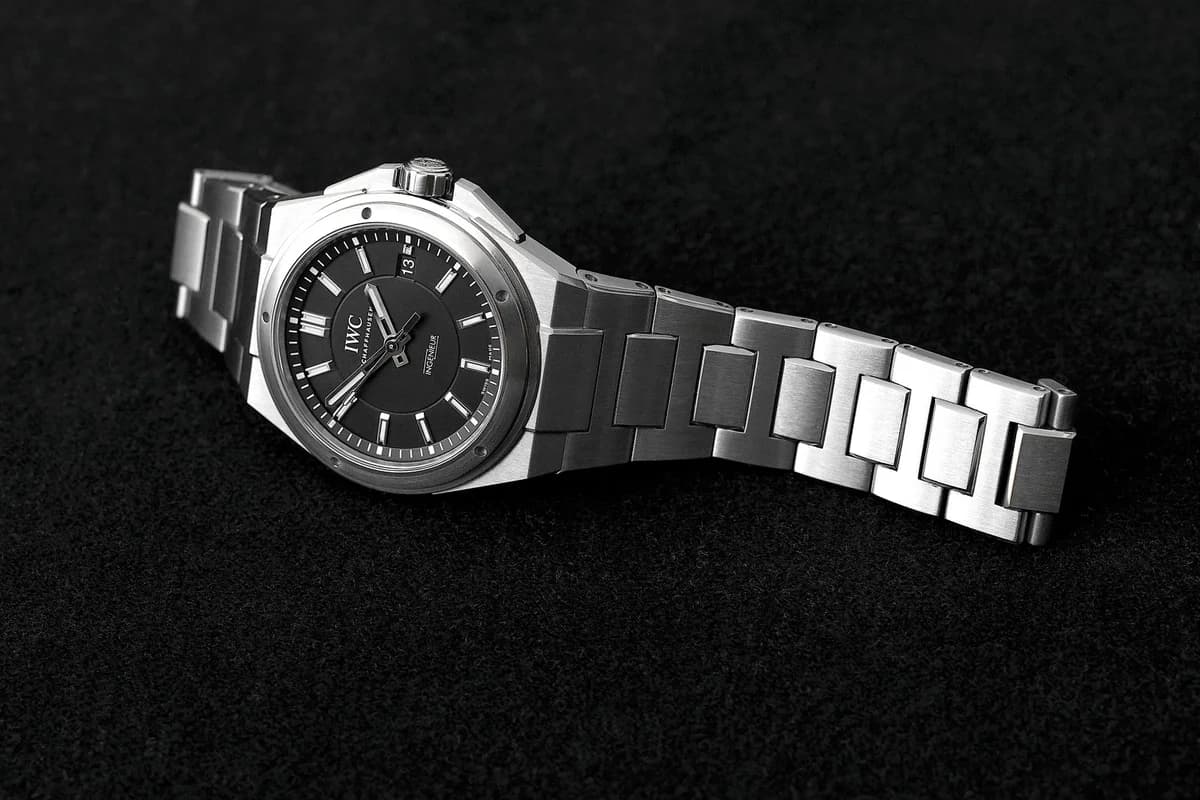
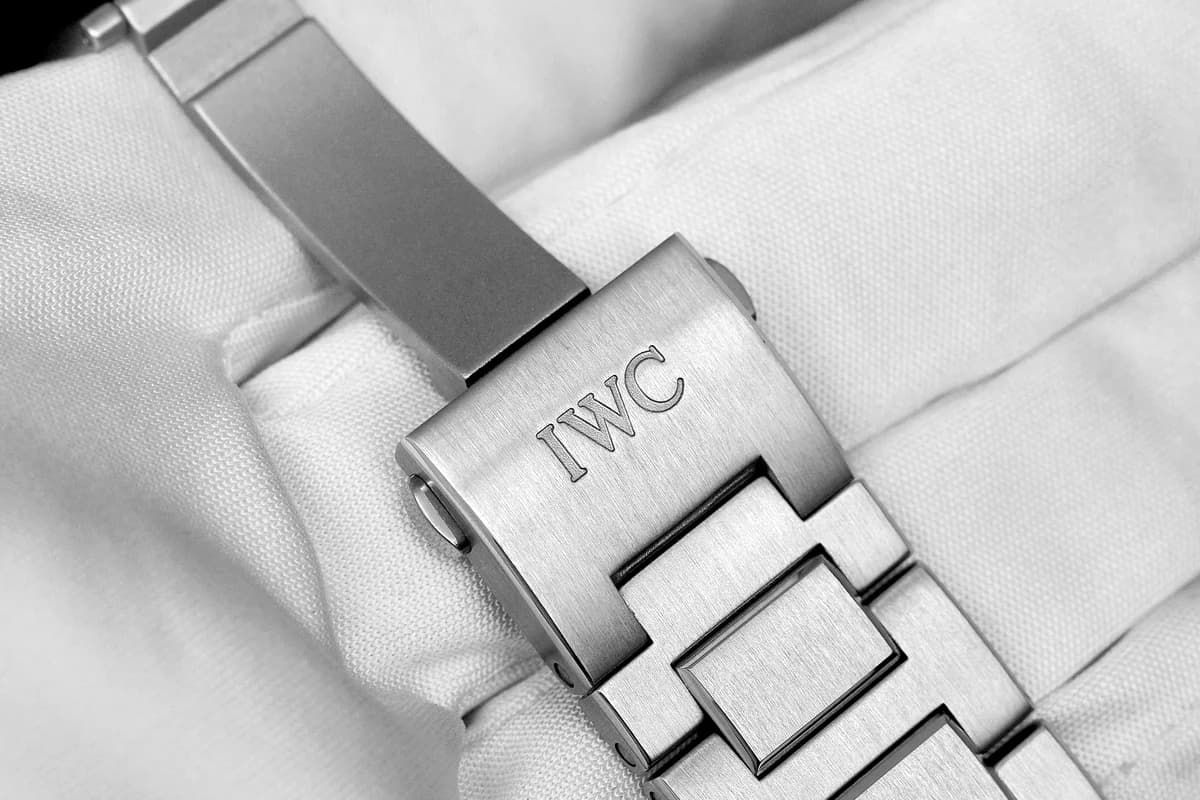
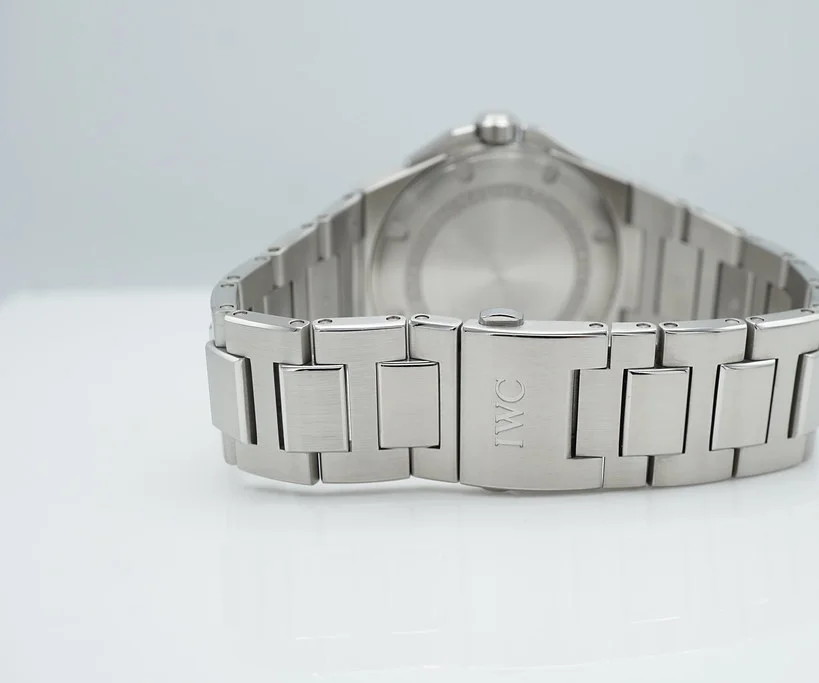
The bracelet deserves its own discussion because it is one of the best things about this watch. The links are brushed on the flat surfaces with polished beveled edges that catch light as the bracelet moves. IWC designed a tool-free link removal system: press the buttons on the rear center of each link with the included stylus and the links separate. No pushing pins, no scratching lugs, no trips to a jeweler for sizing. For someone who has spent time at a watchmaker's bench wrestling with spring bars and tight tolerances, a system like this is exactly the kind of invisible engineering that makes a daily-wear watch genuinely better to live with. The clasp is a push-button deployant with the IWC logo engraved on the outer surface.
The Ingenieur's history after Genta's SL is worth understanding because it explains the watch's identity problem. IWC redesigned the Ingenieur repeatedly across the decades. In the late 1980s, under Blumlein's direction, they attempted to build a movement with inherent antimagnetic properties using a niobium-zirconium balance spring, eliminating the need for a Faraday cage entirely. That experiment produced the caliber 37590, but the springs were so difficult to manufacture consistently that only approximately 598 watches (543 steel and 55 gold) were made before the project was abandoned. In the 1990s, IWC used Jaeger-LeCoultre calibers and shifted toward chronometer certification. In 2005, they introduced a 42.5mm version with the in-house 80110 caliber and partnered with Mercedes-AMG, adding carbon fiber and titanium variants that pushed the design toward motorsport aesthetics. In 2008, they released a vintage-inspired 42.5mm model that deliberately omitted the antimagnetic protection. Every few years, IWC seemed to ask itself what the Ingenieur was supposed to be and came up with a different answer.
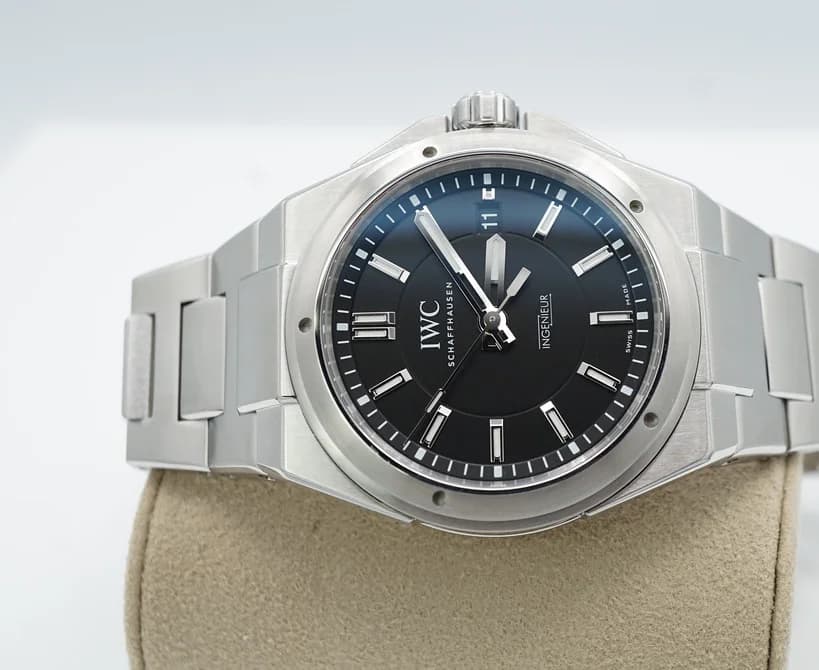
The IW323902 represents IWC's clearest answer since 1976: it is Genta's Ingenieur, brought forward with modern materials and manufacturing but without the identity drift that plagued the collection through the 2000s. 40mm case, integrated bracelet, soft iron inner case, five bezel recesses. The core elements are all present. I find it the most coherent expression of the Ingenieur concept since the original SL.
IWC itself has an interesting place in the Swiss watch landscape. The company was founded in 1868 by Florentine Ariosto Jones, an American watchmaker who had been a director at E. Howard & Co. in Boston. Jones chose Schaffhausen because it had access to Rhine river hydropower to run his machines and a skilled local workforce. His original vision was to combine American production techniques with Swiss craftsmanship and export the finished watches back to the United States. That plan did not survive the 1870s economic downturn, and the company passed to the Rauschenbach family in 1880. But the engineering-first ethos that Jones established has persisted through every ownership change since. IWC remains the only major Swiss watch manufacturer located in the German-speaking part of Switzerland, east of the Jura mountains where most of the industry is concentrated. That geographic separation has shaped the brand's identity. IWC watches tend to have an engineering-first sensibility, less decorative than the Geneva houses, more focused on function and innovation. If you visit Schaffhausen, you can see the original IWC building along the Rhine. The river that once powered Jones's machines still runs past the manufacture windows. Since 2000, IWC has been part of the Richemont group alongside Cartier, Jaeger-LeCoultre, Panerai, Vacheron Constantin, and A. Lange and Sohne. The sister-brand relationships within Richemont mean that movements and technology sometimes cross-pollinate between houses, though each brand maintains its own design identity.
I have to be honest about the tradeoffs. The ETA-based movement is the one area where the Ingenieur falls short of its Genta siblings. The Royal Oak runs on in-house AP calibers. The Nautilus runs on in-house Patek calibers. The Ingenieur IW323902 runs on an enhanced ETA. For some collectors, that matters. I understand the argument, but I also think the movement snobbery around base calibers ignores the practical reality of what makes a good daily-wear watch. The 2892 has been running reliably in thousands of watches for decades. It is thin, accurate, and easy to service. The in-house alternative would have meant a thicker case or a compromised design. The second tradeoff is the solid caseback. Because of the soft iron inner case, there is no exhibition back. The caseback is engraved with International Watch Co. and Ingenieur, but there is nothing to see behind it except the iron shield. For watch enthusiasts who want to admire their movement, this is a real absence. Personally, I would trade an exhibition back for antimagnetic protection without hesitation, but I understand why others feel differently. The third observation is the Ingenieur's identity problem across IWC's own catalog. The brand has never committed to the Ingenieur the way AP committed to the Royal Oak or Patek committed to the Nautilus. Those watches became the centerpieces of their respective brands. The Ingenieur has always been one of several collections competing for attention alongside the Portugieser, the Pilot's Watch, and the Big Pilot. That lack of singular focus has kept the Ingenieur from achieving the cultural status its design pedigree deserves.
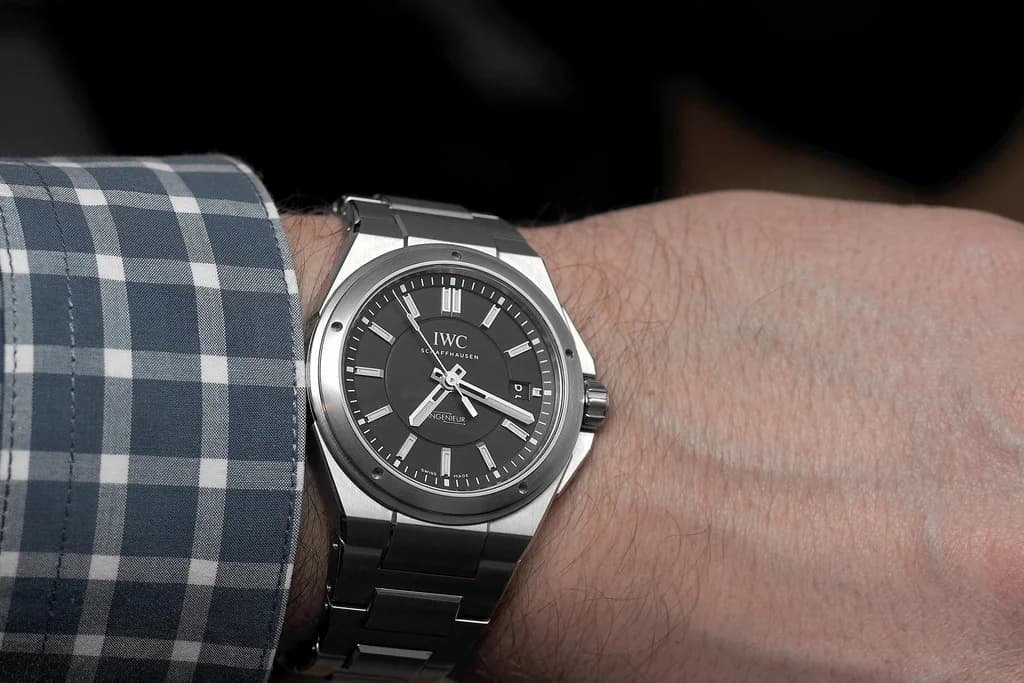
On the wrist, the 40mm case with the integrated bracelet sits close and flat. The brushed surfaces are forgiving with micro-scratches, and the polished bevels on the link edges add just enough contrast to keep it interesting in different lighting. It works with a suit, with rolled sleeves, with almost anything. The steel tone is neutral enough that it pairs with warm fabrics like a Caccioppoli tropical wool just as easily as it works with a grey cotton t-shirt on a Saturday. I love how the integrated bracelet creates a seamless visual line from one end to the other, with no awkward lug gap where the bracelet meets the case. That integration is the entire point of Genta's design philosophy for these watches. The bracelet is not an afterthought attached to the case. It is part of the case. The visual flow from bracelet to bezel is continuous, and that is what gives all of Genta's sports watches their distinctive wrist presence. At 10mm thick, the Ingenieur slides under most cuffs without catching. For my 6.5-inch wrist, 40mm is the sweet spot, and the integrated bracelet distributes the weight evenly enough that I forget it is there after the first ten minutes. On darker skin tones, the steel with the black dial creates a clean contrast that reads well without being flashy. It is one of those watches that photographs well but looks even better in person because the play of light across the brushed and polished surfaces changes constantly with movement.
The Ingenieur is the Genta watch for people who actually know Genta's work beyond the Royal Oak. It carries the same design principles, the integrated bracelet, the geometric case, the emphasis on how the watch relates to the wrist rather than just sitting on it, without the waitlists and without the cultural noise. The original SL failed commercially because it arrived at the wrong time. The IW323902 arrived at the right time but into a market that still does not fully appreciate what it is. That is fine. The people who understand integrated bracelet sports watches, who can trace the line from the Royal Oak through the Nautilus to the Ingenieur, who appreciate that Genta gave IWC the same level of design attention he gave AP and Patek, those are the people who end up with this watch on their wrist. And they tend to keep it there.
Also in Design Icons