
Heuer
Monaco 1133B
1133B
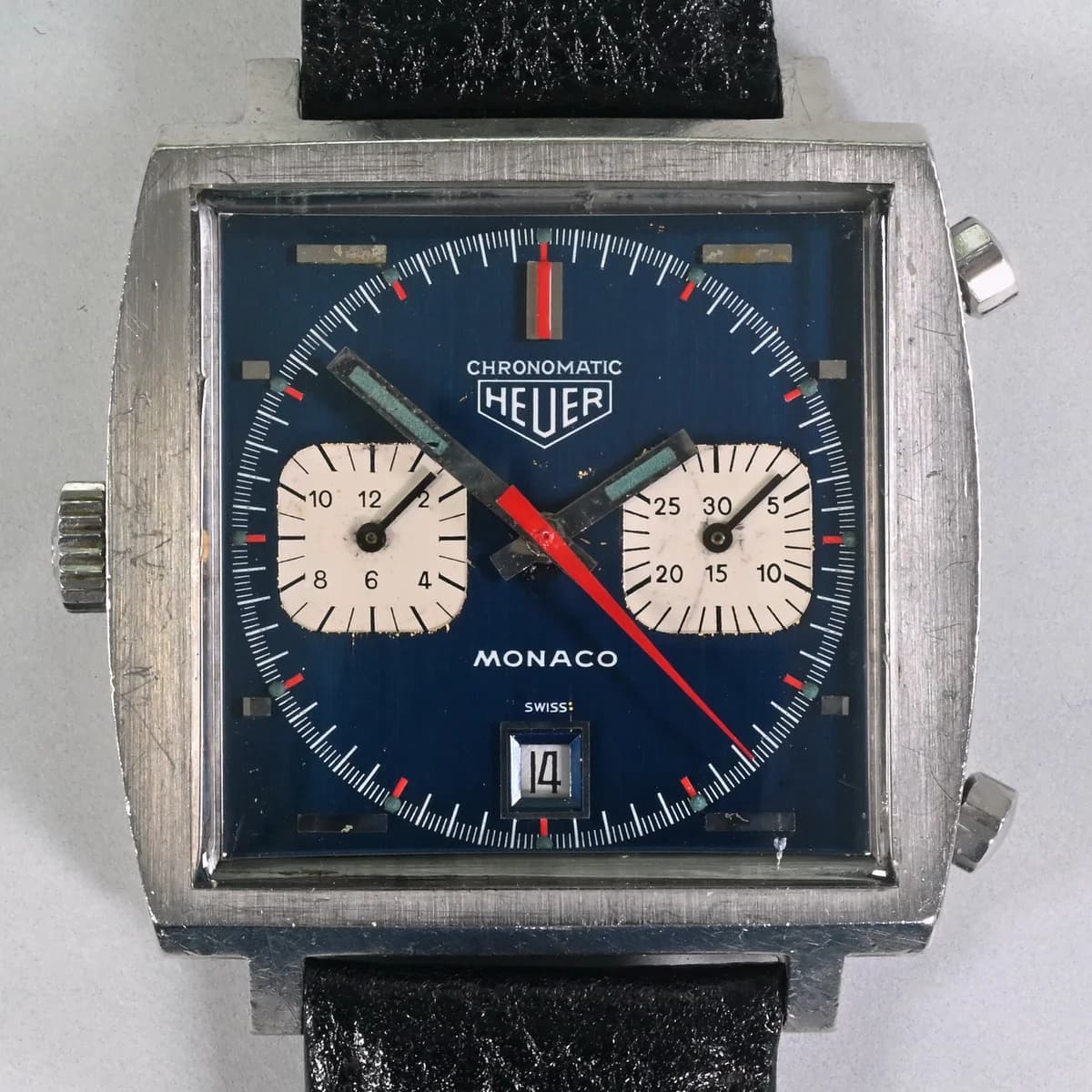
To understand why the Monaco matters, I think it helps to understand what the watch world looked like in 1968. Automatic movements existed. Chronographs existed. But nobody had figured out how to put both functions into the same watch. Winding a chronograph by hand every morning was just how it worked. Four companies decided to change that, and the race to build the first automatic chronograph became one of the most interesting chapters in watchmaking history.
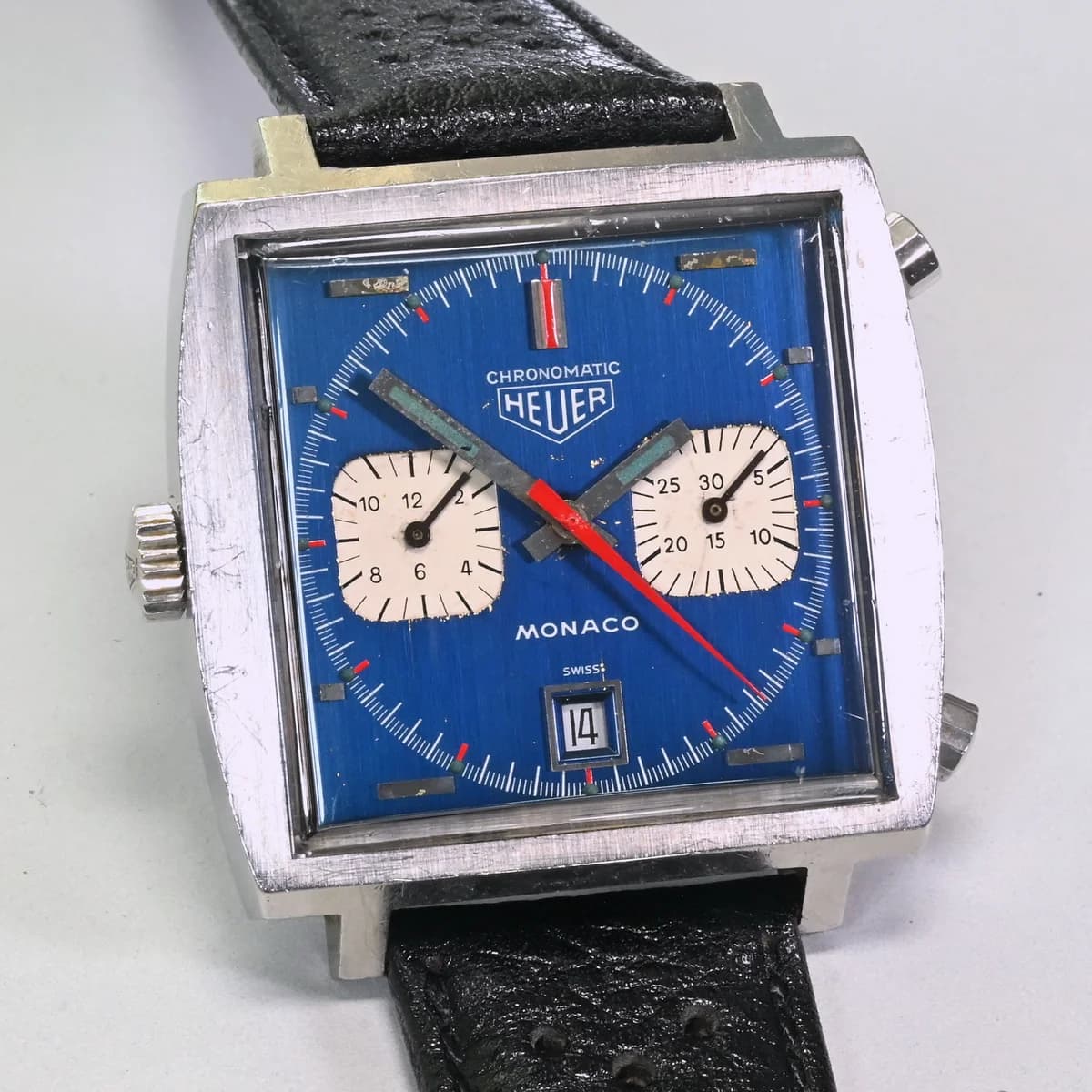
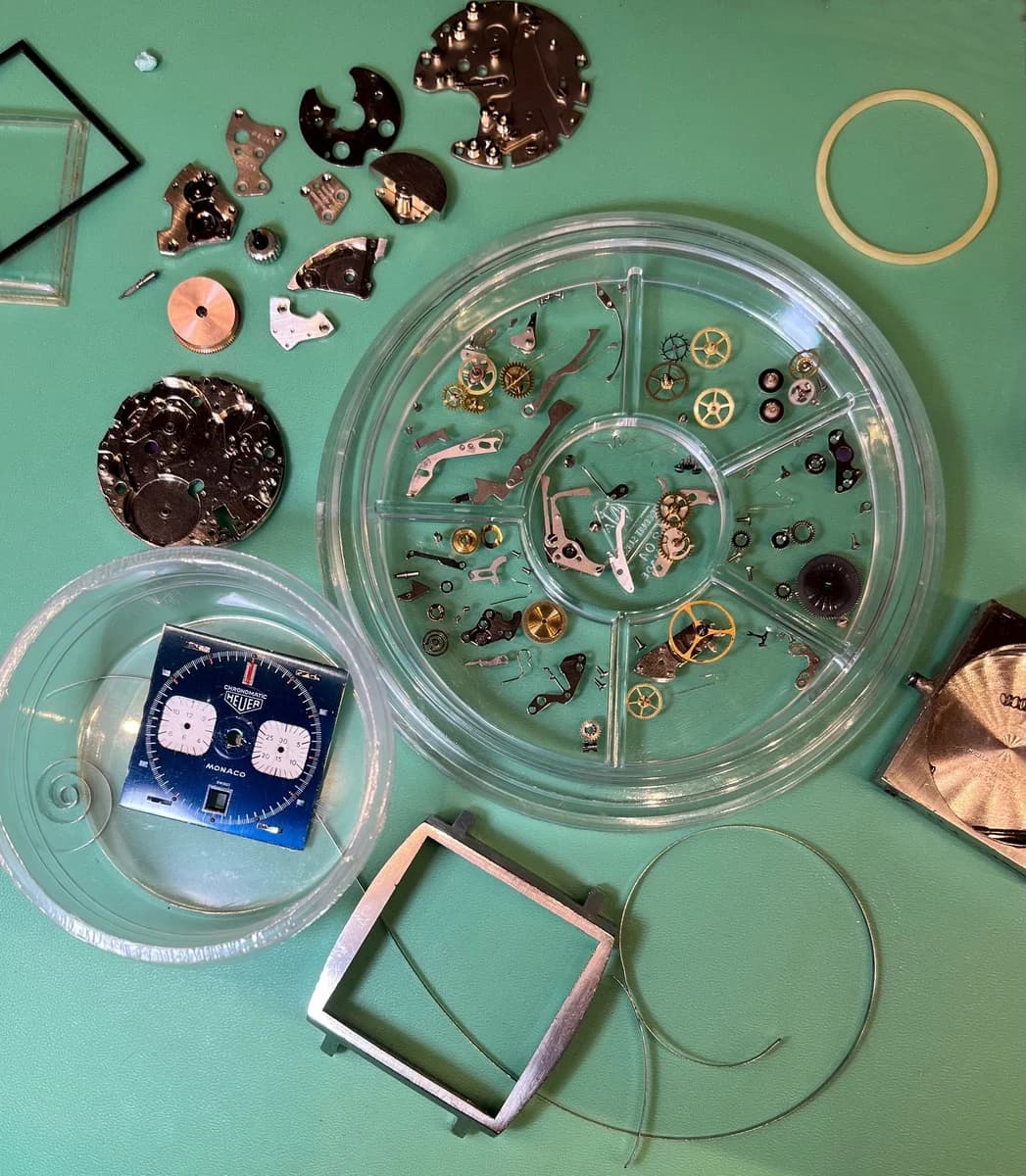
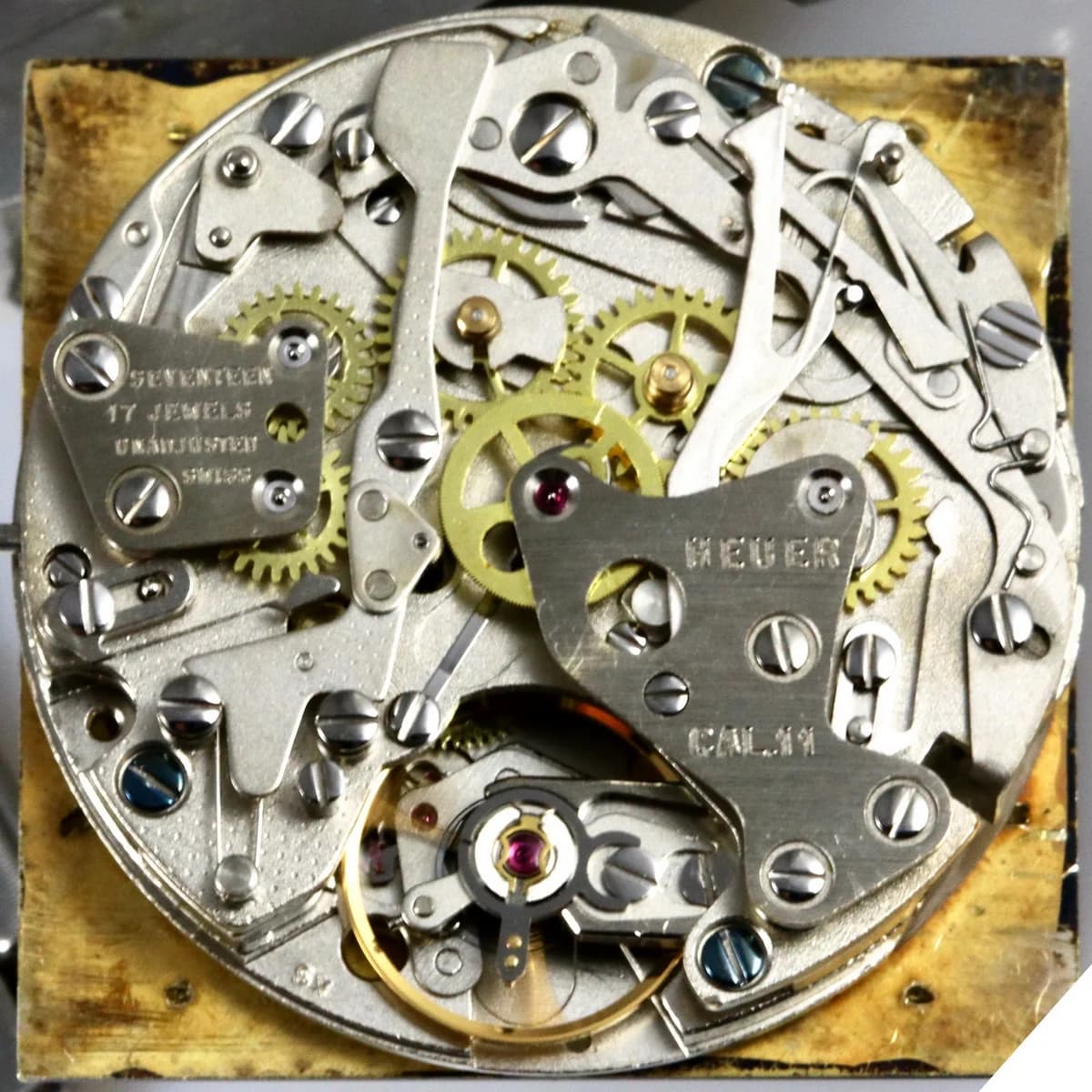
The consortium behind the Caliber 11 was an unusual alliance. Heuer-Leonidas, Breitling, Hamilton-Buren, and the chronograph specialist Dubois-Depraz pooled their resources on what became known internally as Project 99. Each company brought something specific. Buren manufactured the micro-rotor automatic base movement. The micro-rotor was critical because it sat within the plane of the movement rather than on top of it, keeping the total height manageable. Dubois-Depraz designed and manufactured the chronograph module, which bolted onto the back of the Buren base. Heuer and Breitling were the commercial partners who would put the resulting movement into their respective watches and sell them to the world. It was a modular architecture, two distinct mechanisms joined into one, and at the time it was a genuine leap.
On March 3, 1969, the consortium held simultaneous press conferences in New York and Geneva to announce what they called the Chronomatic. One month later at the Basel Fair, the watches themselves went on display. Heuer showed two models using the new movement. The Autavia, a round racing chronograph that made sense to everyone. And the Monaco, a square-cased chronograph that made sense to almost nobody. Jack Heuer, great-grandson of founder Edouard Heuer and Managing Director at the time, had wanted something avant-garde. He got it.
The name came from the Monaco Grand Prix. Heuer had deep roots in motorsport timing, and naming a racing chronograph after the most glamorous race on the calendar was a natural move. But the case shape was anything but natural. Watches are round. Chronographs are round. The Monaco said no to all of it. A square stainless steel case measuring 40mm across and 39mm tall, with sharp corners and a metallic blue dial that filled the entire surface. In 1969 that was a provocation. For context, the Rolex Daytona at the time was 37mm and round. The Omega Speedmaster was 42mm and round. Every serious chronograph was round. Jack Heuer looked at the conventions of his industry and decided to ignore them.
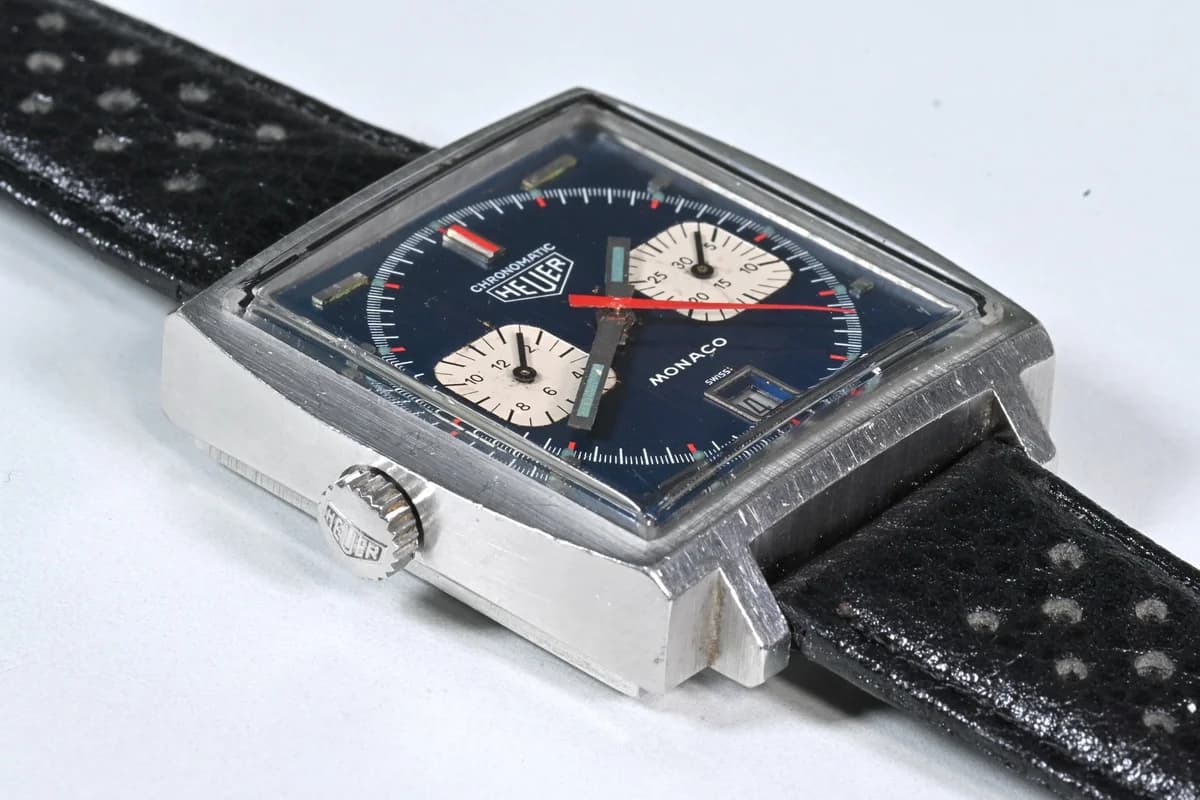
The case itself was a technical achievement that gets overlooked. Square cases had always been confined to dress watches because nobody could make them water resistant. The geometry makes sealing difficult. Round cases seal naturally because of the uniform gasket compression. Square cases have corners where stress concentrates unevenly. A Swiss case manufacturer named Erwin Piquerez solved this with a patented construction that used tension from four notches to create a waterproof seal. The result was the first square, water-resistant chronograph case in watchmaking. The solid caseback snaps on with a specific tool, marked "Tool 033" on the back, and the whole assembly was rated to resist water in ways no square case had before.
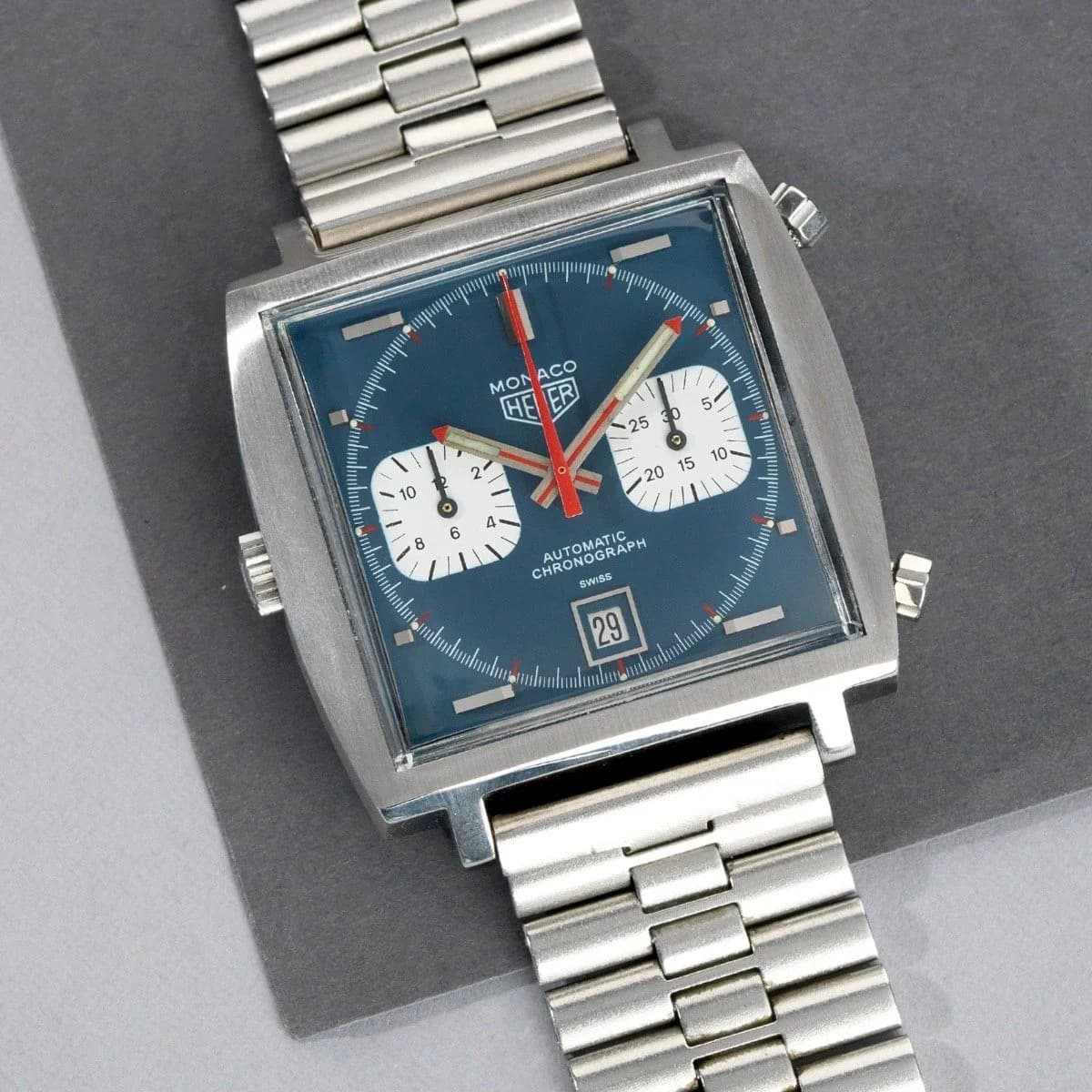
The Caliber 11 inside is a 17-jewel automatic chronograph beating at 19,800 vibrations per hour, which is 2.75 Hz. That frequency is slow by modern standards. A Zenith El Primero runs at 36,000 vph, an ETA 7750 at 28,800. But in 1969 it was enough. The movement delivers 40 hours of power reserve and measures 31mm in diameter by 7.7mm in height. The bi-compax layout puts a 30-minute counter at 3 o'clock, a 12-hour counter at 9 o'clock, and the date at 6. There is no running seconds subdial. The central seconds hand sweeps continuously when the chronograph is engaged, but at rest the dial is quiet. I appreciate that stillness. A dial without a constantly moving hand has a different presence on the wrist.
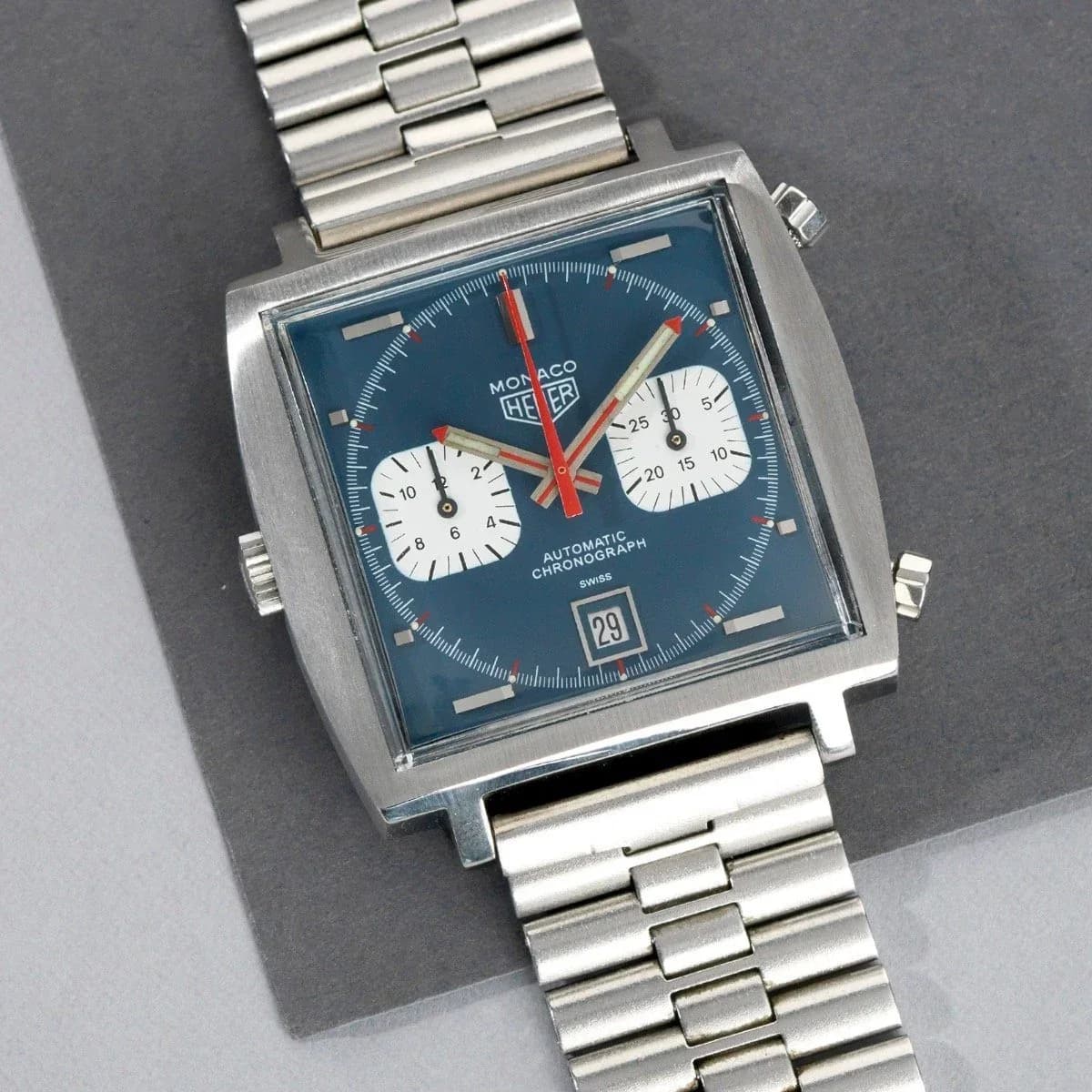
The crown sits at 9 o'clock. This is the Monaco's most recognizable design element and it happened because of engineering, not aesthetics. The Buren micro-rotor base movement placed its winding mechanism on the left side of the caliber, which meant the crown had to go there too. The chronograph pushers remain at 2 and 4 o'clock on the right side, which creates an asymmetry that no other chronograph has. Jack Heuer himself admitted that the left-side crown initially looked strange. He wrote that they all thought it looked weird at first, but then decided to turn it into an exclusive and distinctive feature. The logic was simple. A crown on the left says this chronograph does not need winding every day because it is automatic. That is a product decision I love. Taking a constraint and turning it into a signature.
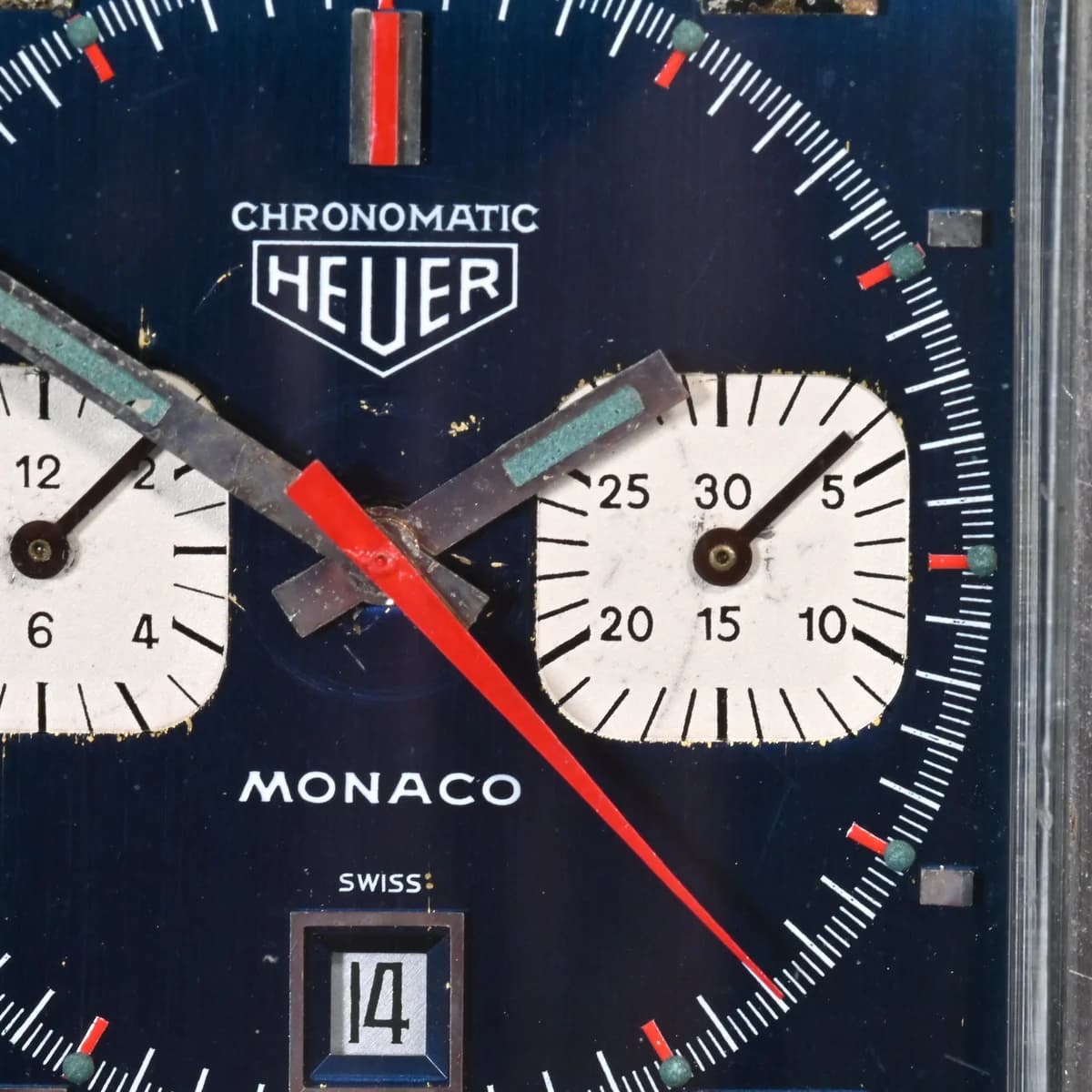
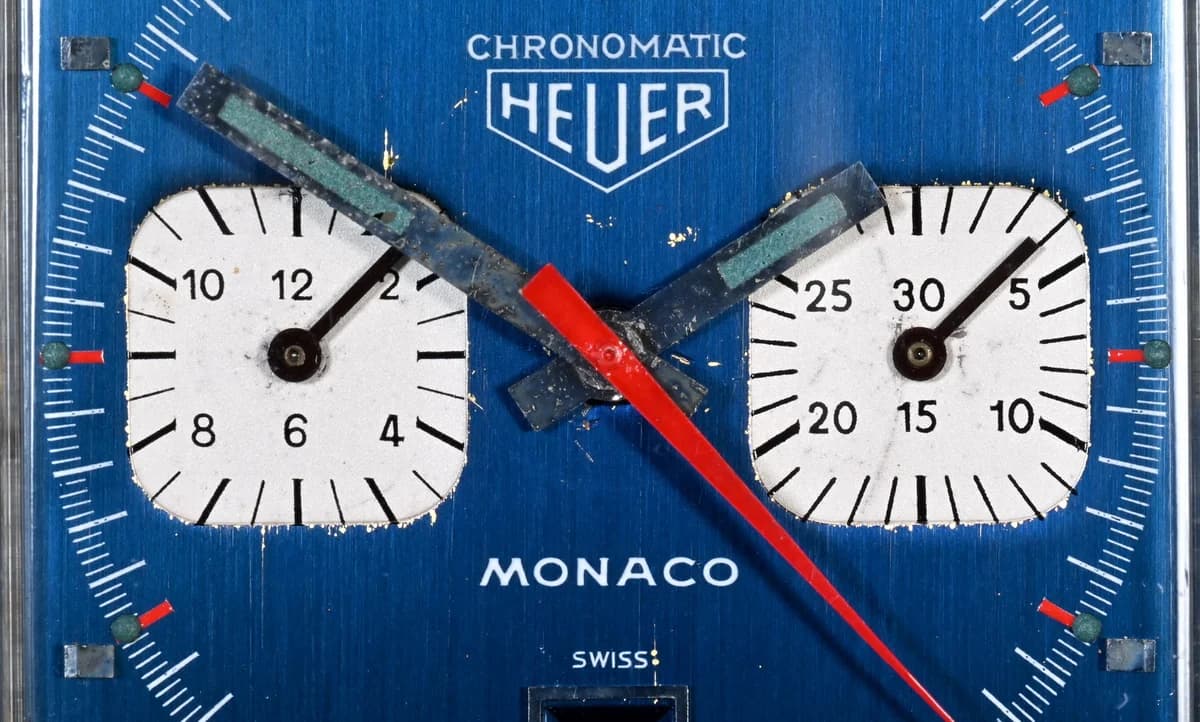
The metallic blue dial is iconic for a reason. The paint has a depth to it that photographs struggle to capture. White subsidiary registers sit against that blue field with polished steel hands featuring luminous inserts and squared-off tips. The applied Heuer logo at 12 and the date window at 6 complete the layout. It is a busy dial in the sense that there is a lot happening, but everything is organized with purpose. The blue and white contrast gives it a clarity that makes reading the chronograph functions intuitive. The domed acrylic crystal sitting over that dial adds a warmth and distortion at the edges that I find more interesting than flat sapphire. When light catches the dome from an angle, the blue dial shifts and deepens. It is alive in a way that sapphire-covered dials rarely are.
The three-way race for the title of first automatic chronograph is one of the best stories in watchmaking. Zenith announced the El Primero on January 10, 1969. The Heuer-Breitling consortium announced the Chronomatic on March 3. Seiko introduced the 6139 in May. All three arrived within five months of each other after years of independent development, and the question of who was actually first depends entirely on how you define "first." Zenith announced first. The Chronomatic consortium may have delivered watches to retailers first. Seiko arguably shipped a wearable product to consumers first. The truth is that all three solved the same problem at roughly the same time, and each solution was fundamentally different. The El Primero was a fully integrated movement running at 36,000 vph with a column wheel. The Caliber 11 was modular with a micro-rotor at 19,800 vph. The Seiko 6139 was a vertical clutch design made entirely in-house in Japan. I find the parallel development fascinating, and I am still not sure any of the three can rightfully claim the title alone. Three independent teams on three continents, none aware of each other's progress, all arriving at the same destination within weeks.
Steve McQueen changed everything for the Monaco. In 1970, production began on Le Mans, a film about the 24 Hours of Le Mans endurance race. The property master, Don Nunley, needed a watch for McQueen's character, the racing driver Michael Delaney. Nunley assembled watches from five brands: Tissot, Omega, Bulova, Rolex, and Heuer. McQueen initially preferred an Omega. But his racing suit already had a "Chronograph Heuer" patch sewn onto it, so the watch needed to match the sponsor. Jack Heuer personally delivered the watches to Nunley, including six blue-dial reference 1133B Monacos. One disappeared almost immediately, leaving five for the production. Among Heuer's offerings, which included the Autavia, McQueen chose the Monaco. Nunley later recalled that McQueen picked the most unusual piece in the entire collection. That tracks with everything we know about McQueen. He did not reach for the safe choice. He reached for the one that looked like nothing else.
The film Le Mans is not a great movie by conventional standards. The dialogue is sparse, the plot is thin, and the first 37 minutes contain almost no speaking. But the racing footage is real, shot during the actual 1970 24 Hours of Le Mans, and McQueen's presence on screen wearing that blue-dial Monaco on a black leather strap became one of the most enduring images in watch history. The association between McQueen and the Monaco is as permanent as the association between Sean Connery and the Submariner. The Monaco is McQueen's watch. It will always be McQueen's watch. After filming, the watches scattered. McQueen reportedly kept one. Nunley gave one to his father. Two were sold on eBay years later. One sold at auction in 2012. The provenance stories of those six watches are a rabbit hole that collectors have been exploring for decades.
The original Monaco was not a commercial success. Heuer produced approximately 4,000 to 4,500 units across all Monaco references between 1969 and 1975, which is a modest number for a six-year production run. The square case was too radical for most buyers in the early 1970s. The 14mm thickness made it a substantial presence on the wrist, taller than many chronographs of the era. And then the quartz crisis arrived. Japanese quartz movements undercut the entire Swiss mechanical watch industry, and unusual designs like the Monaco were among the first casualties. After a final attempt with the black PVD reference 74033N, Heuer discontinued the Monaco around 1975. The watch might have been forgotten entirely if not for McQueen.
The corporate history between 1975 and the Monaco's revival is worth knowing. In 1985, the TAG Group, Techniques d'Avant-Garde, acquired Heuer and formed TAG Heuer. The company modernized, grew sales dramatically through the late 1980s and 1990s, and eventually caught the attention of LVMH, who acquired TAG Heuer in 1999. Under LVMH, TAG Heuer sits alongside Hublot, Zenith, and Bulgari in the group's watch division. The fact that TAG Heuer and Zenith are now corporate siblings under the same luxury conglomerate, after their parent companies raced each other to build the first automatic chronograph in 1969, is one of those ironies that only the watch industry produces.
In 1998, TAG Heuer reissued the Monaco as reference CS2110 in a limited edition of 5,000 pieces. The re-edition had a flat black dial with the old Heuer shield logo, maintaining the bi-compax layout but moving the crown to the right side at 3 o'clock. That crown move was controversial among purists who considered the left-side crown essential to the Monaco's identity. The re-edition sold well enough that TAG Heuer followed with additional variations, and the Monaco has remained in continuous production since. Recent references have used the in-house Heuer 02 movement, and in 2026 TAG Heuer introduced a new Monaco with the in-house TH20-11 caliber. The Monaco is no longer a commercial risk. It is a pillar of the brand.
I need to talk about what it is actually like to wear a vintage Monaco. The 40mm by 38mm case at 14mm thick is not small. The square shape means it wears larger than a 40mm round watch because there are no curves to soften the visual footprint. The corners extend past where lugs on a round case would end. On my wrist it would sit with authority, filling the wrist top without wrapping around the sides. The 22mm lug width accommodates a decent range of straps, and vintage examples typically come on either a stainless steel bracelet or the black perforated leather rally strap that McQueen wore in the film. The rally strap is the correct pairing for this watch. It connects the Monaco to its motorsport DNA in a way that a bracelet does not.
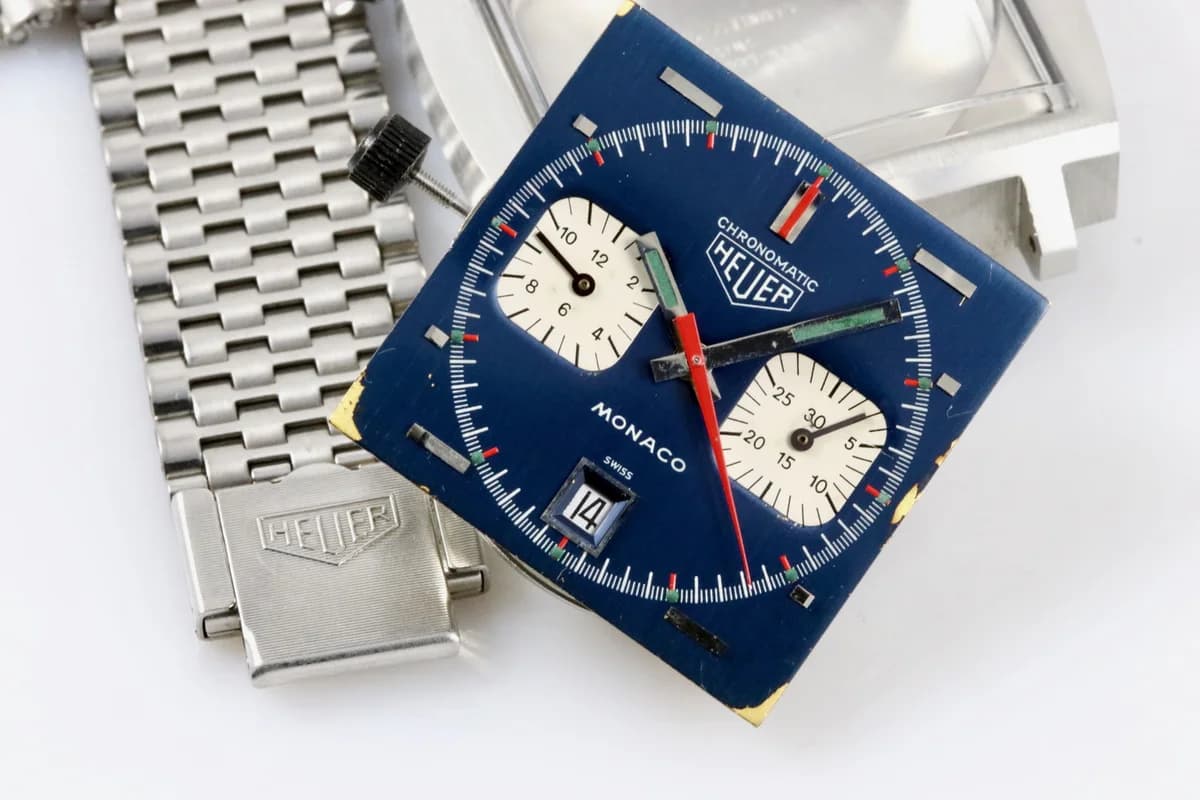
The honest critique is the acrylic crystal. I appreciate the way domed acrylic distorts light and gives the dial character, but acrylic scratches easily. Daily wear will mark it up within weeks. Polywatch paste can buff out surface scratches, and replacement crystals are not expensive, but it is maintenance that sapphire crystal owners never think about. There is also a documented issue with vintage examples where the black rubber seal between the dial and crystal degraded over time, essentially melting and damaging the dial underneath. Collectors call the most extreme cases of dial paint degradation "Paintless Wonders," where the metallic blue has worn away to expose the brass dial base. Some collectors actually prefer the patina. I understand the appeal of a watch that shows its age honestly, but a melting seal is not patina. It is a materials failure. The 19,800 vph frequency is also slow by any standard. The chronograph seconds hand does not sweep smoothly the way a 28,800 vph or 36,000 vph movement does. It ticks in visible increments. Whether that bothers someone is personal, but it is worth knowing before committing to a vintage Caliber 11.
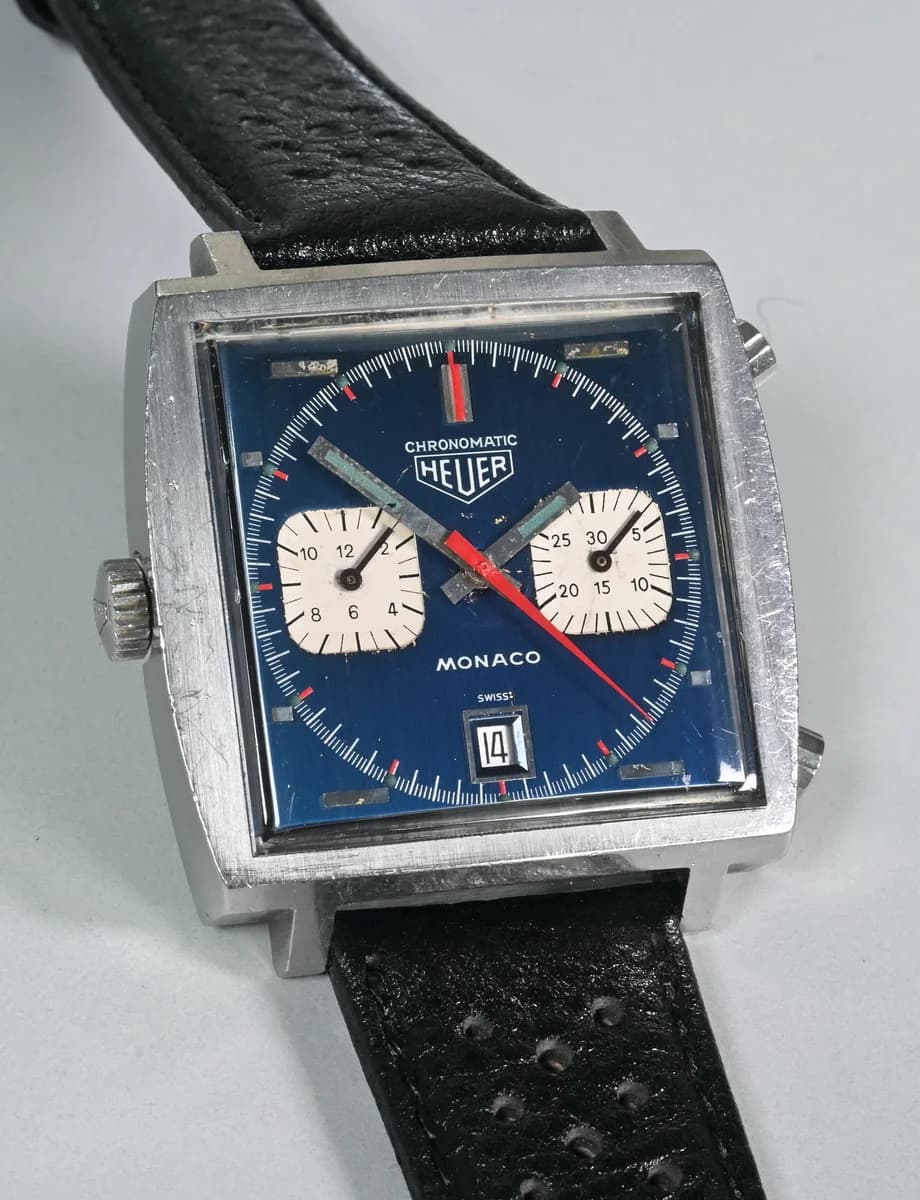
The Monaco pairs differently with clothing than a round chronograph does. The square case has an architectural quality that works with structured tailoring. A fitted navy suit in Zegna wool with a Monaco on a black leather strap has a formality that a Daytona on Oysterflex does not. The blue dial picks up navy, charcoal, and black fabrics naturally. On darker skin tones, the stainless steel case and blue dial create a cool-toned contrast that reads clean and deliberate. I would not wear it with a t-shirt. The Monaco is not casual. It carries too much visual weight for that. But with a sport coat and open collar, or under the cuff of a tailored shirt, it makes a statement without being loud. The square case disappears under a cuff more easily than you would expect because the flat top sits flush rather than protruding the way a domed round case does.
The Monaco's influence extends further than most people realize. The Audemars Piguet Royal Oak arrived in 1972, three years after the Monaco, with an octagonal bezel that was considered radical at the time. The Patek Philippe Nautilus followed in 1976 with its porthole-shaped case. Both watches get credited with redefining what a luxury sport watch could look like, and rightly so. But the Monaco was there first, saying that a chronograph did not have to be round, that a case could be geometric and aggressive and still be a serious watch. Gerald Genta designed the Royal Oak and the Nautilus with rounded geometries, softened edges, integrated bracelets. The Monaco has none of that softness. Its corners are sharp. Its lines are straight. It does not apologize for its shape. I think there is something honest about that. The Royal Oak and the Nautilus compromised between round and not-round. The Monaco committed fully to the square.
What I keep coming back to with the Monaco is the accumulation of firsts. First automatic chronograph movement in a square case. First square water-resistant chronograph case. First watch to put the crown on the left. Each of those decisions was a risk in 1969, and each of them became the defining characteristics of the watch. Jack Heuer took a movement that was already unconventional, put it in a case that was radical, named it after the most prestigious race in the world, and then watched Steve McQueen turn it into an icon. There was no marketing playbook for any of that. The Monaco happened because a small group of people at Heuer, at Buren, at Dubois-Depraz, and at Erwin Piquerez decided to solve problems in ways nobody had tried before. That is what I love about this watch. It was not designed by committee to appeal to the broadest possible market. It was designed by people who were willing to be wrong. They were not wrong.
Also in Design Icons