
Hamilton
Ventura
H24411732
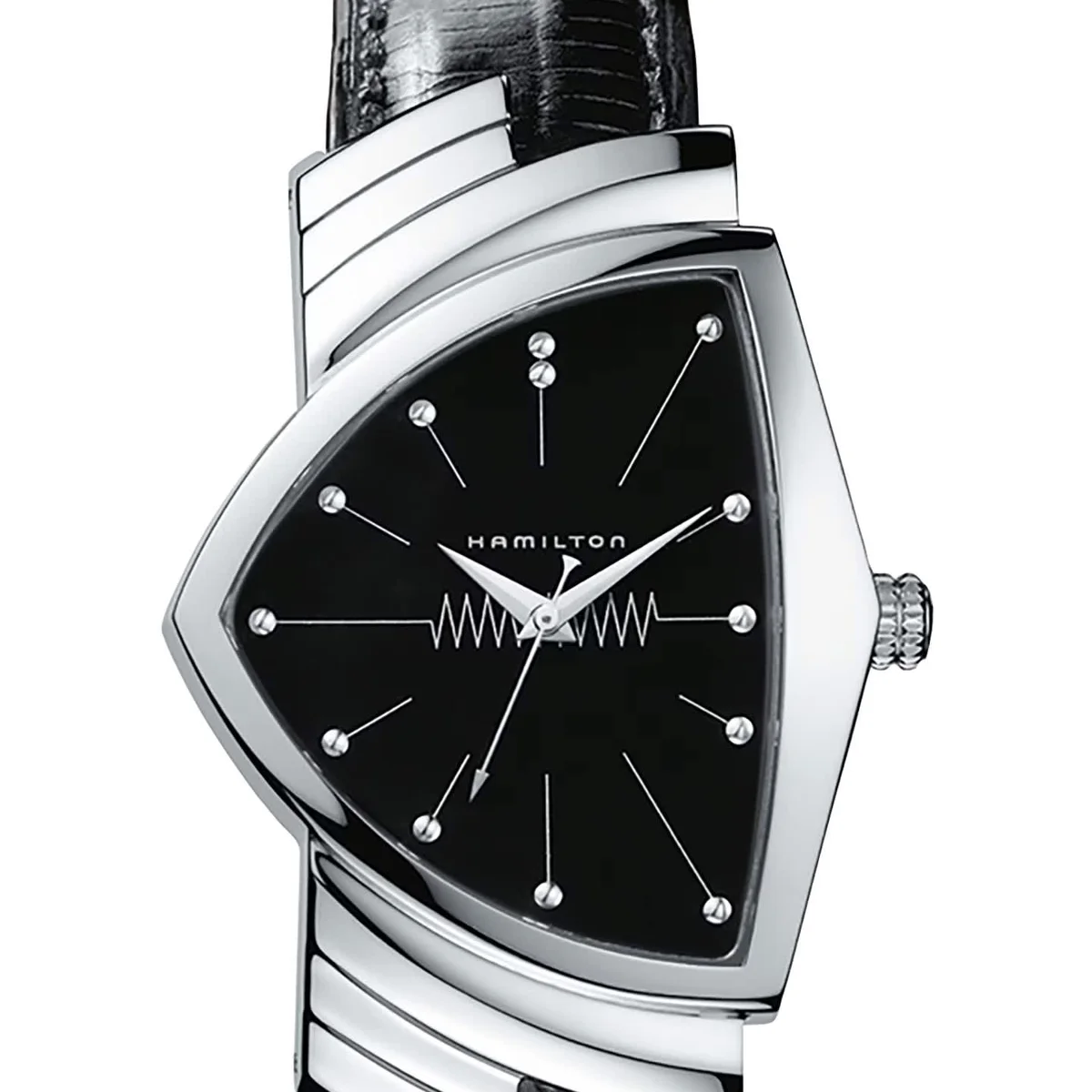
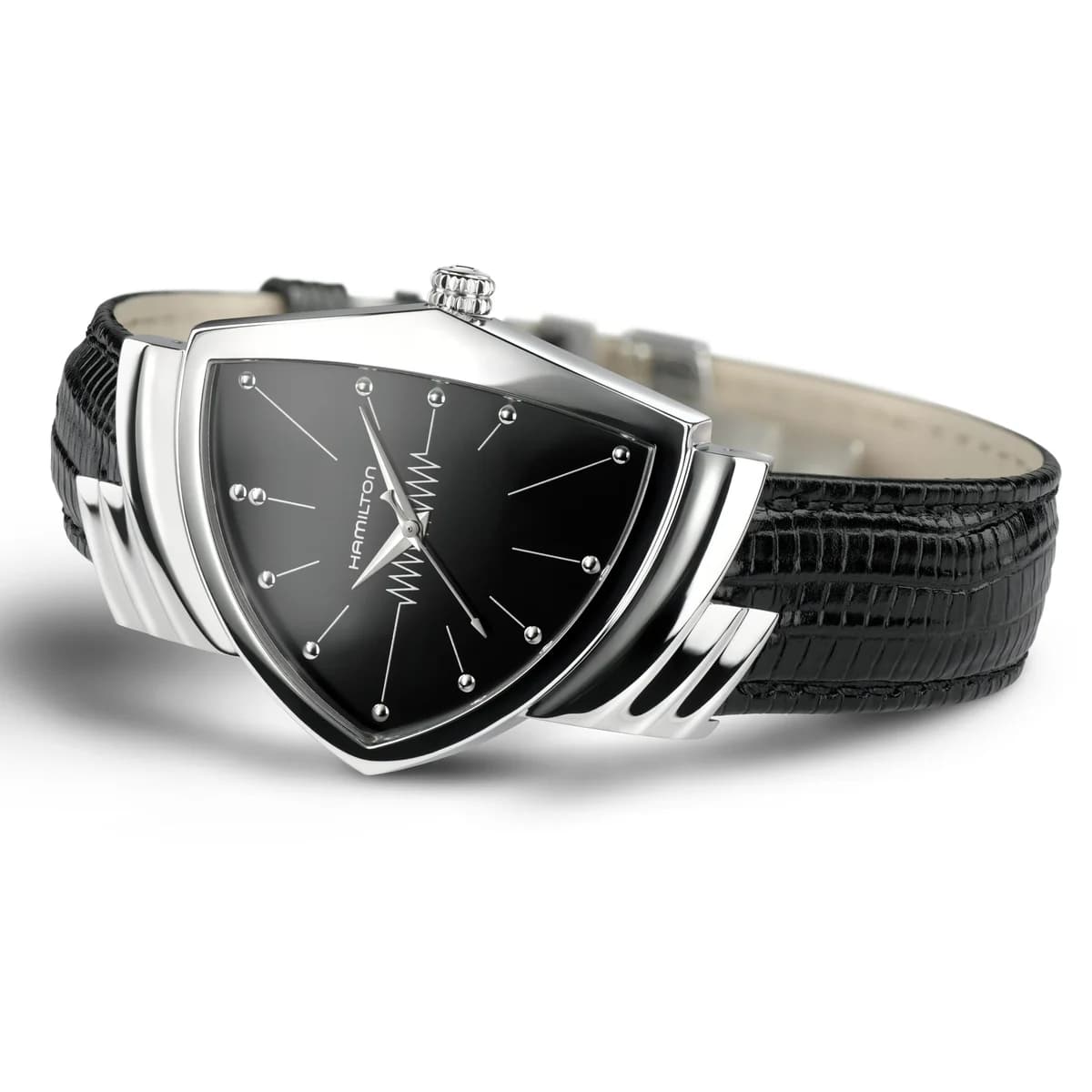
The Hamilton Ventura is the first battery-powered electric watch ever made. January 3, 1957. Hamilton staged the unveiling at the Savoy Plaza Hotel in New York City with over 120 reporters in attendance. Before quartz. Before digital. Before everything. The watch world ran on springs and gears, and Hamilton walked into that room with a wristwatch powered by a battery. Richard Arbib, an American industrial designer who had graduated from the Pratt Institute in 1939 and then gone on to style cars for General Motors under Harley Earl, drew a case shape that looked like nothing the watch industry had ever seen. A shield. An asymmetric triangle with one side sweeping up past 12 and the other dropping down past 6. People compared it to a guitar pick, to a spaceship, to something from a science fiction film. In 1957, science fiction was the right comparison. Sputnik launched that same year. The space age was beginning and the Ventura looked like it belonged in that future.
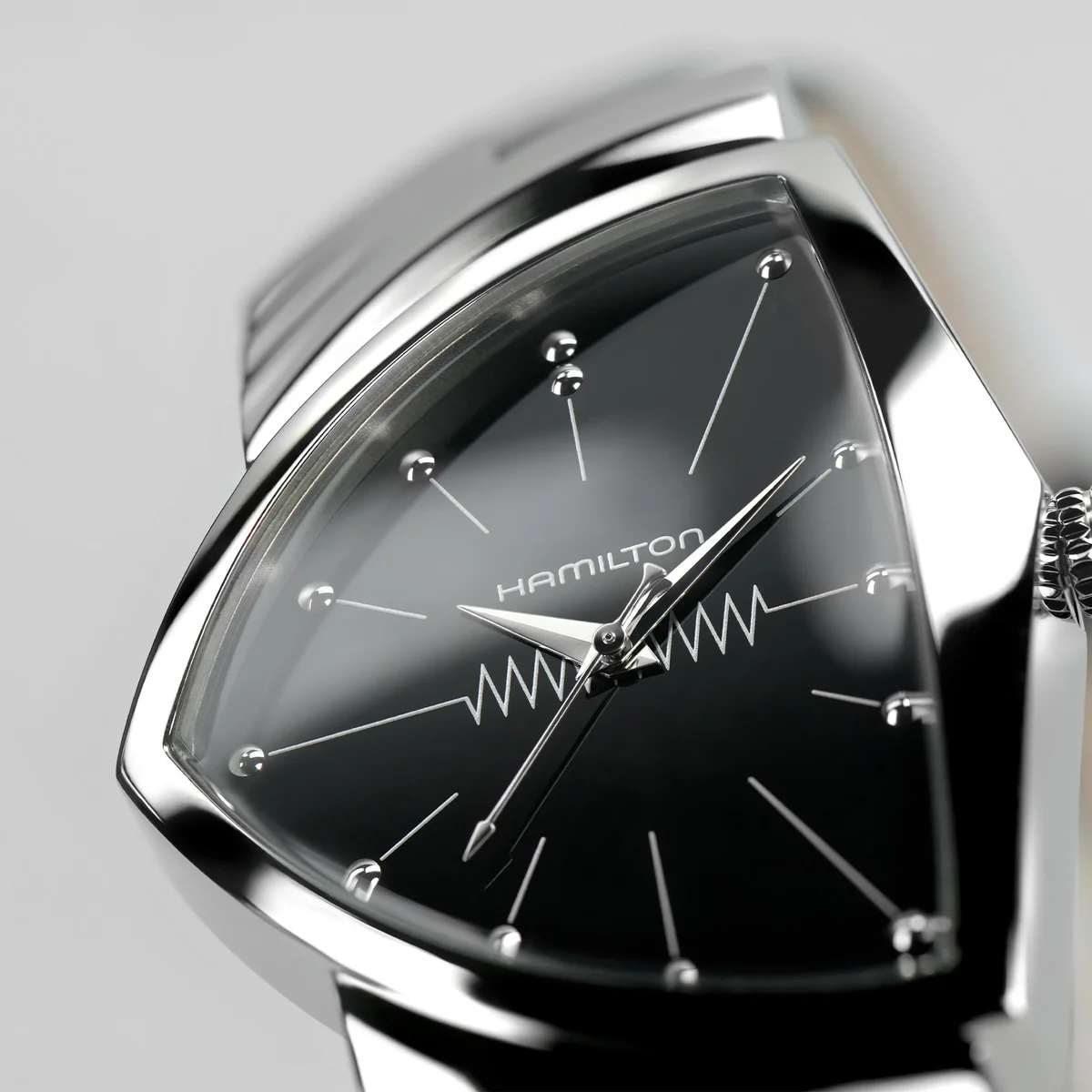
Arbib was not a watchmaker. He was a car guy. His first job out of Pratt was consulting for the General Motors Art and Color staff under Harley Earl, the man who essentially invented automotive styling as a discipline. Arbib went on to design the Packard Pan American, which won first place for outstanding design at the International Motor Sports Show in 1952. He designed the Astra-Gnome concept car for Nash Metropolitan, his vision of what an automobile would look like in the year 2000, complete with a celestial navigation clock. He worked for American Motors Corporation on the Hudson line in 1955. This was a man who thought in swoops and curves and aerodynamic forms. When Hamilton brought him in to design the case for their revolutionary electric movement, he did not draw a watch. He drew a concept car for the wrist. The Ventura's layered lug structure, the way the case flows into the strap attachments through stepped ridges of polished steel, those are automotive design cues translated into a 32mm case. What strikes me about that cross-pollination is how rare it still is. The best design often comes from people who bring vocabulary from a completely different field. In my experience, the watch industry has been slow to learn that lesson, even after the Ventura proved it in 1957.
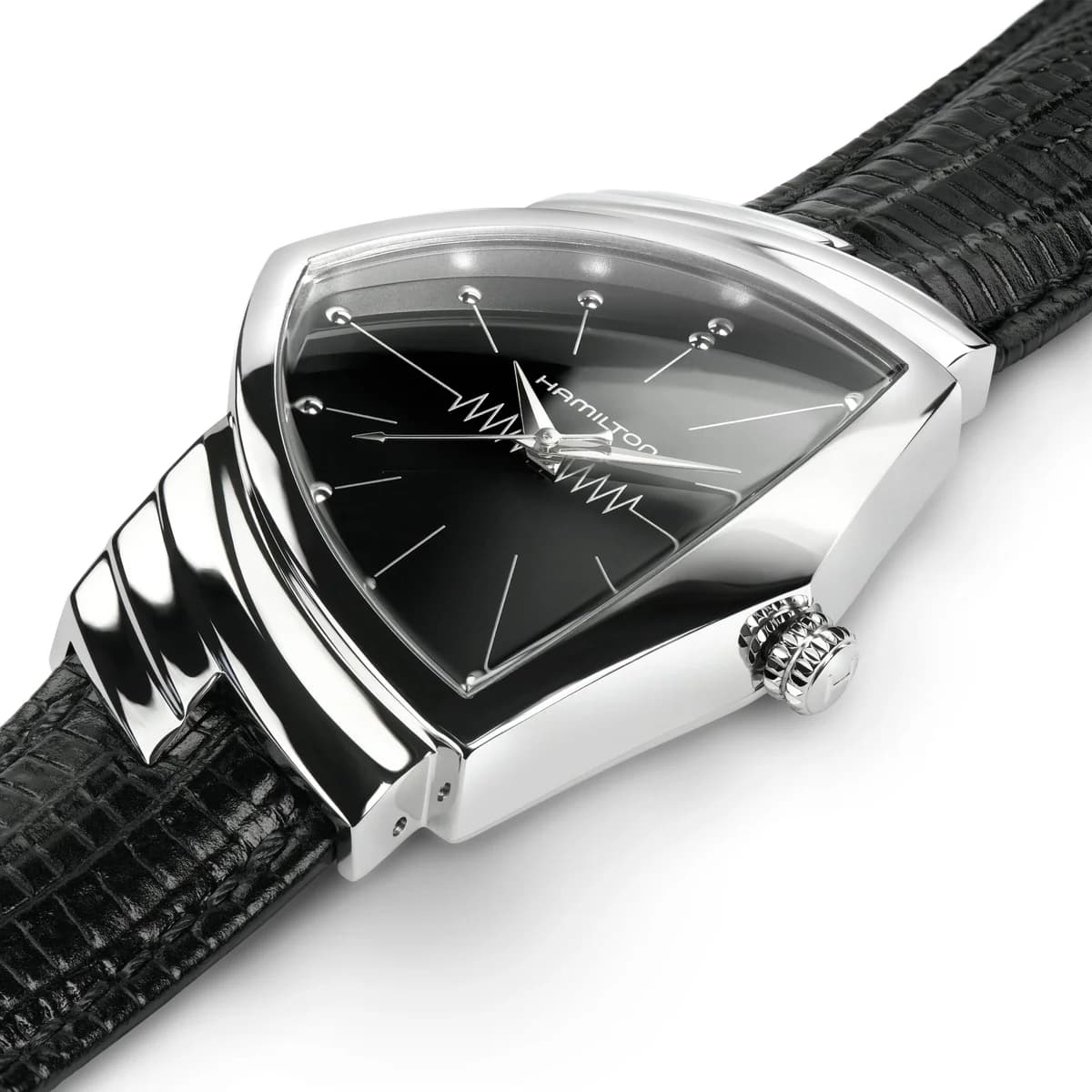
The movement inside the original 1957 Ventura was the Hamilton 500, and the engineering story behind it is just as interesting as the design. Hamilton had been working on electric watch technology since 1946 under a program called Project X. George Luckey led the research and development effort, with John Van Horn heading the wristwatch team and Philip Biemiller and James Reese building the early prototypes. The Caliber 500 used a traditional balance wheel oscillating at 2.5 Hz (18,000 vibrations per hour), but instead of a mainspring providing the impulse, a small button-cell battery and an electromagnetic system did the work. Two very fine contact wires mounted on posts extended to the balance wheel. As the balance swung, the wires made brief contact with a gold pin on the balance hub, closing the circuit and energizing an electromagnetic coil. Two small platinum-cobalt magnets then pushed the coil, sustaining the oscillation. The technology was revolutionary and deeply flawed. Those contact wires were incredibly delicate, requiring precise adjustment with essentially no margin for error. The contact point on the balance hub was prone to corrosion, and even microscopic amounts would stop the watch. Hamilton improved the design with the 500A in 1959 and the more reliable 505 in 1961 (which replaced the adjustable wires with a simpler non-adjustable contact), but the fundamental fragility remained. The battery, developed in collaboration with the National Carbon Company (now Energizer), provided approximately one year of power. Hamilton manufactured all components of the electric caliber in-house, which was unusual even for that era. Hamilton discontinued the original Ventura in 1963, just six years after its debut.
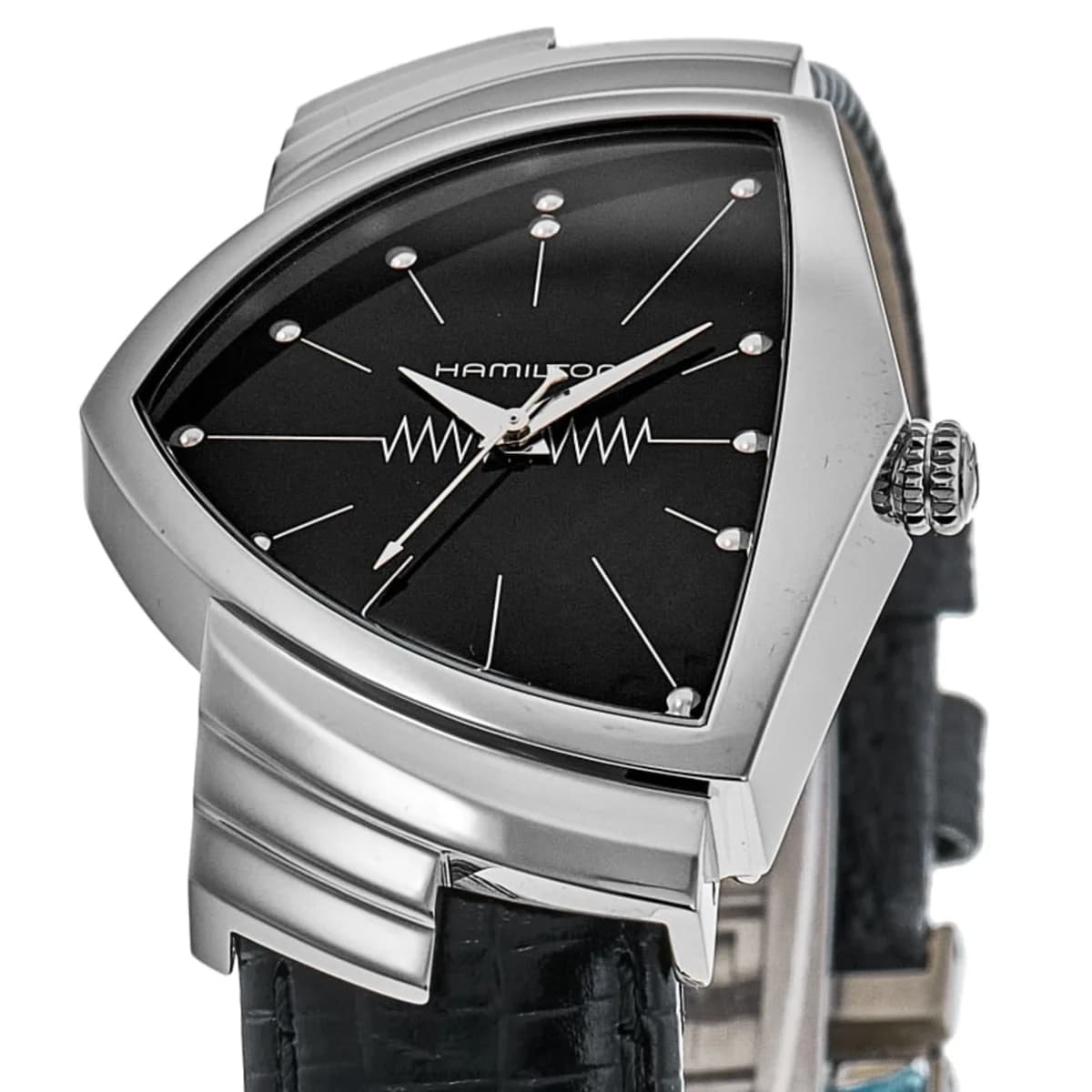
But in those six years, something happened that no amount of engineering could have planned. Elvis Presley wore one. A 14-karat white gold Ventura on a black leather strap, on the set of Blue Hawaii in 1961. He was not paid by Hamilton. He bought it himself. Elvis appreciated watches and owned several throughout his life, including pieces from Omega, Rolex, and Corum, and he was known to give Venturas as gifts to friends and associates. The Ventura fit the image of a performer who was redefining American culture. The asymmetric case, the space-age design, the fact that it was the most technologically advanced watch in the world at that moment, all of it worked. That single film appearance cemented the Ventura as a cultural icon. The watch survived its own discontinuation because of what it represented. And it would not be the last time Hollywood came calling.
Hamilton itself has a story that runs much deeper than most people realize. The company was established in 1892 in Lancaster, Pennsylvania, named after Andrew Hamilton, the Scottish-born attorney who founded Lancaster County. During the expansion of the American railroad system, Hamilton maintained over 56 percent of the railroad pocket watch market. Their local workforce grew to more than 2,000 employees through the 1940s, 1950s, and 1960s. This was a serious American manufacturing operation, deeply embedded in the infrastructure of the country. Hamilton supplied marine chronometers and military watches during both World Wars, and their reputation for precision was earned through decades of railroad service where a watch running slow could mean a fatal collision. In 1966, Hamilton acquired the Buren Watch Company in Switzerland, and by 1969 they had ended American manufacture entirely, shifting production to the Buren factory. On May 16, 1974, the Hamilton brand was sold to ssih, which would merge with another Swiss conglomerate in 1983 to form what we now know as the Swatch Group. Today Hamilton operates out of Biel/Bienne, Switzerland, the same city where Omega and Swatch Group headquarters are located. The brand sits in a fascinating position within the group: Swiss-made movements and manufacturing, but an American heritage and identity that sets it apart from every other Swatch Group brand. I appreciate that Hamilton has leaned into that duality rather than trying to hide it.
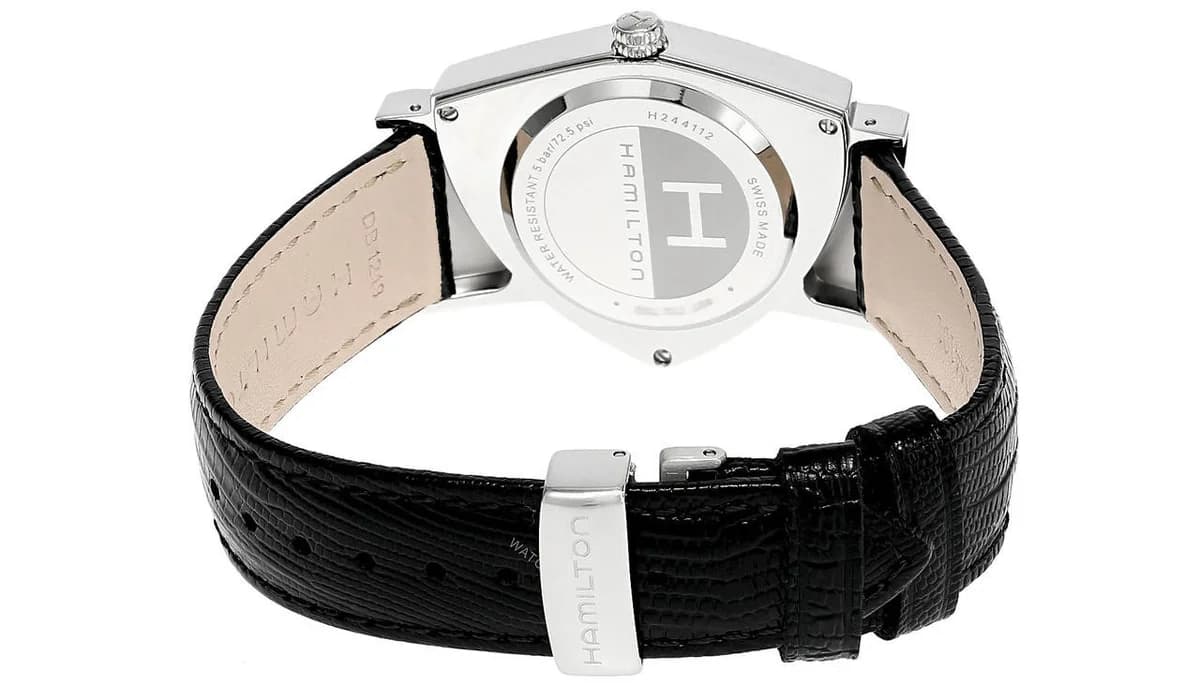
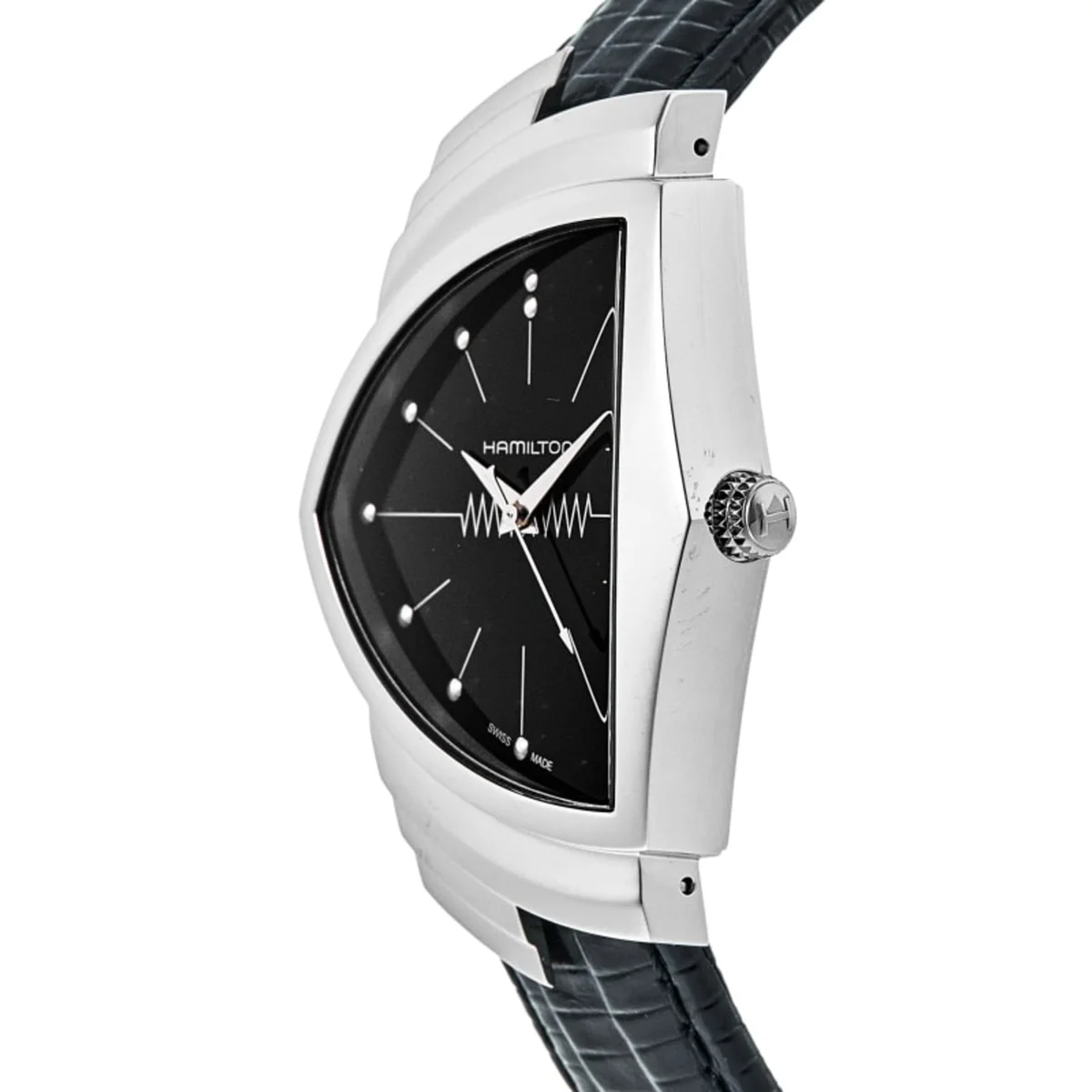
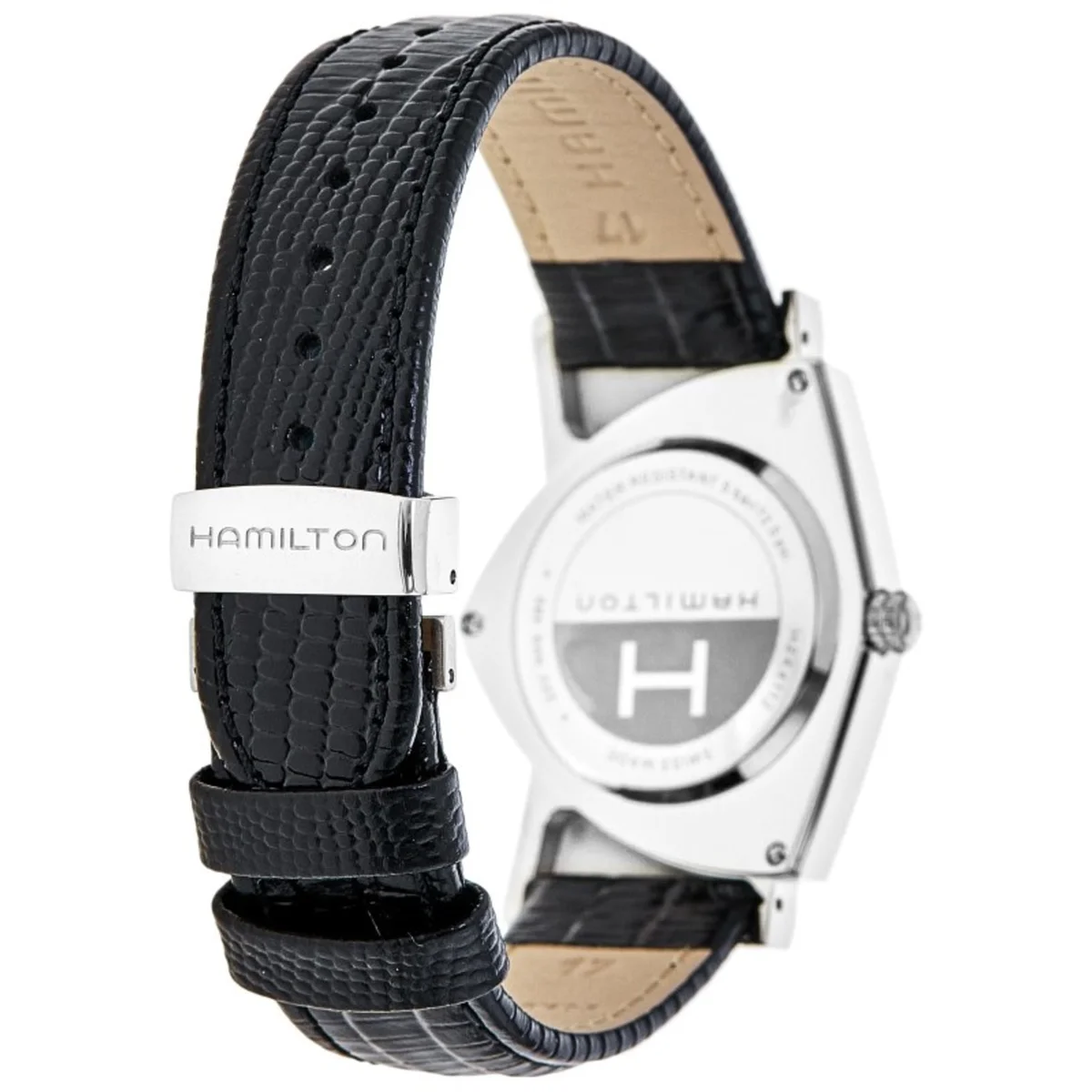
The modern Ventura quartz that I feature here, reference H24411732, is faithful to Arbib's original design while being an entirely different watch underneath. The Caliber 955.412 Swiss quartz movement replaced the temperamental electric system with something that just works. The case measures 32mm wide by 50mm from lug to lug, with a thickness of 9.27mm and a lug width of 17mm. Stainless steel with a polished finish. Black dial with silver sword-style hands, applied dot indices, and that signature zigzag pattern running horizontally across the center of the dial, a graphic reference to the electrical waveform that powered the original. Mineral crystal. 50 meters of water resistance. Black cow leather strap with a lizard-grain texture and a butterfly deployant buckle. The H-branded crown sits at 3 o'clock, small and unobtrusive. The dimensions are slightly different from the 1957 original but the proportions are right. It looks like the same watch because the ratios between the case elements, the sweep of the asymmetric shield, the layered lug architecture, all of it carries forward exactly as Arbib drew it.
I include the Ventura in this collection not because of its movement or its specifications but because of what it represents in the history of watch design. Before the Ventura, watches were round. Some were square. Some were rectangular. The Tonneau existed. But none were asymmetric shields designed by a man who styled Packards and dreamed up space-age concept cars. The Ventura proved that a watch could be a piece of industrial design, not just a timekeeping instrument. Every avant-garde case shape that followed, from the Audemars Piguet Royal Oak's octagon to the Richard Mille tonneau to the MB&F Horological Machines, exists in a lineage that the Ventura helped start. Gerald Genta was a jewelry designer before he drew the Royal Oak. Arbib was a car designer before he drew the Ventura. The pattern is clear. The most interesting watch designs come from people who bring visual language from outside the watch industry.
The Ventura's second act in popular culture came through the Men in Black franchise. In the original 1997 film, both Will Smith (Agent J) and Tommy Lee Jones (Agent K) wore the Ventura, specifically the H24411732 reference with the black dial and black leather strap. The asymmetric case, the monochrome palette, the retro-futuristic design, it was the perfect match for secret agents who police extraterrestrial activity while wearing sharp black suits. The watch returned in Men in Black II in 2002, Men in Black 3 in 2012 (where Smith wore a Ventura Chrono), and Men in Black: International in 2019 (with Tessa Thompson wearing the classic quartz and Chris Hemsworth wearing the Ventura Automatic). Four films across 22 years. That level of brand integration is rare, and it happened because the Ventura genuinely looks like a prop from the future. The wardrobe designers did not have to force it. The watch fit the world. I think that organic fit is why the partnership has lasted so long. Most product placements in films feel like exactly what they are. The Ventura in Men in Black feels like a prop department found the one watch that already looked like it belonged in that universe.
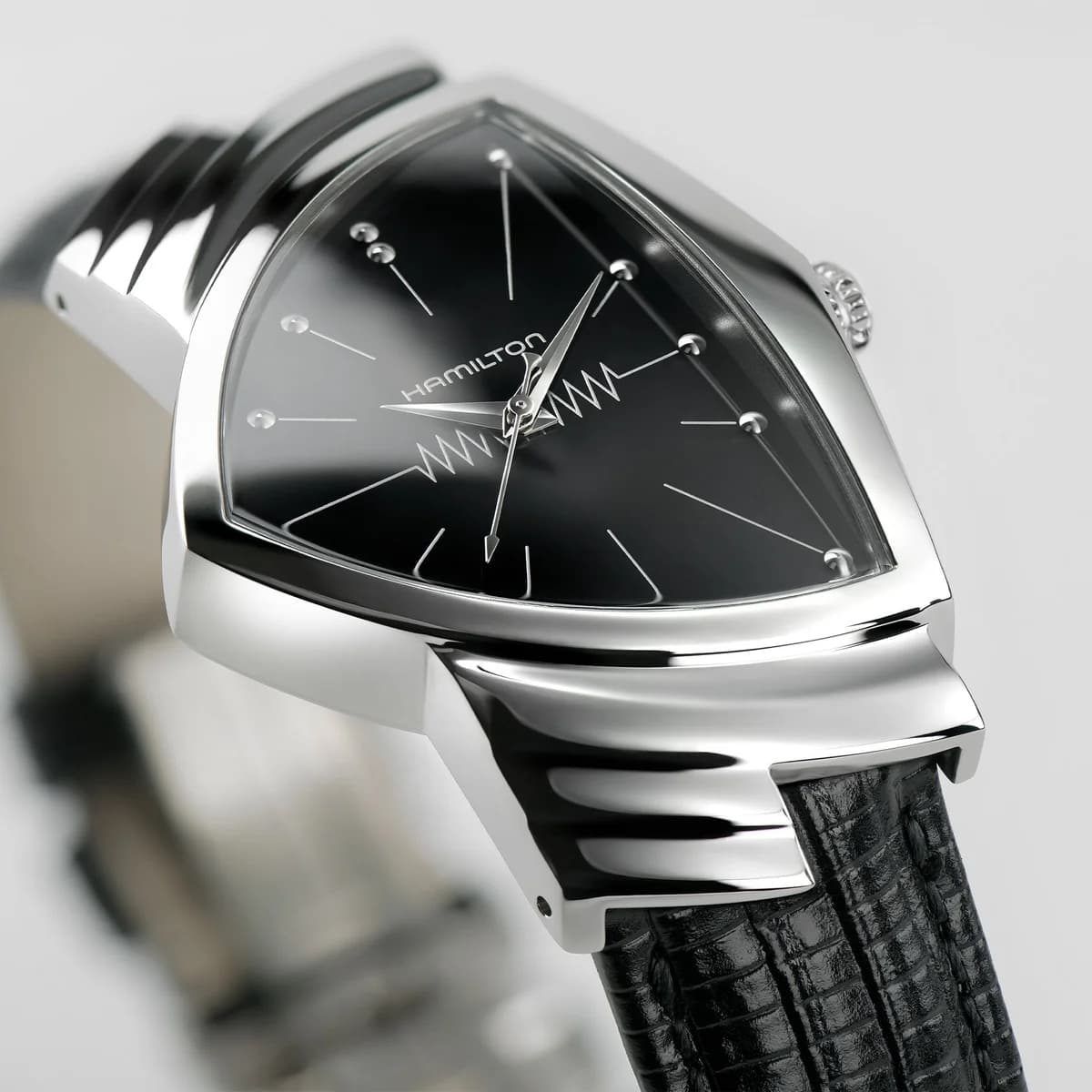
The broader Ventura family has grown into one of Hamilton's most diverse collections. In 2015, Hamilton released the Ventura Elvis80 to mark what would have been Presley's 80th birthday. It is a larger watch, 42.5mm by 44.6mm, with a black PVD finish and an automatic movement. The Ventura Open Heart adds a dial cutout revealing the balance wheel. The Ventura XXL stretches the case proportions for a bolder presence. The Ventura Skeleton takes the Open Heart concept further. What I find interesting about this family is how each variant explores a different dimension of Arbib's original shape. The proportions scale up or down. The dial opens up to reveal mechanics. The finish changes from polished to matte to PVD. But the fundamental geometry, that asymmetric shield, remains constant across every version. That is a sign of a design so strong that it can absorb almost any variation without losing its identity. The Ventura Open Heart is particularly interesting because the asymmetric dial shape gives the balance wheel aperture a completely different visual weight than it would have on a round dial. The cutout sits off-center within a case that is already off-center, and somehow it works. It should feel chaotic. It feels dynamic instead.
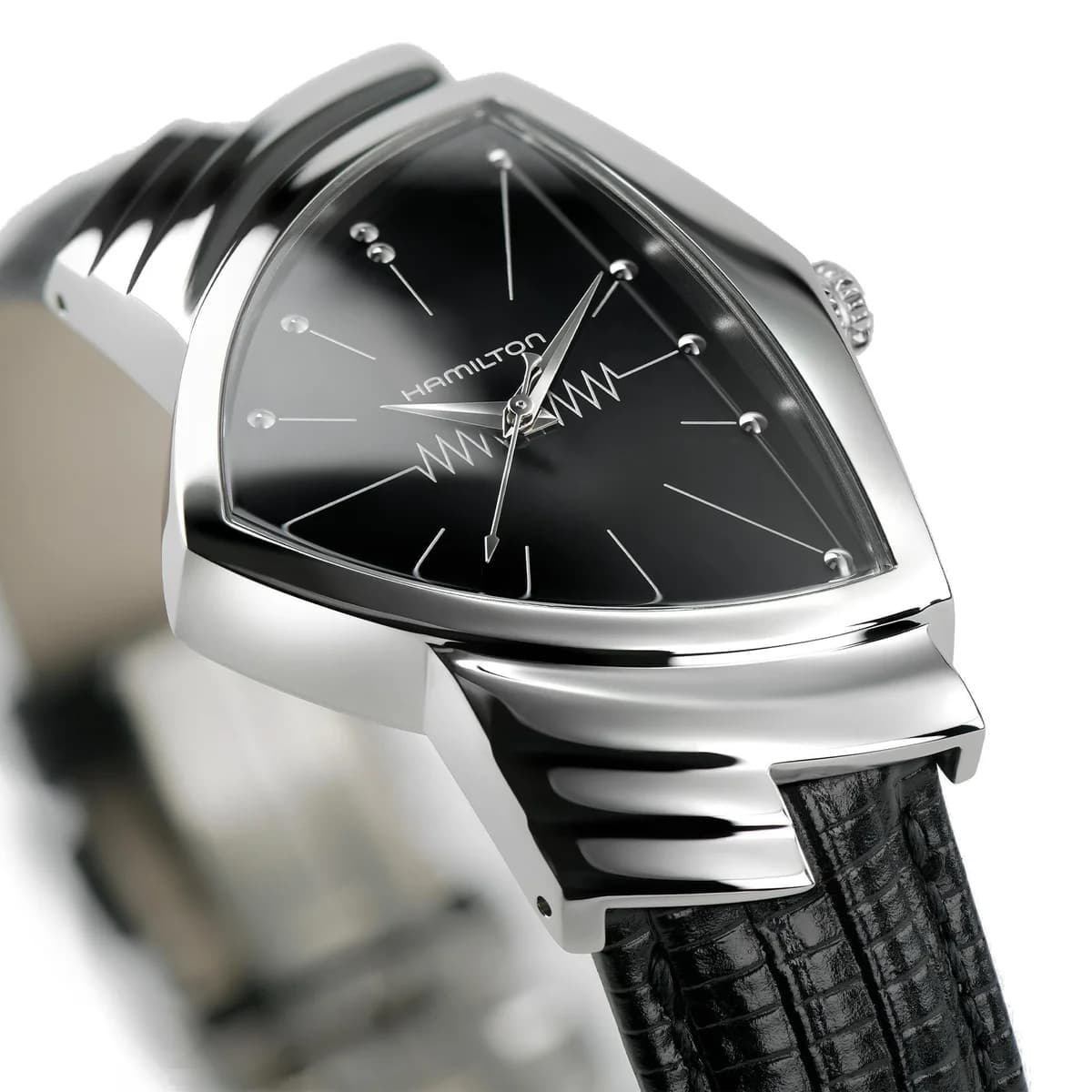
The honest critique of the Ventura starts with the crystal. Mineral glass on a watch at this level is a tradeoff I wish Hamilton had made differently. The automatic Ventura references use sapphire, and I would love to see that trickle down to the quartz models. Mineral glass is harder than acrylic but much softer than sapphire, sitting around 5 to 6 on the Mohs scale versus sapphire's 9. It will scratch over time with regular wear, and unlike hesalite on a Speedmaster, you cannot polish mineral glass back to clarity with Polywatch. A scratched mineral crystal means a crystal replacement. The other observation is readability. The asymmetric dial shape and the linear indices pointing inward from the edges create a dial that is beautiful but not the easiest to read at a glance. The sword hands are thin and polished, which looks elegant but does not offer the instant legibility of, say, a Seiko diver with its thick luminous hands. There is no lume to speak of on the indices. In low light, telling time requires effort. That said, the Ventura is not trying to be a tool watch. It is a design statement. And as a design statement, the legibility tradeoff is one I can live with. I just wish the crystal were sapphire. The weight is also worth noting. The Ventura is a light watch. The stainless steel case and leather strap combination does not have the wrist presence of a heavy diver or a steel bracelet sports watch. Some people want that substantial feeling when they wear a watch. The Ventura is more of a whisper. Personally, I think the lightness suits the design. A heavy Ventura would feel wrong. The watch is supposed to float on the wrist, not anchor it.
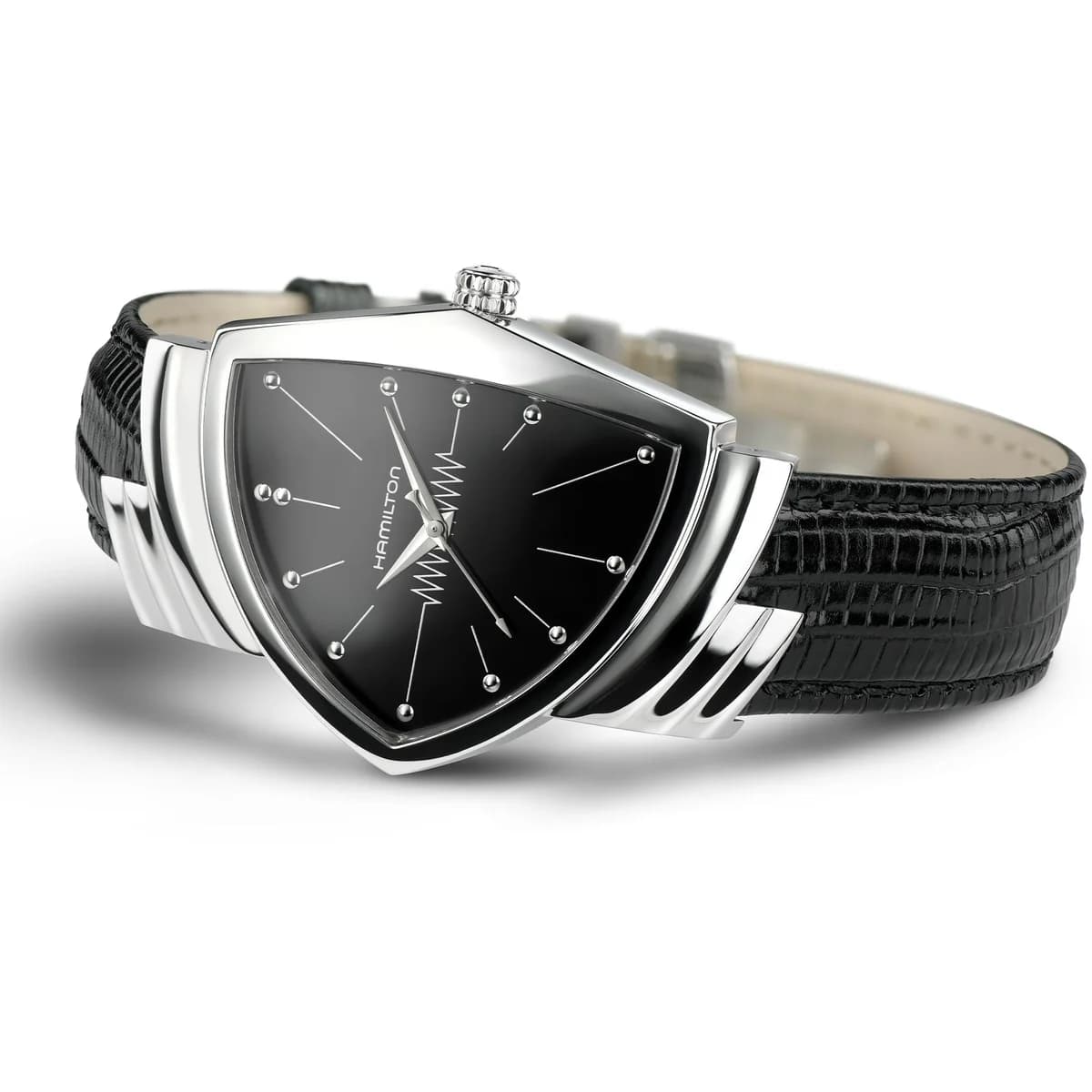
On the wrist, the 32mm by 50mm case sits in an unusual way because of the asymmetry. The shield shape means the watch wears larger than those numbers suggest. The extended point at 6 o'clock and the sweeping edge past 12 create a visual footprint that reads closer to a 38mm or 40mm round watch. At 9.27mm thick, it sits flat. On a 6.5-inch wrist, the proportions feel balanced. The black dial and polished steel contrast reads clean against darker skin, and the silver hands pick up light in a way that creates a subtle flash with wrist movement. The lizard-grain leather strap is comfortable and appropriately retro. This is a watch that pairs naturally with a slim-cut Ermenegildo Zegna suit, a white dress shirt, and minimal accessories. It does not compete with a tie or cufflinks for attention. It sits quietly on the wrist and waits to be noticed. That quiet confidence is the essence of the Ventura's appeal. It does not announce itself. It rewards the people who look closely. For me, that restraint is what separates the Ventura from watches that try too hard to be different. The Ventura is not trying. It simply is different, and it has been since 1957. On my wrist, the asymmetric shield catches light in a way that round watches never do. Tilt your arm slightly and the case transforms. The polished surfaces on the upper lug create a bright flash while the lower edge disappears into shadow. I have never seen another watch do that.
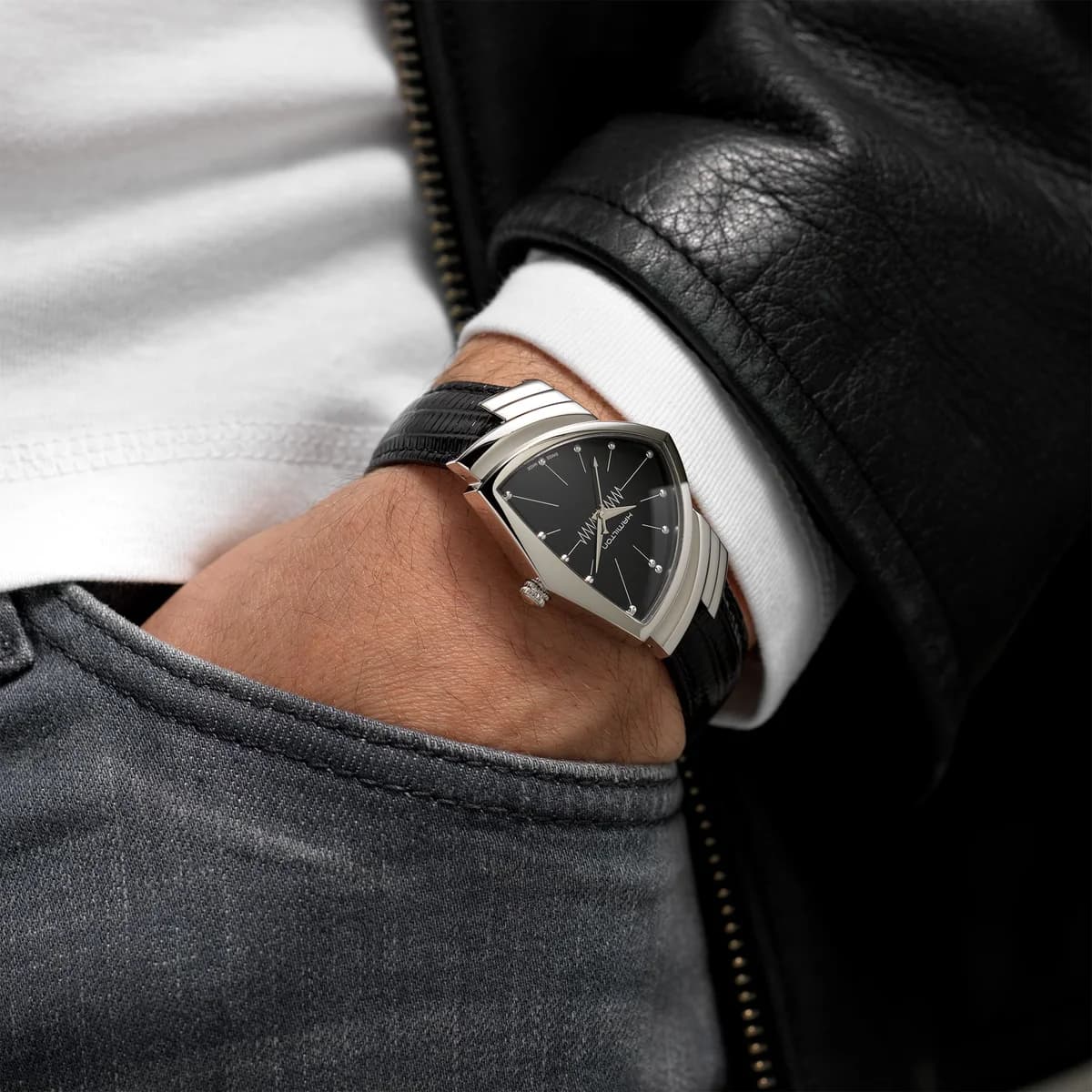
The Ventura occupies a space in watchmaking that nothing else fills. It is not the most technically impressive watch. It is not the most expensive. It is the watch that proved a wristwatch could look like anything. Richard Arbib died in 1995 in Manhattan, 38 years after the Ventura debuted. He never saw the Men in Black films. He never saw the Elvis80 tribute. But the shape he drew in the mid-1950s, inspired by car design and space-age optimism and a willingness to throw out every convention about what a watch was supposed to look like, that shape is still in production. Still recognizable from across a room. Still unlike anything else on anyone's wrist. I keep coming back to that. Arbib gave Hamilton something that transcended the technology inside it. The electric movement failed. The quartz replacement is unremarkable. The case shape is immortal. That is the real legacy of the Ventura. Nearly seven decades later, it still does not look like any other watch on the market. That is the rarest kind of design success.
Also in Design Icons