
Gronefeld
1941 Remontoire
1941 Remontoire Red Gold Salmon
The Gronefeld brothers are not from La Chaux-de-Fonds. They are not from Geneva. They are not from Glashutte. They are from Oldenzaal, a small town in the eastern Netherlands near the German border. Their grandfather Johan became a watchmaker in 1912 and took responsibility for maintaining the mechanism of the Saint Plechelmus basilica clock in Oldenzaal, a clock that featured a remontoire, a constant-force mechanism that has been regulating timekeeping in church towers for centuries. When Johan died, his son Sjef took over both the watchmaking workshop and the care of that clock. Bart and Tim Gronefeld grew up watching their father service that mechanism. The 1941 Remontoire is the wristwatch version of what they learned at home. The name 1941 refers to the year their father was born.
To understand how Bart and Tim became capable of building something like this, it helps to know where they went after Oldenzaal. Bart, born in 1969, was hired by Renaud et Papi, the Audemars Piguet complications subsidiary that builds some of the most complex movements in the Swiss industry. He spent eight years there as a specialist in chronographs, minute repeaters, and grand sonneries. Tim, born in 1972, followed his brother to Switzerland and worked at Renaud et Papi for six years, specializing in tourbillons and movement regulation. Between the two of them, the Gronefeld brothers trained on virtually every major complication in haute horlogerie at the workshop that manufactures them for brands ten times their size. In 1998, they decided to return to Oldenzaal. They reestablished the family workshop. In 2008, they began producing watches under their own name. The gap between 1998 and 2008 was not idle. They were restoring and servicing complicated watches for collectors and other brands, building a reputation for precision and hand-finishing quality, and developing the supplier relationships and tooling infrastructure that would eventually produce the 1941 Remontoire. When they finally launched their own collection, the industry took notice immediately. These were not amateur watchmakers learning on the job. They were Renaud et Papi trained specialists who had chosen to do this from home.
A remontoire is one of the most elegant solutions in all of mechanical engineering. The problem it solves is fundamental to every mechanical watch ever made. A mainspring delivers power unevenly. When fully wound, it pushes harder. As it unwinds, the force drops. This means the escapement receives inconsistent energy across the power reserve, which affects the rate. A fresh wind runs slightly faster. A depleted spring runs slightly slower. Every mechanical watch has this problem. Most compensate for it through clever escapement design and regulation. A remontoire eliminates it. Instead of powering the escapement directly from the mainspring, the mainspring powers a small intermediate spring that sits between the gear train and the escapement. This intermediate spring is recharged at fixed intervals, in this case every eight seconds, delivering a consistent pulse of energy regardless of how much power remains in the mainspring. The result is constant force at the point where it matters most. The watch runs at the same rate whether the mainspring was wound ten seconds ago or thirty hours ago.
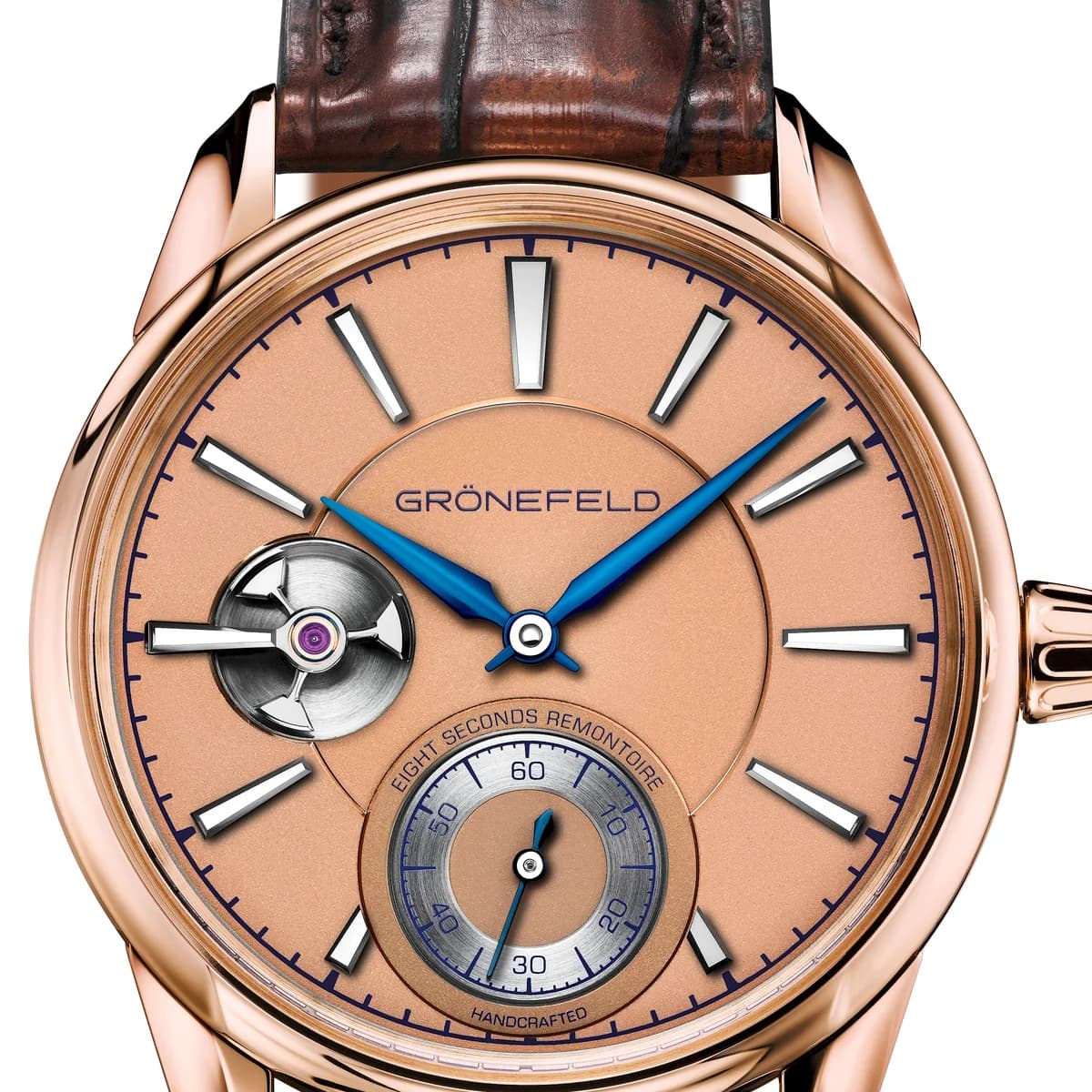
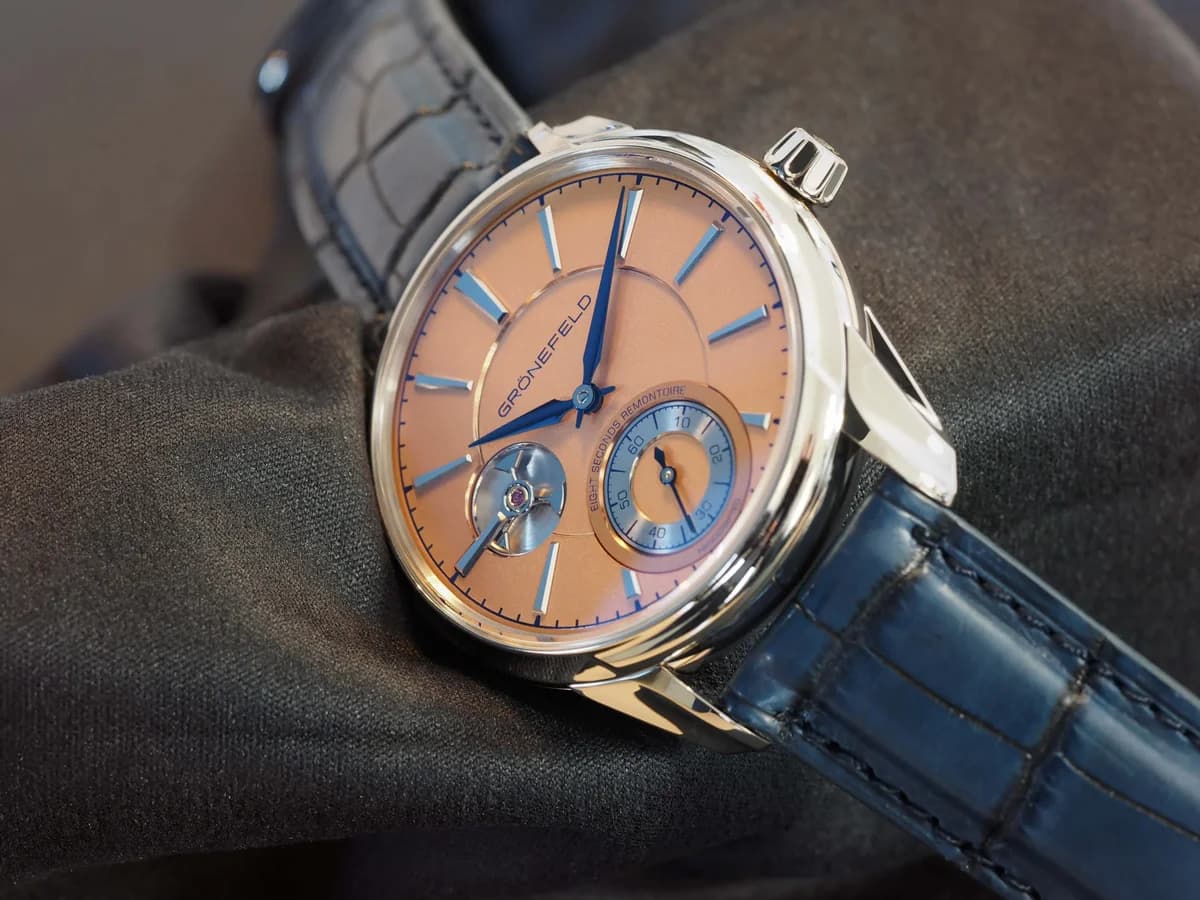
I need to explain why this is so difficult to execute in a wristwatch. Constant-force mechanisms have existed in tower clocks for centuries. The Saint Plechelmus clock proves that. But a tower clock has room. A wristwatch does not. The Caliber G-05 fits this entire mechanism, 258 parts including 36 jewels partially set in solid gold chatons, into a movement that is 32mm in diameter and 5.5mm thick. The case is 39.5mm and 10.5mm thick. That is a dress watch profile for a complication that most brands would not attempt at any size. The remontoire uses hypocycloidal gears, twin ball bearings, jewelled levers, and pinions to rewind the intermediate spring every eight seconds. That is 450 recharges per hour. 10,800 per day. Each one must deliver the same energy to the escapement without creating a shock that disturbs the balance wheel. A governor speed regulator visible through the dial at 9 o'clock prevents the rewind from creating that shock. Without the governor, each rewind would deliver a sharp jolt to the gear train. The governor absorbs that energy and releases it gradually. Watching it work through the dial is one of the most mesmerizing things I have seen in any watch. Every eight seconds, the small seconds hand at 6 o'clock pauses for a fraction of a moment, the governor spins, the intermediate spring recharges, and the seconds hand resumes. It is a visible heartbeat.
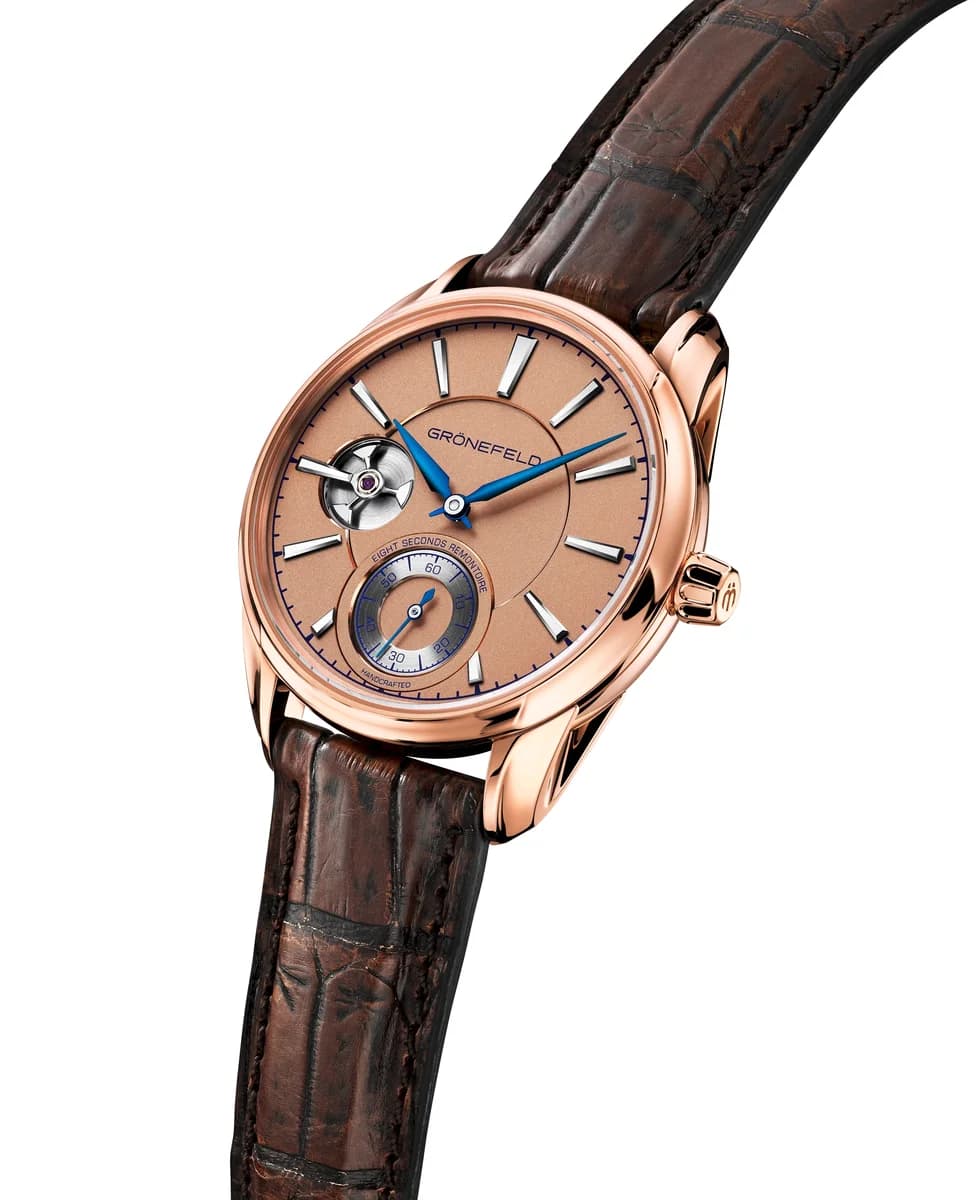
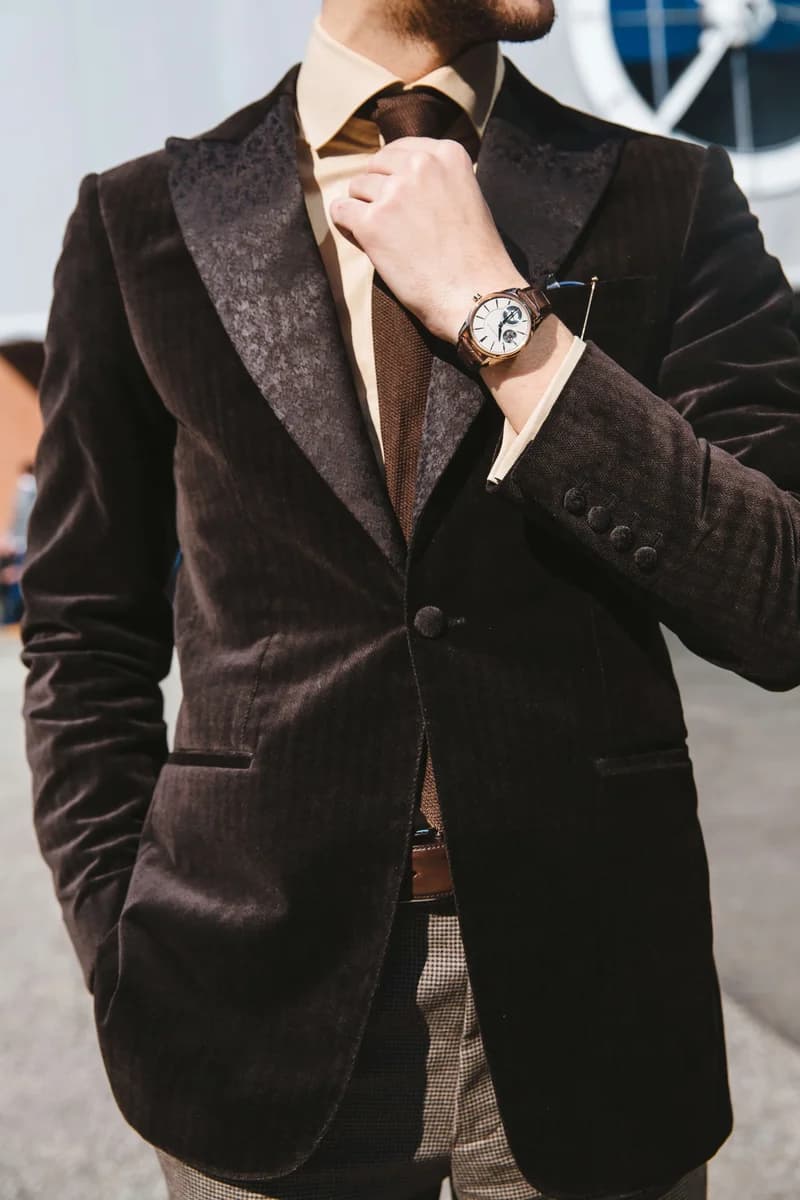
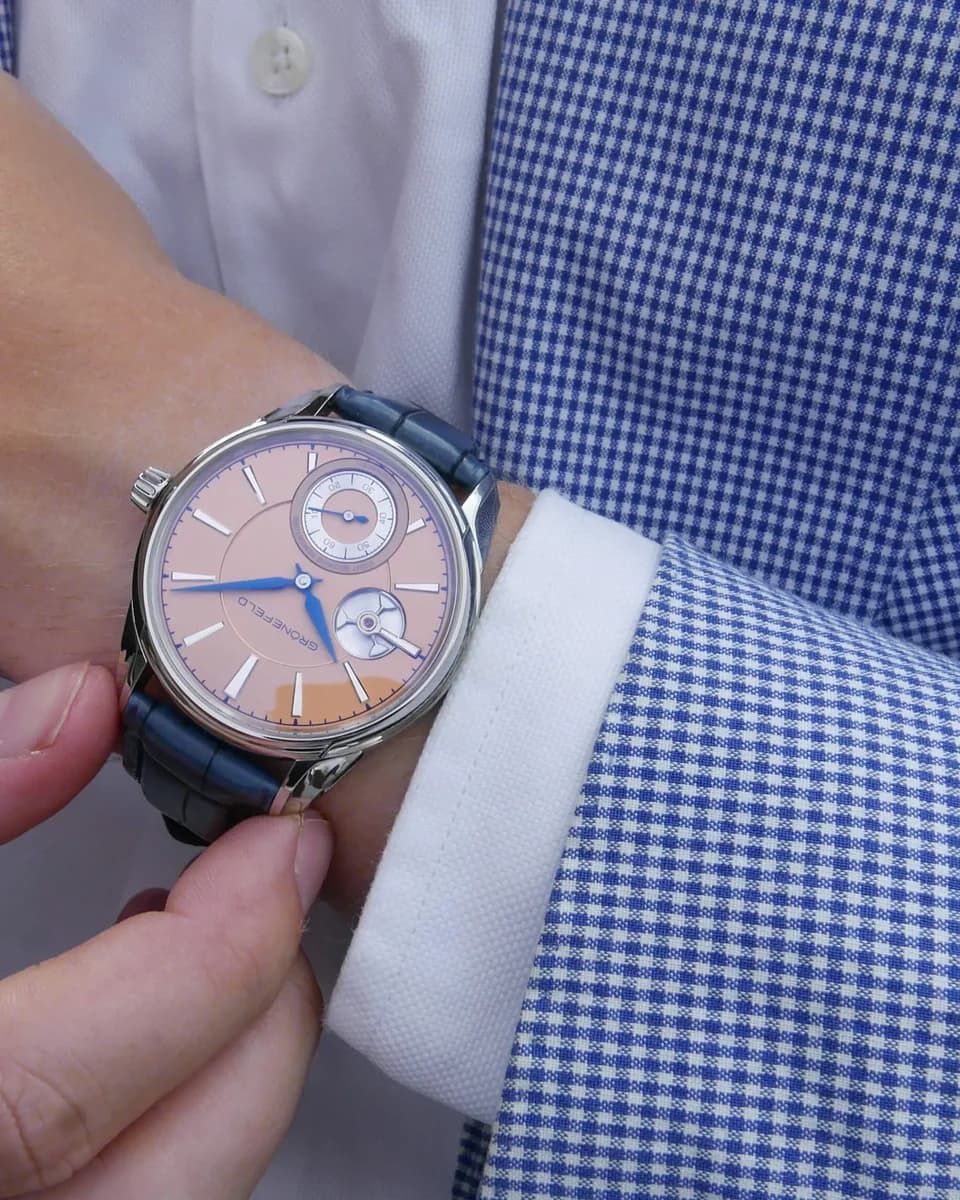
The case is 5N red gold, 18 karats, and the dial is solid sterling silver with a copper-salmon finish. The combination is extraordinary. Red gold is warmer than yellow gold and richer than rose gold. The salmon dial sits somewhere between pink and copper depending on the light. In direct sun, it leans copper. In shade, it goes pink. Against the red gold case, the two warm tones create a monochromatic harmony that is unlike anything in the Swiss catalog. The hands are flame-blued steel with mirror-polished centers, the lancette style that has been a Gronefeld signature. The contrast of cold blue steel against the warm salmon and red gold is a deliberate tension. It keeps the dial from becoming too warm, too soft. The blue hands are the anchor. They give the design structure. The domed sapphire crystal on the front and flat sapphire caseback both carry hard anti-reflective coatings, and the crown has what collectors describe as a champagne cork shape, engraved with the Gronefeld logo. Water resistance is 3 atmospheres, 30 meters, which means rain and hand washing. This is a dress watch and it makes no pretense otherwise.
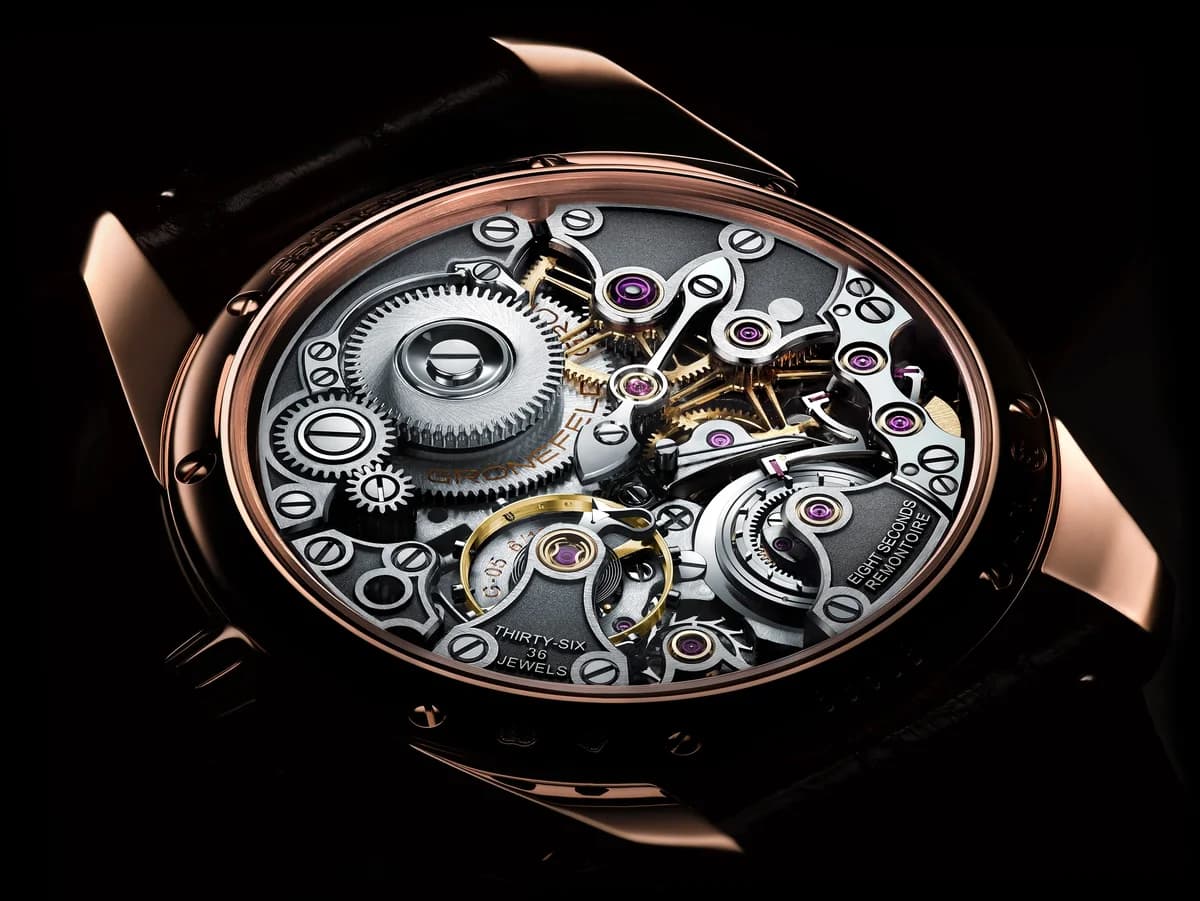
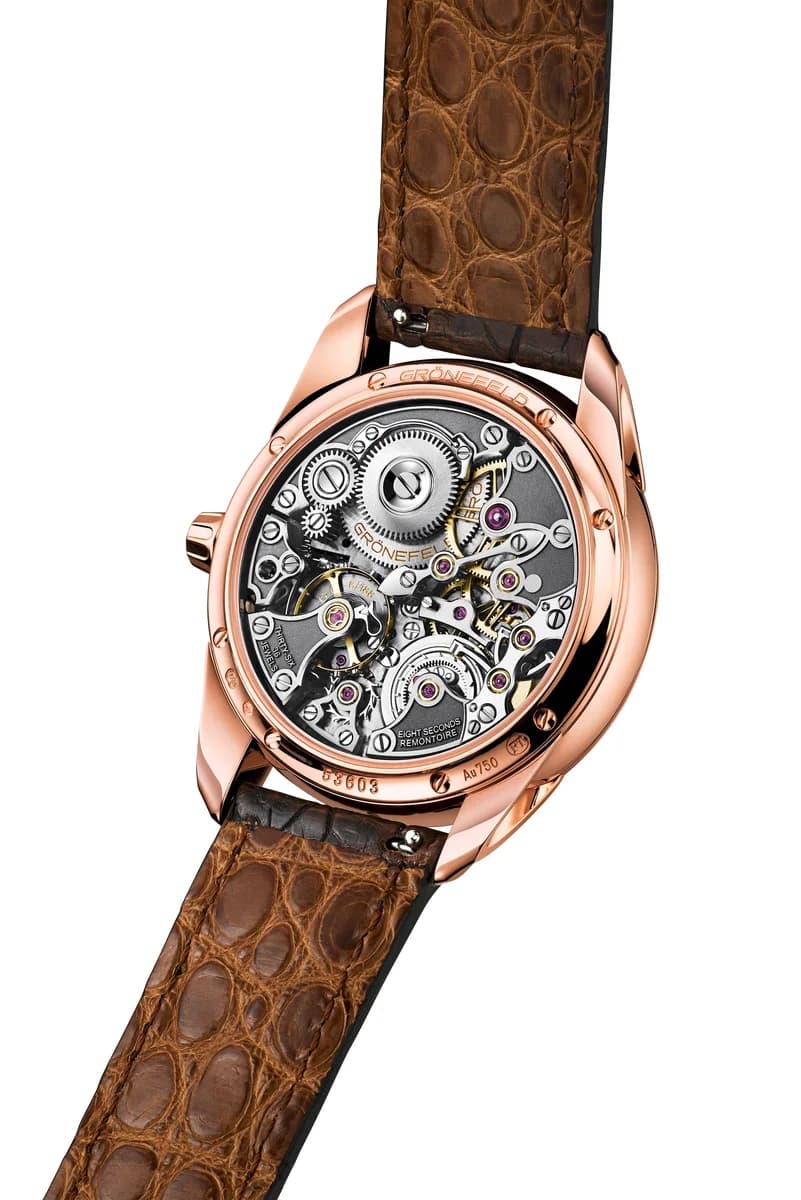
The movement finishing is where the Gronefeld brothers separate themselves from brands ten times their size. The bridges are stainless steel, which is unusual. Most haute horlogerie movements use German silver or brass. Stainless steel is much harder to finish by hand. The bevels are hand-polished to a mirror edge. The centers are micro-blasted with circular grain. The main plate is spotted and ruthenium electroplated brass. The jewels sit in solid gold chatons, a traditional technique where each jewel is pressed into a gold cup and then friction-fitted into the plate. Gold chatons serve no functional purpose that a modern press-fitted jewel cannot match. They exist because they are beautiful and because they represent a standard of craft that the brothers refuse to abandon. Looking through the sapphire caseback at the Caliber G-05 is looking at work that could have been produced in the Vallee de Joux by a team of twenty. It was produced in Oldenzaal by two brothers and a small team.
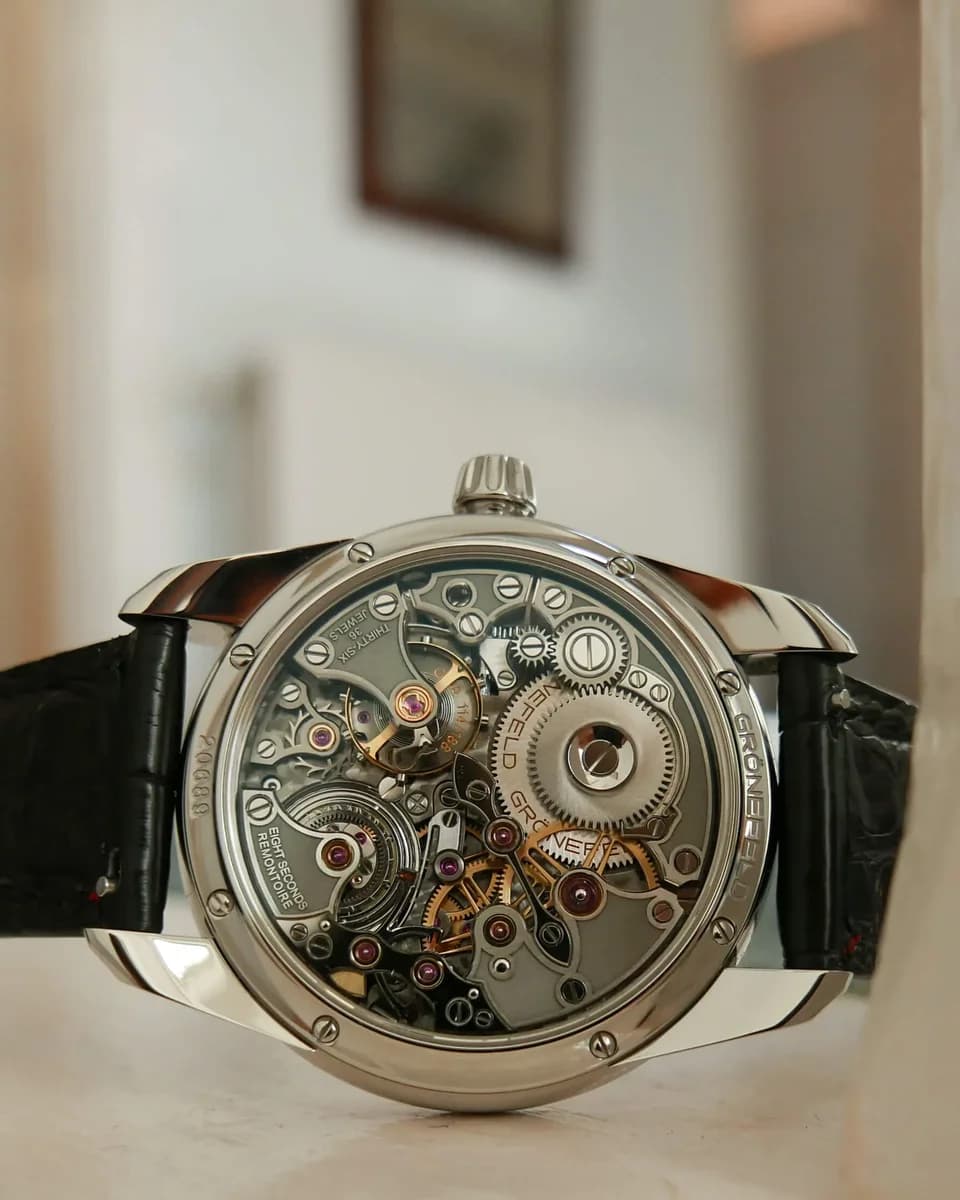
The bridge shapes themselves carry a detail that I find genuinely touching. The stainless steel bridge profiles are designed to echo the facades of Dutch bell gable houses, the stepped rooftops that define the architecture of towns like Oldenzaal throughout the eastern Netherlands. It is an architectural signature embedded in the movement. Most independent watchmakers reference Geneva stripes or Glashutte ribbing. The Gronefeld brothers reference the skyline of their hometown. Through a loupe, the bridge outlines look like a row of Dutch houses. Through the sapphire caseback, they look like beautifully finished movement architecture. Both readings are correct. That duality is rare in watchmaking.
The 1941 Remontoire won the Grand Prix d'Horlogerie de Geneve Men's Watch Prize in 2016. The GPHG is the closest thing watchmaking has to the Oscars. The Men's Watch Prize is not a niche category. It is the main event. A Dutch independent with no Swiss heritage, no Geneva seal, no centuries of brand mythology, walked into the ceremony and won it against established Swiss houses. The Gronefeld brothers had already won the GPHG Tourbillon Watch Prize in 2014 for their Parallax Tourbillon. Two GPHG wins from a workshop in the Netherlands. That is not a fluke. That is a pattern.
Andreas Strehler of Sirnach, Switzerland, collaborated on the movement development. Strehler is himself one of the most respected independent watchmakers in the world, known for his work on constant-force mechanisms and astronomical complications. The partnership makes sense because it was not formed by introduction. Bart and Tim worked alongside Strehler during their years at Renaud et Papi in the 1990s. They already knew each other. They had already worked together on complex mechanisms. When it came time to build the Remontoire, the bridges and certain components were manufactured in Strehler's workshop in Sirnach, which has the equipment for small-volume production of complicated plates, bridges, wheels, pinions, springs, and the kind of micro-components that a constant-force mechanism demands. The finishing, assembly, and regulation were completed entirely in-house at Gronefeld in Oldenzaal. This is not a Swiss movement with a Dutch name on the dial. The intellectual property, the design, and the final execution are Dutch.
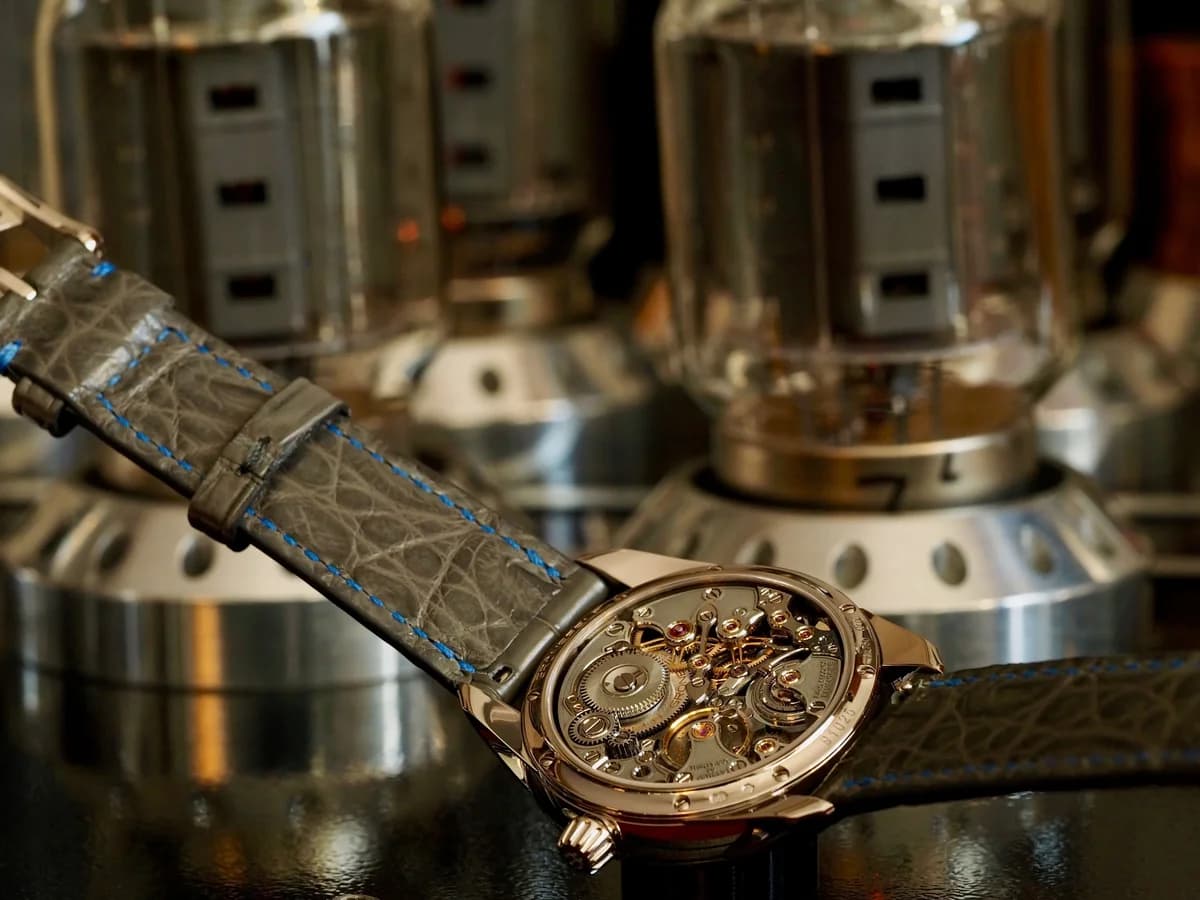
The power reserve is 36 hours with constant force and a stop mechanism. When the mainspring can no longer provide enough energy to rewind the intermediate spring, the watch stops rather than running inaccurately. This is a philosophical decision. Most watches will continue running as the mainspring depletes, losing accuracy gradually until they stop. The Gronefeld stops cleanly. It would rather show no time than show the wrong time. That tells you everything about how the brothers think. An eccentrically mounted ring gear limits the rotation of the mainspring barrel, which is the mechanical enforcement of this philosophy. It is not a software decision. It is a gear that physically prevents the mainspring from unwinding past the point where constant force is no longer achievable.
The balance wheel is a variable-inertia design with four white gold timing screws, 10mm in diameter, free-sprung with a Phillips terminal curve and triangle hairspring stud. The frequency is 21,600 vibrations per hour, 3 Hz, which is lower than the 4 Hz found in most modern sport watches. The lower frequency is deliberate. A slower oscillation consumes less energy, which extends the effective constant-force window and reduces wear on the remontoire mechanism over decades of use. The entire system is designed around the remontoire. Every specification serves the constant-force goal. A three-jewel pallet anchor sits at the heart of the escapement, and a hacking seconds mechanism allows the owner to set the time to the exact second, a feature implemented via a long curved spring near the balance wheel rather than a conventional lever.
The honest critique is the power reserve. 36 hours is short. Take the watch off at midnight and it stops before the next evening. This is the tradeoff of the remontoire mechanism. The intermediate spring consumes energy every eight seconds. That constant recharging cycle draws more from the mainspring than a conventional gear train. The stop mechanism compounds it by cutting power before the mainspring is fully depleted. The result is a watch that requires daily winding. For some people, that is a burden. For the kind of person who buys a Gronefeld, it is a ritual. I would also note the water resistance. At 30 meters, this is genuinely splash-proof and nothing more. On a watch this rare, caution around water is the natural posture anyway, but it does mean taking it off for anything beyond hand washing.
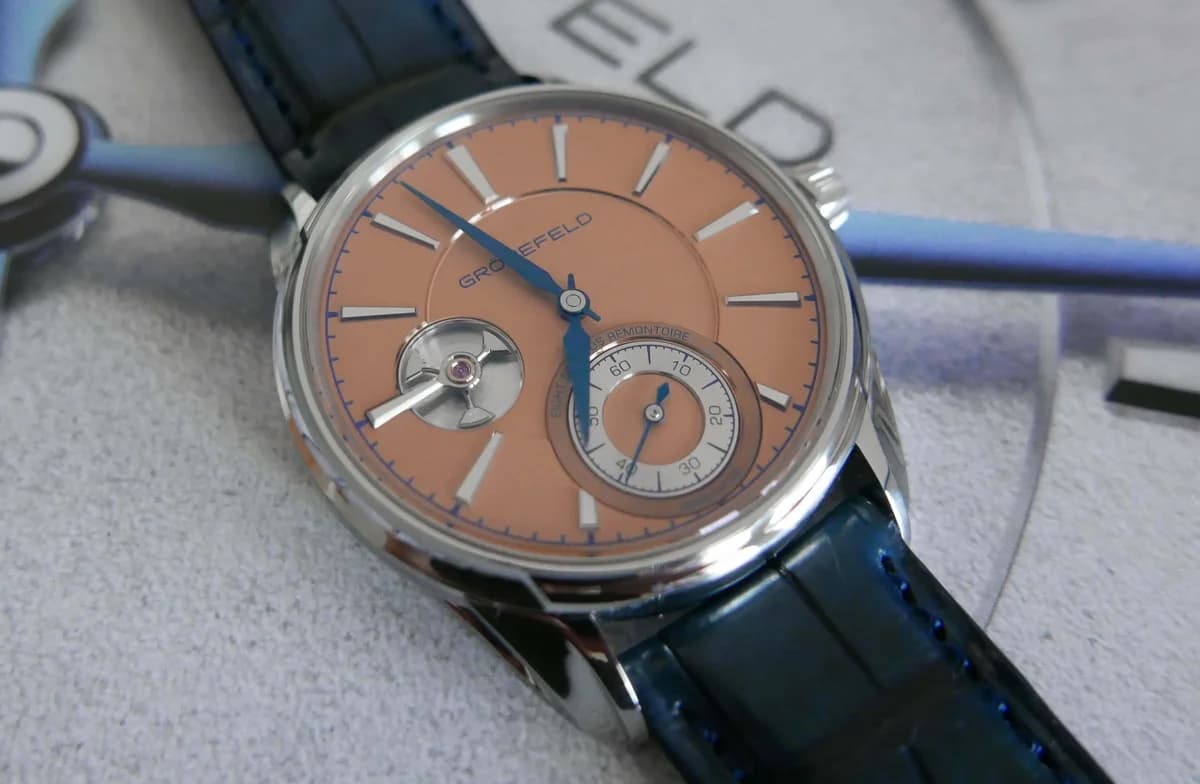
Production of the 1941 Remontoire is limited to 188 movements. That is not 188 per year. That is 188 total, across all dial variants, all case materials, for the entire production run. Gronefeld as a workshop produces approximately 70 to 80 watches per year across all models. That volume puts them among the smallest serious independents in the world. For context, F. P. Journe produces roughly 900 watches per year. Philippe Dufour produces single digits. Gronefeld sits somewhere between Dufour and Journe, closer to the artisan end of the spectrum but with enough scale to maintain a small team of watchmakers in Oldenzaal. The waiting list currently stretches over two years. Demand runs at nearly double their production capacity, which is evidence of the quality and the word-of-mouth reputation among collectors who have actually seen the work up close. The 1941 Remontoire is also available in white gold and, more recently, stainless steel, each with different dial options. The red gold salmon remains the definitive combination.
The watch community loves to talk about independent watchmakers. F. P. Journe. Philippe Dufour. Kari Voutilainen. MB&F. De Bethune. All of them Swiss or based in Switzerland. The Gronefeld brothers are conspicuously absent from most of those conversations despite having two GPHG wins, a constant-force mechanism that rivals anything from the Vallee de Joux, and movement finishing that holds up against any Swiss independent at any price. Part of it is geography. The Netherlands is not Switzerland. The watch world has a deep bias toward Swiss-made, and a workshop in Oldenzaal does not trigger the same associations as one in Geneva or Le Locle. Part of it is volume. Gronefeld produces extremely few watches per year. They do not have the commercial presence of Journe or the social media visibility of MB&F. They are quiet. They simply build. And when the GPHG jury evaluates the work on its merits, without the brand mythology and the geographic bias, the Gronefeld brothers win.
On my wrist, the 39.5mm case in red gold sits comfortably at a 6.5-inch circumference. The 10.5mm thickness keeps it flat under a shirt cuff. The hand-sewn ostrich leather strap is soft and breaks in quickly. Red gold against darker skin creates a warmth that white gold and steel do not achieve, and the salmon dial amplifies that warmth in a way that feels intentional. I think about this watch with a Vitale Barberis Canonico flannel in charcoal or a Holland and Sherry tropical weight in navy, the cuff sliding back to reveal the salmon glow of the dial. It is a watch for deliberate dressing. Not casual. Not sporty. Dressed. The combination of warm metals, warm dial, and cold blue hands works across seasons and lighting conditions. In a dim restaurant, the salmon leans pink and the red gold catches candlelight. In afternoon sun, the copper comes forward and the blue hands go electric against it. The absence of lume means reading it in true darkness requires a phone light, but this is a watch built for the kinds of places where the lighting is always at least a little flattering.
That is the story of the 1941 Remontoire. Two Dutch brothers, raised on their father's church clock, trained at the best complications workshop in Switzerland, returned home, and built a wristwatch that does what the church clock did: deliver constant force. They did it in 39.5mm and 10.5mm. They did it in red gold with a salmon dial. They did it with 258 hand-finished parts in a movement whose bridge shapes echo the rooftops of Oldenzaal. And they did it from a town that nobody in watchmaking had heard of before they started winning prizes. The Swiss do not own precision. They never did. They just had a head start.
Also in Independent Masters