
F.P. Journe
Vagabondage III
Vagabondage III
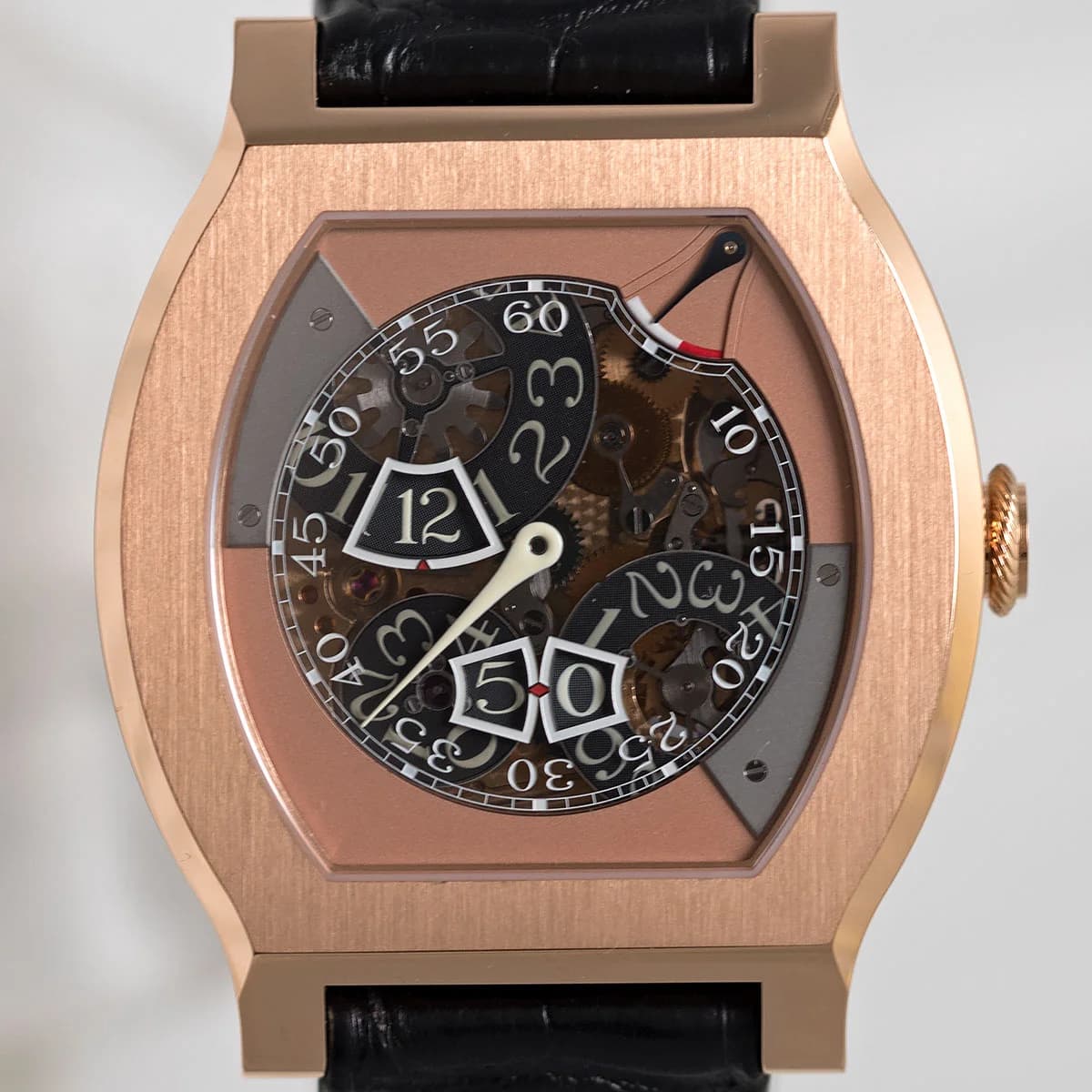
The Vagabondage series is where Francois-Paul Journe stops being polite and starts being interesting. The Souverain collection is his classical voice, the Octa is his practical one, and the Vagabondage is where he experiments. Three limited editions across three concepts, each exploring a different way to display time using jumping mechanical indications. The word itself means wandering or vagabonding in French, and that is exactly what these watches do. They wander away from everything Journe normally builds. Different case shape. Different display architecture. No signature on the dial. The Vagabondage is Journe unchained from his own conventions, and the III is where that freedom produced something that had never existed before in watchmaking.
The origin story starts in 1997, when Journe created a unique automatic watch called the Carpe Diem for a close friend. It featured a wandering jump hour display around a central exposed balance wheel, housed in a round yellow gold case. That one-off planted a seed. Six years later, Antiquorum contacted Journe about creating a piece for their 30th anniversary charity auction benefiting the ICM Foundation, which funds brain and spinal cord research. Journe did not create one piece. He created three unique Vagabondage watches, each in a different gold color (rose, yellow, and white), all with brass movements, all housed in the flat tortue case that would define the series. They sold for triple their estimates. The response convinced Journe that the concept deserved a proper production run.
The first commercial series launched in 2006. The Vagabondage I featured a jumping hour display with a wandering minutes aperture. 69 pieces in platinum, plus 10 diamond-set versions. The second series arrived in 2010. The Vagabondage II moved to digital jumping hours and minutes, displayed through rotating discs positioned at the center of the dial. Again 69 in platinum, 68 in 18K 6N gold, and 10 in platinum jewelry. Each series pushed the digital display concept further, each required a dedicated movement designed from scratch for a production run of fewer than 150 watches. Most manufacturers would not invest that kind of development capital for numbers that small. Journe is not most manufacturers.
The Vagabondage III arrived in 2017, and it accomplished something that had never been done in a wristwatch. Digital jumping seconds. Not a retrograde seconds hand jumping once per second. Not a deadbeat seconds hand that ticks. Two rotating discs at 6 o'clock that physically jump to display the current second as a two-digit number, advancing every single second through a mechanical disc change. That is 86,400 jumps per day. Each jump requires enough energy to physically rotate a disc to its next position, precisely, consistently, for as long as the mainspring has tension. The engineering challenge is enormous. Every jump places a sudden load on the power source that could disrupt the amplitude of the balance wheel and compromise timekeeping accuracy. Journe solved this the same way he solved the power delivery problem in the Tourbillon Souverain. He added a remontoire.
The Caliber 1514 is built entirely in 18K rose gold, consistent with every F. P. Journe movement since the transition from brass in 2003. It contains 249 components and 32 jewels, beats at 21,600 vibrations per hour (3 Hz), and provides a power reserve of approximately 40 hours. The movement measures 29.3mm by 28.2mm and stands just 5.88mm tall. Journe designed a dedicated caliber for a series limited to 147 pieces. That decision alone tells you something about his priorities. He could have adapted an existing movement from the Souverain or Octa collections. Instead, every bridge, every wheel, every spring in the Caliber 1514 was engineered specifically for this watch and this complication. F. P. Journe is the only manufacture to design and produce a specific caliber for a series this small.
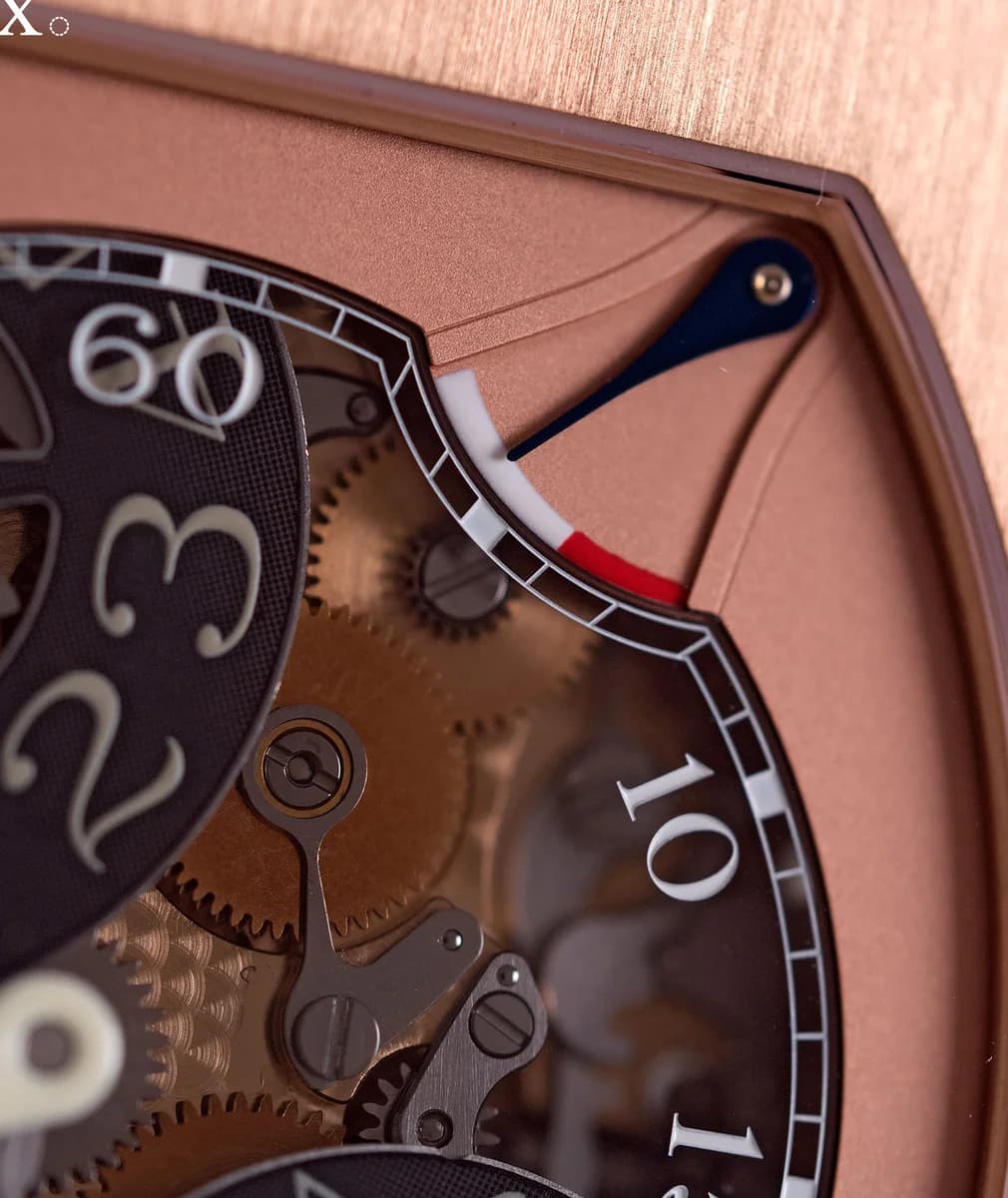
The remontoire d'egalite inside the Caliber 1514 is a patented one-second constant force device (European Patent EP 1528443). It functions like a relay station between the mainspring and the escapement. The mainspring delivers energy through the gear train, but instead of that energy reaching the escapement directly, it charges the remontoire's auxiliary blade spring. That spring stores a precisely measured amount of energy and releases it in one-second intervals. Each release simultaneously drives the escapement and provides the burst of force needed to advance the jumping seconds discs. The blade spring design (rather than a spiral spring) keeps the mechanism compact enough to fit within the 5.20mm movement height. Without the remontoire, the constant jumping of the seconds discs would place such an inconsistent load on the power source that timekeeping would be negatively affected. The remontoire isolates the escapement from those energy demands, ensuring constant amplitude in the balance wheel regardless of what the seconds discs are doing.
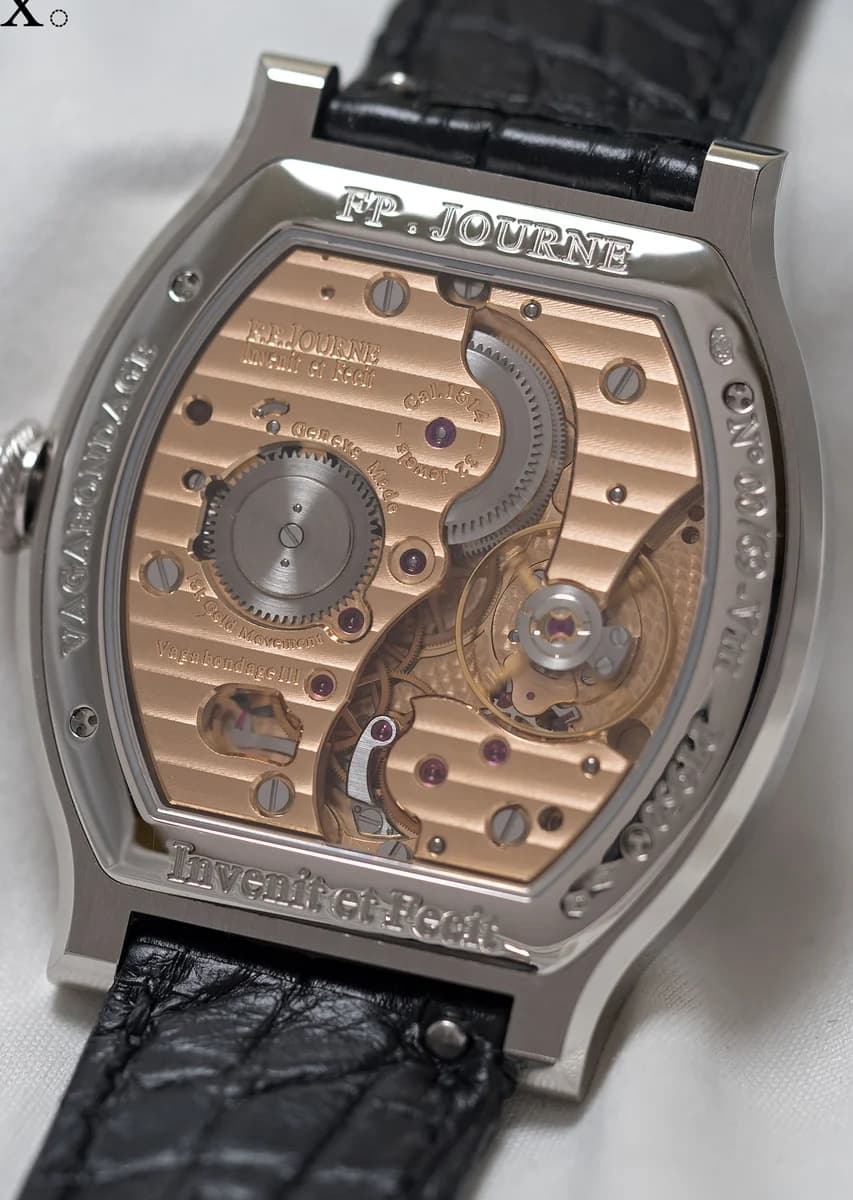
The balance wheel uses a free-sprung design with four inertia weights and a flat Anachron micro-flamed spring. Free-sprung means the rate is adjusted by moving small weights on the balance rim rather than using a regulator index, which eliminates the friction and inconsistency that comes with a traditional regulator. The Anachron spring is a proprietary F. P. Journe component, flame-treated to improve its elasticity and temperature stability. At 3 Hz, the balance oscillates at a deliberately moderate frequency. A higher frequency would consume more energy from the already-taxed power reserve, and the remontoire's one-second release cycle is designed to synchronize with this beat rate.
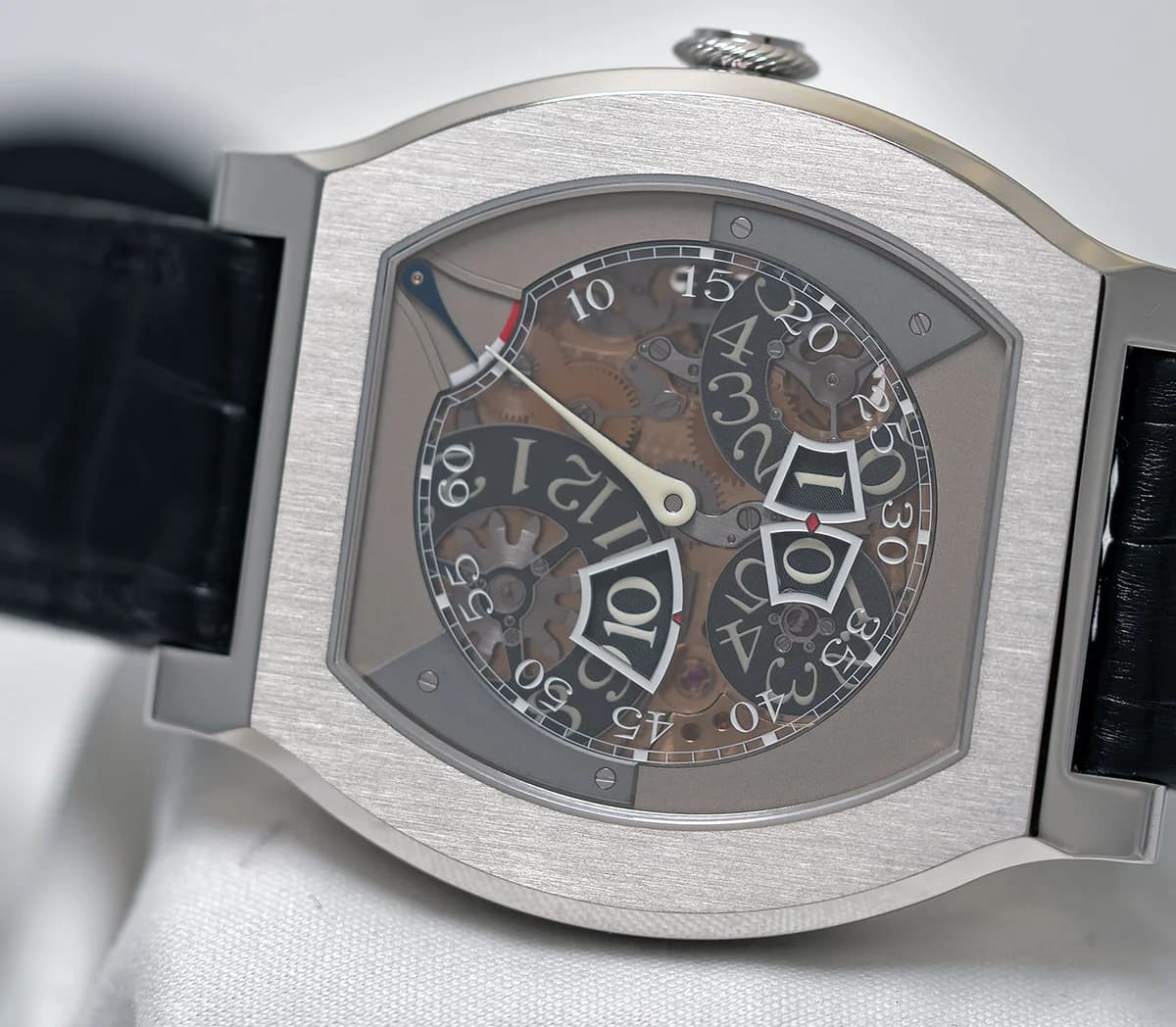
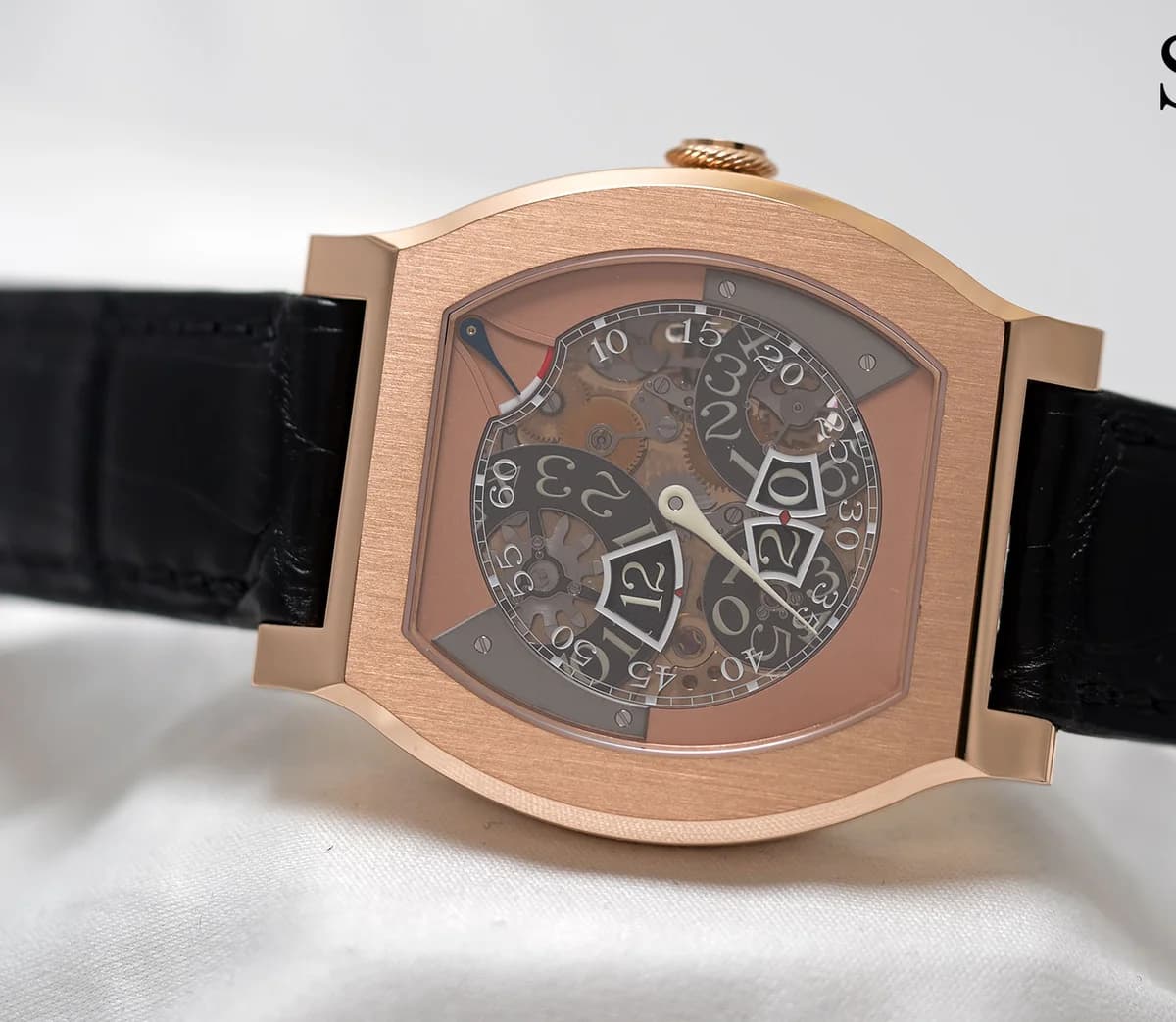
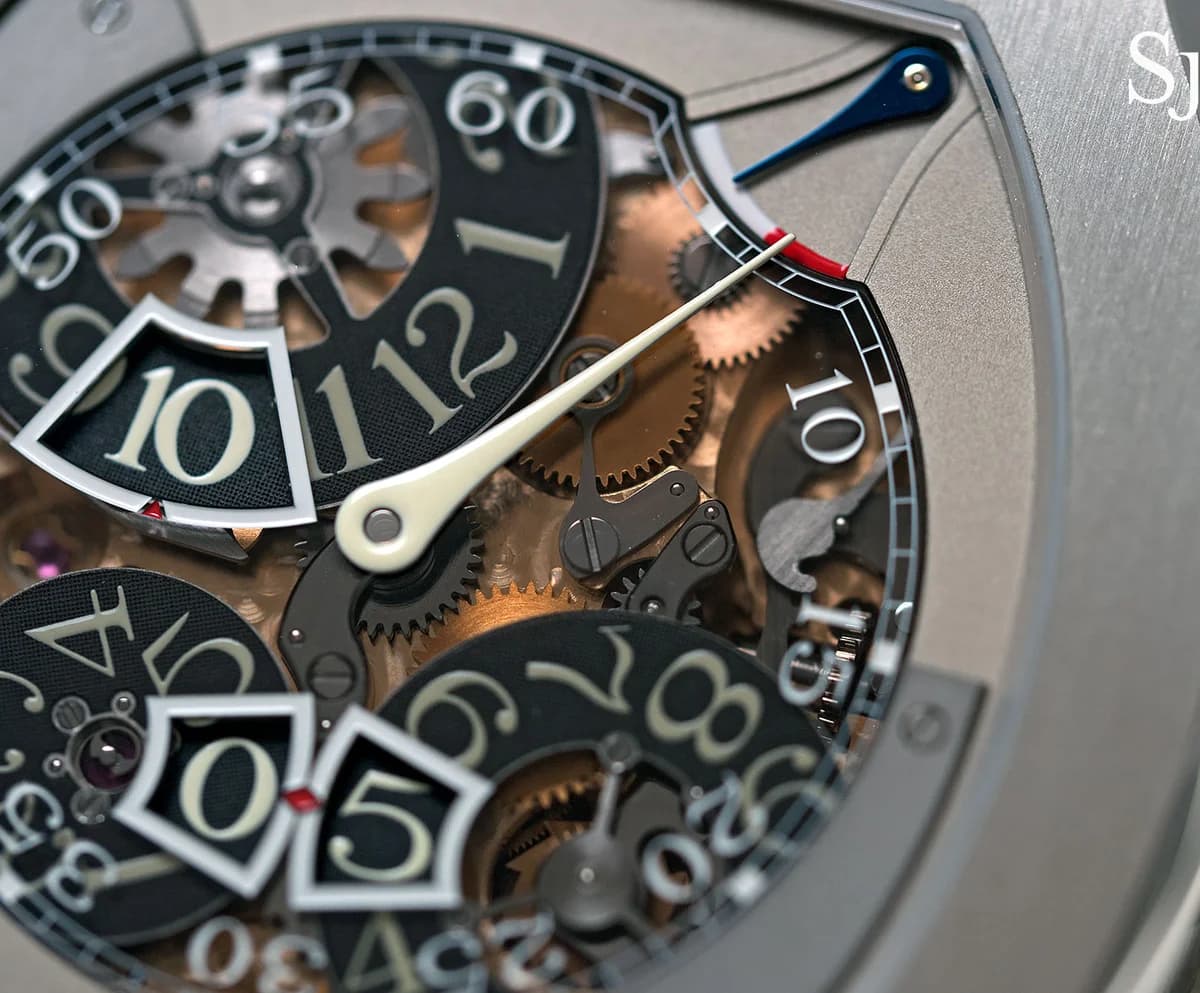
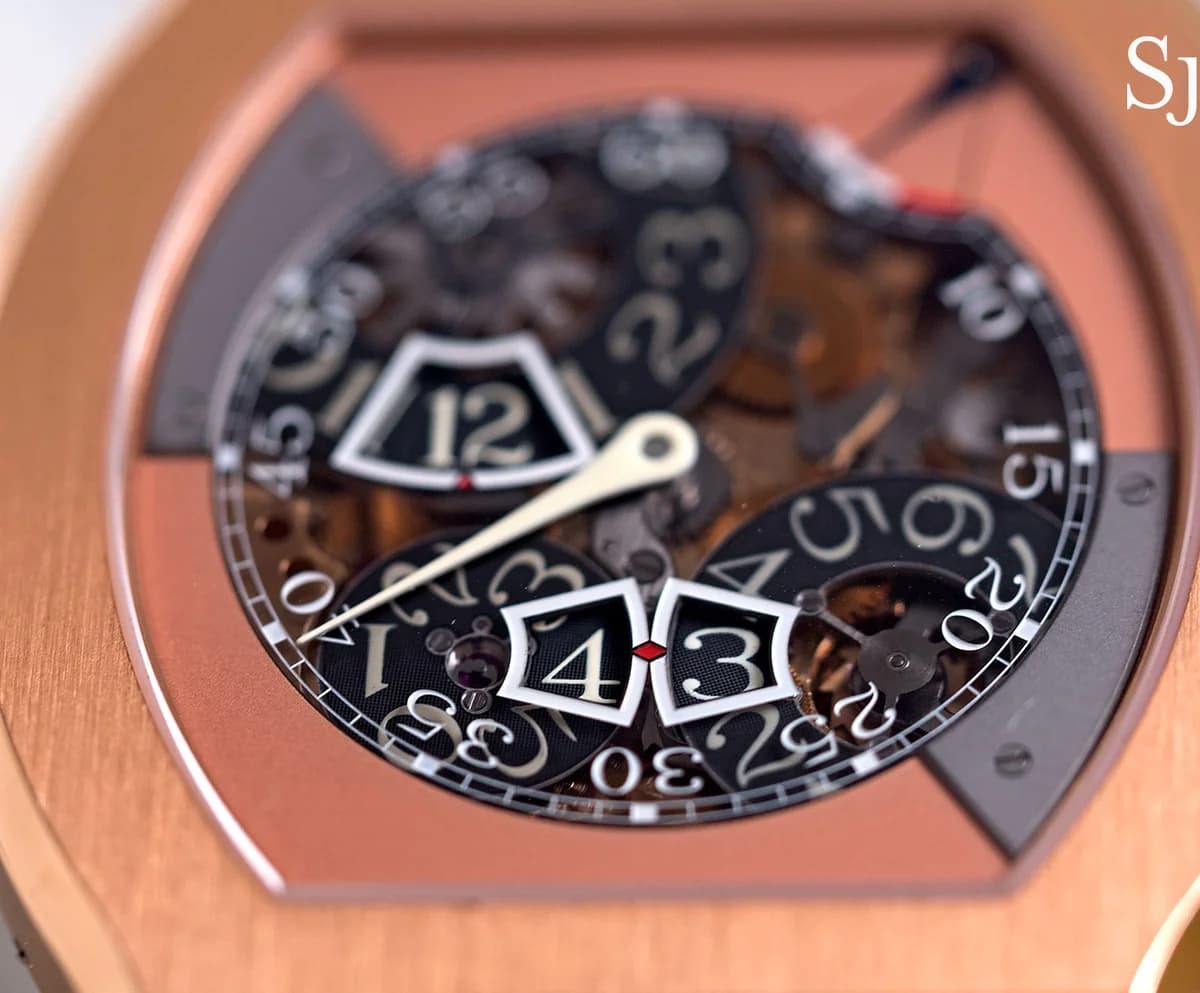
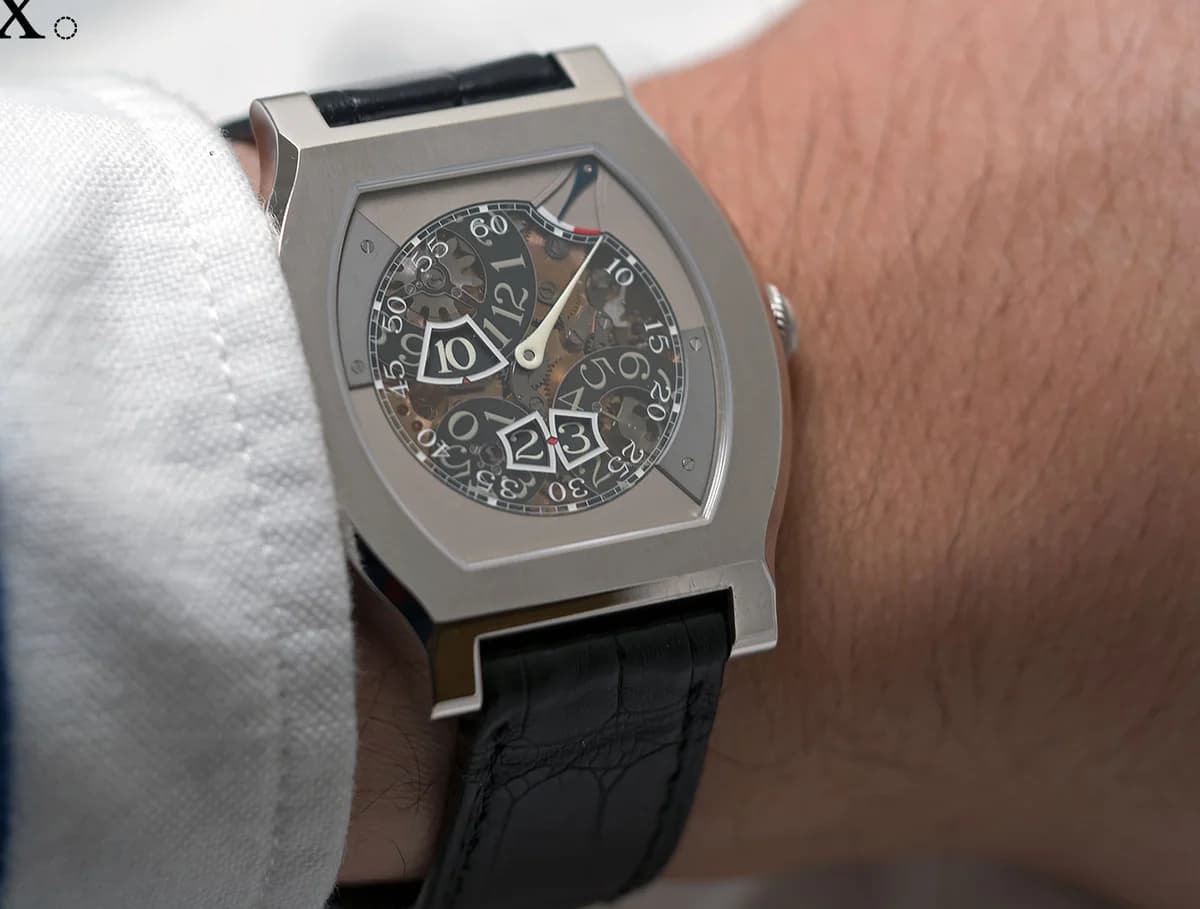
I love what happens when I look at the dial. The smoked sapphire inner disc reveals the 18K rose gold movement beneath, so the entire mechanism is partially visible from the front. The jumping hour appears in a shield-shaped window at 10 o'clock. The jumping seconds appear in two adjacent shield-shaped windows at 6 o'clock, one for the tens digit and one for the units. A central ivory-colored minute hand sweeps across a chapter ring with Arabic numerals printed at five-minute intervals. The power reserve indicator sits at 1 o'clock, a blued steel hand against a scale with a red sector warning when the reserve drops too low. The aperture frames are 18K white gold, which creates a clean visual separation between the display windows and the smoky transparency of the inner dial. The movement's rose gold bridges and Geneva stripes are visible through the sapphire, creating a layered depth that changes depending on viewing angle and light.
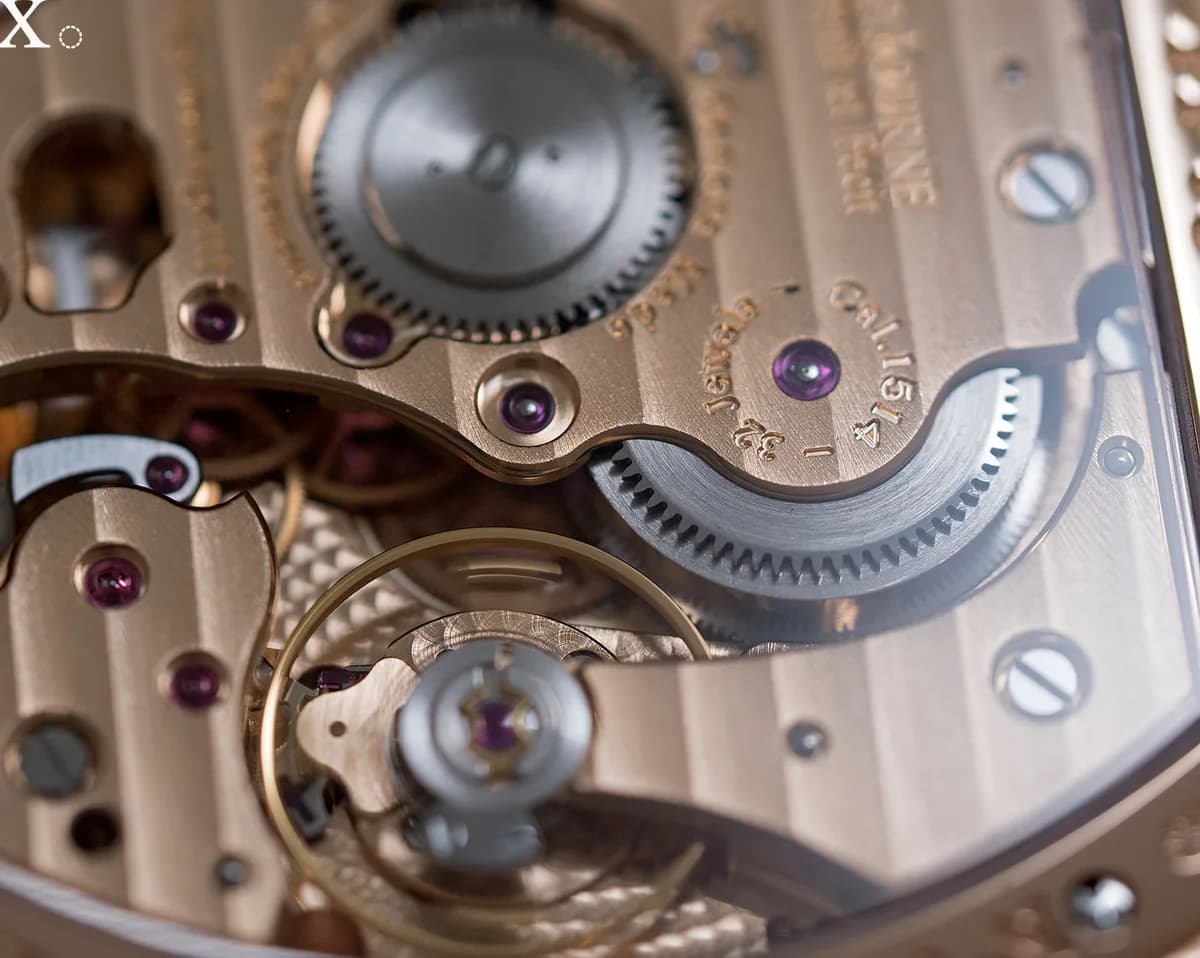
And then there is the absence. No F. P. Journe signature anywhere on the dial. This is deliberate and consistent across all three Vagabondage models. The Souverain and Octa collections carry the brand name prominently. The Vagabondage does not. It exists outside the main collection. The only place you find the F. P. Journe name is on the caseback, engraved around the sapphire exhibition window alongside Vagabondage, the serial number, and Invenit et Fecit. That Latin phrase, he invented and he made it, appears on every F. P. Journe movement. On the Vagabondage III it feels particularly appropriate because there is genuinely nothing else like this in watchmaking.
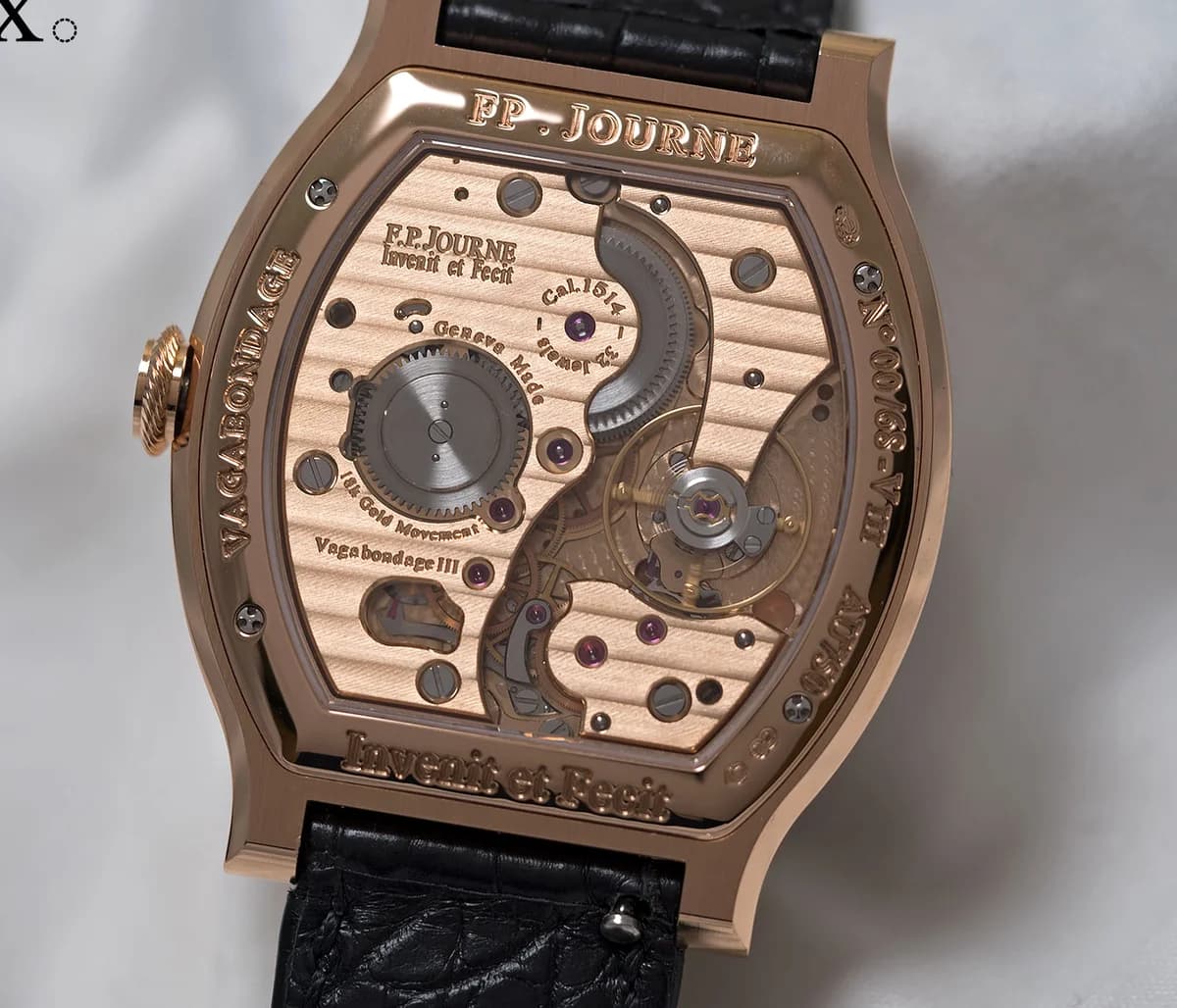
The flat tortue case measures 45.2mm by 37.6mm and stands just 7.84mm thick. The tortue (French for tortoise) shape is an elongated cushion with curved sides, borrowed from early 20th-century pocket watch case designs. It is wider than it is tall, which distributes the visual mass horizontally across the wrist rather than vertically. Despite the 45.2mm dimension, the curved sides and relatively narrow 37.6mm width mean it wears much smaller than those numbers suggest. On my wrist, the tortue shape follows the wrist contour rather than sitting on top of it like a round case would. The 7.84mm thickness is remarkable for a watch containing a remontoire, two jumping disc mechanisms, and a complete time display. For comparison, the Tourbillon Souverain Reference TN, which houses a simpler complication set (tourbillon plus remontoire), is 9.9mm thick. Journe managed to fit more mechanical complexity into less vertical space.
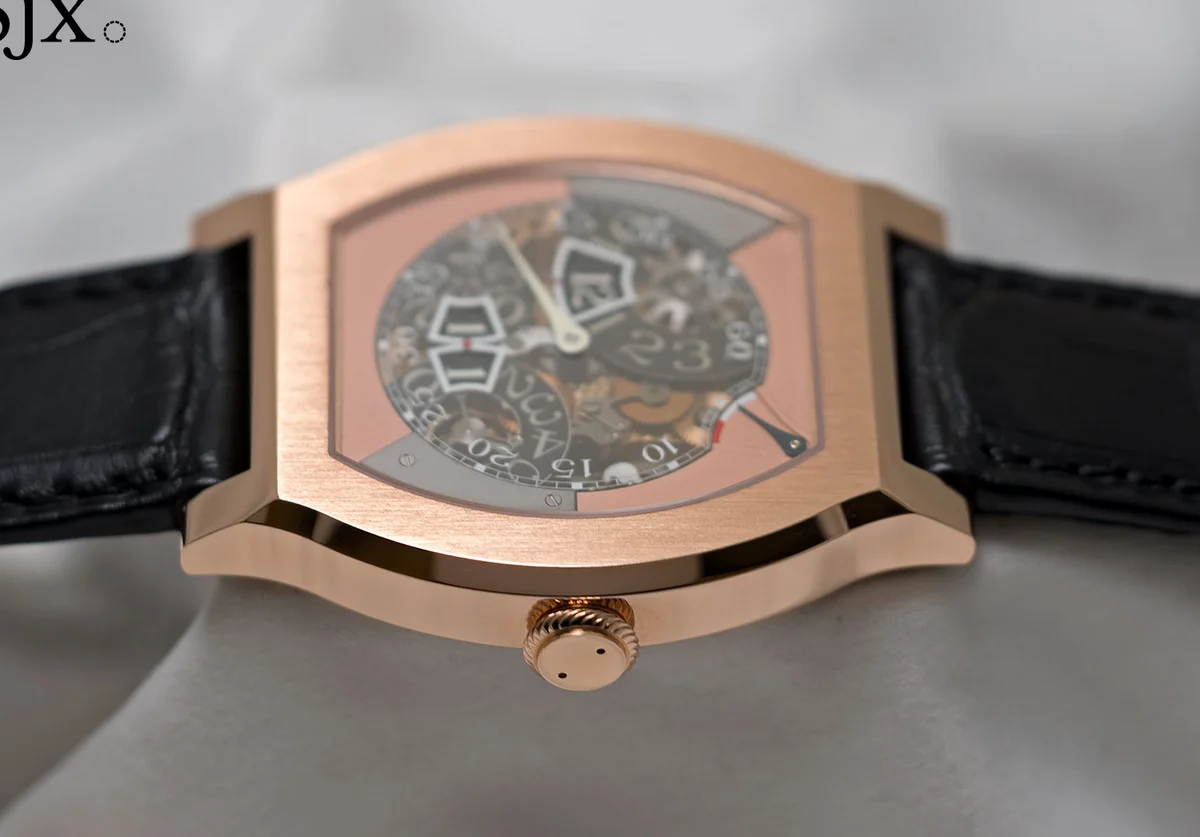
The case was available in platinum PT 950 or 18K 6N gold, plus 10 pieces in a diamond-set platinum jewelry version. 69 platinum pieces were produced, numbered 1 through 69. 68 gold pieces were produced, numbered 1 through 68. The total production across both primary metals is 137 pieces, or 147 including the jewelry versions. Production ran from 2016 to 2019. Each piece came on a black alligator strap with a folding clasp in matching metal.
Through the sapphire caseback, the Caliber 1514 reveals itself in full. The rose gold bridges are decorated with Cotes de Geneve (Geneva stripes) and the main plate carries the engravings F. P. Journe, Invenit et Fecit, Cal. 1514, 32 Jewels, Geneva Made, 18K Gold Movement, and Vagabondage III. The S-shaped bridge architecture is distinctly Journe. The balance wheel is visible in the lower right, the barrel in the upper left, and the gear train follows the curved bridge contours between them. The finishing on Journe movements is excellent but not ostentatious. It is precise and clean rather than decorated for decoration's sake. The bevels are sharp, the stripes are even, the jewel settings are correctly countersunk. It is the kind of finishing that communicates competence rather than spectacle.
I notice something particular about how the jumping seconds behave in person that specifications cannot convey. Each jump is precise and instant, but the visual effect of watching two discs rotate simultaneously every single second creates a rhythm that is fundamentally different from anything else in mechanical watchmaking. A sweeping seconds hand flows. A deadbeat seconds hand ticks. The Vagabondage III's digital display clicks. It is mechanical, percussive, almost binary in its on-off transition. The disc showing the current second sits still for exactly one second, then both discs rotate simultaneously to reveal the next number. Through the smoked sapphire dial, the gear mechanisms driving those discs are partially visible, so the motion has depth. The discs move on the surface while the rose gold wheels turn beneath them.
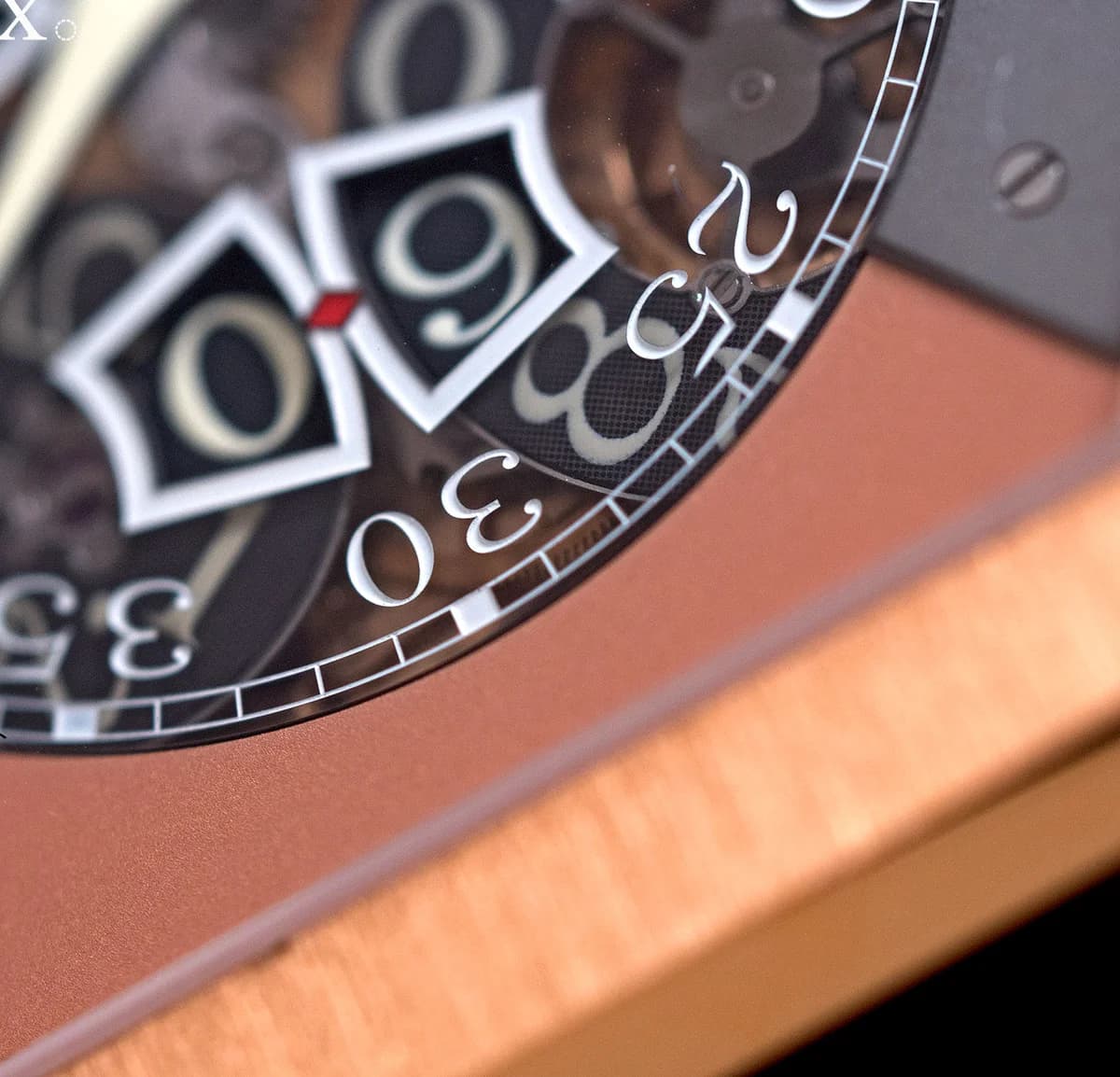
If I have one honest observation about the Vagabondage III, it concerns legibility. The smoked sapphire dial creates a beautiful layered effect, but it also means the jumping hour and seconds displays share visual space with the printed minute numerals on the chapter ring and the partially visible movement components beneath the sapphire. Reading the time requires a moment of orientation rather than an instant glance. The hour window at 10 o'clock and the seconds windows at 6 o'clock are framed in white gold to distinguish them, but the minute hand sits on the same visual plane as the disc numerals, and the disc numerals that are not currently in the active window are still partially visible as they rotate behind the sapphire. It is a sea of numbers and movement. I find myself reading the seconds first (because the two shield windows at 6 o'clock are the most visually prominent element), then looking for the hour, then finding the minute hand. That sequence, seconds then hours then minutes, is the opposite of how every other watch is read. It is not a flaw exactly. It is a consequence of the architecture. The jumping seconds are the point of the watch, so they dominate the visual hierarchy. But anyone expecting to glance at the Vagabondage III and instantly know the time the way they would with a Chronometre Bleu will need to recalibrate their expectations.
The 30-hour power reserve is the other practical consideration. It means daily winding, without exception. Miss a morning and the watch stops. The Tourbillon Souverain's 42-hour reserve at least gives a buffer. The Vagabondage III does not. The remontoire mechanism and the energy demands of jumping two discs 86,400 times per day consume mainspring tension faster than a conventional time-only movement. Journe addressed this with a dual-spring barrel, but even with two springs the reserve remains modest. The power reserve indicator with its red warning sector becomes a functional necessity rather than a decorative element. I appreciate the honesty of that design. Journe could have hidden the power reserve and let the owner discover the short reserve through a stopped watch. Instead, the red sector says clearly when it is time to wind. That is good product design.
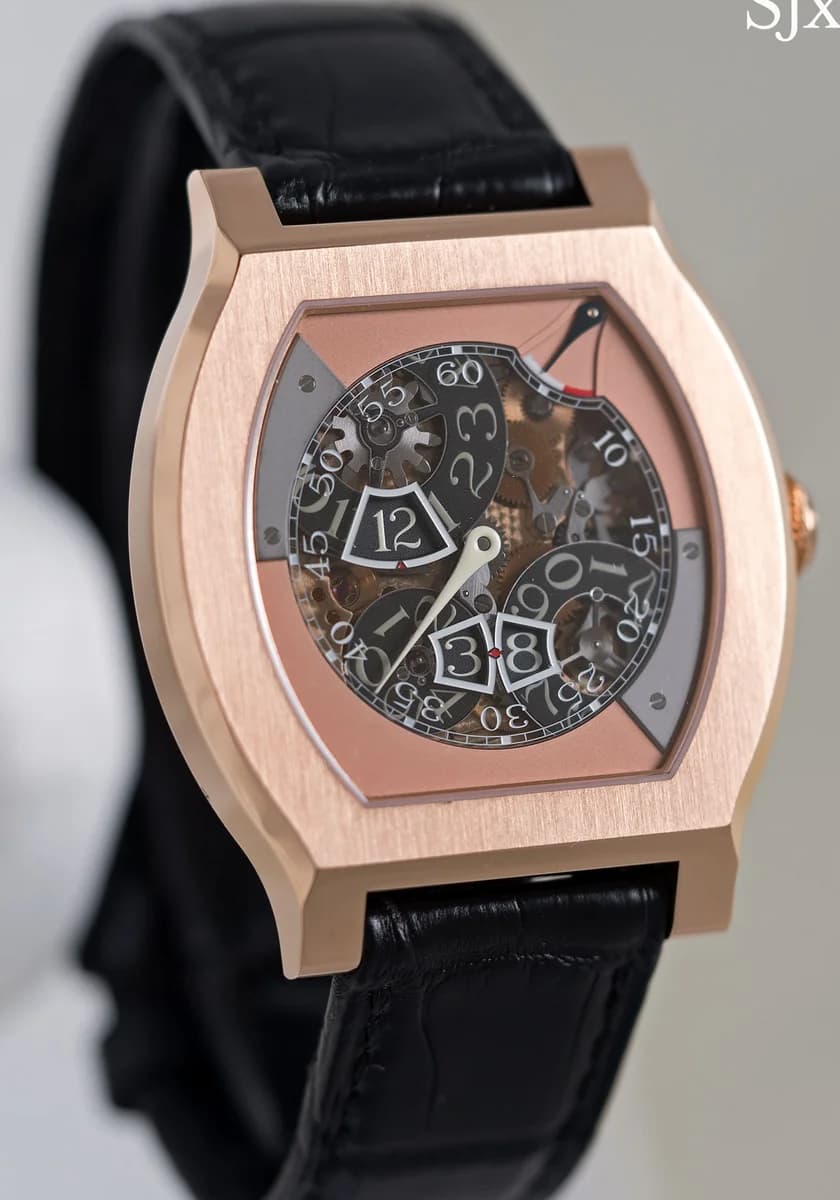
On the wrist, the Vagabondage III in platinum has a cool, matte presence. The brushed case surfaces absorb light rather than reflecting it, which gives the watch a quiet confidence that contradicts its mechanical complexity. The gold version is warmer, and I find the rose gold case paired with the rose gold movement visible through the smoked sapphire creates a tonal continuity that the platinum version does not have. In platinum, the case is silver-gray and the movement beneath the sapphire is rose gold, creating a deliberate contrast. In 6N gold, the case and movement are the same material, and the watch reads as a single unified object. Both are beautiful. They are just different conversations about the same idea.
I appreciate that the tortue case sits so flat despite its width. At 7.84mm, the Vagabondage III slides under the cuff of a Loro Piana cashmere sport coat without catching. The flat profile and the curved case sides work together to keep the watch close to the wrist. It does not ride high. It does not tilt. The proportions are excellent for what is essentially an oversized complication watch. Journe understood that the Vagabondage's unconventional display needed a case shape that was equally unconventional but still wearable. A round 45mm case at 7.84mm would feel enormous. The tortue shape distributes that dimension differently, and the result is a watch that feels smaller than it measures.
The Vagabondage III exists in the same conceptual space as the A. Lange and Sohne Zeitwerk. Both use jumping digital displays. Both required dedicated movements designed specifically for the energy demands of instantaneous disc changes. But the approaches are different. The Zeitwerk uses a constant-force mechanism to drive jumping hours and minutes, with a conventional small seconds. The Vagabondage III uses its remontoire to drive jumping seconds, with the hours also displayed digitally but the minutes shown on a conventional hand. The Zeitwerk reads like a digital clock implemented mechanically. The Vagabondage III reads like a watchmaker exploring what seconds mean when they are made tangible and visible. Every single second becomes an event, a physical click, rather than an abstract sweep.
Journe builds the Vagabondage III in his Geneva manufacture on Rue de l'Arquebuse, the same facility in the Coulouvreniere neighborhood where the Tourbillon Souverain, the Resonance, and every other F. P. Journe reference is produced. Total annual production across all references is approximately 800 to 900 watches. The Vagabondage III's 147 pieces (including jewelry versions) were produced across three years, meaning roughly 50 pieces per year were integrated into that production schedule alongside the Souverain, Octa, and Linesport collections. That is a tiny fraction of an already tiny output. He also owns his own casemaker (Les Boitiers de Geneve) and his own dialmaker (Les Cadraniers de Geneve), both in Meyrin. The tortue cases, the smoked sapphire dials, the movement components, all of it comes from facilities that Journe controls. That vertical integration at this scale is rare even among independent watchmakers.
The Vagabondage is the watch that separates the people who buy Journe from the people who collect Journe. The Souverain is what draws you in when you discover the brand. The Resonance is what earns your respect when you understand the physics. The Vagabondage is what captures you when you understand the man. These watches represent Journe at his most intellectually free, designing movements that will only ever exist in quantities measured in dozens, solving problems that nobody asked him to solve, and doing it all in 18K rose gold because he believes that is the only material worthy of the work. The fact that 249 components and 32 jewels are assembled into a dedicated caliber for 147 watches, that a blade spring remontoire was patented and implemented to make jumping digital seconds possible at wristwatch scale, that the entire enterprise was funded and executed by a single independent manufacture in central Geneva, tells you everything about what F. P. Journe values. The Vagabondage III is not a product decision. It is a statement about what a watchmaker with complete creative freedom chooses to do when nobody is telling him what to build.
Also in Independent Masters