
F.P. Journe
Elegante
ELEGANTE-48-TI-BLK
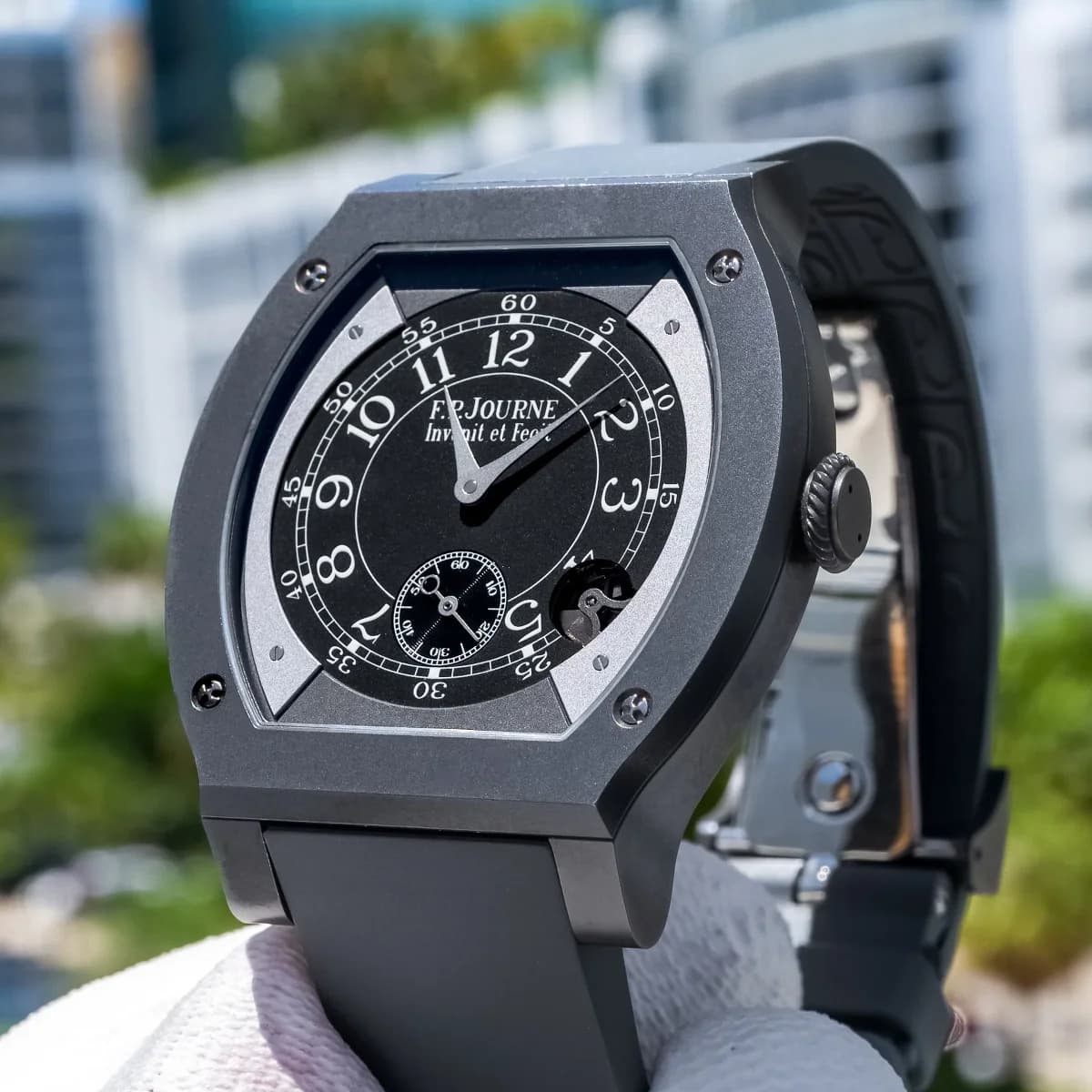
Francois-Paul Journe is widely considered the greatest living independent watchmaker. He built his first tourbillon from scratch at 25. Every movement in his collection has been crafted in 18K rose gold since 2004, a distinction no other brand in the world shares. He produces fewer than 900 watches per year. His Chronometre a Resonance is considered one of the most ingenious wristwatches ever made. His work sits in museum collections and in the hands of collectors who understand what Invenit et Fecit means. And then he made a quartz watch. Not because he had to. Because he wanted to prove that quartz could be done with the same intellectual rigor and artisanal quality as everything else he builds. It took him eight years.
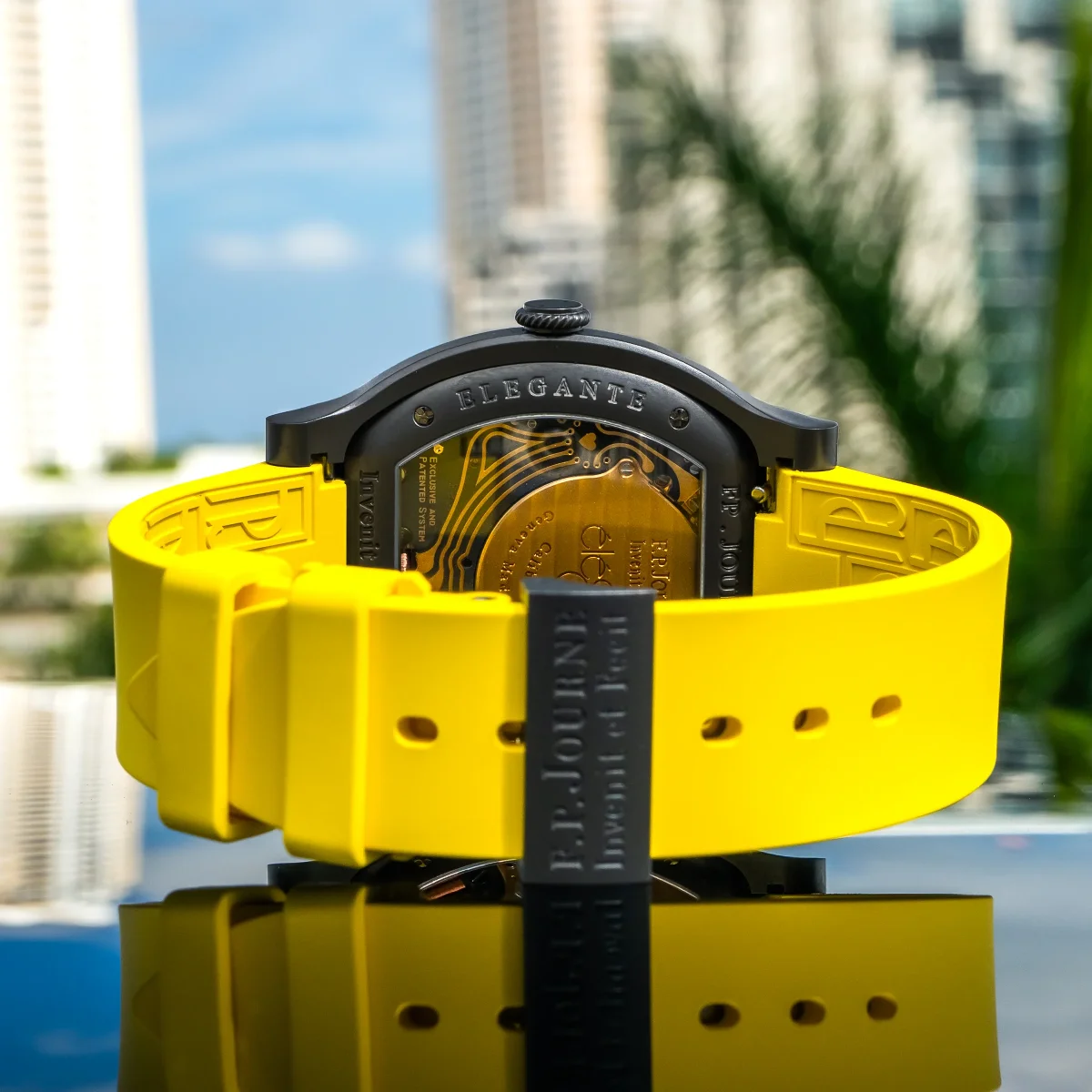
The Elegante was born from a specific frustration. Collectors and their wives kept asking Journe why he made beautiful watches for men but nothing for women. His answer was not to make a smaller mechanical watch with diamonds on the bezel. His answer was to rethink quartz from the ground up. He spent eight years developing the Calibre 1210 with microelectronic engineers. The result is a movement with 132 components, 18 jewels, a patented twin-rotor motor system, and zero lubricated parts. Zero. The entire movement is virtually maintenance-free until the battery dies, which takes 8 to 10 years of daily use. If you take the watch off and leave it in a drawer, a mechanical motion detector at 4:30 on the dial senses the lack of movement. After 35 minutes of stillness, the watch goes to sleep. The hands stop. But the microprocessor keeps tracking time. When you pick it up, the oscillating weight swings, the watch wakes, and the hands travel to the correct time by the shortest route, clockwise or counterclockwise, whichever is faster. In sleep mode, the battery lasts up to 18 years. That is not a quartz watch. That is an intelligence. And that is the Journe mindset in one product. He does not build watches to fill a catalog. He solves problems. The Chronometre Souverain solved the problem of dead-beat seconds in a wristwatch. The Resonance solved the problem of chronometric stability through sympathetic oscillation. The Elegante solved the problem that nobody in luxury watchmaking would touch: making a quartz watch that deserves to exist. Eight years of development for a watch that most mechanical purists would have dismissed on principle. The fact that they did not dismiss it, the fact that collectors who own Resonances and Tourbillon Souverains also bought Elegantes, tells you everything about how Journe thinks. He does not care what a watch is supposed to be. He cares what it can be.
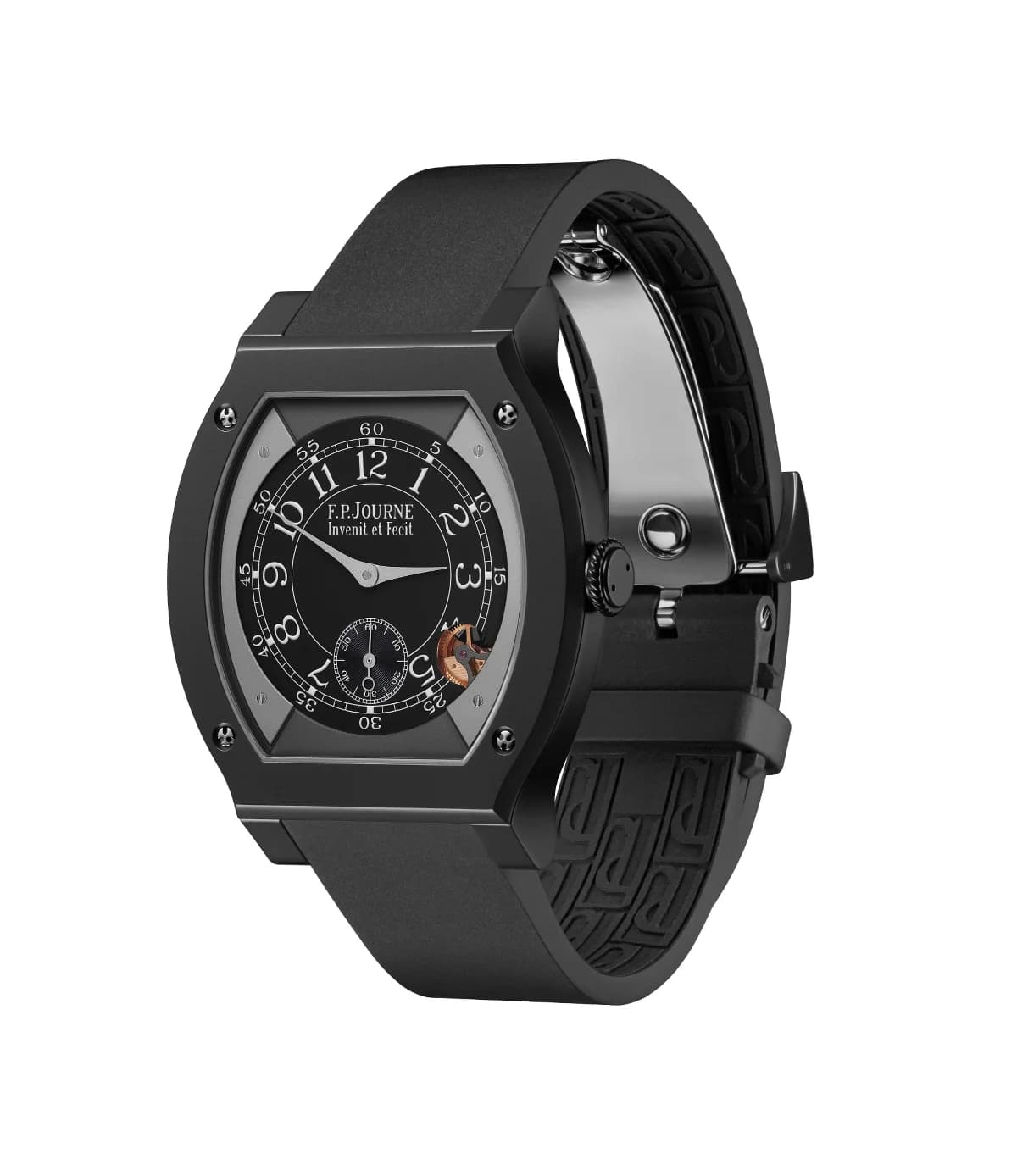
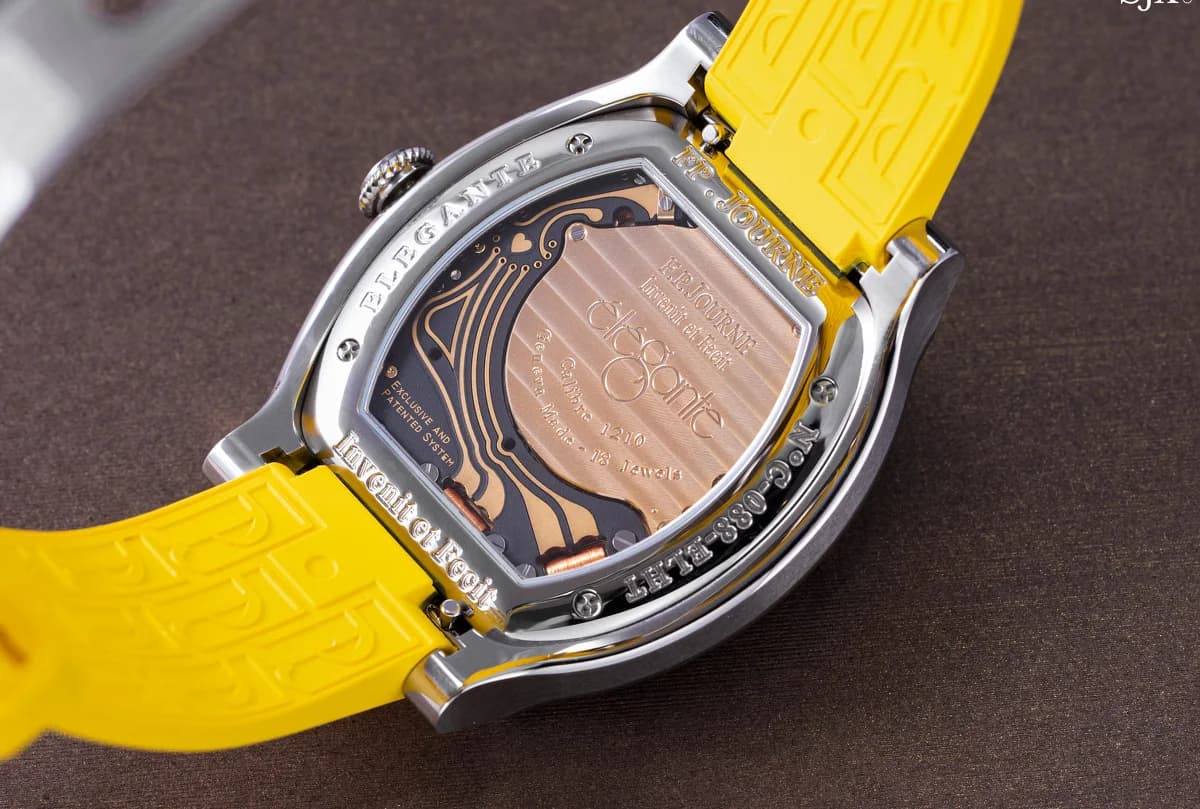
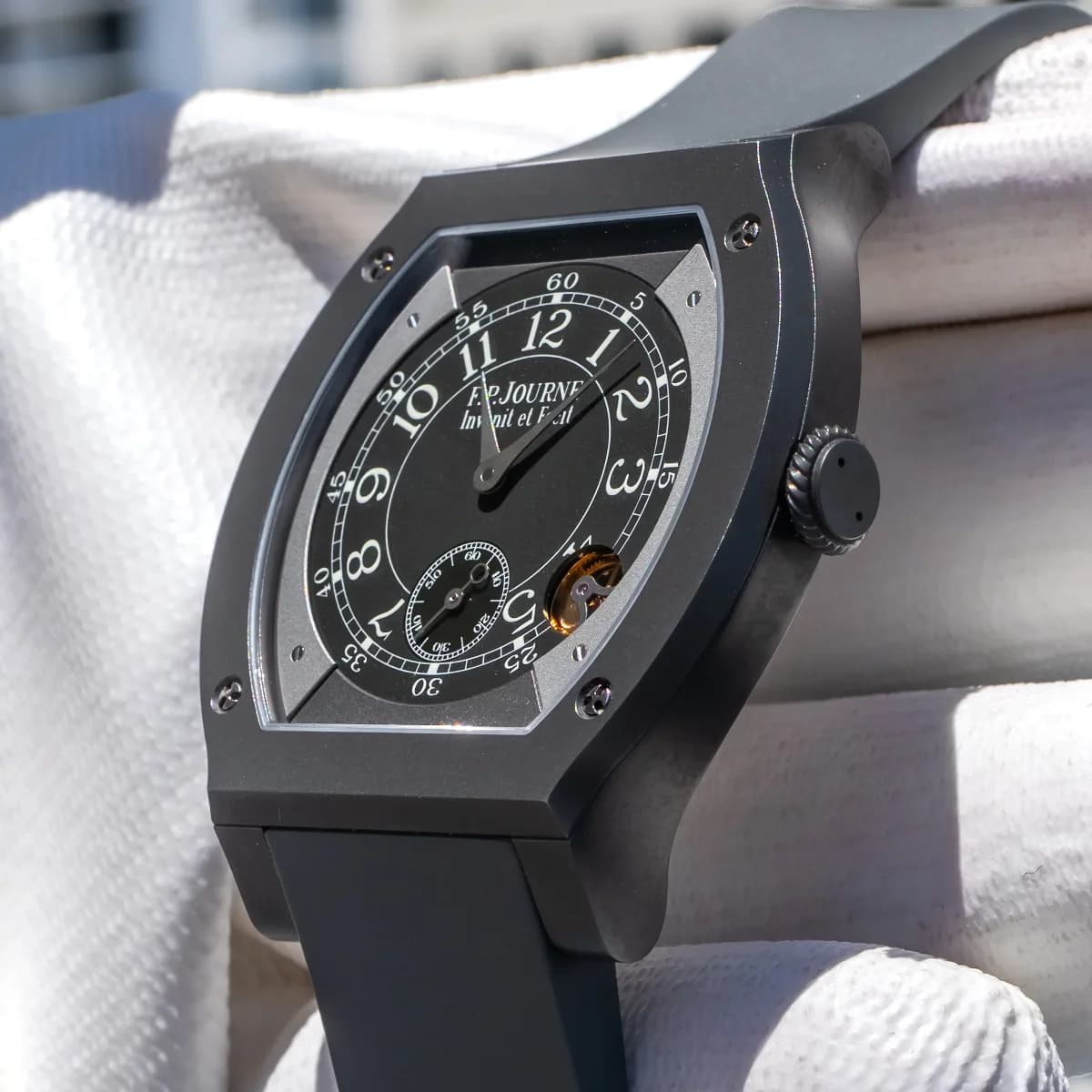
The 48mm version launched in 2016 after the original 40mm ladies' model debuted in 2014. The case is a flat tortue shape, 48 by 40mm and only 7.95mm thick. In titanium, it weighs almost nothing for its size. The Titalyt variant uses electro-plasma oxidation to harden the titanium and give it a darker anthracite tone. The black luminescent dial glows in the dark because the entire surface is treated with Super-LumiNova, not just the indices and hands. The screwed steel elements on the outer dial add industrial texture to what is otherwise a remarkably clean design. Through the sapphire caseback, you see the Calibre 1210 with its rose gold-plated bridge and solid rose gold tracks on the circuit board. Journe gave a quartz watch a display caseback because he built something worth looking at. That alone tells you everything about his approach. The movement itself sits just 3.13mm tall inside the case, which is why the overall height stays under 8mm despite the sapphire caseback. The 40mm version for women measures 40 by 35mm and stands just 7.35mm thick, making it one of the thinnest quartz movements available in any luxury watch.
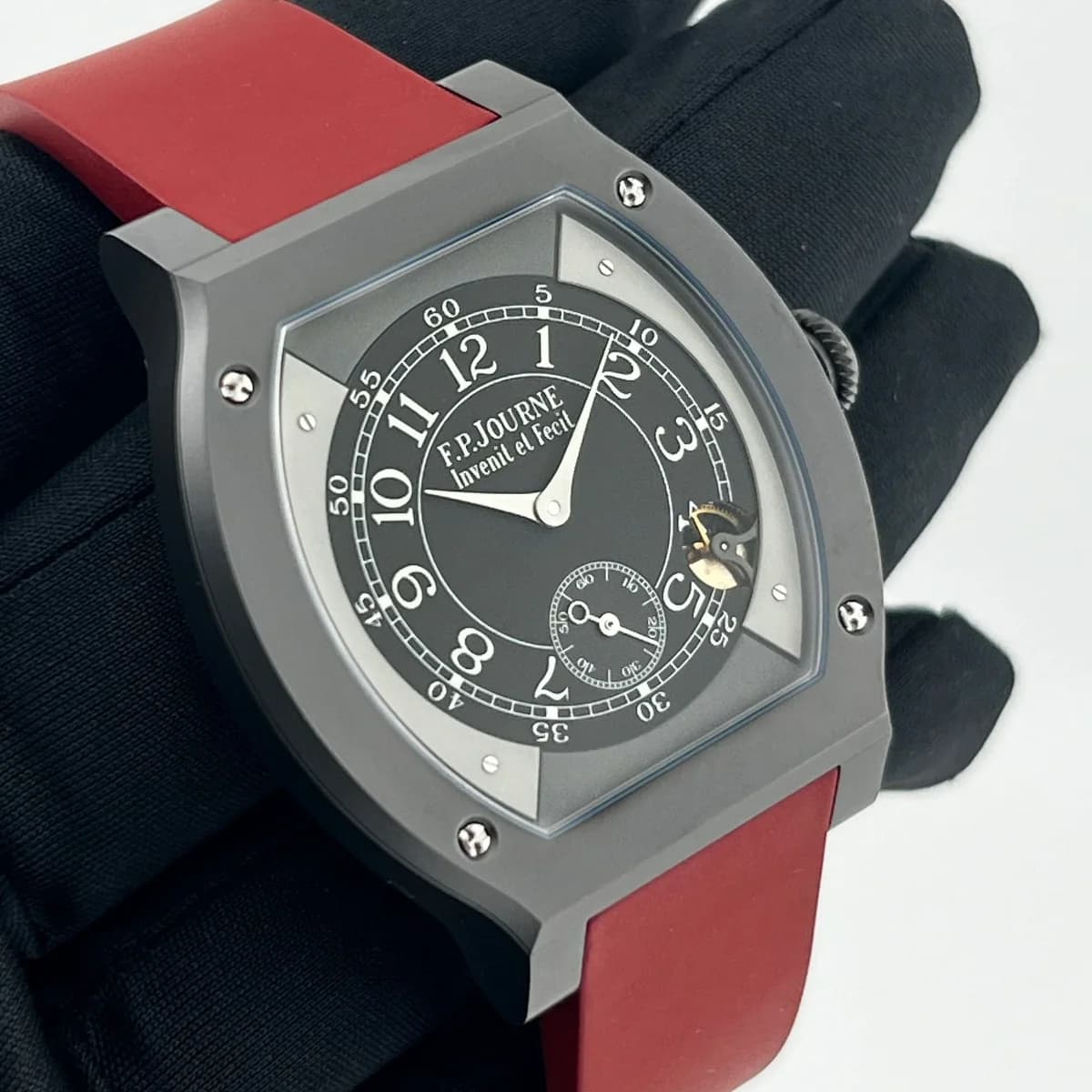
F. P. Journe calls it electromechanical, not quartz. He is technically correct. The timekeeping regulation uses a quartz crystal oscillating at 32,768 Hz, which is standard. But the mechanical motion detection, the dual-motor architecture with separate motors for seconds and hours, the sleep-wake intelligence, and the artisanal finishing of the movement are all Journe's own design. The complete movement architecture was developed in-house. An external Swiss company provides the timekeeping module and motors. Every mechanical component is manufactured at Journe's facility in Geneva. He did not put a Miyota quartz module in a titanium case and call it luxury. He built a new kind of movement that happens to use a quartz crystal for regulation.
The watch collector community was initially skeptical. A forum thread on WatchUSeek was literally titled "Is it High-End? Is it a serious watch?" Some collectors questioned whether a quartz watch belonged in the Journe collection at all. Over time, the engineering depth won people over. The eight-year development cycle. The zero-lubrication architecture. The fact that Journe applied the same standard of finishing to a quartz movement that he applies to his rose gold tourbillons. The skeptics came around because the work was undeniable. I remember reading those early forum threads and thinking the critics were missing the point entirely. This was never about quartz versus mechanical. This was about whether intellectual rigor has a boundary, and Journe's answer was no. What made the skepticism interesting is that it forced Journe to defend his work with the work itself. He did not do interviews dismissing the critics. He let the movement speak. And the movement, with its rose gold finishing and visible mechanical motion detector, spoke clearly.
What I appreciate about the Elegante is where it sits within the broader F. P. Journe collection. The Souverain line is his classical voice, built around traditional complications executed at the highest level. The Chronometre Souverain solves dead-beat seconds. The Tourbillon Souverain uses a remontoire for constant force to the escapement. The Resonance achieves chronometric stability through sympathetic oscillation between two independent gear trains. The Octa line is his daily-wear engineering, with automatic movements and integrated calendars and power reserves. The Vagabondage series is his experimental side, jumping digital displays in limited runs of platinum and gold. The Elegante is none of those things and all of them at once. It carries the same intellectual ambition as the Resonance, the same obsessive finishing as the Tourbillon Souverain, and the same willingness to ignore convention as the Vagabondage. Journe runs his entire operation out of Geneva, where he owns not just the movement manufacture but also Les Boitiers de Geneve for cases and Les Cadraniers de Geneve for dials, both located in Meyrin. The ceramic glass stones on the Gino's Dream bezel are produced at Boitiers de Geneve, his own casemaking facility. That level of vertical integration in a house producing fewer than 900 watches annually is something I find remarkable. For context, Patek Philippe produces around 70,000 watches per year. Rolex produces over a million. Journe makes fewer than 900 across his entire range, which includes the Souverain, Octa, Linesport, and Elegante collections. The rarity is not manufactured scarcity. It is the natural constraint of a workshop where everything from the bridges to the case to the dial is made under one roof. Walking through the old town in Geneva, the watchmaking heritage is embedded in the architecture itself, and Journe's manufacture on Rue de l'Arquebuse sits right in that history. The Elegante is made in the same building as the Resonance and the Tourbillon Souverain, by the same hands, to the same standard. Every component, from the circuit board tracks in rose gold to the Titalyt surface treatment, reflects a workshop where one person controls everything from concept to finished product.
And then there is Gino's Dream. Serge Cukrowicz, who went by Gino, was born in 1959 to a diamond dealer family. He co-founded Ginotti Jewelers in 1987 and worked with some of the leading names in independent watchmaking, including Gerald Genta, Franck Muller, and Daniel Roth. It was Daniel Roth who introduced Gino to Francois-Paul Journe at Basel Fair in the early 1990s. Journe was wearing his first tourbillon during that meeting, and Gino recognized immediately what he was looking at. In 1999, Gino became the first outside partner in what would become Montres Journe SA, with Philippe Rabin joining as the third. He traveled the world with Journe building the brand, opening boutiques from Tokyo to New York. He was known for flamboyant style, bright-colored outfits, diamond earrings, and he always wore his Elegante on a yellow rubber strap. For those who met him, Gino was impossible to forget. He had the energy of someone who genuinely loved every minute of what he did, and he channeled that energy into building F. P. Journe's presence across Asia and the Americas. Gino passed away on May 6, 2021, in Singapore.
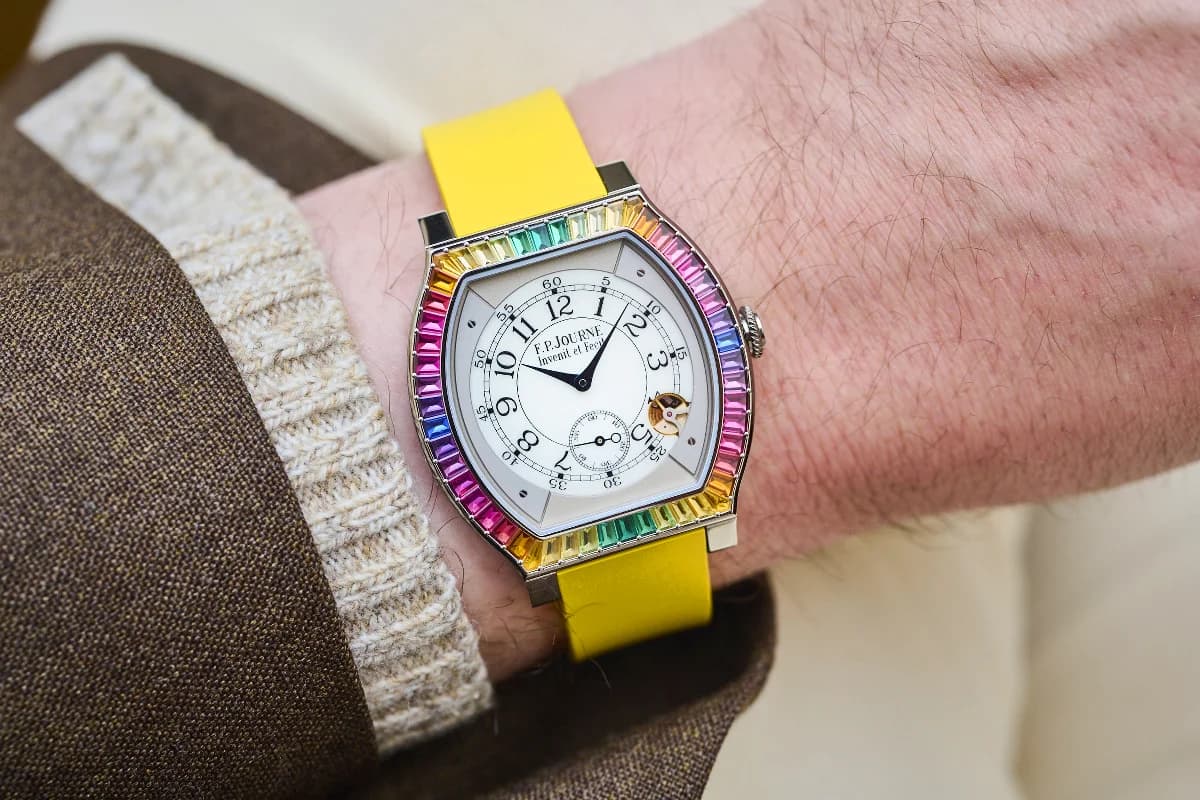
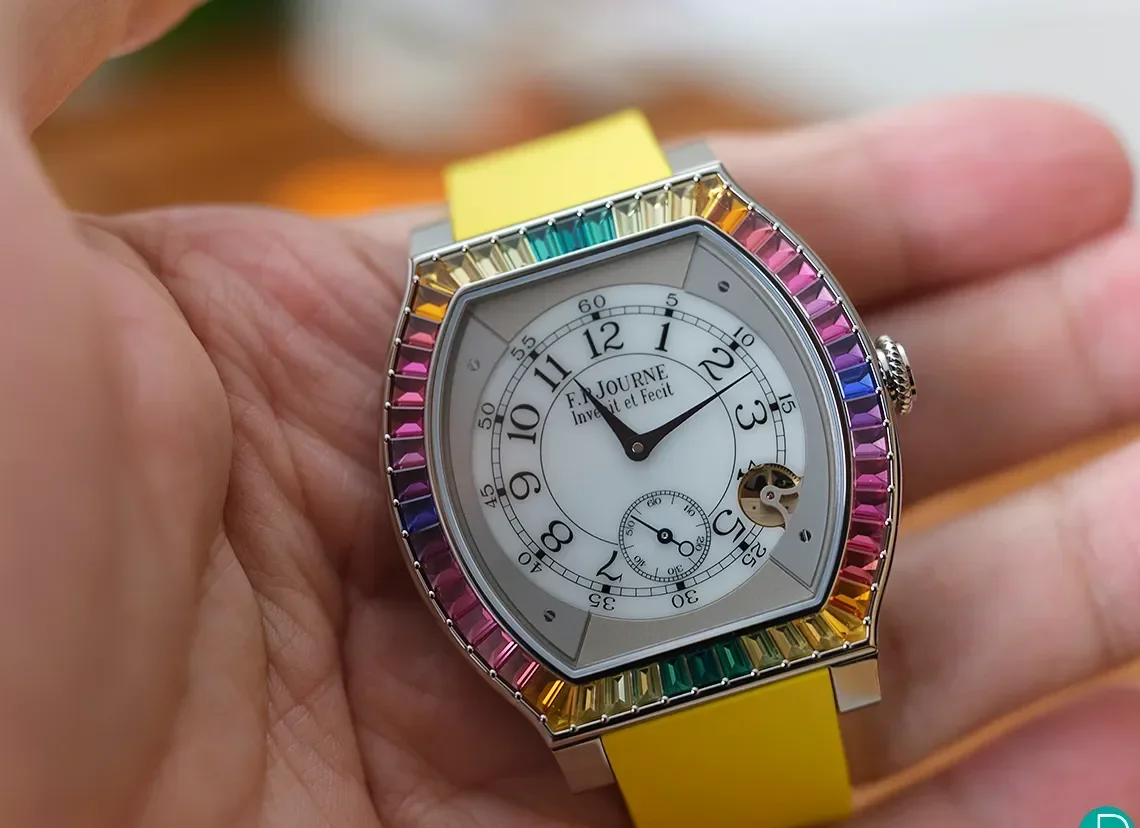
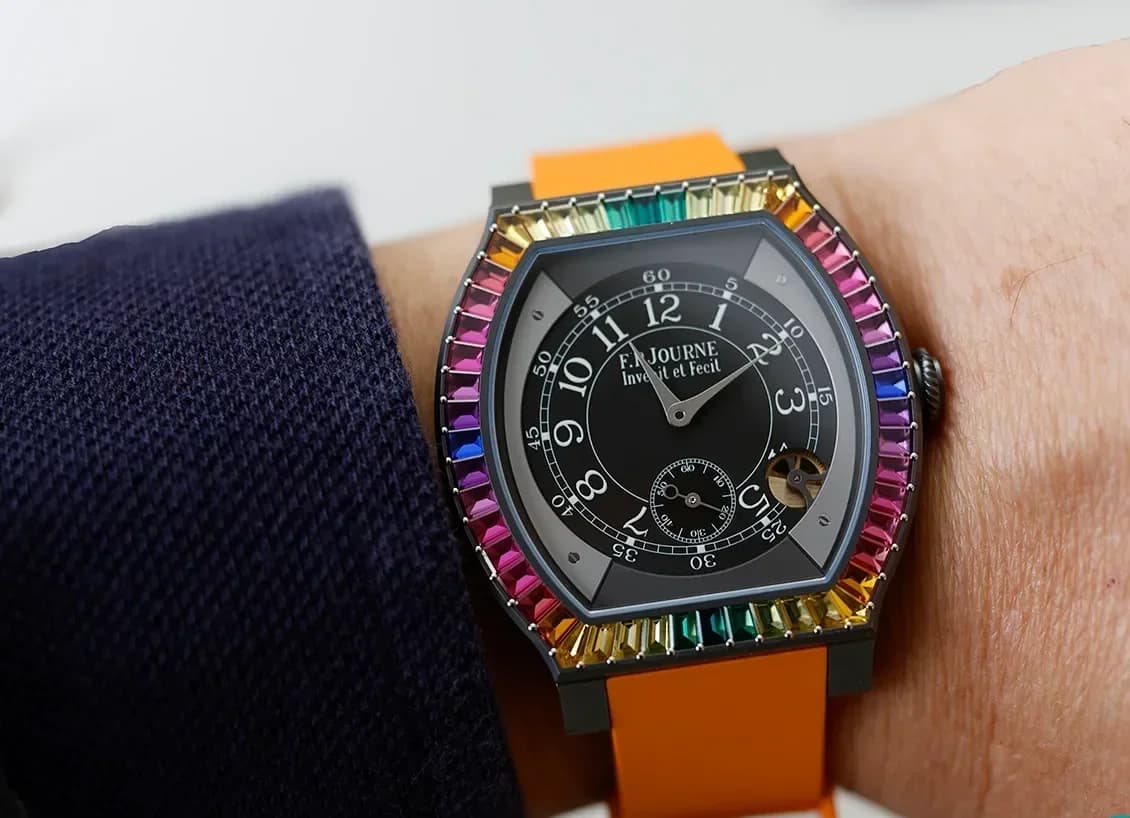
The Gino's Dream Elegante was created for the 10th anniversary of the collection in 2024. It is not a limited edition. It is limited only by how many the workshop can produce. The bezel is set with 52 baguette-cut ceramic glass stones in rainbow hues, hand-selected and placed with precision of one hundredth of a millimeter. The white dial version pairs these rainbow stones with a luminescent white face and blued steel hands on a yellow rubber strap. It is bold. It is joyful. It is everything Gino was. The white dial has an inner radiance from the Super-LumiNova treatment that gives it a glow even in daylight. In the dark, it lights up bright blue-green. On darker skin, the white dial against the cool titanium case creates a contrast that is striking without being harsh. The design language of the Elegante is strong enough to carry white. Most white-dial watches read as delicate or classical. This one reads as confident.
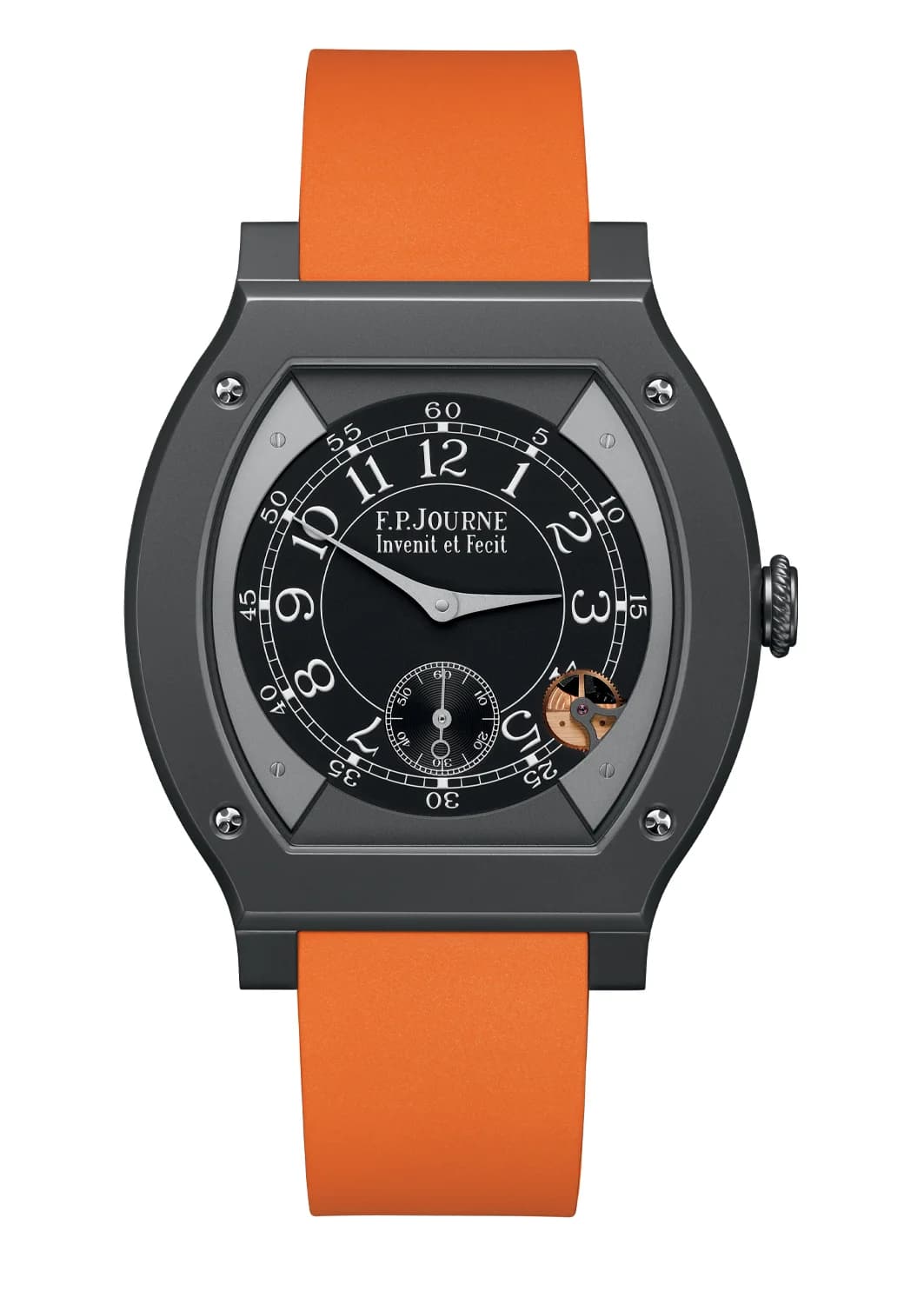
The Elegante wears differently than the dimensions suggest. At 48 by 40mm, it sounds like a large watch, but the tortue shape distributes that length along the wrist rather than across it, and the 7.95mm thickness means it disappears under a cuff with zero effort. In titanium, it weighs next to nothing. I notice this especially when comparing it to a steel sport watch of similar dimensions, where the difference in wrist fatigue after a full day is real. The rubber strap with its ergonomic shape adds to that sense of weightlessness, and the folding clasp sits flat without creating a pressure point on the underside of the wrist. On darker skin, the Titalyt's matte anthracite finish creates a quiet contrast that feels deliberate, not accidental. It pairs naturally with a Loro Piana tropical weight wool in charcoal or navy, sitting flat against the wrist without catching on the fabric. It is equally comfortable on a weekend with rolled sleeves and a linen shirt. The yellow and orange rubber strap options on the Gino's Dream add another dimension entirely. Against summer linen, the yellow strap carries an energy that is hard to describe without the word playful, which is not a word that comes up often in independent watchmaking. For anyone who travels frequently, the Elegante's battery life and sleep-wake system solve a specific problem that mechanical watches cannot address. Leave it in a drawer between trips, and it sleeps. Pick it up three weeks later, and it is on time within seconds. No winder, no resetting, no fussing with a crown at 3 AM in a hotel room. The Elegante is one of those rare watches where the materials and proportions conspire to make it genuinely comfortable for all-day wear regardless of what the occasion demands.
If there is one honest observation I would make about the Elegante, it is the water resistance. Thirty meters is splash-proof at best, and for a watch that Journe positions within a collection that carries the word sport in its DNA, that feels conservative. The screw-down crown is there. The titanium case can handle more. And yet 30 meters means this is not a watch for the pool or the ocean. For something that does everything else with such intelligence, I wish the water resistance reflected the same ambition. The 48mm case diameter is also a tradeoff worth acknowledging. On a 6.5-inch wrist, it wears well because the tortue shape keeps the lug-to-lug manageable, but on smaller wrists this demands a certain confidence. The 40mm version exists for exactly this reason, though the proportions of the 48mm are where the design language fully breathes. Journe clearly chose visual impact over universal wearability, and I respect the conviction even if it narrows the audience. The absence of a date complication is also worth noting for a watch that could easily serve as a daily wearer. Journe could have added a date window at 3 o'clock or 6 o'clock without much difficulty. I suspect he would argue that it would compromise the dial's clean geometry, and looking at the symmetry of that black luminescent surface with nothing but time and the motion detector, he would not be wrong.
What strikes me most about the Elegante is what it reveals about Journe as a person. Most independents at his level would never risk their reputation on a quartz movement. The entire framework of independent watchmaking rests on mechanical mastery, on hand-finishing, on tradition. Journe looked at that convention and decided it was a constraint, not a principle. He spent eight years building something that nobody asked for, knowing that a portion of his collectors would resist it on ideology alone. The fact that he built it anyway, with the same standard of finishing and the same obsessive attention to engineering, tells you more about who he is than any of his mechanical watches do. The Chronometre a Resonance shows his genius. The Tourbillon Souverain shows his mastery. The Elegante shows his character. And the Gino's Dream shows his heart. I love that a single collection can carry all four of those qualities at once. In my experience, the watches that age best in a collection are not always the ones with the most complications or the most decorated movements. They are the ones that tell you something true about the person who made them. There is a reason the Elegante was where Gino spent his time. Not the Resonance with its twin gear trains. Not the Tourbillon Souverain with its remontoire. The quartz watch. The one that on paper has the least to prove. Gino understood that the Elegante was not the simplest watch Journe made. It was the bravest. The Elegante tells you that Journe is curious, stubborn, brilliant, and unafraid.
If I am buying with my head, I am buying the 48mm Titalyt with the black dial. The story is the story. A mechanical purist spent eight years building a quartz watch that made the watch community reconsider what quartz can be. No lubrication. 18-year battery life in sleep mode. A display caseback on a quartz movement. Rose gold finishing inside an electromechanical caliber. It is the most accessible F. P. Journe and arguably the most intellectually interesting quartz watch ever produced. If I am buying with my heart, I am buying the Gino's Dream in white. The rainbow bezel is not subtle. It is not supposed to be. Gino was not subtle. And the watch is better for it.
Also in Independent Masters