
F.P. Journe
Chronometre Souverain
CS.RG
Before Francois-Paul Journe built watches, he restored them. As a young watchmaker in Paris, he apprenticed at his uncle Michel Journe's workshop, restoring antique pocket watches and studying the work of Abraham-Louis Breguet. Not reading about Breguet. Holding Breguet's movements in his hands, disassembling them, understanding how the greatest watchmaker of the 18th century solved problems with the materials and tools available to him. That experience shaped everything Journe would later create. The natural escapement that powers his Chronometre Optimum is a direct realization of a concept Breguet patented in 1802 but could never produce reliably. Journe's years restoring Breguet pieces gave him the insight to finish what Breguet started, two centuries later, using silicon and modern manufacturing. When I look at an F. P. Journe movement, I see the intellectual lineage of Breguet filtered through a man who spent his formative years inside Breguet's actual work. Journe was born in Marseille in 1957. An unruly kid by his own telling, he was sent to a local technical college at 14 before his uncle Michel brought him to Paris and enrolled him at the Pierre Girard School of Watchmaking. He split his time between formal classes and his uncle's restoration bench, where the real education happened. By 1976 he had graduated and set up his own workshop in the Saint-Germain-des-Pres district. His first pocket watch tourbillon came in 1978. A commission from Asprey of London for a planetarium mechanism followed. The wristwatch version of the tourbillon took until 1991. And then in 1999, at Baselworld, he launched Montres Journe SA with a debut collection of chronometers under a four-word Latin promise that would define everything he built from that day forward.
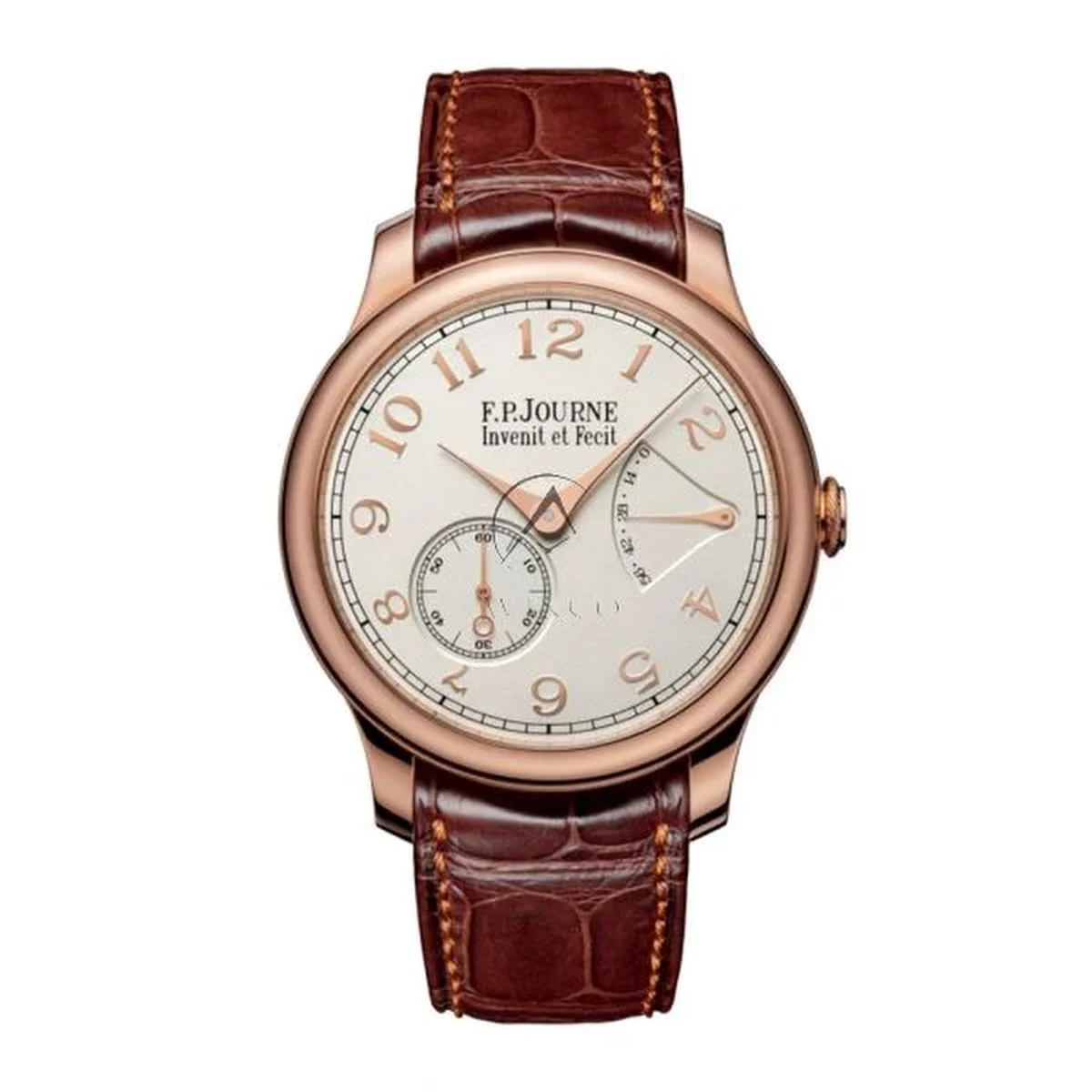
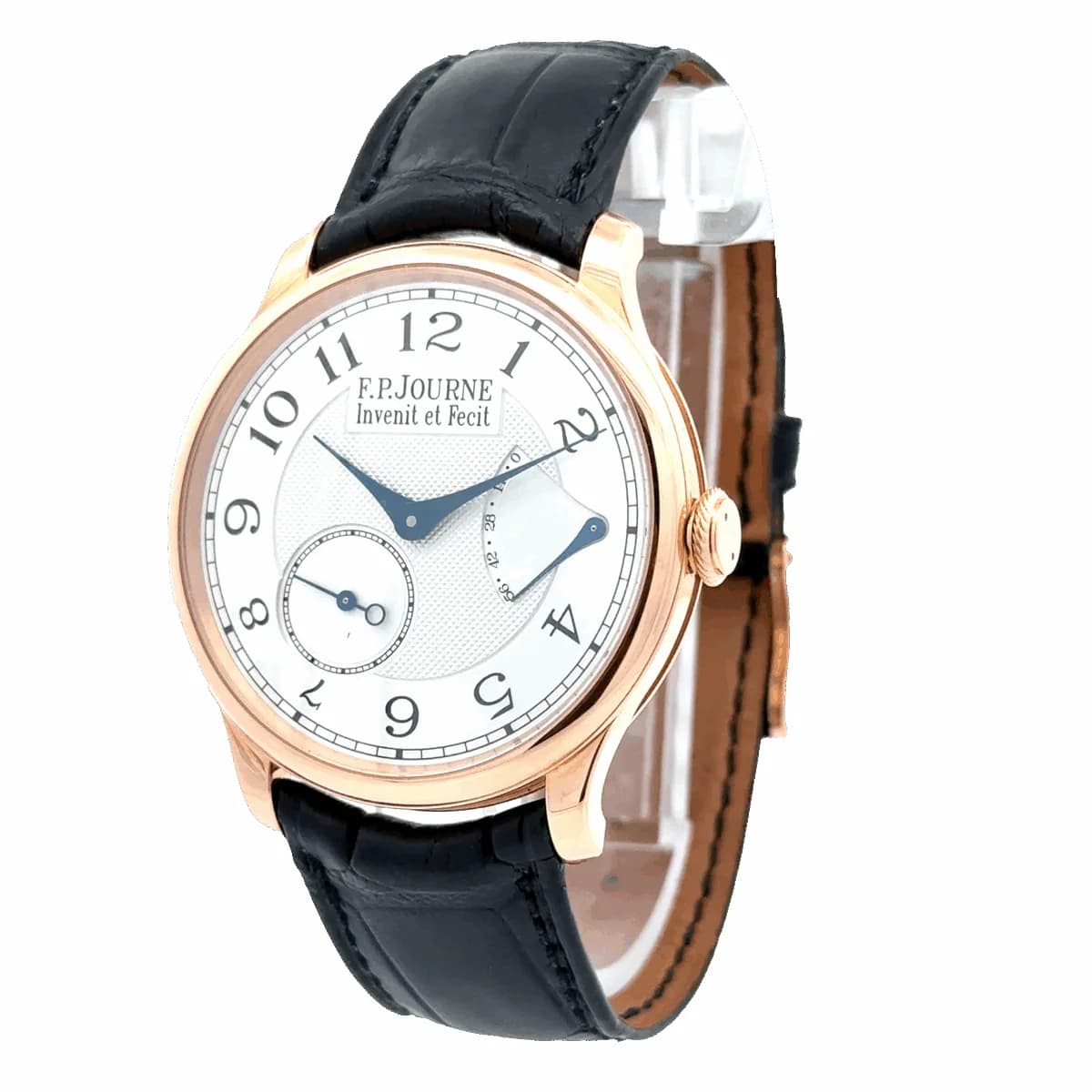
The Chronometre Souverain arrived in 2005, six years into the brand's existence. By that point Journe had already proven himself with the Tourbillon Souverain and the Chronometre a Resonance. Both were complicated watches. The Souverain went the other direction entirely. Where his peers were stacking complications to prove technical prowess, Journe built a watch that asked a harder question: can a time-only watch from an independent maker stand on its own against anything in the industry. Hand-wound. 40mm in 18K 6N rose gold or platinum 950. Dead-beat seconds at 7:30 on the dial, where the seconds hand ticks in precise one-second jumps rather than sweeping. Power reserve indicator at 3 o'clock. Hours and minutes on the off-center main dial. In a world where independent watchmakers competed on complications (tourbillons, minute repeaters, grand sonneries), Journe introduced what is essentially a time-only watch and won the Best Men's Watch Prize at the Grand Prix d'Horlogerie de Geneve that same year. The Caliber 1304 inside is hand-wound with 22 jewels, beats at 21,600 vibrations per hour (3 Hz), runs for 56 hours on a full wind, and contains 161 components. The movement stands just 4mm tall inside a case that is only 8mm thick. That is dress watch territory. For context, a Patek Calatrava 5196 is 8.05mm thick. The Souverain lives in the same dimensional class as the most refined time-only watches from any brand, and it does it with a constant-force mechanism running inside.
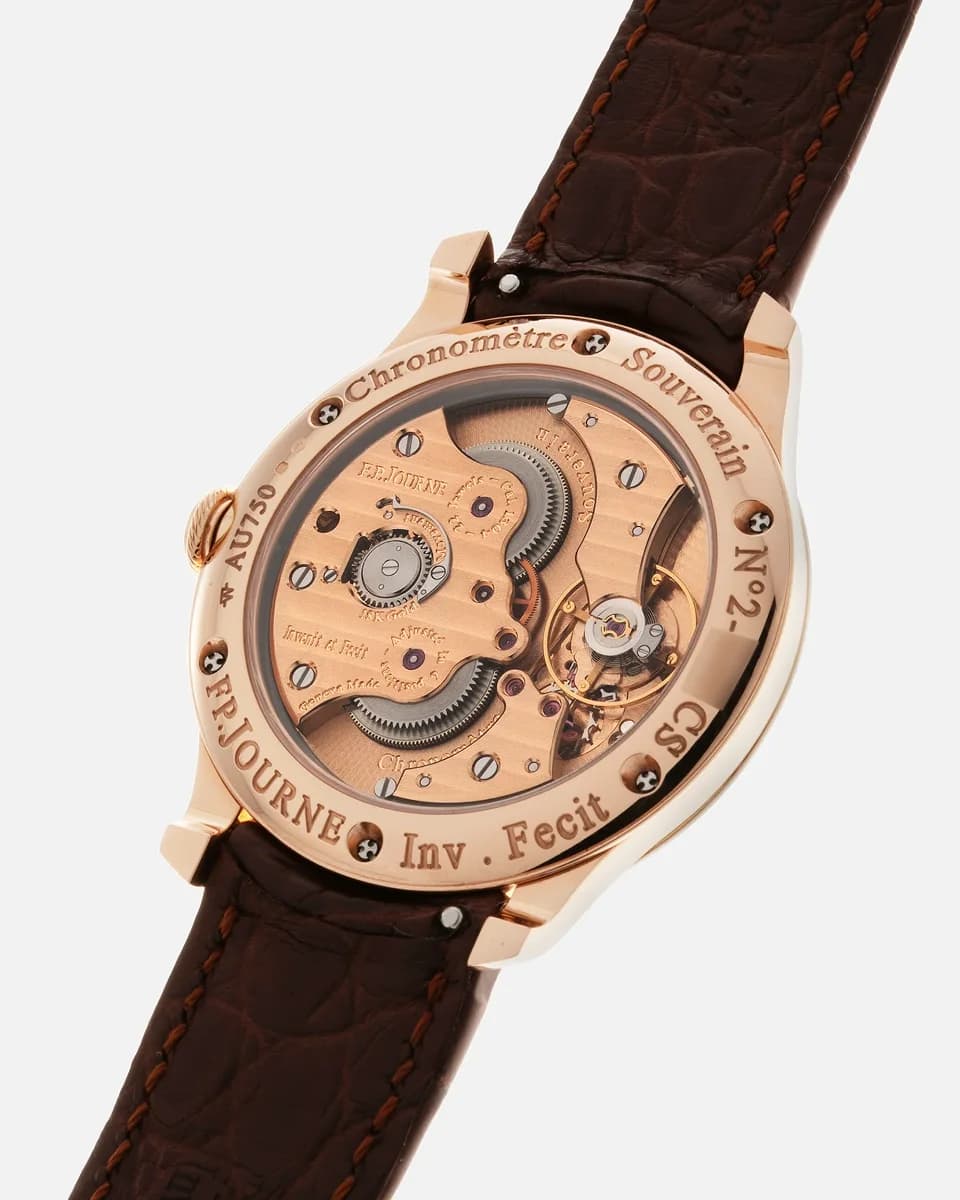
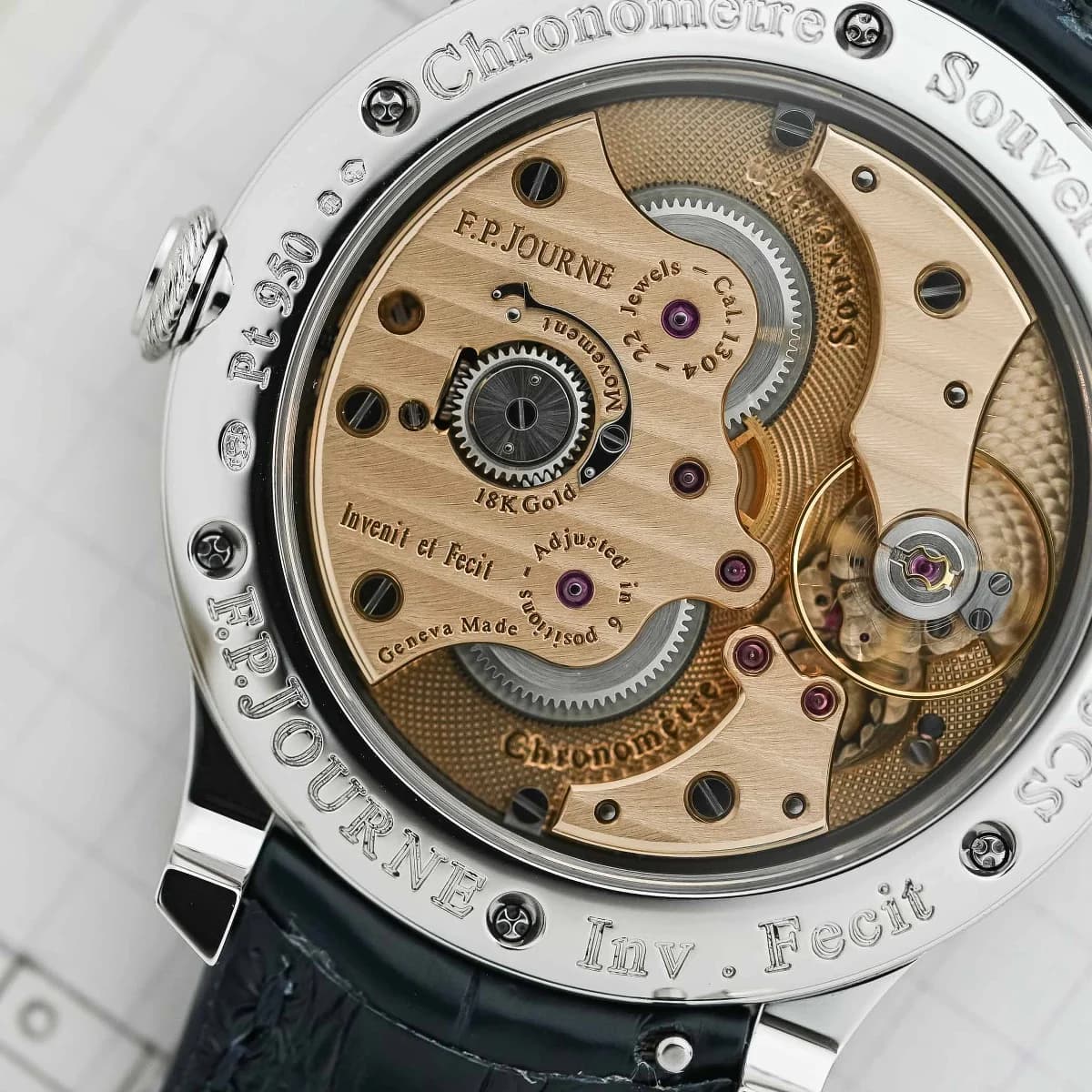
The movement is made entirely of 18K rose gold. Not plated. Not decorated brass. The base plate, the bridges, all of it is solid rose gold. This is unique in the industry. Nobody else does it at this scale. The Chronometre Souverain debuted in 2005, one year after Journe transitioned all of his calibers from brass to rose gold in 2004. So unlike the Tourbillon Souverain or the Resonance, which existed in both brass and gold eras, the Chronometre Souverain has always been a rose gold movement watch. It never had a brass era. That distinction matters to collectors who track the evolution of Journe's manufacturing. The pre-2004 brass movement pieces from other models in the collection (rhodium-plated brass rather than warm rose gold) are now among the most sought-after F. P. Journe watches in existence. Collectors prize those early examples because they represent the genesis of the brand, the moment before Journe decided that everything would be gold from that point on. But the Chronometre Souverain was born into the golden age, literally. Rose gold is harder to machine than brass, more expensive, and more challenging to finish. Journe made the switch because he felt brass did not reflect the level of craft he wanted to express. When I look through the caseback of a Souverain and see that warm rose gold tone across every surface of the Caliber 1304, I understand why he made that decision. It transforms the movement from something you appreciate intellectually into something that stops you mid-sentence.
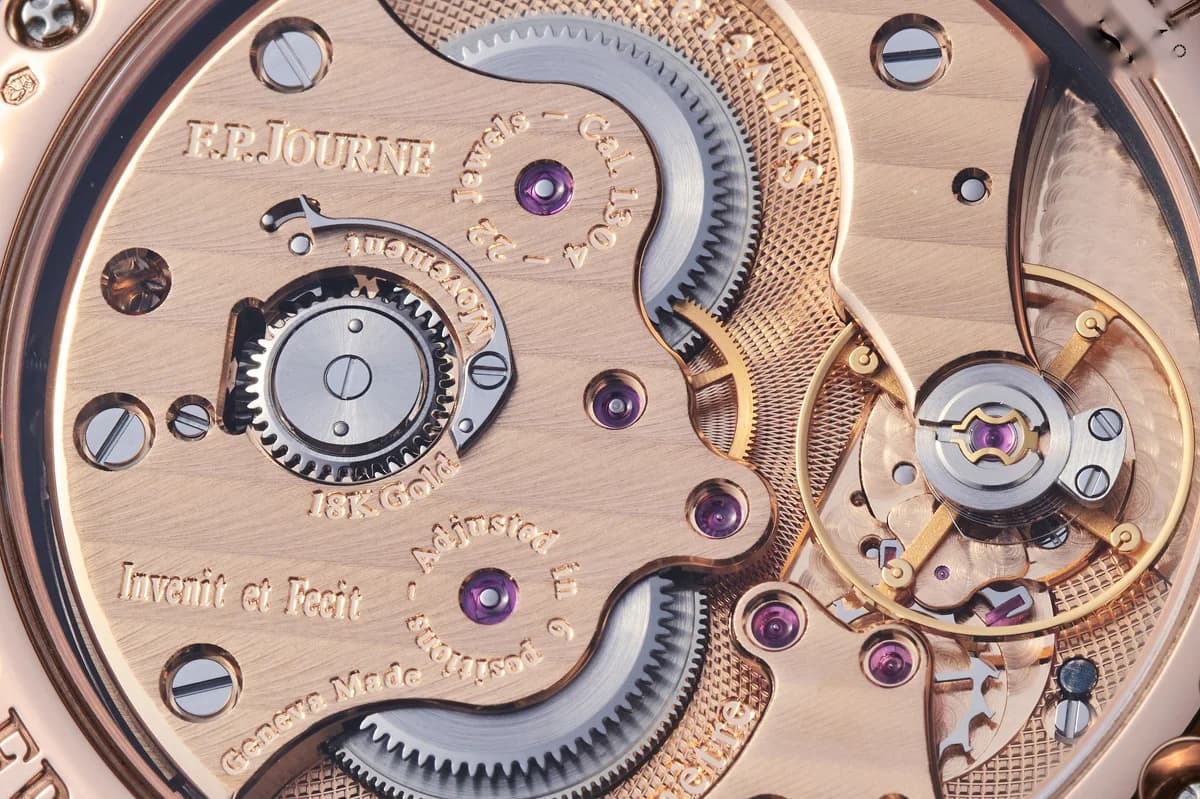
The dead-beat seconds complication is not a gimmick. It exists because Journe wanted the most accurate visual representation of each passing second, and because his inspiration for the entire watch was the marine chronometer. Traditional marine chronometers had three hands and a power reserve indicator, exactly the layout the Souverain uses. Even the power reserve scale is inverted, where zero indicates zero hours since the watch was last wound, just as it was on the chronometers that guided ships across oceans. A sweeping seconds hand moves continuously and the eye can never point to the exact moment a second passes. A dead-beat hand stops, waits, then jumps precisely to the next second marker. The remontoire d'egalite that enables this is a constant-force mechanism using an auxiliary spring that delivers a uniform pulse of energy to the escapement every second. It sits between the fourth wheel of the gear train and the escapement, rewinding itself in short bursts from the mainspring while providing perfectly consistent impulses to the balance. This is the same principle that A. Lange and Sohne uses in the Zeitwerk for a completely different purpose, and it is the same principle that governed the precision of naval chronometers three centuries ago. Journe's implementation is elegant in the original sense of the word. It does what is necessary and nothing more. The balance assembly itself is worth noting. It uses a four-spoke free-sprung design with mobile stud holders and a flat Anachron micro flamed hairspring. The hairspring is laser-welded to the collet using Nivatronic technology. Free-sprung means there is no regulator index to interfere with the oscillation. Timing adjustments happen through the four inertia weights on the balance wheel rim. It is a more refined approach than a regulated balance, and it is one reason the Souverain keeps excellent time in practice. The official amplitude at full wind (dial up) is 320 degrees, dropping to 280 degrees at 24 hours. That is a tight range for a hand-wound watch, and it speaks directly to the quality of the remontoire's constant-force delivery.
I love how the twin mainspring barrels are mounted in parallel rather than in series. Most watches with dual barrels connect them end to end for longer power reserve. Journe connects them side by side for more linear torque delivery. The mainspring loses force as it unwinds, and a single barrel delivers noticeably different energy at full wind versus 40 hours in. Two barrels in parallel share the load and flatten the torque curve across the entire 56-hour duration. The going train is hidden on the dial side of the movement, which means when you flip the watch over and look through the sapphire caseback, all you see are the two barrels flanking the balance wheel with its four-spoke free-sprung design and flat Anachron hairspring. The visual result is pure symmetry. The technical result is superior chronometric performance. I appreciate that kind of engineering where the functional decision also produces the more beautiful outcome. That is not always the case in watchmaking, but Journe found it here.
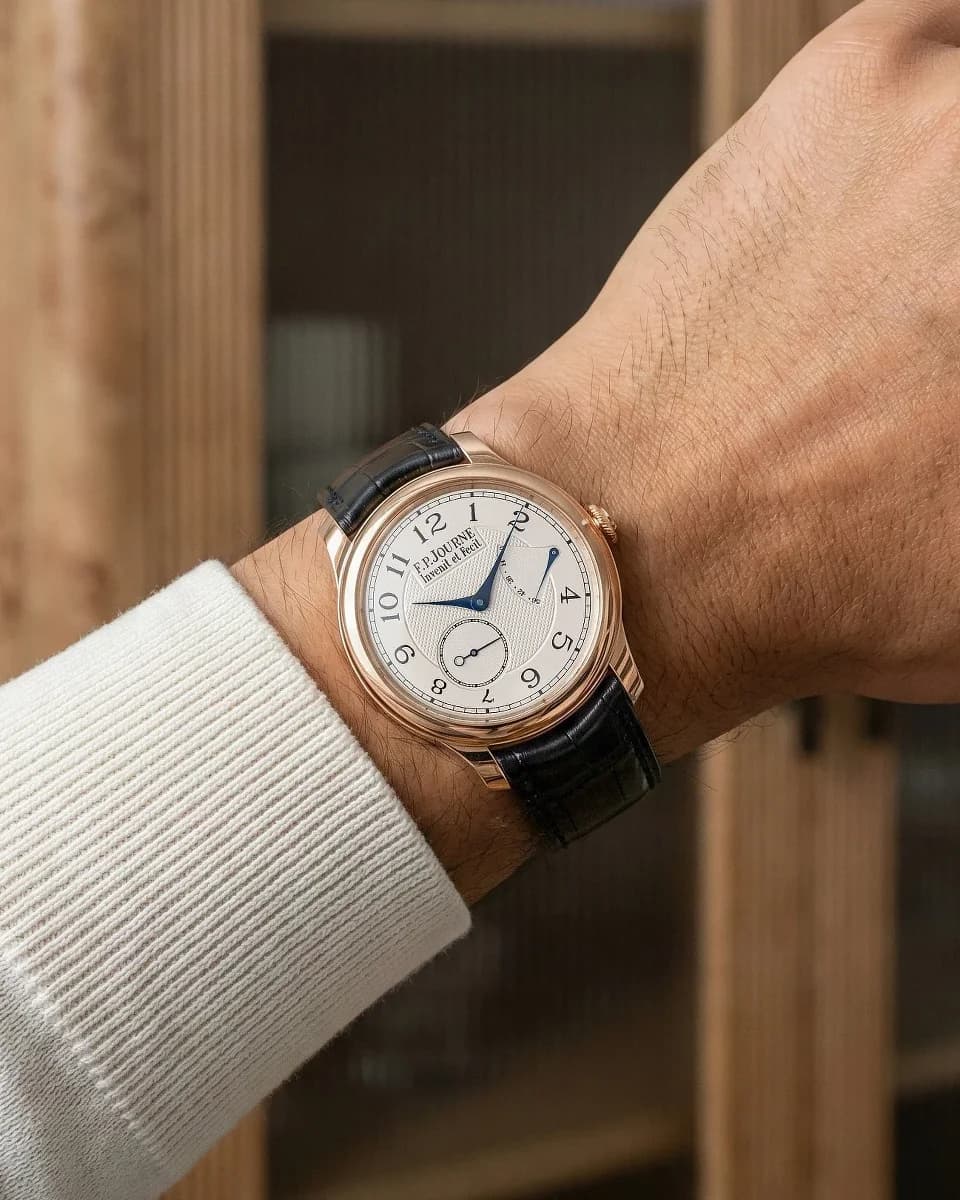
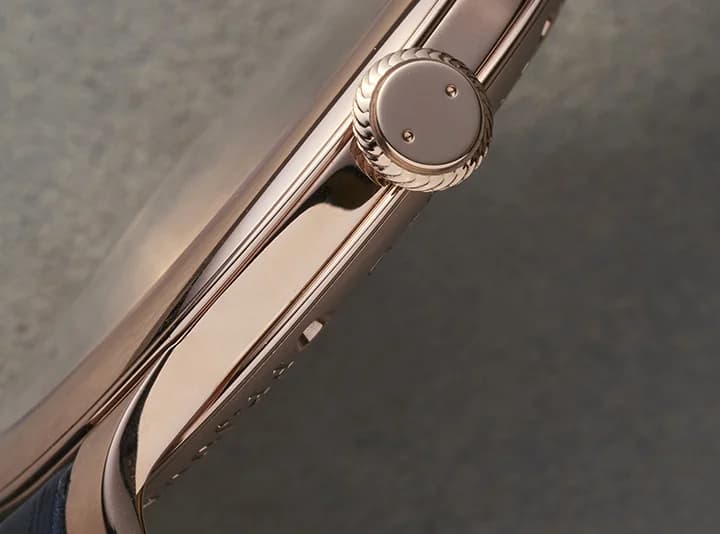
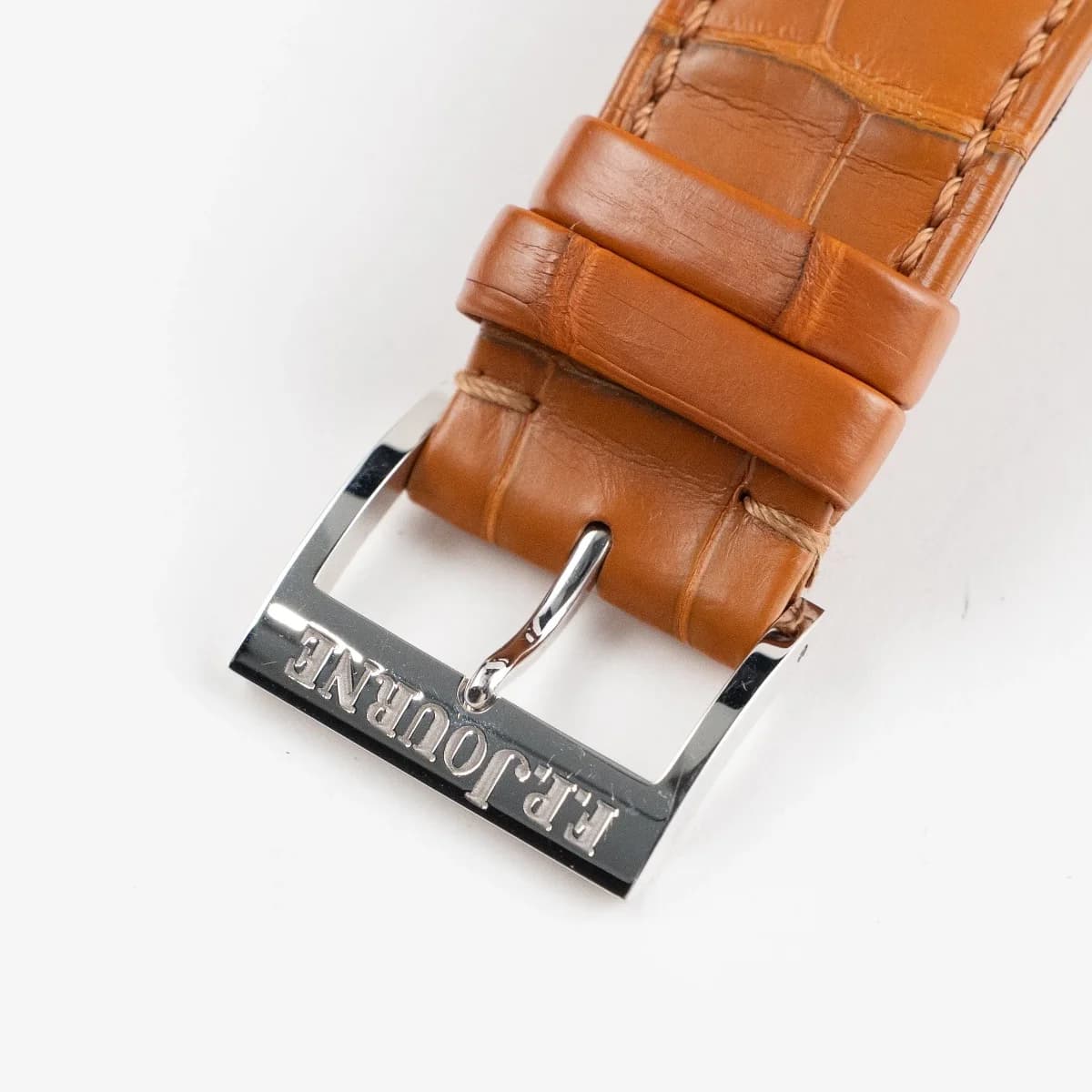
The case at 40mm wears larger than the number suggests because the lugs are long. The lug-to-lug span is 48.2mm, which is on the edge for a 6.5-inch wrist. The saving grace is that the lugs curve downward nicely, and the strap uses curved spring bars, so it wraps rather than overhangs. At 8mm thick the Souverain disappears under a Tom Ford suit cuff. It sits flat. There is no crown guard, no thick bezel, nothing that catches on fabric. The case is available in platinum, 18K rose gold (6N), or 18K white gold, with domed sapphire crystals on both sides. Water resistance is 30 meters, which is typical for a dress watch and perfectly fine for everyday wearing as long as it stays out of the pool. On darker skin the 6N rose gold has a warmth that pairs well with brown and tan tones. The whitened guilloche silver dial with gold applique numerals catches light in a way that shifts between cool silver and warm gold depending on the angle. I find myself tilting my wrist just to watch the guilloché pattern change. The strap is alligator with a tang buckle in matching rose gold or platinum. Strap changes use traditional spring bars, which means a tool is required and there is the usual risk of scratching the lugs if the screwdriver slips. I keep a Bergeon 6767-F nearby for exactly this reason. The spring bars are curved, which adds to wrist comfort but makes strap changes slightly less straightforward than flat spring bars. It is not a quick-release system, so the Souverain is not a watch built for daily strap swaps. It is a watch built to wear on one strap that pairs with everything in the wardrobe, and the classic black alligator does exactly that.
I think about where the Souverain sits in Journe's lineup and what comes above it. The Tourbillon Souverain has the same constant-force remontoire but adds a tourbillon cage. The Chronometre Optimum uses a natural escapement derived from Breguet's 1802 patent, the concept Breguet could never produce reliably that Journe finally realized using silicon and modern manufacturing. The Sonnerie Souverain, with its minute repeater and grande sonnerie complications, represents the absolute ceiling of what one independent workshop in Geneva can produce. The Chronometre a Resonance is considered one of the most ingenious wristwatches ever made, using acoustic resonance between two balance wheels to improve chronometric stability. These are all extraordinary watches. The Souverain is the one that teaches what Journe is about before moving to the complications. It shares the same movement material, the same finishing standards, and the same four-word inscription on the movement as every other watch in the collection. It is the entry point to a world where the entry point is already at the top. If you visit Geneva and find yourself near the Rue de l'Arquebuse, that is where Journe's manufacture sits. Walking through that neighborhood and knowing that the entire Journe collection comes out of one building gives a different perspective on what fewer than 900 watches per year actually means. It means the person who conceived every caliber in the lineup still walks the workshop floor. It means the same hands that assembled a Sonnerie Souverain also assembled a Chronometre Souverain. That continuity of craft from the simplest to the most complex watch in the collection is something only a handful of independent watchmakers in the world can claim. Philippe Dufour in the Vallee de Joux and Kari Voutilainen in Motiers come to mind, but even among that company, Journe's output volume and range of complications set him apart.
If I have one honest observation about the Souverain, it is the lug-to-lug length. At 48.2mm on a 40mm case, the proportions run long. On a wrist under 6.5 inches the lugs can approach the edges, and while the curved spring bars help a great deal, it is a watch that wears bigger than its case diameter implies. The 18K rose gold is also 2.75 on the Mohs hardness scale, which means the polished surfaces will pick up micro-scratches with daily wear. I would call that character rather than damage, but it is something to know going in. The fully polished case shows those marks more readily than a brushed finish would. Over time the Souverain develops a lived-in warmth that I actually prefer to the factory-fresh polish, but not everyone shares that view. The platinum version sidesteps this entirely. Platinum is harder, heavier, and more resistant to scratching. It also has a cooler, more subdued tone that pairs differently with clothing and skin. On darker skin, I find the rose gold more striking, but the platinum has its own kind of quiet authority. The white gold option splits the difference, offering rose gold's lighter weight with a cooler color closer to platinum. Three metals, three personalities, one caliber.
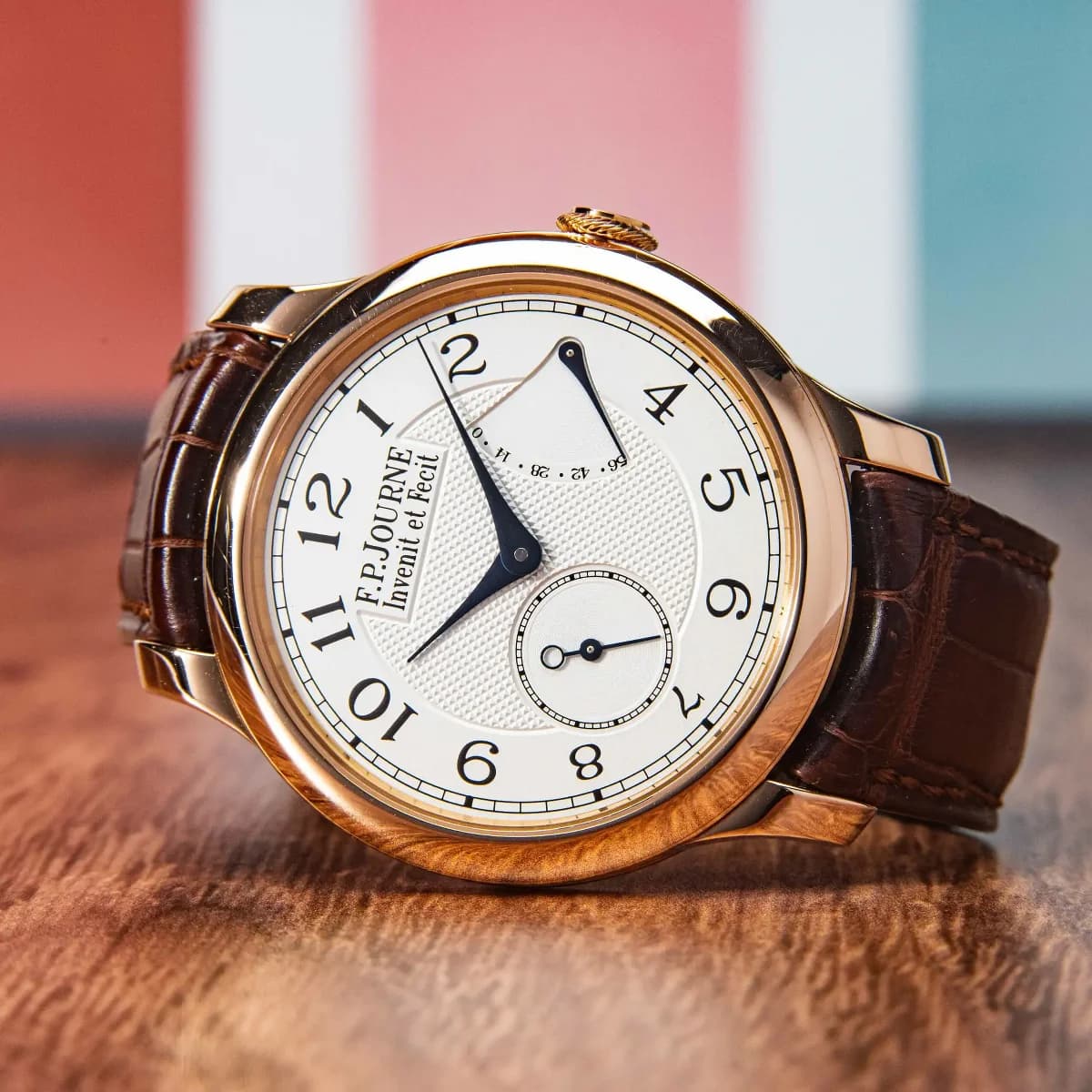
The dial layout deserves its own mention. The sub-seconds at 7:30 and power reserve at 3 o'clock create an asymmetry that gives the Souverain its visual identity. Most watches with subsidiary dials place them at 6 o'clock or 9 o'clock. Journe positioned them to balance the visual weight of the watch across the entire dial, and the result is a face that feels alive without being busy. The blued steel hands against the whitened silver dial provide excellent legibility in any light. There is no lume on the hands or indices, which is consistent with its identity as a dress watch but means reading the time in a dark restaurant requires pulling out a phone or angling toward a candle. That is the tradeoff of a pure dress watch, and it is one I accept willingly because the dial finishing would suffer if luminous material were applied to those slender hands. The guilloché itself deserves attention. The center section of the dial uses a barleycorn pattern that catches light from every direction, while the sub-dials have their own concentric circular graining. These are not printed textures. They are engine-turned patterns cut into solid silver. The quality of the guilloché is immediately visible when compared to machine-stamped patterns on lesser dials, and it is one of the reasons the Souverain photographs so well from different angles. Every tilt reveals a different light pattern across the dial surface.
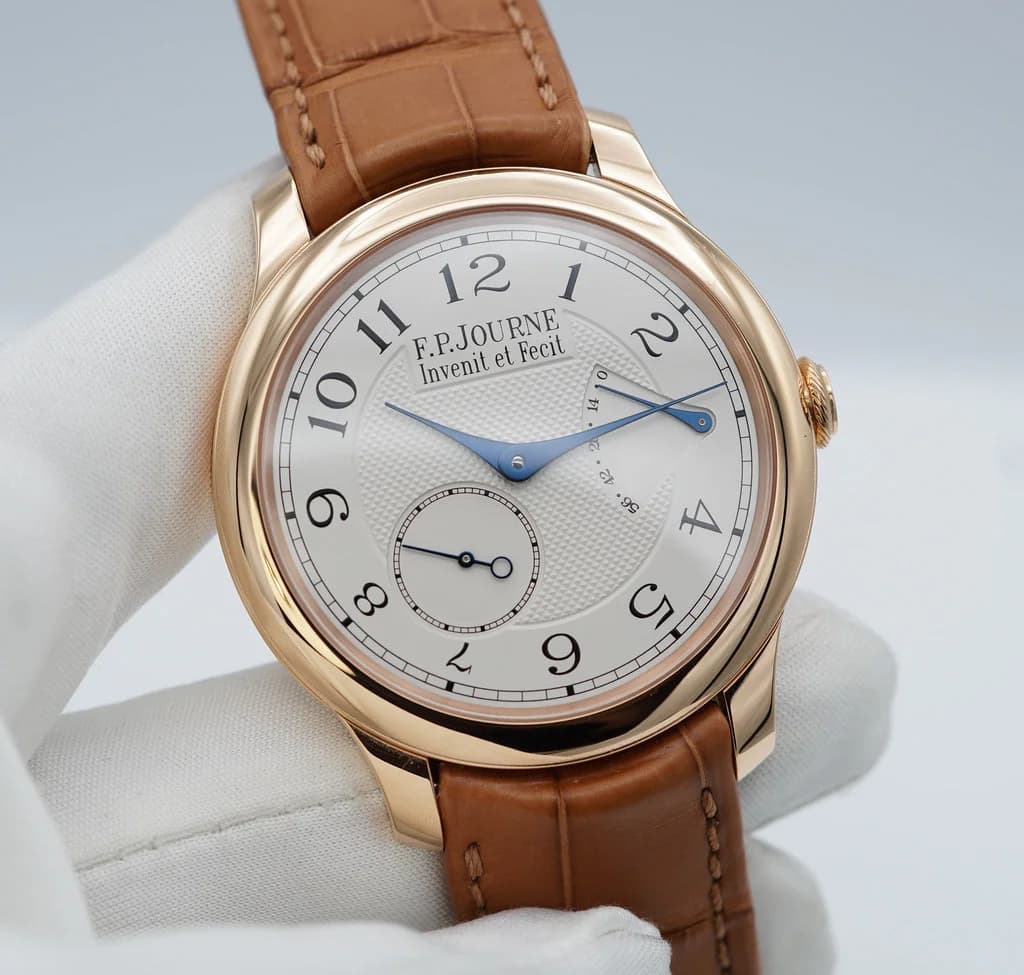
Journe signs every watch Invenit et Fecit. Latin for he invented and he made. It is not a marketing slogan. It is a verifiable claim that every caliber in the collection is an original conception, designed and manufactured entirely within Journe's workshops in Geneva. Fewer than 900 watches leave his manufacture each year across all models. He owns Les Boitiers de Geneve for his cases and Les Cadraniers de Geneve for his dials, both located in Meyrin. The vertical integration is real. The man who started by restoring Breguet's pocket watches in his uncle's Paris workshop now builds watches that sit alongside Breguet's work in museum collections. The Chronometre Souverain has been in production for twenty years, and the Caliber 1304 has remained essentially unchanged across that entire span. That kind of stability in a movement design is a quiet statement of confidence. Journe got it right the first time, and two decades later the market agrees. The Souverain is not the most complicated watch he makes. It is not the rarest. It is the one that says everything about what F. P. Journe stands for with nothing more than three hands, a power reserve, and a movement made of gold.
Also in Independent Masters