
De Bethune
DB28
DB28
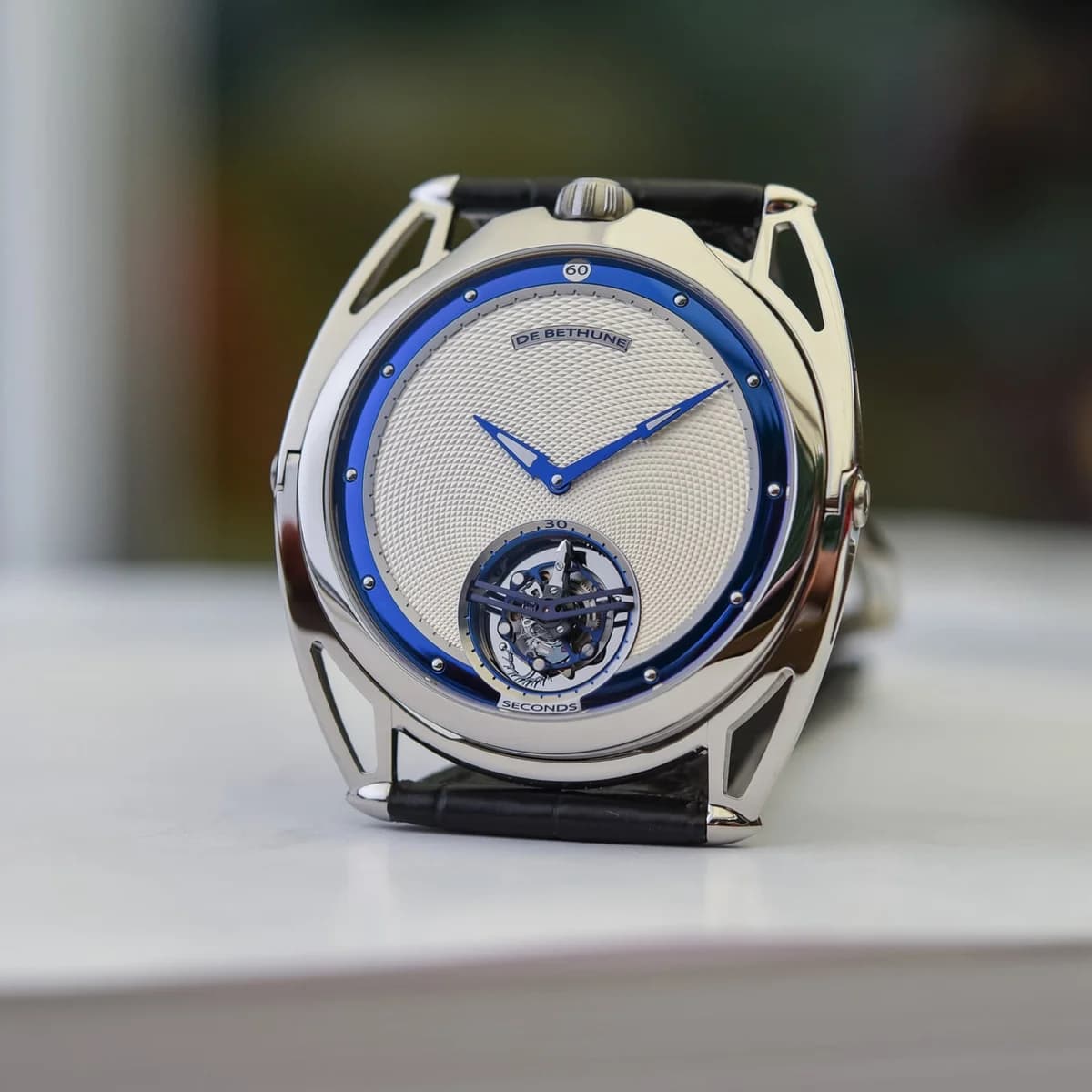
Denis Flageollet is one of the most innovative watchmakers of the 21st century and almost nobody outside the collector community knows his name. He is the technical mind behind De Bethune, a brand he co-founded with David Zanetta in 2002 in the village of L'Auberson, near Sainte-Croix in the Swiss Jura. While the rest of the Swiss industry was refining established calibers and adding ceramic bezels, Flageollet was rethinking fundamentals. He developed a titanium balance wheel with white gold inserts. He created a triple pare-chute shock protection system. He built a spherical moon phase that is accurate to one lunar day every 122 years. He machined watch dials from fragments of four-billion-year-old meteorite. And he did all of this from a small manufacture that produces fewer than 350 watches per year across every reference.
Flageollet's background explains why De Bethune looks like nothing else. He is a fourth-generation watchmaker from Gérardmer in the Vosges mountains of northeastern France. He trained in watchmaking and micro-engineering at the Technicum du Locle, then worked as a technician at the Watch Museum of Le Locle restoring historical pieces. From there he moved to Michel Parmigiani's workshop, where he worked on the restoration of complicated antique movements. That combination of classical training and hands-on restoration work gave him a deep understanding of what has worked in watchmaking over centuries and, more importantly, what has not. He then co-founded THA Horlogerie (Techniques Horlogères Appliquées) alongside François-Paul Journe and Vianney Halter, two of the most respected independent watchmakers alive. He spent twelve years at THA managing the production workshop, leading research and development, and building prototypes. When you look at De Bethune's technical output, you are looking at a watchmaker who learned alongside Journe and Halter before deciding to go further than either of them in terms of materials science.
David Zanetta, the other co-founder, came from a different world. He was an Italian collector and dealer of art and vintage watches who crossed paths with Flageollet at THA. Zanetta understood the collector market. He understood positioning and storytelling. When they founded De Bethune on April 22, 2002, the division was clear. Flageollet would build the watches. Zanetta would build the brand. The name De Bethune itself references the Chevalier de Béthune, a 17th-century French horologist and friend of Christiaan Huygens. It was a deliberate statement about the kind of watchmaking they intended to pursue, rooted in scientific inquiry rather than decorative tradition.
The DB28 arrived at Baselworld 2010 and it changed the conversation about what an independent watch could look like. The launch story is worth telling. Zanetta showed the prototype to journalist Ian Skellern on his wrist during the fair. When Skellern asked when they planned to officially launch it, Zanetta reportedly said, "When you publish your photos." The watch was never exhibited at the fair. Skellern published it as "The Best Watch I Saw At Baselworld 2010 Wasn't Even Exhibited At The Fair." That was the launch. No press conference, no booth, no marketing campaign. Just a watch that was so visually arresting and technically dense that a single set of photographs was enough.
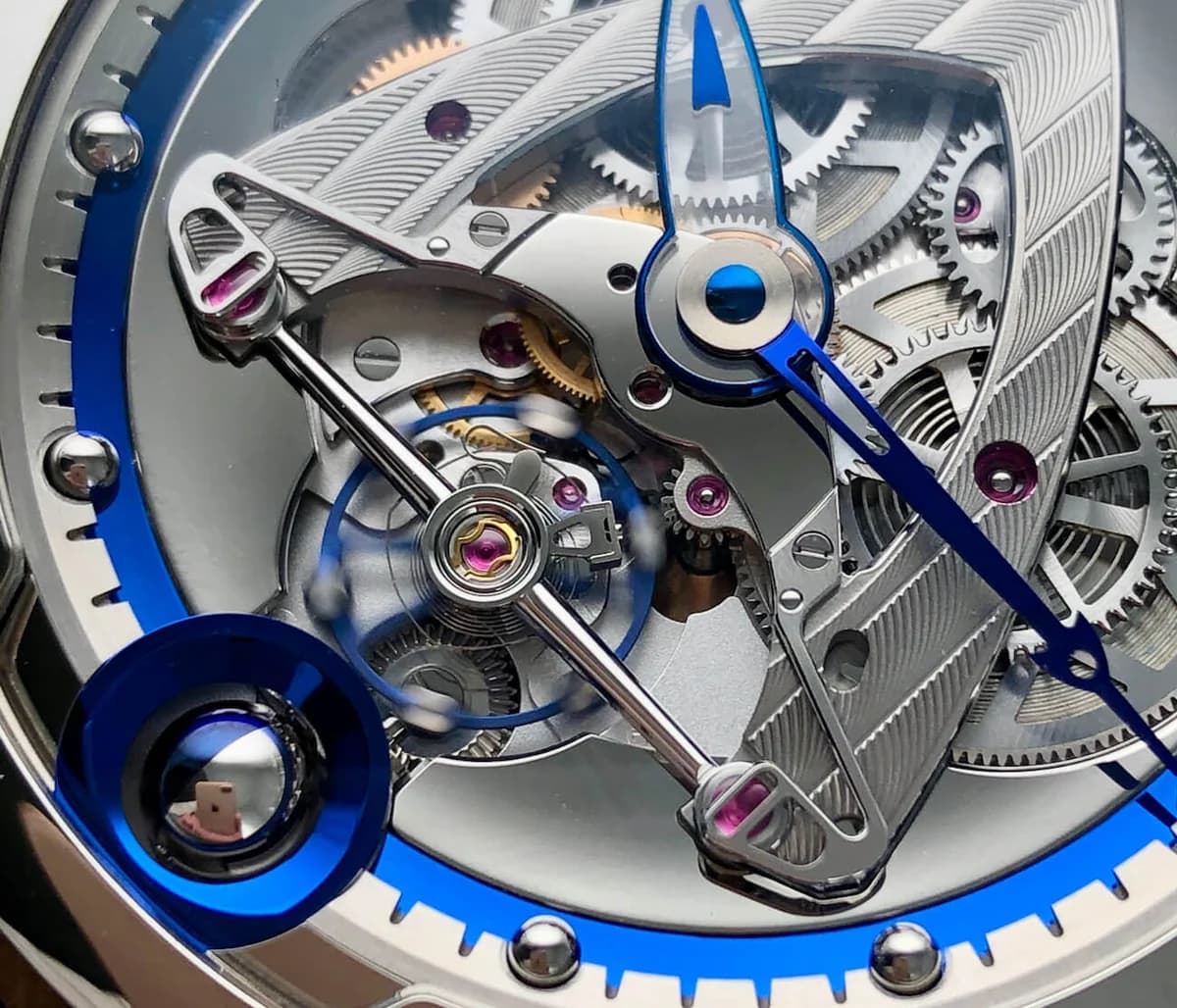
The DB28 is powered by the Caliber DB2115, a manually wound movement with 38 jewels, beating at 28,800 vibrations per hour (4 Hz), with a six-day power reserve from a self-regulating twin barrel system that De Bethune patented in 2004. The movement is 30mm in diameter and contains 297 components. Those specifications alone are impressive, but they only hint at what makes this caliber different. The balance wheel is made of titanium with white gold inserts, a combination Flageollet chose because titanium is light and rigid while white gold provides the mass needed for inertial stability without adding weight where it is not needed. The balance spring features De Bethune's own flat terminal curve, which is a patented geometry designed to improve isochronism. The escape wheel is silicon, which is lighter than metal, naturally anti-magnetic, and requires no lubrication at the escapement interface. Flageollet was working with silicon before it became a talking point for the rest of the industry.
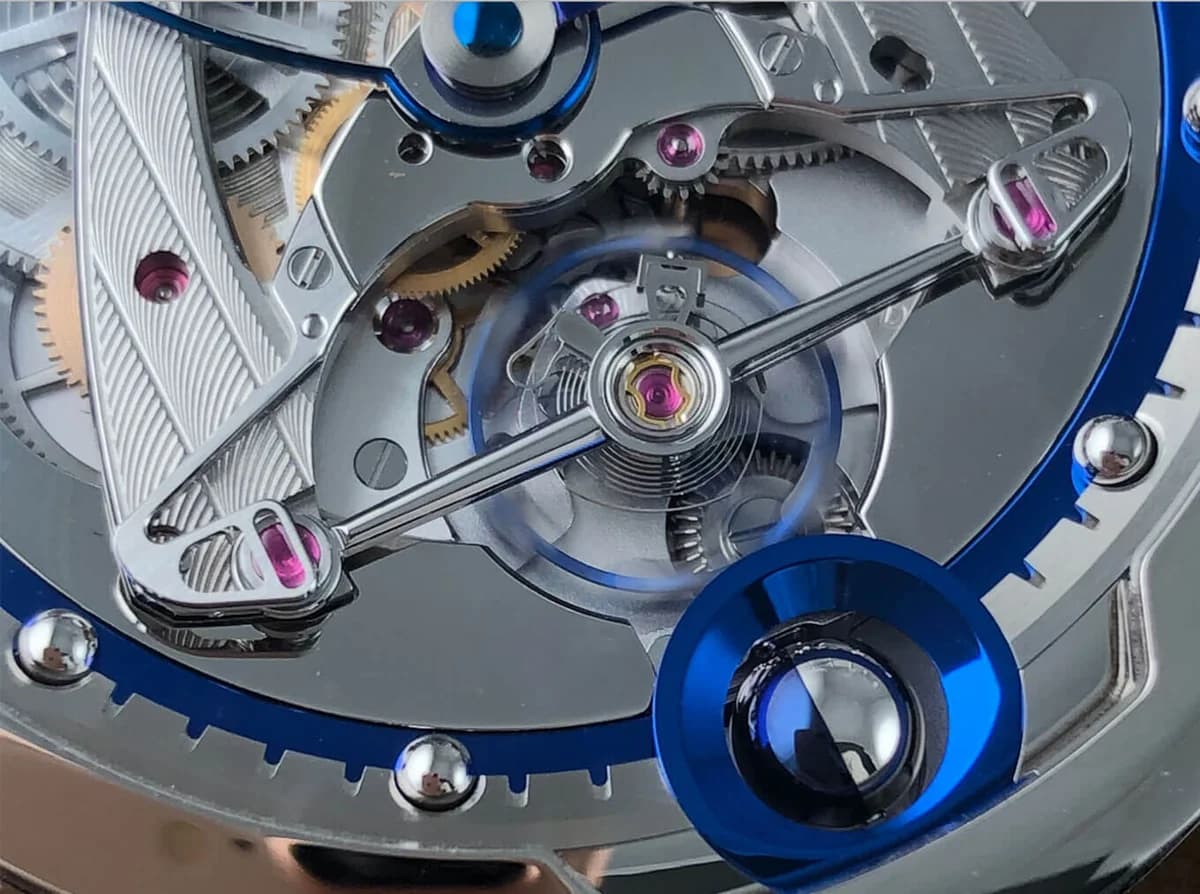
I find the approach to silicon particularly interesting because it is so different from what the big groups are doing. Rolex developed Parachrom, a niobium-zirconium alloy hairspring, to address magnetism and shock resistance. Omega uses a silicon hairspring in their co-axial movements. Both of those approaches apply silicon (or silicon-derived materials) to one specific component. Flageollet took a broader view. He uses silicon in the escape wheel and developed his own balance wheel geometry with titanium and precious metal inserts. The balance spring uses a proprietary flat terminal curve. It is a system-level rethink rather than a component swap. Whether that approach is objectively better is debatable, and I appreciate that honest watchmakers can disagree about the ideal role of silicon in a mechanical movement. But the ambition of rethinking the entire oscillating and escapement system as a unified design is something you only see from independents.
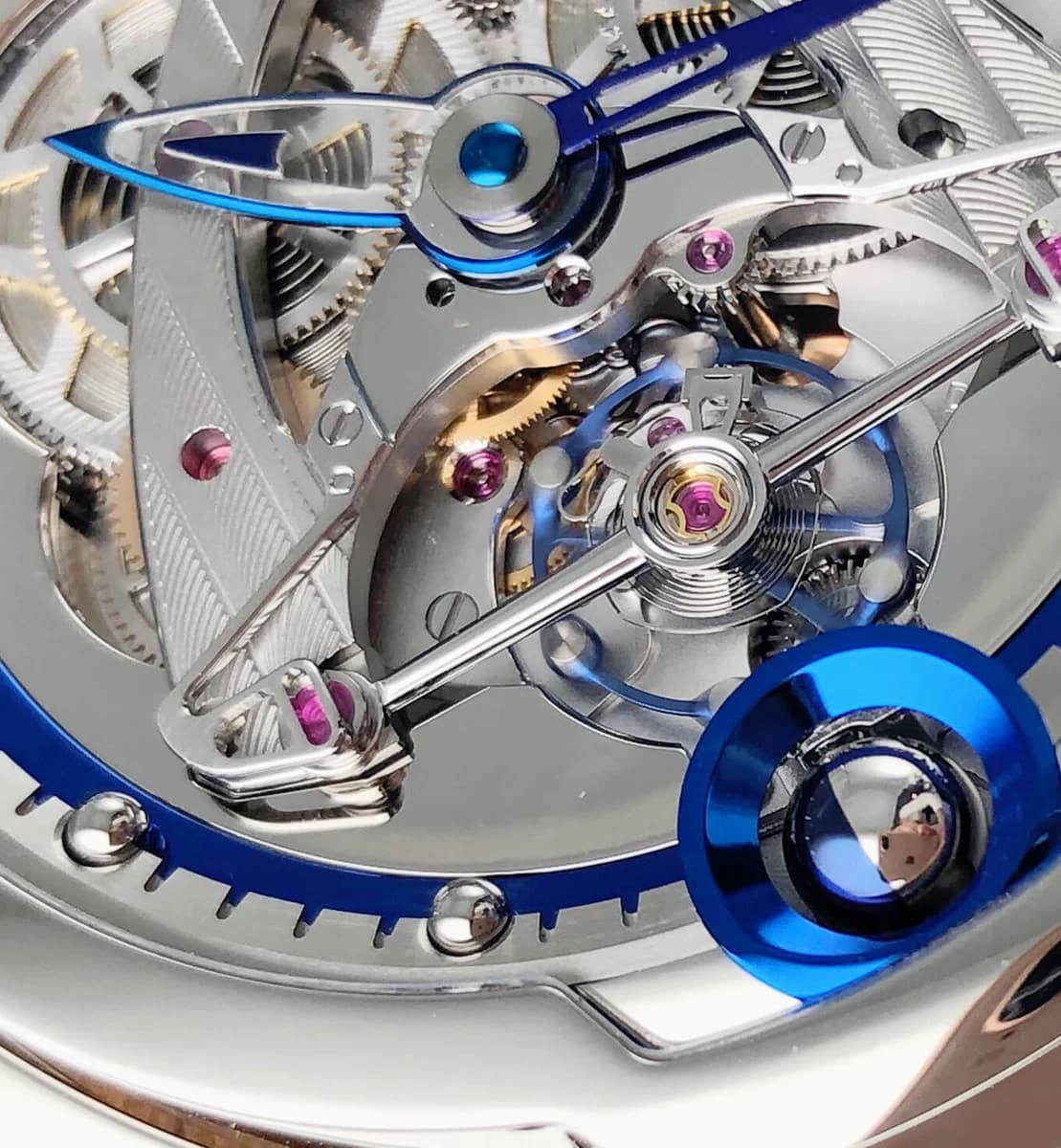
The triple pare-chute shock protection system is another Flageollet invention that deserves attention. Most watches use a single shock protection system, typically Incabloc or Kif, which protects the balance staff pivots from impact damage. Flageollet designed a three-point system with a titanium bridge incorporating ruby and blade spring absorbers at both ends, plus a central absorber protecting the balance wheel itself. The name is a deliberate play on "parachute," referencing Abraham-Louis Breguet's original pare-chute shock protection system from the 18th century. Flageollet took Breguet's concept and tripled it. The result is a balance assembly that can absorb shocks from multiple angles, which is relevant for a watch worn daily and not just displayed in a safe.
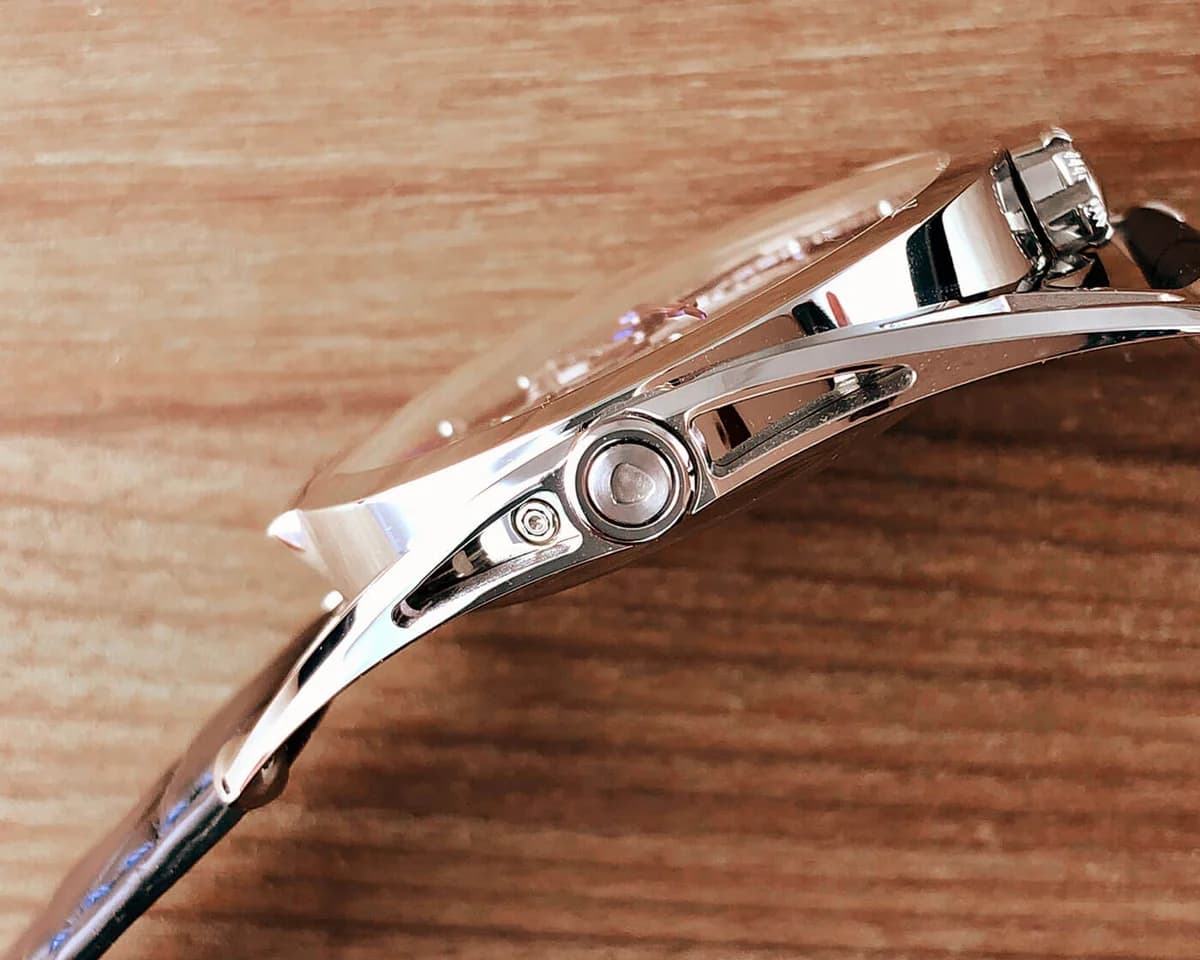
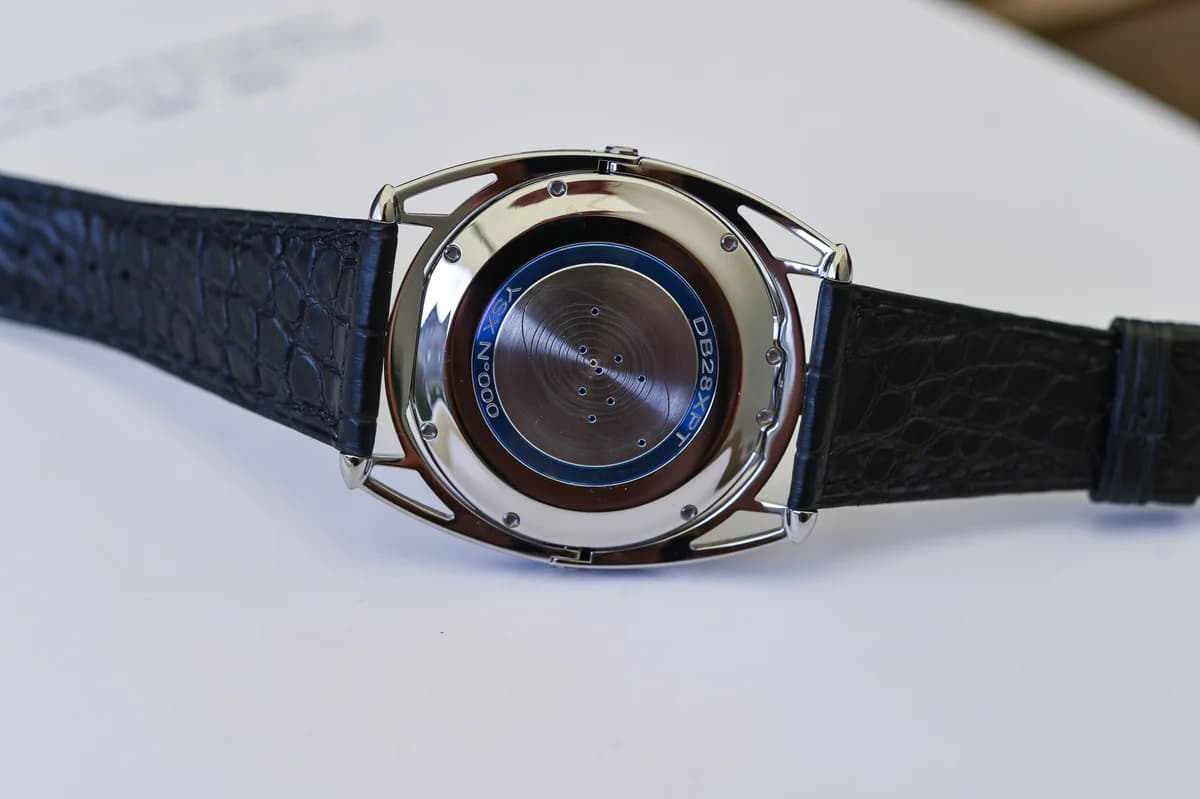
The case of the DB28 measures 42.6mm in diameter and 9.30mm in thickness in the current standard version. The original 2010 model was 11.4mm thick. When De Bethune celebrated the DB28's tenth anniversary in 2020 with the DB28XP, they reduced the thickness to 7.2mm while actually increasing the power reserve from five days to six. That kind of engineering is the opposite of what most brands do when they make anniversary editions. Most brands add gold and a commemorative caseback. Flageollet made the movement thinner, more efficient, and more powerful simultaneously. The case is typically grade 5 titanium, though De Bethune offers it in zirconium, white gold, and rose gold depending on the reference. Titanium is the signature material because it is light, hard, and allows Flageollet to apply his heat-bluing process, which creates that distinctive blue titanium finish that has become De Bethune's visual trademark.
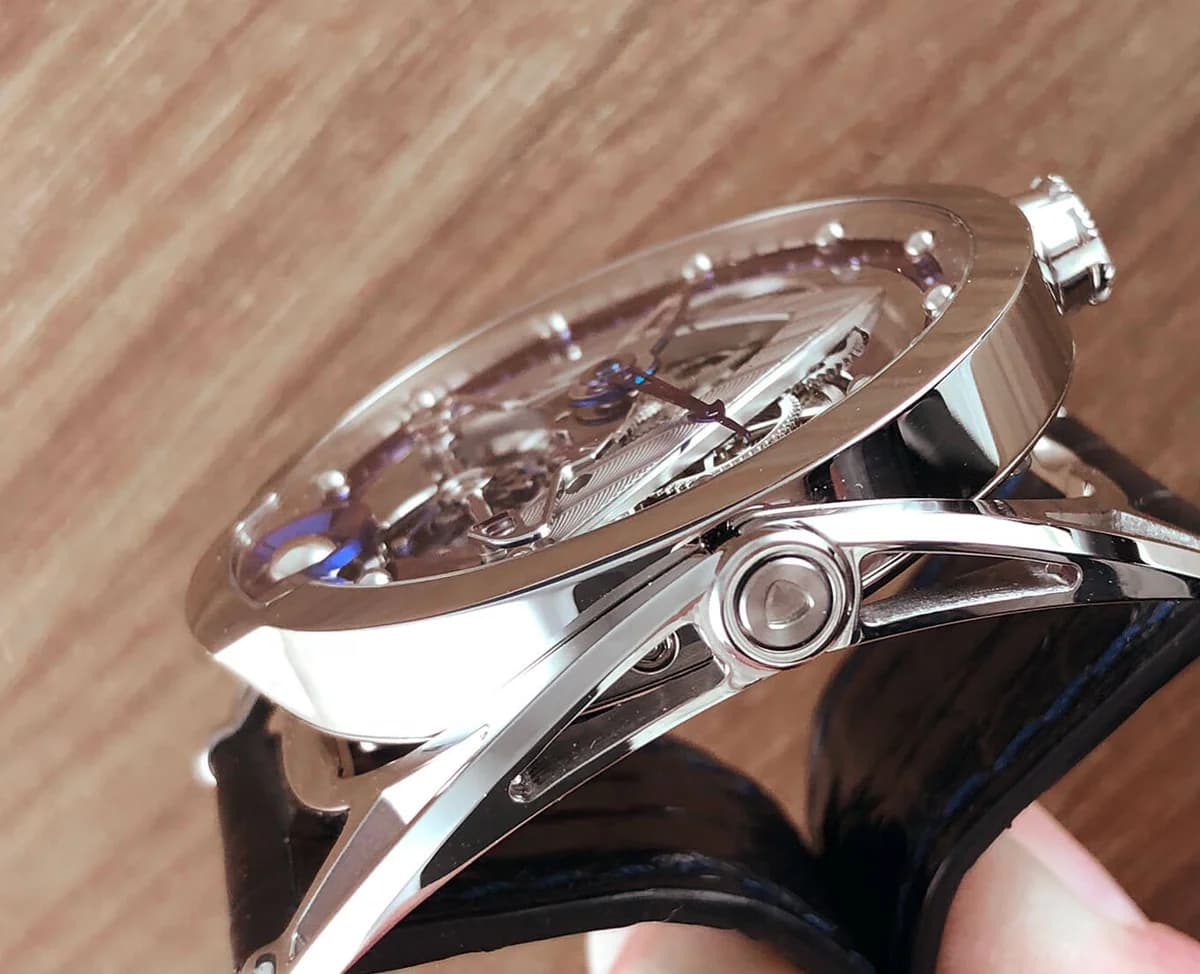
The floating lugs are the feature that people remember most after seeing the DB28 on a wrist. Patented in 2006, they are spring-loaded articulating lugs that pivot at the three and nine o'clock positions, allowing the case to float above the wrist and adapt to its shape. In standard form, the lug span varies from approximately 53mm to 58mm depending on the wrist geometry. De Bethune offers short and long lug options, and different sizes can be swapped during service for an even more tailored fit. Owners who have worn the DB28 daily for years report that the lug hinges and springs feel just as tight and precise after seven years as they did new. There is no play, no wobble, no degradation. For a moving mechanical joint on a watch case, that durability speaks to the quality of the engineering. Despite the 42.6mm case diameter, which sounds large on paper, the titanium construction keeps the weight low enough that the wrist impression is of a much smaller watch.
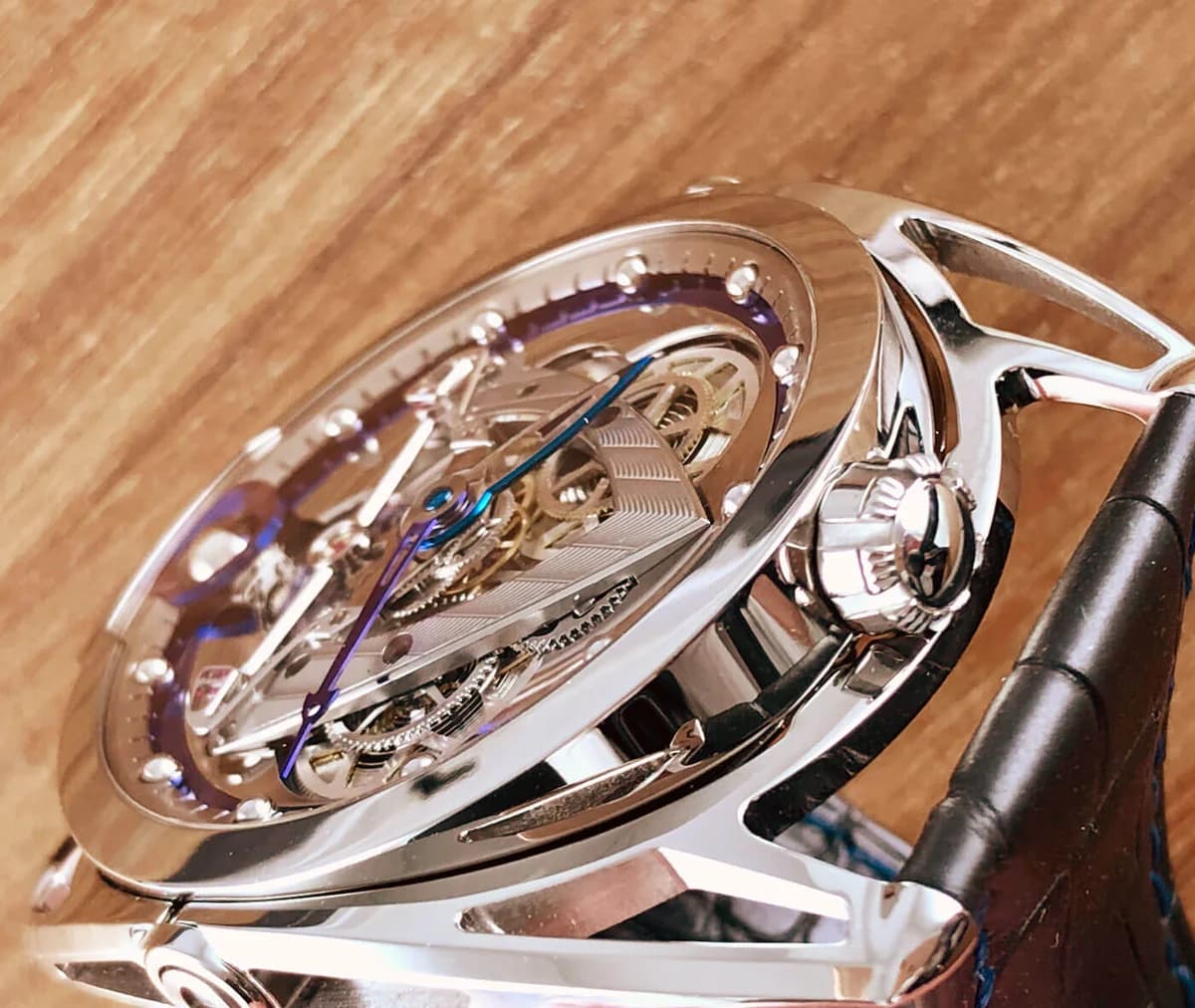
The crown at 12 o'clock is one of those design choices that seems purely aesthetic until you wear the watch. On most watches, the crown at 3 o'clock can dig into the back of the wrist during extension, particularly on smaller wrists. Moving it to 12 eliminates that pressure point entirely. It also creates a visual symmetry with the spherical moon phase at 6 o'clock that gives the DB28 a distinctive face. The crown is screw-locked and adjustable in two positions. Looking at the watch straight on, the movement bridges are visible through the dial side, creating a semi-open architecture where you can see the balance wheel oscillating near 6 o'clock, the silicon escape wheel, and the gear train in motion. A sapphire crystal front and back, both treated with double anti-reflective coating, allows light to enter from both sides.
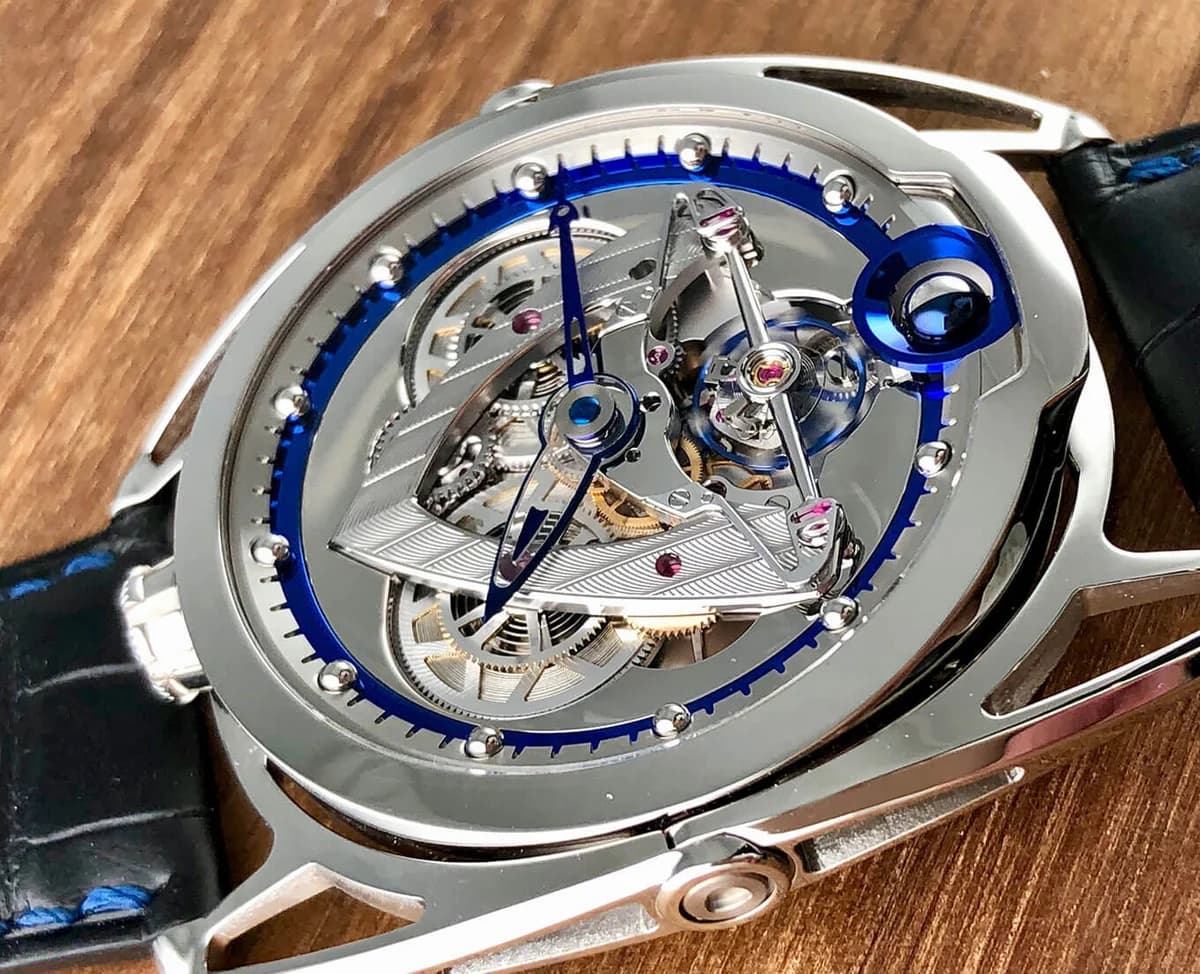
The spherical moon phase at 6 o'clock is a De Bethune patent from 2004 and it remains one of the most beautiful moon phase complications in watchmaking. It is not a flat disc behind an aperture like a traditional moon phase. It is a three-dimensional sphere, crafted from platinum and blued steel, that rotates on its own axis to display the current lunar phase. The accuracy is one lunar day every 122 years, which means in practice you would never need to adjust it in your lifetime. For context, most conventional moon phase displays lose a day every two and a half to three years. The spherical display is more mechanically complex, but it is also more intuitive and more beautiful than a flat aperture. Watching the tiny sphere rotate is one of those details that reminds you this is a handmade mechanical object, not a mass-produced consumer product.
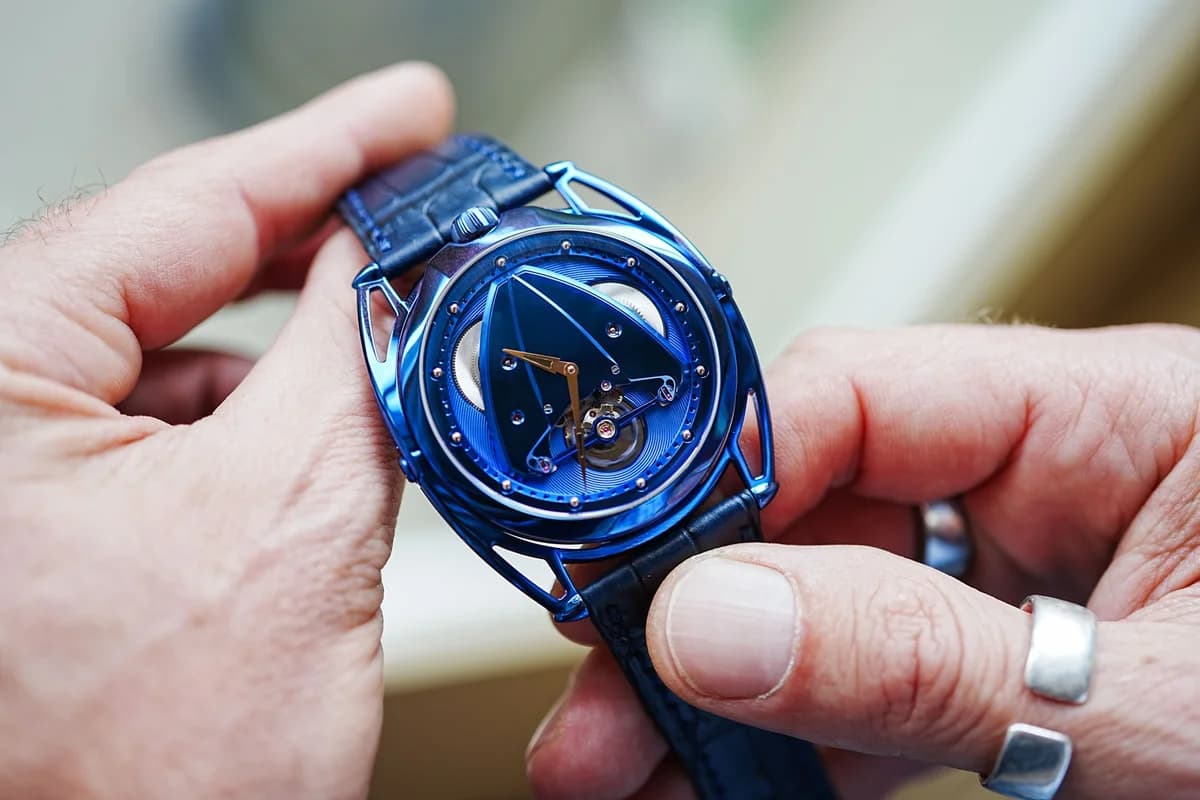
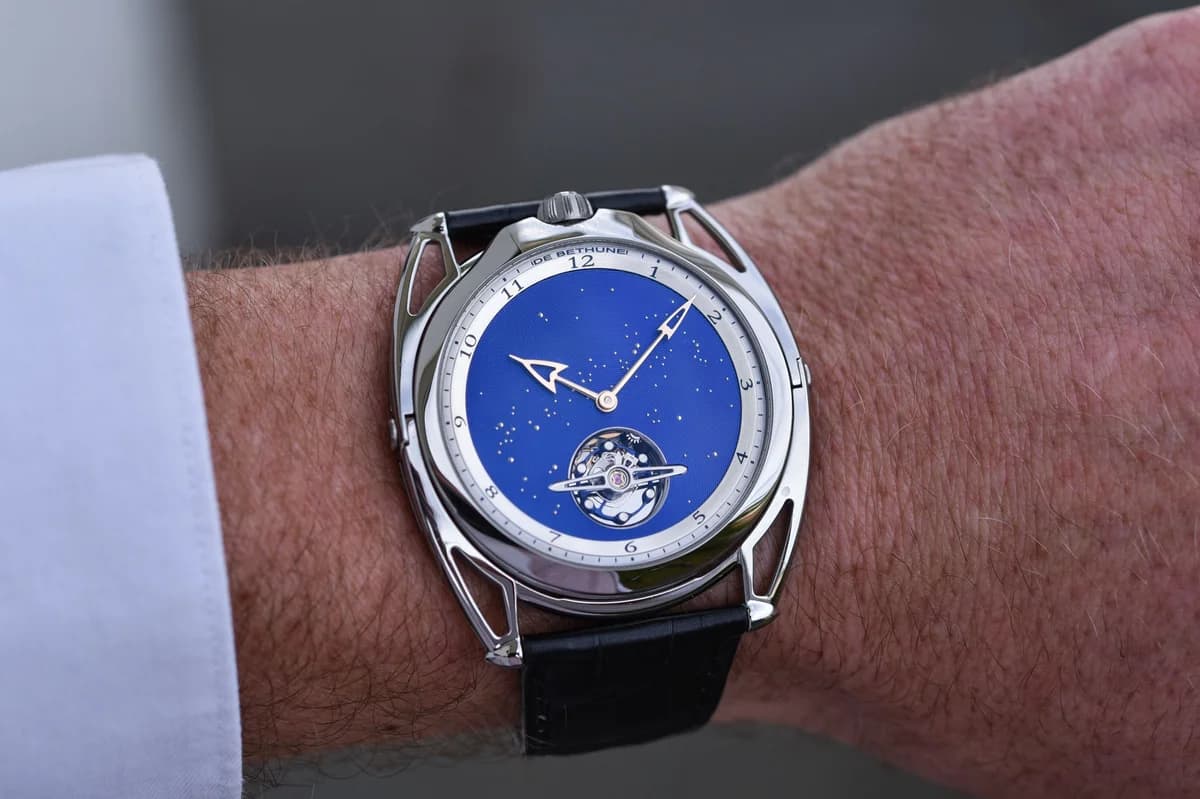
The Starry Varius and Starry Sky versions of the DB28 family take the celestial theme further. The dial is blued titanium with tiny pins of white gold driven through one by one to represent stars. Each pin is hand-set with care and accuracy to create a representation of the night sky. On the Starry Varius, the sky can be configured to depict the exact constellation visible from a specific location on a specific date. Your wedding night, the birth of a child, any moment that matters to you. The stars are not printed or engraved. They are physical gold pins set into metal. Under light, the blued titanium shifts between deep blue and near-black while the white gold pins catch and scatter light like actual stars. It is not a star chart. It is a sculpture that happens to be astronomically accurate if you want it to be.
De Bethune also produces DB28 variants with meteorite dials. The DB28XP Météorite, introduced in 2021, uses the Muonionalusta meteorite, one of the oldest known meteorites on Earth. The Widmanstätten patterns in the iron-nickel alloy create a dial surface that is genuinely unique to each watch because the crystalline structure varies throughout the meteorite. Earlier variants, like the DB28 Kind of Blue Tourbillon, used a meteorite from Santiago del Estero, Argentina. Working with meteorite at watchmaking tolerances is not straightforward. The material has to be stabilized, cut, polished, and finished to specifications that allow it to function as a dial surface without warping, corroding, or degrading over time. The fact that Flageollet treats four-billion-year-old space debris as just another material to be machined tells you something about his engineering mentality.
De Bethune has won the GPHG Aiguille d'Or in 2011, awarded to the DB28 as the best watch of the year. The Aiguille d'Or is the top prize at the Grand Prix d'Horlogerie de Genève, chosen by an international jury of professionals. The ceremony took place on November 19, 2011 at the Grand Théâtre de Genève in front of approximately 1,500 industry professionals. The brand has also won the GPHG Chronograph Prize in 2014 for the DB29 Maxichrono Tourbillon and the Chronometry Prize in 2018 for the DB25 Starry Varius Chronomètre Tourbillon. Three GPHG wins across three different categories tells you that the jury has trouble putting De Bethune in a single box, which is exactly the point.
I love that Flageollet trained alongside François-Paul Journe and Vianney Halter at THA. Those three represent three completely different philosophies of independent watchmaking. Journe is the classicist, building movements that could have existed in the 18th century if the materials had been available. Halter is the artist, creating cases and dials that look like they arrived from a parallel timeline. Flageollet is the engineer, pushing materials science and component design into territory that neither of the other two would pursue. All three of them worked in the same workshop for years. The fact that their watches look nothing alike despite that shared origin is evidence of how much personal vision matters in independent watchmaking.
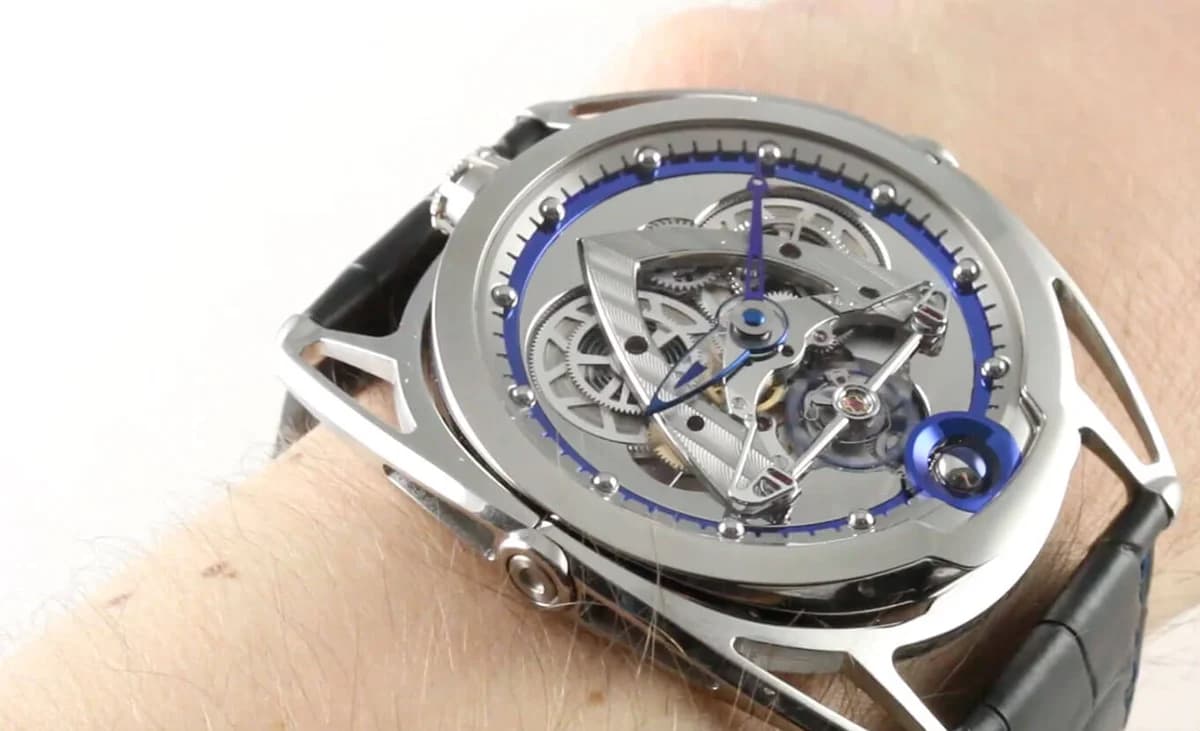
The honest critique of the DB28 is that De Bethune's small production volume makes the watch nearly impossible to experience in person. Fewer than 350 watches per year across all references means the DB28 is not sitting in a display case at your local authorized dealer. There are no De Bethune boutiques on every major shopping street. If you want to see one, you need to attend a watch fair, visit a specialist dealer, or know someone who owns one. That inaccessibility is genuine, not manufactured. Flageollet physically cannot produce more watches without compromising the finishing and innovation that make them worth seeking out. But it does mean that for most watch enthusiasts, the DB28 exists as something you read about rather than something you interact with. In my experience, the watches that leave the deepest impression are the ones you interact with in person. I wish more people could see the floating lugs in motion, watch the spherical moon phase rotate, and feel how light a titanium case sits on the wrist. The engineering deserves to be experienced, not just described.
The other observation is that the semi-open dial architecture, while visually dramatic, does sacrifice some legibility compared to a traditional dial. The hour markers are polished steel on a blued titanium ring, and the hands are flame-blued steel. In good light, it reads beautifully. In low light, the lack of applied lume on the standard DB28 means you are relying on the reflective properties of polished steel and the mirror-finished central plate. For a watch at this level, the absence of lume is a design choice rather than an oversight. Flageollet clearly prioritized the visual purity of the open movement over nighttime legibility. I understand the reasoning, and the watch is intended to be admired as much as it is read. But it is worth knowing going in.
The DB28 sits beautifully under a cuff despite its 42.6mm diameter because the 9.30mm thickness and titanium weight keep the profile slim and light. On my wrist, the floating lugs would tuck the 42.6mm case close without the overhang that a fixed-lug watch of that diameter would create. The blued titanium finish pairs naturally with darker skin tones, and the blue-to-black shift of the dial surface works with both navy and charcoal suiting. I think this is a watch that looks particularly good with Dormeuil tropical weight wool, where the lightness of the titanium case matches the lightness of the fabric. A heavy gold case on a heavy wool suit makes sense. A titanium case on a summer-weight suit makes a different kind of sense. The strap changes easily enough, though De Bethune uses its own lug attachment system rather than standard spring bars, so you are working within their strap ecosystem.
De Bethune is a future that most of the Swiss industry is not brave enough to pursue. The major groups iterate. They refine. They add a ceramic bezel here, a new alloy there, an extra ten hours of power reserve on the next generation. Flageollet reinvents. The floating lugs are not an improvement on traditional lugs. They are a replacement. The crown at 12 is not a variation on crown placement. It is a rethink of how the watch interfaces with the wrist. The silicon escape wheel is not an upgrade to a metal escape wheel. It is a different material chosen for different reasons. Every major design element of the DB28 is a first-principles decision rather than an incremental refinement. Felix Baumgartner of Urwerk reportedly called Flageollet "the best contemporary watchmaker, bar none." When the founder of one of the most technically adventurous independent brands in the world says that about another watchmaker, it carries weight.
I think about the DB28 the same way I think about the best architecture. Great architecture does not just solve the problem of shelter. It proposes a different way of living. The DB28 does not just solve the problem of telling time. It proposes a different relationship between the watch and the wearer. The floating lugs change how the case sits. The crown at 12 changes where you interact with it. The spherical moon phase changes what you look at. The open movement changes what you see. What strikes me is that every element invites a different kind of attention than a conventional watch demands. That is what makes it genuinely innovative rather than merely unusual. Denis Flageollet spent twelve years learning alongside Journe and Halter, decades restoring the greatest historical movements ever built, and then he used all of that knowledge to build something that looks forward instead of backward. The DB28 is the result.
Also in Independent Masters