
Casio
F-87W & F-91W
F-87W / F-91W-1 / F91WM-9A
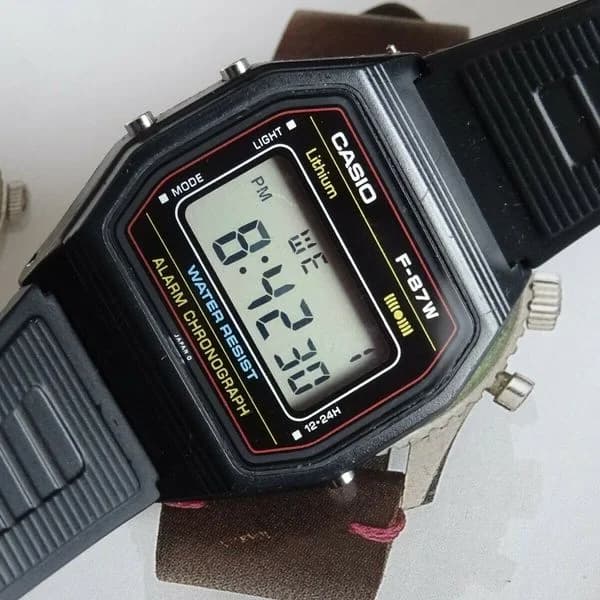
This is the watch that started everything for me. Not the F-91W that everyone knows. The one before it. The Casio F-87W, with its red border around the dial, the word "Lithium" printed right on the face, and an amber backlight that glowed warm when you hit the button. That was my watch. Somewhere around 1984 or 1985, this thing ended up on my wrist, and nothing has been the same since.
Historical context
3 images· tap to view
The F-87W came out in the mid-1980s, right in the middle of the digital watch era. It ran on Module 415 in the early production and Module 595 in later runs. The specs were almost identical to what the F-91W would later offer: a CR2016 lithium battery rated for about five years, a stopwatch, a daily alarm, an hourly signal, and a backlight. But the details were different. The case had traditional lugs instead of the integrated strap design the F-91W would introduce. The dial had "Lithium" printed on it because in the mid-1980s, lithium battery technology was still new enough to be a selling point. Most digital watches at the time needed battery changes every year or two. Five years was remarkable, and Casio wanted you to know it. By 1989, when the F-91W came out, lithium batteries had become standard and the text was removed.
Historical Video
The Casio F-87W head-on, in hand, on a NATO strap. Video credit: @thizz_king on Instagram
The F-87W on the wrist with a NATO strap. Video credit: @thizz_king on Instagram
And then there was the red. The F-87W had a red accent border around the dial, which made it visually distinct from its sibling, the F-84W, which had a blue border. Mine had the red. That red with the black case and the yellow text gave it a warmth that the later F-91W, with its blue accent ring, never quite matched.
But the real difference was the light. The F-87W had an amber LED microlight. Not the greenish-blue LED that current F-91Ws have. A warm, soft amber glow. And that amber light is specifically why I loved hitting that button so much. It was soft on the eyes, almost cozy. I would hide under blankets, crawl into dark closets, go under tables, anywhere dark, just so I could press that button and watch the display glow. I felt like a secret agent. I was watching Knight Rider on TV, watching David Hasselhoff talk into his watch to communicate with kitt, and then I would look down at my F-87W and press the light button and feel like I was doing the same thing. I was watching shows with countdown timers and bomb defusal scenes, and I would set my stopwatch and imitate what I saw on screen. The watch was not just a watch. It was an extension of every toy I played with and every TV show I watched. It was part of my imagination.
When the strap broke or got uncomfortable, I would take the head off and put it in my backpack. Just the module in a little pocket, like a pocket watch. I would pull it out to check the time and put it back. I did this for months before getting a new strap. A kid carrying a digital watch head in his bag like some kind of miniature instrument. Looking back, that might have been my first experience with the idea that the watch itself is what matters, not how you wear it.
The 1980s were a different world for watches. Digital dominated everything. The Swiss industry was in freefall from the Quartz Crisis. Their market share had crashed from over 50% in the 1960s to 24% by 1978. The number of Swiss watch companies dropped from 1,600 to under 600. Meanwhile, Casio, Seiko, and Citizen were putting calculator watches, game watches, and data bank watches on the wrists of every kid in America. Mechanical watches were what your grandfather wore. Digital was the future, and the future was accessible. For the price of a couple of comic books you could get a watch with a stopwatch, an alarm, a backlight, and a date function. The F-87W was exactly that kind of watch. Pure function, pure fun, at a price that put it on the wrist of anyone who wanted one.
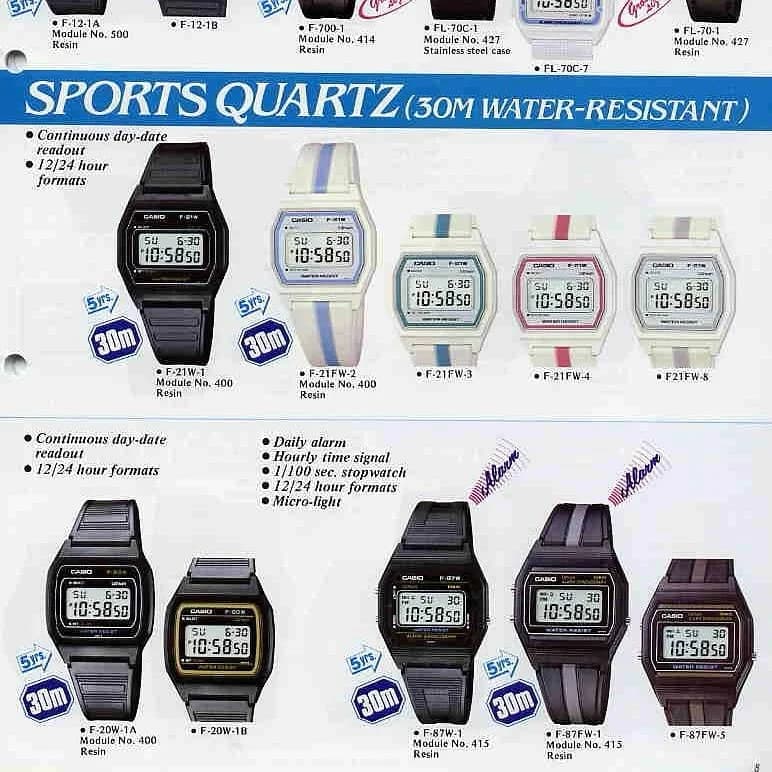
Looking at the original Casio catalog page from 1984 tells you everything you need to know about how this watch was positioned. The F-87W sits in the "Sports Quartz" section alongside the F-20W, the F-21 series, and other F-series models, all rated at 30 meters water resistance. You can see the F-87W-1 in black with Module 415 and the F-87FW-5 in brown, both listed as resin case construction. The catalog shows "5 yrs" battery life, the 30m water resistance badge, and the key features: daily alarm, hourly time signal, 1/100 second stopwatch, 12/24 hour formats, and the micro-light. That micro-light is the amber LED I keep talking about. What strikes me about this catalog is how many variants Casio was producing simultaneously. The F-21FW series alone had at least five color options including white with colored stripes. This was Casio flooding the market with affordable digital watches in every color and configuration imaginable. The Swiss were losing market share by the month, and this one page shows you exactly why.
The module lineage tells a story most collectors miss entirely. The F-87W launched with Module 415, the first generation, made in Japan starting in 1984. That module was the foundation for an entire family. Casio iterated through Modules 587, 590, 593, 595, and 596, all sharing the same basic architecture and the same instruction manual. Module 595 appeared in later F-87W production runs. Module 593 became the heart of the F-91W and is still in production today. The fact that all six modules share a single manual tells you how consistent the engineering was across the family. Casio did not reinvent the circuit with each revision. They refined it, reduced production costs, and optimized for longevity. The Module 415 in a 1984 F-87W and the Module 593 in a 2026 F-91W are fundamentally the same design, separated by four decades of incremental improvement.
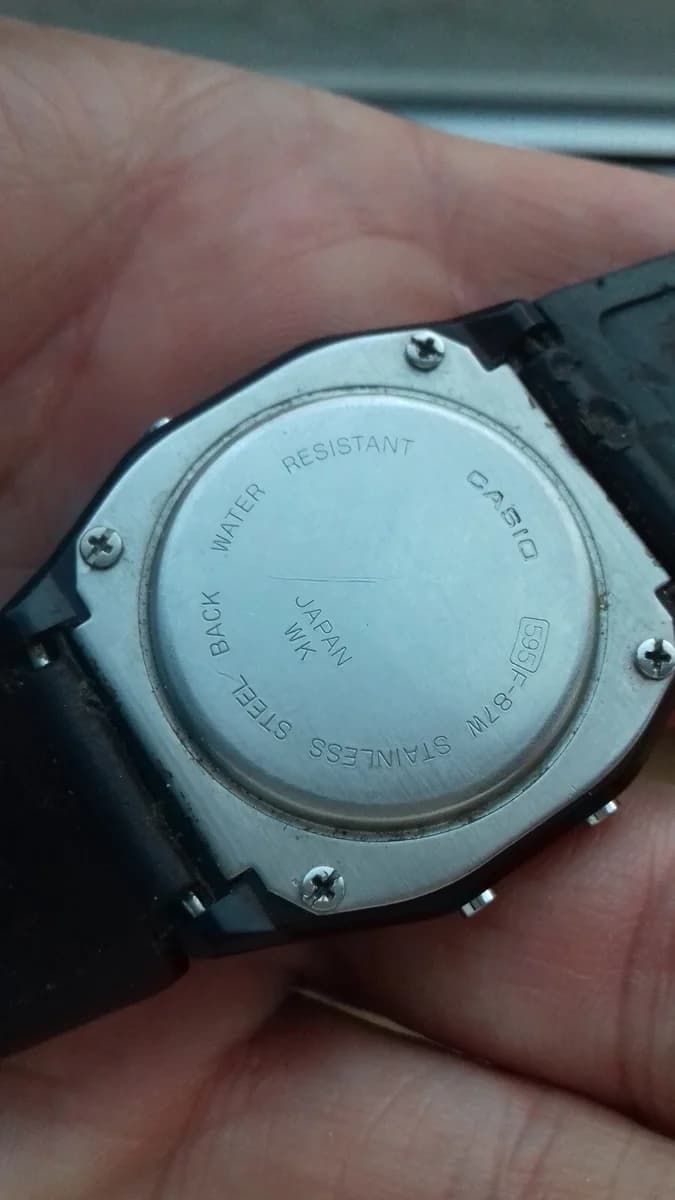
The F-87W is discontinued now. It has been for decades. If you find one on eBay or a collector marketplace, you will quickly discover how rare they have become. There was even a TV Asahi branded Japanese domestic version, which tells you the watch had enough market presence in Japan for corporate tie-ins. It is genuinely rare at this point. The F-91W sells three million units a year. The F-87W is a collector's piece that most people have never heard of.
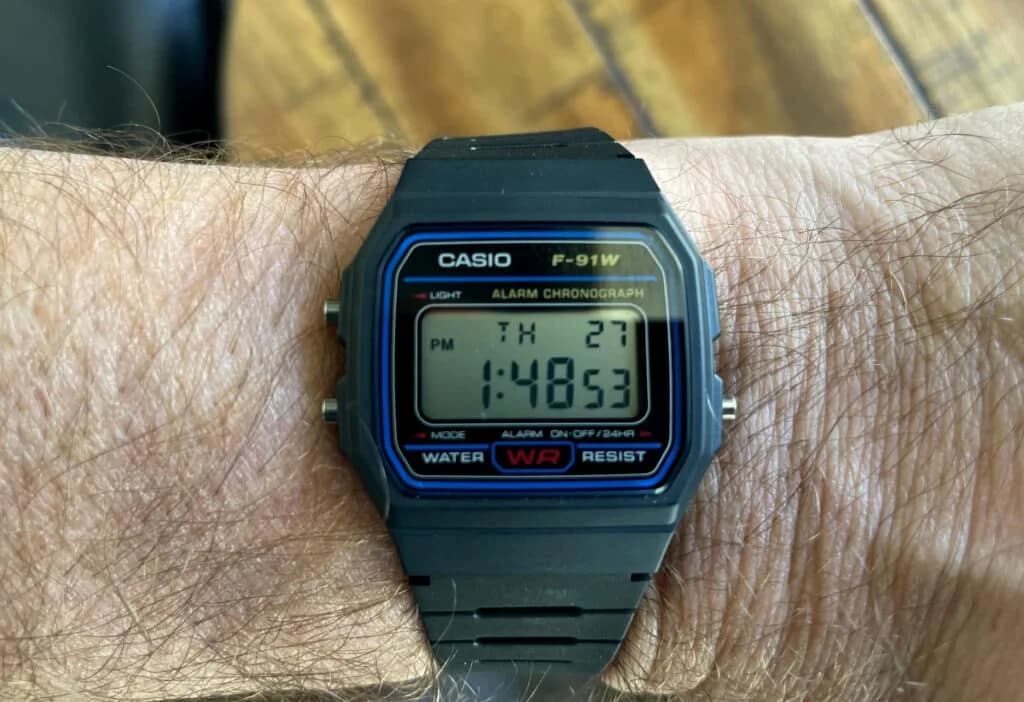
And that is where the story transitions. In June 1989, a designer named Ryusuke Moriai created his first watch for Casio. It was called the F-91W, and it was a direct successor to the F-87W. Moriai later became the chief designer of the G-Shock line, which tells you something about the caliber of mind behind this unassuming little watch. The design brief was simple: take what the F-87W did well and refine it. Build a watch anyone could afford, make it accurate enough to trust, and keep it running for years without maintenance. Moriai achieved all three goals so completely that Casio has never changed the design. The F-91W you buy today in 2026 is essentially the same watch that rolled off the line in 1989. 37 years of continuous production with no redesign. That is not a lack of innovation. That is a design so right the first time that there was never a reason to touch it.
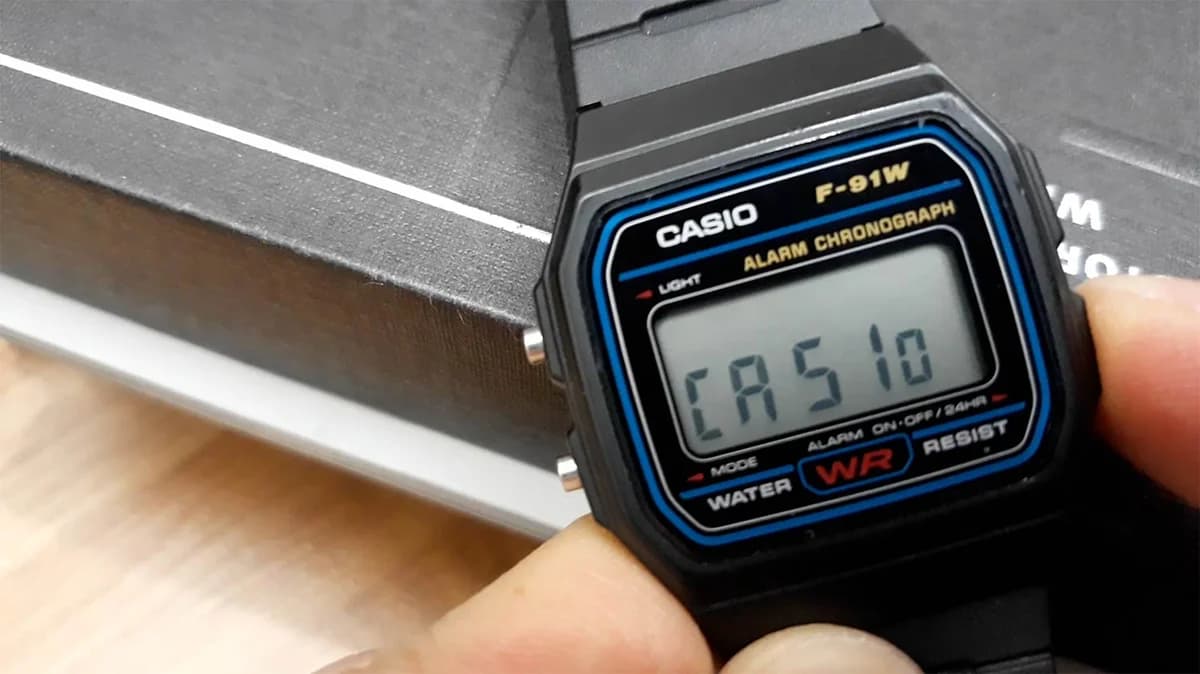
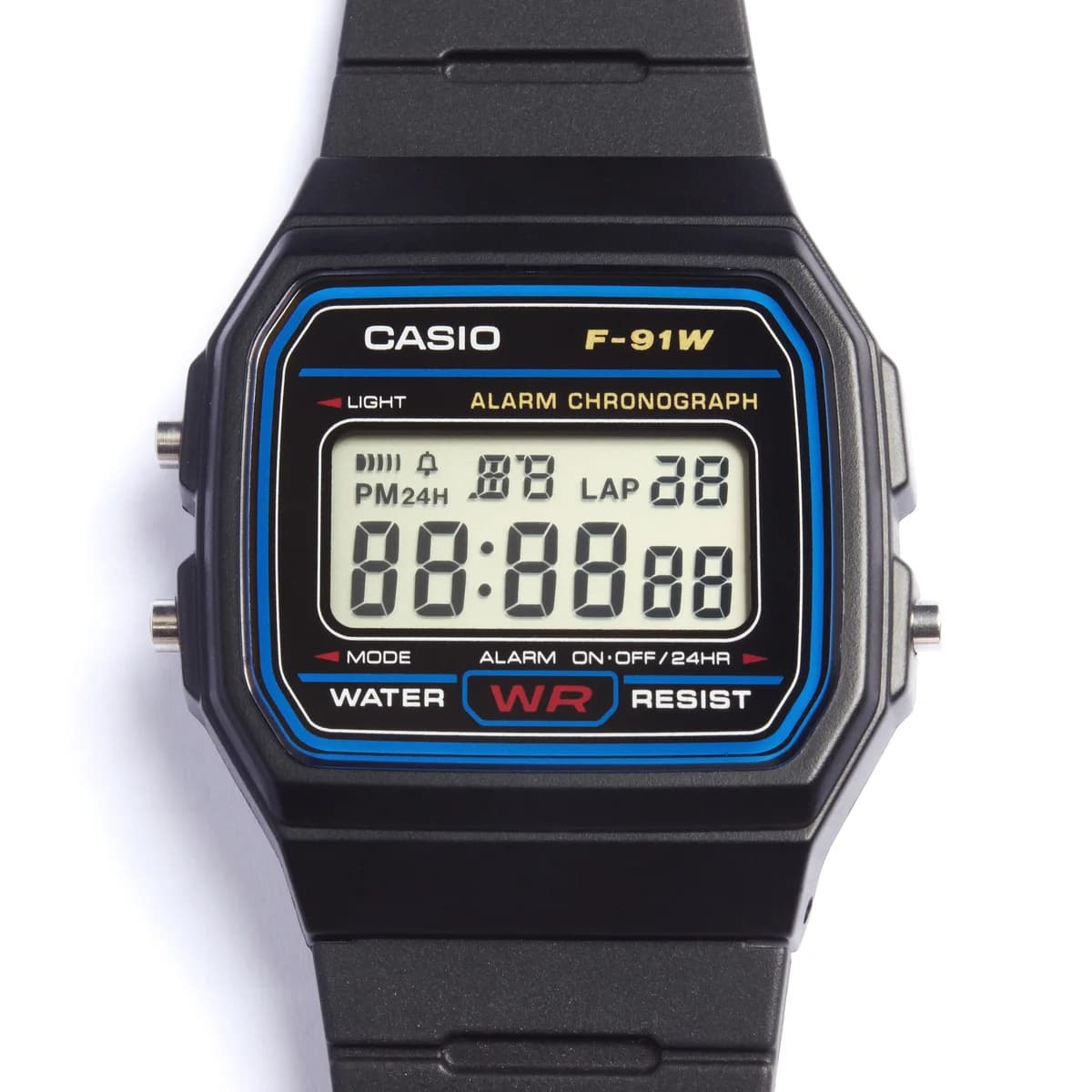
What Moriai changed from the F-87W was subtle but important. He gave the case an integrated strap design instead of traditional lugs, which made it sleeker and more modern. He swapped the red border for a blue accent ring. He cleaned up the dial, removing the "Lithium" text. He kept the same essential functions, the same battery life, the same accessibility. The F-91W weighs 21 grams, runs on a CR2016 battery for about seven years, is accurate to plus or minus 30 seconds per month, and has a stopwatch, daily alarm, auto calendar, and LED backlight. The LED changed from amber to green over the years. Every decision in this watch was made to deliver maximum function at minimum cost, and the result is something that anyone on earth can afford.
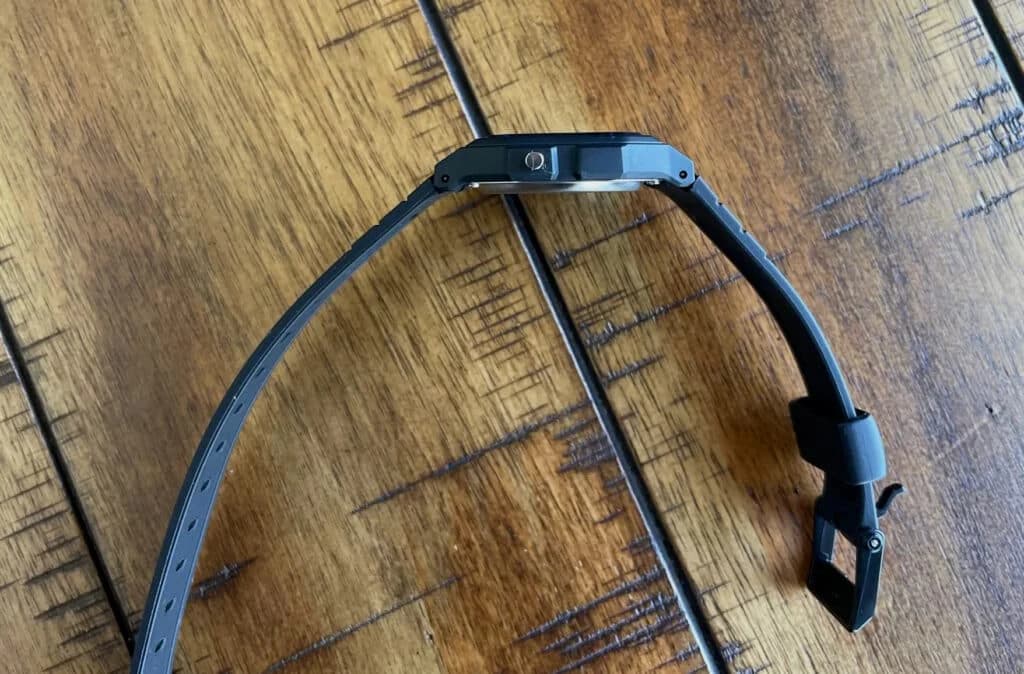
The engineering achievement is easy to overlook because the watch looks so simple. But that simplicity is the engineering. The Module 593 has a minimal number of components. Fewer parts means fewer failure points. The resin case absorbs shocks rather than transmitting them to the circuit. The LED backlight draws almost nothing, which is why the battery lasts seven years. The tooling for production was amortized decades ago. Casio produces approximately three million F-91Ws per year and has done so for 37 years. Over 100 million units sold. It is the best-selling traditional watch in human history. The ieee inducted it into the Consumer Electronics Hall of Fame alongside the transistor radio and the Sony Walkman.
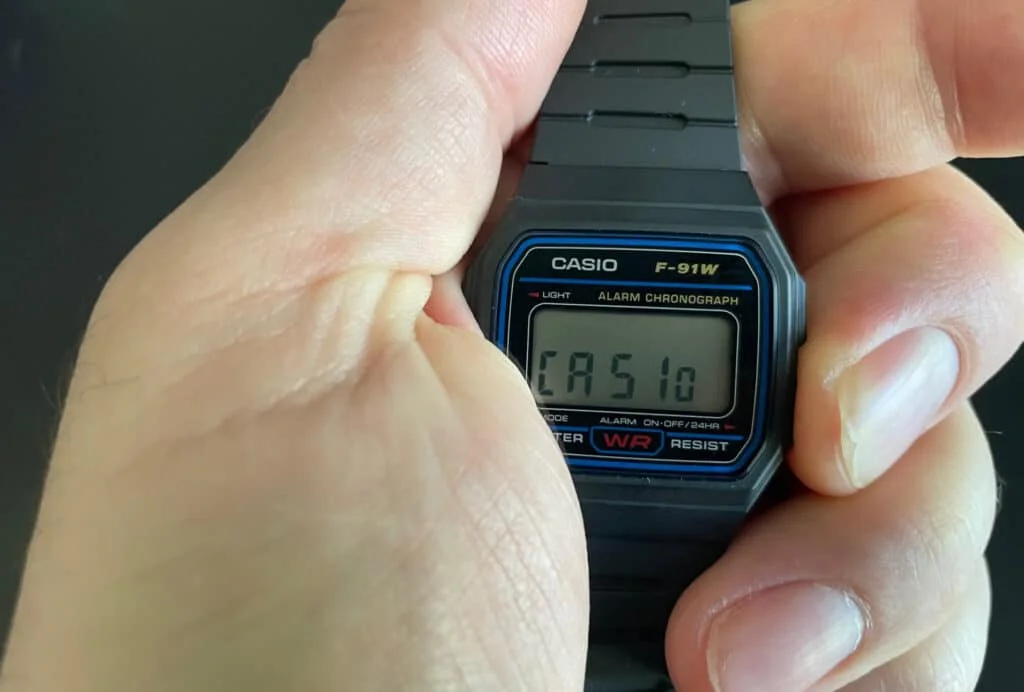
The cultural significance of this watch goes beyond sales numbers. Barack Obama has been photographed wearing one. So has Osama bin Laden. Neo wears one in The Matrix. Walter White wears one in Breaking Bad. At Guantanamo Bay, the F-91W was listed as a suspicious item because al-Qaeda reportedly distributed them at training camps. The alarm function, long battery life, and cheap availability made it useful as a timing component. Watch collectors with six-figure collections genuinely respect the F-91W. Not ironically. It represents what horology is supposed to be about at its most basic level: a device that tells time reliably.
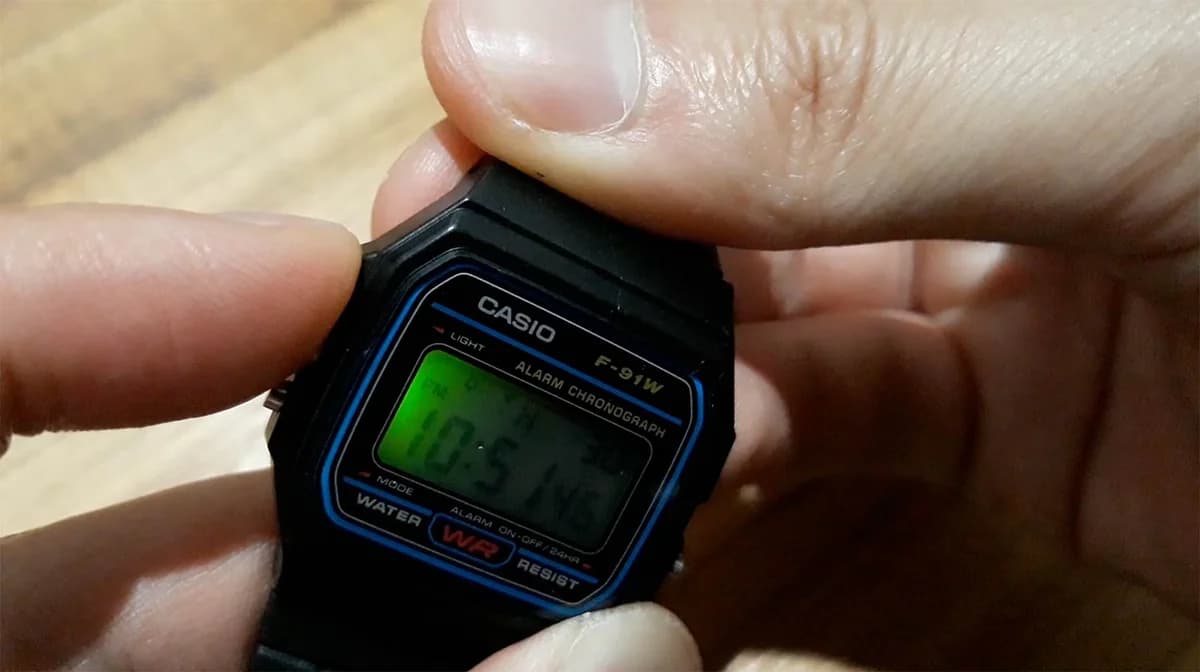
If there is a criticism of either watch, it is the water resistance. Both the F-87W and F-91W are rated for splashes and rain, not swimming. The acrylic crystal will scratch over time. These are not complaints. They are the honest tradeoffs of watches that cost less than lunch.
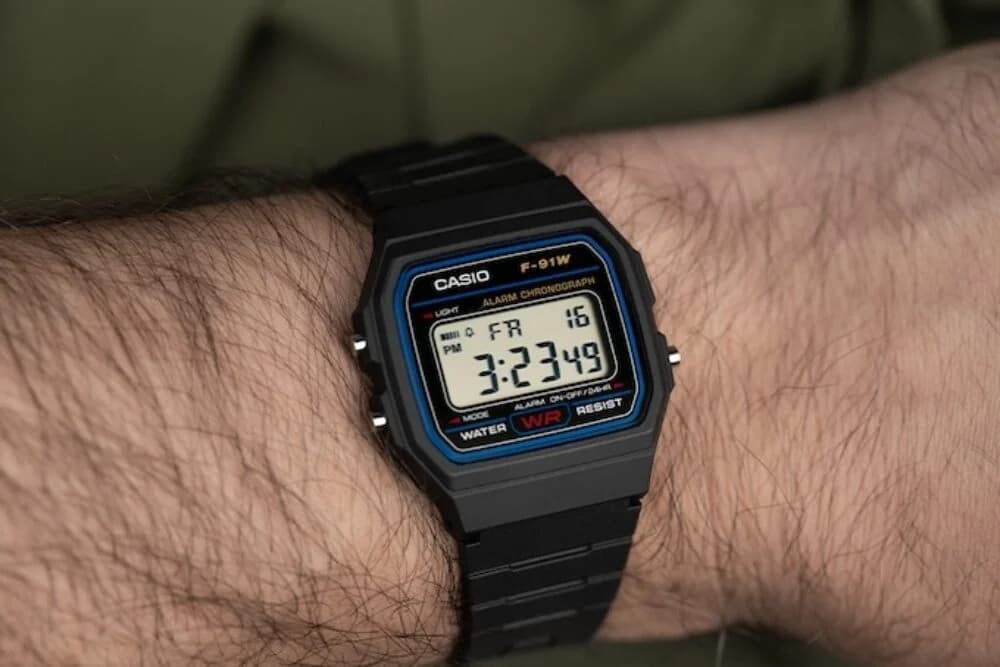
Something that doesn't get enough attention is the modding community that has grown up around the F-91W. People swap the resin strap for a single-pass NATO in olive or grey, and suddenly this mass-produced digital watch reads completely differently. There's an entire subreddit dedicated to exactly this combination, with thousands of members posting their configurations daily. The modding goes further. People install new LED colors. They swap the modules into different cases. They source first-generation DH-stamped modules from Japan, before production moved to Thailand and China, and treat them as collectibles. A Made in Japan F-91W from the late 1980s or early 1990s with an early Module 593 and original DH stamp is a different object than the current production version, even though they're functionally identical. The collector's eye finds the nuance. It always does.
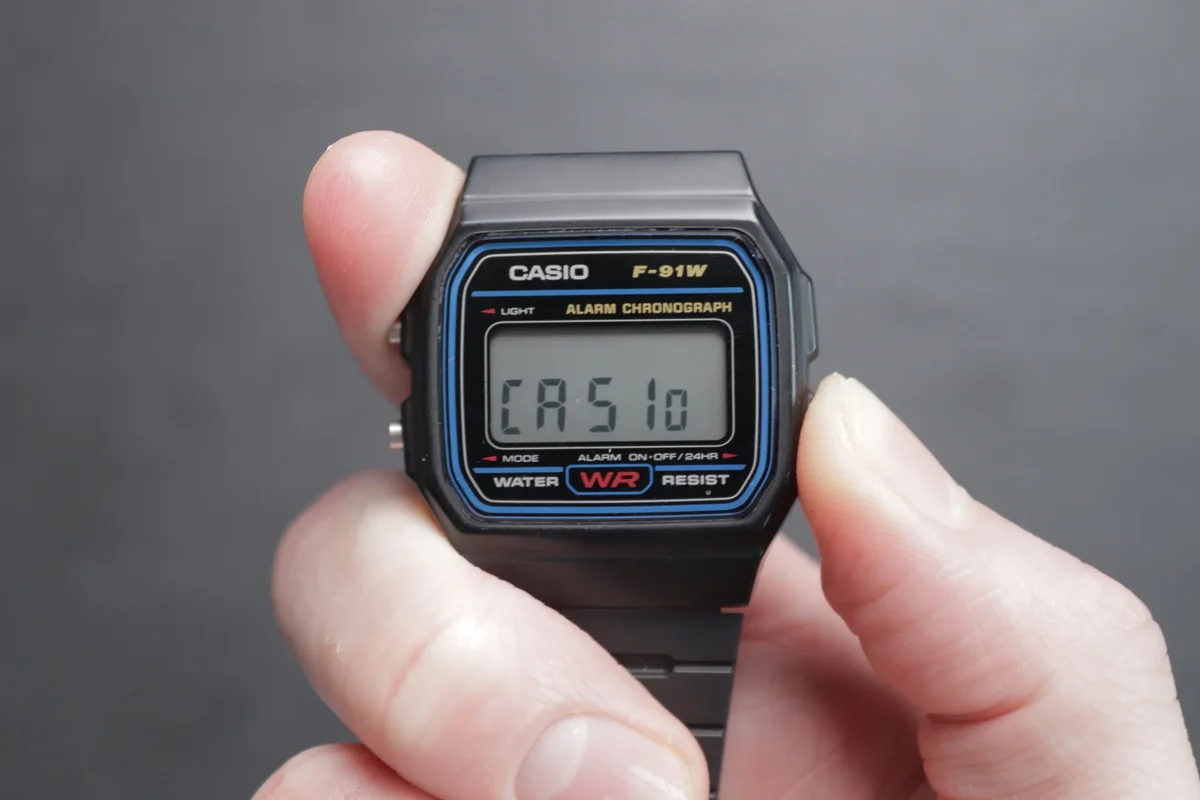
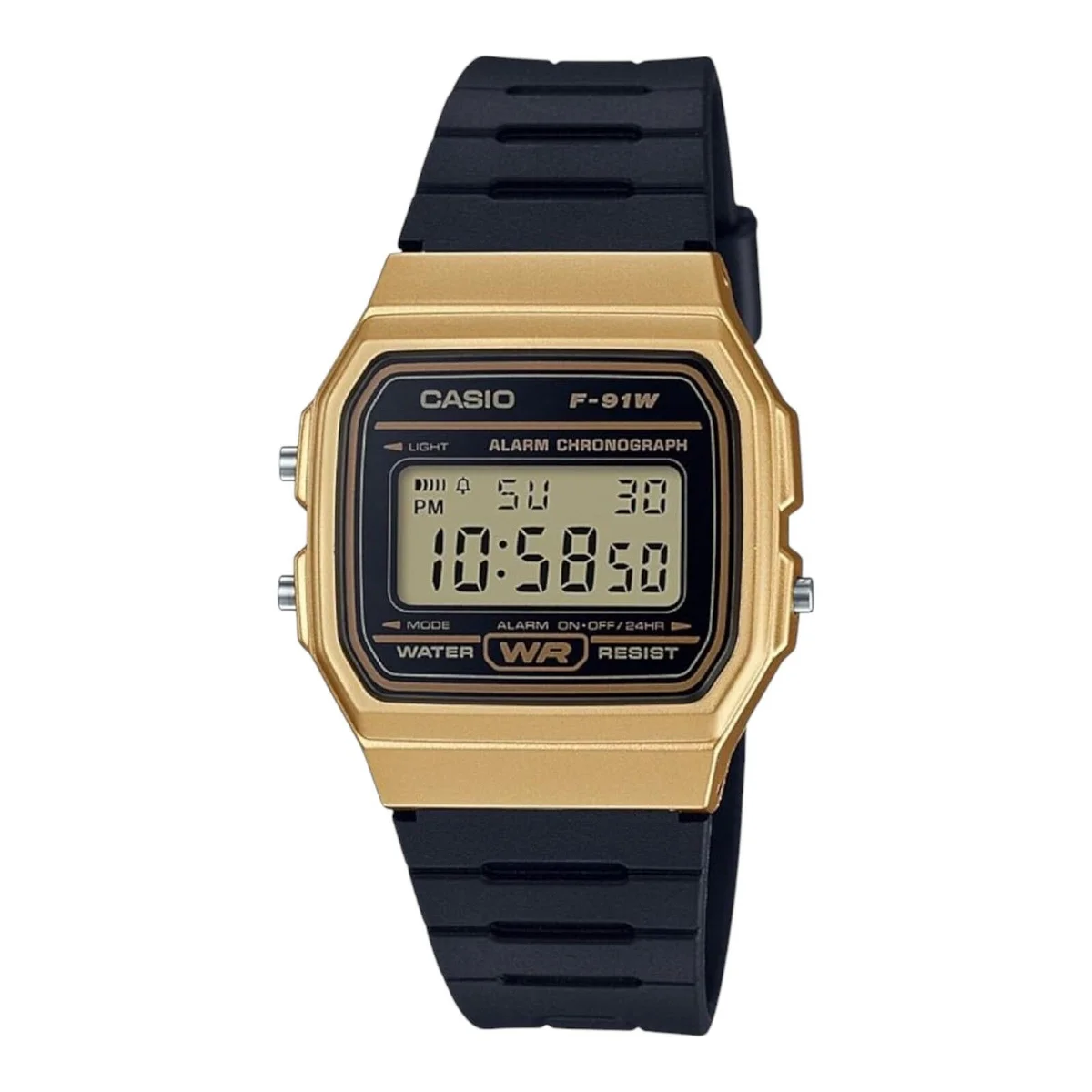
The F91WM-9A is the one that gets me every time. The WM series dropped in 2018 and the 9A colorway is the most considered of the bunch. Gold-tone resin case, gold-tone dial text to match, black resin strap as the counterweight. Everything coordinated. Nothing fighting anything else.
What I want to make clear: this is not a gold-plated watch. There is no metal here. The case is resin, same material as the standard F-91W, just molded in gold. That means it actually ages better than a plated finish would. Plating wears through. This doesn't. And it keeps the watch at 21 grams, which is essentially nothing on the wrist. You forget it's there after about 10 minutes. The dimensions are unchanged from the classic: 38.2 by 35.2 millimeters, 8.5 millimeters thick. It slides under a cuff without catching.
Inside, it's running Module 593. The same module that's been in the F-91W since 1989. Stopwatch, alarm, calendar, backlight. Nothing has changed mechanically because nothing needed to change. The 593 has been quietly accurate for decades and the WM series sees no reason to complicate that.
What the gold colorway does is shift the character of the watch entirely. The standard F-91W disappears. That's part of its genius and also part of its limitation. The F91WM-9A doesn't disappear. It announces itself, quietly. Gold reads warm, intentional, dressed-up without being dressed-up. On darker skin it pops in a way that the black-on-black never does. This is my favorite colorway in the entire F-91W family because it offers a level of class that the utilitarian black version simply can't reach. Same bones, completely different energy. The modding community figured that out years ago. They were right.
The fashion world has noticed, too. The F-91W has appeared in fashion editorials alongside watches that cost a thousand times more. The logic is obvious once you see it: the contrast is the point. A full-grain leather strap on a fifteen-dollar digital watch is a deliberate signal that the person wearing it understands what they're doing and isn't trying to impress anyone. It's the opposite of signaling, which is itself a form of signaling to people who understand that game. When a watch that costs less than a meal appears next to a five-figure Swiss piece in a magazine spread and the editor doesn't feel the need to explain the juxtaposition, the watch has achieved something. The F-91W belongs in that conversation.
The IEEE Consumer Electronics Hall of Fame is where I always end up when I'm trying to explain to someone why this watch matters beyond the personal story. The inductees include the transistor radio, the Sony Walkman, and the Casio F-91W. Those are three objects that changed how people interact with technology. The transistor radio put professional broadcast sound in a pocket. The Walkman privatized music. The F-91W put precise timekeeping, a stopwatch, an alarm, and a backlight on anyone's wrist for almost nothing. These are not equivalent in scale, but the principle is the same: technology that was once inaccessible became universal. When your watch keeps time to within 30 seconds per month over a seven-year battery life, the argument that timekeeping requires a complicated mechanical movement becomes a different kind of argument. Not wrong. But different. The F-91W doesn't try to be anything other than what it is, and that honesty is why it endures.
The production longevity is staggering when you think about it in manufacturing terms. The tooling for the Module 593 was amortized decades ago. The LCD supplier relationships have been in place since the 1980s. The resin injection molds for the case have been refined over 37 years to the point where they're essentially perfect at what they do. Three million units per year, every year, with no redesign. That kind of production stability doesn't happen by accident. It happens because the product is so precisely right that any change would be an improvement in the wrong direction. Ryusuke Moriai understood in 1989 that the best design for this watch was the simplest possible design, executed with enough quality to last years and priced so that anyone could have one. That's not a compromise. That's vision. 37 years of unchanged production is the market confirming the vision every single day.
What I find myself returning to, decades after the F-87W, is how much that watch shaped the way I think about design. Not the aesthetics, but the philosophy behind it. A well-designed object does its job so precisely and so reliably that you stop thinking about it. The F-87W told time, glowed in the dark, beeped when I needed it to, and survived everything a kid put it through. The F-91W does exactly the same thing and has done so for hundreds of millions of people. Casio and Ryusuke Moriai proved that functional perfection could come from a resin case and a modest battery. I never forgot that lesson.
I think about the F-87W differently now than I did as a kid. Back then it was a toy, a gadget, an extension of my imagination. Now I see both of these watches as genuine pieces of design history. The F-87W established the template in the mid-1980s with its red border and amber glow. Ryusuke Moriai took that template in 1989 and created something that has sold over 100 million units, been inducted into the same hall of fame as the transistor radio, and still costs almost nothing. The one I grew up with, the F-87W with the red accent and the warm amber light, is now a collector's piece. Its successor is still selling three million units a year, unchanged. That kind of lineage, from my wrist as a kid to the most sold watch in history, is something I find genuinely remarkable. And it all started with a light button and a dark closet and a kid who felt like a secret agent. These two watches, separated by two years of production and separated by thirty-seven years from now, make the same argument: that clarity of purpose and honesty of construction are never out of date.
Also in Tool Watches