
Breguet
Tradition
7097BR/G1/9WU
Abraham-Louis Breguet was born in Neuchatel in 1747 and founded his workshop on the Quai de l'Horloge in Paris in 1775. He was 28 years old. Over the next 48 years, he invented or perfected the tourbillon (patented June 26, 1801), the pare-chute shock protection system (the forerunner of every modern shock absorber in every mechanical watch), the perpetuelle self-winding mechanism using a pivoted platinum weight, the Breguet overcoil hairspring for improved isochronism, and the pomme hands that now bear his name. He created the gong spring for repeater watches in 1789, replacing the bell with a flat spring that took up far less space and allowed thinner case construction. He developed the secret signature as an anti-counterfeiting measure in 1795, because even during his own lifetime, his work was so admired that it was extensively forged. He pioneered guilloche engine-turning on dials starting around 1786. He created the montres a tact in 1799, watches that could be read by touch in the dark, and Empress Josephine purchased one on February 18, 1800. He sold watches to Napoleon, Marie Antoinette, and the Ottoman Sultan. When he died in 1823, he had fundamentally shaped what a mechanical watch could be. Every watchmaker working today, whether they know it or not, is building on Breguet's foundations.
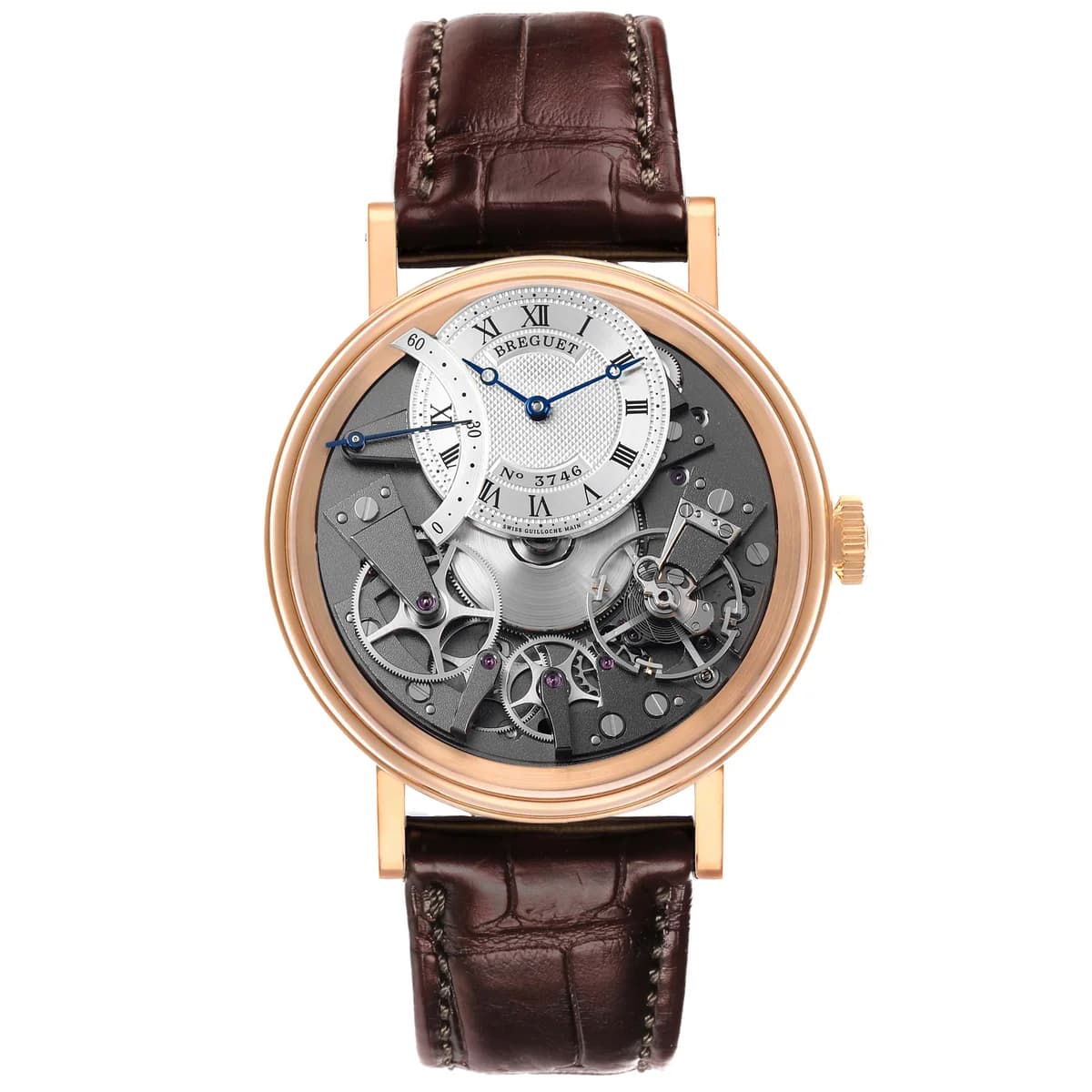
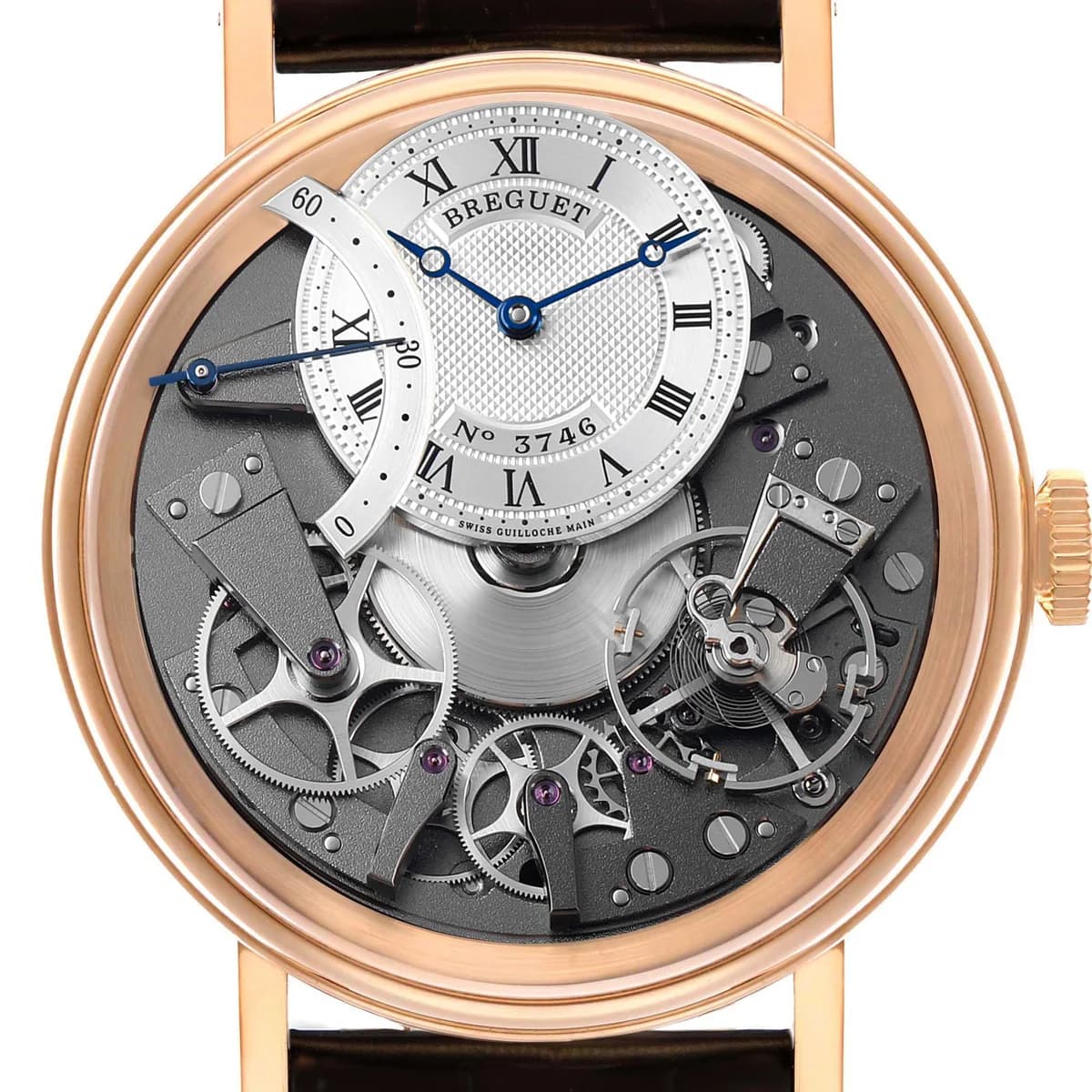
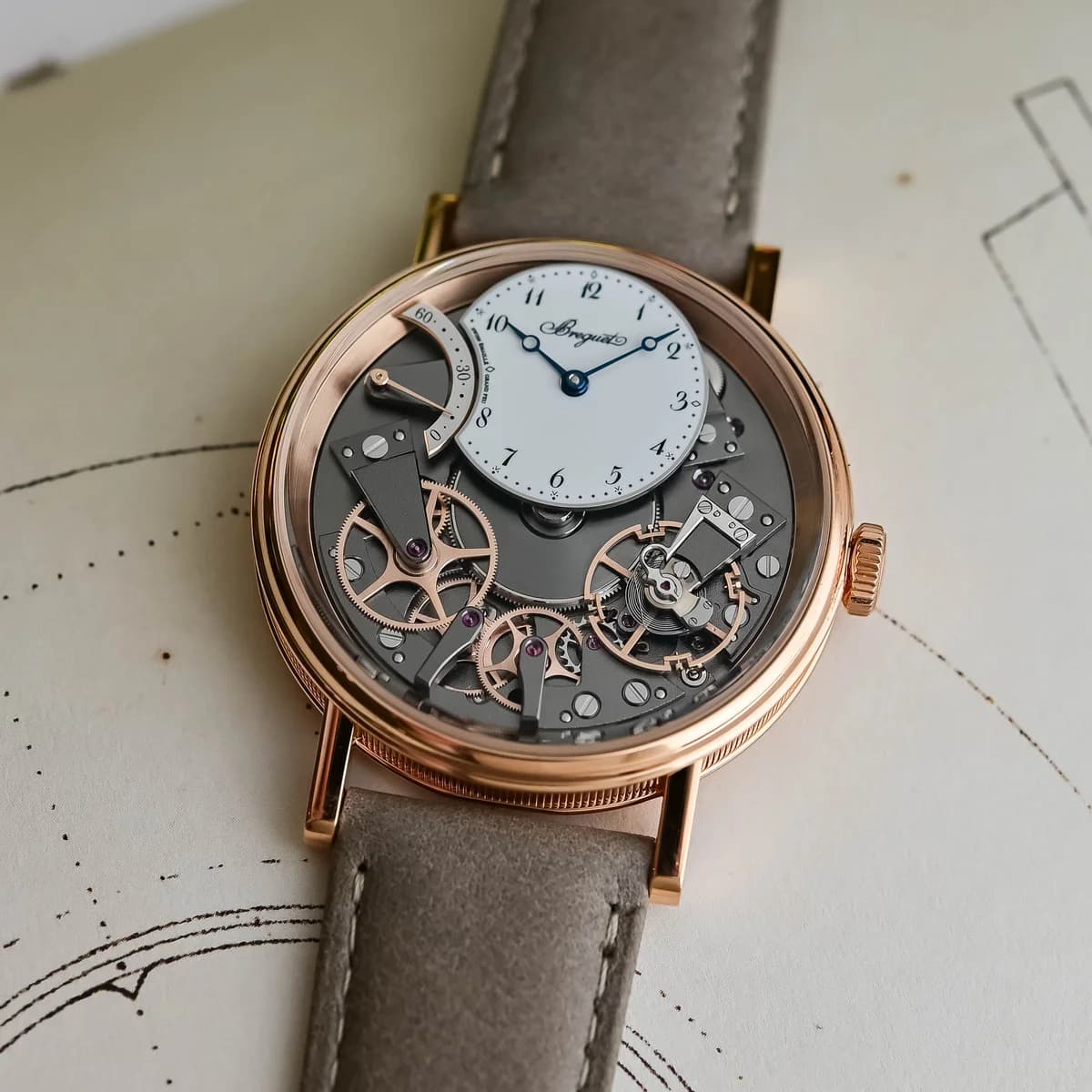
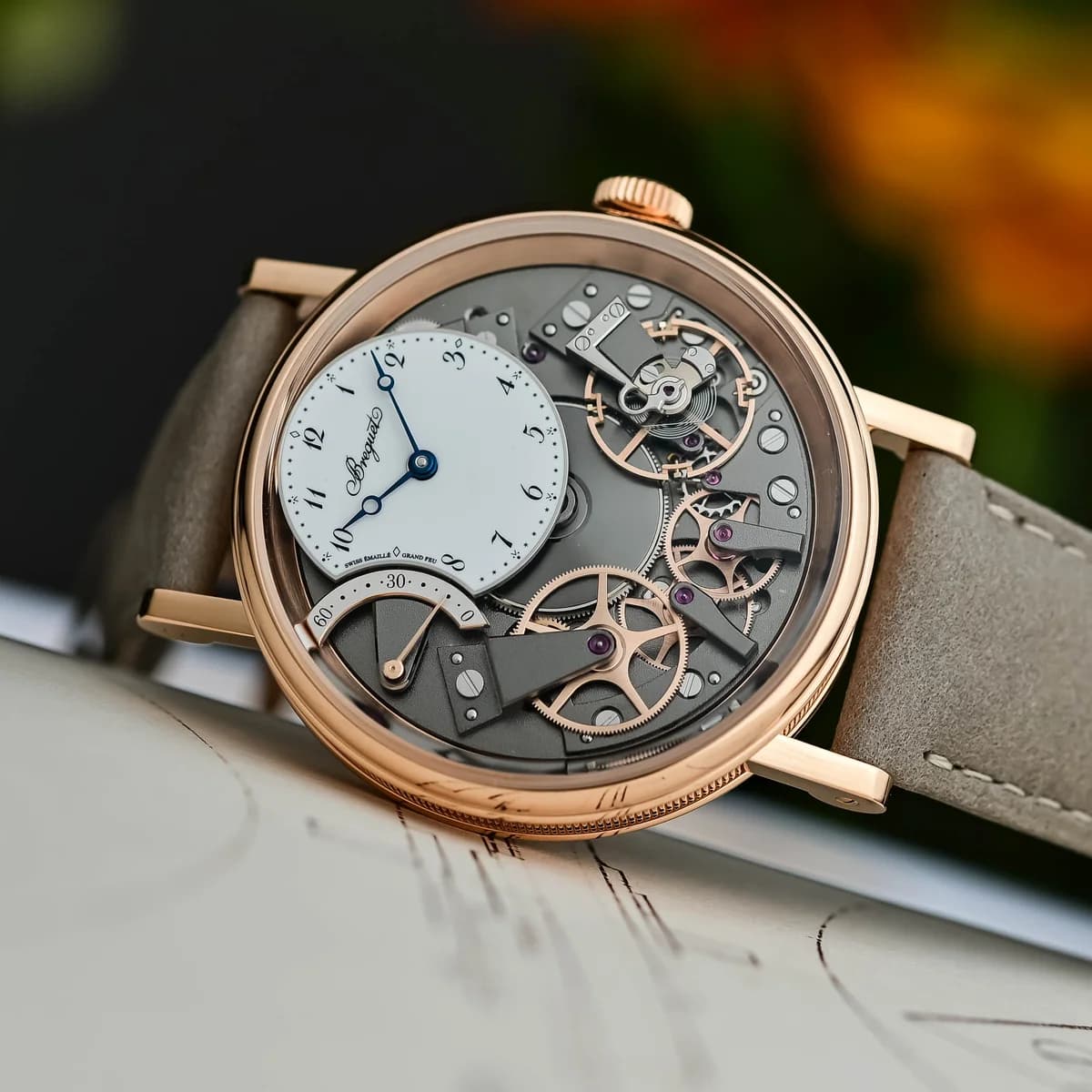
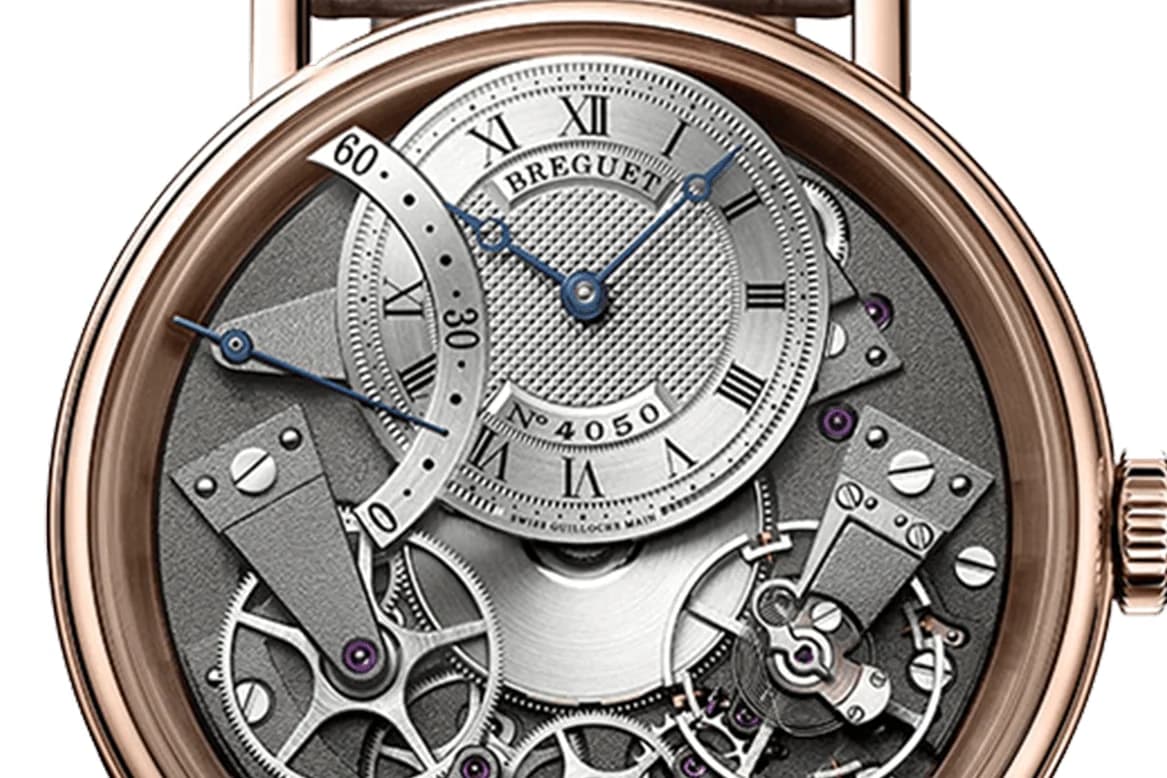
The Tradition takes that history and turns it inside out. Literally. The entire movement is flipped 180 degrees so that the mainspring barrel, gear train, escapement, and balance wheel face the wearer instead of hiding behind the dial. This is a critical distinction that I think gets lost in casual conversation: the Tradition is not a skeleton watch. A skeleton watch removes material from bridges and plates to create openwork, cutting away the structure to let you see through it. That weakens the movement and often destroys legibility because the hands get lost against the busy background. The Tradition does the opposite. No material has been removed. The structural integrity of the movement is completely preserved. What Breguet did was reorganize the architecture so the most dynamic, most visually interesting components face you directly. The barrel sits at visual center. The gear train radiates outward symmetrically. The balance wheel oscillates visibly. The pare-chute shock protection, Breguet's own invention from around 1790, is displayed at 4 o'clock. The hours and minutes read from a small sub-dial at 12 o'clock with Breguet's signature pomme hands in blued steel. A retrograde seconds indicator arcs across 10 o'clock. The rest of the dial is the movement itself. Revolution Watch described this approach as structural, architectural legibility, and that is exactly right. The architecture of function becomes the architecture of form.
The concept descends directly from Breguet's subscription watches of 1796. Those were born out of necessity. The French Revolution had devastated both Breguet's finances and his clientele. He had fled Paris in 1793 and returned around 1795 to a workshop and a customer base that were both diminished. His solution was brilliant in both business and watchmaking terms. Customers paid a 25% deposit upfront, giving Breguet the working capital to fund production. In return, he delivered a simplified single-hand watch for approximately 600 francs. About 700 were produced between 1798 and 1805. The design was minimalism approaching perfection: one hand, a large central barrel for efficient energy transmission, and an enamel dial. The movement architecture of those subscription pieces, with the barrel, escapement, and balance visible on one side, is the direct ancestor of the Tradition's layout. Breguet took a pragmatic solution from 1796 and reimagined it as a modern display of horological art. In 2025, for their 250th anniversary, Breguet released the Classique Souscription, directly recreating this concept with a one-handed display. That watch won the GPHG Special Jury Prize, the highest honor in watchmaking. The jury chose restraint over complexity.
F. P. Journe is the most celebrated independent watchmaker alive, and his entire career traces back to Breguet. In 1982, Journe was given the opportunity to restore the Breguet No. 3177 at the Arts et Metiers Museum in Paris. He used George Daniels' book, The Art of Breguet, as his primary reference. That restoration fundamentally shaped how Journe thinks about watchmaking. His patented natural escapement is a modernization of Breguet's own concept. His remontoire d'egalite, his resonance mechanism, his sympathique clocks, all of them trace directly to inventions Breguet pioneered two centuries earlier. Journe even adopted Breguet's subscription sales model for pre-orders of his Tourbillon Souverain and Chronometre a Resonance. When I think about Breguet's influence, I keep coming back to this: the most innovative independent watchmaker of our era spent his formative years studying Breguet's work, and he has never stopped crediting that experience. The influence is not historical trivia. It is a living, active thread running through the finest independent watchmaking of our time.
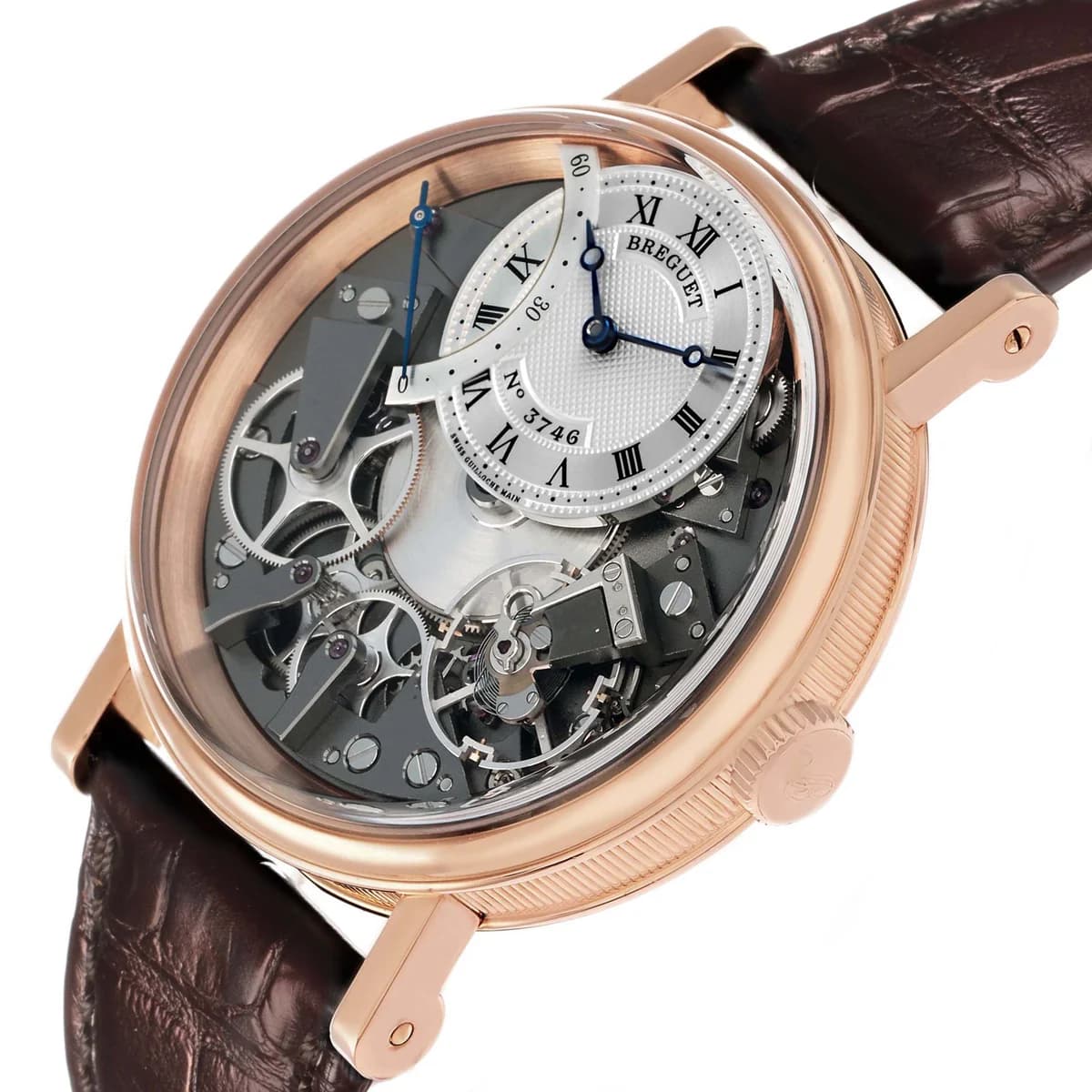
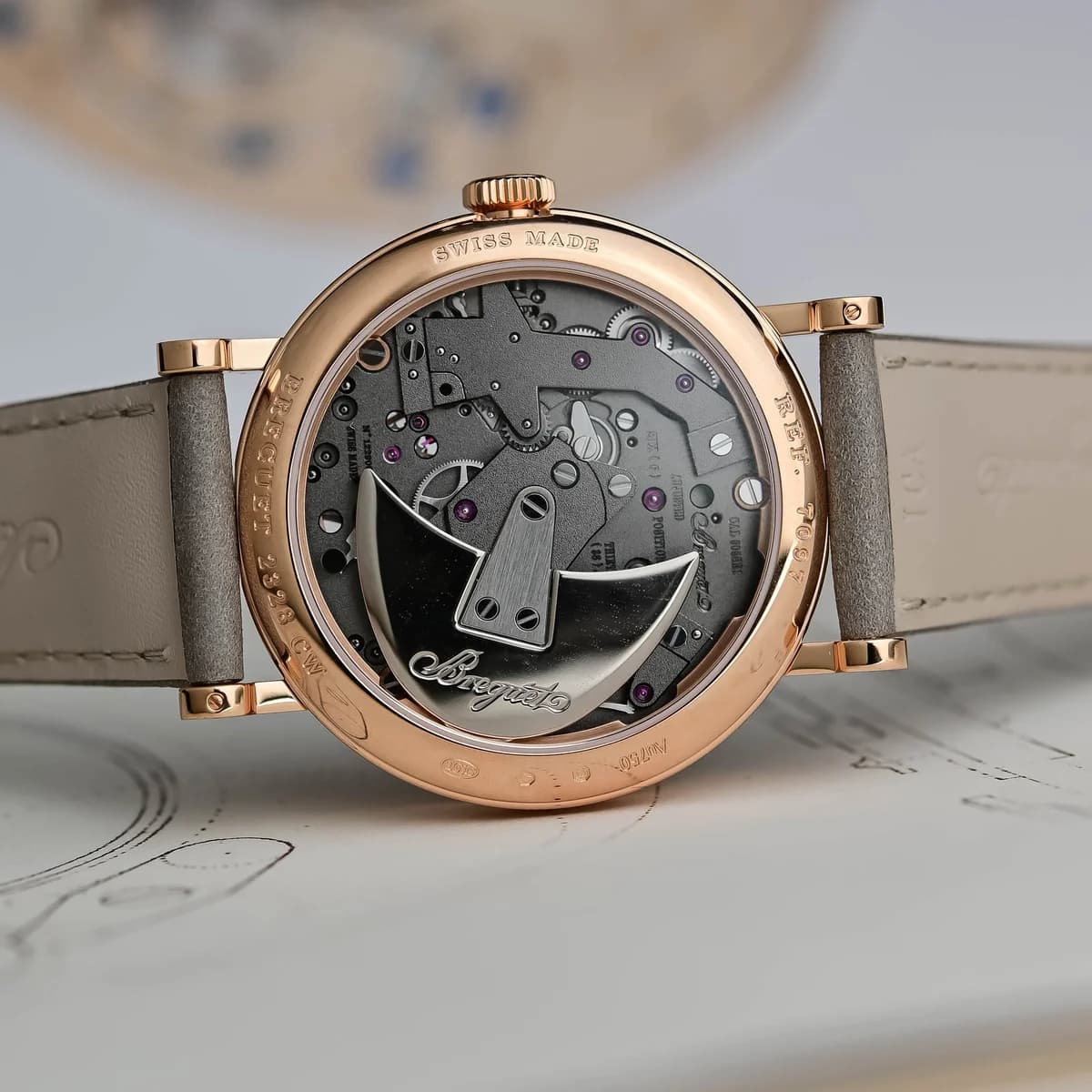
The Caliber 505 SR1 inside the 7097BR is a 38-jewel automatic with a 50-hour power reserve, beating at 21,600 vibrations per hour. The movement consists of 249 individual components, adjusted in six positions. The escapement uses silicon pallets and a silicon Breguet overcoil hairspring. Silicon is the material that has quietly transformed modern watchmaking. It does not need lubrication, which means the escapement can run for decades without the oil degradation that traditionally necessitates servicing. It is antimagnetic, so daily exposure to phones, laptops, and magnetic clasps does not affect timekeeping. And it can be manufactured using photolithography to tolerances that traditional metals simply cannot match. The white gold oscillating weight is shaped after the original perpetuelle rotor that Breguet himself invented around 1780. That is the kind of detail that separates Breguet from brands that merely borrow aesthetic cues. The rotor is not just functional. It is a direct citation of its own inventor's original design.
Every surface you see through the front of the Tradition is finished by hand, and the symmetrical bridge layout means any imperfection would be immediately visible. The mainplate is shot-blasted to a matte grey, a technique called grenaillage that produces a uniform, finely grained surface. The bridge top surfaces are satin-brushed, creating subtle contrast against the shot-blasted base. The barrel cover is hand-guilloche in a snailed pattern. Guilloche is engine-turned decoration using a rose engine lathe, a specialized tool with custom-cut rosettes that create intricate geometric patterns through the rotation of those cams. Breguet pioneered this technique around 1786, and the company still does it by hand on rose engines today. Each dial is unique because the process is manual. I love this about Breguet. The gift of imperfection, as their artisans describe it, is the seal of authenticity. A machine would produce identical results every time. A human hand does not. The train wheels feature curved spokes matching the original souscription movements. Every component is numbered and signed Breguet.
The secret signature deserves its own attention. In 1795, Breguet introduced a nearly invisible engraving on his dials as an anti-counterfeiting measure. Even during his own lifetime, his work was extensively counterfeited. The signature is ghost-like: the word BREGUET engraved so finely that it reveals itself only when the dial is examined in oblique, raking light at a specific angle. On modern Breguet watches, the signature is typically laser-etched. On special pieces, like the 2025 Classique Souscription, it is still applied the traditional way using a manually operated pantograph with a diamond-tipped tool that traces fine incisions into hardened enamel. I appreciate that Breguet maintains this detail across their entire production. It is one of those things that 99% of people will never notice, but it connects every modern Breguet directly to a decision Abraham-Louis made 231 years ago. That kind of unbroken continuity is rare in any craft.
The pomme hands on the Tradition's sub-dial at 12 o'clock are another direct lineage detail. Breguet created them around 1783. The name means hollowed-out apple, referring to the eccentric hollow circle at the tip of each hand that resembles a crescent moon. Before Breguet's innovation, watch hands in the 1780s were often short, broad, and heavily decorated, making dials difficult to read. Breguet's pomme hands combined extreme delicacy with dramatically improved legibility. They were widely adopted by the principal watchmakers of the era. They fell out of favor in the late nineteenth century, were revived around 1930, and today they appear on virtually every Breguet watch. They are also extensively imitated across the industry. On the Tradition, the blued steel pomme hands against the silvered guilloche sub-dial at 12 o'clock are the most traditional element on a watch that is otherwise entirely about exposing the mechanical architecture beneath.
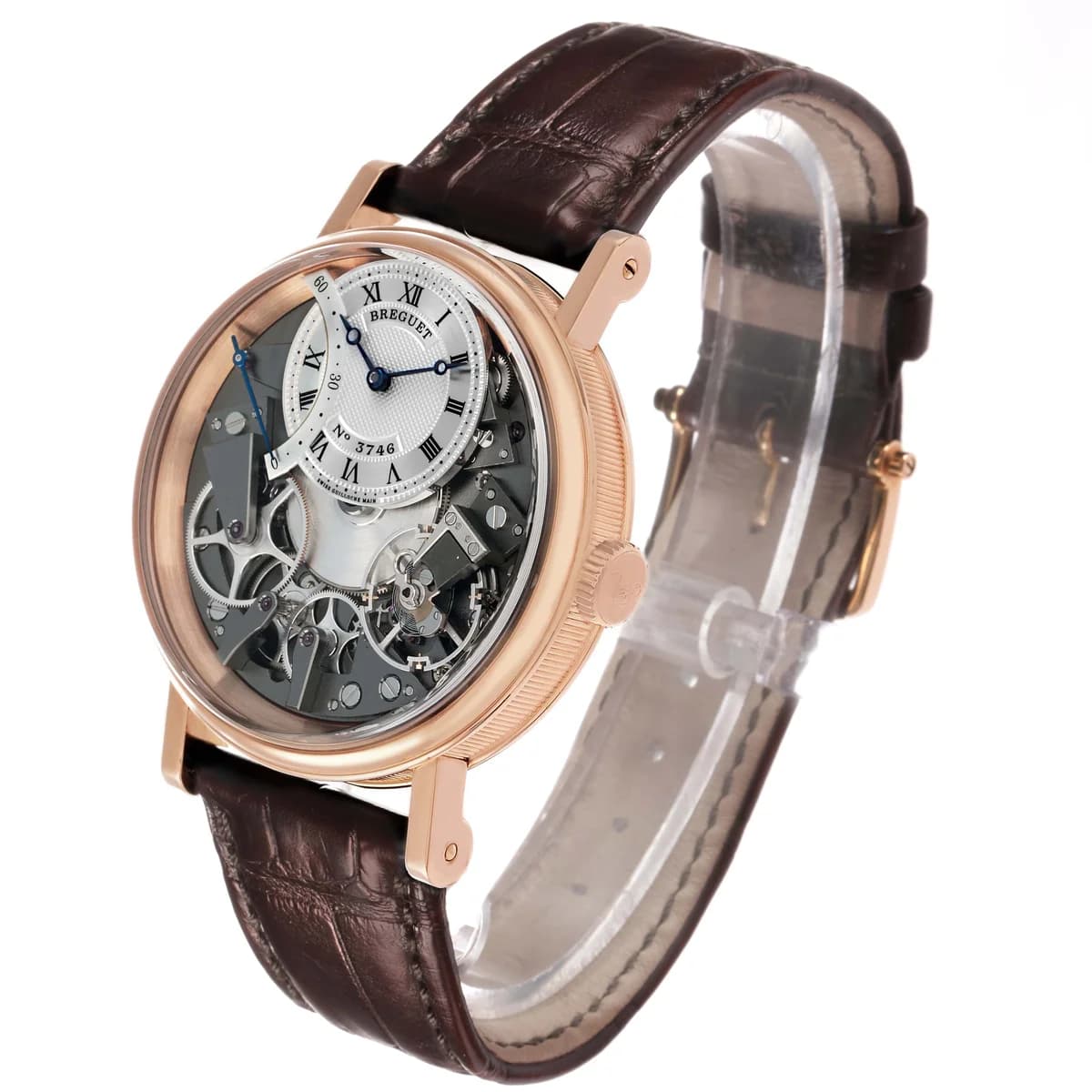
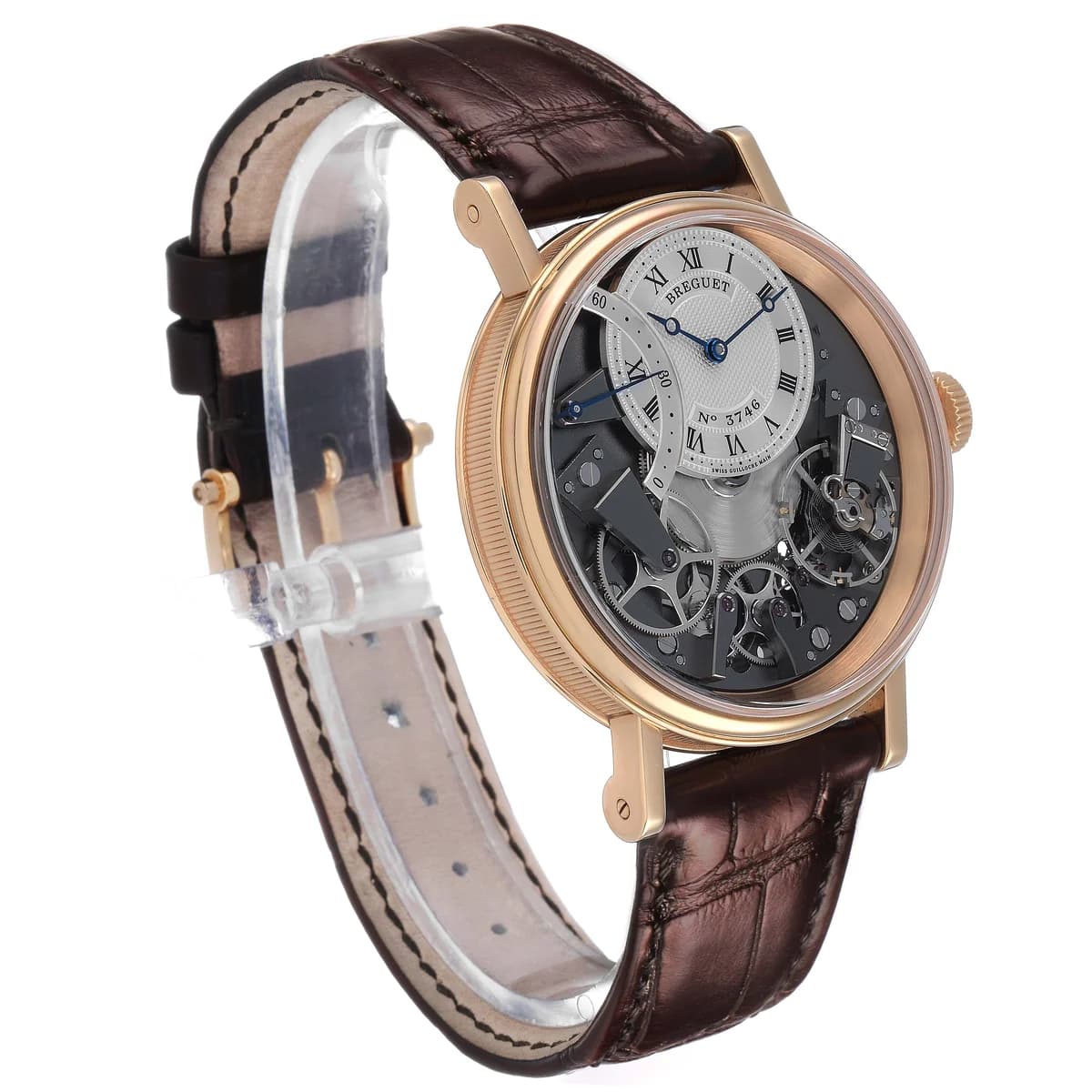
At 40mm and 11.8mm thick in 18K rose gold, the Tradition wears like a proper dress watch despite the mechanical theater on the front. The movement itself is only 6.3mm thick at 32.70mm in diameter. The slim bezel maximizes the visible movement area, so the visual complexity fills the entire watch face. On the wrist, the three-dimensional depth of the exposed gear train catches light differently from every angle. The balance wheel oscillating at 3 Hz is mesmerizing in a way that, for me, only a visible mechanical heartbeat can achieve. Long-term owners on WatchProSite describe it as wearing amazingly well even on smaller wrists, praising the slim bezel for making the 40mm case feel larger and more substantial than its dimensions suggest. One owner, after four years, still called out the comfort and wrist presence as the qualities that kept it in regular rotation. The alligator strap with 18K rose gold pin buckle keeps it close to the wrist, and 30 meters of water resistance means splash-proof at best. This is not a tool watch. It is a dress watch that happens to display its entire mechanism. The sapphire caseback reveals the other side of the movement, and while the dial-side presentation is the main event, the caseback view shows the Breguet-signed white gold rotor and the traditional finishing on the other side of the bridges. For a watch that wears its mechanism on its face, the caseback is almost an afterthought, but Breguet finished it properly anyway.
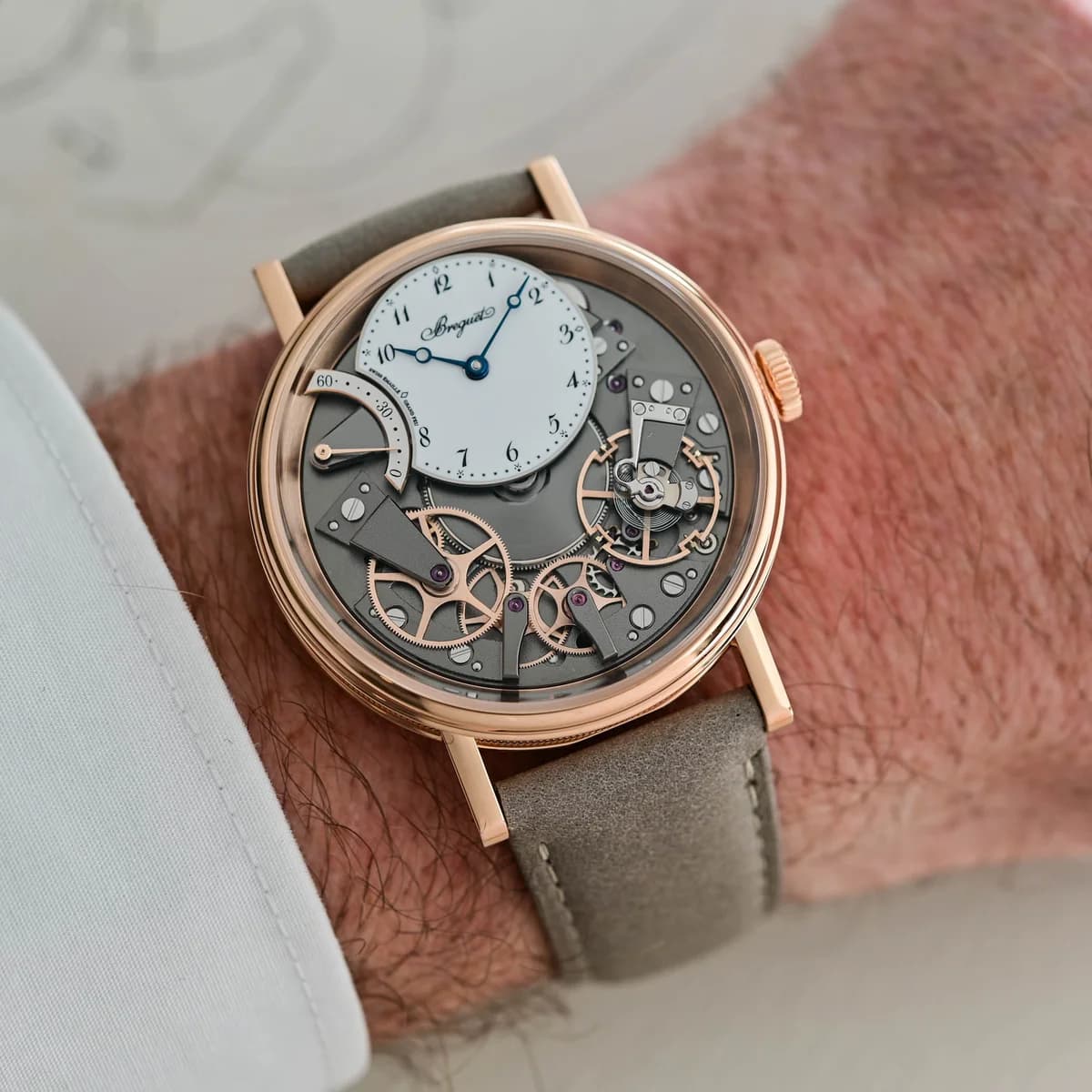
On darker skin, the rose gold case and the warm tones of the shot-blasted movement create a layered warmth that is genuinely beautiful. The copper content in 18K rose gold produces a reddish warmth that harmonizes with melanin-rich complexions in a way that white gold and platinum simply do not. Under a Zegna wool cuff, the Tradition sits perfectly flat, invisible until the sleeve slides back and the exposed gear train catches the light. With rolled linen sleeves, it becomes a conversation piece. The warm grey of the movement against the rose gold case works with earth tones, navy, charcoal, and almost anything in a natural palette. This is a watch that does not need to match an outfit. It sets its own register.
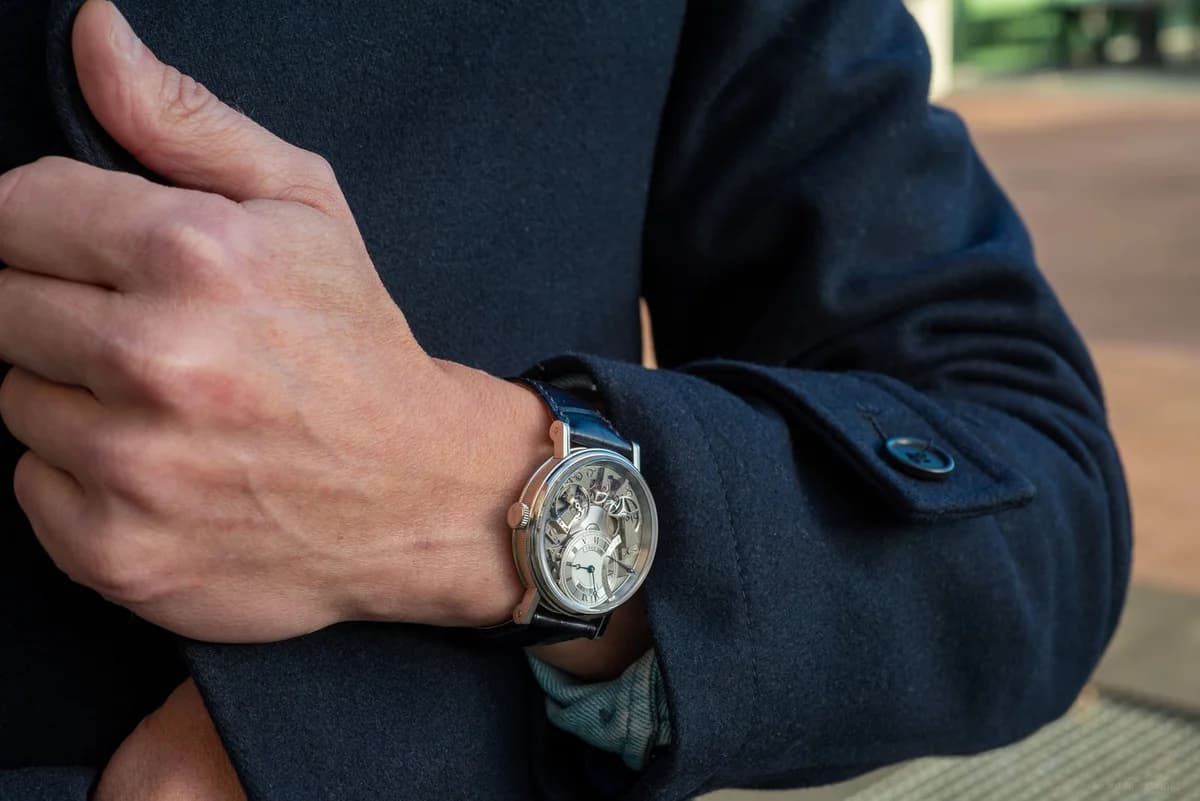
The honest critique is the brand perception. Breguet invented more of what modern watchmaking is than arguably any other single person in history, but the brand today sits within the Swatch Group and does not carry the same collector cachet as Patek, Lange, or even F. P. Journe. That perception gap is a marketing issue, not a quality issue. The craftsmanship is on par with any of those brands. Silicon escapement, in-house automatic movement, hand-guilloche decoration, 18K rose gold case, a direct lineage to the man who invented the tourbillon. All of that is present in the Tradition. Collectors who understand the history know this. The Tradition won the GPHG Special Jury Prize when it launched in 2005, beating entries from Chopard and F. P. Journe. Breguet won the Aiguille d'Or, the top prize, in 2025. And in 2025, Breguet's total auction sales volume across major houses surpassed Audemars Piguet for the first time in recent years. The market is catching up to what the historians have always known. Nicolas Hayek, the founder of Swatch Group, acquired Breguet from Investcorp in 1999 and personally spearheaded the revival of the brand, including the Tradition project. After his death in 2010, his grandson Marc Hayek continued that work. The irony is that corporate ownership is both Breguet's perceived weakness and its practical strength. Swatch Group resources funded the silicon escapement research, the hand-guilloche preservation, and the manufacturing investment that makes the Tradition possible at this level of finishing.
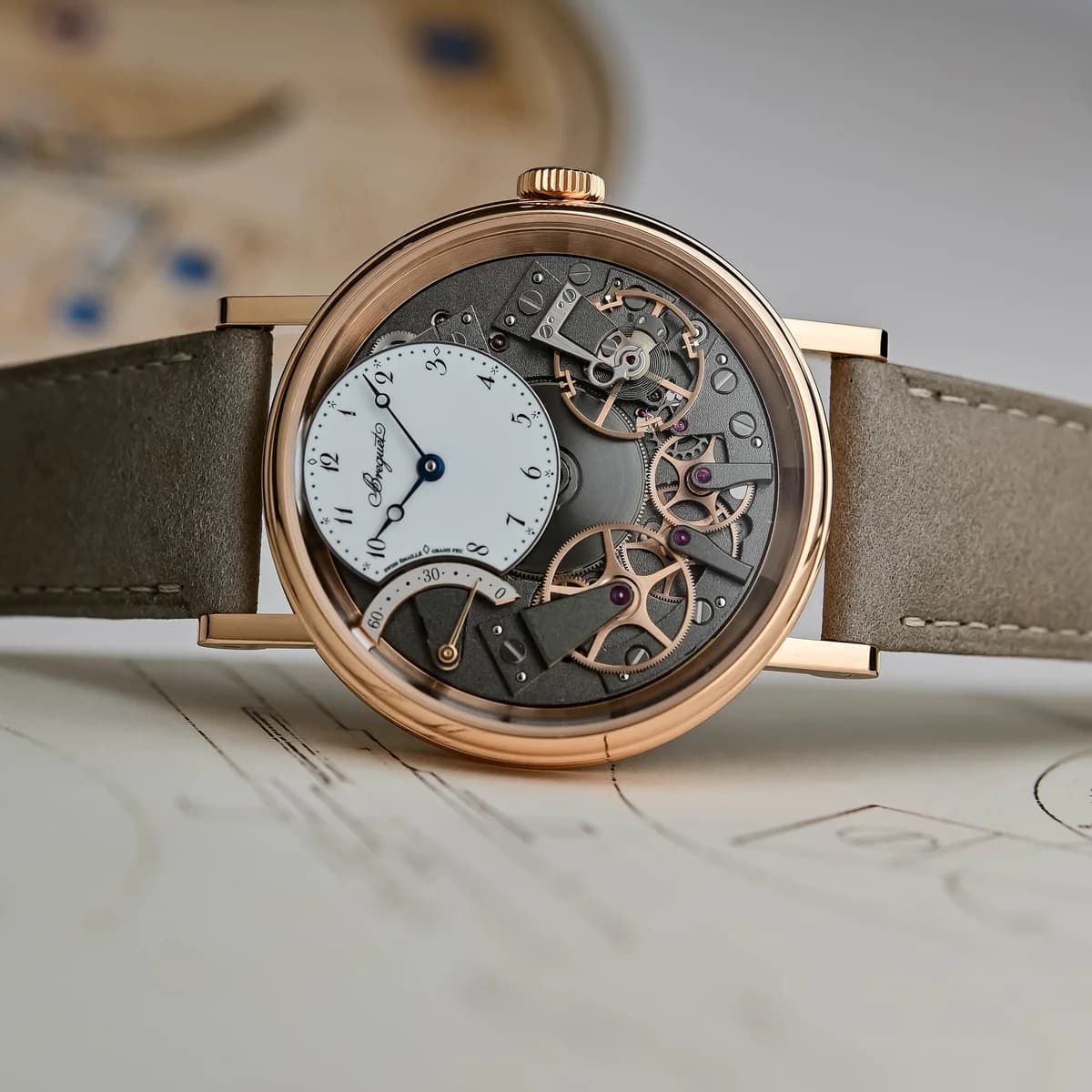
I think about the Tradition differently than most watches I write about. Most watches present a finished dial, a curated surface, the face the brand wants you to see. The Tradition presents the mechanism itself. It asks the viewer to find beauty in the engineering. Walking through the Breguet spaces in the Place Vendome in Paris, seeing the original souscription pocket watches in the same building where they sell the modern Tradition, that connection between the 1796 architecture and the 2005 reinterpretation becomes visceral. It is not a marketing story. The bridge layout is the same. The barrel position is the same. The philosophy is the same.
The Tradition exists in several variants, and the range tells you something about Breguet's ambitions. The 7097 in rose gold or white gold at 40mm is the core automatic model with retrograde seconds. The 7037 has a smaller 38mm case, which in 2026 comes with entirely blue-finished movements and Grand Feu enamel dials. The 7038 adds a diamond-set bezel with aventurine glass. The 7067 adds a GMT complication in platinum with a green gradient Grand Feu enamel dial and the option of Arabic or Oriental numerals, a deliberate nod to Breguet's Ottoman Empire clientele. And then there is the 7047. The 7047 is the pinnacle of the line: a 41mm fusee tourbillon with 542 components, a reverse fusee chain for constant force delivery, and dual mainsprings. The fusee-chain is a medieval technology, a conical pulley and chain system that compensates for diminishing mainspring torque as the watch runs down. Breguet's reverse fusee configuration swaps the barrel and fusee positions so the chain crosses over, making winding easier and reducing friction at the pivots. That is the watch for someone who wants to see Breguet's engineering taken to its absolute limit.
The 7097 is where most people start. It is where I would start. Because looking down at your wrist and seeing a balance wheel oscillating above a gear train that traces its architecture back to 1796, knowing that the man who designed that layout also invented the tourbillon and the self-winding mechanism and the shock protection system and the overcoil hairspring, is an experience that no spec sheet can convey. Fratello Watches described the Tradition as a costume drama on the wrist. The Hour Markers wrote that it does not ask to be loved immediately, it asks to be studied. I think both are right. The Tradition rewards patience. It rewards knowledge. And the more you learn about Abraham-Louis Breguet, the more you see in this watch. That is the real magic of the Tradition. It is not just a watch you wear. It is a history lesson you carry on your wrist, told through the language of gears, springs, and bridges that have been speaking for over two centuries.
Also in Haute Horlogerie