
Breguet
Classique 7147
7147BR/29/9WU
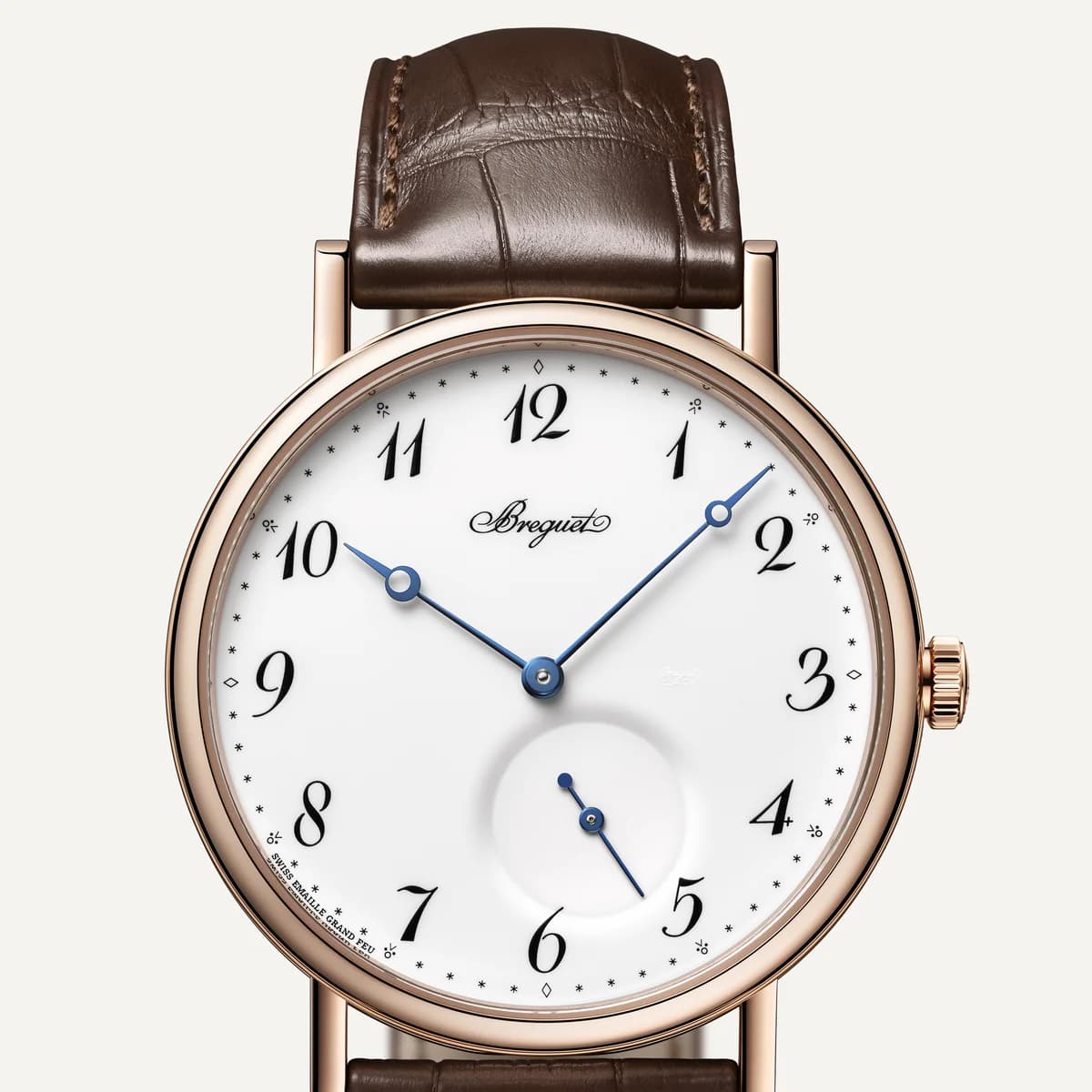
Abraham-Louis Breguet was born in Neuchatel in 1747. He opened his workshop on the Ile de la Cite in Paris in 1775, and over the next 48 years he invented or perfected more of what modern watchmaking is than arguably any other single person in history. He patented the tourbillon in 1801. He invented the Breguet overcoil hairspring. He invented the pare-chute shock protection system. He invented the perpetuelle self-winding mechanism using a rotor, the concept that eventually became the Perpetual in Rolex's hands. He perfected guilloche engine-turning. He developed the Breguet numerals that bear his name, the distinctive typeface with the open loop at the top of each digit. He sold watches to Napoleon, to Marie Antoinette, to the Ottoman Sultan. When F. P. Journe talks about the watchmaker who inspired everything he does, he is talking about Breguet. The man died in 1823 and his fingerprints are still on every serious mechanical watch being made today. Consider what that means. Every tourbillon you see at a watch fair, every self-winding rotor spinning behind a sapphire caseback, every overcoil hairspring regulating a high-end movement, every engine-turned dial catching light at different angles, all of it traces back to one workshop in Paris. The Classique 7147 is the most direct line to that legacy in the current catalog.
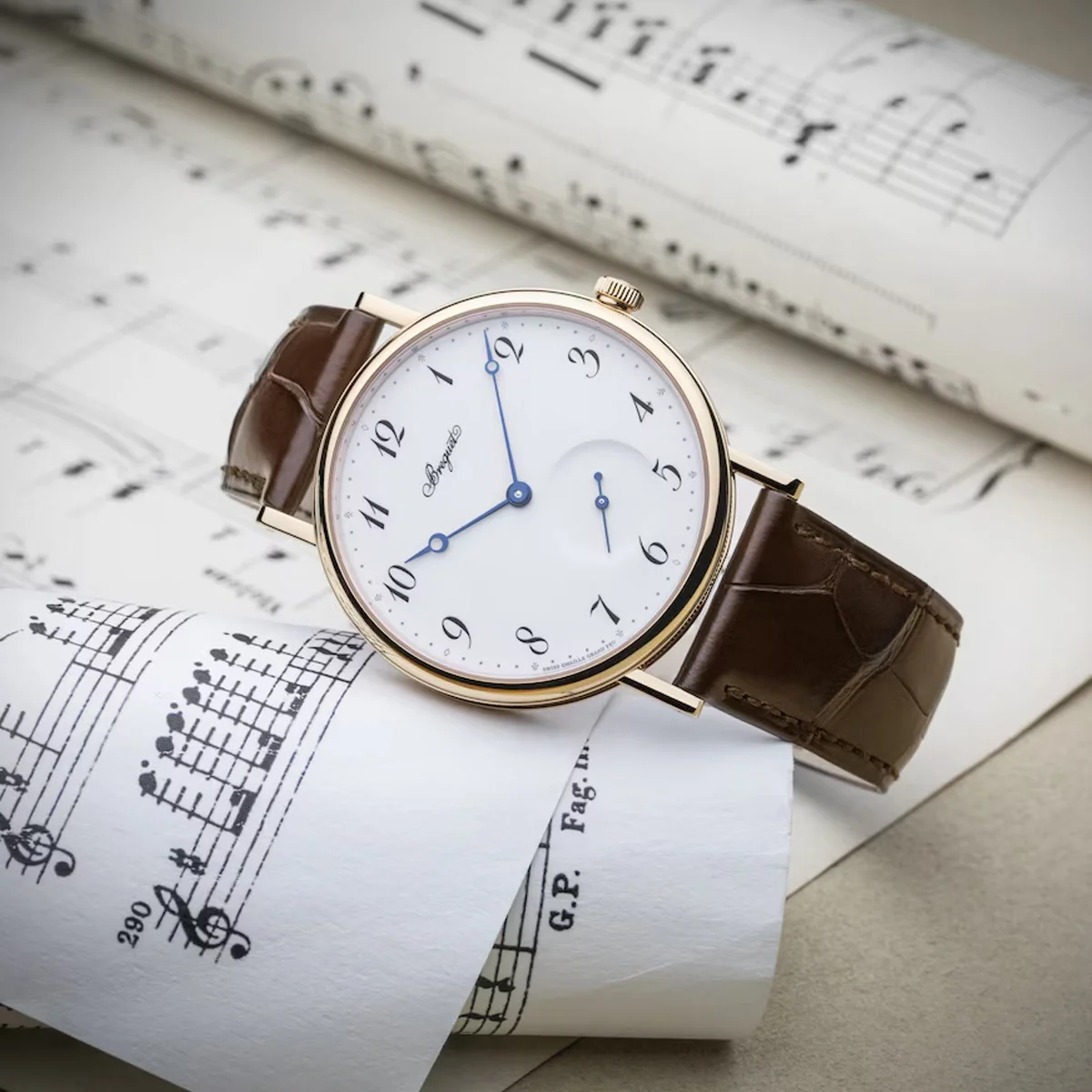
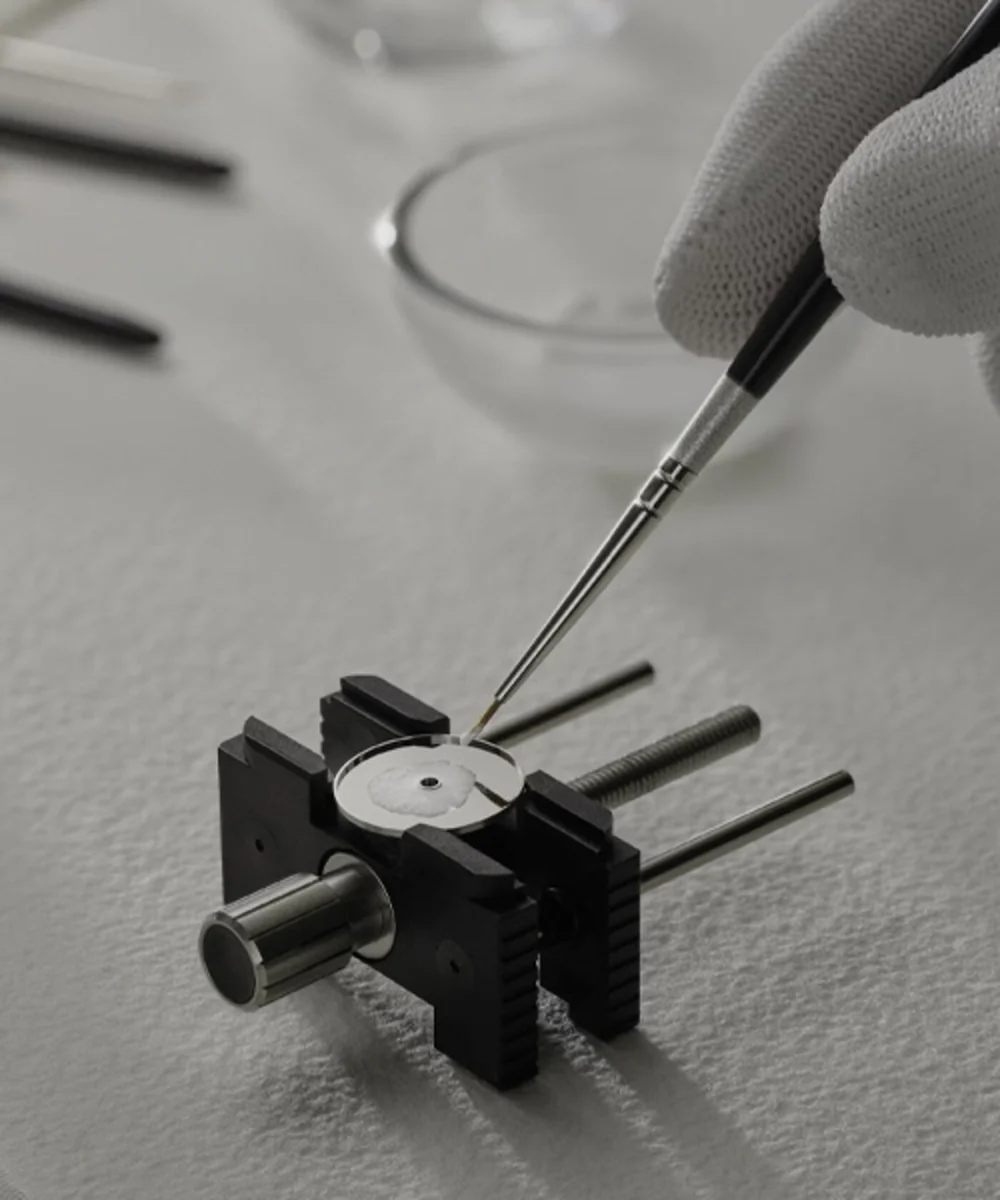
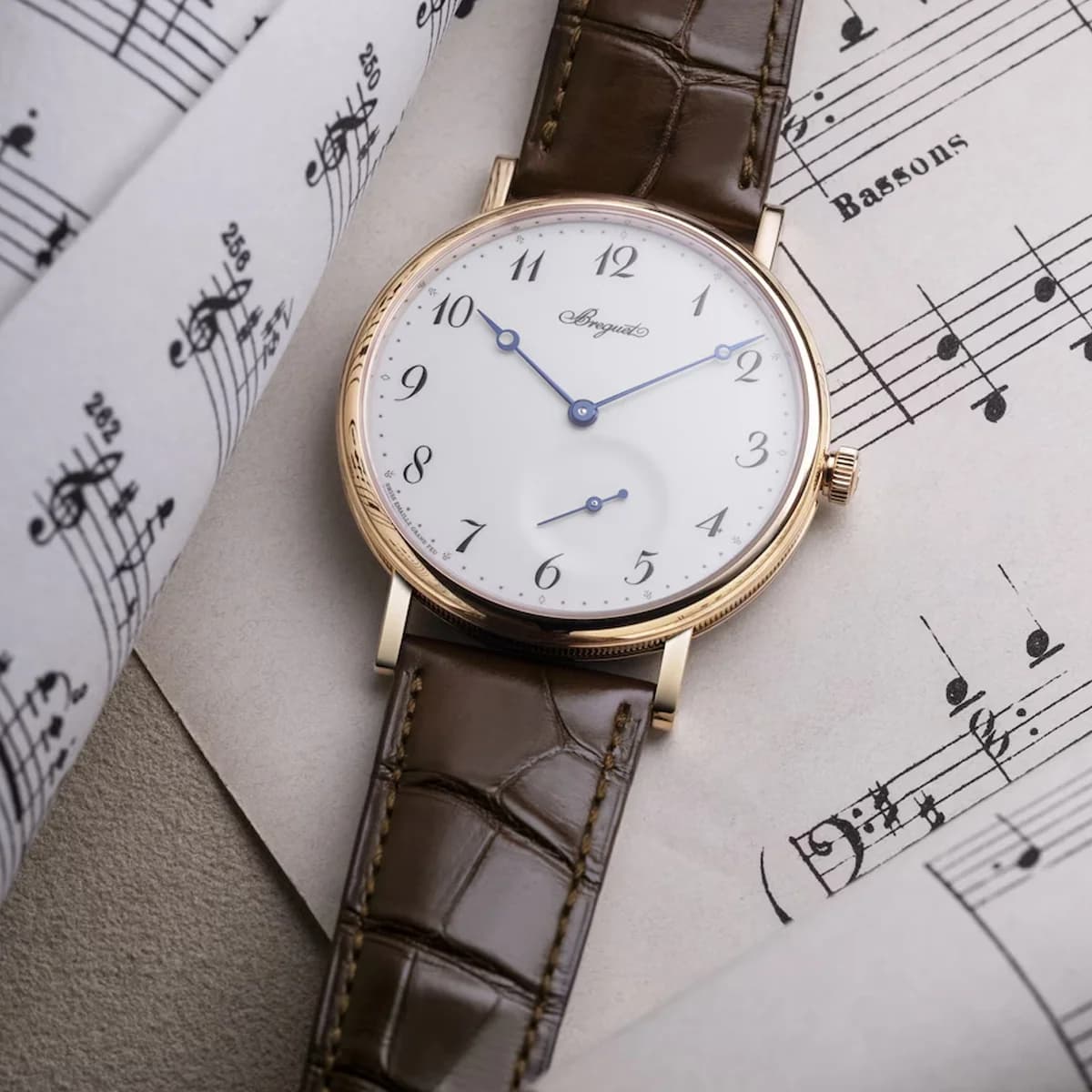
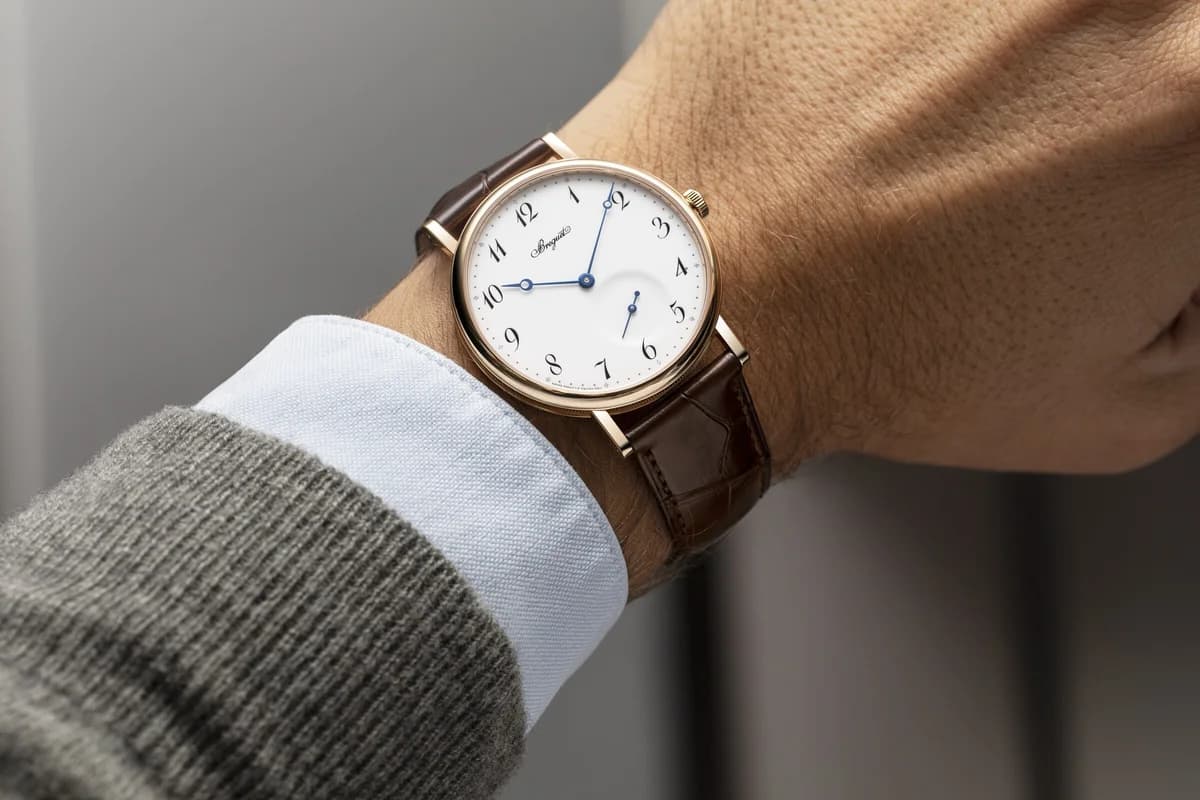
The dial is Grand Feu enamel. Not lacquer. Not paint. Not ceramic. Enamel, which is glass powder fused to a metal substrate at over 800 degrees Celsius. Each firing risks cracking, discoloration, or bubbling. The process can require five, ten, or even more individual firings to build up the depth and the milky white opacity that characterizes Grand Feu. The rejection rate is brutal. Roughly one in ten dials survives the full process without a bubble, a crack, or a halo that renders it unusable. The Breguet numerals sit on top of the enamel, transferred onto the surface after the final firing. The result is a dial that has a luminosity, a depth, that no other finishing technique can match. I have looked at guilloche dials, lacquer dials, painted dials, sunburst dials, and none of them have the quality of light that Grand Feu enamel produces. It is a glow that comes from light passing through the glass layers and reflecting back from the metal substrate beneath. In two hundred years, this dial will look exactly as it does today. Grand Feu enamel does not fade, does not yellow, does not degrade. It is glass. It is permanent.
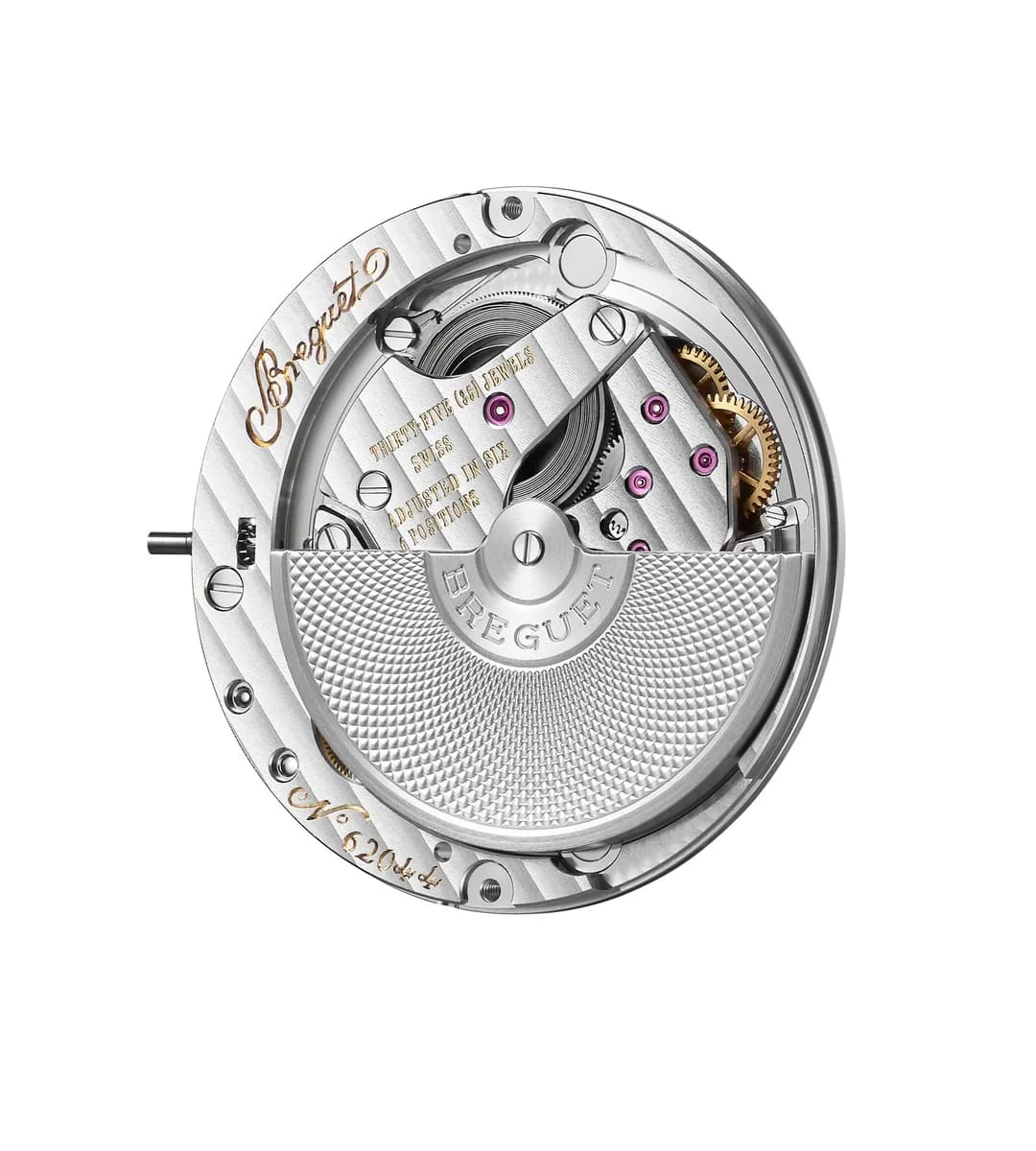
The case is 40mm in 18K rose gold, 6.1mm thick. For a self-winding watch with a sapphire caseback, that is remarkably thin. The thinness is the direct result of the Caliber 502.3 SD, an automatic movement that stands just 2.4mm tall. For context, a stack of two credit cards is roughly 1.6mm. The entire mechanical engine of this watch, mainspring barrel, gear train, escapement, balance wheel, and winding rotor, all fits within a height barely exceeding that. 35 jewels. 21,600 vibrations per hour. 45-hour power reserve. 162 individual components working in a space 2.4mm tall. The movement is visible through the sapphire caseback, and the finishing includes hand-engraved decoration on the off-center rotor and traditional Cotes de Geneve striping on the bridges. Water resistance is 30 meters, which is strictly splash-proof. Sapphire crystals cover both the front and the exhibition caseback.
The Caliber 502.3 SD traces its lineage to the Calibre 70 created by Frederic Piguet in 1970. Piguet was an independent movement maker in Le Sentier, in the Vallee de Joux, who became known for ultra-thin ebauches. He filed the patent in 1967 for an automatic movement with an off-center rotor, a design that allowed the movement to achieve its extraordinary thinness by avoiding the need to stack the rotor above the keyless works. The Calibre 70 was commercially available by 1970 and was already 2.4mm at 35 jewels. In 1985, it was replaced by the improved Calibre 71, with a redesigned mainspring barrel and finer gear train toothing. When the Swatch Group acquired Breguet in 1999, Frederic Piguet's workshop was already within the group. The Calibre 71 evolved into the Breguet Caliber 502, and the 502.3 SD is the current expression, now updated with silicon technology. What I find remarkable about this lineage is that the fundamental architecture, the 2.4mm height, the 27.4mm diameter, the 35-jewel layout, has survived over fifty years of refinement. The bones are that good. Frederic Piguet solved ultra-thin automatic winding in 1970, and fifty-six years later nobody has made the solution obsolete. They have only added silicon to make it better.
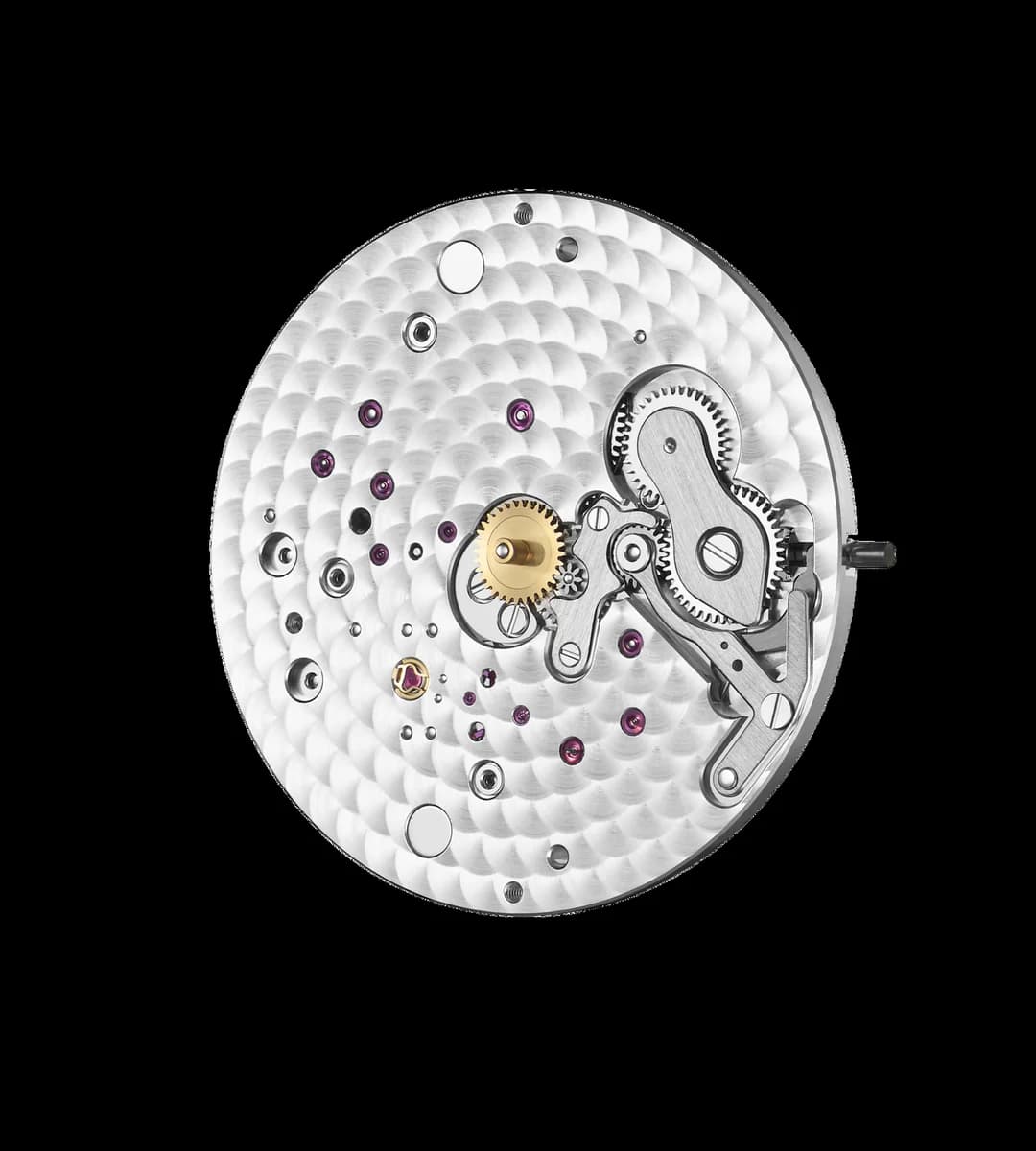
The silicon in this movement is worth understanding. Traditional balance springs are made of Nivarox, a nickel-iron alloy that can be affected by magnetic fields, temperature changes, and positional variance. Silicon is diamagnetic, meaning magnetic fields have essentially zero effect on it. It also has a near-zero thermal coefficient when properly treated, so temperature swings do not change the rate. The 502.3 SD uses silicon for both the balance spring (a flat silicon spiral) and the pallets in the inverted in-line lever escapement. Breguet was one of the earliest adopters of silicon in mechanical movements, and the dual silicon approach in this caliber gives it a genuine advantage in real-world accuracy and long-term stability. Silicon components also do not require lubrication at the escapement, which reduces service intervals and eliminates one of the primary causes of accuracy degradation in traditional movements. The movement is adjusted in six positions. This is not marketing language. Silicon measurably improves performance in the conditions where mechanical watches actually get worn.
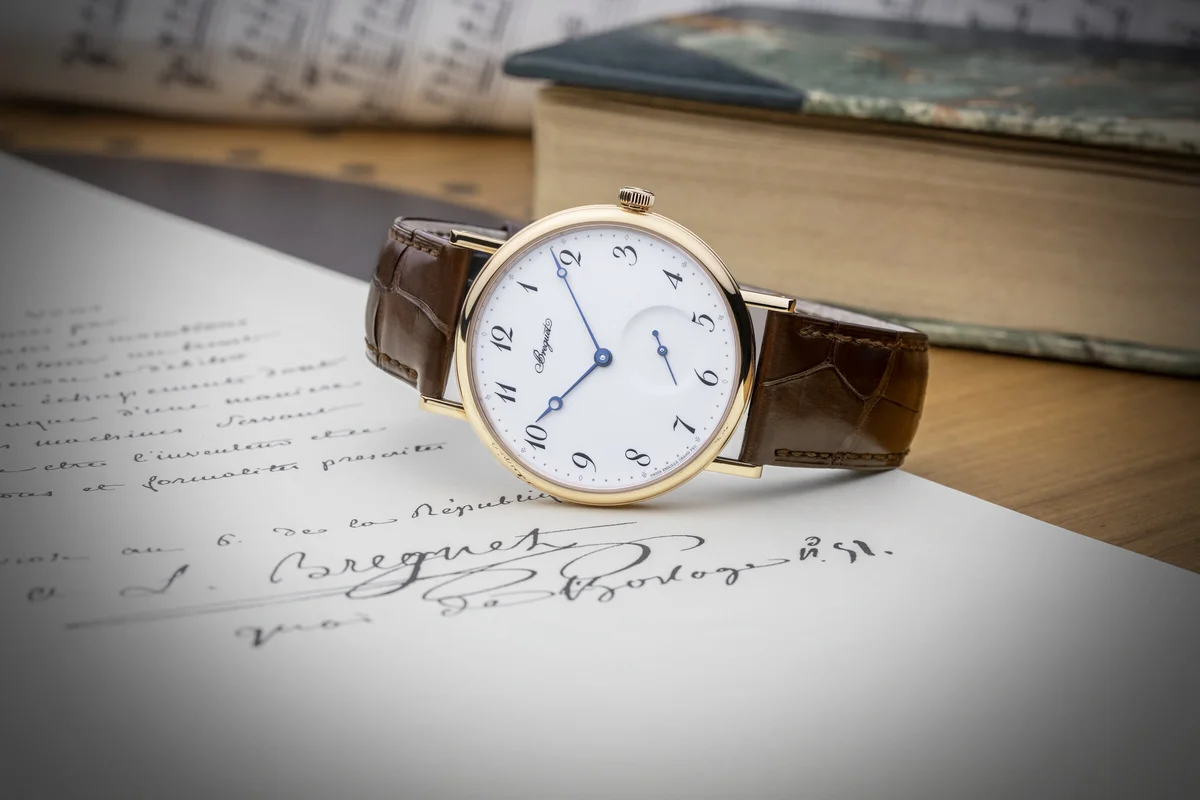
The hands are Breguet's signature blued steel with the open-tipped pomme profile. The word pomme translates to apple, and the distinctive open circle near the end of each hand is one of the most recognizable hand designs in watchmaking. Abraham-Louis Breguet himself developed this hand shape, and it has been used on Breguet watches for over two hundred years. On the Grand Feu enamel dial, the contrast between the heat-blued steel and the pure white enamel is striking. The small seconds sits between 5 and 6 o'clock rather than the more common 6, an asymmetric placement that Breguet has used as a house tradition. It breaks the expected visual balance of a centered subdial, and once noticed, it becomes part of the character. The case band carries a fluted coin-edge pattern, a knurled vertical ribbing that Breguet has applied since the eighteenth century. It is a tactile detail that becomes apparent when turning the watch in your hands, a subtle texture that distinguishes the case from the smooth, polished cases of most dress watches.
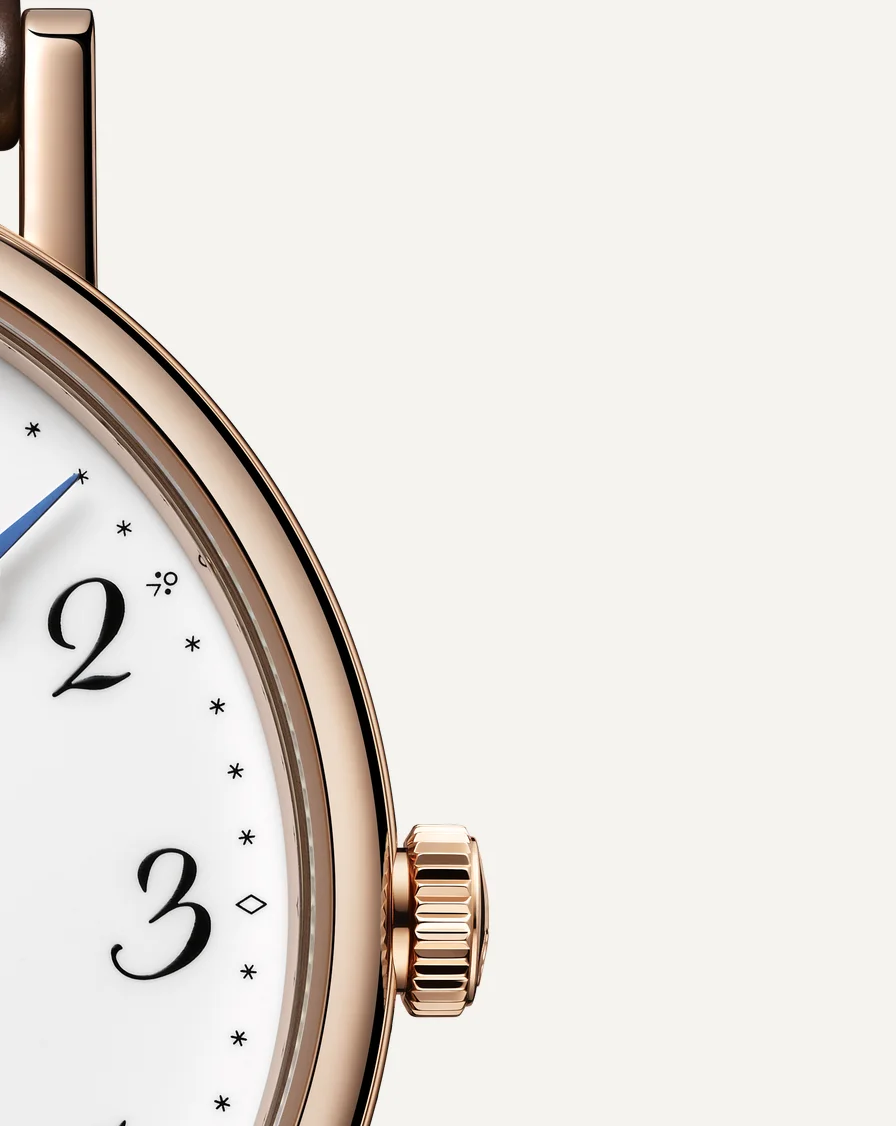
Every Breguet carries a secret signature on the dial, and I love that detail. Abraham-Louis Breguet introduced this feature in 1795 as an anti-counterfeiting measure. The signature is nearly invisible under normal viewing angles. Only when light hits the dial at a specific oblique angle does the engraving become visible, typically near the 12 o'clock position. On the Grand Feu enamel of the 7147, this signature is engraved directly into the enamel surface, a final touch that connects this modern watch to a security feature the founder implemented over 230 years ago. It is functional history, not decoration. The fact that Breguet was already thinking about brand authentication in the 1790s tells you something about how far ahead of his time he was. Counterfeiting was a real problem even then. Breguet's watches were so sought after that imitations circulated widely, and the secret signature was his solution. Over two centuries later, luxury brands are still trying to solve the same problem with holograms and blockchain. Breguet solved it with an engraving technique and a specific angle of light.
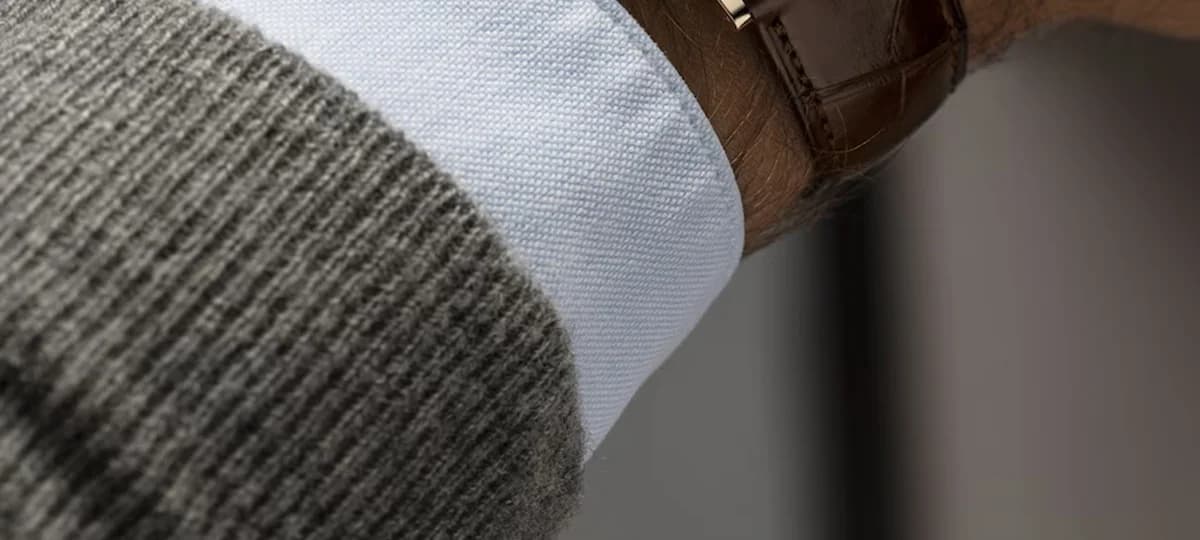
At 40mm and 6.5mm thick, the 7147 essentially vanishes under a shirt cuff. This is a watch that lies flat against my wrist rather than sitting on top of it. The straight lugs give it a clean profile from the side, and the alligator strap with the rose gold pin buckle is comfortable for all-day wear. There is no lume on the hands or numerals. In low light, this watch is effectively unreadable. That is the honest reality of a Grand Feu enamel dress watch with blued steel hands. The aesthetic purity comes at the cost of darkness readability. I do not consider that a flaw. It is the natural consequence of what this watch prioritizes. On darker skin, the warmth of the rose gold case against the pure white enamel creates a contrast that I find genuinely beautiful. The dial has a luminosity in person that photographs consistently underrepresent. Grand Feu enamel has a depth and glow that only direct observation captures, and that quality is one of the reasons I keep coming back to enamel dials over every other finishing technique.
What I appreciate about the 7147 is the restraint. This is a three-hand dress watch with no date, no power reserve indicator, no complications beyond small seconds. In a market where brands feel compelled to add features to justify positioning, Breguet looked at the Classique and asked what could be removed rather than what could be added. The Grand Feu enamel alone would make this watch notable. Combined with a 2.4mm movement, blued pomme hands, and a coin-edge case that traces directly to the founder, it becomes something more. It becomes an argument that simplicity, when executed at this level, is the highest expression of what Breguet represents. The 7147 was introduced at Baselworld 2017 in this Grand Feu enamel configuration, available in both rose gold (7147BR) and white gold (7147BB). The guilloche-dial version preceded it by a year. Both references share the same movement and case architecture, but the enamel version is the one that carries the full weight of Breguet's metiers d'art tradition.
The Classique collection is the core of Breguet's identity. The 7147 sits alongside the 5157, which has a guilloche dial and a slightly smaller 38mm case, the 5177 with Grand Feu enamel and a date window, and the 5207 with a retrograde date. The Tradition collection turns the movement inside out, exposing the gear train on the dial side in a design that descends from Abraham-Louis Breguet's subscription watches of 1796. The Type XX is Breguet's pilot chronograph, with military heritage dating back to the French naval aviation. And the Marine collection covers sport-luxury with thicker cases and higher water resistance. The 7147 is where the brand's DNA is most concentrated. No complications to distract. No sport pretensions. Just the fundamental design elements that Abraham-Louis Breguet established, executed with modern materials science. If Breguet the man walked into the manufacture today and saw a 7147 on the bench, I think he would recognize it immediately. The numerals are his. The hands are his. The coin-edge case is his. The secret signature is his. The only things he would not recognize are the silicon and the sapphire crystals. Everything else is a direct continuation of the design language he created in the late 1700s.
The honest observation about modern Breguet is that the brand exists within the Swatch Group. Nicolas Hayek Sr. acquired Breguet in 1999 from Investcorp, a Bahrain-based investment firm that had owned the brand since purchasing it from the Chaumet family in 1987. Some collectors view corporate ownership as a dilution of the independent spirit that Breguet originally represented. I understand that perspective, and it is a fair concern for the brand overall. The collector market currently positions Breguet below where its technical and historical credentials suggest it should sit relative to Patek, Lange, or even F. P. Journe. Whether that is a reflection of brand perception, marketing strategy, or simply market inefficiency is a conversation that watch enthusiasts will be having for years. But the 7147 specifically does not suffer from the corporate association. The Grand Feu enamel dial is produced using the same centuries-old process. The movement is a genuine ultra-thin caliber with silicon technology and a lineage stretching back to 1970. The finishing is hand-executed. The design codes are direct lineage from the founder himself.
The practical tradeoffs of this watch are worth acknowledging honestly. The 30-meter water resistance means this is strictly a dry-conditions watch. No swimming, no careless hand-washing, no rain without thought. For a Grand Feu enamel dress watch, that is expected, but it is worth knowing going in. The 45-hour power reserve is adequate but not generous. Take it off Friday evening and it may not survive to Monday morning. The Vacheron Patrimony manages about 38 hours from its hand-wound Caliber 1400, so the 502.3 SD does better, but watches like the Grand Lange 1 deliver 72 hours. The 18K rose gold case at 40mm will pick up micro-scratches over time, because 18K gold sits at about 2.75 on the Mohs scale compared to 5.5 for steel. The polished surfaces will show wear. Some people see that as patina. Some see it as damage. Both perspectives are valid. I see it as the natural life of a watch that gets worn rather than stored. The enamel dial, by contrast, is essentially indestructible short of a direct impact. The dial will outlast the case, the movement, and the strap by centuries. That permanence is part of what makes Grand Feu enamel so appealing. The case will age. The dial will not.
Under a Cesare Attolini cashmere sport coat cuff, the 7147 disappears entirely. That is the point. A 6.5mm dress watch in rose gold is not meant to be a conversation piece on the wrist. It is meant to be a quiet signal of taste when the cuff rises naturally. The rose gold works with warm-toned suits, navy, charcoal, deep brown, in a way that steel never quite achieves at this level. On darker skin tones, the combination of rose gold case and pure white enamel dial creates a warmth and contrast that photographs consistently fail to convey. This is a watch that pairs with linen in summer and flannel in winter without needing to change character. It does not need to be versatile across sport and formal contexts. It is perfect for one context, and that context is elegance. The alligator strap uses screw-pins rather than traditional spring bars, which means strap changes require a proper screwdriver rather than a spring bar tool. That is a minor inconvenience compared to quick-release systems, but it also means the lugs will never get scratched by a slipping spring bar tool. I have launched spring bars across a room more times than I care to admit, and the damage they leave on polished lugs is permanent. Screw-pins eliminate that risk entirely.
Breguet invented half of what the Swiss watch industry uses today. The tourbillon, the overcoil hairspring, the pare-chute shock protection, the self-winding mechanism, guilloche decoration, the numerals that bear his name. The Classique 7147 is the clearest reminder of that fact in the current catalog. A Grand Feu enamel dial that will outlast the person wearing it. A 2.4mm movement from a lineage that stretches back to 1970 and a design philosophy that stretches back to 1775. Blued pomme hands that Abraham-Louis Breguet himself would recognize. This is not a watch that needs to convince anyone of anything. The history is already there. The craft is already there. The 7147 simply presents both, quietly, on your wrist.
Also in Haute Horlogerie