
Berneron
Mirage
Mirage 38
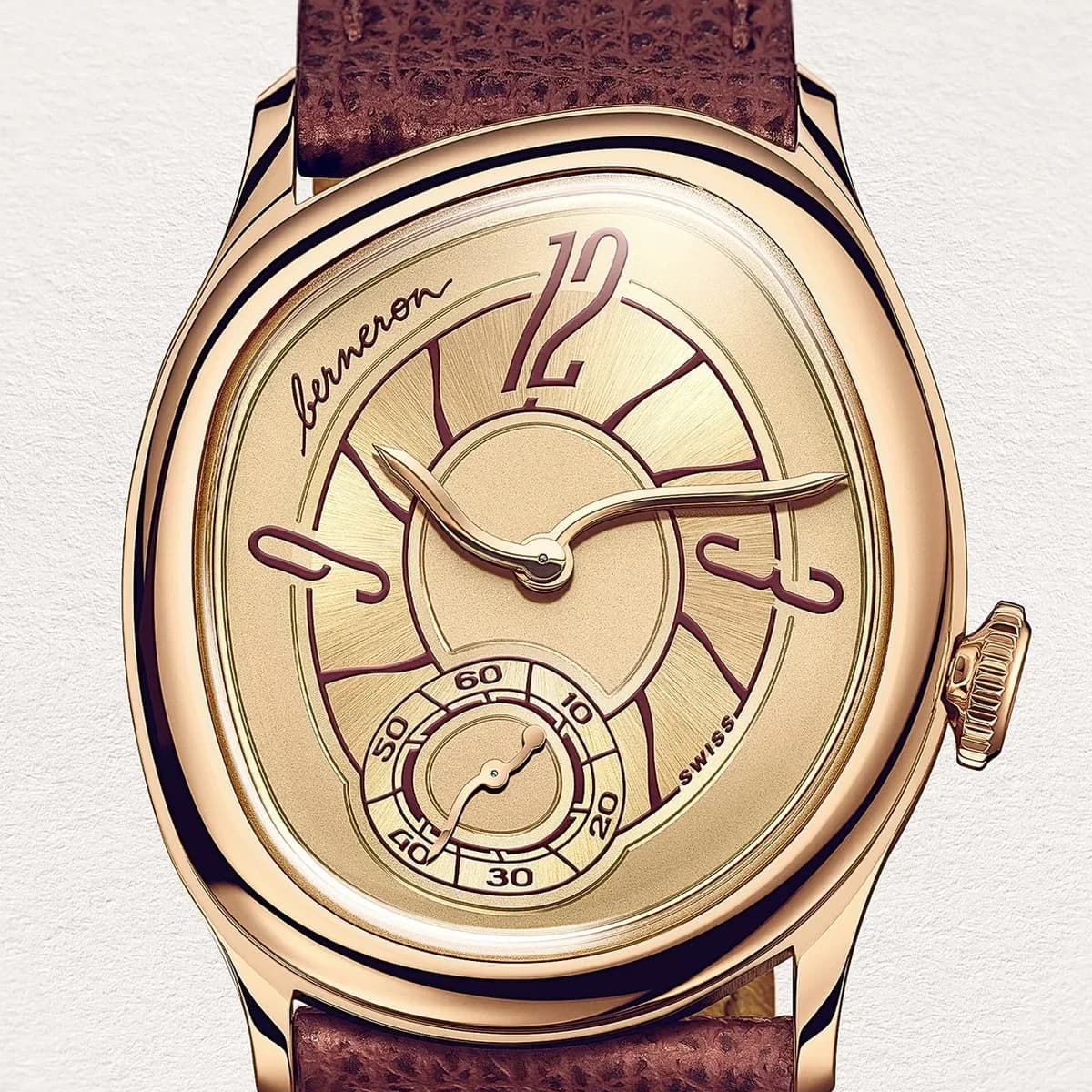
Most shaped watches are a lie. Not in a malicious way, but in a structural way that matters once you understand it. Take any shaped watch on the market, a Cartier Crash, a Patek Asymetrie, even a Lange 1 with its off-center dial. The case has an interesting shape, but underneath that case sits a round movement. The interesting geometry stops at the surface. The movement does not care what the case looks like. It sits in a circular cavity, held by a movement ring, doing its job in a perfectly conventional circle while the case pretends to be something else. I find that disconnect fascinating from a design standpoint, because it reveals how the industry thinks about shaped watches. The case is the costume. The movement is the actor. And the actor is always round.
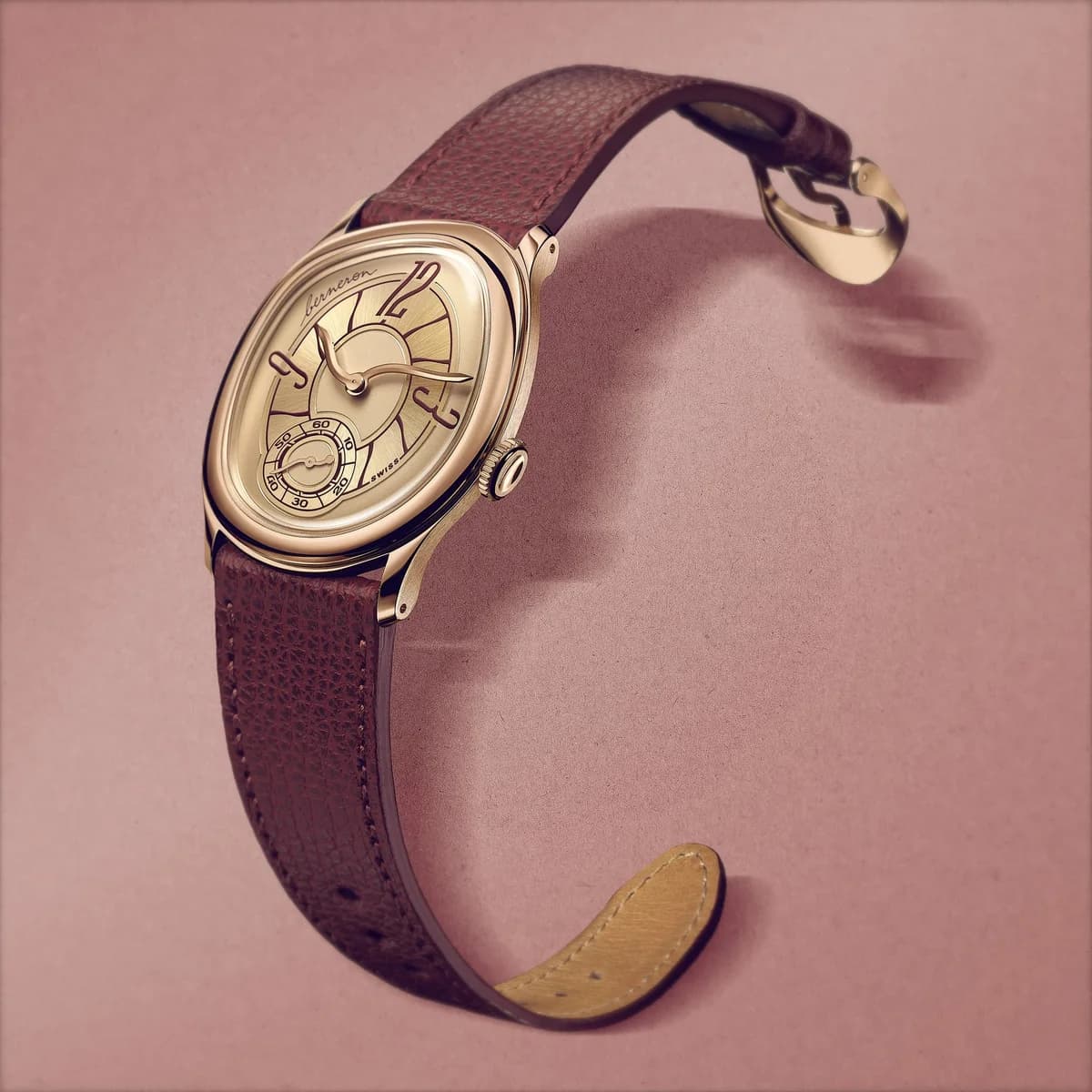
Sylvain Berneron looked at that and asked a different question. What if the movement itself was the shape? What if instead of designing an interesting case and fitting a round caliber inside, you designed the movement first, let the mechanics go where the mechanics wanted to go, and then wrapped the case around whatever shape emerged? That is the Mirage. It is the first shaped watch where the asymmetry originates in the caliber, not the case. Every curve on the outside exists because something underneath needed to be there. The case is not a costume. It is a consequence.
To appreciate why that matters, it helps to know who Berneron is and where he comes from. Sylvain Berneron grew up in Versailles. His father was an IT engineer who restored cars and motorbikes on the side. His mother was a painter. That combination of mechanical precision and artistic instinct runs through everything he does. He studied industrial design at Strate School of Design in Paris, one of the top product design programs in France. At 19, BMW brought him on as a working student, and he stayed for several years as a designer. He moved on to Porsche and then Ducati. Somewhere along the way, the watch world caught his attention.
He spent five years at the Richemont Group, working at IWC. Then Georges Kern brought him to Breitling, where he rose from Creative Director to Chief Product Officer in a five-year stint. By his early thirties, Berneron was running the product vision for one of the biggest names in Swiss watchmaking. He was instrumental in the redesign of Breitling's entire portfolio under Kern's leadership. That is an extraordinary career arc for someone who was not trained as a watchmaker. Berneron is a product designer. He thinks in systems, in user experience, in the relationship between form and function. He is not the person who sits at the bench with a loupe. He is the person who decides what the person at the bench should build, and why.
In September 2022, Sylvain and his wife Marie-Alix founded Berneron SA in Neuchatel. Marie-Alix brought her own serious credentials. She holds dual business degrees, retrained as an architect, and previously worked in product development at Chanel Horlogerie. She handles the brand's graphics, visual design, and strategic direction. Kern, to his credit, agreed to let Sylvain continue as a part-time creative consultant at Breitling while he built his own brand. For two years, Berneron worked seven days a week. Dawn to dusk at two jobs, building a watch company from nothing on the side. He invested nearly a million of his own savings. There was no outside investor writing a check. No conglomerate backing. Just a designer who believed he had something to say.
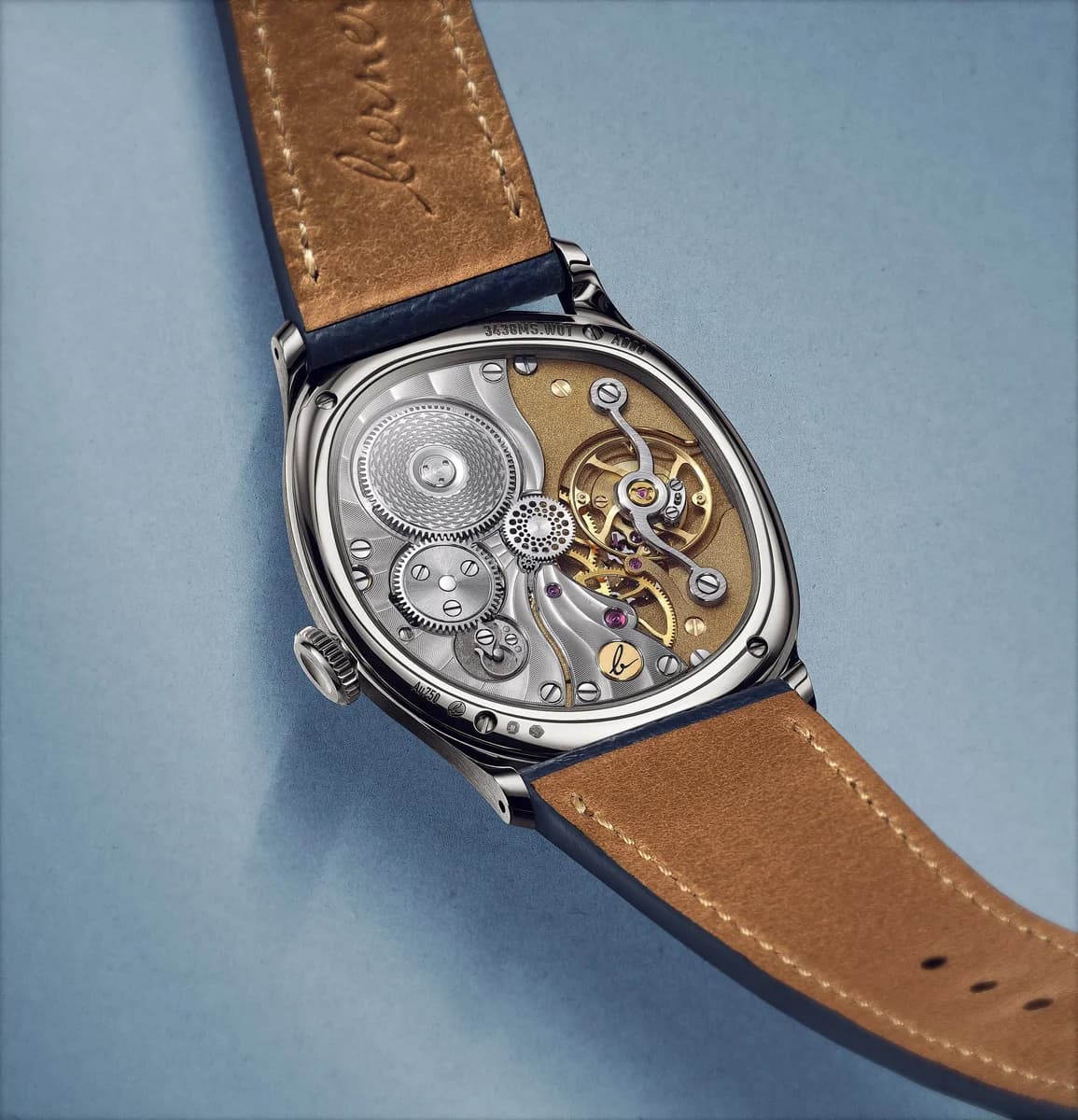
The Mirage is what he had to say. Caliber 233 is asymmetric by design. The name comes from its height: 2.33 millimeters. That is remarkably thin for a hand-wound movement with a 72-hour power reserve. For context, the Jaeger-LeCoultre Caliber 849, one of the thinnest round movements in production, stands 1.85mm but has a power reserve of only 38 hours. The Piaget 430P is 2.1mm with 43 hours. Getting to 72 hours in 2.3mm of vertical space required a larger barrel, and a larger barrel required the movement to break free from the traditional circle. Cal. 233 measures 30 by 28 millimeters. It is not round. The barrel sits where it needs to sit to maximize the mainspring volume. The free-sprung balance sits where it gives the best amplitude. The small seconds occupies its own natural position. Nothing was forced into a predetermined geometry.
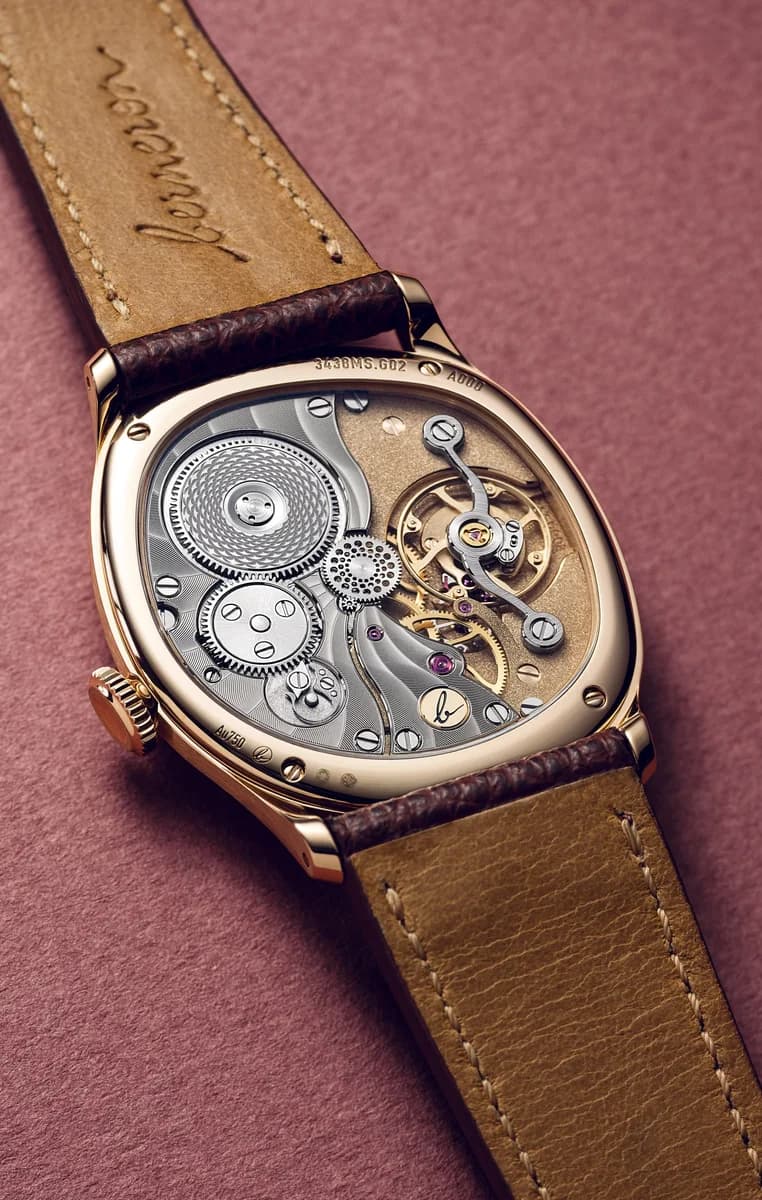
The movement is built from 135 components. The mainplate and bridges are 18K gold, which gives them that warm, deep tone visible through the sapphire caseback. The winding and timing gears are steel, because steel provides the rigidity and torque characteristics that gold cannot. That is a smart material choice. Gold where it is seen and appreciated, steel where it needs to work. The movement runs at 21,600 vibrations per hour, which is 3 Hz, with 17 jewels and a Swiss lever escapement. None of those specifications are exotic. The architecture is.
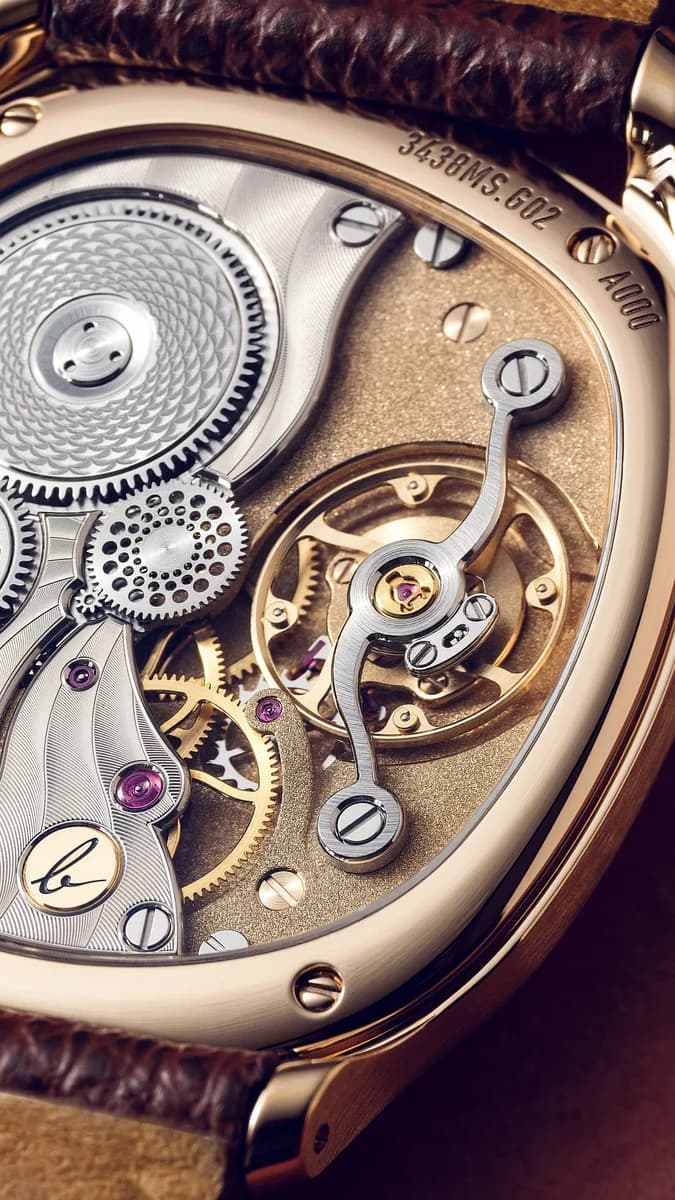
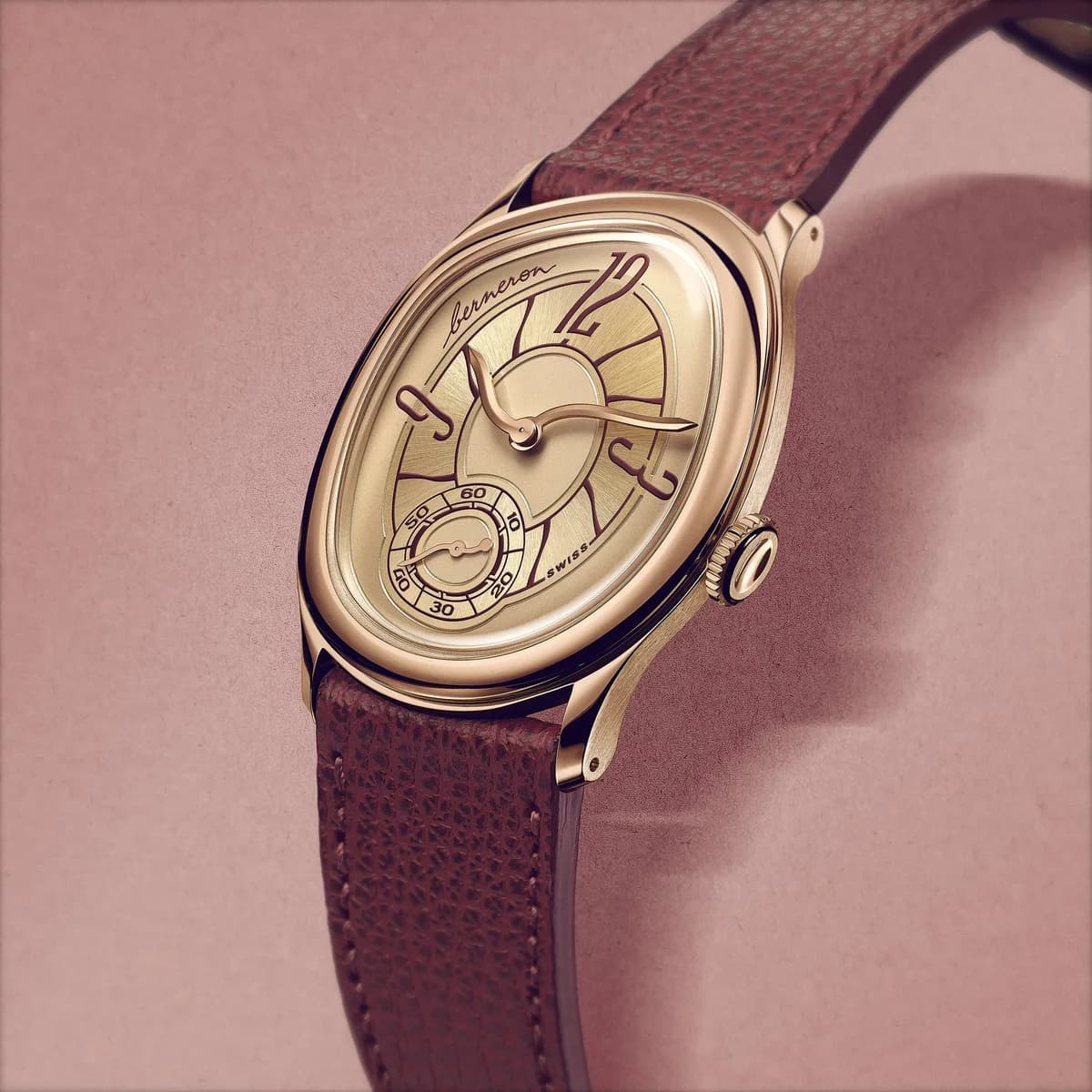
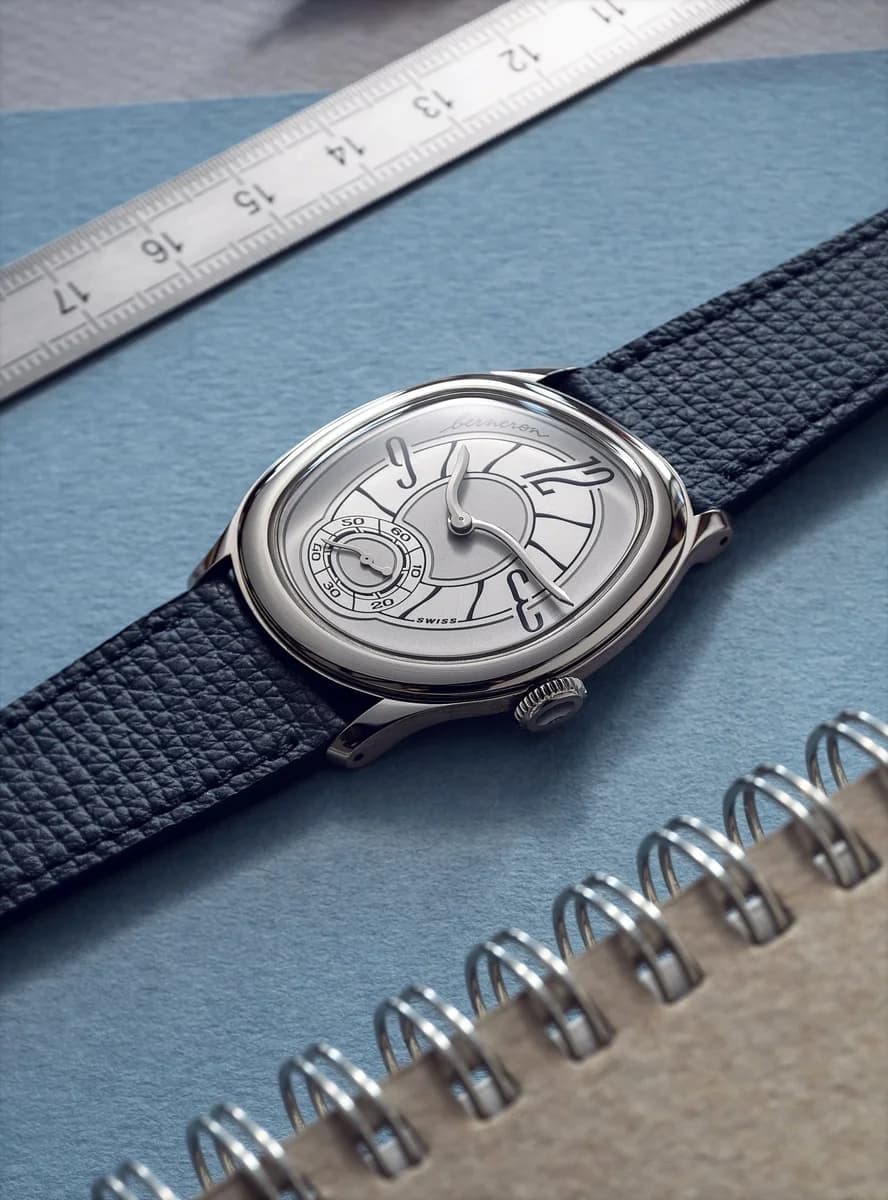
One detail I appreciate is the inverted hand set. On most watches, the minute hand sits on top of the hour hand. Berneron reversed it. The hour hand rides above the minute hand. This required reconfiguring the motion works to the bridge side of the movement, which saved vertical space and contributed to that 7mm overall case thickness. It also creates a subtle visual effect. The hour hand catches light differently because it sits slightly higher. Most people will never notice it consciously, but it gives the dial a depth that feels unusual.
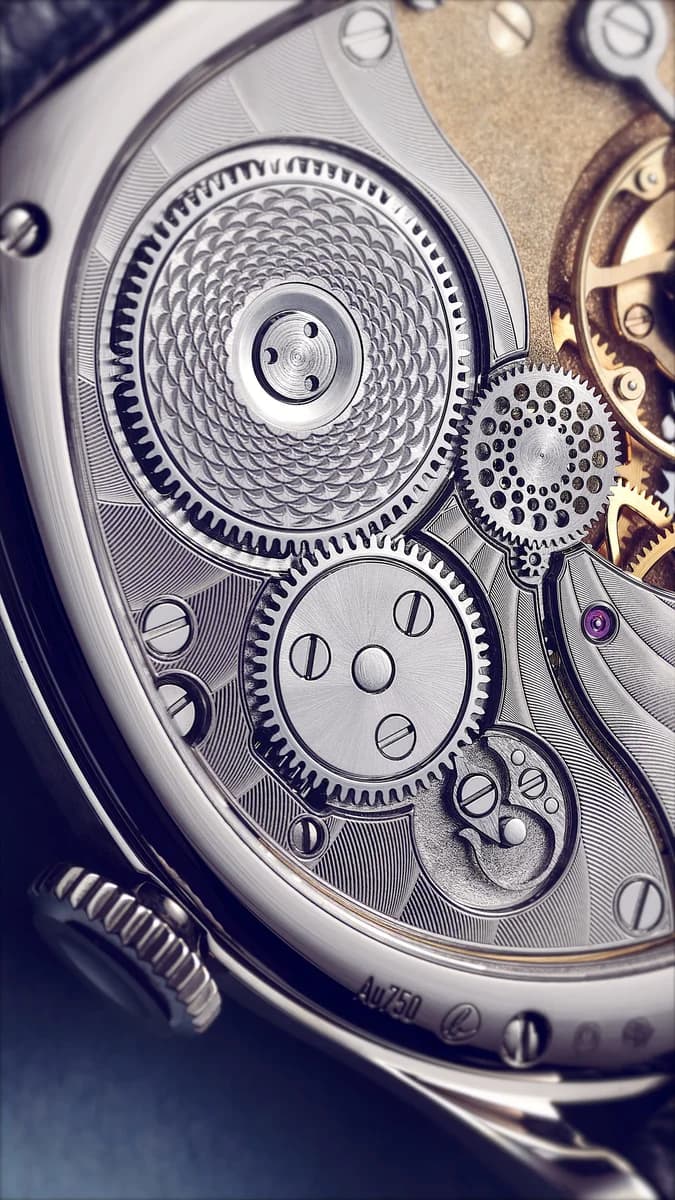
The movement decoration is thorough for a watch at this production scale. Guillochage on the bridges, colimaconnage on the crown wheel, anglage on every edge, cerclage on the hour wheel, traits tires on the cliquet, and nuagage on the bridge pockets. The barrel gets a laser engraving. These are not token finishes. They are visible through the sapphire caseback and they hold up under a loupe.
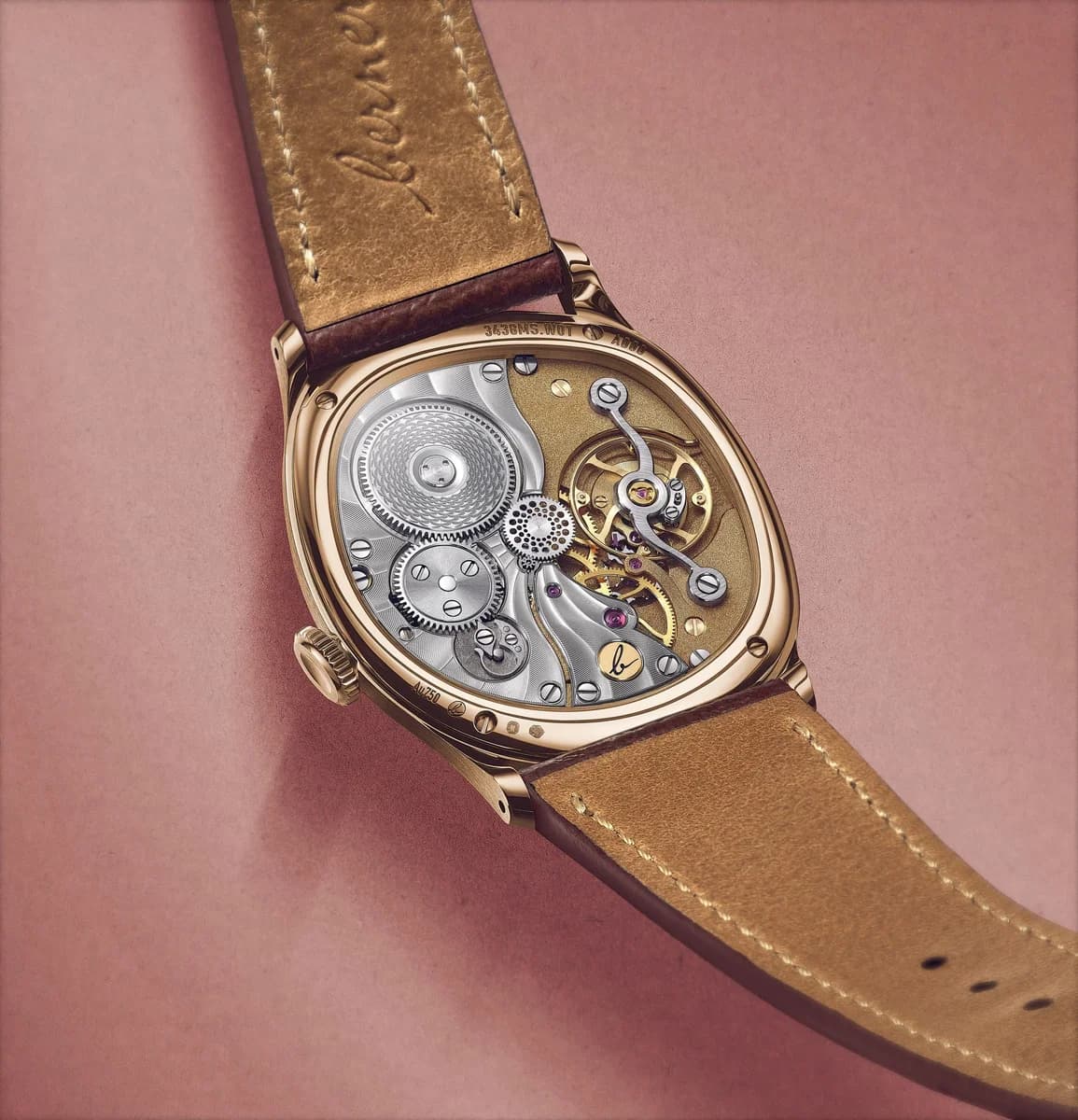
Berneron did not build the movement alone. Cal. 233 was conceived by his team and manufactured by Le Cercle de Horlogers, a highly regarded movement specialist based in the Jura. Le Cercle also produces movements for Jean-Claude Biver's eponymous brand, Louis Vuitton, and Trilobe, among others. This is the etablissage model that many independents use. The conception, design, development, and assembly happen in-house at Berneron's workshop. The component manufacturing is done by specialists. It is the same approach that F. P. Journe used for years before building his own movement manufacture. What matters is who designed it and why, not whose CNC machine cut the parts.

The case is where the Fibonacci sequence enters. Berneron used the mathematical properties of the Fibonacci spiral and the golden ratio to derive the proportions. A spiral emanating from the central axis defined the curves. The result is an organic shape that feels balanced even though it is asymmetric. Nature uses the Fibonacci sequence constantly, in pinecone bracts, nautilus shells, sunflower seed patterns. There is something about those proportions that the human eye reads as harmonious even when the shape is irregular. The Mirage does not look like a random blob. It looks like it grew that way. That is the Fibonacci at work.
The case measures 38 by 34 by 7 millimeters with a 42mm lug-to-lug distance. Everything is 18K gold. Not just the case. The dial, the hands, the buckle, even the spring bars. I cannot think of another watch where the spring bars are gold. It is a detail nobody will see, but it tells you something about how Berneron thinks about integrity of materials. The Sienna version uses yellow gold. The Prussian Blue uses white gold. There are no steel versions. Berneron has said he wants no steel versions ever, so the watches can be fully restored by a goldsmith decades from now without mixed materials. On the wrist, 38 by 34 sits beautifully on a 6.5-inch wrist. The 42mm lug-to-lug is short enough to avoid overhang, and 7mm thick means this watch disappears under a cuff. It weighs almost nothing for a gold watch because the movement is so thin.
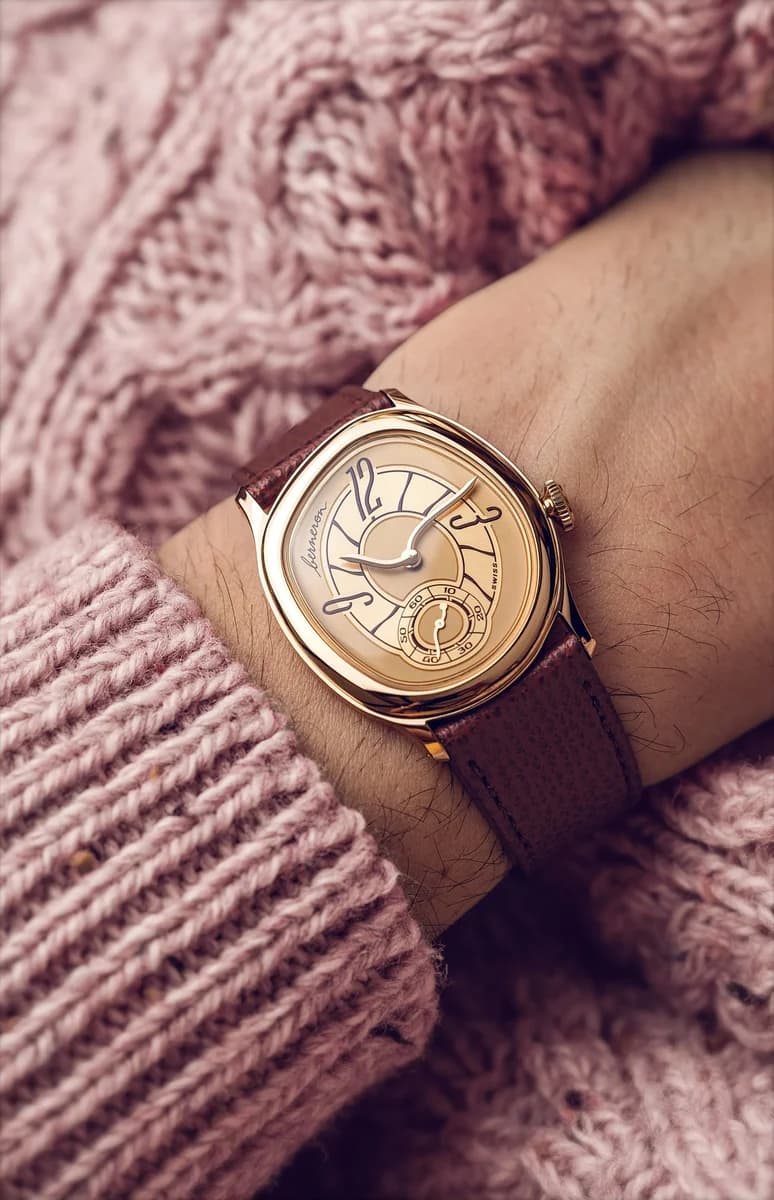
Berneron uses hesalite instead of sapphire for the top crystal. This is a deliberate engineering choice, not a cost decision. Hesalite is thinner than sapphire for the same diameter, which matters when the movement is only 2.3mm tall and the total case height is 7mm. Every fraction of a millimeter counts. Hesalite also has a warmth to it that sapphire does not. Light passes through differently. The dial has a slightly softer quality that is hard to describe but immediately visible in person. Omega uses hesalite on the Speedmaster Moonwatch Professional for similar reasons. The tradeoff is scratch resistance. Hesalite is softer than sapphire. It will pick up micro-scratches over time. But here is the thing. Hesalite scratches can be polished out with Polywatch or any plastic polish. Sapphire cannot be polished. If you scratch sapphire, you either live with it or replace the crystal. With hesalite, you spend two minutes with a cloth and the scratch is gone. Berneron added a scratch-resistant coating to the hesalite, which helps. The caseback crystal is sapphire with inner anti-reflective coating, because that side needs to be more durable and the thickness is less critical.
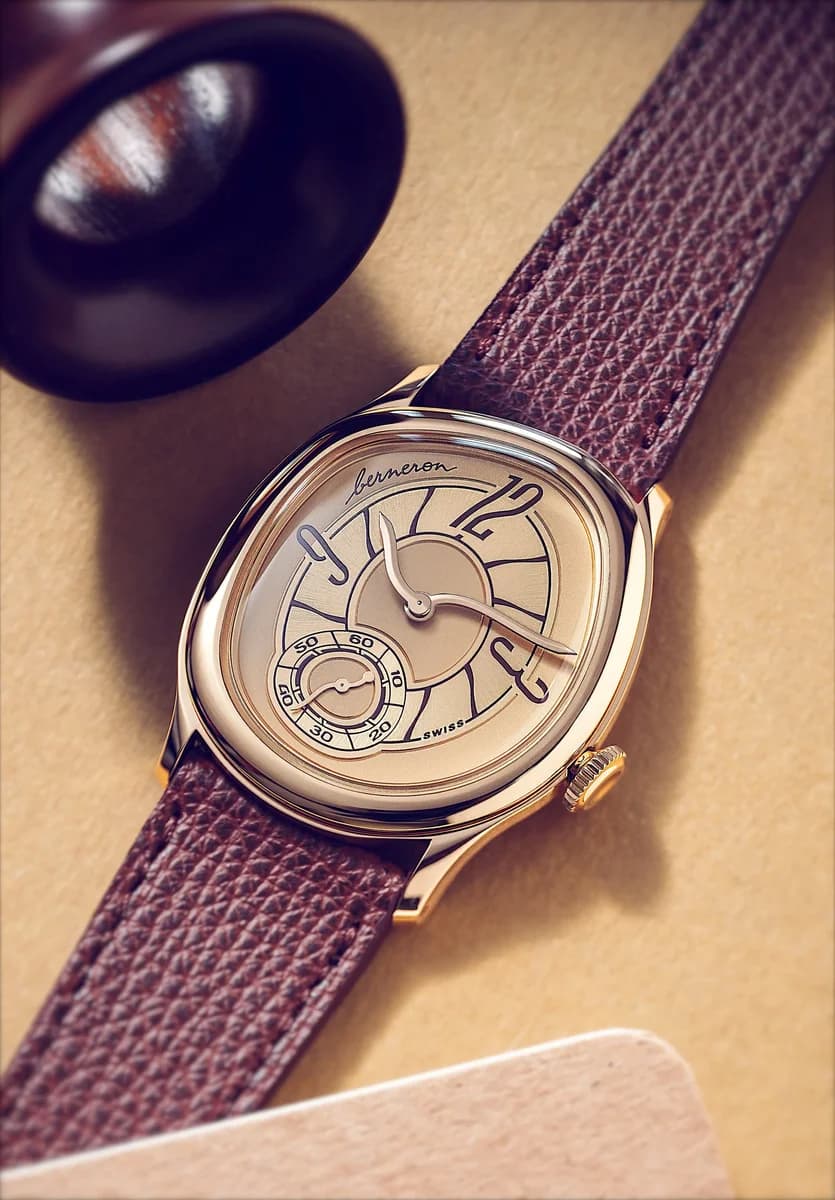
I love the thought process behind the all-gold construction. 18K yellow gold is about 2.75 on the Mohs hardness scale. Steel is 5.5 to 6.5. That means the Mirage will pick up micro-scratches more easily than a steel watch. On any raised surface, the bezel edge, the crown, the buckle, those tiny marks will accumulate. But Berneron's argument is that a full gold watch develops a patina that tells its own story. And because everything is the same material, a goldsmith can refinish the entire watch without worrying about mixed metals or plated surfaces. Fifty years from now, a skilled goldsmith can restore this watch to new. That kind of thinking comes from someone who designs products for decades, not seasons.
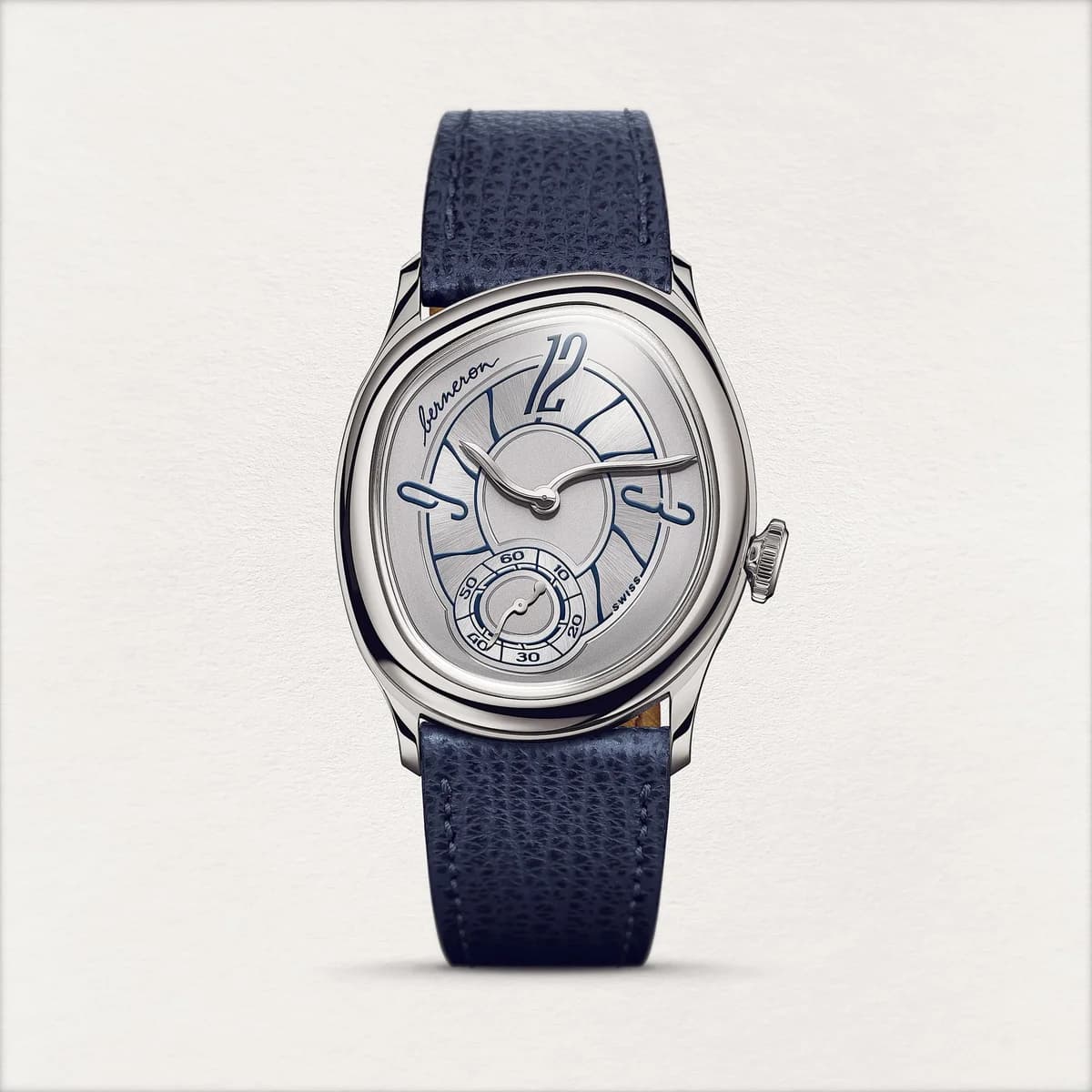
The Mirage 38 comes in two dial variants. Sienna has a warm, golden tone on yellow gold. Prussian Blue has a deep blue dial on white gold. Both are 18K gold dials. The Mirage 34 is a separate model with its own caliber, the Cal. 215. That movement stands just 2.15mm tall, has 118 components, 23 jewels, and beats at 3.5 Hz with a 72-hour power reserve. The Mirage 34 is where Berneron gets into hardstone dials. Tiger Eye in yellow gold and Lapis Lazuli in white gold. The lapis lazuli is sourced from Afghanistan, the traditional source for the deepest blue stones, and every dial is manually inspected. The failure rate for both hardstone dials is 60 percent. Six out of ten stones do not make the cut. That is the cost of working with natural materials at this level. Production for the Mirage 38 is 24 pieces per dial color per year. The allocation list is full through the end of 2027. There is no retail network. You buy directly from Berneron. No authorized dealers, no grey market. You buy from Berneron or you do not buy at all.
In November 2024, the Mirage Sienna won the Audacity Prize at the Grand Prix d'Horlogerie de Geneve. The GPHG is the closest thing watchmaking has to the Oscars. The Audacity Prize specifically recognizes non-conformist approaches to watchmaking. For a debut watch from a brand that did not exist two years earlier to win any GPHG category is remarkable. Berneron is also a member of the GPHG Academy, which means his peers in the industry recognized both the brand and the contribution quickly.
The honest critique is the one that comes with every independent at this scale. Brand visibility is limited. If you wear a Berneron Mirage, almost nobody will know what it is. That is either the point or the problem, depending on your perspective. I see it as the point. Water resistance at 30 meters is minimal. This is a dress watch. Splashes and hand washing are fine. Swimming is not. The 72-hour power reserve is good for a hand-wound movement this thin, but it means you are winding every three days or so. And servicing an independent brand always raises the question of long-term infrastructure. Berneron is five people in a 650-square-meter workshop in Neuchatel. They opened that workshop in April 2025. The components are sourced entirely from the Neuchatel and Jura cantons. Everything is 100 percent Swiss made. But the bench depth is thin compared to a brand like Jaeger-LeCoultre or even F. P. Journe. If something goes wrong in fifteen years, the servicing path depends on Berneron still existing as a going concern. That is the reality with any independent.
What Berneron is doing next puts the Mirage in a different light. The Quantieme Annuel is a full annual calendar. Caliber 595 has 476 components, 33 jewels, and a 100-hour power reserve from two barrels. The case is 950 platinum with a removable 904L steel protective layer on the bezel, lugs, and crown. Berneron calls it steel armor. The idea is that platinum is soft, 3.5 Mohs, and the high-contact areas need protection. So the steel layer takes the daily wear while the platinum case underneath stays pristine. The watch has a double regulator layout. Time reads vertically: jumping hours at the top, central minutes in the middle, small seconds at the bottom. The calendar reads horizontally: day on the left, retrograde date in the center, month on the right. Two patents were filed for the mechanism. First deliveries begin in October 2026. Twenty-four pieces per color per year for a planned ten-year run. Going from a shaped time-only debut to a fully in-house complicated calendar in two watches is a trajectory I have not seen from any independent. Most take a decade to get there. Berneron did it in three years.
On the wrist with a Brunello Cucinelli tropical-weight wool in charcoal, the Sienna disappears beautifully under the cuff and catches the light when the sleeve rides up. Yellow gold against darker skin has a warmth that white gold and steel do not. The Barenia leather strap ages well and develops its own character. It is comfortable immediately, no break-in period. The 20 to 16mm taper is elegant without being delicate. This is a watch for the person who gets dressed with intention, not the person who grabs whatever is in the watch roll.
I think about what Berneron represents in the broader context of independent watchmaking. A product designer, not a watchmaker, built a watch company from scratch, invested his own money, won a GPHG prize with his first watch, and is delivering a complicated calendar for his second. The allocation list runs to 2027. The workshop is small, five people in Neuchatel, producing watches entirely from Swiss-made components. The design language is mathematically derived from the Fibonacci sequence. The movement architecture is genuinely different from anything else on the market. And the ambition, from the platinum annual calendar with steel armor to the hardstone dials with a 60 percent failure rate, is clearly not small. I do not know many brands at any scale that think this way. Berneron does.
Also in Independent Masters